
The 30-second answer
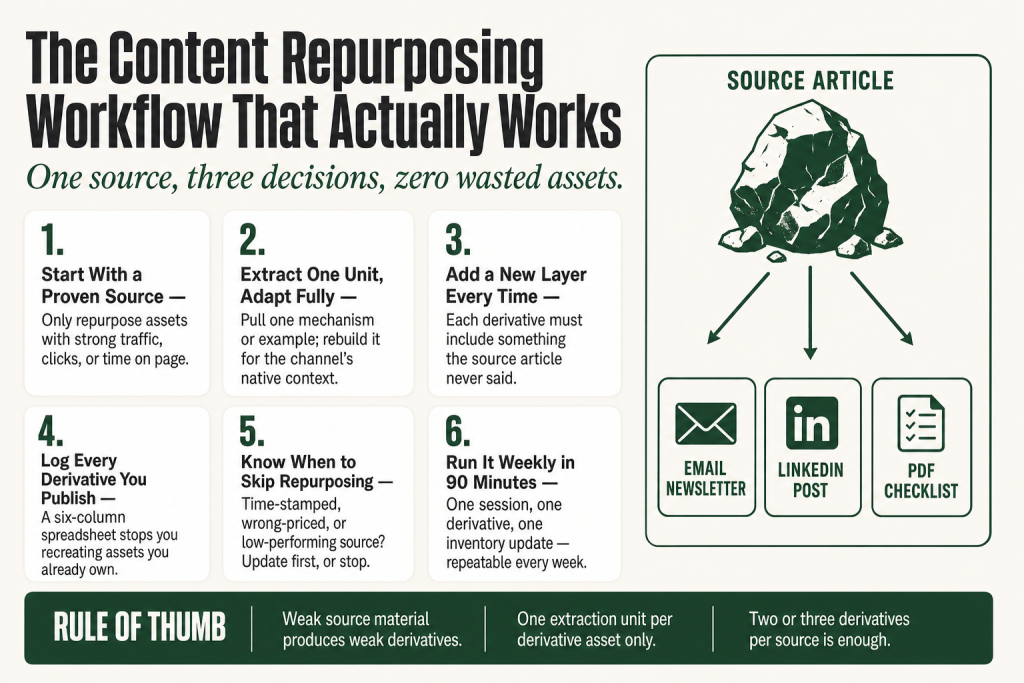
- Pick a worthy source first. Only repurpose assets that already proved themselves: strong search traffic, high email clicks, or a question you answer live every week. Weak source material produces weak derivatives.
- Extract a specific insight, then adapt the format and frame. Don’t copy the article. Pull one mechanism, one example, or one counterintuitive point and rebuild it for the channel’s native context and reader intent.
- Log every derivative in a reuse inventory. A six-column spreadsheet tells you what exists, where it lives, and what hasn’t been touched yet. Without it, you’ll recreate assets you already own.
- Know the one rule for skipping repurposing. If the source content is time-stamped to a moment, a price, or a trend that’s passed, don’t touch it. Update the source first or leave it alone.
- AI assists the extract-and-adapt step, but you make the calls. Use it to draft the derivative, then rewrite the opening, check every claim, and add the context only you have. The judgment about what to extract and whether the output is accurate stays with you.
Take this fix into your next scenario. The free Builder’s Companion Kit collects the checklists and templates that pair with this guide — so next time, you start from a template, not a blank page. Grab it free →
- What Repurposing Actually Means (and What It Doesn’t)
- Step One: Choose a Source Worth Repurposing
- Step Two: The Content Repurposing Workflow Extract-and-Adapt Step
- Worked Example: One Article Becomes Three Distinct Assets
- The Reuse Inventory: Stop Losing What You’ve Built
- The One Rule for When NOT to Repurpose
- Running the Workflow Every Week Without Burning Out
- FAQ
A content repurposing workflow sounds like the kind of thing that saves you ten hours a week. In practice, most solo operators end up with a pile of watered-down copies that say the same thing in slightly different fonts. The problem isn’t the idea. The problem is skipping the three decisions that make repurposing actually work: which source is worth touching, how to reshape the material rather than just copy it, and where you record what you’ve built so nothing disappears into a folder you’ll never open again. Get those three right and you can run the whole thing in a focused block on Friday afternoon.
What Repurposing Actually Means (and What It Doesn’t)
Repurposing is not cross-posting. Cross-posting drops the same text into multiple places. Repurposing extracts a piece of the source and rebuilds it so it fits the new channel’s context, format norms, and reader intent. The output should feel like it was written for that channel, not pasted there.
The distinction matters because readers are channel-native. Someone on LinkedIn is skimming between meetings. Someone in your email list opened because the subject line matched something they’re actively wrestling with. Someone reading a long article searched for a specific answer. Each of those readers has a different job for your content to do. A derivative that doesn’t acknowledge that difference is just noise with your name on it.
Think of the source asset as an ore deposit. The ore is real and valuable. Repurposing is the refining step that extracts the useful metal in a form people can actually use. Shoveling raw ore onto a new platform is still just raw ore.
Step One: Choose a Source Worth Repurposing
The most common repurposing mistake is starting with something convenient rather than something that earned it. If the source piece didn’t land with readers the first time, a LinkedIn post version isn’t going to save it.
Use a simple three-question filter before you touch anything:
- Did it perform? Look at organic traffic, email click rate, or time on page. If one of those numbers is clearly above your average, that’s a signal the content connected. Check your analytics before you decide.
- Is it evergreen? The content should answer a question that’s still true today. Pricing commentary from two years ago, event recaps, and news reactions all fail this test.
- Does it contain at least two extractable insights? Read the piece with a highlighter. If you can mark two or three specific mechanisms, examples, or counterintuitive points that could each stand alone, it’s a good candidate. If the whole thing is one long argument that only makes sense as a whole, leave it as an article and move on.
Start-from-scratch content often feels like the safer bet because it’s fresh. But strong existing content has already been tested against real reader behavior. That’s a significant head start. Your own analytics tell you which pieces cleared the bar before you invest another hour.
Step Two: The Content Repurposing Workflow Extract-and-Adapt Step
This is where most solo operators get it wrong. They copy the subheadings into a new document, change a few words, and call it a derivative. That’s not adapting. That’s reformatting. The reader on the new channel gets nothing extra.
Here’s the actual process:
- Choose one extraction unit. This is a single mechanism, a before-and-after example, a counter-intuitive finding, or a concrete how-to step from the source. One extraction unit per derivative asset. If you try to squeeze the whole article into an email, you get a long email nobody finishes.
- Identify the channel’s native context. Email newsletters want a clear problem in the first two lines, then a tight resolution. LinkedIn posts earn attention with a strong first sentence because the rest is hidden behind a click. A short-form video script needs a hook in the first five seconds and a visual demonstration mid-way through. Each of those formats has a different grammar.
- Rewrite for intent, not for length. Shorter isn’t automatically better. Some channels want depth. The question is: what is the reader trying to accomplish right now on this channel? Write for that job, not for word count.
- Add one new layer. The derivative should include something the source didn’t. A more recent example. A mistake to avoid. A specific prompt or template. If the derivative says nothing the source didn’t already say, the reader who found both has been cheated.
AI is genuinely useful here, but it’s a drafting tool, not a judgment tool. You can prompt it with the extraction unit and the channel context, get a draft, and then rewrite the opening, add your specific example, and verify every claim it produces. What it can’t do is decide which insight is worth extracting, confirm whether its claims are still accurate, or supply the context that only comes from your own experience with the work. The judgment about what to extract, what to add, and whether the derivative is actually useful stays with you. That’s not a limitation. That’s the work. If you’re new to using AI for copy tasks, the process at how to write marketing copy with AI applies directly to the drafting step here.
Worked Example: One Article Becomes Three Distinct Assets
Here’s a real-world walkthrough using a hypothetical but realistic scenario. You publish a 1,800-word article titled “Why Your Lead Follow-Up Timing Is Killing Your Close Rate.” It earns solid search traffic and a higher-than-average time on page. It contains three distinct mechanisms: the 5-minute response window, the follow-up sequence structure, and the common mistake of selling too hard on the first touch.
Derivative 1: Email newsletter (600 words). You extract the 5-minute response window, because that’s the most provocative and immediately actionable insight. The email opens with a specific scenario a reader will recognize instantly. It explains the one finding, gives a concrete fix, and links back to the full article for readers who want the rest. The email doesn’t summarize the article. It takes one brick and builds something with it.
Derivative 2: LinkedIn post (250 words). You extract the counter-intuitive third mechanism: selling too hard on the first touch actually lowers close rates. That tension makes a strong first sentence. The post walks through the mistake in plain terms, gives a one-sentence fix, and ends with a question that invites replies. It doesn’t mention the article unless someone asks. It works as a standalone post.
Derivative 3: A lead magnet checklist (one page PDF). You extract the sequence structure and turn it into a five-step checklist a reader can print or keep open on their phone. Each step is one sentence. The checklist has your URL at the bottom but it’s genuinely useful without clicking anything. If you already have a lead magnet funnel set up, this slots right in. The lead magnet for service business guide covers how to position and gate something like this correctly.
Three distinct assets. Three different reader jobs. One source article. None of them copies the article. All of them link back or build your list.
The Reuse Inventory: Stop Losing What You’ve Built
The inventory is the unglamorous part of the workflow that most people skip, then regret. Without it, you end up recreating assets you already own, missing obvious reuse opportunities, and having no way to see what’s been dormant long enough to refresh.
You don’t need software for this. A Google Sheet with six columns handles it:
- Source title and URL. The original piece this came from.
- Derivative title or description. One line that makes it findable.
- Format. Email, social post, PDF, video script, etc.
- Channel. Where it was published or where it lives.
- Published date. When it went live.
- Status. Published, draft, needs refresh, or evergreen.
That’s it. Add a row every time you publish a derivative. When you sit down for your weekly repurposing block, open the sheet first. You’ll see which source articles have never spawned a derivative. You’ll see which derivatives are over 18 months old and due for a refresh. You’ll also see which channels you’ve been neglecting without realizing it.
The inventory does one other thing: it proves the ROI of your time. After a few months you can look at one source article and count six assets it generated. That’s a concrete argument for writing one thorough article instead of six thin ones. For the broader question of what to track across your marketing, the framework in reading your marketing data without an analyst applies to how you score which derivatives performed.
The One Rule for When NOT to Repurpose
Here’s the rule: if updating the source would take longer than writing something new, don’t repurpose it, update the source first.
Specifically, skip repurposing when any of these are true:
- The source contains a price, a platform UI detail, or a statistic that’s now wrong. You’d be distributing bad information at scale.
- The source is tied to a specific moment: a launch, a news event, a seasonal push. Pulling a mechanism out of it still carries the time-stamp, and readers notice.
- The source never performed. If the article got 40 pageviews and a bounce rate that says readers left immediately, the problem is the premise or the audience fit. Repurposing doesn’t fix a broken premise. It just distributes the mistake to more people.
The test for the third case is blunt: would you link a prospective client to this article to answer their question? If the honest answer is no, it’s not a candidate. Fix it or archive it.
This same logic applies to your welcome sequence and nurture emails. Repurposing a blog post into an email only works if the post itself holds up. If the email is going to people who just opted in, the quality bar is even higher because it’s often the first substantive thing they read from you. The welcome email sequence guide covers what those early touchpoints need to accomplish.
Running the Workflow Every Week Without Burning Out
The workflow only works if it fits in the time you actually have. Here’s a structure that takes roughly 90 minutes once you’ve done it a few times:
- Open the reuse inventory (5 minutes). Scan for source articles without derivatives and for derivatives that are due a refresh. Pick one source for the session.
- Read the source and mark extraction units (10 minutes). Highlight specific mechanisms, examples, or data points. Mark two or three. You’ll use one today and log the others as future candidates.
- Choose one channel and one extraction unit (5 minutes). Match the extraction unit to a channel where your audience is active and where you have a publication rhythm. Don’t pick the channel because it’s easy. Pick it because the extraction unit fits it.
- Draft the derivative (30 minutes). Use AI to get a first draft if you want speed, then rewrite the opening, add the context only you can add, and verify any claims. Your voice and your specific examples are what make the derivative worth reading. The AI draft is a starting point, not a finished piece, and fact-checking it is your job, not the tool’s.
- Review and publish (20 minutes). Read it as the target reader, not as its author. Does it work as a standalone piece? Does the opening earn the rest of the read? If yes, publish. If not, cut until it does.
- Update the inventory (5 minutes). Add the new row. Note the other extraction units from the same source as future candidates.
Fifteen minutes of that time is pure admin. The rest is actual editorial work. If the draft step is slow, the AI drafting approach in how to write marketing copy with AI will cut it down. If you want to measure whether the derivatives are actually moving people toward a purchase, the lead follow-up process playbook shows you where repurposed content typically fits in the sequence that closes.
FAQ
How often should I repurpose content?
Once a week is a workable starting rhythm for many solo operators, but the right cadence depends on your situation. If you have a deep backlog of strong evergreen content and multiple active distribution channels, you might sustain that pace comfortably. If you’re publishing less frequently, or your business runs in project cycles rather than a steady editorial calendar, every two weeks may be more realistic. The point isn’t the number. It’s that repurposing happens on a fixed schedule rather than whenever you remember. One focused session per week, one derivative per session, is a reasonable default to test and adjust from there.
Does repurposing content hurt SEO?
Repurposing your own content across formats doesn’t create duplicate content penalties as long as you’re not reposting the same article word-for-word on a second domain you own. Derivatives in different formats on different channels (email, social, PDF) don’t compete with the source for search rankings. The source page is still the canonical piece.
What’s the difference between repurposing and just reposting?
Reposting publishes the same content with no changes. Repurposing extracts a specific part of the source and rebuilds it for a new channel’s format and reader intent. A repost gives readers who’ve already seen the original nothing new. A repurposed derivative gives the same reader a different angle or a different reader the idea for the first time.
Can I use AI to automate the whole repurposing workflow?
AI can draft derivatives quickly once you give it the extraction unit and the channel context. What it can’t do is decide which insight is worth extracting, verify that claims are still accurate, or add the specific example from your own experience that makes the piece credible. It also can’t catch when it has quietly added a claim the source never made, or softened a limitation that mattered. Those calls stay with you. Use AI to cut drafting time, not to replace the editorial judgment. You’re still the one who decides what goes out and whether it’s right.
How do I know which derivative formats are working?
Track the metric that matters for each channel: email click rate for newsletter derivatives, engagement rate or replies for social posts, download count for PDFs. Log those numbers in your reuse inventory next to each derivative. After a few months you’ll see which formats produce signal and which just fill the calendar. Stop producing the ones that don’t move people.
How many derivatives should I make from one source article?
Two or three is a realistic target for most solo operators. Beyond that, you’re squeezing diminishing returns and risking reader fatigue if your audience follows you across channels. A source with three strong extraction units can produce three genuinely distinct derivatives. A source with one strong point produces one good derivative. Quality of extraction beats quantity of output.
Sources:
Methodology and framing informed by: Cognism content repurposing framework (cognism.com, published September 2025, last updated July 2026); Refact AI content repurposing workflow analysis (refact.co, May 2026); Stackmatix repurposing across channels guide (stackmatix.com, April 2026); WSI Digital Marketing channel adaptation guidance (wsiworld.com, May 2026); Buffer repurposing best practices guide (buffer.com); Content Marketing Institute tools for reuse and repurposing (contentmarketinginstitute.com). All platform-specific claims verified against current documentation before publication.
Brian Kasday spent forty years in direct-response marketing before rebuilding the whole operation as a one-person shop. He writes The Operator’s Library — including “Build a Complete Marketing Department” — for operators who’d rather build it themselves than wait on someone else.
Get the Builder’s Companion Kit — the free checklists and templates that pair with this guide: mmsvegas.com/resources.
This guide handles one marketing job. Build a Complete Marketing Department builds the whole department. See the manual →
More Marketing guides
Free · Marketing Operator Toolkit
Running marketing on your own?
Get the free toolkit — the templates and the expensive mistakes behind a one-person marketing department, plus a note when this guide changes.
Get the free toolkit →