
The 30-second answer
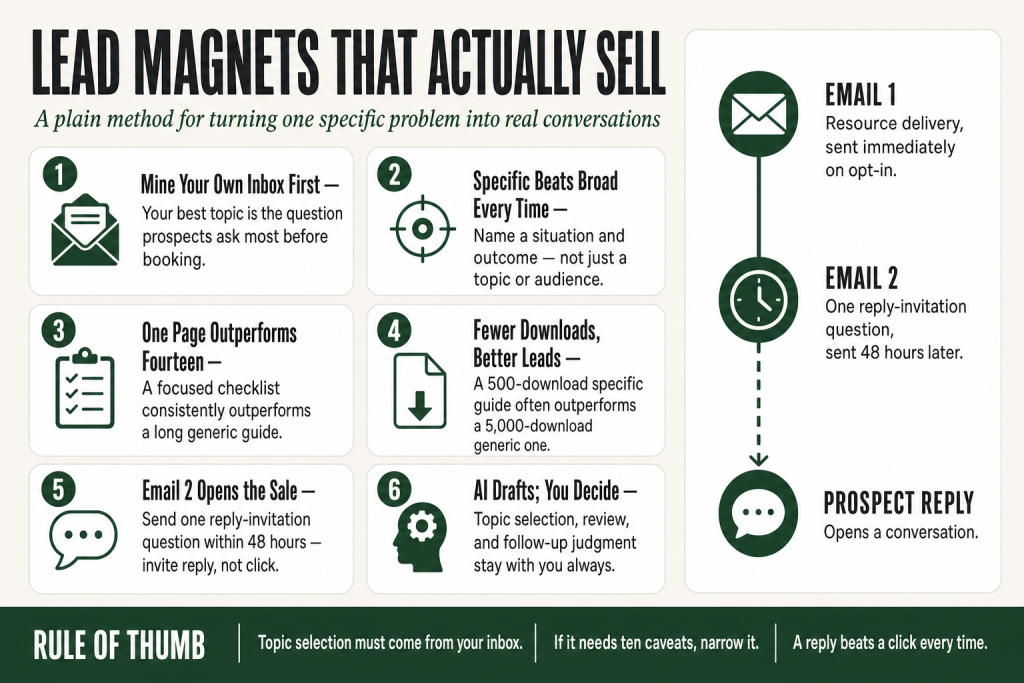
- Pick the problem from your own intake data. The right topic is whatever question your best customers ask most before they sign. Check your intake emails, your DMs, your last ten discovery calls.
- Make it specific enough to feel like it was written for one person. Narrow the audience, name a situation, attach a measurable outcome. “Homeowner guide” is not a magnet. “What to fix before you list in under 30 days” is.
- Deliver it fast and ask one question. Send the resource in the first email, then send a second email within 48 hours with a single reply-to question that opens a real conversation. That reply is your sales door.
- The judgment and final positioning stay with you. AI can draft content once you’ve chosen the topic and reviewed the direction. The topic selection, the tone calibration, the line-by-line review, and the follow-up conversation are yours to own. The draft is a starting point, never a finished product.
Take this fix into your next scenario. The free Builder’s Companion Kit collects the checklists and templates that pair with this guide — so next time, you start from a template, not a blank page. Grab it free →
- How to Pick the One Problem Worth Solving
- How to Make Your Lead Magnet for Service Business Specific Enough to Feel Valuable
- Before and After: A Weak Generic Magnet Turned Specific
- The Single Follow-Up Step That Turns a Download Into a Conversation
- A Plain Method for Creating It This Week
- FAQ
A lead magnet for service business is not a brochure with a download button. It’s a specific answer to a specific question your best customers already ask before they hire you. Get that right and the magnet does real selling work. Get it wrong and you spend a weekend building a PDF nobody reads, attached to an email list that never buys.
Most operators default to the generic version because it feels safer: “Five Tips for a Healthier Home” or “The Complete Guide to Estate Planning.” Wide topic, no friction, no takers. The problem isn’t the format. It’s the selection logic. This article gives you a plain method for choosing the one problem worth solving, a before-and-after example that shows what specific actually looks like, and the single follow-up move that turns a download into a booked conversation.
How to Pick the One Problem Worth Solving
You already have the research. You just haven’t labeled it yet.
Pull up the last ten emails or messages from prospects before they booked. Not clients, prospects. People who were still deciding. What did they ask? What did they say they were worried about? What did they Google before they found you? That pile of questions is your topic shortlist.
Now apply two filters. First: is this a problem your service actually solves? A magnet that attracts people you can’t help is worse than no magnet at all. The topic should be a problem your service solves, or a skill your service enables. Second: is this a question people ask early, before they know if they need you, or late, when they’re comparing prices? Early-stage questions make better magnets because the person downloading isn’t in “get three quotes” mode yet. You’re still in the trust-building window.
Run the shortlist through that filter and you’ll usually be left with one or two real candidates. Pick the one you can answer in under five pages without hedging. If you need ten caveats to answer it, the problem is too broad. Narrow it until the answer fits on a single-sided sheet and still feels complete.
One practical technique: listen for the sentence that starts with “I never know if…” or “I always wonder whether…” Those phrases signal real uncertainty, and real uncertainty is what a lead magnet exists to resolve. Effective lead magnets succeed because they solve immediate, specific problems for clearly defined audiences. The most successful ones address precise pain points that your ideal customers experience regularly.
One thing to be clear about: topic selection is not a task you hand to AI. AI can help you draft content once the topic is locked, but it has no visibility into your actual prospect conversations, your service positioning, or the nuance of what your best clients were worried about before they hired you. Those signals live in your inbox and your memory. The topic has to come from you. AI enters after the decision is made, not before.
If you want to pressure-test your topic choice against your actual positioning, the article on how to find your niche in a crowded market walks through the same audience-narrowing logic from the competitive angle.
How to Make Your Lead Magnet for Service Business Specific Enough to Feel Valuable
Specificity is not about length. It’s about precision of fit. Your lead magnet should solve a single, specific problem for a single, specific audience. When a prospect reads your title and thinks “that’s exactly what I was trying to figure out,” you’ve done it. When they think “I guess that could be useful someday,” you haven’t.
There are three levers you can pull to sharpen a generic magnet into a specific one:
- Name the audience situation, not just the topic. “Home sellers” is an audience. “Home sellers who need to move in 60 days” is a situation. The second version self-selects the right people and repels the wrong ones.
- Attach a measurable outcome. “Tips for your HVAC” is a topic. “How to cut your HVAC bill before summer starts” is an outcome. The reader can picture the result.
- Strip it to one question answered completely. High-converting lead magnets are specific, deliver a quick win, solve one clear problem, and match the audience’s level of awareness in the buying journey.
Notice that none of these levers require more content. They require more precision in what you promise and to whom.
Generic “ultimate guide” PDFs converted well in 2018 and barely move the needle now. What still works: specific magnets that solve one clear problem, deliver a fast win, and connect to whatever you actually sell.
One more thing worth saying directly: specific lead magnets attract fewer total downloads but dramatically higher percentages of ideal customers. A 500-download specific guide often outperforms a 5,000-download generic one in qualified leads generated. Downloads are a vanity number. Qualified conversations are the actual goal.
Before and After: A Weak Generic Magnet Turned Specific
The clearest way to show this is with a real business type. Take a residential landscaping company. The owner gets asked the same question on every estimate call: “What should I do with my yard before winter so it doesn’t look terrible in spring?” He’s answered it verbally a hundred times. He’s never written it down.
Here’s what the generic version looks like versus the specific version:
- Before (generic): “The Complete Homeowner’s Guide to Lawn Care”, 14 pages, four seasons, all yard types, general tips anyone could find with a search.
- After (specific): “Your November Yard Prep Checklist: 6 Things to Do Before the First Frost (So You Don’t Start Spring Behind)”, one page, one season, one situation, actionable in an afternoon.
The generic version signals that the owner knows a lot about lawns. The specific version signals that the owner knows exactly what this particular customer is worried about right now. That’s a different kind of trust.
The specific version is also easier to write because the scope is defined. You’re not trying to cover everything. You’re answering the one question the prospect already has in their head when they find you. The purpose of a lead magnet is to truly help your ideal customer by quickly solving one of their most common problems. In return you establish yourself as an expert and begin building a relationship so they turn to you for future paid support.
The same before-and-after logic applies to any service category. A bookkeeper’s “Small Business Finance Guide” becomes “What to Organize Before Your Tax Appointment If You’ve Been Ignoring Your Books.” A web designer’s “Website Tips” becomes “5 Things Your Service Business Website Is Missing That Cost You Inquiries.” In each case, the shift is from topic to situation. The reader recognizes themselves in the title before they even click.
When you’re ready to write the actual content, AI can speed up the drafting step once you’ve locked the topic and defined the single problem you’re solving. Feed it the direction you’ve already decided on, and it can give you a working first draft to edit. But the judgment about what the prospect actually needs to hear, how much detail removes uncertainty without overwhelming them, and whether the draft sounds like you rather than a template stays with you. Read every line before you publish. The tool produces a draft. You produce the magnet. For a practical method on using AI to draft without losing your voice, see the article on how to write marketing copy with AI.
The Single Follow-Up Step That Turns a Download Into a Conversation
Most operators stop at delivery. They send the resource, maybe automate a weekly newsletter, and wait. That’s the sequence that produces a list of people who remember downloading something but don’t remember why they cared.
The handoff from magnet to sale requires exactly one step: a reply-invitation email sent within 48 hours of the download.
Here’s what that email does and doesn’t do:
- It does not pitch your service. No pricing, no “book a call” link, no urgency language.
- It asks one question that only your ideal buyer has a reason to answer. Something like: “Quick question while the checklist is fresh, which of those six items felt most confusing?” or “Did anything in there match what you’re dealing with right now?”
- It invites a reply, not a click. A reply is a conversation. A click is a metric. You want the conversation.
When someone replies to that email, you have permission to respond like a human. You can ask a follow-up. You can offer to walk them through their specific situation on a quick call. That’s not a pitch, that’s a logical next step that the prospect initiates by answering your question.
Email 1 should arrive immediately after the opt-in. The promised resource should hit their inbox while they’re still warm. Automate it to send within minutes. The reply-invitation email is Email 2, sent one to two days later. That’s the full sequence for a service business at this stage. You don’t need five nurture emails before you’re allowed to start a conversation. You need one good question.
What makes this work is that the magnet and the question are about the same specific problem. The specificity of your magnet is what makes the reply-invitation feel natural instead of salesy. If your magnet was “What to Fix Before You List in 30 Days,” your question is about the exact same 30-day window. There’s no subject-change gap to jump. The prospect is still in the problem headspace you put them in with the download.
Once a reply comes in, that person moves from “lead who downloaded something” to “prospect in a real conversation.” At that point your lead follow-up process takes over, not your magnet automation.
On the automation side: both emails can be set up in any standard email marketing tool (Kit, MailerLite, Brevo, and Mailchimp are common choices for solo operators). The first email sends on opt-in confirmation. The second sends on a time delay. You set both once and they run. If you want the full welcome sequence architecture that sits behind this, the article on welcome email sequences for small business covers the structure in detail.
A Plain Method for Creating It This Week
This is not a four-week content project. Here’s the shortest path from zero to a working magnet:
- Day 1: Pick the problem. Scan your last ten prospect conversations. Find the question that shows up most before someone books. Write it down in the prospect’s words, not your professional language. This step is yours. No AI shortcut replaces reading your own inbox.
- Day 2: Write the answer. Answer the question completely in plain language. Aim for 400 to 600 words or a checklist of six to ten items. If you have more to say than that, you’ve picked a problem that’s too broad. Narrow it.
- Day 3: Name it specifically. Use the formula: [What to do] + [Specific situation] + [Outcome or time frame]. Test the title by asking: would a person who is NOT my ideal customer also want this? If yes, narrow it more.
- Day 4: Set up delivery and the reply email. Put both emails in your email marketing tool of choice. Email 1 delivers the resource. Email 2 goes out 48 hours later with one reply-invitation question tied directly to the magnet topic.
- Day 5: Put it in front of one traffic source. Add it to your website’s most-visited page, your email signature, or a pinned social post. Don’t build a full landing page before you’ve gotten ten downloads. Validate the topic first.
The production polish can come later. A plain Google Doc or a one-page PDF works for the first version. The goal this week is to confirm that the topic resonates. If people download it and reply to Email 2, the topic is right. Then you invest in polish.
AI is useful for the drafting step once the topic is locked and you’ve written your own raw answer first. Paste your hand-written answer into a prompt, ask it to tighten the language, cut filler, and make each bullet actionable. Then read every line before you publish. The AI produces a draft. You decide what goes out. That’s the right division of labor, and the only one that keeps your voice in the piece.
If this is part of a broader funnel you’re building out alone, the article on how to build a sales funnel without a team covers how the magnet fits into the larger structure.
FAQ
what should a lead magnet be about for a service business
It should answer the single question your best prospects ask most before they hire you. Pull that from your own intake emails, discovery calls, or DMs. The right topic is always closer than you think, and it’s already in your inbox.
how long should a lead magnet be
Short enough to finish in one sitting. A focused checklist or one-page answer consistently outperforms a long guide because the reader actually completes it and connects that quick win to your name. If your answer runs past five pages, the problem you picked is too broad.
how do I turn a lead magnet download into a sale
Send a second email within 48 hours of delivery that asks one specific question tied to the magnet topic, something only your ideal buyer has a real reason to answer. Invite a reply, not a click. That reply opens a real conversation, which is where service sales actually happen.
does a lead magnet have to be a PDF
No. A plain Google Doc, a short video, a checklist, or even a well-formatted email can work. Format matters less than specificity. Pick the format you can produce this week without a design project. You can upgrade the packaging once you’ve confirmed the topic converts.
can I use AI to create a lead magnet
Yes, for drafting once the topic is chosen and you’ve written your own rough answer first. AI can tighten language, format bullets, and cut filler quickly. But you read every line before anything goes out. The topic selection, the problem framing, the line-by-line review, and the follow-up conversation judgment stay with you. Handing the topic choice to AI is exactly where generic magnets come from.
why isn’t my lead magnet converting
Usually one of three things: the topic is too broad and doesn’t feel relevant to anyone specific, the title doesn’t name a situation the prospect recognizes, or there’s no follow-up email that opens a real conversation after delivery. Fix the topic first, then check the follow-up.
Sources:
Research and claims in this article draw from the following sources: Launch Leads, “Lead Magnets That Convert in 2026”; Bdow, “12 Lead Magnet Examples That Actually Convert in 2026”; Solomon Advising, “What Makes a Lead Magnet Actually Convert”; Woodpecker, “How to Create a Lead Magnet Email Sequence”; Mindstamp, “9 Lead Generation Best Practices for 2025”; Designrr, “The Anatomy of a High Converting Lead Magnet”.
Brian Kasday spent forty years in direct-response marketing before rebuilding the whole operation as a one-person shop. He writes The Operator’s Library — including “Build a Complete Marketing Department” — for operators who’d rather build it themselves than wait on someone else.
Get the Builder’s Companion Kit — the free checklists and templates that pair with this guide: mmsvegas.com/resources.
This guide handles one marketing job. Build a Complete Marketing Department builds the whole department. See the manual →
More Marketing guides
Free · Marketing Operator Toolkit
Running marketing on your own?
Get the free toolkit — the templates and the expensive mistakes behind a one-person marketing department, plus a note when this guide changes.
Get the free toolkit →