Last updated: August 2026
Product led growth is the strategy of making your product the primary vehicle for acquiring, converting, and expanding customers, and by the end of this page you’ll know whether it applies to your business, which parts you can steal even if you’re not a SaaS company, and where operators consistently go wrong chasing it.
The old model went like this: spend money to generate awareness, convert that awareness into leads, hand leads to salespeople, close deals, then hand closed deals to customer success. Every step relied on humans and headcount. If you wanted more revenue, you hired more people or spent more on ads. The math worked until it didn’t, and for a lot of operators, it stopped working quietly, around the time buyers started doing most of their research before ever raising a hand.
PLG inverts the sequence. Instead of using sales and marketing to drive people toward the product, you use the product to drive people toward a purchase. The product creates the proof. The product does the distribution. The product generates the expansion. When it works, it’s one of the most capital-efficient growth patterns that exists, your CAC payback gets shorter because a user who already loves what your product does is dramatically cheaper to convert than a cold prospect who hasn’t touched it.
One caveat before you read further: PLG is primarily a framework built around software products, particularly SaaS. That doesn’t mean non-software operators have nothing to learn from it, the underlying logic of ‘prove value before asking for the sale’ applies almost everywhere. But the mechanics of freemium tiers, in-app virality, and product-qualified leads are native to digital products. You’ll find the full toolkit if you’re building software; you’ll find transferable principles if you’re not.
The idea in 30 seconds
- Product led growth (PLG) is a go-to-market model where the product itself, not your sales team or ad spend, is the primary engine for acquiring, activating, and retaining customers.
- It works by giving users real value before asking for money, then letting usage, sharing, and outcomes do the persuading.
- The central mechanism is shortening Time to Value: getting users to their ‘aha moment’ fast enough that they stick, pay, and tell others.
- The key lead type shifts from MQL (marketing-qualified) to PQL (product-qualified), someone who has already experienced value and is behaviorally signaling readiness to pay.
- PLG is not the same as freemium, and it doesn’t mean you never hire salespeople, it means the product qualifies the demand before humans touch it.
- The honest limit: PLG requires a product that delivers clear, self-evident value quickly. If your offering needs significant explaining, context, or customization to land, a pure PLG motion will frustrate you.
Where Product Led Growth Came From
Blake Bartlett, a partner at OpenView Venture Partners, coined the term in 2016 after noticing something unusual in his portfolio: certain software companies were growing fast and staying capital-efficient in ways that traditional sales-led models didn’t explain. Users were finding the product, getting value from it, and pulling it into their organizations, often before the company’s sales team knew they existed.
Companies like Atlassian, SurveyMonkey, and Dropbox had been operating this way for years before anyone had a label for it. Wes Bush, who watched a free Chrome extension he helped launch at Vidyard attract over 100,000 users in under a year, wrote the canonical book on PLG in 2019, and a community formed quickly around it. The underlying shift driving all of it was simpler than the label suggests: software buying changed. Decisions that once flowed top-down from IT and procurement started flowing bottom-up from individual users and small teams who’d already adopted a tool and were now asking the organization to pay for it.
The hype crested, as it always does. By 2023, some PLG companies were hitting the same churn and growth walls that plagued sales-led businesses, because ‘product-led’ had become a positioning term as much as a strategy, and plenty of companies slapped freemium on a product that hadn’t solved activation and called it PLG. The core idea is sound. The execution is harder than the label makes it look.
The Core Principles of Product Led Growth
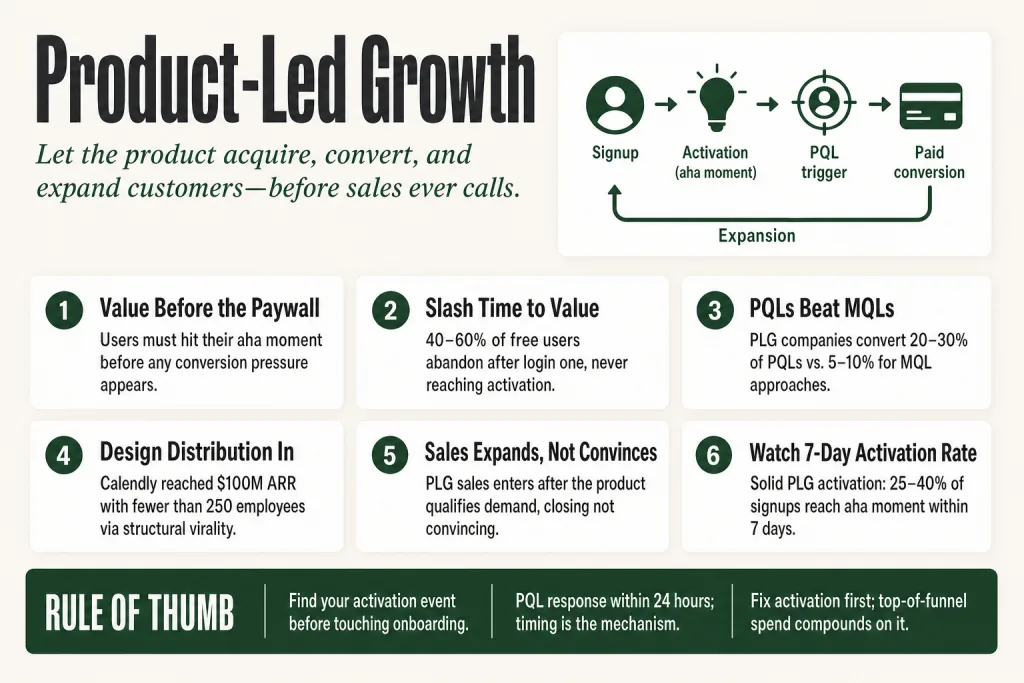
Strip PLG to its bones and you get three commitments: the product creates value fast enough that users don’t need a salesperson to explain it, the product distributes itself through normal use, and the product signals when a user is ready to pay, so that a human conversation, if it happens at all, is closing rather than convincing.
1. Value Before the Paywall
This is the central bet in PLG: you let users experience real, meaningful value before you ask them to hand over a credit card. That might be a freemium tier, a permanent free version with usage or feature limits. It might be a time-boxed free trial with full access. It might be a ‘try before you buy’ demo environment genuinely populated with their data. The form doesn’t matter as much as the outcome: the user must hit their ‘aha moment’, the point where they personally feel what the product can do, before conversion pressure enters the picture. If they don’t reach that moment, no upgrade prompt, no email nurture, and no sales call is going to save the conversion.
2. Ruthless Reduction of Time to Value
Time to Value (TTV) is the elapsed time between a user’s first interaction with the product and the moment they experience its core benefit. It’s the single most controllable lever in a PLG motion. Industry analyses estimate that 40 to 60 percent of free users in a typical PLG funnel abandon after their first login, typically because they never reach the activation milestone. Every form field, every required setup step, every tutorial video you force a new user to watch before they can touch the product is a dropout point. The operator’s job is to audit that path relentlessly and remove friction until the time from signup to ‘oh, this is useful’ is measured in minutes, not days.
3. Built-In Distribution
The best PLG products spread through normal use. Calendly spreads because every scheduling link a user shares is an ad, the recipient sees the product working in real time, can book a meeting, and is one click away from starting their own account. Slack spreads because the product requires teammates, so every new user is implicitly an acquisition channel for more users. Figma spreads because sharing a design file to get feedback pulls collaborators into the tool without a sales motion. The pattern: the product’s core use case creates a moment where a non-user interacts with it and immediately understands what it does. That’s structural virality, and it’s not an accident, it’s a design decision.
4. The Product-Qualified Lead (PQL)
In a sales-led model, leads get qualified by demographic fit and expressed interest: did they download the white paper, attend the webinar, match your ICP firmographics? That’s a marketing-qualified lead (MQL). In a PLG model, the better signal is behavioral: has this user actually experienced value in your product, and are they showing signs they need more than the free tier provides? That’s a product-qualified lead (PQL). The PQL is someone who has used the product for a while, reached meaningful milestones, and is now hitting the limits of what the free experience offers, at which point a well-timed upgrade prompt or a sales conversation converts dramatically better than a cold email ever could. High-performing PLG companies convert 20 to 30 percent of PQLs to paying customers, compared to 5 to 10 percent for MQL-based approaches. You’re closing, not convincing, and the numbers show it.
5. Expansion Through Usage
PLG companies typically monetize expansion, not just acquisition. Pricing is often usage-based (you pay more as you use more), seat-based (your bill grows as your team grows), or feature-gated (pay to unlock capabilities you’ve already discovered you need). The commercial motion is downstream of product success rather than upstream of it, which is why net revenue retention at strong PLG companies tends to be high. You’re not selling them; they’re growing into more product naturally.
Product Led Growth in Action: Real Companies, Real Mechanics
Theory is easier to trust when you can see the gears turning. Here are a few cases where the PLG mechanics are legible rather than vague.
Slack: The Structural Viral Loop
Slack didn’t enter organizations through IT procurement. It entered through individual teams, a small group would start using it, invite colleagues, and the workspace grew organically. Free workspaces converted to paid plans not through sales pressure but through natural usage expansion, specifically when a team hit the 10,000-message archive limit and realized they were genuinely dependent on the tool. The freemium model reduced adoption friction to near zero, and the network effect was structural: Slack became more valuable as more teammates joined, so every user was inherently motivated to bring others in.
Calendly: Virality Through the Core Use Case
Calendly reached $100 million ARR with fewer than 250 employees, a number that only makes sense through the lens of PLG. Every scheduling link a Calendly user shares exposes a new potential user to the product in context. The recipient experiences the product solving a real problem (eliminating scheduling back-and-forth) before they’ve signed up for anything. By September 2023, Calendly reported that 86% of Fortune 500 companies were using the product, not through enterprise sales, but through individual adoption that eventually compelled organizational adoption.
Dropbox: Incentivized Distribution
Dropbox built virality into its referral program by rewarding the action that made the product more valuable, sharing. Users who invited friends received additional free storage, and the invited users got the same. This wasn’t just a referral hack; it aligned the incentive with the product’s core value proposition. According to Drew Houston’s public presentations, that referral program was responsible for 35% of Dropbox’s daily signups at its peak, helping the company grow from 100,000 to 4 million registered users in 15 months.
Cursor: What Modern PLG Actually Looks Like
The most instructive recent case is Cursor, the AI code editor built by Anysphere. It crossed $500 million ARR by June 2025 and $2 billion ARR by February 2026, per reporting from Bloomberg and TechCrunch, without a dedicated enterprise sales leader until well past the $200 million mark. The company let developers start on the free tier and naturally upgrade as usage increased, with enterprise expansion occurring organically as individual developers advocated for team-wide adoption.
The revenue composition tracks that story. At roughly $400 million ARR in late 2024, enterprise customers were about 25% of revenue; by $1 billion ARR in November 2025, enterprise had grown to approximately 45%; by $2 billion ARR in early 2026, enterprise was approaching 60%. The product created the demand; sales captured the expansion. By the time Cursor hired former Rubrik President Brian McCarthy as President of Global Revenue in February 2026, there was already a multi-billion-dollar ARR business to formalize.
The honest footnote on Cursor: its category, AI coding tools, benefits from unusually high individual willingness-to-pay and near-zero switching cost from a developer’s existing editor. That combination is rare. Most products won’t replicate those growth rates. But the structural lesson holds. A developer downloads Cursor, starts typing, and immediately sees AI-powered completions. No onboarding wizard, no 14-day trial clock, no feature gate blocking the core experience. That frictionless entry to immediate value is the goal. Few products hit it perfectly, but every product can move closer.
Putting this to work? The ideas in the Canon are the foundation under the tactical playbook in Build a Complete Marketing Department — grab the free companion kit at mmsvegas.com/resources.
How an Operator Actually Applies Product Led Growth Today
If you run a software product, SaaS, a plugin, an app, a digital tool of any kind, the PLG playbook applies directly. Here’s how to think about execution in practice, roughly in order of priority.
Step Zero: Find Your Aha Moment
Before you touch your onboarding, your pricing, or your referral mechanic, you need to know the specific action inside your product that predicts long-term retention. Not a proxy metric like ‘logged in three times’, the actual behavior. Slack’s was team message volume. Dropbox’s was a shared folder upload. Notion’s was creating a second page. You find yours by segmenting users who retained for 30+ days against users who churned in the first week, then identifying the earliest product action that reliably separates the two groups. That action is your activation event. Everything you do to your onboarding should accelerate users toward it.
Audit Your Time to Value
Walk your signup and onboarding flow right now as if you’ve never seen your product before. Count every step between account creation and the moment the product delivers its first value. Every step is a potential dropout. Required email verification before they can do anything? Dropout. Forced profile completion before the core feature appears? Dropout. A blank-state screen with no sample data and no guidance on what to do? Major dropout. For B2B self-serve products, time from signup to aha moment should be under 20 minutes; top-performing consumer apps aim for under 10. If you’re nowhere near those numbers, start cutting. Defer every setup step that isn’t essential to delivering the first value. Use smart defaults. Pre-populate with sample data. Get them to the thing that made them sign up as fast as possible.
Design Distribution Into the Product, Not Onto It
A lot of operators try to add virality to a product after the fact, a ‘share this’ button, a referral program, a ‘powered by’ footer. Sometimes those work at the margin. But structural virality is built into the product’s core use case. Ask: does my product become more valuable when other people use it? Does normal use of my product expose non-users to it in a way that demonstrates value? If the answer to both is no, you’re working against physics. If the answer is yes, your job is to make those exposure moments as clear and frictionless as possible, so the non-user who encounters your product understands immediately what it does and can try it with minimal friction.
Define and Track Your PQLs
Decide what a product-qualified lead looks like in your specific product. What behavioral signals, features used, milestones reached, usage frequency, proximity to a tier limit, indicate that a user has experienced value and is likely ready for a paid conversation? Define that precisely, then instrument it. If you’re using a CRM, pipe that behavioral data into it so your sales team (or you, if you’re the sales team) knows who to call and why. A sales conversation with someone who has already hit their storage limit, created 15 projects, and invited four team members is fundamentally different from a cold call to someone who downloaded your white paper last Tuesday.
Match Your Monetization to Your Motion
PLG monetization typically works in one of three ways: freemium (permanent free tier with limits that eventually motivate upgrade), free trial (full access for a defined period, then a decision), or usage-based pricing (pay as you grow). The right choice depends on your product’s nature. If the core value is evident quickly and the product is useful at small scale, freemium works. If the full value only becomes clear with time or depth of use, a free trial may serve you better. If the product’s value scales with usage, usage-based pricing creates the most natural expansion motion. What doesn’t work in PLG is requiring a purchase decision before any value exchange has happened, that’s the anti-pattern PLG was built to replace.
Layer Sales on Top, Not Instead
One of the most persistent misconceptions about PLG is that it means no sales. It doesn’t. The companies winning with PLG in 2026 are building product-led foundations with sales-assisted expansion. Slack had a sales team. Figma has a sales team. Cursor hired enterprise sales past the $200 million mark. The difference is that in a PLG motion, sales enters the conversation after the product has already done the qualifying, which makes every sales conversation warmer, shorter, and higher-converting. Your sales team’s job in a PLG model isn’t to convince; it’s to accelerate and expand.
Where Product Led Growth Works, and Where It Doesn’t
PLG has a genuine set of preconditions. Pretend they don’t exist and you’ll spend money building a self-serve funnel for a product that needs to be sold, not experienced.
PLG tends to work when: the product solves a problem that’s immediately recognizable to the end user, the core value can be demonstrated without significant setup or customization, the product creates some form of natural network or sharing effect, the target user has some degree of autonomy over tool adoption (individual contributor, small team, solo operator), and the product can be instrumented, meaning you can see what users actually do inside it.
PLG tends to struggle when: the product requires deep integration with existing systems before delivering value (enterprise middleware, compliance-heavy tools, complex data infrastructure), the buying decision is inherently political and involves stakeholders who will never touch the product, the value proposition is primarily about strategic outcomes that take months to materialize, or the total addressable market is small enough that viral distribution gives you limited leverage.
A specific trap worth naming: some operators look at a complex, high-touch service business and conclude they need to ‘productize’ it so PLG can work. Sometimes that’s right. Often it strips out the nuance that made the service valuable and creates a generic product that competes in a crowded market without the differentiation the original service had. Know what you’re actually selling before you decide how to sell it.
For operators outside software entirely, professional services, physical products, local businesses, the principles of PLG transfer even when the mechanics don’t. Lead with demonstrated value rather than promised value. Reduce friction between interest and proof. Build referral dynamics into the core service rather than bolting them on. These are PLG instincts in non-digital form, and they work. But the freemium SaaS playbook itself doesn’t port directly.
What People Get Wrong About Product Led Growth
Misunderstanding 1: PLG means freemium. Freemium is one implementation of PLG, not the definition of it. A well-designed free trial is equally PLG. A usage-based model where the first tier is effectively free is PLG. A self-serve demo with live data is PLG-adjacent. The common thread is that value precedes commitment, not that something is permanently free.
Misunderstanding 2: PLG replaces salespeople. It doesn’t. It changes what salespeople do. In a PLG motion, a sales rep’s first conversation is with someone who has already decided the product is useful; the rep is helping them expand, secure budget, and navigate an organizational decision, not convincing them from scratch. That’s a better job, and it commands better conversion rates. Most mature PLG companies have robust sales teams; those teams just engage at a different point in the customer journey.
Misunderstanding 3: Any product with a free tier is product-led. This one does real damage. Slapping a freemium plan on a product with a broken onboarding experience, unclear value proposition, and no measurement of activation is not PLG, it’s giving something away for free and hoping something good happens. PLG is an operational discipline, not a pricing decision. The free tier is only the front door; what happens after someone walks through it determines whether you have a PLG motion or just a leaky acquisition funnel with no paywall.
Misunderstanding 4: PLG is only for early-stage companies. The pattern of individual and team adoption bootstrapping organizational adoption is, if anything, more powerful at scale. Enterprise PLG, where the product lands at the team level and expands upward through the organization, is one of the most durable revenue patterns in software. Datadog’s land-and-expand motion, which starts with developers adopting one monitoring product and expands across the organization over time, reached $3.43 billion in revenue for fiscal year 2025, per the company’s earnings release. PLG isn’t just a startup trick.
Misunderstanding 5: Viral growth is optional in PLG. Not exactly optional, but structural virality is much harder to retrofit than to design in. If your product’s core use case doesn’t naturally expose non-users to it, you’re in a harder position. You can still build a solid PLG motion through high activation and strong word-of-mouth, products that are genuinely good at their job get talked about, but the growth ceiling will be lower than a product with built-in distribution.
Common Mistakes
- Skipping activation measurement before going self-serve — Set up a single dashboard that shows your weekly activation rate, the percentage of signups who hit your defined activation event within seven days, before you launch self-serve. Without that number you have no baseline, no way to know which onboarding changes are helping, and no early warning when a funnel step silently breaks. Instrument first, then open the tap.
- Calibrating the free/paid gate by intuition instead of conversion data — The gate should sit just past the aha moment, users need to experience enough value that paying feels obvious, not arbitrary. If your upgrade prompt requires explaining why the paid features matter, the gate is too early. If your free tier conversion rate is below 5%, it may be too late and you’re carrying non-paying users through features they should be paying for. Run the placement as an experiment with conversion data, not a debate.
- Building a PLG funnel before the activation event is identified — Segment your retained users against your week-one churners and find the earliest in-product action that separates them cleanly. That is your activation event. Without it, you’re optimizing onboarding toward the wrong destination, you might cut friction on a step that doesn’t matter while leaving the actual dropout point untouched. Identify the event first; redesign the funnel second.
- Treating PQL routing as optional until you hire a sales team — PQL triggers don’t require a sales team, they require someone who responds within 24 hours when a user hits the behavioral threshold you’ve defined. That someone can be you. Define the signals (usage volume, features adopted, tier proximity), program them as CRM triggers or even a Slack alert, and respond. High-performing PLG companies convert 20 to 30 percent of PQLs to paying customers; a cold email to the same person weeks later converts in the low single digits.
- Mistaking top-of-funnel signup volume for a working PLG motion — High signup numbers with low activation rates mean you’ve built an efficient awareness engine attached to a broken onboarding experience. Pull signup volume out of your weekly KPI review and replace it with seven-day activation rate. Vendor benchmark pages put a solid PLG activation rate at 25 to 40% of new signups reaching the aha moment within 7 days, none of them stating a sample, so treat it as a rough orientation. If you’re below 20%, additional top-of-funnel spend makes the problem more expensive, not smaller.
Operator’s Take
Almost every operator who gets PLG wrong does so at the same spot. They spend weeks debating the pricing model, freemium or trial, which features to gate, whether to add a referral bonus, and never once pull the activation data. The pricing conversation feels like strategy. It isn’t. It’s decoration on top of a problem you haven’t diagnosed yet.
So do this first, before anything else. Pull the cohort of users who retained past 30 days. Pull the cohort who disappeared in week one. Find the earliest in-product action that cleanly separates them, not ‘logged in three times,’ the specific behavior. That is your activation event. Once you have it, you know what your onboarding needs to accomplish, what your upgrade prompts should reference, and what to score in your PQL model. Every dollar you spend on growth before you know that number is a guess wearing a plan’s clothing.
On the freemium-vs-trial question: for most small SaaS operators at early stages, a structured free trial beats freemium. Trials sound less generous. They’re almost always more effective. Freemium is expensive, you carry support and infrastructure costs for a large population who may never pay, and calibrating the free/paid line is genuinely hard. Set it too low and you give away so much value that nobody upgrades. Set it too high and users hit the gate before they’ve experienced anything worth paying for. A 14-day trial with full access and a deliberate activation sequence creates a natural deadline, surfaces your power users fast, and gives you clean conversion data. You can always add a freemium tier later once you understand who your stickiest users actually are.
One thing PLG is not: an excuse to skip the work of explaining a complex product. Some products genuinely take time to understand, and building a self-serve funnel for something complicated is a fast way to collect disappointed churned users. What PLG removes is friction from a clear value exchange. It doesn’t manufacture clarity where none exists. If three sales calls are required before someone understands what you built, the bottleneck isn’t your sales process, it’s the product.
The PQL piece is where most operators leave the most money sitting, and it’s also the easiest win to execute. You don’t need a full sales team. You need behavioral data flowing into your CRM and someone, maybe just you, who responds within 24 hours when a user hits the thresholds you’ve defined. Set those thresholds now: usage volume, features adopted, team size, proximity to a tier limit. Program them as CRM triggers or even a Slack alert. Then respond fast. A call with a user who’s created 12 projects, invited three teammates, and just bumped into their storage limit closes in about 20 minutes. That same person, reached six days earlier via a nurture email, probably doesn’t convert at all. Timing isn’t a nice-to-have in PLG sales, it’s the whole mechanism.
One number to watch above all others: your 7-day activation rate. Vendor benchmark pages put a solid PLG activation rate at 25 to 40% of new signups reaching the aha moment within 7 days, none of them stating a sample, so treat it as a rough orientation, with top-quartile B2B products above 50%. If you’re below 20%, no amount of top-of-funnel spend will fix the business, you’re just sending more people through a broken experience faster. Every week that number sits below threshold, your CAC payback is getting longer and your free-trial conversion is getting worse. Fix activation first. Everything else compounds on top of it.
Used in
- ✓ Build a Complete Marketing Department
Used to frame the acquisition and activation stages of the marketing system, specifically how the product itself can carry lead qualification and conversion work that operators typically assign to campaigns and salespeople. - ✓ The Missing Manual for FunnelKit
Applied when designing trial and onboarding flows in FunnelKit, the PLG principle of reducing Time to Value maps directly to how you sequence steps in a self-serve onboarding funnel to reach activation before dropout. - ✓ The Missing Manual for Make
Used to automate PQL detection and routing, Make workflows can watch for product-usage events that define a product-qualified lead and trigger the right sales or CS follow-up at the moment behavioral signals peak.
FAQ
Is product led growth only for SaaS companies?
The full mechanics, freemium tiers, in-app virality, PQL scoring, are native to software products. Non-software businesses can still apply the underlying principle: prove value before asking for a commitment. Free consultations, samples, or tools that demonstrate value upfront are PLG thinking in non-digital form.
What’s the difference between freemium and a free trial?
Freemium is a permanent free tier with feature or usage limits; users stay free until they hit a constraint that motivates upgrade. A free trial gives full access for a fixed period, typically 7 to 30 days, after which they pay or lose access. Freemium works when the product delivers meaningful value at low usage levels; trials work better when full value requires more depth or time to show.
What is a product-qualified lead (PQL), and how is it different from an MQL?
An MQL has engaged with your marketing and fits your ICP demographics. A PQL has actually used your product and shown behavioral signals of readiness to buy, hitting usage limits, adopting key features, or reaching a milestone that correlates with purchase intent. High-performing PLG companies convert 20 to 30 percent of PQLs to paying customers, versus 5 to 10 percent for MQLs, because PQLs have already decided the product is useful.
How do I find my product’s ‘aha moment’?
Segment users who retained for 30+ days against users who churned in the first week. The earliest in-product action that reliably separates the two groups is your activation event and the best proxy for your aha moment. Slack’s was team message volume; Dropbox’s was a shared folder upload; Notion’s was creating a second page.
Does product led growth mean I don’t need a sales team?
No. Most mature PLG companies have sales teams, those teams just engage later, after the product has already qualified the demand. Sales in a PLG motion converts and expands rather than cold-convinces, which makes each conversation warmer and shorter.
What metrics should I track if I’m running a PLG motion?
Focus on activation rate (the percentage of signups who reach the activation event within 7 days, benchmark data puts a solid rate at 25 to 40% for B2B, with top performers above 50%), Time to Value (under 20 minutes for self-serve B2B), free-to-paid conversion rate, PQL volume and PQL-to-customer conversion rate, and net revenue retention. Those five tell you whether the PLG motion is actually working.
Further reading
- Product-Led Growth: How to Build a Product That Sells Itself by Wes Bush, the canonical book on PLG mechanics, particularly useful for SaaS founders deciding between freemium, free trial, and hybrid models. Read it for the tactical frameworks, not the hype.
- OpenView Partners’ PLG benchmarks and blog (openviewpartners.com), the original source of the term and home to rigorous annual benchmarking data on activation rates, conversion rates, and PLG company performance. Worth bookmarking for the data alone.
- ‘Inventing Product-Led Growth’ by OpenView Partners, a short, well-sourced account of how Blake Bartlett coined the term and how the idea spread; useful context for understanding what problem PLG was originally solving.
Sources: OpenView Venture Partners (openviewpartners.com), origin of the PLG term, Blake Bartlett interviews, and annual SaaS benchmark reports. ProductLed / Wes Bush (productled.com), definition, framework, Vidyard origin story, and SaaS benchmark data. Amplitude / Tomasz Tunguz, Redpoint Ventures (amplitude.com), PQL conversion benchmarks: 25–30% for PQLs vs. approximately 2% for MQLs to paying customers. GoConsensus (goconsensus.com), PQL conversion rate data (20–30%), citing Data Mania research. Digital Applied (digitalapplied.com), PLG in 2026 analysis; 40–60% free-user abandon rate estimate; PQL conversion benchmarks (25–30% vs. 5–10%). ProductQuant (productquant.dev), PLG activation rate benchmarks: 25–40% typical, top-quartile 50–60%. Calendly press release (calendly.com/newsroom, September 6, 2023), confirmed 86% Fortune 500 adoption figure. Sacra (sacra.com), Calendly ARR estimates; Cursor revenue trajectory estimates including $4B ARR by May 2026. Bloomberg / TechCrunch, Cursor $2B ARR milestone, February 2026 (corroborated by multiple outlets). Axis Intelligence (axis-intelligence.com), Cursor enterprise revenue share shift (25% in late 2024 to 60–65% by early 2026), citing Bloomberg, TechCrunch, and Sacra. Drew Houston / Dropbox (reported in multiple sources citing Houston’s 2010 Startup Lessons Learned presentation), 35% of daily signups from referral program at peak. Datadog investor relations (investors.datadoghq.com), fiscal year 2025 revenue of $3.43 billion, confirmed in February 10, 2026 earnings release.
Brian Kasday spent forty years in direct-response marketing before rebuilding the whole operation as a one-person shop. He writes The Operator’s Library — including “Build a Complete Marketing Department” — for operators who’d rather build it themselves than wait on someone else.
Build the department these ideas describe — the free companion kit: mmsvegas.com/resources.
More The Operator's Canon guides
Free · Operator Toolkit
Want the tools, not just the guide?
Get the free operator toolkit — templates and checklists for the systems you actually run, plus a note when this guide changes.
Get the free toolkit →How to cite: Product-Led Growth (PLG). Associated with Blake Bartlett (OpenView Venture Partners) / Wes Bush, 2016. The Operator’s Canon, MMS Vegas. https://mmsvegas.com/library/product-led-growth-explained/