
Last updated: August 2026
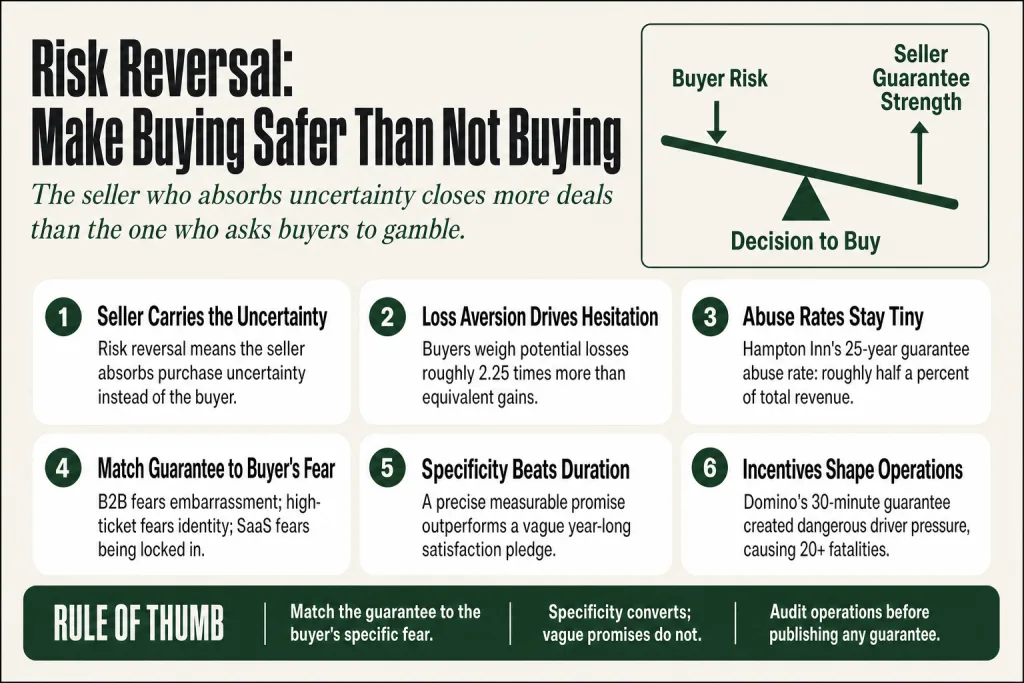
Risk reversal is the discipline of deciding who carries the uncertainty of a transaction before the customer has any evidence that you’ll deliver, and then designing a guarantee that makes buying feel less risky than not buying. By the end of this page, you’ll be able to identify what your customer actually fears, choose the right type of guarantee for your business model, and write a guarantee statement that converts without opening yourself to systematic abuse.
Here’s the situation most operators are in: you know your product works. Your customer doesn’t know that yet. They’ve been burned before, by the consultant who overpromised, the software that didn’t fit, the service that looked great on paper and fell apart in delivery. So they hesitate. They ask for references. They delay the decision for one more quarter. They “circle back.” They ghost.
What they’re really doing is waiting for certainty that you, at the moment of sale, genuinely cannot provide. No amount of testimonials or case studies fully closes that gap. At some point someone has to carry the risk of a new relationship, and by default, the market assigns it to the buyer. Risk reversal is the deliberate decision to pick it up yourself.
That’s a bolder move than it sounds. Most operators offer a wimpy 30-day guarantee buried in the footer that they hope nobody reads. That’s not risk reversal, that’s legal compliance. Real risk reversal is a visible, specific, and credible promise that changes the emotional math of the decision.
The idea in 30 seconds
- Risk reversal means the seller absorbs the uncertainty of a purchase instead of asking the buyer to carry it upfront.
- Every purchase has a fear attached to it, the wrong choice, the wasted money, the embarrassment of being fooled. Your guarantee addresses that fear directly.
- A guarantee is not charity. It’s a conversion tool that works because most buyers never invoke it, they just needed permission to say yes.
- The strength of your guarantee signals how confident you are in your own product. Weak guarantees telegraph weak confidence.
- Guarantee design requires you to match the type, duration, and conditions to the actual risk a buyer perceives, not to the minimum you’re comfortable offering.
- By the end of this page, you’ll be able to design a guarantee that addresses your buyer’s real fear, sets honest conditions, and doesn’t invite the abuse you’re probably worried about.
Where Risk Reversal Came From
The idea of a seller absorbing purchase risk is older than the vocabulary for it. Mail-order companies in the early 20th century offered money-back promises simply to close sales at a distance, when a buyer couldn’t feel the fabric or test the machine, a refund guarantee was the only way to get the transaction at all. That’s the essential logic, stripped bare: remove the thing stopping someone from saying yes.
The term “risk reversal” as a named principle is most closely associated with Jay Abraham, who developed and codified it through his consulting work from the late 1970s onward. His core argument was that the seller controls quality, delivery, and outcomes, so the seller should carry the uncertainty, not the buyer. Guarantees themselves predate Abraham by decades; what he contributed was a framework for making the guarantee a deliberate, front-and-center element of the offer rather than fine print in a contract. He applied the same logic to his own fees, structuring arrangements around a share of the additional profit his work generated rather than charging flat upfront retainers, which gave the concept credibility well beyond theory.
The behavioral science scaffolding came later, from Kahneman and Tversky’s prospect theory (1979), which showed that people weigh potential losses roughly 2.25 times more heavily than equivalent gains. Abraham didn’t need the research to arrive at the practice, but it explains precisely why it works: eliminating a potential loss does more conversion work than adding an equivalent benefit.
The most instructive large-scale test of a service guarantee came from Hampton Inn in 1989. The Chester County, Pennsylvania location, one of the first pilot properties, was asked for only 10 refunds out of approximately 8,500 guests during that summer trial. That’s roughly one percent. Most guests with complaints didn’t want their money back; they just wanted management to hear about the problem. Phil Cordell, who led the brand’s satisfaction program, later noted that standard thinking across service industries at the time was that the concept was doomed to fail through abuse. It wasn’t, and the hotel’s own data confirmed it. The abuse rate among guests invoking the guarantee over the program’s first 25 years amounted to roughly half a percent of total revenue.
Domino’s is the cautionary counterpoint, and it deserves a clear-eyed telling, because the lesson is specific. Starting in 1979, the chain promised delivery in under 30 minutes, and the guarantee drove genuine growth, with the company reaching 5,000 stores before the end of the decade. The problem was internal, not external: driver compensation and bonuses were tied directly to meeting the 30-minute window, which created pressure that cascaded into dangerous driving. By 1989, collisions involving Domino’s drivers had been linked to more than 20 fatalities. A 1993 verdict awarded a St. Louis plaintiff $78 million in punitive damages, a figure that matched, almost to the dollar, what the company had paid out in late-delivery credits that same year. Domino’s ended the guarantee shortly after. The lesson isn’t that guarantees are dangerous. It’s that a guarantee shapes operational behavior just as powerfully as it shapes customer perception. Design one without thinking through the internal incentives and you’ve built a liability, not a tool.
Why Risk Reversal Works on the Human Brain
You don’t need a PhD in behavioral economics to use this well, but understanding the mechanism sharpens how you design it.
When a prospect evaluates your offer, they’re not running a spreadsheet. They’re running a loss calculation. What’s the worst-case scenario if this goes wrong? How bad does that feel compared to how good the upside feels? Research by Kahneman and Tversky showed that the torment of a loss can be psychologically twice as powerful as an equivalent gain, and their later cumulative prospect theory work estimated the ratio at closer to 2.25 to 1. That asymmetry is what you’re fighting every time someone has to decide.
Think about what’s actually happening inside a prospect’s head when they look at your offer. They’re not just calculating whether your service will deliver. They’re imagining the social exposure of having made a bad call, the awkwardness of explaining to their boss why they chose the wrong vendor, the sting of telling their spouse they wasted the budget, the private embarrassment of having been taken in by a slick pitch. These are real psychological costs. They’re not irrational. They’re what the brain is designed to protect against.
Risk reversal interrupts that calculation. When you take the downside off the table, or dramatically reduce it, the prospect’s loss calculation comes out closer to zero. And a near-zero downside changes the decision math entirely. When you guarantee the result, extend the trial, or promise to make things right at your expense, you remove the single biggest reason people hesitate.
There’s a secondary effect that most operators miss: the guarantee signals confidence. A weak guarantee, “we’ll do our best to resolve any issues”, tells the buyer you’re not sure your product holds up. A strong, specific guarantee does the opposite. It says you’ve run this before, you know what happens, and you’re willing to put money behind it. That signal is part of what converts. The guarantee doesn’t just reduce fear; it builds credibility before the customer has any experience to draw on.
There’s also the endowment effect worth noting: once a customer has used your service or product, even briefly, they begin to feel ownership over the relationship. Free trials and extended evaluation periods exploit this in the right direction. The buyer gets attached. The return or cancellation starts to feel like a loss rather than a smart choice. So a guarantee that says “try it for 30 days, no charge” often works not because people plan to use it, but because by day 30, they don’t want to.
The Main Forms Risk Reversal Takes
“Guarantee” gets used as a catch-all, but there are meaningfully different structures, and choosing the wrong one for your business model is one of the most common mistakes operators make. Here are the ones that actually matter in practice.
Unconditional Money-Back Guarantee
The simplest form. Buy it, try it, if you don’t like it for any reason, you get your money back. No hoops, no questions, no conditions. This works best on physical products, lower-ticket offers, and situations where the buyer needs to try the thing to know if it fits. The abuse rate is almost always lower than operators fear. Hampton Inn’s pilot showed roughly one percent of guests invoked an unconditional free-night promise, and most who had complaints just wanted someone to hear about the problem.
Conditional or Performance Guarantee
Here you promise a specific outcome if the customer does their part. “Complete the program and implement the steps, if you don’t see X result within 90 days, we’ll refund you.” The condition does two things: it filters out buyers who won’t do the work (making the guarantee economics better for you), and it creates commitment from the buyer, which paradoxically improves their results. The risk is that conditions can feel like fine print. If your list of conditions is longer than your guarantee statement, you’ve undermined the whole thing.
Risk-Free Trial
The buyer uses the product or service for a defined period before being charged, or with the understanding that they can cancel before a charge hits. SaaS businesses live here. The 14-day free trial is so standard in software that it’s table stakes rather than differentiation, the risk reversal value has been commoditized. In that context, you need to go further: extended trials, concierge onboarding, or a first-month refund on top of the trial if they’re not happy after actually using it in production.
Price Guarantee
You guarantee the price won’t change, or that you’ll match a lower price the buyer finds elsewhere. This addresses a different kind of risk, the fear of overpaying, rather than the fear of a bad outcome. Useful in commodity categories where the buyer’s main hesitation is “could I get this cheaper somewhere else?” Less useful when the fear is about quality or fit.
Service-Level or Timeline Guarantee
You guarantee delivery by a specific date, a specific response time, or a specific measurable standard of service. Done well, it differentiates on reliability, which in many service businesses is the buyer’s real concern. Done badly, it creates incentives that destroy the safety culture your team needs to do the job right. The Domino’s story is the permanent case study on that second failure mode.
Outcome or Results Guarantee
The most powerful and the hardest to execute. You guarantee a measurable result, a specific number, a ranking, a revenue figure, a test score. This works when you control enough of the inputs to be confident in the outcome. It falls apart when the buyer’s behavior is a major variable, which it usually is in professional services, coaching, and anything requiring client implementation. Abraham applied this logic to his own consulting practice by structuring fees around a share of the profit his work generated for clients, which both aligned incentives and forced him to be selective about which engagements he took on.
Deciding Who Bears the Risk, Before You Write a Word
The strategic question underneath all of this isn’t “what should my guarantee say?” It’s “which party is better positioned to bear the uncertainty of this transaction, and what would it cost me to accept that burden?”
Think about it this way. In most transactions, the seller has far more information than the buyer. You know whether your product works. You’ve seen it fail and you know why. You know the customer profiles where it doesn’t take and the ones where it consistently delivers. The buyer knows almost none of this going in. Given that information asymmetry, asking the buyer to carry the full risk of the transaction is, put plainly, not a great deal for them. Shifting that risk to you, the party with actual knowledge, is the more rational arrangement.
So the first decision is honest: what can you actually guarantee? Not what sounds impressive in the copy, what are you willing to stand behind with real money? If you can’t answer that question clearly, you have an operations problem, not a marketing problem. Fix the product before you guarantee it.
The second decision is about the specific fear your buyer is carrying. Fear of wasted money is common but not universal. In B2B, the fear is often social: “I’ll look bad for choosing you.” In high-ticket consumer, it’s often identity: “What does it say about me if this doesn’t work?” In subscription software, it’s often switching cost: “If I commit to you, I’m locked in.” Each fear points toward a different type of guarantee.
A useful exercise: write down the three most common objections your sales team hears in the last stage before a deal closes. Those objections are the fear, stated in thinly coded language. Your guarantee is the direct answer to those objections, made into a promise.
The third decision is scope. You don’t have to guarantee everything. A partial risk reversal, one that addresses the most salient fear without exposing you to runaway abuse, is often more credible than an unlimited guarantee that strains believability. “If you implement our onboarding and don’t close three more deals in the first 90 days, I’ll personally work with your team another 30 days at no charge” is more specific and more credible than “100% guaranteed or your money back, no questions asked” on a $40,000 consulting engagement.
Putting this to work? The ideas in the Canon are the foundation under the tactical playbook in Build a Complete Marketing Department — grab the free companion kit at mmsvegas.com/resources.
Risk Reversal Working Today
The best modern examples are businesses that have made the guarantee structural, it’s not a line in the copy, it’s a core part of the business model.
Zappos built its early acquisition strategy around a 365-day free return policy on shoes. The insight was that shoes are notoriously hard to buy online, fit varies by brand, width varies by style, and you can’t know until you walk in them. By absorbing the return cost entirely, Zappos converted hesitation into purchase, and purchase into repeat purchase. The economics looked rough on paper. Zappos’ return rate ran far above the retail norm, and the company said so openly. What made it work was that repeat customers drove the large majority of revenue. Those figures come from Zappos’ own public accounts of itself, including Tony Hsieh’s writing, rather than from audited filings, since the company was private and then inside Amazon, which meant the guarantee was functioning as a customer acquisition cost, not a drain on margin. They weren’t being generous, they were making a rational bet on lifetime value.
Basecamp (formerly 37signals) famously offered a 30-day free trial with no credit card required, a meaningful form of risk reversal in a market where most SaaS companies demanded payment details upfront. The “no card required” qualifier was the real signal: it told the buyer that cancellation was genuinely frictionless. That specificity mattered more than the trial length.
In professional services, contingency-fee law firms operate on a pure outcome-based model, they only get paid if they win. Zero cost to the client if the result doesn’t materialize. It only works when the firm has enough case-selection discipline to take engagements they expect to win, and when the upside on a win compensates for the losses on no-win cases. The model breaks the moment the win rate drops below what the economics require.
In B2B SaaS, vendors have offered “time to value” guarantees, promising a measurable outcome within the first 60 or 90 days of implementation, with a refund or extended service if the milestone isn’t hit. These work because they’re tied to something concrete, and because they pressure-test the vendor’s onboarding process in a healthy way. When you’re on the hook for a 90-day outcome, you build toward it differently than when you’re just hoping clients get there eventually.
At the small-business level, a remodeling contractor offering a “we’ll finish on schedule or we’ll cover your hotel costs” guarantee is using the same mechanism. The specific, calculable consequence is what makes it credible. Compare that to the contractor who says “we stand behind our work”, which means nothing and moves no one.
Where Risk Reversal Is Strongest, and Where to Apply It First
Risk reversal pays the biggest dividend in situations where the buyer’s perceived risk is high relative to their available evidence. That’s most of the time in most businesses, but some situations are particularly ripe.
First purchase from a new vendor. The uncertainty is at its peak. The buyer has no direct experience with you, and whatever references or reviews they’ve checked only reduce the uncertainty, they don’t eliminate it. A guarantee here does proportionally more work than the same guarantee offered to a repeat buyer.
High-ticket offers. The dollar exposure makes the loss calculation more acute. A $50 decision doesn’t need much convincing; a $15,000 decision needs every available confidence signal. The guarantee is one of the most direct ones you can offer.
Intangible services. When the buyer can’t inspect the deliverable in advance, consulting, coaching, training, software implementations, they have no way to evaluate fit before committing. A guarantee partially substitutes for that inspection.
Markets with recent history of bad experiences. If your category is littered with operators who have burned buyers, a strong guarantee positions you against that background noise immediately. “We guarantee X, something most firms in this space aren’t willing to say” is a positioning statement, not just a safety net.
Competitive situations. When a prospect is evaluating you against a comparable competitor, the guarantee can be a tiebreaker. If your pricing, quality, and reputation are similar, the operator willing to put something real on the line earns the business.
The time to value of your offer also matters. The faster a customer can reach a meaningful outcome, the less your guarantee will actually cost you in practice, and the more confidently you can make it bold. Short time-to-value products can make outsize guarantee promises because redemption rates stay low.
Where Risk Reversal Has Real Limits
Risk reversal is not a universal fix, and pretending otherwise leads operators to design guarantees that expose them badly.
When the outcome depends primarily on the customer. If you’re selling a fitness program, a language course, or business coaching, the result requires the customer to do the work. A broad results guarantee on that kind of offer attracts the buyers most likely to not do the work, and then claim the guarantee. Conditional guarantees with completion requirements help, but they need to be structured carefully or they feel manipulative.
When your margins can’t absorb the redemption rate. A guarantee is a liability. Before you commit to one publicly, run the math. What’s your average order value? What’s a realistic worst-case redemption rate? What does that cost per month? If the answer eats your profitability at a redemption rate you think is realistic, you need to redesign either the guarantee or the economics of the offer.
When the product genuinely doesn’t hold up. A strong guarantee on a weak product is an accelerant. You’ll attract more buyers, many of them will be disappointed, more of them will invoke the guarantee, and your reputation for poor delivery will compound faster because more people experienced it. Fix the product before you bold the guarantee.
When the offer is high-ticket and the client’s behavior is the main variable. In complex B2B implementations, a money-back guarantee on a $200,000 project is often counterproductive, it signals you don’t understand the shared nature of the risk. Buyers in those situations don’t want a refund; they want confidence you’ll see it through. A better tool here is the phased contract with clear exit points, not a blanket refund promise.
When prestige is part of the value. Luxury brands and ultra-premium services sometimes find that an aggressive guarantee undermines the positioning. “Satisfaction guaranteed” from a Michelin-starred restaurant feels off-brand. The social proof, exclusivity, and reputation do the risk-reversal work implicitly. Stating it explicitly can make the thing feel cheaper.
What Operators Get Wrong About Risk Reversal Conceptually
“A guarantee will get abused.” This is the fear behind most weak guarantees. It’s almost always wrong in practice. At Hampton Inn’s 1989 pilot, one of the first serious tests of an unconditional service guarantee at scale, only 10 refunds were claimed out of roughly 8,500 guests. The brand later tracked abuse across 25 years of the program and found it amounted to roughly half a percent of total revenue. The buyer who does invoke a guarantee is typically someone who genuinely didn’t get what they expected, they would have left anyway, or disputed the charge, or damaged your reputation with word of mouth. The guarantee just makes the exit clean.
“A guarantee is just a refund policy.” A refund policy is reactive, it says what happens if you complain. A guarantee is proactive, it makes a promise before the buyer has any problem, as part of the selling conversation. Functionally they may do the same thing, but psychologically the guarantee is marketing and the refund policy is customer service. They live in different parts of the buyer’s experience.
“Longer is always stronger.” A 365-day guarantee sounds better than a 30-day guarantee, and often it is. But duration without specificity is still weak. “We guarantee you’ll be happy for a full year” is vaguer and less credible than “if you don’t see a 20% reduction in support ticket volume within 90 days of implementation, we’ll continue working for free until you do.” Specificity beats duration.
“The guarantee only helps with hesitant buyers.” It helps with committed buyers too, in a less obvious way. A buyer who was going to purchase anyway feels better about the decision when there’s a guarantee. Their post-purchase anxiety drops. They’re more likely to use the product, get the result, and become a reference. The guarantee improves outcomes for confident buyers just as much as it converts hesitant ones.
“If I offer a guarantee, I’m admitting I might fail.” The opposite reads true to buyers. A bold guarantee signals deep confidence in your delivery, it’s why operators who are willing to put something real on the line consistently win the buyer who was sitting on the fence. The psychology is confidence signaling, not failure admission. The operator who won’t guarantee their work is the one who sounds unsure.
Common Mistakes
- Burying the guarantee where no one deciding will ever see it — A contractor in Phoenix added a single line to his proposal cover page: “If we miss your agreed completion date by more than three business days, we cover your hotel costs, no paperwork required.” Proposals that had been going dark for two weeks started closing in days. The guarantee hadn’t changed; the placement had. Move it to the first page of the proposal, the pricing section of your website, and the verbal pitch, not the footer or a terms document.
- Writing conditions longer than the promise itself — A marketing agency had a 90-day results guarantee buried in four paragraphs of requirements, client must attend weekly calls, submit all content on time, approve assets within 48 hours, not pause the campaign. Every condition was reasonable. Together, they read as an escape hatch. They rewrote it as two sentences: complete the onboarding checklist and stay engaged for 90 days; if revenue from tracked campaigns doesn’t exceed the retainer cost, we work another month at no charge. Same protection, half the suspicion.
- Picking the wrong guarantee type for the actual fear — A SaaS company selling project management software to construction firms kept offering a 14-day free trial, standard in software, useless in construction, where teams can’t meaningfully evaluate a tool in two weeks while running active job sites. Switching to a 60-day pilot with a full refund if adoption across the team didn’t hit 80% of users logging in weekly changed the sales conversation. The guarantee matched how the buyer actually experienced the product.
- Designing a guarantee that creates bad internal incentives — A fulfillment company offered a 48-hour shipping guarantee without checking whether their warehouse team had capacity to consistently hit it. Within six weeks, staff were cutting corners on quality checks to make the window. The fix wasn’t to pull the guarantee, it was to audit whether operations could support it before publishing, then build the scheduling infrastructure the promise required. A guarantee you can’t operationally honor isn’t bold; it’s a trap you set for yourself.
- Skipping the redemption math before publishing — Run it before you go live: if your average order value is $2,000 and you expect a 4% redemption rate on 50 transactions a month, that’s $4,000 per month in potential exposure. Is that survivable? For most operators at that revenue level, yes, it’s a marketing budget line, not a crisis. If the number terrifies you, the problem is probably margins or offer economics, not the guarantee itself.
- Offering an unconditional results guarantee when the client controls the outcome — A business coach offered a money-back guarantee if clients didn’t double their revenue within six months, with no completion requirements attached. She started attracting clients who did no implementation work, then requested refunds. Switching to a conditional guarantee, complete all six monthly intensives, submit your implementation log, and if you haven’t hit a 30% revenue increase, you get a full refund, filtered the right clients in and the wrong ones out. The guarantee got bolder on paper and cheaper to honor in practice.
Operator’s Take
Before you write a single word of guarantee language, pull up your last ten lost deals and look for the pattern. Not the polite “timing isn’t right”, the actual hesitation underneath it. That’s what your guarantee needs to answer. If deals stall because buyers worry about implementation cost overruns, a money-back clause doesn’t help much; phased payment tied to milestone delivery does. If prospects ghost after the proposal because they’re not sure you’ll finish on time, a timeline guarantee with a specific financial consequence is the answer, something like “if we miss the agreed completion date by more than five business days, we credit you $500 per day toward future work.” Match the guarantee to the fear. Not to the format everyone in your industry has been copying from each other.
Here’s a concrete place to start: write three sentences. First, state the specific result your best clients get. Second, state what you’ll do, in specific, dollar-denominated or time-denominated terms, if they don’t get it. Third, state the one or two actions the client has to complete for the guarantee to apply. That’s your guarantee. If those three sentences are hard to write, you haven’t decided yet what you’re actually willing to stand behind, and that’s the real problem to solve before anything else.
Then pick the guarantee that makes you a little nervous. Not reckless, nervous. If your current guarantee doesn’t cost you anything emotionally to offer, it’s too small to cost the buyer anything emotionally to ignore. A $12,000 consulting engagement where you’re promising three new closed deals within 90 days or 30 more days of your time at no charge, that one changes how you sell, because it changes how seriously you take delivery. Those two things are directly connected, and that connection is the whole point.
Put it where the decision happens. Not the footer. Not a terms page three clicks away. The guarantee belongs in the proposal, on the pricing page, in the verbal pitch, and in the onboarding email, right at the moment the buyer is weighing yes against no. If they have to go looking for it, it’s doing no work at all.
Think hard about what your guarantee forces you to change internally. A timeline guarantee will surface every scheduling breakdown you’ve been tolerating. An outcome guarantee on a coaching program will push you to be selective about who you take on, because you can’t afford clients who won’t implement. That internal pressure is a feature, not a problem. Hampton Inn found that honoring the guarantee turned into something more useful than a refund program: it empowered every team member to fix a problem on the spot, which meant most guests who had complaints declined the refund entirely once the issue was resolved. The guarantee reshaped how the whole organization operated. Let yours do the same thing.
On the abuse question: do the math once, set a threshold, and stop losing sleep over it. Take your expected redemption rate, be conservative, call it 3% to 5% for a new guarantee, multiply by average order value, and confirm the number is survivable. If it is, publish the guarantee and check the numbers in 90 days. If your redemption rate is running well above what good-faith buyers would generate, that’s a product signal, not a guarantee signal. Look at delivery first.
AI can help you stress-test the language, flagging conditions that might read as fine print to a skeptical buyer, running through edge cases you haven’t thought of, checking whether the stated conditions are actually achievable given your typical client profile. What AI can’t do is decide what you’re willing to stand behind. That call is yours. The only version of a guarantee worth publishing is one your team is fully prepared to honor, every single time, without an argument about whether it applies.
The best guarantee I’ve seen from a small operator wasn’t the biggest or the loudest. It was a fractional CFO who promised that if she didn’t find at least a specific dollar amount in recoverable cash flow within the first 60 days, she’d refund the first month’s retainer, no conversation required. Specific enough to be credible. Bold enough to signal real confidence. Tight enough that she controlled the inputs. That’s the target.
Used in
- ✓ Build a Complete Marketing Department
Used to design the offer layer of the marketing system, specifically how to structure a guarantee that makes the core offer more compelling at the decision stage without requiring a price reduction. - ✓ The Missing Manual for FunnelKit
Applied at the checkout and order-bump stages, where a visible guarantee statement directly reduces cart abandonment by addressing last-moment purchase hesitation. - ✓ The Missing Manual for Make
Used to automate guarantee fulfillment workflows, triggering refund sequences, service-extension notices, or follow-up touchpoints when a guarantee clause is invoked, so honoring the promise is operationally frictionless.
FAQ
Won’t a strong guarantee just get abused by bad-faith customers?
Almost never at the rates operators fear. Hampton Inn’s 1989 pilot showed only 10 refunds requested out of approximately 8,500 guests at the Chester County, Pennsylvania test property, roughly one percent. Over 25 years of the full program, tracked abuse amounted to about half a percent of total revenue. Most buyers who invoke a guarantee genuinely didn’t get what they expected, and they would have left, disputed the charge, or damaged your reputation anyway. The guarantee just makes the exit clean.
What’s the difference between a guarantee and a refund policy?
A refund policy is reactive, it describes what happens after a complaint. A guarantee is proactive, it’s a selling promise made before the buyer has any problem. Psychologically, the guarantee is part of the offer; the refund policy is part of customer service. They can say the same thing, but only the guarantee does conversion work.
Should I offer a conditional or unconditional guarantee?
Unconditional works best for lower-ticket physical products and situations where the buyer needs to try the thing to know if it fits. Conditional guarantees work better when client behavior is a major variable in the outcome, coaching, consulting, implementation projects. The key is that conditions must be simple, clear, and genuinely achievable, not a list of fine print that undermines the promise.
How long should my guarantee period be?
Long enough that the buyer reaches a meaningful result, or clearly hasn’t. A 30-day money-back window on a software product with a 60-day onboarding process is almost meaningless. Match the window to the realistic time it takes a buyer to know whether the thing worked for them.
Can I use risk reversal on high-ticket B2B deals?
Yes, but the format matters. A blanket money-back guarantee rarely makes sense on a six-figure contract, sophisticated buyers don’t trust it and it signals you don’t understand the complexity of the engagement. Better structures: phased contracts with defined exit points, performance-fee arrangements, or guarantee of specific interim milestones rather than the overall outcome.
Does the guarantee have to cost me money if invoked?
Not necessarily. The consequence can be additional work at no charge, extended service, a partial credit, or a specific make-good, whatever addresses the buyer’s fear most directly. A money-back guarantee is the most universal form, but it’s not the only credible one. Match the consequence to the nature of the risk.
Did Jay Abraham invent risk reversal?
No, and it would be unfair to say he did. Sellers have been offering money-back guarantees since at least the early mail-order era of the 20th century. What Abraham contributed was a framework and a name: he argued that the guarantee shouldn’t live in the fine print but at the center of the offer, and he applied the same logic to his own consulting fees by structuring them around a share of the client’s additional profit. That reframe, from legal backstop to selling tool, is what he’s credited with, not the underlying concept of guarantees itself.
Further reading
- Jay Abraham, Getting Everything You Can Out of All You’ve GotAbraham’s most accessible book; the risk reversal framework appears throughout his discussion of offers and preeminence. Read it for the mindset, not as a tactical manual.
- Daniel Kahneman, Thinking, Fast and SlowThe behavioral science behind why risk reversal works, explained by the Nobel laureate who co-developed prospect theory. Chapter 26 on loss aversion is the operative section for marketers.
- Christopher Hart, “The Power of Unconditional Service Guarantees” (Harvard Business Review1988)The academic case for unconditional guarantees in service businesses, written one year before Hampton Inn ran its first pilot. Worth locating for the framework on when unconditional guarantees are viable.
Sources: Jay Abraham, Abraham.com (Risk Reversal topic archive); ASBN Strategic Edge, “Risk Reversal: How a More Specific Guarantee Can Guarantee More Sales” (June 2026); eHotelier, “Hampton Hotels Celebrates 25 Years of 100% Satisfaction Guarantee” (October 2014), primary source for Chester County pilot data; Franchising.com, Hampton Hotels 25th Anniversary Guarantee press release (October 2014), corroborating source for 10 refunds / 8,500 guests figure and half-percent abuse rate; Hotel-Online.com, “$6 Million in Free Rooms Provided by Hampton Inn’s 100% Satisfaction Guarantee in Past Decade” (October 1999); The Points Guy, “100% Satisfaction Guarantees at Hotels: Fact or Fiction?” (April 2015); Ranker, “How Domino’s ’30 Minutes Or Less’ Guarantee Resulted In A $78 Million Lawsuit”; Tasting Table, “Why Domino’s Was Forced To Abandon Its Famous 30-Minute Delivery Promise”; The Hustle, “The Failure of the Domino’s 30-Minute Delivery Guarantee” (April 2024); Snopes, “End of Domino’s Pizza Delivery Guarantee”; The Strategy Story, “Deeply Analyzing Zappos Customer Service Strategy” (April 2021); Simply Psychology, “Prospect Theory in Psychology: Loss Aversion Bias”; The Decision Lab, “Loss Aversion” (citing Kahneman & Tversky, 1979 and 1992); Lilach Bullock, “Business Lessons from Jay Abraham” (July 2026).
Brian Kasday spent forty years in direct-response marketing before rebuilding the whole operation as a one-person shop. He writes The Operator’s Library — including “Build a Complete Marketing Department” — for operators who’d rather build it themselves than wait on someone else.
Build the department these ideas describe — the free companion kit: mmsvegas.com/resources.
More The Operator's Canon guides
Free · Operator Toolkit
Want the tools, not just the guide?
Get the free operator toolkit — templates and checklists for the systems you actually run, plus a note when this guide changes.
Get the free toolkit →How to cite: Risk Reversal. Associated with Jay Abraham, 1987. The Operator’s Canon, MMS Vegas. https://mmsvegas.com/library/risk-reversal-guarantees-explained/