
Last updated: September 2026
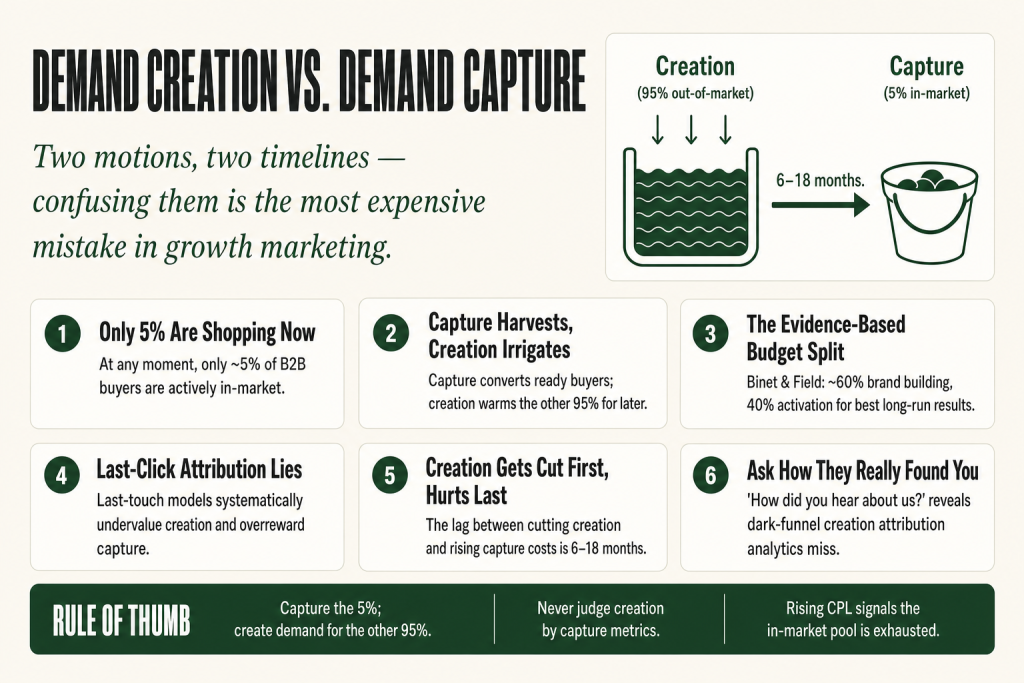
The choice between demand creation vs demand capture is the most important budget decision a growth-stage operator makes, and the one most often made by accident.
Most operators running into a growth wall have a Google Ads account, maybe some retargeting, a LinkedIn page they post to inconsistently, and a vague sense that ‘content’ should be happening somewhere. Revenue is flat or rising slowly. The reflex is to spend more on ads. Cost-per-lead creeps up. The sales team complains about lead quality. Everyone blames the channel.
The diagnosis is almost never the channel. It’s that the operator is running one motion, capture, while neglecting the other entirely. They’re fishing a pond that was already fished and wondering why the catch is down.
The distinction matters at every scale. A solo consultant deciding how to spend twelve hours a month on marketing. A $3M SaaS company allocating a real budget across paid search and content. A regional service business deciding between radio ads and an SEO program. In every case the question is the same: am I trying to catch buyers who are already swimming toward me, or am I trying to grow the number of buyers who will eventually swim this way? Those are different jobs, and conflating them is expensive.
The idea in 30 seconds
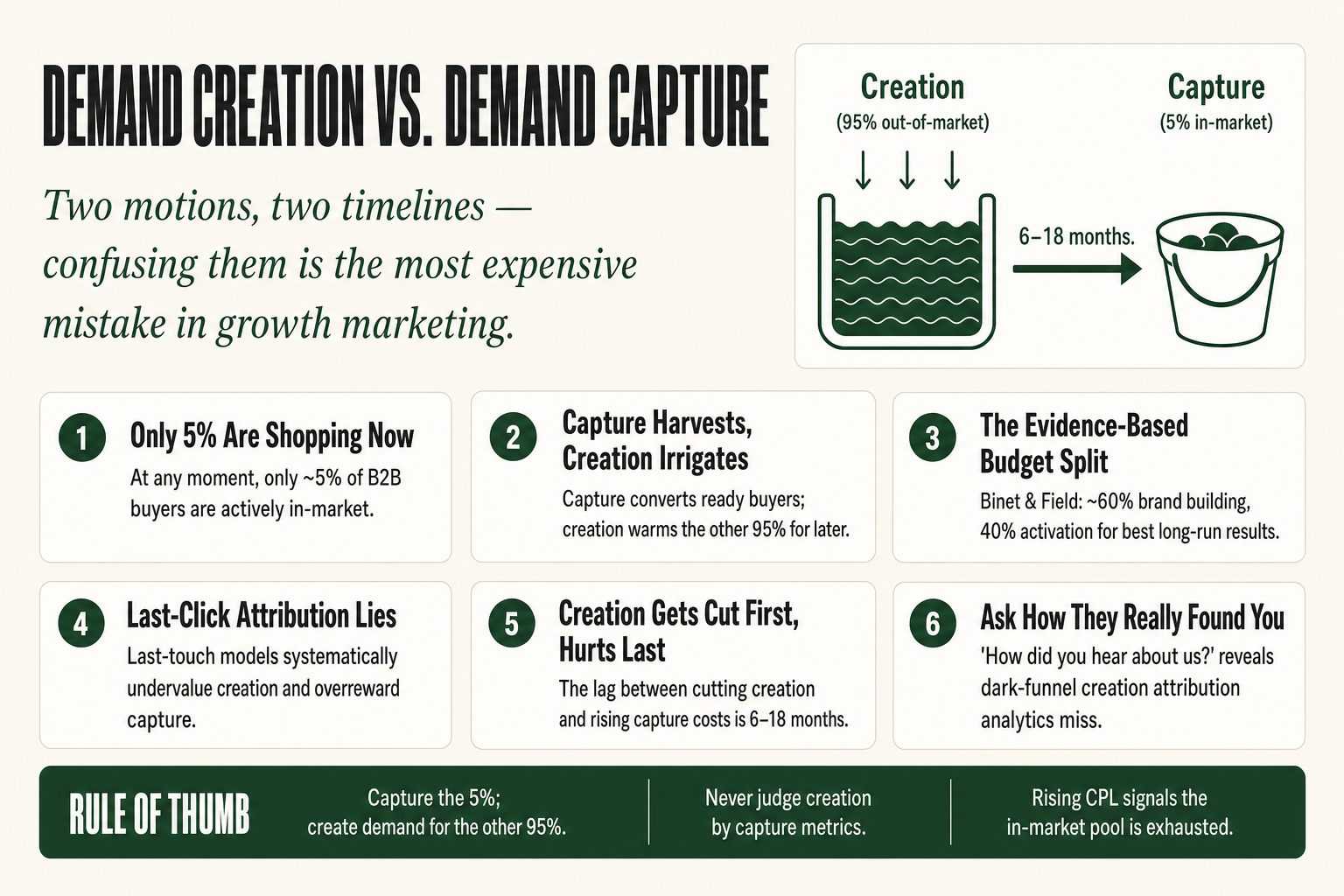
- Demand capture targets the roughly 5% of your market actively shopping right now, Google search ads, retargeting, review-site presence.
- Demand creation warms the other 95% who aren’t shopping yet, content, thought leadership, social, category education.
- Most operators over-invest in capture and starve creation. The result: rising cost-per-click and a shrinking pool of in-market buyers to fight over.
- The two motions need separate budgets, separate metrics, and separate success timelines. Treating them as one funnel is the root cause of most attribution headaches.
- A working ratio for most B2B operators: roughly 60% creation, 40% capture, from Binet & Field’s IPA Databank analysis. B2B-specific data puts it closer to 46/54 in favor of activation. Read the benchmark as a range, not a rule.
- By the end of this page, you’ll be able to diagnose which motion is broken in your business and stop funding the wrong one.
Where the Distinction Came From
Two bodies of research, arrived at from completely different directions, converged on the same conclusion.
The first: Professor John Dawes at the Ehrenberg-Bass Institute formalized what he called the 95-5 rule. Published in 2021 and co-published in Marketing Weekwith thanks to Jon Lombardo and Peter Weinberg at the LinkedIn B2B Institute for encouraging the write-up, the insight is almost insultingly simple: at any given moment, only around 5% of potential B2B buyers are actively in-market for a given solution. The rest are locked into existing contracts, focused on other priorities, or simply unaware your category applies to them. The 5% is a heuristic, in slow-moving categories with five-year contract cycles, the real figure can be closer to 2%. In faster-moving ones, it might reach 10%. The direction is what matters: the overwhelming majority of your market isn’t shopping right now.
The second: Les Binet and Peter Field’s 2013 IPA report The Long and the Short of It analyzed nearly 1,000 effectiveness case studies from the IPA Databank and found that effective marketing balances two distinct modes, long-term brand building, which creates future demand, and short-term sales activation, which harvests current demand. The evidence pointed to a roughly 60% brand / 40% activation ratio as the configuration producing the best long-run results. The 2019 B2B-specific analysis put the split closer to 46% brand / 54% activation, reflecting longer sales cycles and more rational buying committees.
Put the two together: the 95-5 rule tells you why creation matters, and Binet & Field tell you roughly how much to invest in each motion. Most operators, by default, not intention, are running something close to the inverse.
The Problem This Framework Actually Solves
The problem isn’t that operators don’t run any marketing. Most run plenty. The problem is that almost all of it is aimed at the same narrow slice of people.
Every competitor in your category is fishing the same 5%-in-market pond. As more budget pours into the same capture channels, the cost of those channels rises and the quality of results falls. It’s a tragedy of the commons played out in Google Ads auction prices.
Capture is easy to measure and delivers quickly, which is why it dominates budgets. Creation is harder to attribute, running largely through what practitioners call the dark funnel, which is why it’s chronically underfunded. A business that only captures is limited to the demand that already exists. It competes hardest, on price and on bids, for buyers already in-market. As it exhausts that pool, capture gets more expensive and growth stalls.
There’s a subtler version of this problem specific to small operators. Most think they have a lead generation problem when they really have a visibility problem, a credibility problem, or a conversion problem wearing lead-gen clothes. They pour more money into capture before diagnosing that there isn’t enough created demand in the market to sustain what they’re trying to harvest. You can’t capture what hasn’t been created, by you or by anyone else.
The second thing the framework fixes is measurement dysfunction. Most B2B companies rely on last-touch attribution, the final action before conversion gets 100% of the credit. That approach ignores the full buyer journey and systematically undervalues creation. Ask a last-click report which half of your funnel is working and it will give you a confident, precise, and wrong answer. Lower-funnel tactics like branded search and retargeting dominate the conversion columns. Upper-funnel investments look expensive and unaccountable.
Marketers have been reallocating budget based on that picture for a decade. It’s one of the most expensive systematic errors in the industry. The demand creation vs demand capture framework forces separate measurement contracts for each motion, and that act alone usually fixes the budget problem, because creation stops being judged by capture metrics.
The Two Motions, Defined
The terminology is slippery, people use it to mean slightly different things depending on which corner of marketing they come from. So let’s be precise.
Demand Capture
Demand capture engages prospects who have already indicated buying intent. The capture question is: of the people who already want what I sell, how many can I get to choose me?
Capture channels are the ones your attribution model loves, because the buyer arrived already warm. Branded search. Competitor keywords. Review sites like G2, Yelp, or Houzz depending on your category. Retargeting ads to past website visitors. Outbound to contacts who just triggered a buying signal. These are harvest mechanisms, you’re picking fruit that your earlier creation work grew over the prior six to eighteen months, or that some other market force grew for you.
Capture is fast to measure. Results show up in days or weeks. The feedback loop is tight enough to optimize in near-real time. That’s its great advantage, and also why it dominates most operators’ budgets by default.
Demand Creation
At any given time, as much as 95% of your addressable market isn’t actively shopping. The goal of creation is to raise awareness of a problem your ideal buyer may not yet have named, and begin building the mental availability that makes you the obvious choice when they do enter the market.
Creation channels look different: thought leadership content, educational video, organic social, podcast appearances, speaking at industry events, SEO built around problem-awareness keywords rather than product-comparison keywords, webinars that teach rather than pitch. The job is to reach cold audiences with problem-focused content and build recognition with the buyers who aren’t ready yet.
Creation is slow to measure. The person who reads your article in January may not be in-market until August. Your attribution model will credit the Google ad they clicked in August and ignore everything before it. By the time a buyer fills out a demo request, the battle for mindshare is mostly won or lost.
The Relationship Between Them
They’re not opposites and they’re not sequential steps in the same funnel. They’re two parallel motions that operate on different timescales and feed each other. Creation refills the pool, generating the future buyers who will later be captured. That’s why the two are a system, not a choice.
The most useful mental model: creation is irrigation, capture is the harvest. You can harvest without irrigating for a while. Eventually the soil is dry.
Why Capture Dominates, and Why Creation Gets Cut in Downturns
The forces that create this imbalance are structural, not just ignorance. Understanding them is half the battle.
First: measurement. Last-click attribution makes capture look brilliant and creation look invisible. If your CFO reviews a marketing report built on last-click data, cutting the content budget looks like a rational decision. It usually isn’t.
Second: the quarterly pressure cycle. When revenue slows, leadership looks at the budget. Capture channels, branded search, retargeting, high-intent paid, show clear, attributable pipeline. Creation channels, content, organic social, community, events, show softer metrics. So creation gets cut.
For one or two quarters, pipeline looks stable because capture is still harvesting the intent that creation built. Then capture performance degrades. Cost per opportunity rises. Win rates drop. And the team scrambles to figure out what happened.
What happened is nobody was filling the top of the funnel anymore. Binet and Field documented this across hundreds of IPA effectiveness cases: over-reliance on short-term metrics damages brand profitability in the long run. The lag between cutting creation and feeling the impact in capture results is six to eighteen months, long enough that the connection is genuinely hard to prove after the fact.
Third: the performance marketing narrative that dominated the 2010s. A whole generation of operators was trained to treat awareness spend as waste and conversion spend as smart. The logic is seductive, until your cost-per-lead triples and you’re bidding against twelve competitors for the same five thousand in-market buyers this month. WARC’s 2024 data shows 68.8% of marketing budgets flowed to short-term performance tactics, the inverse of what the effectiveness evidence supports.
How to Diagnose Your Current Position
Before deciding how to rebalance, you need to know where you actually sit. These diagnostics take an afternoon.
Is Your Capture Pool Saturated?
Audit your capture channels. Are your Google Search impression shares maxed out on core terms? Is cost-per-lead rising quarter over quarter with no change in targeting? Are the leads getting thinner, more tire-kickers, fewer deal-ready buyers? If bottom-funnel SEM cost per acquisition is rising and impression share is maxed, you’ve likely exhausted the in-market pool. That’s the signal to shift budget upstream into awareness channels that will refill the capture funnel in six to twelve months.
Does Creation Have Any Infrastructure at All?
Ask honestly: does someone who has never heard of you have a way to find you while researching the problem you solve, not your product name, the problem? If the answer is no, you have no creation motion. You’re entirely dependent on buying intent that someone else or some market force created.
What Does Your Attribution Data Actually Reveal?
The most revealing diagnostic for a small business is a simple open-ended form field: “How did you hear about us?” If the answers are mostly “Google” or “saw your ad,” your creation motion is either absent or not registering. Dark funnel indicators look different: inbound leads mentioning “LinkedIn,” “a podcast,” or “a friend mentioned you”, and a gradual rise in branded search traffic, meaning more people are searching your company name without being prompted by an ad. That’s creation working, even when your analytics dashboard doesn’t show it.
What Stage Is Your Business In?
A brand-new business in an established category can often run capture-heavy from day one, category demand exists, you just need to be found. A business trying to enter a market where buyers don’t yet recognize the problem has to invest heavily in creation first, or nothing else works.
Small teams under roughly $3M ARR should not try to run a full dual-motion operation simultaneously. Get capture working first if the category is established. Add creation systematically as you scale. Don’t try to do everything at once with a team of three.
Putting this to work? The ideas in the Canon are the foundation under the tactical playbook in Build a Complete Marketing Department — grab the free companion kit at mmsvegas.com/resources.
Running Demand Creation in Practice
Creation is the motion most operators talk about and fewest actually execute consistently. Here’s what real execution looks like.
Own a Problem, Not a Product
The central discipline of demand creation is choosing the problem, not the solution. Your content, your social presence, your speaking engagements, all of it should be organized around a problem your best future customers are living with, often without yet naming it.
HubSpot didn’t build its content empire by writing about HubSpot. It built it by writing about inbound marketing, lead generation, and the failures of cold outbound, the category problems that its product happened to solve. The product was almost incidental to the editorial point of view.
For a small operator, this is more achievable than it sounds. A commercial HVAC contractor could own content around energy costs in commercial buildings. A fractional CFO could own cash flow planning for service businesses under $5M. A dental practice could own dental anxiety in adults. None of those require a content team, they require a clear point of view and the discipline to publish it consistently.
Consistency Beats Volume
Sporadic creation is almost as bad as no creation. Pick a cadence you can actually sustain, then hold it for 18 months before judging the results. One LinkedIn post a week beats six a week for three months followed by silence. The compounding effect of recognition and mental availability requires repetition over time, not bursts.
Where AI Fits In
AI is genuinely useful for creation at the operator scale: drafting outlines, repurposing a single podcast episode into a LinkedIn post, a newsletter section, and a short blog, all from the same source material. It cuts production overhead and reduces your dependence on freelancers for mechanical work.
What AI can’t supply is the point of view. The specific client story, the contrarian stance, the observation that only comes from actually running the business, that’s still yours. Use AI to scale the production. The editorial judgment stays with you.
Measuring Creation Without Losing Your Mind
Creation success shows up on leading indicators with longer feedback loops: branded search volume month-over-month, share of voice in your category, organic traffic to thought leadership content, audience growth on owned channels. These metrics move quarterly, not weekly. If more people are searching your business name now than six months ago, something in your creation motion is working, even if you can’t directly attribute it. Track branded search and direct traffic as proxies. If self-reported attribution shifts from “saw your ad” to “heard you on a podcast,” your creation programs are working even when the attribution model won’t show it.
Running Demand Capture in Practice
Capture gets more attention in most operator playbooks, so I’ll stay focused on the things operators get wrong, not the basics.
Capture Only Works When You Own the Buying Signals
The core discipline of capture is showing up cleanly and credibly at every moment where a potential buyer signals readiness: ranking for comparison and category keywords, not just branded ones; a current, review-rich presence on whichever platform dominates your category, G2 for software, Houzz for home services, Google Maps for local businesses; clear CTAs, fast page speed, no friction in the quote or booking flow.
When buyers are in the market, they should encounter clear value propositions, credible proof points, and a simple conversion path. If any of those three are missing, you’re losing capture opportunities to competitors who have them, regardless of ad spend.
Retargeting Is Capture, Not Creation
Operators often mistake retargeting for a creation motion because it reaches people who didn’t convert on first contact. It’s still capture, those people already showed intent. Retargeting is a second attempt at harvest, not irrigation. Treat it accordingly: tight messaging, clear offer, short window (14 to 30 days for most categories). Don’t run 90-day retargeting windows and call it brand building.
Capture Metrics Are Fast and Honest
Capture success is measured on conversion metrics with short feedback loops: cost per opportunity, opportunity-to-close rate, pipeline created by channel, time from first touch to opportunity. These move weekly and you can optimize in real time. If a capture channel’s CPL is rising without a corresponding improvement in close rate, it’s losing efficiency, probably because the pool is getting shallower.
Budget Allocation: The Honest Version
Everyone wants a number. Here’s the honest answer: there’s no universal rule. But there are useful reference points.
Binet and Field’s analysis of nearly 1,000 IPA Databank case studies pointed to roughly 60% brand building / 40% activation as the configuration producing the best long-run results for consumer brands. The B2B-specific cut of the data, conducted with the LinkedIn B2B Institute in 2019, landed closer to 46% brand / 54% activation. If you’re running a B2B services or SaaS business, a 50/50 split is defensible, and you won’t find a lot of rigorous data telling you you’re wrong.
What adjusts the ratio in practice:
- Category maturity. In an established category where buyers know what they want and are searching actively, you can run heavier on capture early. In a new or education-heavy category, you need to create before you can capture, no way around it.
- Business stage. Early-stage businesses often run heavier on capture for cash flow reasons. That’s pragmatic, but treat it as a temporary posture with an explicit plan to shift the ratio, or it never happens.
- Captured pool saturation. If your capture channels are saturating, costs rising, impression share maxed, shift budget to creation. If buyers arrive having never heard of you, more capture spend won’t fix that.
- Sales cycle length. Long cycles (90+ days for B2B) make creation more valuable because there’s more time for awareness to influence the decision before a buyer formally enters market. Short cycles favor heavier capture.
One practical heuristic for a small operator with a limited budget: fund capture to the point of efficiency, the point where marginal cost-per-lead equals acceptable CAC, then redirect surplus toward creation. Don’t starve either motion. They need to run simultaneously, even if not in equal proportion.
Modern Examples Worth Studying
A few cases where the distinction is visible enough to learn from.
HubSpot (Classic Creation Play)
HubSpot’s foundational bet was creation: build a free educational resource, the blog, the certifications, the free tools, so thorough that anyone researching the problems HubSpot solves finds HubSpot before they’ve formed a preference. The capture layer (paid search, free-to-paid conversion flows, sales follow-up on trial users) is efficient precisely because the creation layer already built the familiarity and trust. The free Website Grader, launched early in the company’s history, is a near-perfect creation tool: it delivers genuine value, requires no commitment, and positions HubSpot as the expert on the problem before a single sales conversation happens.
Salesforce (Category Creation as Demand Creation)
When Salesforce introduced the idea of software accessed remotely over the internet, there was no search volume for “cloud CRM.” The “No Software” campaign, literally crossing out the word “software” in their logo, was demand creation at its purest: reframing the entire category so that the old way became the problem. Salesforce didn’t capture demand for cloud CRM; they created it, then captured it almost by default because they’d defined the category.
A Local Example: The HVAC Company That Runs Both
You don’t need VC money to run both motions. A regional HVAC company running capture via Google Local Services Ads, showing up when someone searches “AC repair near me”, while simultaneously publishing a monthly newsletter on energy efficiency for local homeowners and sponsoring a YouTube segment on when to replace vs repair your HVAC is running both motions at small-business scale.
The newsletter and YouTube work is creation, reaching the 95% who aren’t searching today but will be in two summers. The Local Services Ads are capture, meeting the 5% with a broken unit this afternoon. Neither replaces the other.
Where Operators Get This Conceptually Wrong
A few persistent confusions that show up in almost every conversation about this framework.
‘We already do content, so we’re doing demand creation.’
Not necessarily. Content that’s product-focused, gated behind a lead form, and designed to capture contact information is capture content, it’s trying to convert people who are already warm enough to trade their email. Demand creation content is ungated, teaches the problem before pitching the solution, and reaches people who don’t know they need you yet.
Both have a place, but they’re doing different jobs. Most operators who think they’re doing creation are actually doing light capture.
‘Demand creation is just brand awareness, it’s for big companies.’
Wrong in both directions. Creation doesn’t require a TV budget. A consistent LinkedIn presence, a well-positioned blog, or a local speaking circuit is demand creation. And the companies that skip it because they think it’s for enterprise brands are often the ones stuck fighting over the same five hundred in-market buyers in their vertical, watching ad costs climb.
The Ehrenberg-Bass research is direct on this: long-term growth comes from staying visible to a broad audience over time, not just activating the small slice that happens to be in-market this quarter.
‘If I’m spending on social ads, I’m doing both.’
Social ads can do either job depending on targeting and creative, but most operators’ social ads are retargeting warm audiences or targeting lookalikes with product-focused creative. That’s capture dressed in social clothes.
True creation on social means reaching cold audiences with educational or perspective-led content that doesn’t ask them to do anything except absorb a point of view. The intent is different, the creative is different, and the measurement expectation is different.
‘Once I build a creation motion, I can reduce capture spend.’
You can usually run capture more efficiently as creation builds familiarity, but you rarely eliminate it. A strong brand makes people more responsive to your performance marketing because they’re already warmed up, creation makes capture cheaper per converted customer. It doesn’t replace it. Budget for both indefinitely.
Common Mistakes
- Measuring creation with capture metrics — Set separate KPIs for each motion, branded search growth, audience size, and share-of-voice for creation; CPL, conversion rate, and pipeline velocity for capture, and review them on different cadences. Never run creation through a last-click attribution model.
- Cutting creation in downturns because it can’t show immediate ROI — Model what capture unit economics look like in two quarters, not just this one, before making the cut. The 6 to 12 month lag between cutting creation and its impact on capture costs makes this a consistently expensive mistake, the cut feels painless until it isn’t.
- Treating gated lead-gen content as demand creation — Ungated, problem-focused content reaching cold audiences is creation. Gated, product-focused content targeting warm audiences is capture. Audit your content library and reclassify honestly, most operators discover they’re doing almost no creation once they apply this test.
- Running creation in bursts rather than consistently — Pick a creation cadence you can hold for 18 months, one LinkedIn post per week beats six per week for three months followed by silence. Mental availability compounds through repetition, not volume.
- Waiting until capture is fully saturated before starting creation — Start a minimal creation motion while capture is still your primary growth driver. Even one consistently published format, a weekly LinkedIn post, a monthly newsletter, means you’ll have a pipeline of warming future buyers when capture costs eventually rise. Starting from zero at that point costs you a full additional year.
- Letting capture ad creative double as brand-building creative — Capture creative needs a clear offer and a direct call to action. Creation content needs a point of view and no ask. Running product-focused ads at cold audiences and calling it demand creation produces neither good capture results nor meaningful brand-building. Brief each creative type separately with explicit goals.
- Failing to track self-reported attribution alongside digital attribution — Add a plain-text ‘How did you hear about us?’ field to every lead form and follow up on it in discovery calls. Digital attribution systematically undercounts dark-funnel creation touchpoints, podcast mentions, LinkedIn posts, word-of-mouth. Self-reported data is imperfect but far better than the invisible-zero that creation registers in last-click models.
Operator’s Take
Most operators don’t have a demand creation problem or a demand capture problem. They have a clarity problem. They haven’t decided what they’re actually trying to do, so they do a little of everything, measure none of it correctly, and then blame the channel when growth stalls.
The operators who get into real trouble aren’t the ones who consciously chose capture-only. They’re the ones who drifted there, because capture is legible and creation is murky. Every time budget was tight, creation took the cut because nobody could prove what it was doing. Then one day CPL has doubled, lead quality is terrible, and the growth chart looks like a plateau. That’s almost always a creation deficit. Not a channel problem.
A few things worth being direct about:
The 60/40 ratio is more useful as a diagnostic than a budget target. Map where your actual spend and time go today, including staff hours, not just media budget. If you’re at 10% creation / 90% capture, the ratio isn’t telling you to immediately flip to 60/40. It’s telling you to start shifting, build an explicit plan, and track the movement over four to six quarters. Sudden reallocation usually just breaks capture without building creation fast enough to compensate. Plan the transition deliberately.
Self-reported attribution is the most underused diagnostic tool available to small operators, and it costs nothing to implement. Before you touch a single budget line, call five recent closed-won customers and ask: how did you first hear about us? Not what did you click, how did you first become aware we existed? I’ve seen operators discover that 60% of their best customers first heard about them through a conference talk given twice a year. They were about to cut the conference budget because it didn’t show in the attribution model. That conversation saved them from a genuinely expensive mistake.
Don’t let AI replace the editorial judgment in your creation motion. Use it for production, turn one good podcast episode into four distribution formats, draft outlines, reduce the freelancer overhead on mechanical tasks. The point of view stays yours. An AI-generated opinion is indistinguishable from your competitor’s AI-generated opinion, which means it builds zero mental availability for your brand specifically.
Here’s the concrete step to take this week: pull your last twelve months of marketing spend, every line, including internal time, and classify each dollar as creation or capture. No grey area allowed; force the call. If creation is below 20%, you now have the number you need to have a real budget conversation. If you don’t know what to do with that number, start with one creation format, one piece of problem-focused content per week for the next quarter, and measure branded search volume at the 90-day mark. That’s not a full creation motion, but it’s enough to see whether the mechanism works before you bet more on it.
Used in
- ✓ Build a Complete Marketing Department
Used to structure the marketing calendar into two distinct budget lines, one for in-market capture channels and one for out-of-market creation programs, so each motion is resourced and measured independently. - ✓ The Missing Manual for FunnelKit
Informs how to build separate funnel tracks for cold (creation-warmed) traffic versus warm (capture-ready) traffic, with distinct entry points, offers, and conversion goals for each. - ✓ The Missing Manual for Make
Applied when automating the handoff between creation-side engagement signals, email opens, content downloads, social interactions, and capture-side follow-up sequences triggered by buying intent.
FAQ
Do I need to run both demand creation and demand capture at the same time?
For most established categories, yes, but not necessarily at equal scale from day one. Get capture working first to generate revenue, then layer in creation systematically. Under roughly $3M ARR, running one primary motion with good attribution instrumentation gets you 80% of the benefit without the overhead of running two full programs simultaneously.
How do I measure demand creation if it doesn’t show up in my attribution dashboard?
Use leading indicators that move on a quarterly, not weekly, timeline: branded search volume growth, direct traffic trends, audience size on owned channels, and qualitative self-reported attribution (‘how did you hear about us?’). Creation’s job is to grow the pool of future buyers, measure the pool, not the conversion event.
Is social media advertising demand creation or demand capture?
It depends entirely on the targeting and creative. Retargeting warm audiences with product-focused creative is capture. Reaching cold audiences with educational or perspective-led content designed to build awareness of a problem is creation. Most operators’ social ad spend is capture, even when they call it brand awareness.
What’s the difference between demand creation and content marketing?
Content marketing is a tactic; demand creation is the motion. Content marketing done well, ungated, problem-focused, reaching cold audiences, is one of the primary tools of demand creation. Content marketing done lazily, gated whitepapers, product-focused case studies, feature announcements, is often disguised capture or just noise.
When should I increase creation spending and when should I increase capture spending?
Increase capture when your creation motion is generating warm intent that isn’t being converted efficiently. Increase creation when your capture channels are saturating, rising CPL, maxed impression share, plateauing pipeline, because those are signals the in-market pool is exhausted and needs to be refilled.
Does the 60/40 brand-to-activation split apply to small businesses?
It’s a useful anchor derived from large-scale IPA Databank analysis, not a precise rule. B2B-specific data puts the optimal ratio closer to 46/54 in favor of activation, so B2B operators shouldn’t feel bound to 60/40. Early-stage businesses in transactional categories can legitimately run heavier on capture. Treat the benchmark as a directional target and a diagnostic, not a law.
Further reading
- The Long and the Short of ItLes Binet & Peter Field (IPA, 2013). The foundational evidence base for why brand building and sales activation require separate investment and separate measurement. The 60/40 ratio comes from this work.
- How Brands GrowByron Sharp (Oxford University Press, 2010). Sharp’s mental availability framework underpins the Ehrenberg-Bass research on out-of-market buyers and explains why reaching the 95% matters for long-run growth.
- The 95:5 RuleProfessor John Dawes, Ehrenberg-Bass Institute (2021, co-published via the LinkedIn B2B Institute and Marketing Week). The primary source for the 95-5 rule; short, readable, and directly applicable to how you think about your addressable market in any given quarter.
- Effectiveness in ContextLes Binet & Peter Field (IPA, 2018). The follow-up to The Long and the Short of It that extended the analysis to digital channels and examined B2B-specific ratios.
Sources: Professor John Dawes, Ehrenberg-Bass Institute (2021), primary source for the 95-5 rule, co-published via the LinkedIn B2B Institute and Marketing Week; Les Binet & Peter Field, The Long and the Short of It (IPA, 2013) and Effectiveness in Context (IPA, 2018), source for the 60/40 brand-activation split and long-run effectiveness data; B2B-specific analysis with the LinkedIn B2B Institute (2019), source for the 46/54 B2B ratio; WARC advertising budget allocation data (2024); Kalungi, Warmly, ORM Technologies, Measured.com, and SingleGrain for practitioner frameworks and dark-funnel attribution guidance.
Brian Kasday spent forty years in direct-response marketing before rebuilding the whole operation as a one-person shop. He writes The Operator’s Library — including “Build a Complete Marketing Department” — for operators who’d rather build it themselves than wait on someone else.
Build the department these ideas describe — the free companion kit: mmsvegas.com/resources.
More The Operator's Canon guides
Free · Operator Toolkit
Want the tools, not just the guide?
Get the free operator toolkit — templates and checklists for the systems you actually run, plus a note when this guide changes.
Get the free toolkit →