
Last updated: November 2026
A swot analysis is the most widely recognized strategic planning tool in business, and, by most honest accounts, also the most consistently misused one. By the end of this page, you’ll know the difference between a SWOT that produces one real decision you can act on Monday and the kind that fills a whiteboard for two hours and then disappears into a shared drive. That difference matters, because most operators who run a SWOT get the second kind.
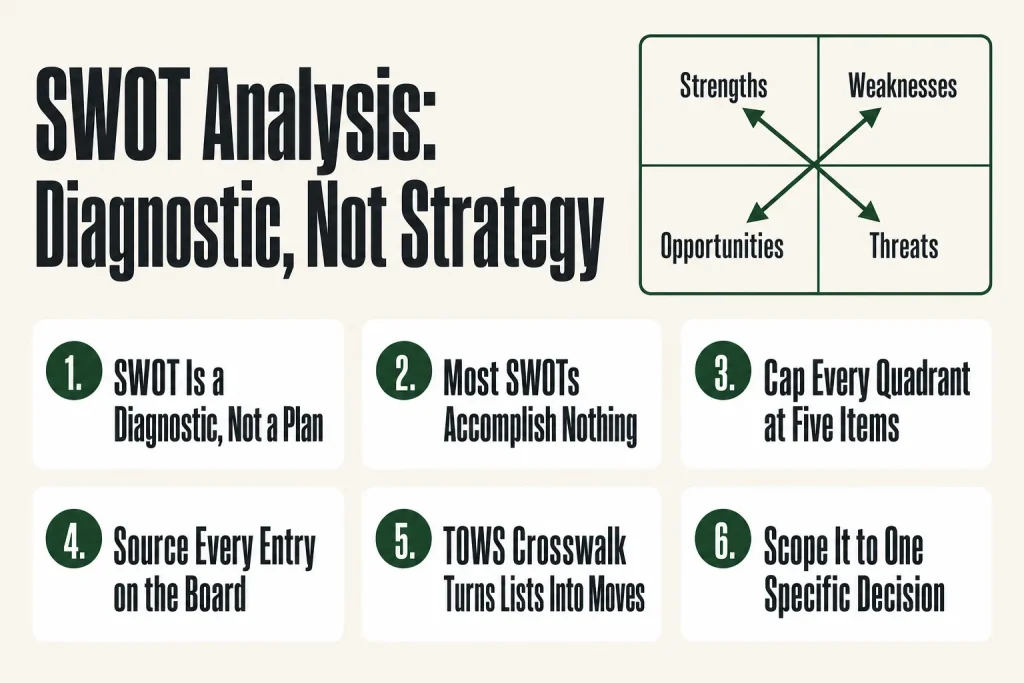
The framework itself is not complicated. Four quadrants, two internal (Strengths, Weaknesses), two external (Opportunities, Threats). You could explain it to someone in three minutes. The problem is that simplicity invites sloppiness. When something looks easy, people skip the hard part, which, in this case, is deciding what to do with what they found.
SWOT has been taught in every MBA program for decades, assigned in every undergraduate strategy course, and deployed in boardrooms and back offices and corner-table planning sessions the world over. And a remarkable share of those exercises end the same way: a list that is too long, too vague, and never consulted again. That’s not a critique of the concept. It’s a critique of how most people run it. Done right, with tight inputs, honest answers, and a commitment to letting the analysis actually change something, it’s one of the most useful two hours you can spend on your business.
The idea in 30 seconds
- SWOT stands for Strengths, Weaknesses, Opportunities, and Threats. Strengths and weaknesses are internal; opportunities and threats come from outside.
- The framework grew out of corporate planning research at the Stanford Research Institute in the 1960s. The acronym evolved from an earlier framework called SOFT analysis. The exact chain of authorship is genuinely contested in the academic literature, with the 2023 Puyt, Lie, and Wilderom study in Long Range Planning tracing it most carefully to Robert F. Stewart’s team.
- It’s a diagnostic, not a strategy. The list you produce is raw material, the decisions you make with it are the actual work.
- The most common failure mode: 40-item lists that sit in a folder and never inform a single choice. Hill and Westbrook documented exactly this in their 1997 paper in Long Range Planning.
- The fix is to run a tight SWOT (five items per quadrant, maximum), pair the results using the TOWS approach, and attach each insight to a specific action with an owner and a date.
- By the end of this page, you’ll know how to run a SWOT that produces at least one clear decision, and how to spot the version that produces nothing but a filled-in box.
Where SWOT Came From (the Short Version)
The version of history most people repeat goes like this: Albert Humphrey, a management consultant at the Stanford Research Institute, invented SWOT in the 1960s. That story is partly right and mostly folklore.
What Humphrey himself wrote, in a paper published posthumously in the SRI Alumni Association Newsletter in December 2005, is more careful. He described SWOT as the product of team research at SRI between 1960 and 1970, naming Marion Dosher, Dr. Otis Benepe, Robert Stewart, Birger Lie, and himself. The original framework was called SOFT, not SWOT. SOFT stood for Satisfactory, Opportunity, Fault, and Threat. The name change to SWOT appears to have happened at a 1964 Zurich seminar.
Puyt, Lie, and Wilderom’s 2023 paper in Long Range Planning (Vol. 56, No. 3, Article 102304) went further, using primary archival sources to trace the technique specifically to Robert F. Stewart’s team at the SRI’s Long Range Planning Service. Their conclusion: SWOT’s originator was Stewart, not Humphrey, and the common crediting of Humphrey as sole inventor is, in the words of the 2023 paper, an origin story that the available evidence doesn’t fully support.
That’s enough history for practice. The tool was built to give planning teams a shared language for diagnosing their position before deciding on direction. Somewhere between SRI and the average small-business planning meeting, it got reduced to a wall exercise with sticky notes and no follow-through. That’s the actual problem worth solving.
The Four Quadrants: What They Actually Mean
The framework divides into two axes. The internal axis covers what your business controls directly. The external axis covers what the market, the competitive environment, regulation, technology, and economic conditions are doing around you. Each axis then splits into favorable and unfavorable. That gives you four cells.
Strengths
What your business does better than alternatives, in ways that actually matter to your customers. The operative phrase is “in ways that matter.” A lot of operators list things under Strengths that customers either don’t value or can’t distinguish from what a competitor offers.
The test: a good Strength is specific and verifiable. “We’re the only provider in a 30-mile radius certified to service Brand X equipment” is a strength. Something vague about being passionate or having a friendly team is not, unless you have review scores, referral rates, or repeat-purchase data to back it. Without that evidence, it’s self-regard dressed up as analysis.
Weaknesses
What your business does poorly or is structurally disadvantaged in, relative to what customers want or what competitors offer. This is where most people get dishonest. Hill and Westbrook’s 1997 paper in Long Range Planning documented that typical SWOTs produce padded Strengths and minimized Weaknesses, people overstock the top-left quadrant and tiptoe around the bottom-left. That makes the analysis feel good and do nothing.
Useful Weaknesses are things that cost you revenue or customers right now. Cash flow volatility. Owner-dependency on key relationships. No process for following up with past customers. If a competitor showed your SWOT to a prospect, the Weaknesses section is where you’d wince. That’s the bar.
Opportunities
External conditions that could work in your favor if you positioned or invested to capture them. The key word is external, Opportunities come from shifts in the market, not from your own potential. “We could get better at social media” is not an Opportunity; it’s a potential response to one. The Opportunity might be: “There are 15,000 searches per month in our metro for a service nobody near us is positioning around.” The distinction matters because one requires self-reflection and the other requires watching your environment.
Threats
External conditions that could hurt the business if left unaddressed. New competitors entering your niche. A platform you depend on changing its algorithm or pricing. A regulatory shift that changes your cost structure. A demographic trend that is slowly shrinking your core customer base. Good Threats are specific and near-term enough to do something about. Vague macro-fears like “economic uncertainty” belong on no one’s list, they’re too broad to inform any decision.
What SWOT Was Solving For (and Why That Still Matters)
The research at SRI that produced SOFT, and later SWOT, started from a pointed question: why does corporate planning fail? The finding, simplified: big companies had elaborate planning documents that departments then ignored. The plans failed not because the analysis was wrong but because the people executing them never owned the diagnosis. SWOT was designed partly as a team exercise, a way to get a management group to look at the same picture and agree on what it showed, so that the resulting strategy had shared buy-in rather than being handed down from a consultant’s report.
The framework gained traction because it provided an accessible way to organize strategic information without requiring specialized analytical training. You don’t need an MBA to fill in four boxes. You do need judgment, honesty, and a willingness to follow through. That accessibility is a feature, not a bug, but it’s also what makes the tool easy to abuse. When the bar to entry is a whiteboard and 90 minutes, people treat it as a checkbox rather than a conversation that’s supposed to change something.
For a small-business operator, the core value is still the same as it was in the 1960s: getting your whole team, even if that’s three people, to agree on what your position actually is before you spend money or make commitments. A shared diagnosis is worth more than a perfect plan that only you believe.
What the Research Actually Found: Why Most SWOTs Accomplish Nothing
In 1997, Terry Hill and Roy Westbrook published “SWOT Analysis: It’s Time for a Product Recall” in Long Range Planning (Vol. 30, No. 1, pp. 46 to 52). The title was deliberate. They reviewed SWOT use across 20 UK manufacturing companies, drawn from a larger pool of 50 that had participated in a Manufacturing Planning and Implementation scheme, and found consistent patterns: overly long lists, generalized and often meaningless descriptions, no prioritization, and no attempt to verify any of the entries.
The most damning finding wasn’t the lists themselves. Hill and Westbrook found that in only three of the twenty companies did the SWOT output get used in any subsequent stage of the planning process. All the applications showed similar characteristics: lists averaging over 40 factors, general descriptions, no prioritization, and no verification of any points.
Hill and Westbrook’s recommendation was not to abolish SWOT but to redesign how it’s run so that it actually drives decisions. That paper was published nearly three decades ago. The pattern it described is still the dominant one. Walk into most planning meetings today and you’ll find the same 40-item lists going nowhere.
The academic literature has consistently identified the same cluster of problems: lack of temporal perspective, absence of factor prioritization, and lack of action orientation. These criticisms connect at three levels, ambiguity in identifying what constitutes a factor to include; absence of shared criteria for assigning factors to the four categories; and the predominance of description over explanation, resulting in a weak connection between identified factors and what actually happens next.
None of this means SWOT is useless. It means the typical execution is useless. The tool is fine. The ritual around it is broken.
Putting this to work? The ideas in the Canon are the foundation under the tactical playbook in Build a Complete Marketing Department. Grab the free companion kit at mmsvegas.com/resources.
How to Run a swot analysis That Actually Produces a Decision
The version that works looks different from the version most people run. Here’s what distinguishes one from the other.
Start with a question, not a template
A SWOT run against “the whole business” tends to sprawl and produce nothing actionable. A SWOT run against a specific decision, should we add a second location, should we enter the commercial market, should we kill this service line, stays focused. Before you open the four boxes, write the decision you’re trying to make at the top of the page. Every item you add should be relevant to that decision. If it’s not, it doesn’t belong.
Cap each quadrant at five items
This is a constraint, not a suggestion. Five items forces prioritization. It forces you to ask: out of everything we could list here, what actually matters most? Three to five concrete items per quadrant beat ten generic ones. If you have 15 candidates for Weaknesses and need to pick five, you’ve already done useful analytical work. The act of choosing is part of the exercise.
Source every item
Each entry in your SWOT should trace back to something observable. Customer reviews, revenue data, lost-sale notes, a competitor’s pricing page, a trend report from your trade association. Hill and Westbrook found that practitioners commonly do not verify factors with primary data, and that’s exactly why SWOT lists tend to reflect the room’s collective opinions rather than what’s actually happening. A claimed strength needs a referral rate or a review score behind it. “A new competitor entered the market” needs a name and an observed impact, not a general anxiety.
Distinguish between what is and what could be
Opportunities are things happening in your external environment right now that you could exploit. They are not aspirations. “We could build a referral program” is an internal initiative, not an Opportunity. The Opportunity might be: “There are 400 businesses in our metro that use our category of service and have no established vendor relationship.” Get the distinction right or your four boxes will blend into each other and you’ll have a confused list rather than a useful map.
Use the TOWS crosswalk to generate specific moves
Heinz Weihrich introduced the TOWS matrix in his 1982 paper “The TOWS Matrix: A Tool for Situational Analysis,” published in Long Range Planning (Vol. 15, No. 2, pp. 54 to 66). The name TOWS is simply SWOT reversed, a deliberate choice by Weihrich to signal that the framework starts from the external environment and works inward. His goal was to give practitioners a structured way to generate strategies from SWOT data rather than stopping at the analysis stage.
The TOWS crosswalk pairs internal and external factors to generate specific moves: SO strategies use strengths to seize opportunities; WO strategies overcome weaknesses by taking advantage of opportunities; ST strategies use strengths to reduce exposure to threats; and WT strategies minimize weaknesses while avoiding threats.
In practice, you don’t need to build a formal TOWS matrix. You need to ask four questions after your SWOT is complete: Which strengths can we use to pursue which opportunities? Which weaknesses, if fixed, would open up which opportunities? Which strengths can defend against which threats? Which combinations of weakness and threat require an immediate defensive move? Answer those four questions with specific actions, attach a name and a date to each, and you’ve done what most SWOT exercises never do.
Revisit it
A SWOT is a snapshot. Weihrich explicitly proposed repeating the analysis across time periods because the factors move. Run one at the start of a planning cycle, not once every five years. For most small operators, once a year with a mid-year check is about right. Markets move. What was an Opportunity in January can be a Threat by August if a competitor gets there first.
Where a SWOT Analysis Still Earns Its Place
The right use cases for SWOT are ones where the goal is shared situational awareness rather than deep quantitative analysis. Here’s where it still makes sense.
Before a major commitment
Opening a new location, hiring your first full-time salesperson, launching a new service line, entering a new geographic market. Any decision that involves significant irreversible cost benefits from a structured look at what you’re bringing to the table, where you’re thin, what the external conditions look like, and what could go wrong. SWOT doesn’t replace a financial model for that decision, but it surfaces the qualitative context a model might not capture.
Onboarding a new leadership team member
When someone new joins at a senior level, a partner, an operations manager, a head of sales, running a SWOT together accelerates their orientation and surfaces your own assumptions. You often learn things about your own business by watching what a smart outsider lists as a weakness that you’d quietly normalized.
Annual planning as a conversation-starter
Not as the planning document itself, but as the opening move. What changed this year in the market? What do we know now about our own operations that we didn’t know twelve months ago? A SWOT at the start of a planning conversation keeps it grounded in reality before you get into goal-setting, which otherwise tends toward optimism untethered from facts.
Competitive response
A new competitor enters your market, or an existing one makes a significant move. A quick SWOT specifically scoped to that competitive dynamic, what do we have that they don’t, where are we exposed, what opening does their move create for us, gives you a structured way to think through your response rather than reacting on instinct.
Where It Doesn’t Work and Shouldn’t Be the Tool You Reach For
SWOT is not an all-purpose planning instrument. There are situations where it’s the wrong tool, and using it anyway produces false comfort rather than useful insight.
As a substitute for market research
If you don’t actually know your competitive landscape, your customer’s real alternatives, or the demand trends in your market, running a SWOT will produce a list of your team’s assumptions, not a diagnosis of your position. The “Opportunities” quadrant especially suffers from this: without real data about what’s happening in the market, it fills up with hopes dressed as analysis. SWOT summarizes what you know. It doesn’t replace the work of going and finding things out.
For dynamic, fast-moving decisions
SWOT has been criticized for its static nature, which can limit its usefulness when market conditions are shifting quickly. When you’re making a decision that needs to be made in days rather than weeks, a SWOT session is probably slower than the problem. In a fast-moving situation, you’re better served by a focused competitive intelligence scan and a quick scenario analysis than by a formal four-box exercise.
As a performance diagnosis
SWOT doesn’t tell you why something is happening. If sales are down, a SWOT might surface “competition increased” or “our sales process is weak” as factors, but it won’t trace the actual cause. For operational diagnosis, figuring out why your acquisition cost is rising, why your churn rate is up, why a particular service line isn’t hitting margin, you need data-first tools, not a qualitative brainstorm.
As a substitute for making a decision
This is the trap most operators fall into. The SWOT gets run, the boxes get filled in, everyone nods, and then everyone goes back to what they were doing. Hill and Westbrook found this in their 1997 study: in only three of the twenty companies they reviewed was the SWOT output used in subsequent stages of the strategy process. If your SWOT doesn’t produce at least one specific commitment, one person, one action, one deadline, it probably wasn’t worth the time.
What People Get Wrong About the SWOT Analysis Conceptually
These are misunderstandings about what SWOT isnot just bad execution.
Mistaking it for strategy
SWOT is a diagnostic, not a strategy. The list tells you where you stand. The decisions you make in response to that understanding are the strategy. Calling a completed SWOT a “strategic plan” is like calling a blood panel a treatment plan. It’s necessary input, not output. TOWS, the crosswalk Weihrich set out in his 1982 Long Range Planning paper, is the step that turns input into options. SWOT without TOWS is a list waiting for a plan that may never arrive.
Treating internal and external as obvious categories
The internal/external distinction matters and trips people up more than you’d expect. “Our pricing is too high”, is that internal (your cost structure forces it) or a reflection of an external condition (the market won’t bear your price)? “Platform algorithm changes hurt our reach”, that’s external. “We haven’t diversified our marketing channels”, that’s internal. Getting this right matters because the two categories call for different types of responses. External conditions require positioning and adaptation. Internal weaknesses require operational change.
Assuming Opportunities are inherently good
An Opportunity is only worth pursuing if your specific business can credibly capture it. A market trend that benefits well-capitalized national chains is not necessarily an opportunity for a local operator. Run every entry in your Opportunities quadrant through one filter: given our specific Strengths and Weaknesses as listed, can we realistically act on this within a reasonable timeframe? If the answer is no, it’s market context, not an opportunity.
Thinking more factors means more insight
More items in each quadrant does not mean a more thorough analysis. It usually means less prioritization and therefore less usability. Hill and Westbrook found that the SWOT analyses they reviewed averaged over 40 factors, with no prioritization or verification. A short, honest, well-sourced SWOT beats a sprawling one that nobody can act on. If you can’t read your five Weaknesses out loud and immediately connect each one to a business consequence, the list is too long or too vague.
Running it alone
SWOT was designed as a team exercise. Part of its value is surfacing disagreement about the business’s position. If you run one by yourself and fill in the boxes with your own views, you’ve produced a document of your existing beliefs, not a diagnosis. At minimum, include one person close to customers, a frontline employee, a trusted client, an advisor, whose perspective will challenge your own.
Common Mistakes
- Starting the session without a focal decision written at the top of the page. Before anyone fills in a box, write the specific decision you’re trying to make at the top, “Should we add a second location” or “Should we move into commercial accounts.” Then cut any item that doesn’t bear on that question. The most common sign this step was skipped: a Strengths list that includes things like company culture and office location alongside pricing power and certification status, with no visible logic connecting them to anything.
- Letting unverified assertions stay on the board. Before the session ends, require a one-line source for every entry: a named competitor’s move, a customer review score, a revenue figure, a trade association report. Items without a source go to a “proposed” list to be verified before anyone acts on them. Hill and Westbrook found no verification was done on any item across the companies they studied, that’s the standard you’re beating, and it’s a low bar.
- Ending the session when the four boxes are full. Reserve the last 20 minutes for the TOWS crosswalk. Pair Strengths against Opportunities and ask: what’s one specific move this combination suggests? Pair Weaknesses against Threats and ask: what’s the minimum defensive action if this collision worsens? Write each answer on a separate sheet with a name and a deadline attached. Without this step, the boxes are inventory. Inventory doesn’t make decisions.
- Including only leadership in the room. Add at least one person with daily customer contact before the session, a frontline employee, a service tech, an account manager. Owners and managers normalize weaknesses over time; people in daily contact with customers often notice the ones that hurt most. If the first time you hear a customer complaint is during a SWOT session, the right person wasn’t in the room.
- Filing the output and never returning to it. Schedule a 30-minute review 90 days out at the close of the session, while everyone is still in the room. The Opportunity you documented in January may be captured by a competitor by April. A SWOT that never gets revisited is a time-stamped record of a moment that no longer exists, not a living planning tool.
Operator’s Take
The ROI rating on this page is a 3 out of 5, and I want to explain that number specifically, because it’s not a knock on the framework. It’s a knock on how the framework gets used in practice, and what you can actually do about it.
A 3 reflects what happens when operators treat SWOT as the destination rather than the starting point. You spend 90 minutes in a room, the boxes fill up, everyone feels productive, and then nothing changes. That’s not hypothetical, it’s what Hill and Westbrook documented in 1997, and it’s still the modal outcome. The rating would be a 4 if you do two things the average operator doesn’t: scope it tightly before the session starts, and run the TOWS crosswalk before anyone leaves the room. Miss either one, and you’re back to a 3.
Here’s what that actually looks like in practice. Say you’re a 12-person HVAC company deciding whether to pursue commercial maintenance contracts. That’s your focal question. Everything that goes on the board has to connect to that decision. A vague Strength like “great customer service” doesn’t earn its spot, your average residential review score or your contract renewal rate does. A generic Threat like “economic uncertainty” doesn’t belong, a named competitor who just hired a commercial sales rep and underbid your last two proposals does. The specificity requirement isn’t pedantic. It’s what separates a useful list from one that feels complete but tells you nothing you can act on.
The TOWS crosswalk is where I see the biggest gap in practice. Most operators end the session when the four boxes are full. That’s exactly the wrong stopping point. The boxes are inputs. The question you’re actually there to answer, do we go after commercial accounts or not, gets answered in the crosswalk. Your Strength in service reliability maps against the Opportunity that commercial clients have longer average contract lengths than residential. Your Weakness in having no commercial sales experience maps against the Threat that the new competitor does. Those two pairings alone probably tell you more about whether to make the move than a month of informal deliberation would.
One more thing. AI can meaningfully cut the research burden on the external half of the SWOT. Pulling together competitor positioning, local market demand signals, and industry trend data used to take hours of manual work before a session. Now it takes considerably less. That doesn’t change what belongs on the board, you still need to verify everything and make the judgment calls yourself, but it does mean the Opportunities and Threats quadrants can be grounded in actual market data rather than whatever the room happens to remember. The diagnosis stays yours. The research load doesn’t have to be.
Used in
- ✓ Build a Complete Marketing Department
Used as the opening diagnostic before choosing positioning, channel priorities, and offer structure, the SWOT surfaces the constraints and advantages that govern every downstream marketing decision. - ✓ The Missing Manual for FunnelKit
Applied when auditing an existing funnel to identify internal execution gaps (Weaknesses) and external conversion opportunities before rebuilding or optimizing flows. - ✓ The Missing Manual for Make
Referenced when scoping automation priorities, the Weaknesses quadrant often reveals the manual bottlenecks that automation should address first.
FAQ
How long should a SWOT analysis take?
For a small-business operator, 60 to 90 minutes is enough if you come in with pre-gathered data and a specific question to answer. The time isn’t the problem, it’s what you do with the output afterward. A three-hour SWOT that produces no decisions is worse than a 45-minute one that produces two.
What is the difference between a SWOT and a TOWS matrix?
A SWOT lists your four categories. A TOWS, introduced by Heinz Weihrich in his 1982 paper ‘The TOWS Matrix: A Tool for Situational Analysis’ in Long Range Planning, pairs them systematically, Strengths against Opportunities, Weaknesses against Opportunities, and so on, to generate specific strategic moves. SWOT is the input; TOWS is the step that turns it into decisions.
Should I run a SWOT on my whole business or just a specific initiative?
Scoping it to a specific decision almost always produces more useful output. ‘Should we expand into commercial accounts’ or ‘should we add a second location’ gives every entry a relevance filter. Business-wide SWOTs sprawl and lose focus quickly.
How often should a small business run a SWOT analysis?
Once a year as an orientation exercise, with a targeted one whenever you’re facing a significant decision or a material change in your competitive environment. Market conditions can shift faster than an annual cycle, so treat it as a tool you pick up when needed, not a scheduled ritual.
What’s the most common reason a SWOT analysis produces nothing useful?
The list never gets converted into a specific commitment. Hill and Westbrook, in their 1997 paper in Long Range Planning, found that in only three of the twenty companies they studied was the SWOT output used in any subsequent decision-making stage. The fix is to close every session with at least one named action, one owner, and one deadline.
Can AI help with a SWOT analysis?
AI can help you gather external data, competitive information, market trends, industry research, that makes your Opportunities and Threats quadrants more grounded and less speculative. It can also prompt you to consider angles you might overlook. The judgment calls about what belongs in each quadrant and what to do about it still sit with you; AI cuts the research load, not the thinking.
Did Albert Humphrey invent SWOT analysis?
He was a key contributor, but not the sole inventor. In a paper published posthumously in the SRI Alumni Association Newsletter in December 2005, Humphrey described SWOT as coming from team research at SRI between 1960 and 1970, naming four colleagues alongside himself. Puyt, Lie, and Wilderom’s 2023 study in Long Range Planning (Vol. 56, No. 3, Article 102304) traced the technique specifically to Robert F. Stewart’s team at SRI and identified Stewart as the originator. The acronym itself evolved from an earlier framework Humphrey’s group called SOFT analysis, and the name change to SWOT appears to have happened at a 1964 Zurich seminar. Humphrey is fairly credited as a central figure; crediting him as the sole originator goes beyond what the evidence supports.
Further reading
- Hill, T. and Westbrook, R. (1997). “SWOT Analysis: It’s Time for a Product Recall.” Long Range Planning30(1), pp. 46 to 52. The paper that documented what most SWOT sessions actually produce versus what they’re supposed to. Reading it once changes how you run every future planning session.
- Weihrich, H. (1982). “The TOWS Matrix: A Tool for Situational Analysis.” Long Range Planning15(2), pp. 54 to 66. The original paper introducing the TOWS crosswalk, the step that converts a SWOT list into strategic options. Short and readable.
- Puyt, R.W. Lie, F.B. and Wilderom, C.P.M. (2023). “The Origins of SWOT Analysis.” Long Range Planning56(3), 102304. The most thorough peer-reviewed reconstruction of how SOFT became SWOT, using primary sources from the SRI archive. Useful if you want the actual history rather than the folklore version.
- Andrews, K. (1971). The Concept of Corporate Strategy. Dow Jones-Irwin. Helped formalize the internal/external diagnostic distinction that underpins SWOT. Useful context if you want to understand where the framework sits within the broader history of strategy thinking.
Sources: Origin and history: Albert S. Humphrey, ‘SWOT Analysis for Management Consulting,’ SRI Alumni Association Newsletter, December 2005 (primary source, posthumously published). Historical reconstruction: Puyt, R.W. Lie, F.B. and Wilderom, C.P.M. (2023), ‘The Origins of SWOT Analysis,’ Long Range Planning, 56(3), 102304, peer-reviewed; traced the SOFT-to-SWOT evolution using primary SRI archival sources and identified Robert F. Stewart as originator. Academic critique: Terry Hill and Roy Westbrook, ‘SWOT Analysis: It’s Time for a Product Recall,’ Long Range Planning, Vol. 30, No. 1, February 1997, pp. 46 to 52. TOWS Matrix: Heinz Weihrich, ‘The TOWS Matrix: A Tool for Situational Analysis,’ Long Range Planning, 15(2), 1982, pp. 54 to 66. Valentin, E.K. (2001), ‘SWOT Analysis from a Resource-Based View,’ Journal of Marketing Theory and Practice (referenced for the 2001 academic critique; venue confirmed from secondary citations). No proprietary vendor statistics cited.
Brian Kasday spent forty years in direct-response marketing before rebuilding the whole operation as a one-person shop. He writes The Operator’s Library — including “Build a Complete Marketing Department” — for operators who’d rather build it themselves than wait on someone else.
Build the department these ideas describe. The free companion kit: mmsvegas.com/resources.
More The Operator's Canon guides
Free · Operator Toolkit
Want the tools, not just the guide?
Get the free operator toolkit — templates and checklists for the systems you actually run, plus a note when this guide changes.
Get the free toolkit →