
Last updated: July 2026
Jobs to be done is the idea that your customers aren’t really buying your product, they’re hiring it to make progress on something that matters to them. By the end of this page, you’ll be able to run a five-person interview sprint that reveals the real job your business is being hired for, and use that insight to rewrite your positioning, your ads, and your offer in language that actually connects.
Here’s the uncomfortable part: most operators describe their business in terms of what they sell. The website says ‘premium landscaping services’ or ‘fast, reliable bookkeeping.’ The customer isn’t thinking in those terms at all. They’re thinking about the fight they had with their last landscaper, or the anxiety spike they get every April when tax season hits. They have a job, a specific struggle in a specific moment, and they’re looking for something to hire that will resolve it. Your product is either in the running or it isn’t, and that depends almost entirely on whether your message speaks to their job or your own résumé.
That gap is what jobs to be done closes. It sounds deceptively simple. It isn’t, because the job customers tell you about and the job that actually drove the purchase are often two different things entirely.
The idea in 30 seconds
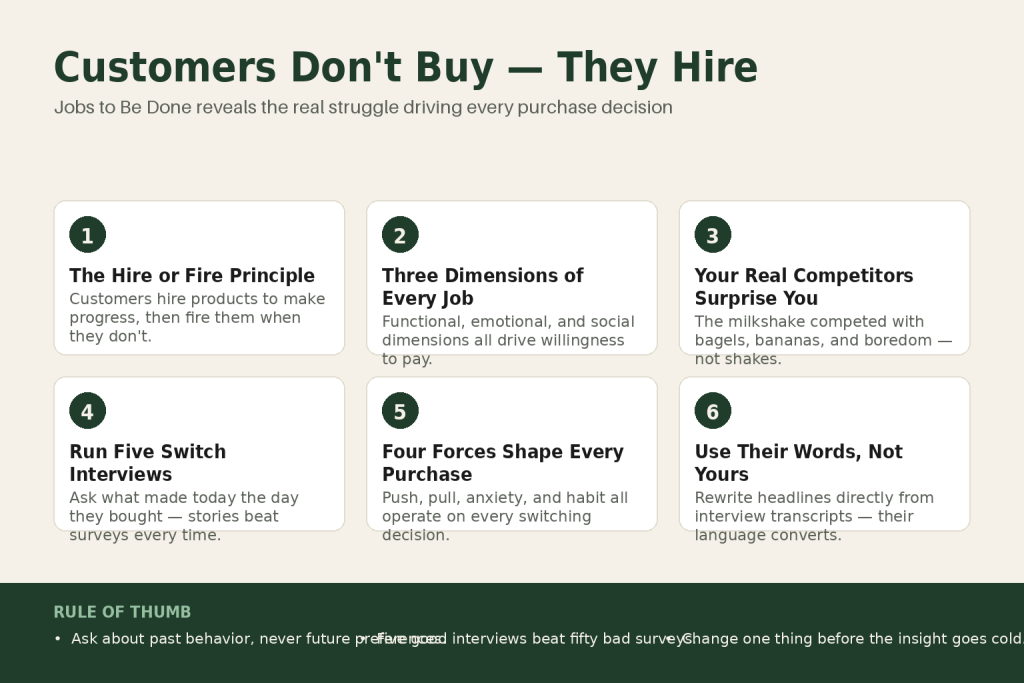
- Customers don’t buy your product, they hire it to accomplish a specific job in their life or work. When it stops doing that job well, they fire it.
- Every job has three dimensions: functional (what it does), emotional (how it makes them feel), and social (how it makes them look). Operators who only pitch the functional dimension leave money on the table.
- Your real competitors aren’t who you think they are. The milkshake competed with bagels, bananas, and boredom, not other shakes.
- The fastest way to find the job is to interview 5 to 10 recent buyers using the switch interview: ask what caused them to act that specific daynot what they generically like about you.
- Once you know the job, rewrite your messaging around it, the situation, the struggle, and the outcome, not your features.
- AI tools can help you synthesize interview transcripts and spot job patterns fast, but the interviews themselves still require a human on the phone.
Where Jobs to Be Done Came From
The underlying intuition goes back decades. Theodore Levitt made it plain in his 1960 Harvard Business Review essay ‘Marketing Myopia’: people don’t want a quarter-inch drill, they want a quarter-inch hole. Customers seek outcomes, not objects. That wasn’t new when Levitt wrote it, and it wasn’t new when Clayton Christensen and Bob Moesta picked it up.
What they added, beginning with the milkshake research they conducted together in the mid-1990s, was a verb and a repeatable protocol. The verb was hire. The milkshake study, in which standing in a parking lot and watching actual behavior revealed that morning commuters weren’t competing against other milkshakes but against bagels, bananas, and boredom, became the framework’s most famous illustration. Christensen first put the hire/fire framing in print in his 2005 Harvard Business Review article ‘The Cause and the Cure of Marketing Malpractice,’ and the full theory reached its complete articulation in the 2016 book Competing Against Luckco-written with Taddy Hall, Karen Dillon, and David Duncan.
Tony Ulwick was building parallel ideas through Outcome-Driven Innovation, a more quantitative lens on essentially the same territory. The two camps have disputed credit ever since, which is mostly useful as a reminder that JTBD is not a clean, single-origin story. What Christensen’s popularization contributed was the hiring metaphor, a memorable case, and an interview protocol practical enough to use outside a research lab.
The Core of Jobs to Be Done: What the Idea Actually Says
The framework rests on a few ideas that sound obvious until you try to apply them, at which point they get difficult in useful ways.
Customers hire products to make progress
Every purchase is a decision to hire something to resolve a struggle or reach a better state. When someone hires your product and it does the job well, they hire it again. When it doesn’t, they fire it and look for something else. This framing matters because it reorients the whole question of competition. You’re not just competing with other businesses that sell what you sell. You’re competing with every solution the customer might hire for the same job, including doing nothing, DIY-ing it, or hiring a person instead of a product.
The job is circumstance-based, not demographic-based
This is where most operators’ market research goes wrong. Standard segmentation groups customers by who they are, age, income, industry, location. Jobs theory groups them by what they’re trying to do in a specific moment. The same person might hire a meal-kit service for ‘impress a date with a home-cooked dinner’ one week and for ‘avoid thinking about dinner on a Tuesday’ the next. Same customer. Completely different job. The circumstances drive the decision, not the demographic profile.
Every job has three dimensions
Fully understanding a job means understanding its functional, emotional, and social dimensions, and the trade-offs a customer is willing to make between them. The functional dimension is the practical task: get through the commute without being hungry. The emotional dimension is how they want to feel: not anxious, not bored, slightly rewarded. The social dimension is how they want to be perceived: as someone competent, as a good parent, as a professional who has it together.
Jobs that look purely functional almost always have emotional and social layers driving the actual decision. Those layers often matter more than the function itself when it comes to willingness to pay and loyalty. Operators who stop at the functional job are leaving the most persuasive part of the story on the table.
Competitors are anything hired for the same job
From a jobs-theory perspective, your competitors aren’t the companies that build a similar product. They’re any solution being used to get the same job done. A bookkeeper’s real competition isn’t just other bookkeepers, it’s the owner doing it themselves on Sunday nights, a spouse with a spreadsheet, a software subscription that makes hiring a human feel unnecessary. If you only benchmark yourself against direct category competitors, you’re missing most of the competitive picture.
The job is stable; the product that does it changes
This is Christensen’s clearest strategic point: jobs persist even as products get disrupted. People have needed a way to ‘be entertained during a commute’ for decades. The product hired for that job went from a newspaper to a cassette player to an iPod to a podcast. The job didn’t change. If you define your business by the job rather than the product, you get early warning when a new solution is about to fire you.
The Switch Interview: How Operators Actually Find the Job
Knowing the theory is not the same as knowing your job. The way you find out what job your customers are actually hiring you for is through a specific kind of conversation, not a survey, not a focus group, not a Net Promoter Score. An interview.
Bob Moesta has argued that the single greatest step you can take is to talk to someone who recently purchased you, and to someone who recently quit you. Those switching moments, toward you and away from you, pull a thread that reveals the real causal structure of demand.
The key distinction from standard customer research: you’re asking about a specific event in the past, not about opinions in the present. ‘What made today the day you decided to buy?’ is a more useful question than ‘What do you value in a service like ours?’ The first forces the customer to reconstruct the actual moment of decision, the context, the frustration, the trigger, the hesitation. Opinions are post-hoc rationalizations. Stories are data.
The four forces every switch interview is looking for
Moesta describes four forces that operate on any purchasing decision:
- Pushthe frustration or dissatisfaction with the current situation that made the customer start looking. Something had to get bad enough, or urgent enough, to create motion.
- Pullthe attraction of the new solution. What made yours seem like it might get the job done better?
- Anxietythe worry that the new solution might not work, might be too expensive, might be too complicated. This is the force that stalls purchases and causes cart abandonment.
- Habitthe inertia of the existing solution. ‘The old thing was annoying but at least I knew how to use it.’ This is often the hardest force to overcome and one most operators never address in their messaging.
A good switch interview surfaces all four. When you hear the same push-pull-anxiety-habit pattern across five or six customers, you’ve found a job. That pattern is what goes into your messaging, your offer design, and your onboarding, not your best guesses about what customers want.
Your five-interview sprint
You don’t need a research department to do this. Call five recent customers, ideally people who bought within the last three months, while the memory is still fresh. Spend forty-five minutes each. Ask them to walk you through the period before they hired you: what was happening, what triggered them to start looking, what else they considered, what almost stopped them from buying, and what they were hoping would be different afterward. Then stop talking and listen.
Don’t ask leading questions. Don’t ask what they’d like to see improved. Don’t ask what they think of your competitors. Just ask them to tell you the story of that decision. The job lives in that story.
After five interviews, you’ll start hearing patterns in the language, specific words, specific situations, specific moments of frustration. Write your next homepage headline, your next ad, your next email subject line in that language. Not yours, theirs.
AI can help you move faster here. Record the calls with permission, transcribe them, and run the transcripts through an AI tool to identify recurring phrases, emotional triggers, and switching moments. The synthesis that used to take a consultant a week can happen in an afternoon. But the interviews themselves, the phone calls, the listening, the follow-up when something interesting surfaces, still need you. The judgment about what’s signal versus noise stays with the operator.
Why Jobs to Be Done Works When Demographics Don’t
Standard market research asks customers what they want. The problem is that customers are often wrong about themselves, not maliciously, but because they don’t have conscious access to the actual drivers of their behavior. They say they bought a gym membership because they want to get fit. They actually hired it to feel less guilty about a recent health scare and to have a social reason to leave the house on Tuesday mornings. Those are not the same job, and marketing to the first one while ignoring the second produces ads that look right but don’t convert.
Jobs theory sidesteps this by focusing on behavior, not stated preference. What did you actually do? When did you do it? What changed that made that day different from every other day you didn’t buy? You can’t lie your way through a behavioral timeline the way you can lie through a preference survey. The story self-corrects.
The other reason it works: it expands your competitive picture in genuinely useful ways. When you know the job, you know the full range of things your customer might hire instead of you. That tells you where to find them (they’re probably researching those alternatives), what objections to pre-empt (the anxieties about switching), and what story to tell (one that speaks to the push, not just the pull).
And it’s durable. Demographics shift as your customer base evolves. The job they’re hiring you for tends to be more stable, because it’s rooted in a human struggle that doesn’t change as fast as market segments do. A landscaping company that figures out its customers are hiring it primarily for ‘eliminate the source of arguments with my spouse about the yard’ has a positioning that can outlast any demographic trend.
Putting this to work? The ideas in the Canon are the foundation under the tactical playbook in Build a Complete Marketing Departmentgrab the free companion kit at mmsvegas.com/resources.
Jobs to Be Done in Practice: Named Examples Worth Studying
A few real cases make the idea concrete enough to apply.
Casper and the sleep category
According to Bob Moesta’s accounts of this JTBD work, including SaaS Club podcast episode 423 (2026), Casper’s real competitor wasn’t other mattress brands. It was ZzzQuil. Customers weren’t primarily shopping for a new mattress; they were desperate to fix a sleep quality problem and hiring whatever might help. Once Casper understood that the real job was ‘fix my sleep’ rather than ‘buy a better mattress,’ the messaging shifted to speak to that struggling moment directly. The team ran an ad asking, in effect, how many bottles of ZzzQuil you need to take before you realize you need a new mattress, and per Moesta’s reported figures, that single repositioned ad boosted sales 37%. The product didn’t change. The competitive frame did.
The condo developer and moving anxiety
Moesta has described this project in multiple primary-source accounts, including his Business of Software 2023 talk and a LinkedIn interview. A regional Detroit-area homebuilder was selling condos to empty-nesters who kept stalling at the point of decision. The push was there, the big house was too much to maintain, but switch interviews revealed what was blocking the purchase: not the condo itself, but decades of accumulated stuff that wouldn’t fit in a smaller space. The question ‘what do I do with all this?’ was stalling a $400,000 decision. Moesta added moving services and two years of complimentary storage to the offer. In his own words from the Business of Software 2023 talk: sales increased 22%. The product didn’t change. The resolved anxiety unlocked the hire.
InVideo’s pivot
InVideo, a video creation platform, had plateaued by 2022 despite healthy sign-up numbers. In a JTBD project with The Re-Wired Group, multiple distinct customer jobs emerged inside the product, and one was creating tension that stalled growth. Power users the team had been building for, experienced video editors who wanted complexity, kept churning. The real demand lived with beginners who needed to look professional fast, without a learning curve. By refocusing on that job, InVideo grew to $25 million in revenue, per The Re-Wired Group’s published case study. The product didn’t change dramatically. The job clarity did.
Intercom
Per The Re-Wired Group’s published case study, Intercom worked with Moesta’s team after three years of plateaued growth as an all-in-one platform. JTBD interviews identified distinct jobs customers were actually hiring them for, reshaping both product architecture and go-to-market approach. The Re-Wired Group reports Intercom achieved 500% growth in 18 months as a result. Intercom co-founder Des Traynor has said: ‘I can’t think of one area of our business Jobs-to-be-Done consultancy hasn’t improved.’
What this means for a small operator
You don’t need to be a venture-backed startup to apply any of this. A local HVAC company that interviews five recent customers and discovers people are hiring them primarily for ‘peace of mind that something expensive won’t break in August’, not ‘a maintenance check’, can rewrite its seasonal campaign around that job today. A bookkeeper who finds that clients are hiring her primarily for ‘not dreading tax time anymore’ rather than ‘accurate records’ can restructure her onboarding, her deliverables, and her pricing tier names around that emotional job. The insight is the same whether you’re Intercom or a two-person service firm in Nevada.
Where Jobs to Be Done Still Applies, and Applies Especially Well
Jobs theory is most powerful in a few specific situations that come up constantly for small operators.
When your conversion rate is lower than it should be. If people who should be buying aren’t, the most likely explanation is a mismatch between the job they’re trying to get done and the message you’re putting in front of them. The product might be right. The pitch is speaking to the wrong struggle.
When customers churn or go quiet after one purchase. Churn almost always means the job changed, or the product stopped doing it as well as something else. Interviewing churned customers with JTBD questions, specifically asking what happened, what changed, and what they hired instead, is more useful than any retention survey.
When you’re launching something new. Before you build, five switch interviews with people who currently solve the problem you’re targeting (imperfectly, with some other solution) will tell you more than months of market research. You’re looking for the struggling moment, the push that gets someone to act, and the anxiety that might stop them from hiring you even if they want to.
When your marketing feels like it’s about you instead of them. If your website talks primarily about your credentials, your process, your years of experience, but doesn’t speak to a specific struggle in a specific situation, you’re failing the jobs test. Jobs theory gives you the raw material to fix that.
When you’re entering a crowded market. If the category is already full of credible options, competing on features or price is a slow war of attrition. Finding an underserved job, a struggle that existing solutions handle badly, is how you create a wedge. That’s the entire logic of Christensen’s disruptive innovation theory applied at the operator level.
Where Jobs to Be Done Gets Oversold
Jobs theory doesn’t solve everything, and some operators apply it in ways that waste time.
It’s not a substitute for a viable business model. You can identify the job your customers hire you for with perfect clarity and still price yourself out of the market, underdeliver on the functional dimension, or build something so niche that there aren’t enough customers to sustain you. The job insight is an input, a powerful one, but it doesn’t do the whole job of running a business.
It’s less useful in pure commodity markets. If you’re selling gasoline at a highway exit, the job is obvious and undifferentiated, and knowing it doesn’t help much. Jobs theory earns its keep in markets where there’s real ambiguity about why customers choose what they choose, which, to be fair, includes most service businesses and most products with a meaningful price tag.
The interviews take real time and real skill. Five well-conducted switch interviews will tell you more than fifty bad ones. And bad ones are easy to conduct: you ask leading questions, you accept the first answer, you don’t probe the timeline, you let the customer give you preference data instead of behavioral data. The protocol matters. Rushing it produces noise that feels like signal.
Jobs theory can become an excuse to avoid hard product decisions. Some teams use JTBD research as a reason to keep iterating on messaging when the real problem is that the product is bad at the job. If seven out of ten interviews reveal that customers tried to use your service and it didn’t deliver the outcome they expected, no amount of job-aware messaging fixes that. The research tells you the job. It’s on you to actually do it.
Common Misunderstandings About Jobs to Be Done
Misunderstanding: ‘The job is just the benefit my product delivers.’ No. The job is the struggle the customer has before they meet you, in the specific circumstances that made them act. ‘Clean teeth’ is not a job. ‘Not being embarrassed at an important meeting because of my breath’ is closer. The job lives in the situation, not in your product’s feature set.
Misunderstanding: ‘I should ask customers what job they’re hiring me for.’ Don’t ask this directly. Most customers can’t answer it, they don’t think in those terms, and the question produces useless abstractions. You find the job by asking about the timeline of the decision: what happened before, what triggered the search, what almost stopped the purchase, what they were hoping would be different. The job emerges from the story.
Misunderstanding: ‘JTBD replaces customer personas.’ It doesn’t replace them, it makes them more useful. A persona that includes the job (the specific struggle, the trigger, the anxiety, the competing solutions considered) is far more actionable than a persona built on demographics and generic attitude statements.
Misunderstanding: ‘The job is always functional.’ This might be the most expensive misunderstanding, especially for service businesses. The functional job (get my taxes done) is often table stakes, all your credible competitors do that. The emotional and social dimensions of the job (feel like a competent adult, stop losing sleep over the IRS, look like someone who has their finances handled) are where differentiation actually lives. If your messaging only speaks to the functional job, you’re competing on capability in a market where most credible operators have similar capability.
Misunderstanding: ‘Five interviews isn’t enough data.’ For pattern recognition in your specific market, five to ten well-conducted switch interviews with recent buyers usually reveals the dominant jobs. You’re not trying to achieve statistical significance, you’re trying to find the recurring story. When you hear the same push, the same trigger, the same anxiety across multiple interviews, you’ve found something real. Fifteen mediocre surveys won’t tell you what five good conversations will.
Common Mistakes
- Asking forward-looking questions and calling it JTBD researchA marketing team ran eight switch interviews and walked away with a feature wish list, because every question they asked pointed forward: ‘What would you like to see improved?’ or ‘What would make this product better for you?’ Forward questions produce wish lists. Anchor every question to a specific past event instead. ‘Walk me through the two weeks before you bought’ produces a usable story. ‘What do you wish we did better’ produces noise dressed up as data. Before your first call, write out your question list and delete anything that isn’t about something that already happened.
- Writing a job statement that’s really just a feature descriptionA B2B software company ran solid switch interviews, synthesized the findings, and defined their dominant job as ‘get accurate reports fast.’ That’s a product spec, not a job. What their customers kept saying across six interviews, almost word for word, was ‘stop being the person in the room who doesn’t know their numbers.’ Same functional output. Completely different emotional weight, different copy, different objections to address in the sales process. The tell: if your job statement could appear in your product’s feature list, rewrite it. Use the format ‘When [specific situation], I need to [make progress] so I stop feeling [the fear or loss they named].’
- Completing the research and then letting it sit for three months before changing anythingThe most common JTBD failure isn’t bad interviews, it’s interviews that produce a deck and then go quiet while the operator waits for the ‘right moment’ to act. Patterns that felt urgent in week one feel obvious by week six and get rationalized away. The fix is to commit, before your first call, to one specific deliverable with a hard deadline. A rewritten homepage headline. A revised ad. A new onboarding email. Not a strategy document, one thing, with a date. The research has a short half-life. Change something while the interviews are still a little uncomfortable to sit with.
- Rewriting messaging only around the functional job and leaving conversion flatA home services company ran legitimate JTBD interviews, identified a clear job, and rewrote their seasonal HVAC campaign entirely around the functional angle: ‘fix your AC before summer.’ Conversion stayed flat. What the transcripts had actually surfaced, but the team had skimmed past, was a consistent emotional job: ‘not be the homeowner who lets something expensive fail because I didn’t stay on top of it.’ And a social dimension: ‘look responsible to my spouse.’ The functional claim got them into consideration. The emotional and social claims would have gotten them hired. If your rewritten messaging doesn’t touch at least one non-functional dimension, go back to the transcripts and look again.
- Defining your competitive set by category label and missing the real alternativesA business coach assumed her competition was other coaches. Switch interviews told a different story: most buyers had seriously considered three other paths first, a business book, a mastermind group, and grinding it out alone for another six months. Her existing sales page addressed none of those. Once she named them directly, and explained specifically why coaching solved what the others couldn’t, her conversion rate on discovery calls improved within the first month of changes. If your messaging doesn’t acknowledge the non-obvious things people seriously considered before hiring you, you’re leaving the most important objection unanswered.
Operator’s Take
Most operators who discover JTBD read about the milkshake study, nod enthusiastically, and then go back and write a website that leads with their fifteen years of experience and their commitment to quality service. The idea lands. The action doesn’t follow. So here are four places where operators actually move, and one place where the whole thing quietly goes sideways.
Start with the headline, not the job map. The highest-leverage move you can make with JTBD isn’t a positioning workshop or a customer journey canvas. It’s rewriting one sentence, the first thing a prospect reads, in language pulled directly from interview transcripts. ‘Tired of spending Sunday nights doing books you don’t understand?’ beats ‘Professional bookkeeping for small businesses’ not because it’s clever, but because it names the push that actually drove the hire. Your interviewees will hand you that line, usually by the second conversation. The job is already in their words. You’re just listening for it.
Address the habit force directly in your copy. Your customer’s existing solution, however mediocre, has comfort on its side. They know how it works. They’ve made peace with its flaws. Switch interviews will regularly surface that what’s blocking a sale isn’t doubt about your product, it’s the friction of leaving what they already have. That’s solvable. A single line that acknowledges the switching cost, something like ‘we handle the migration, you don’t touch a thing’, can do more work than three paragraphs of capability claims. Almost nobody puts this in their messaging. That’s your opening.
Use the job to find channels you’d never have thought to look at. When Moesta worked on that Detroit condo project, switch interviews kept surfacing the same push: a friend being forced to move alone after a spouse died. Once he heard it five times, he moved his advertising budget to the obituaries section of the local paper. Per his Business of Software 2023 talk, traffic increased 37% and cost dropped 70%. That’s not in any media-buying playbook. It came entirely from understanding the push, the specific moment that made people act. Run your interviews, find your push, then ask: where are people when that moment hits? That’s where your ad belongs.
Use AI to compress synthesis, not to replace the interviews. Record your calls with permission, transcribe them, and feed the transcripts to an AI tool with a prompt asking for recurring emotional phrases, specific triggers, and the anxieties that nearly killed each deal. What used to take a research firm a week now takes an afternoon. The calls themselves, the actual listening, the follow-up when something interesting surfaces, still need you. AI cuts the time you spend on pattern-matching. Your judgment about what matters stays where it belongs.
One place the framework reliably goes sideways: it becomes a research project that never produces a decision. Five interviews, one dominant job, one changed piece of messaging, that’s the sprint. If you’re on interview twelve and still building job maps before you’ve changed anything on the site, you’ve turned a practical tool into an intellectual hobby. Pick the job that showed up in three of your five conversations. Write to that one. Refine from there.
Used in
- ✓ Build a Complete Marketing Department
Used to define the customer’s real struggle before writing any positioning, offer, or campaign, the job interview findings feed directly into the messaging brief that governs all marketing output. - ✓ The Missing Manual for FunnelKit
Applied to landing page and headline decisions, knowing the specific job ensures each funnel stage speaks to the push, pull, and anxiety that drive the actual buying decision rather than generic category benefits. - ✓ The Missing Manual for Make
Used to prioritize which automations to build first, automating around the job (e.g. follow-up that addresses the switching anxiety) produces higher ROI than automating around internal convenience.
FAQ
What is jobs to be done in plain terms?
It’s the idea that customers don’t buy products, they hire them to make progress on a specific struggle in a specific situation. When the product does that job well, they keep hiring it. When it doesn’t, they fire it and look for something else.
How is jobs to be done different from standard customer research?
Standard research asks what customers want or prefer. Jobs theory asks what specific event caused them to act, what they considered instead, and what almost stopped the purchase. The first produces opinion data; the second produces behavioral data that reflects actual decision-making.
How many interviews do I need to find the job?
Five to ten well-conducted switch interviews with recent buyers is usually enough to identify the one or two dominant jobs in your market. You’re looking for recurring patterns in the story, not statistical significance, and a tight pattern typically emerges by the fifth conversation.
Can I use jobs to be done for a product business, not just services?
Yes, the original milkshake example is a product, not a service. Jobs theory applies anywhere a customer has a choice about what to hire. It’s especially powerful for products where the purchase category and the underlying job are different things, which is more common than most operators realize.
What’s the difference between a functional job and an emotional job?
The functional job is the practical task being accomplished, file my taxes, fix my HVAC, get through my commute. The emotional job is how the customer wants to feel after the job is done, less anxious, more competent, relieved, respected. Most service businesses compete on functional jobs while the emotional job is doing most of the decision-making work.
How does jobs to be done change my marketing copy?
It shifts the copy from describing your product’s features and credentials to naming the customer’s situation and struggle. Instead of ‘professional bookkeeping for small businesses,’ you write toward the specific moment of friction that drove the hiring decision. The language comes directly from interview transcripts, their words, not yours.
Further reading
- Competing Against LuckClayton Christensen, Taddy Hall, Karen Dillon, David Duncan (2016). The primary text on jobs theory; the milkshake case and the full theoretical framework are here.
- Demand-Side Sales 101Bob Moesta (2020). The switch interview protocol in detail, from the co-developer of the framework. Practical and fast to read.
- The Innovator’s DilemmaClayton Christensen (1997). The broader disruption theory that JTBD grew out of; useful context for understanding why knowing the job matters at a strategic level.
- ‘Marketing Myopia’Theodore Levitt, Harvard Business Review (1960). The intellectual ancestor of jobs theory; the drill-and-hole argument that shaped everything that followed.
- ‘The Cause and the Cure of Marketing Malpractice’Clayton Christensen, Harvard Business Review (2005). The first place Christensen put the hire/fire framing in print.
Sources: Clayton Christensen, Taddy Hall, Karen Dillon, David Duncan, Competing Against Luck (HarperBusiness, 2016); Clayton Christensen et al., ‘Know Your Customers’ Jobs to Be Done,’ Harvard Business Review (September 2016); Clayton Christensen, ‘The Cause and the Cure of Marketing Malpractice,’ Harvard Business Review (2005); Bob Moesta, Demand-Side Sales 101 (2020); The Re-Wired Group, InVideo JTBD case study, therewiredgroup.com/case-studies/invideo-jtbd/ (confirmed: $25M revenue figure); The Re-Wired Group, Intercom case study, therewiredgroup.com/case-studies/intercom/ (confirmed: 500% growth in 18 months; Des Traynor quote); The Re-Wired Group, Homebuilder case study, therewiredgroup.com/case-studies/homebuilder/; Bob Moesta, Business of Software Conference talk, ‘Understanding Your Customer Jobs-to-be-Done’ (BoSEU23, 2023), source for condo 22% sales increase and obituaries 37% traffic / 70% cost figures, quoted directly from transcript at businessofsoftware.org/talks/understanding-your-customer-jtbd/; SaaS Club podcast, ep. 423, Bob Moesta on JTBD (March 2026), source for Casper/ZzzQuil 37% sales figure; Chad McAllister PhD, ‘JTBD Tips from a Veteran Practitioner, Bob Moesta,’ LinkedIn (2021), corroborating source for condo 22% figure; Harvard Business School Online, ‘The Jobs to Be Done Framework & Real-World Examples’ (2026); Theodore Levitt, ‘Marketing Myopia,’ Harvard Business Review (1960); Tony Ulwick, Strategyn (strategyn.com); The Re-Wired Group, Milkshakes case study (therewiredgroup.com).
Brian Kasday spent forty years in direct-response marketing before rebuilding the whole operation as a one-person shop. He writes The Operator’s Library, including “Build a Complete Marketing Department”, for operators who’d rather build it themselves than wait on someone else.
Build the department these ideas describethe free companion kit: mmsvegas.com/resources.
More The Operator's Canon guides
Free · Operator Toolkit
Want the tools, not just the guide?
Get the free operator toolkit — templates and checklists for the systems you actually run, plus a note when this guide changes.
Get the free toolkit →How to cite: Jobs to Be Done (JTBD). Associated with Clayton Christensen / Bob Moesta, 2016. The Operator’s Canon, MMS Vegas. https://mmsvegas.com/library/jobs-to-be-done-explained/