
Last updated: July 2026
The kano model is a framework for sorting every element of your offer into categories based on what each one actually does to customer satisfaction, and by the end of this page, you’ll be able to look at your own offer, name exactly which parts are protecting you from disaster, which parts are winning you deals, and which parts you’re investing in that customers genuinely don’t care about.
That last category stings a bit. Most operators have at least one feature they’re proud of, maybe they spent months building it, maybe they still mention it on every sales call, that lands somewhere between indifferent and invisible in their customer’s mind. This is the tool that surfaces that truth without requiring a consultant to deliver it.
It also answers a question that’s deceptively hard: why do some improvements to your offer produce enormous lifts in satisfaction while others produce almost nothing? You add same-day confirmation emails and customers love it. You add a fancy new client portal and nobody mentions it. Both took time. Only one mattered. The kano model tells you which is which, and more importantly, whybefore you build.
The idea in 30 seconds
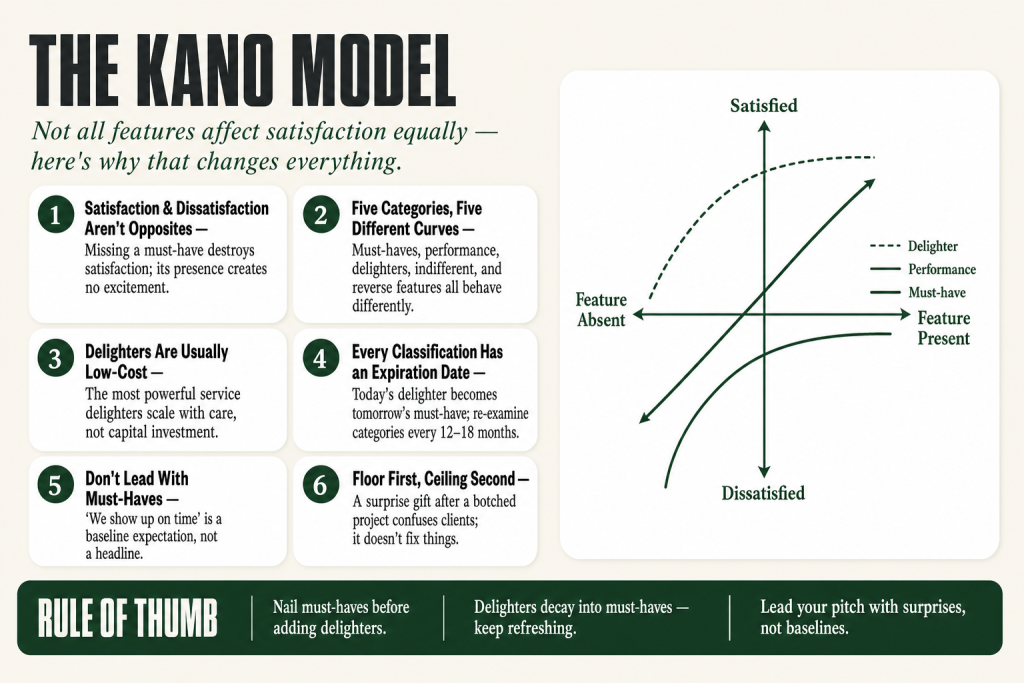
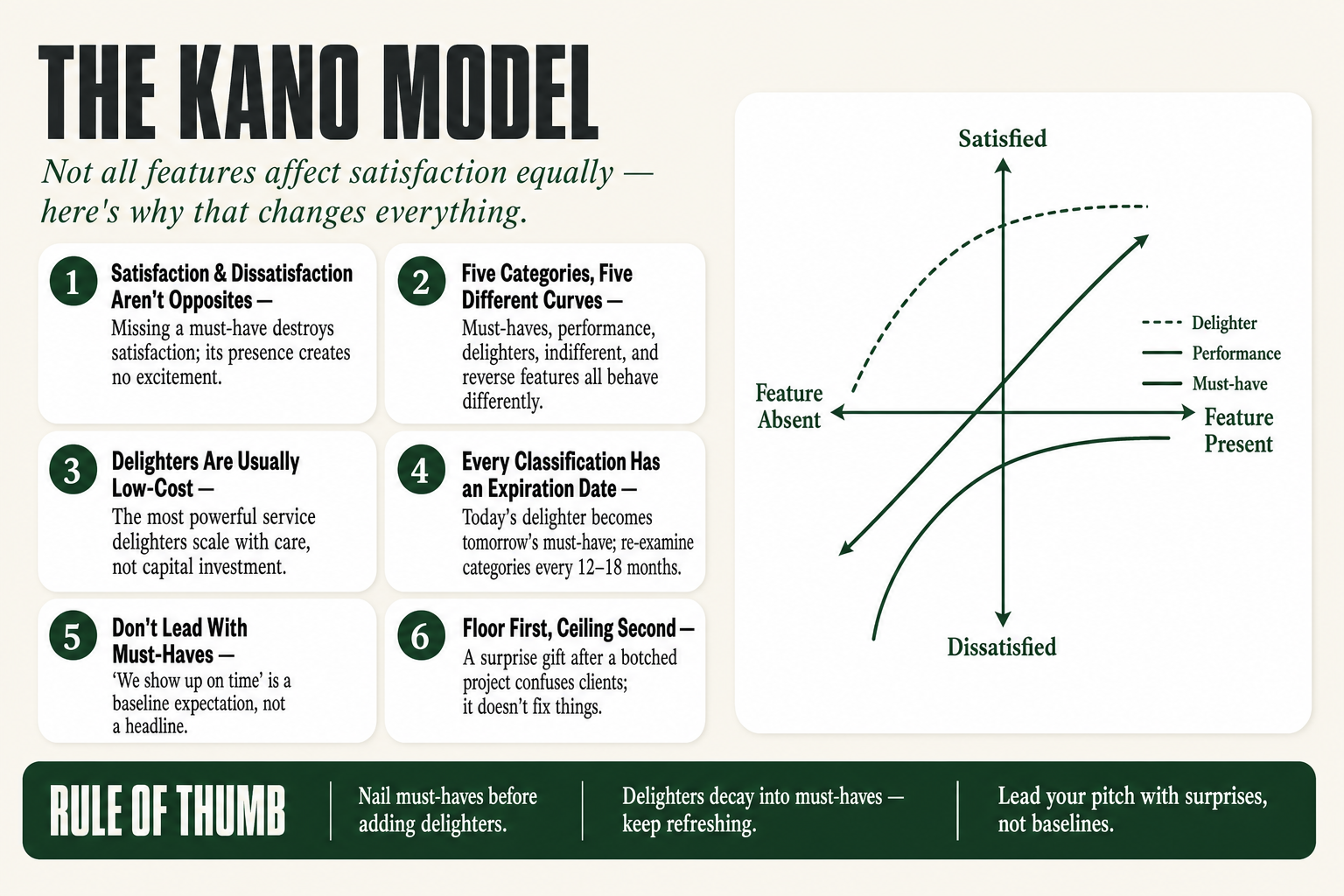
- The kano model classifies every feature of your offer into five categories based on how its presence or absence affects customer satisfaction, not all features pull in the same direction.
- Must-haves (basics) don’t earn praise when present, but their absence destroys satisfaction fast.
- Performance features scale linearly, more of them, more satisfaction. Most competitive battles get fought here.
- Delighters are unexpected wins: customers don’t ask for them, don’t miss them if absent, but are genuinely thrilled when they appear.
- Indifferent and reverse features waste resources or actively hurt you, the model helps you spot and cut them.
- Categories aren’t permanent: yesterday’s delighter becomes tomorrow’s must-have, so your classification has an expiration date.
Where the Kano Model Came From
Noriaki Kano developed the model in 1984 at the Tokyo University of Science. He published it with co-authors Nobuhiko Seraku, Fumio Takahashi, and Shin-ichi Tsuji in a paper titled “Attractive Quality and Must-Be Quality”, the title alone carrying the central claim: not all quality is the same kind of quality.
Kano’s insight borrowed from Herzberg’s two-factor theory, the behavioral research showing job satisfaction and job dissatisfaction aren’t two ends of one dial but two separate mechanisms. Kano asked the same question about products. What if the things that make customers unhappy and the things that make them happy operate by entirely different rules? That reframe became the model. A precursor paper in 1979 introduced the dual-axis idea; the 1984 paper formalized it. It reached Western product management through the 1990s and has held up across industries Kano never imagined, a reasonable test of whether a framework is actually useful or just popular.
The Core Insight: Satisfaction and Dissatisfaction Are Not Opposites
This is the part most people skip over, and it’s the part that makes the whole model work.
What distinguishes the kano model from simple priority lists is that it makes the asymmetry of customer satisfaction visible. A missing must-be feature creates massive dissatisfaction, but its presence creates no excitement. A delighter feature creates joy, but its absence creates no dissatisfaction. That seems obvious once you hear it, but almost every prioritization conversation in small business ignores it.
A restaurant operator adds online booking because a competitor has it, customers barely notice. Same operator lets the bathrooms get disorganized, reviews tank for six months. Same resource investment, wildly different outcomes. That’s this framework playing out in the real world.
The asymmetry has a direct consequence for how you allocate resources. Some investments prevent damage. Some win comparisons. Some create stories customers tell. Each layer demands different resource allocation and different messaging. Treating them all the same, the ‘feature checklist’ approach, is how you end up spending your best energy on the wrong things.
Features sort into three live categories: must-be (expected, punished only when absent), performance (linear, more is better), and attractive (delighters that thrill when present and cost nothing when missing), with indifferent and reverse catching the rest. Three very different satisfaction curves. One checklist conflates all of them.
Five Categories, What Each One Means for Your Offer
The kano model classifies product and service features by their effect on customer satisfaction, distinguishing five categories, must-be features, performance features, attractive (delighter) features, indifferent features, and reverse features, revealing that not all features affect satisfaction equally. Here’s what each one actually means when you’re building or refining an offer.
Must-Haves (Basic / Threshold)
Must-haves are table stakes: no one praises a hotel for having running water, but missing it creates outrage. Must-haves are risk management, not differentiation.
For a service business: showing up on time, returning calls within 24 hours, delivering what you promised, billing accurately. Nobody raves about you for these. But miss one and you’re in a review-response spiral. They protect the floor, they don’t raise the ceiling.
The trap operators fall into: spending money beautifying must-haves while neglecting performance and surprise. Upgrading your invoicing software so invoices look prettier doesn’t move satisfaction. Accurate invoices on time already did the job.
Performance Features (One-Dimensional / Satisfiers)
Performance features behave the way we intuitively expect, satisfaction rises in proportion to how well they’re delivered. Response time, accuracy rate, output quality, range of options: classic performance territory. More is genuinely better, proportionally.
This is where most competitive fighting happens. Your prospect is comparing your turnaround time against a competitor’s. Your customer satisfaction score is measured on a scale. These features live on the comparison page, in the demo, in the proposal. You win deals here, but winning on performance alone is expensive, because someone can always match a number. The operator who competes purely on performance is always one competitor away from losing the edge.
Delighters (Attractive / Excitement)
Delighters are unexpected extras that produce satisfaction out of proportion to their effort, while their absence goes unnoticed. They signal that someone actually cares about the small details, above-standard quality, not just above-standard delivery.
A landscaping company that sends a photo update mid-job. A bookkeeper who flags an unusual expense before the client noticed. A plumber who puts booties on before entering the house. None of these were in the job description. All of them generate word-of-mouth. The best delighters in service businesses are often low-cost, high-attention moves, which is good news for small operators competing against larger ones.
The crucial rule: cover the must-haves first. A surprise gift at the end of a botched project doesn’t fix the botched project. It just confuses the client.
Indifferent Features
Indifferent features are requirements that customers simply don’t care about either way, satisfaction stays neutral whether the feature is present or absent. The brand of software you use internally. The certification you spent months obtaining that your customers never ask about. The redesigned invoice template nobody notices.
This is where a lot of small-business energy quietly disappears. The kano model gives you permission to stop investing there, or at minimum, to stop leading your pitch with them.
Reverse Features
Reverse features cause dissatisfaction when present and satisfaction when absent. An overly complex interface that simpler users find alienating. An automated follow-up sequence that sophisticated buyers find condescending. A formal contract process that a long-time referral client reads as a loss of trust.
Reverse features create dissatisfaction when present and satisfaction when absent, a ‘helpful’ assistant that interrupts; an animation that delays interaction. For operators, the lesson is direct: you can actively make your offer worse by building things certain segments don’t want. The model doesn’t let you pretend those features are neutral.
Feature Decay: Why Your Classification Has an Expiration Date
The most underappreciated idea here isn’t the categories. It’s what happens to them over time.
The kano model’s most useful idea isn’t the categories themselves, it’s the time dimension: delighters become must-haves, and that insight reshapes how you think about product investment. The decay is real and faster than founders expect.
The clearest modern example is the smartphone camera. Portrait Mode on the iPhone was a genuine surprise when it launched, people screenshot the announcement and texted it to friends. Feature decay is the natural progression where delighters become performance features and eventually must-haves over time: smartphone cameras were once a delighter, then a performance feature (more megapixels = better), and are now a must-have baseline expectation. Apple had to keep finding the next thing.
Cars show the same arc at a scale you can watch across a single decade. Power windows, anti-lock brakes, the backup camera, adaptive cruise control, the center touchscreen: each walked the path from optional delighter to advertised performance feature to assumed baseline, the backup camera even completing the journey into law in some markets, which is category decay in its final form.
For service businesses, this can move even faster than it does in hardware. Copying a service feature requires no R&D budget, just a policy change. You introduce same-day responses as a differentiator. Within 18 months, the competitors who want to win have matched it, and the ones who haven’t are losing not because of you but because of expectations you helped set. Your delighter became the industry floor.
The practical implication: treat your classification like a product roadmap, not an encyclopedia entry, it needs updating. A kano analysis has an expiration date; in dynamic markets like SaaS, telecom, or financial services, repeat it every 12 to 18 months. For most small businesses, that means re-examining your categories at least once a year, more often if a major competitor is moving fast or the market is shifting.
Putting this to work? The ideas in the Canon are the foundation under the tactical playbook in Build a Complete Marketing Department — grab the free companion kit at mmsvegas.com/resources.
How to Apply This as a Small-Business Operator
The formal kano methodology involves structured surveys with paired functional/dysfunctional questions for each feature. Instead of just asking ‘Would you like feature X?’, the kano model uses paired questions: functional (‘How would you feel if our service had feature X?’) and dysfunctional (‘How would you feel if our service didn’t have feature X?’). That methodology is the gold standard if you have a large enough customer base and the research infrastructure to run it properly.
Most small operators don’t. And that’s fine. The categories work as a mental model even without the survey apparatus, especially if you use them to structure conversations you’re already having.
Step 1: Inventory Your Offer
List every element of your offer, not just the main deliverable, but the surrounding experience. Scheduling process, communication cadence, delivery format, follow-up, guarantees, bonuses, packaging, customer support. Everything a customer encounters from first contact to post-purchase. You’re trying to surface the full iceberg, not just the tip.
Step 2: Sort Honestly by Category
For each element, ask yourself: if this was absent tomorrow, would customers complain immediately? If you improved this significantly, would satisfaction noticeably increase? If you added this tomorrow without announcing it, would customers be pleasantly surprised? If you removed it, would customers be relieved?
The catch: your instinct here is unreliable. Even ten customer conversations, structured around ‘what would you immediately notice if we stopped doing X’ and ‘what’s something we do that you didn’t expect,’ will dramatically improve the exercise over gut instinct alone. To know whether a feature is considered a must-have, performance feature, or delighter, you must talk to customers and understand their perspective well.
Step 3: Align Investment with Category
Once you’ve sorted, you know where to put energy:
- Must-haves: Make sure they’re solid, then stop gold-plating them. Reliability is the goal, consistency, not elaboration.
- Performance features: Incremental investment produces incremental satisfaction. If you want to win on comparison, response time, output quality, range, price-to-value, this is the bucket. Invest proportionally to how much competitive differentiation matters in your market.
- Delighters: Find one or two low-cost, high-surprise moments you can build into the experience systematically. Not as an occasional gesture, but as a repeatable system. The handwritten note. The unexpected early delivery. The follow-up call nobody else makes three weeks post-project.
- Indifferent features: Stop promoting them as if they differentiate you. They may still belong in the offer, just not in your pitch.
- Reverse features: Remove them, or segment carefully so they only reach the customers who actually want them.
Step 4: Translate to Messaging
This is a step most product-focused presentations of this framework skip, but it’s where a lot of operator value lives. Must-haves belong on feature lists and FAQ pages. Performance features belong on comparison pages, demos, and case studies. Delighters belong on homepage heroes, social content, and announcement posts, wherever attention is highest and you want someone to lean forward.
The rule: don’t lead with must-haves. ‘We show up on time and do what we say’ is not a headline, it’s a baseline expectation. Leading with your must-haves signals you don’t have much else. Delighters belong in your story: the thing you mention that makes people say ‘wait, you do that?’
In Action: Real Examples Operators Can Learn From
The most instructive examples show the full arc, not just what category something sits in today, but how it got there and where it’s going.
Amazon’s Two-Day Shipping
When Amazon introduced Prime in 2005, two-day shipping was a genuine surprise. Nobody expected it; it drove Prime subscriptions because it delighted people in the best way. By 2015 it had become a performance feature, still appreciated, still compared, but no longer surprising. Today, for Prime customers, anything less than two-day feels like a failure. The feature completed the full decay arc in roughly fifteen years. Amazon had to keep finding the next thing, same-day delivery, Alexa, one-click returns, to stay ahead of its own history.
Slack’s Emoji Reactions
Delighters are unexpected positives, their absence is forgiven because customers don’t miss what they don’t expect, but their presence creates outsized satisfaction. Slack’s customizable emoji reactions are a clean example of this. Nobody put ‘custom emoji reactions’ on a product requirements document. When they appeared, teams started using them to replace entire reply threads. That’s the mechanism at work, the feature created a behavior customers didn’t know they wanted until they had it. Today, the absence of emoji reactions in a team communication tool would feel like a missing feature. Delighter to must-have, faster than most people noticed the shift.
Service Businesses and the Hairdresser
A simpler example closer to most operators’ world: picture a hairdresser. Must-have, the hair is washed with shampoo. Performance feature, a pleasant head massage included during the wash. Delighter, the hairdresser offers coffee or a glass of fresh orange juice. Indifferent, the hairdresser only uses cutting tools from brand XY. Nobody walked in expecting the coffee. When it arrives, it becomes part of the story they tell at dinner. The brand of scissors? Nobody’s thought about it once.
Notice how few of these involve capital investment. The coffee costs almost nothing. The head massage is just attention paid. This is a recurring pattern: the most powerful delighters in service businesses are effort-based, not budget-based. You can out-surprise a chain on fifty dollars if you’re paying attention to what customers don’t expect but would love.
Dropbox and the Freemium Architecture
Dropbox focused on flawless basics, reliable syncing, plus one major surprise: simple file sharing that nobody else made frictionless. The must-haves had to be airtight or the delighter wouldn’t land. Files that synced perfectly plus sharing that felt effortless, that sequence is the kano model as a growth strategy, not just a feature audit. Dropbox grew from 100,000 to 4 million users in 15 months by getting that sequence right.
Where It Works Best, and Where It Doesn’t
This framework is broadly applicable, but it shines in specific contexts and struggles in others. Know which you’re in before you invest heavily in the methodology.
Where It Works
Redesigning or auditing an existing offer. When you’ve been running your business for a few years and the offer has accumulated features like barnacles, some valuable, some vestigial, a kano sort is the fastest way to bring clarity. You’re not inventing new features; you’re reclassifying what you already have and reallocating attention accordingly.
Prioritizing limited build capacity. If you have ten things you could add next quarter and can only do three, this helps you sequence them: start with any must-haves you’re currently missing (existential), then choose the highest-value performance improvement (competitive), then add the most cost-effective delighter (memorable). That sequence beats building by internal enthusiasm almost every time.
Service businesses competing against larger players. The delighter category is where small operators can genuinely punch above their weight, because the gestures that create surprise, personalization, unexpected attention, remembering details, scale with care, not capital.
Messaging and positioning work. Once you’ve classified your features, you know what to lead with, what to save for the comparison, and what to quietly retire from the pitch.
Where It Struggles
Brand new categories with no customer frame of reference. If your customers have never experienced a product like yours before, they have no existing expectations, which means the must-have/performance/delighter distinction doesn’t yet have a stable anchor. In that case, Jobs to Be Done thinking often gives you more traction.
Markets with highly fragmented customer segments. A professional services firm serving both startup founders and enterprise procurement managers will find that the same feature, say, a detailed deliverables specification, reads as a pleasant surprise for the founder and a non-negotiable must-have for the enterprise buyer. The model still works, but you need to run it per segment, not across the whole list averaged together.
Features where the operator is too close to the product. Internal teams consistently mis-classify features, elevating indifferent features to performance or delighter status because of pride-of-ownership. The model requires actual customer input to work honestly. Skipping that step and running the exercise entirely in-house produces the answer you wanted going in.
Small sample sizes. Insufficient responses make findings unreliable, if you survey only a small, non-representative group, the majority vote could be misleading. Aim for at least 100 to 200 valid responses from diverse customers. For most small operators doing qualitative work rather than formal surveys, this is a known limitation, the remedy is to treat the output as directional, not definitive, and to revisit it regularly rather than treating a single pass as permanent.
Kano vs. the Value Equation: Two Ways of Thinking About Offer Value
Alex Hormozi’s Value Equation and the kano model are both tools for thinking about offer value, but they cut the problem differently, and understanding the contrast makes both more useful.
The Value Equation asks: how do you make your offer feel more valuable by manipulating four levers, dream outcome, perceived likelihood of achievement, time delay, and effort required? It’s a persuasion framework: given what the customer wants, how do you make your offer feel like the fastest, safest, easiest path to that result?
The kano model asks a prior question: which elements of your offer actually produce satisfaction at all? It’s a prioritization framework, before you position and pitch, do you know which features prevent damage, which drive comparison wins, and which create stories?
Used together, they’re powerful. Kano tells you what to invest in and improve. The Value Equation tells you how to frame the result in your messaging. You’d use kano analysis to decide that same-day response is a performance feature worth improving, and the Value Equation to position it as ‘you’ll have answers before your competition has even submitted a quote.’ The structure of the offer (kano) and the framing of the offer (value equation) are separate exercises that reinforce each other.
The contrast also reveals something important: a feature can be a kano-category delighter and still be framed poorly, which wastes its potential. And a feature can be framed brilliantly in a value-equation pitch while actually being an indifferent feature nobody cares about in practice. Operators who build on both frameworks tend to have fewer ‘great offer, weak conversion’ and ‘strong conversion, bad retention’ problems simultaneously.
Common Misunderstandings About the Kano Model
“Delighters are expensive to add.” The features that require large capital investment are almost always performance features, faster delivery, better software, more staff. The most effective delighters in service businesses tend to be costless gestures applied consistently. The handwritten birthday card. The proactive heads-up call. The extra page of context in the report nobody asked for. Attention is usually the raw material, not infrastructure.
“Once I classify my features, I’m done.” Kano categories are not stable, Kano himself described the systematic migration of quality attributes, noting that what delights today becomes expected tomorrow. A classification is a snapshot with a built-in expiration date. Treat it like a compass bearing, not a destination.
“The model is only for product companies.” Every offer, a consulting engagement, an event, a subscription box, a professional service, has must-haves, performance features, and potential delighters. The categories translate directly to services; the examples differ, the logic is identical.
“I should always try to add more delighters.” Not if your must-haves are shaky. A delighter on top of an unreliable foundation doesn’t save the relationship, it confuses it. Customers who receive an unexpected gift right after a botched deliverable don’t feel surprised; they feel managed. The sequence matters: floor first, ceiling second.
“Kano tells me what customers want.” It tells you how features affect satisfaction, which is related to, but distinct from, what customers are actually trying to accomplish. Customers famously can’t tell you they want a delighter, because delighters work precisely because they weren’t anticipated. This model works best alongside tools that surface jobs-to-be-done and voice-of-customer data, not as a standalone research method.
Common Mistakes
- Describing your delighter in the same breath as your must-haves on the sales call — When you list ‘we show up on time, we communicate clearly, and we also do X’ in one breath, X gets buried. Must-haves and delighters need separate real estate in your pitch, leads with the surprise first, then confirm the basics exist. One afternoon restructuring your opening is usually all it takes.
- Surveying only your happiest customers when sorting features into categories — Power users and long-term clients skew heavily toward performance features because their must-haves are already met. Your real must-have gaps show up in the answers from newer customers and, if you can reach them, churned ones. A sample of recent cancellations or first-90-day customers will surface must-have failures that your best customers have long stopped mentioning.
- Building a delighter into your offer but leaving it undocumented and inconsistent — A delighter only works if every customer experiences it, not just the ones whose project manager remembered to do the thing. If your bookkeeper flags unusual expenses before the client notices, that needs to be a checklist item, not a personality trait. Delighters that aren’t systematized are just random acts of kindness; they don’t build a reputation.
- Running the kano exercise entirely in-house and then treating the result as validated — Internal teams reliably mis-classify features based on how much effort went into building them. The certification nobody asks about gets elevated to a performance feature. The follow-up nobody expects gets overlooked entirely. Even five structured customer conversations, ‘what would you immediately notice if we stopped doing X?’, will catch mis-classifications that internal review never catches.
- Keeping a reverse feature in the offer because it works for some customers, without segmenting delivery — An automated onboarding flow that feels helpful to a first-time buyer can feel infantilizing to a returning client who’s worked with you for three years. A formal scope-of-work contract that enterprise procurement requires can feel like a loss of trust to a referral who sent you their best friend. The answer isn’t to remove the feature, it’s to segment who gets it. If you’re not doing that, you’re actively cooling relationships with the people most likely to refer you.
- Competing exclusively on performance features while letting the delighter pipeline run dry — <cite index=’3-2′>Category leaders have to keep introducing new delighters to stay ahead, followers are always one cycle behind on commodities.</cite> Performance feature advantages erode as competitors catch up. If you’re not actively developing the next delighter while your current one is still surprising, you’ll find yourself flat-footed when the decay completes and you have nothing new to lead with.
Operator’s Take
Most operators who run this exercise treat it like a spring-cleaning project. They sort the list, feel good about the categories, and go right back to building by gut feel. The model got used once and quietly retired. That’s the wrong takeaway, and it’s also the most common one.
Here’s my honest read on where the real leverage sits.
Don’t run the category sort with your team. Run it with five actual customers. Ask them two things: ‘What would you immediately notice, as in, call us, if we stopped doing X?’ That surfaces your real must-haves. Not the ones your team thinks are critical, but the ones that would actually trigger a reaction. Then: ‘What’s something we do that you didn’t expect when you hired us?’ That surfaces your existing delighters, which most operators have but have never named, never systematized, never led with in a pitch. The gap between your team’s classification and your customers’ classification is almost always significant, usually embarrassing, and almost always worth money if you close it.
The faster win is usually in messaging, not the offer itself. If you’re opening your sales call with three must-haves, ‘we show up on time, we communicate clearly, we do what we say’, and burying your one genuine delighter in a bullet point at the bottom of your proposal, you’ve spent the highest-attention moment of the sales cycle on the least interesting parts of your offer. Pull the delighter forward. Give it a name. Make it the thing prospects remember when they’re comparing you to the next option. That change costs an afternoon, not a quarter.
Watch your performance features for the moment they stop being performance features. You built your reputation on 48-hour turnaround. You’ve been winning on it for two years. The features you’re shipping today that feel cutting-edge will be table stakes in three years, and most teams only think about the current quarter’s feature list, which is exactly why the company that was exciting five years ago feels mid today. If three of your main competitors have matched your turnaround in the past year, it’s no longer a differentiator, it’s a floor they have to hit too. Customers won’t give you credit for it anymore; they’ll only penalize you if you miss it. The diagnostic: ask customers how your turnaround compares to what they’d expect from anyone in your category. If the answer is ‘that’s just normal now,’ you need a new performance differentiator before that erosion shows up in your revenue numbers.
Treat finding new delighters as an operational habit, not a once-a-year insight. Build one short question into your quarterly rhythm: what’s one thing we could start doing in the next 90 days that nobody else in our market does yet? Keep the constraint explicitly low-cost. A $5,000 feature addition is a project. A $50 gesture applied consistently to every client relationship is a system. Category leaders have to keep introducing new delighters to stay ahead; followers are always one cycle behind on commodities. The businesses that tend to stay ahead aren’t the ones with the best performance features, they’re the ones with a pipeline of small surprises that keep refreshing what customers tell their friends about.
Use the classification to end internal arguments. ‘I think this is important’ is a conversation that never resolves cleanly. ‘Customers have told us they’d call us if we stopped doing this’ usually does. Kano gives you a customer-grounded language for priority conversations that isn’t just whoever-talks-loudest, which matters more than people give it credit for, especially when the founder has strong opinions about everything and the team has learned not to push back.
One honest caveat: this framework tells you how satisfaction works. It doesn’t tell you why customers hired you in the first place. For that, you need Jobs to Be Done thinking alongside it. Kano for offer architecture, JTBD for motivation, the two together give you a clearer picture than either alone.
Used in
- ✓ Build a Complete Marketing Department
Used to audit and classify offer elements before positioning work begins, so must-haves are solid and delighters are front-line in messaging, not buried in feature lists. - ✓ The Missing Manual for FunnelKit
Applied when structuring offer pages and upsell sequences, the kano categories inform which benefits lead each page and which belong in supporting copy versus the headline. - ✓ The Missing Manual for Make
Referenced when automating the delivery experience, helping operators identify which automated touchpoints are must-have reliability checks and which are opportunities for systematic surprise.
FAQ
Do I need to run a formal survey to use the kano model?
Not necessarily. The formal kano survey with paired functional/dysfunctional questions is the most precise method, but for most small operators, even ten structured customer conversations will dramatically improve your classification accuracy over gut instinct alone. Start with conversations, validate with a simple survey if you need more confidence.
How often should I re-run a kano analysis?
At minimum once a year for most businesses; more frequently if a major competitor is moving fast or you’ve noticed satisfaction scores shifting unexpectedly. Feature decay is real, your delighters from 18 months ago may already be must-haves in your customers’ minds.
Can the kano model be used for service businesses, not just products?
Yes, every service offer has elements that map cleanly to the five categories. It’s just as applicable to a consulting engagement, a home services company, or a professional practice as it is to a SaaS product. The examples differ; the logic is identical.
What’s the difference between a performance feature and a delighter?
Performance features are things customers already know they want, they compare you on them, and more is proportionally better. Delighters are things customers didn’t know to ask for, their absence isn’t noticed, but their presence creates genuine surprise and positive emotion. Customers can tell you about performance features in advance; they usually can’t tell you about delighters until they experience one.
Is the kano model the same as prioritizing by customer importance scores?
No, and this is the key insight. Traditional importance scoring assumes satisfaction scales linearly with feature quality. The kano model shows that’s only true for performance features. Must-haves follow a completely different curve, more investment past ‘reliable’ produces almost no gain. Treating all features as importance-scored conflates fundamentally different satisfaction mechanisms.
How do I find my delighters if customers can’t tell me what they want?
Look for moments in your process where you’ve gone beyond the job description and customers responded enthusiastically. Ask customers what they tell others about you, the stories people repeat tend to be about delighters, not must-haves. Review testimonials for what customers specifically call out as unexpected. Those are your existing delighters; make them systematic.
Further reading
- ‘Attractive Quality and Must-Be Quality’Noriaki Kano et al. Journal of the Japanese Society for Quality Control1984. The original paper; dense but worth reading for the underlying logic of the two-axis model.
- Competing Against LuckClayton Christensen. Not about kano directly, but Jobs to Be Done theory pairs naturally with kano analysis and adds the motivational layer the model leaves out.
- Obviously AwesomeApril Dunford. A positioning book that implicitly applies kano thinking to messaging, how to identify the features that actually differentiate versus those that are table stakes in your category.
Sources: Noriaki Kano, Nobuhiko Seraku, Fumio Takahashi, Shin-ichi Tsuji, ‘Attractive Quality and Must-Be Quality,’ Journal of the Japanese Society for Quality Control, Vol. 14, No. 2, 1984. Wikipedia entry on the Kano model and on Noriaki Kano. ProductPlan Kano Model Glossary. Startups.com Kano Model Lexicon entry. Product Marketing Alliance, ‘Using the Kano Model for product messaging.’ FourWeekMBA Kano Model analysis. Productschool.com Kano Model guide. SI-Labs Kano Model practical guide (February 2026). Umbrex Kano Model framework reference. Yukai Chou, ‘The Kano Model: S-Tier Behavioral Designer’s Guide’ (July 2025). ProductLeadership.com Kano Model for Product Management (May 2026). Koji.so Kano Model guide (June 2026). Conjointly, ‘Criticisms and counter-criticisms of Kano model.’
Brian Kasday spent forty years in direct-response marketing before rebuilding the whole operation as a one-person shop. He writes The Operator’s Library — including “Build a Complete Marketing Department” — for operators who’d rather build it themselves than wait on someone else.
Build the department these ideas describe — the free companion kit: mmsvegas.com/resources.
More The Operator's Canon guides
Free · Operator Toolkit
Want the tools, not just the guide?
Get the free operator toolkit — templates and checklists for the systems you actually run, plus a note when this guide changes.
Get the free toolkit →