
Last updated: July 2026
The value ladder is the structural answer to one of the most common small-business marketing traps: having great services but no logical path to take a customer from ‘trying you out’ to relying on you completely. By the end of this page, you’ll be able to map your own offer portfolio onto a coherent progression, and identify exactly where customers are dropping off, stalling, or never being invited to go further.
Most operators have more to offer than they’re selling. Not because they’re bad at sales, but because they’ve never arranged what they offer into a sequence a customer can follow. They have a flagship service, maybe a discount intro, and a vague sense that ‘bigger clients buy more.’ That’s not a ladder. That’s a pile of offers leaning against a wall.
The value ladder gives the pile a shape. It converts a scattered product set into a deliberate customer journey, one where the first transaction funds your acquisition cost, the middle tiers build trust and revenue, and the top of the ladder is where real margin lives. The economics shift completely when you design it this way. You stop needing every new customer to be immediately profitable. You start treating CAC as an investment, because you have a proven path to recoup it.
The idea in 30 seconds
- The value ladder is a structured sequence of offers at ascending price and value points, entry offer first, premium engagement last.
- It solves the core economics problem: CAC is fixed, but LTV can grow if you have somewhere to take a proven customer.
- Every rung must deliver more value, not just cost more, that’s what earns the ascent.
- You don’t need all rungs at launch. Build bottom-up; let customer demand reveal what the next rung should be.
- The front-end offer’s job is trust and margin-tolerance, not profit, profit lives higher up the ladder.
- Where it breaks: businesses that treat the ladder as a manipulation sequence rather than a delivery of escalating results.
Where the Value Ladder Came From
Russell Brunson named and popularized the value ladder in DotCom Secretspublished in 2015. The book’s central argument: you can’t profitably sell expensive things to cold strangers, so you build a system where customers enter cheap and trust their way up. ClickFunnels, the software company Brunson co-founded with Todd Dickerson in 2014, turned the framework into a technical implementation, giving operators the tools to build multi-step funnels with upsells, order bumps, and post-purchase sequences without an enterprise budget.
The underlying economics weren’t new. Direct-response marketers had worked with backend offer logic for decades, Dan Kennedy and Jay Abraham each wrote about ascension thinking in different forms. What Brunson did was bridge that tradition with the subscription-based logic of SaaS businesses and wrap the whole thing in a visual metaphor that made it teachable. ‘Backend offer architecture’ never caught on. ‘The value ladder’ stuck immediately.
The association with funnel culture through the mid-2010s is both the framework’s biggest asset and its biggest liability. Asset: mainstream awareness. Liability: a generation of operators who copied the mechanics, countdown timers, ‘one-time offer’ pop-ups, aggressive upsell sequences, without grasping the purpose underneath. That gap between form and function is still the most common way the ladder gets misused.
The Value Ladder: What It Actually Is
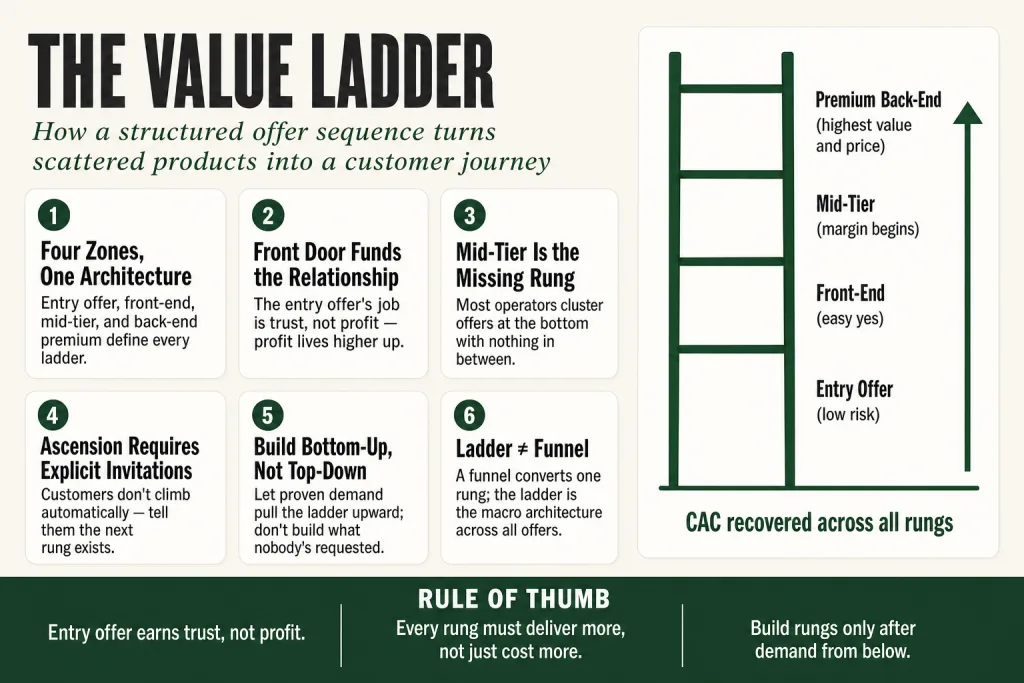
A value ladder is a structured sequence of offers at increasing price points, where each tier delivers more value than the one before it. The key word is ‘structured’, it’s not just having multiple products, it’s having products that logically lead from one to the next, so a customer’s natural progression through your business is also their progression up your ladder.
Here’s the basic anatomy. Every value ladder has roughly four zones:
- The bait / entry offerfree or very low cost; its job is to get a stranger to make a micro-commitment and experience your quality firsthand. A free consultation, a checklist download, a $7 book, a free tool. Risk: near zero. Value: real but narrow.
- The front-end offerfirst paid transaction; priced to be an easy yes, not a profitable one in isolation. A workshop, a small-scope service, a starter plan. This is where you break even on acquisition at best.
- The mid-tier offer(s)where genuine margin begins. The customer has already bought; they trust you; they want more. This is the zone most operators under-develop.
- The back-end / premium offeryour highest-delivery, highest-price engagement. Done-for-you services, retainers, mastermind memberships, custom consulting. Not for everyone, but very profitable for the subset who arrive here.
The rungs aren’t just price points. Each one has to deliver meaningfully more than the one below it, which is also what earns the customer’s willingness to spend more. Brunson’s framing in DotCom Secrets is direct on this: keep providing more value, and people keep spending more to stay in the relationship. The ladder earns its ascent; it doesn’t demand it.
There’s also a structural distinction worth knowing. Brunson describes two types: the macro value ladder, which maps the full ecosystem of what your business offers, all products and services in order of increasing value, and the micro value ladder, which focuses on the specific offers within a single funnel. For most small operators, get the macro right first. Get the big arc clear before worrying about the upsell sequence inside any individual funnel.
Why the Value Ladder Changes Your Acquisition Math
The reason this framework earns an operator ROI rating of 5 isn’t philosophical, it’s arithmetic. Without a value ladder, your CAC has to be recovered from a single transaction. That limits how much you can bid on ads, how aggressively you can price the front door, and how competitive you can be on entry-level offers. You’re trying to extract full lifetime value from the first check.
With a well-designed ladder, the math changes. When you’re thinking about lifetime value rather than a single purchase, you can spend more to acquire a customer, because even a modest percentage reaching the next rung, and a smaller slice reaching the one above that, dramatically expands your effective acquisition budget. You’re not betting on one transaction. You’re betting on a relationship.
HubSpot is the clearest B2B example of this in operation. Their free CRM, available indefinitely, no credit card required, is the bottom rung of a ladder that runs up through Starter tiers into Marketing Hub Professional at $890 a month or more. They don’t offer the free tier out of generosity. They offer it because they know the ascension model works: get enough companies dependent on the free product, and a meaningful percentage will need the paid features badly enough to upgrade. In Q2 2024, HubSpot reported subscription revenue of $623.8 million for the quarter (HubSpot Q2 2024 earnings press release, NYSE: HUBS, August 7, 2024, ir.hubspot.com), built on a ladder that starts at $0. The free CRM is the bait. The SaaS revenue above it is where the business actually runs.
For a local service business, the structure plays out differently but identically in logic. A landscaper who offers a $49 lawn analysis has a rung. The regular maintenance contract is the next rung. The full redesign project is a rung above that. The ongoing irrigation maintenance agreement at the top is where margin is thick and churn is low. Each rung funds the next. The $49 analysis doesn’t have to be profitable, it has to start a relationship.
One implication operators often miss: the value ladder has two distinct payoffs, not one. The financial payoff, more revenue per customer, is obvious. The positional payoff is subtler: you become the operator they go deeper with, rather than the one they sample and leave. Those are different kinds of businesses, and the ladder is what makes the second kind possible.
Putting this to work? The ideas in the Canon are the foundation under the tactical playbook in Build a Complete Marketing Department — grab the free companion kit at mmsvegas.com/resources.
Building the Value Ladder: Where Operators Actually Start
Here’s the mistake most operators make when they first encounter this framework: they try to design the whole ladder before they have any customers at the top. They spend weeks mapping out a premium mastermind group before anyone has bought the workshop below it. Don’t do that.
Build from what you already have, then look for the gaps.
Step 1: Inventory what exists
Write down every offer you have, paid and free. Sort them by price. That’s your rough ladder. Most operators discover they have a cluster of offers at the bottom and one big offer at the top, with nothing in between. That gap, no mid-tier, is the single most common structural flaw. If you’re in that camp, you need a bridge offer. If you have multiple offers that don’t connect into a coherent path, you need to sequence them before you add anything new.
Step 2: Define the entry offer
The entry offer has one job: get a real prospect to raise their hand and experience your quality at near-zero risk. It doesn’t have to be free. A $10 book, a $25 workshop, a free 30-minute audit, the price matters less than the perceived risk. Make it an easy yes.
The entry offer also pre-qualifies. A roofing company that offers a free roof inspection isn’t just generating leads, it’s getting a buyer onto the property where an honest conversation can happen. The entry offer sets up every rung above it.
Step 3: Design the ascension logic
Each rung above the entry should answer a question the customer has after completing the rung below it. Not ‘what else can I sell you?’, that’s a salesperson’s question. The right question is: ‘What does this customer need next to get more of what they came here for?’ If your workshop teaches the framework, the mid-tier might implement it with them. If the mid-tier implements it, the premium tier might do it for them. The customer’s progress drives the logic.
Each tier earns its own revenue, but the real value is the trust it builds for the tier above. Most businesses don’t need to plan all tiers at launch. Start with the bottom, add tiers as audience demand warrants, and let your most engaged customers tell you what they want next.
Step 4: Build the return path
A ladder isn’t just a one-way climb. Some customers will move sideways, pause, or come back in after a long gap. Email sequences, retargeting, and loyalty programs are the mechanisms that bring customers back when they’ve stepped off. Most operators set this up once and ignore it. It’s the most passive revenue in the system, and the most neglected.
Value Ladder Examples That Work in the Real World
Abstract frameworks are easier to reject. Here’s what a value ladder looks like when it’s actually running.
Ramit Sethi / I Will Teach You to Be Rich
Ramit Sethi built one of the cleaner ladders in the personal finance and business education space. Free email content and blog posts sit at the bottom. His book I Will Teach You to Be Richfirst published in 2009, is the next rung. Above that, Earnable, a course currently priced at $1,499 for full access (iwillteachyoutoberich.com, accessed June 2026), takes buyers into implementation. Higher-ticket programs for established business owners sit at the top.
What makes this ladder clean is the logic: the free content proves the thinking, the book deepens it, the course implements it, and the higher-ticket programs apply it to your specific situation. A customer can follow that naturally. They’re not being sold up a ladder; they’re choosing to climb because each rung paid off.
HubSpot
HubSpot’s free CRM is the most effective bottom-rung offer in B2B software, not because HubSpot is generous, but because the ascension is built into the product architecture itself. Once a company’s contacts, pipelines, and workflows live inside HubSpot, the switching cost grows every month. When teams hit the free tier’s limits, upgrading to Starter or Professional is the obvious next step. (HubSpot pricing: hubspot.com/pricing, accessed June 2026.)
The local contractor
The value ladder works just as cleanly offline. A fitness center can start with a low-priced introductory class, layer in a standard monthly membership, then a personal training package, then a premium transformation program with nutrition coaching. Each step costs more, delivers more, and requires more commitment, but the customer chooses to climb because each rung was worth it. No software required. Same structure as HubSpot; different ZIP code.
Duolingo
Duolingo runs a freemium ladder with a distinctly modern twist. The free tier is the product, deliberately enjoyable and habit-forming. Duolingo Plus (now Super Duolingo) removes ads and adds streak repair, priced at roughly $84 per year. The ladder is short by design: two rungs, a massive free base, and a meaningful but low-friction upgrade. The economics work because the free product is genuinely good enough that millions use it, and a fraction of millions at $84 a year is a real business. The lesson for operators isn’t to copy the freemium model; it’s that a two-rung ladder can outperform a five-rung one when both rungs are genuinely strong.
Where the Value Ladder Works, and Where It Doesn’t
The value ladder is broadly applicable, but it’s not universally the right move. Know the conditions where it thrives and the ones where it’s a distraction.
Where it thrives
Service businesses with a natural depth of engagement. Accounting firms, marketing agencies, coaches, consultants, legal services, all have a natural progression from ‘occasional help’ to ’embedded partner.’ The ladder just makes that progression intentional and repeatable.
Knowledge and education businesses. If you create content that teaches something, you have a built-in entry offer, the free content, and a natural mid-tier in the course or workshop that goes deeper. The ladder is implicit; your only job is to make it explicit.
Any business where CAC is high relative to first-transaction revenue. If you’re spending $200 to acquire a customer for a $150 service, you’re bleeding money, unless there’s a $400 second offer and a $1,200 annual contract above it. The ladder turns a losing unit economics problem into a winning one.
Where it struggles
Pure commodity and one-time purchase businesses. If someone buys a car from you, there’s no obvious next rung. The ascension model doesn’t apply cleanly to transaction types that naturally don’t repeat. Though smart dealers have found ways, service plans, upgrades, referral incentives, so even here the assumption is worth questioning.
Early-stage businesses with nothing validated above the entry offer. Building the top of a ladder you haven’t tested is a good way to waste six months. If no one has asked for your premium tier yet, don’t build it. Sell it first. Then build it.
Markets where trust is destroyed by ascension tactics. There are verticals, medical, legal, some high-touch B2B, where an aggressive upsell sequence after a free download will kill the relationship instantly. In those cases, the ladder still exists; it just has to be navigated with patience and positioned as a service, not a sales flow. Funnel-culture critics have a fair point here: the implementation pattern that worked for info products doesn’t transplant cleanly to every professional context.
What People Get Wrong About the Value Ladder
Misunderstanding 1: ‘More rungs = better ladder.’ Wrong. A five-rung ladder with a missing bridge between rungs two and three is worse than a three-rung ladder where every transition is natural and earned. The number of rungs is irrelevant. The quality of the logic connecting them is everything.
Misunderstanding 2: ‘The entry offer has to be free.’ No. Free is one option. Low-price is another. The real requirement is low-perceived-risk. A $49 workshop that solves a specific problem is a better entry offer than a free lead magnet that over-promises and under-delivers. Brunson’s dentist example from DotCom Secretsa paid cleaning leading to whitening trays leading to an ongoing hygiene plan, is a paid-to-paid ladder with no free rung. It works because each step is the logical next question.
Misunderstanding 3: ‘The value ladder is a funnel.’ A funnel is the conversion mechanics for one rung’s path. The value ladder is the macro architecture across all your offers. Conflating the two leads operators to obsess over funnel mechanics while never designing the actual offer progression.
Misunderstanding 4: ‘Customers climb automatically.’ They don’t. Moving customers up the ladder requires explicit invitations, follow-up sequences, milestone check-ins, direct asks. The ladder creates the path; you still have to tell people it exists.
Misunderstanding 5: ‘It’s about extracting more money.’ This is the framing that gets operators into trouble. The ladder is a delivery architecture, not a revenue extraction mechanism. The moment a rung exists to capture revenue without delivering proportional value, the whole model corrodes. Customers sense it, sometimes fast, sometimes slowly, but always eventually.
Common Mistakes
- Building top-down instead of bottom-up — Design and sell the premium tier only after customers at the rung below it are asking for more, let proven demand pull the ladder upward, not aspiration push it.
- Skipping the mid-tier entirely — The jump from a $97 entry offer to a $6,000 flagship kills your ascension rate. One offer in the $800, $1,500 range, solving the next specific problem, gives customers a logical next step and gives you real margin before anyone reaches the top rung.
- Treating ascension as automatic — Build explicit invitations, email sequences, post-purchase check-ins, milestone offers, that actively tell customers the next rung exists and why it’s the right next step for them right now.
- Abandoning buyers who stepped off mid-ladder — A three-email reactivation sequence, tied specifically to where a buyer stopped and what the next rung solves, will pull back a meaningful percentage at zero acquisition cost. Build it once; let it run.
- Conflating a funnel with a ladder — The funnel is the conversion mechanics inside a single rung, ads, landing pages, email sequences for one specific offer. The value ladder is the full architecture across all your offers. Get the macro right before optimizing the micro.
- Pricing rungs by margin, not by value delivered — Each rung’s price should be anchored to the outcome it delivers. A mid-tier priced at $299 when it delivers $1,200 worth of result often signals low value and suppresses conversions. Test the higher price before assuming cheap wins.
Operator’s Take
The conversation almost nobody has: pricing the middle of the ladder.
Here’s a pattern that shows up constantly. Entry offer at $97. Premium service at $6,000. The gap between them is canyon-wide, and the operator fills it with a $299 course because ‘that’s what the market wants.’ Sometimes that’s true. More often, the $299 price sends a signal: this isn’t worth much. A mid-tier priced at $1,200 to $1,500, when it genuinely solves the next real problem the buyer has, will often outsell the $299 version in a comparable market, because the price signals that something substantive is happening. Before you assume cheap wins, run the test. The margin difference alone makes it worth doing even if conversion drops slightly.
The other consistent failure: treating the return path like an afterthought. You build the ladder, write the upsell sequences, obsess over front-end conversion rates, and then completely abandon the 25 to 30% of buyers who stepped off at rung two and never came back. A reactivation sequence of three emails, each tied specifically to where they stopped and what the next rung actually solves for them, will pull a meaningful slice of that group back in. That’s not new acquisition spend. That’s revenue sitting in your existing list with nobody making the ask. Set it up once, let it run. Most operators never do this. The ones who do notice the difference within a quarter.
One place AI earns its keep in this process: the inventory audit. Drop your current offers, pricing, and a brief description of what each delivers into a conversation with an AI tool. Ask it to map the ascension logic, flag where two offers might be solving the same problem at nearly the same price point, and surface the gap where a mid-tier should exist but doesn’t. That’s a ladder problem, not a funnel problem, and AI surfaces it in ten minutes instead of a quarter of hand-wringing. You take what it finds. You decide what to do with it. The judgment stays with you.
The one thing I’d tell an early-stage operator who only has one offer right now: don’t let the value ladder framework make you feel like you’re behind. You’re not building a ladder yet. You’re finding the rung that actually works. Once buyers come back unprompted or refer others without being asked, that’s the signal to start thinking about what sits above and below it. Not before.
Used in
- ✓ Build a Complete Marketing Department
Used to design the full offer portfolio, mapping entry offers, mid-tier services, and premium engagements into a coherent sequence that guides customers from first contact to highest-value relationship. - ✓ The Missing Manual for FunnelKit
Used to configure the micro-level funnel logic for each rung, determining which upsells, order bumps, and post-purchase sequences correspond to each step in the value ladder. - ✓ The Missing Manual for Make
Used to automate the ascension mechanics, triggering the right follow-up sequences, tagging customers by rung, and surfacing next-step offers at the right moment without manual intervention.
FAQ
How many rungs should a value ladder have?
Most small businesses work well with three to four rungs: an entry offer, one or two mid-tier offers, and a premium back-end. More rungs aren’t better unless each one delivers a meaningfully different level of value. Start with what you have, then add rungs as demand warrants.
Does the entry offer have to be free?
No. The entry offer needs to be low-perceived-risk, not necessarily free. A $25 workshop or a $49 assessment can be a strong entry rung if it solves a specific, real problem. Free works well when you need to build a list first; a low-priced entry offer often pre-qualifies buyers better.
Can a value ladder work for a brick-and-mortar service business?
Yes, in some ways it’s more natural offline than online. A dental practice, landscaping company, fitness studio, or accounting firm all have a natural progression from introductory service to ongoing, high-engagement relationship. The ladder just makes that progression intentional.
What’s the difference between a value ladder and a sales funnel?
A sales funnel is the conversion mechanics for a single offer or rung, the ads, landing pages, email sequences that get someone to buy one specific thing. A value ladder is the macro architecture of all your offers arranged in ascending order. Every rung can have its own funnel, but the ladder is the bigger picture.
How do I get customers to move up the ladder?
Explicit invitations, not passive hope. Build post-purchase email sequences that introduce the next rung, create milestone check-ins after delivery, and make direct offers at the right moment. Customers who loved the previous rung are far more likely to buy the next, but only if they know it exists.
Is the value ladder still relevant in 2025 and beyond?
The mechanics, lower acquisition cost at the front, higher margin at the back, are as relevant as ever. What has changed is tolerance for aggressive upsell tactics; customers today are quicker to leave a ladder that feels extractive rather than helpful. The framework is sound; the execution needs to be relationship-led, not revenue-first.
Further reading
- DotCom Secrets by Russell Brunson (2015; updated edition 2020), the originating source for the named framework. Read it for the full value ladder concept and the funnel architectures that implement each rung. The core architecture chapters hold up. Some tactical sections date to the early ClickFunnels era and can be skimmed.
- Getting Everything You Can Out of All You’ve Got by Jay Abraham (St. Martin’s Press, 2000), predates the named framework but covers backend offer logic and lifetime value thinking that the value ladder systematizes. Valuable context for understanding why the economics work the way they do.
Sources: Russell Brunson, DotCom Secrets2015 (first edition); updated edition 2020. Todd Dickerson confirmed as ClickFunnels co-founder and CTO via ClickFunnels team page (clickfunnels.com/our-team) and AccessWire/Yahoo Finance profile (June 2020); ClickFunnels launched September 2014 per toddadickerson.myclickfunnels.com and corroborated by markinblog.com Dickerson profile. Earnable pricing ($1,499 full access) confirmed via iwillteachyoutoberich.com/how-to-price-your-online-course/ (accessed June 2026) and corroborated by ippei.com course documentation. HubSpot free CRM as bottom-rung entry offer confirmed via hubspot.com/pricing (accessed June 2026). HubSpot Q2 2024 subscription revenue ($623.8M) sourced from HubSpot Q2 2024 earnings press release (NYSE: HUBS), August 7, 2024, ir.hubspot.com, confirmed via SEC Form 8-K filing (EDGAR) and BusinessWire release of the same date.
Brian Kasday spent forty years in direct-response marketing before rebuilding the whole operation as a one-person shop. He writes The Operator’s Library — including “Build a Complete Marketing Department” — for operators who’d rather build it themselves than wait on someone else.
Build the department these ideas describe — the free companion kit: mmsvegas.com/resources.
More The Operator's Canon guides
Free · Operator Toolkit
Want the tools, not just the guide?
Get the free operator toolkit — templates and checklists for the systems you actually run, plus a note when this guide changes.
Get the free toolkit →How to cite: Value Ladder. Associated with Russell Brunson / DotCom Secrets, 2015. The Operator’s Canon, MMS Vegas. https://mmsvegas.com/library/value-ladder-explained/