
Last updated: July 2026
The halo effect is the reason a prospect who loves your website is already half-sold before they read a single line of copy, and the reason a prospect who hits a broken link on that same site quietly starts looking for the exit. One signal. Total frame-shift. It happens before anyone consciously decides anything.
Most operators understand this when it’s described to them. Far fewer build for it deliberately. That gap is the opportunity, and it’s bigger than most people realize, because the halo doesn’t just affect the first impression. It colors the pricing conversation, the proposal, the onboarding, the first invoice. Get the first signal right, and you borrow credibility for every interaction that follows. Get it wrong, and you spend the rest of the sales process digging out of a hole you didn’t know you were in.
The idea in 30 seconds
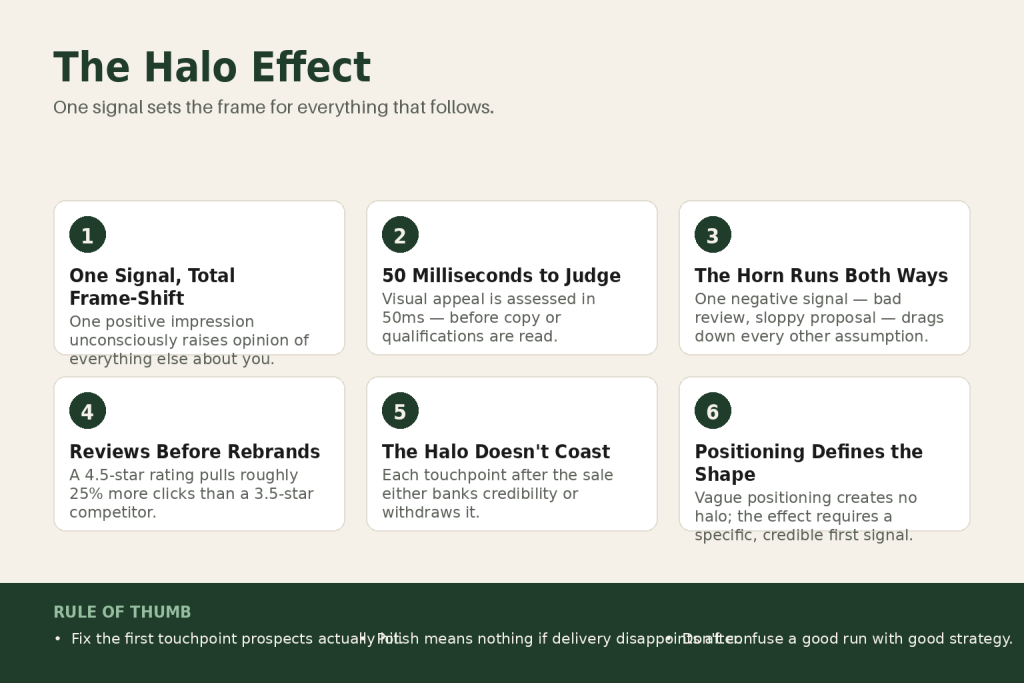
- The halo effect is a cognitive bias where one positive impression, a great-looking site, a standout product, a warm first call, unconsciously raises a prospect’s opinion of everything else about you.
- It runs in reverse too: one ugly or broken signal (slow website, sloppy proposal, bad review) casts a shadow over attributes the prospect hasn’t even evaluated yet, that’s the horn effect.
- For small operators, the highest-leverage application is engineering the first signal: whatever a prospect encounters first sets the frame for everything that follows.
- A single credibility marker, a relevant award, a recognizable client logo, a five-star rating, can activate the halo before a prospect reads your pricing or meets your team.
- The halo is not permanent. It erodes without reinforcement; one sharp contradiction, a sloppy follow-up after a polished pitch, can flip it into a horn.
- Phil Rosenzweig’s 2007 book of the same name adds a useful counter-warning: don’t let the halo trick you into misreading your own business performance.
Where the Halo Effect Came From
The story starts in an unexpected place: WWI-era military personnel files. Psychologist Edward L. Thorndike was analyzing rating data from U.S. Army officers who had been asked to evaluate their subordinates on intelligence, physique, leadership, and character, without having spoken to the men they were judging. The correlations between supposedly independent ratings were implausibly high. Officers who rated a soldier as physically impressive also rated him as smarter, a better leader, more trustworthy. The ones who didn’t look the part got dragged down across every dimension.
Thorndike published his findings in 1920 as ‘A Constant Error in Psychological Ratings’ in the Journal of Applied Psychology. His data showed the ratings were shaped by a global impression, a tendency to see someone as generally good or inferior, that bled into every separate judgment. The name he chose came from a visual analogy: the glowing circle above the heads of saints in medieval and Renaissance paintings. See the halo, and you read the whole face differently, good, worthy, trustworthy. One visible marker, total character transfer.
That mechanism has held up. A century after the original paper, the halo effect remains one of the most replicated findings in applied psychology. It survived the replication crisis that took down power posing and ego depletion. It’s not a theory waiting to be overturned.
A second, very different treatment came in 2007 when Phil Rosenzweig, then a professor at IMD in Lausanne, published The Halo Effect…and the Eight Other Business Delusions That Deceive Managers (Free Press). The book was named Business Book of the Year at the 2007 Frankfurt Book Fair and has since been translated into fourteen languages. Rosenzweig’s argument: when analysts and journalists look at a high-performing company, they let its financial results color every other judgment they make about it, the strategy was brilliant, the culture was strong, the leader was visionary. When the numbers turn, the same attributes get reread as flaws. The strategy was wrong all along. The culture was complacent. Rosenzweig’s target was business journalism and management research methodology, not marketing, but the underlying mechanism is identical.
Two distinct lenses, then. Thorndike’s is the one operators use offensively: one strong positive signal colors how a customer sees everything else. Rosenzweig’s is the defensive one: don’t let your own good run convince you that every call you made was brilliant. Both matter. The rest of this page focuses on the offensive application, because that’s where the practical leverage is for a small business.
How the Halo Effect Actually Works (And Why Your Brain Can’t Opt Out)
The brain is a prediction machine. When it encounters a new person, brand, or business, it wants to form a coherent model quickly, not because it’s lazy, but because coherent models are cheaper to maintain than ambiguous ones. So when a prospect encounters one strong positive signal, a beautiful website, a glowing referral, a prominent award, their brain doesn’t hold that signal in isolation. It uses it as evidence about everything else. It fills in the blanks with positive assumptions.
The logo design tells them something about the professionalism. The professionalism tells them something about whether you’ll return calls. Prompt communication probably means accurate invoicing. And on it goes, a chain of inferences built from one data point. The halo effect is the tendency for a positive impression in one area to spread outward and color opinions in others, a cognitive shortcut that prevents people from forming judgment based on the full picture.
Here’s the part that catches operators off guard: people experience the halo without being aware of it. The prospect doesn’t consciously think, ‘this site looks good, therefore this company is trustworthy.’ The inference just happens. Nisbett and Wilson’s classic 1977 study had participants watch a videotaped instructor presented as either warm or cold, then rate that same instructor’s appearance, mannerisms, and accent, and they showed the bias while being unable to detect it was shaping their judgments. By the time your prospect is reading your About page, the frame is already set.
The horn effect is the same mechanism in reverse. One negative perception of any single trait, a sloppy email, a slow website, an ambiguous pricing page, drags down every other assumption a prospect makes, just as fast as a positive signal runs the chain in the other direction. You don’t get a chance to argue your way out of it, because the prospect isn’t consciously aware it happened.
The website case is especially striking. Lindgaard and her team at Carleton University ran a series of experiments in 2006 that found visual appeal can be assessed within 50 milliseconds, roughly a twentieth of a second. Participants shown pages for just 50ms rated them almost identically to those shown the same pages for 500ms. That first snap judgment is almost entirely visual. It has nothing to do with your qualifications, your copy, or how good your product actually is.
There’s also a temporal dimension that operators miss. The halo isn’t just about the first moment, it’s about the first category of experience. A strong referral creates a halo that survives a mediocre website. A stunning first meeting creates a halo that makes a slightly high price feel reasonable. The question is always: what does the prospect encounter first, and is it carrying the signal you want?
The Halo Effect in Marketing: How Brands Have Used It Deliberately
Marketers figured out the practical application of the halo effect long before they had a name for it. Celebrity endorsements, premium packaging, flagship products, all of it runs on the same rail: associate your brand with one undeniably strong signal, then let the inference engine do the rest.
Apple is the case study everyone reaches for, and for good reason. When Apple launched the iPod in 2001, Macs were a niche player in the PC market. The iPod’s success led to record Mac sales and market share gains, a pattern Morgan Stanley analysts tracked and called the ‘iPod halo effect’ in real time. The causality has always been contested, the Mac mini launch and the expansion of Apple retail stores happened concurrently, and some analysts argued the Intel processor switch in early 2006 mattered just as much. Gartner’s managing VP for client computing at the time acknowledged that “quantifying the halo effect is difficult, but we certainly believe that effect exists.” That’s about as honest as it gets. The strategic logic holds even where the attribution is murky. One loved product changes the prior probability that a prospect will like the next one. That’s the halo, and it compounds.
Nike’s Air Jordan partnership is another clean example. The logic isn’t ‘Michael Jordan knows shoes.’ It’s ‘Michael Jordan is excellent, and by proximity, these shoes are excellent.’ The actual connection between basketball greatness and shoe construction is thin. The inference runs anyway, which is exactly the point.
For smaller operators without celebrity budgets, the halo gets built differently but the mechanism is identical. Showing the logos of recognizable clients tells visitors: this is the calibre of business we work with every day. A prominent review count says the same thing faster. One signal, broad inference.
The risk side is just as real. A very public, very ugly moment can activate the horn effect at scale, think of any high-profile service failure that became a news story. Every subsequent interaction gets evaluated through a tainted frame, even the perfectly fine ones. A positive halo buys you tolerance for small errors and reduces criticism as it accumulates, but that tolerance evaporates fast once the horn takes hold.
Putting this to work? The ideas in the Canon are the foundation under the tactical playbook in Build a Complete Marketing Department — grab the free companion kit at mmsvegas.com/resources.
Where the Halo Effect Lives in a Small Business, and How to Engineer It
Here’s what separates abstract psychology from operator-level practice: you have to decide which signal is firstand then you have to own it.
For most small businesses, there are five common first-contact moments. Each one can carry a halo or a horn. Pick the one most prospects hit first in your specific business, and start there.
1. The Website
A well-designed, fast-loading site signals competence and credibility before a visitor has read a single line of copy. This isn’t a design vanity argument. The 50ms research makes it structural: the visual judgment arrives before any conscious evaluation of your qualifications, pricing, or process. The question to ask when auditing your site isn’t ‘is it functional’, it’s ‘if this were the only thing a prospect saw before deciding whether to call me, would I win?’ Those are different bars.
2. The Referral Frame
Referrals carry their own built-in halo, the trust transferred from the person making the recommendation. The mistake is treating referrals as passive. ‘You should call Brian, he does good work’ and ‘Brian is the only person I’d trust with this project, he saved us a year ago when everything was falling apart’ are both referrals. One of them walks in with a halo already glowing. Ask your best clients to tell the story, not just drop the name.
3. Credibility Markers at the Top of the Funnel
The prospect hasn’t read your website yet. They’ve seen one signal, an award badge, a star rating, a familiar client logo, and the inference chain has already started. Put your strongest credibility marker where it gets seen first. In digital marketing, businesses that highlight awards, certifications, or star ratings in Google Ads create positive first impressions before a single click; landing pages with prominent testimonials and recognizable client logos near the contact form build trust through association before the prospect reads anything else.
4. The First Meeting or First Call
For service businesses especially, the first call is often the real first impression, more powerful than the website because it’s live, two-way, and personal. An operator who’s prepared, who asks smart questions early, who doesn’t fumble the basics of the prospect’s situation, that person gets a halo that colors the entire proposal, the pricing conversation, and the onboarding. An operator who’s late, distracted, or clearly winging it gets a horn that the best proposal in the world won’t fully undo.
5. The Flagship Product or Entry-Level Service
If you have multiple offerings, the one that most new clients encounter first is your halo-setter. This is why a law firm might invest disproportionately in making its initial consultation exceptional, not because the consultation is where the revenue is, but because it sets the frame for everything that follows. The Value Ladder framework operationalizes this: get the entry-level experience right and you earn the right to sell the next tier.
Stacking Multiple Signals
You don’t have to pick just one. A beautiful website and a prominent client logo and a well-framed referral create a cumulative halo that’s much harder for a competitor to dislodge. Each positive signal reinforces the inference that every other positive thing the prospect hasn’t seen yet is probably also true. That’s compounding trust before the sale even starts.
The Halo Effect and Positioning: Why They’re Inseparable
Positioning and the halo effect are not the same idea, but they’re deeply entangled. Positioning determines what you want to be known for, the one thing your business can credibly own in a prospect’s mind. The halo effect is the mechanism that makes positioning pay off: once a prospect accepts your claimed position as true, that acceptance radiates outward to color all their other assumptions about you.
If you own the position ‘most reliable contractor in the metro area,’ and a new prospect arrives already believing that (through a referral, a review, a prominent case study), they’ll interpret a slow response time as unusual, a price increase as reasonable, and a minor error as a one-off. The frame bends toward forgiveness. Compare that to the operator who hasn’t established a clear position, every ambiguous signal gets read neutrally at best, suspiciously at worst, because there’s no halo absorbing the uncertainty.
This is why vague positioning is expensive even when it feels safe. ‘Full-service marketing agency’ or ‘one-stop shop for all your needs’, these don’t create a halo because they don’t give the prospect’s brain anything concrete to generalize from. The halo effect requires a specific, credible, first positive signal. Generalities don’t trigger it.
Strong positioning gives you a specific signal. The halo effect turns that signal into a broad advantage. Positioning defines the halo’s shape; the halo is why positioning pays off beyond the moment of first contact.
The same logic applies to what’s sometimes called category design: if you can get a prospect to see you as the obvious representative of a category you’ve defined, the halo isn’t just personal, it’s structural. Being the first name in a category means every positive thing a prospect believes about that category now points at you by default. A durable halo, and one that compounds over time.
Where the Halo Effect Applies, and Where It Runs Out of Power
The halo effect is not magic. It’s a strong cognitive tendency with real limits. Understanding those limits is what separates operators who use it well from ones who rely on it when they shouldn’t.
Where it applies most reliably
High-consideration, low-information purchase decisions. When a prospect can’t easily verify quality in advance, choosing an accountant, a contractor, a marketing consultant, a surgeon, they lean heavily on signals. The halo fills the information vacuum. This is why it has disproportionate power in professional services and B2B contexts.
Early-stage relationships. The halo is most powerful before and during early direct experience. Once a customer has worked with you through multiple projects, their opinions are grounded in data, not inference. The halo’s ROI is front-loaded in the customer acquisition phase.
Crowded markets with similar-looking competitors. When everyone offers roughly the same service at roughly the same price, the first strong positive signal wins the attention asymmetry. The halo is your differentiator when the underlying product is genuinely comparable.
Where it loses power or backfires
After repeated direct experience. The halo that walked a prospect through the door doesn’t survive a sustained pattern of bad delivery. Customers recalibrate. A halo built on a beautiful website but backed up by missed deadlines will flip to a horn faster than you’d expect, and the resentment is sharper because the gap between expectation and reality is bigger.
Sophisticated buyers who deliberate. A procurement officer comparing six vendors with a structured scoring rubric is working hard to suppress the halo. Nothing fully eliminates it, but its influence shrinks when buyers are trained and incentivized to be rigorous.
When the signal is incongruent with the category. If your first signal is the wrong kind of impressive for your market, it can create a halo in the wrong direction. A law firm with an overly playful, irreverent website might impress design enthusiasts and confuse the general counsel who’s about to hand over a significant matter. Match the signal to what your specific buyer considers trustworthy.
When you’re the incumbent, not the challenger. The halo effect mainly operates in the prospecting and conversion phases. Once you’re the trusted vendor, the relationship dynamic shifts. Service Recovery takes over, how you handle problems matters more than the initial signal that got you in the door.
What People Get Wrong About the Halo Effect
Misunderstanding 1: ‘The halo effect is about being attractive or likable.’ Thorndike’s original research involved physical appearance as one dimension, but his actual finding was broader: a single global impression, ‘this is a good soldier’, drove every separate rating, regardless of which trait triggered that impression first. The trigger can be a design choice, a credential, a client name, a review count, a response time, a well-written proposal. Limiting the idea to ‘be charming’ massively undersells its scope.
Misunderstanding 2: ‘Building a halo is about perception management.’ The most durable halos are anchored to something real, an actual award, a verifiable client success story, genuine expertise. The halo buys you a generous interpretation of your early interactions. Your actual quality then either reinforces it or collapses it. Operators who build halos on thin air and then deliver average work end up with the horn effect, and recovery is slow.
Misunderstanding 3: ‘The halo only applies to consumer brands, not small B2B businesses.’ Some of the clearest halo dynamics happen in small professional services contexts. Showing recognizable client logos, accumulating a credible review count, landing a visible award, these all fire the same inference chain for a solo consultant or a ten-person firm as they do for a national brand. Scale doesn’t diminish the effect. If anything, the lower the marketing budget, the higher the relative return on getting the first signal right.
Misunderstanding 4: ‘The halo effect is the same as brand awareness.’ Awareness just means someone has heard of you. The halo is about the quality and direction of the impression attached to that awareness. You can have high awareness with a bad halo, plenty of brands are well-known and widely distrusted. A strong halo with modest awareness is far more valuable than the reverse.
Misunderstanding 5: ‘Rosenzweig’s book means the halo effect is a delusion to be avoided.’ Rosenzweig’s critique targets analysts and business journalists who misread halo-inflated signals as evidence of superior strategy. His focus is on why it’s so hard to understand high performance, not on first impressions in a sales context. Both applications are real. They don’t cancel each other out.
Common Mistakes
- Optimizing a touchpoint no one hits first — Before you invest in anything, a new website, a logo refresh, better photography, map the actual path your last ten new clients took before they contacted you. Organic search, Google Maps, LinkedIn, referral. Then fix the signal at that specific entry point. A contractor whose clients mostly find him through Google Maps needs 50 reviews before he needs a new logo. Spending on the wrong touchpoint doesn’t just waste money, it leaves the real first impression untouched.
- Building a polished front end that a mediocre back end immediately collapses — A stunning website followed by a two-day email response time, a proposal with the wrong client name in the header, or a missed onboarding call doesn’t just fail to sustain the halo, it makes the gap between expectation and reality sharper than if you’d never set a high bar. Audit the first five operational touchpoints after first contact: inquiry response time, proposal quality, onboarding speed, first deliverable, and first invoice. The halo you build in acquisition is only worth what your process can back up.
- Hiding credibility markers where no one sees them — A service firm that lists ‘Trusted by Fortune 500 clients’ in a footer nobody reads has the same functional halo as a firm that lists nothing. Move your strongest signal, the logo strip, the review count, the award badge, above the fold, where it lands in the first ten seconds of a visit. A credibility marker buried on a testimonials page that requires three clicks to reach does nothing for the halo at the moment it matters.
- Treating the halo as a set-and-forget asset — The halo doesn’t coast. Each major touchpoint after the sale, the onboarding email, the first deliverable, the first invoice, either banks credibility or withdraws it. A single misstep early in an engagement can start eroding a halo that took months to build. Build reinforcement touchpoints deliberately: a first-call agenda sent the day before, an onboarding email within an hour of signing, a clean first invoice with no ambiguous line items.
- Letting a horn run unchecked after a failure — A bad review, an invoicing error, a missed deadline, left unaddressed, each one starts coloring every future interaction. Address service failures fast and directly: a prompt, honest recovery can interrupt the horn before it colors the client’s entire retrospective judgment. See the Service Recovery Paradox for the specific mechanics of how a well-handled failure can end up building more trust than a smooth interaction would have.
Operator’s Take
Here’s my honest read on where most small operators go wrong with this: they’re optimizing the wrong first impression. Not because they don’t care about how they look. Because they’ve never actually traced the path a new prospect walks before picking up the phone.
Take a contractor, let’s say a commercial painting company doing solid work, getting solid referrals, healthy repeat business. But they’ve got eleven Google reviews while their main competitor sits at ninety-three. Their website was last touched in 2020. Their proposal is a Word doc with a previous client’s project name still in the header. Every prospect who finds them outside of a direct personal introduction is meeting that business through its worst signal. The halo effect is firing, just in the wrong direction. They’re not losing on price. They’re losing the click.
That’s the version I see most often. But the more expensive version is the opposite problem: real money spent on brand polish, photography, a beautiful site refresh, maybe a rebrand, followed by answering prospect emails two days late and sending proposals with the client’s name misspelled. A stunning first impression followed by a flat experience doesn’t just disappoint. It makes the disappointment worse, because you set a bar and then missed it. The halo you built becomes the measuring stick that judges everything that comes after.
So if I were sitting down with a service-business owner today and they wanted one place to start, I’d say: fix your Google Business Profile review count before anything else. Not a rebrand. Not a new website. Reviews first. BrightLocal’s 2025 Local Consumer Review Survey found that 83% of consumers use Google to evaluate local businesses. A business rated at 4.5 stars pulls materially more clicks than one at 3.5. The specific multiples quoted for that gap come from review-platform vendors without published samples, so we leave the number out, before a prospect has seen a single page of your site. And volume matters independent of the average: BrightLocal data shows about a third of consumers expect to see at least 20 to 49 reviews before they trust a business. If you have under 25 reviews and your competitor has 80, that gap is costing you decisions you never even know you’re losing.
After that? Map the actual path most new clients take to find you, organic search, Google Maps, LinkedIn, referral, and audit that single touchpoint as a stranger with zero context. One question only: does this signal what I want it to signal? Don’t touch anything else until that answer is yes.
Then protect it downstream. The first invoice, the onboarding email, the first deliverable, these are where the halo either compounds or cracks. A first-call agenda sent the morning of the meeting. An onboarding email that hits within an hour of signing. Proposals that have the right name in the header. None of this is expensive. All of it sends the same message: this operation has its act together. That’s the halo, reinforced at every step where it could have gone wrong.
One more thing, and this one is for your own decision-making rather than your prospects’: keep Rosenzweig’s warning close when business is good. When revenue is up, clients are happy, and the referrals are rolling in, the halo has a way of making every recent decision look smarter than it was. Don’t confuse a good run with a good strategy. The operators who miss the turn in the road are almost always the ones who stopped questioning their own judgment right around the time the business stopped requiring them to.
Used in
- ✓ Build a Complete Marketing Department
Used to prioritize which customer-facing touchpoints to invest in first, specifically to engineer the first signal that sets the frame for acquisition and conversion. - ✓ The Missing Manual for FunnelKit
Applied when designing funnel entry points and landing pages, the visual, copy, and social-proof choices that fire the halo in the first few seconds of page load. - ✓ The Missing Manual for Make
Relevant to automated first-touch sequences, onboarding emails, confirmation messages, and follow-up triggers that reinforce or undercut the halo created at acquisition.
FAQ
Can a small business deliberately engineer the halo effect, or is it something that just happens?
You can absolutely engineer it. Choose the one touchpoint most new prospects hit first, website, Google profile, first call, referral script, and make that signal as strong and credible as possible. The halo fires automatically once that signal lands; your job is to control what that signal is.
How long does the halo effect last in a business relationship?
The halo has the most power before and during early direct experience. Once a client has worked with you through several interactions, their judgment shifts to actual track record. The halo matters most during acquisition and the first 60 to 90 days, after that, your ongoing delivery takes over.
What is the horn effect and how does it relate to the halo effect?
The horn effect is the same cognitive mechanism running in reverse. One strong negative signal, a bad review, a sloppy proposal, a broken website, activates negative inferences across the board. It’s just as automatic and just as hard for a prospect to consciously override.
Is Phil Rosenzweig’s book about the same concept as the psychological halo effect?
Related but distinct. Rosenzweig’s book uses the same mechanism to warn managers not to let a company’s financial success color their analysis of that company’s strategy and leadership. It’s a critique of business journalism and management research methodology, not a marketing playbook, though both are grounded in the same underlying bias.
Does social proof (reviews, testimonials, logos) create a halo effect?
Yes, and it’s one of the most accessible halo-engineering tools for small businesses. A prominent review count, a recognizable client logo, or a specific award creates a positive first signal that the prospect’s brain then generalizes across all other assumptions about you. Placement matters: it needs to appear early in the prospect’s journey, not buried in a testimonials section.
Can the halo effect help with pricing?
It can make premium pricing more credible. When a prospect arrives with a strong positive halo already in place, a higher price reads as confirmation of quality rather than an obstacle. The halo doesn’t eliminate price sensitivity, but it shifts the reference frame, prospects are comparing you to what they imagine you’re worth, not just to the cheapest alternative.
Further reading
- Edward L. Thorndike, ‘A Constant Error in Psychological Ratings’ (1920)The original paper that named the bias. Short and genuinely readable for anyone who wants to see where this started.
- Phil Rosenzweig, The Halo Effect…and the Eight Other Business Delusions That Deceive Managers (2007, Free Press)Named Business Book of the Year at the 2007 Frankfurt Book Fair (per Wikipedia’s entry on the book) and translated into fourteen languages. Best read as a critical thinking tool for evaluating business success stories, not a marketing playbook.
- Daniel Kahneman, Thinking, Fast and Slow (2011, Farrar, Straus and Giroux)Provides the broader cognitive science framework (System 1 vs. System 2 thinking) that explains why biases like the halo effect are so automatic and persistent.
- Lindgaard et al. ‘Attention web designers: You have 50 milliseconds to make a good first impression’ (2006, Behaviour and Information Technology25:2)The Carleton University study behind the 50-millisecond finding cited throughout this page.
- BrightLocal, Local Consumer Review Survey 2025Annual survey of U.S. consumer review behavior; the primary source for review count and star-rating statistics cited in the Operator’s Take section.
Sources: Thorndike, E.L. (1920). ‘A Constant Error in Psychological Ratings.’ Journal of Applied Psychology4(1), 25 to 29. Thorndike’s study methodology confirmed via Britannica. Phil Rosenzweig, The Halo Effect and the Eight Other Business Delusions That Deceive Managers (2007, Free Press); ‘Business Book of the Year’ at the 2007 Frankfurt Book Fair confirmed via Wikipedia (‘The Halo Effect (book)’); translated into fourteen languages per multiple Amazon listings and pmrbooks.com. Nisbett and Wilson (1977) warm/cold instructor study cited via lifebylogic.com and simplypsychology.org. Apple iPod/Mac halo case: Morgan Stanley ‘iPod halo effect’ projections reported by AppleInsider (2005); Gartner managing VP quote on difficulty of quantifying the effect reported by NBC News (2008); causation-vs.-correlation caveats from lowendmac.com and AppleMatters analysis. Website first-impression research: Lindgaard, G. Fernandes, G. Dudek, C. and Brown, J. (2006). ‘Attention web designers: You have 50 milliseconds to make a good first impression.’ Behaviour and Information Technology25(2), 115 to 126; study design and 50ms finding confirmed via Semantic Scholar, websiteoptimization.com, and evelan.de. Google review data: BrightLocal Local Consumer Review Survey 2025 (83% of consumers use Google for reviews, sourced via starfish.reviews and surfsigma.com); 4.5-star vs. 3.5-star click-rate comparison (~25% more clicks) sourced via midlandmarketing.co.uk citing BrightLocal 2024 data; 33% of consumers require 20 to 49 reviews for trust (BrightLocal, sourced via starfish.reviews). Proposal quality research: Proposify ‘The 4 Most Costly Errors Found in Proposals’; Proposify ‘How to Lose a Proposal in 5 Ways.’ Marketing applications via ventureharbour.com, omniscient.com, leadalchemists.com, and stringeex.com.
Brian Kasday spent forty years in direct-response marketing before rebuilding the whole operation as a one-person shop. He writes The Operator’s Library — including “Build a Complete Marketing Department” — for operators who’d rather build it themselves than wait on someone else.
Build the department these ideas describe — the free companion kit: mmsvegas.com/resources.
More The Operator's Canon guides
Free · Operator Toolkit
Want the tools, not just the guide?
Get the free operator toolkit — templates and checklists for the systems you actually run, plus a note when this guide changes.
Get the free toolkit →How to cite: Halo Effect. Associated with Edward L. Thorndike, 1920. The Operator’s Canon, MMS Vegas. https://mmsvegas.com/library/halo-effect/