
Last updated: July 2026
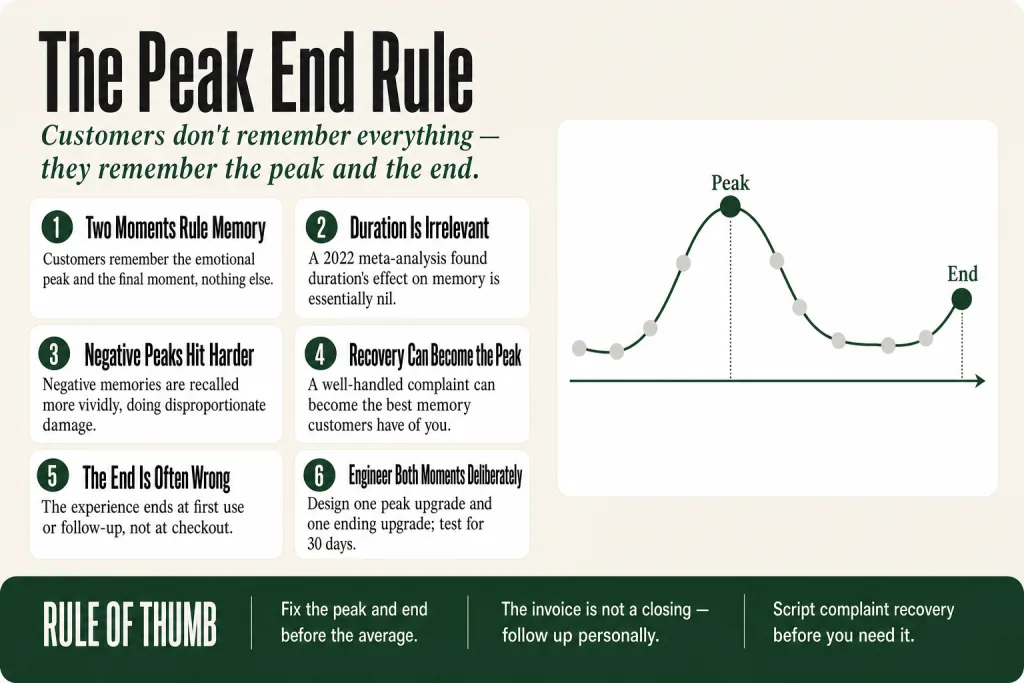
The peak end rule is the finding that when a customer remembers your business, they don’t tally up every interaction and divide by the number of touchpoints. They remember how they felt at the most intense moment of the experience, and how things felt when it was over.
That’s grounded in real research. Kahneman’s work, and a significant body of follow-on study, shows that people’s retrospective ratings are dominated by the emotional peak and the final moment, with the total duration of the experience having almost no effect at all. Your customer who waited fifteen minutes at checkout and then got a warm thank-you note remembers something different from the customer who had a smooth experience throughout but was left with a terse auto-reply. Same quality of service, wildly different memories, and the memory is what drives whether they come back, refer a friend, or leave a review.
Most operators spend their improvement budget trying to smooth out the average. Fix every friction point, tighten every process, optimize every touchpoint. That’s not wrong exactly, but if you’re a small operation with limited time and money, it’s probably the wrong priority order. The peak end rule says: find the moment that matters most, make it extraordinary, then own the exit.
The idea in 30 seconds
- People don’t average every moment of an experience when judging it, they remember the emotional peak (positive or negative) and how it ended.
- Duration neglect is the corollary: a longer experience is not automatically remembered as better or worse, length barely registers.
- A negative peak can be rescued by a strong ending, which is why service recovery done right often produces more loyalty than a flawless experience.
- Most operators under-invest in the end of the customer journey because it feels like the transaction is already done. It isn’t, the memory is still being written.
- You don’t need to fix everything. Identify the one moment of highest emotional intensity and the last impression you leave, then engineer both.
- This is not a soft ‘nice experience’ idea, it predicts repeat purchase, referrals, and review behavior more accurately than satisfaction averages.
Where the Peak End Rule Came From
The research started with an uncomfortable question: if you have to undergo a painful procedure twice, would you choose the shorter one that ends at maximum discomfort, or a longer one that fades slightly at the end, even though you’d endure more total pain?
Rationally, you’d choose the shorter one. Most people don’t.
In 1993, Daniel Kahneman, Barbara Fredrickson, Charles Schreiber, and Donald Redelmeier published “When More Pain Is Preferred to Less: Adding a Better End” in Psychological Science. Participants held their hand in cold water for 60 seconds, then in a second trial endured an additional 30 seconds as the temperature rose slightly. When given the choice of which to repeat, a significant majority chose the longer trial. More total pain, kinder ending, kinder memory. Duration barely registered. The peak and the end did.
A 1996 follow-up by Redelmeier and Kahneman applied the same logic to real colonoscopy patients, comparing real-time pain recordings against retrospective assessments. The pattern held: patients judged the experience by the worst and final moments, not by how long the procedure ran. (Redelmeier & Kahneman, 1996, Pain66(1): 3 to 8.) Kahneman later formalized the theoretical framework in Thinking, Fast and Slow (2011), distinguishing between the experiencing self, which lives through every moment, and the remembering self, which edits the whole thing down to two data points when deciding whether to return, recommend, or avoid. (Kahneman won the Nobel Prize in Economics in 2002 for his broader contributions to behavioral economics, not for the peak-end work specifically, but that underlying research on memory and judgment is what’s directly relevant here.)
A 2022 meta-analysis by Alaybek and colleagues, published in Organizational Behavior and Human Decision Processesconfirmed the effect across a large body of independent samples: the peak-end combination produced a substantial effect on retrospective evaluations, consistent across contexts and stronger than the effects of beginning, trough, trend, or duration. The duration effect was essentially nil. (Alaybek et al. 2022, OBHDP170: 104149.)
The Problem: You’re Optimizing the Wrong Thing
Before this research, the common model of customer experience was roughly utilitarian: more good moments minus bad moments equals a better experience. Smooth out every friction point. Raise average satisfaction scores. Keep complaints low across the board. It sounds logical, which is why most customer experience programs are built around average NPS or average CSAT.
The peak end rule says that model is wrong. People aren’t conducting a running average of your performance. Their memory is being written right now at two specific moments, and the rest of the journey, however long, however consistent, is background noise to the remembering self.
An operator who spends three months flattening every friction point across a twelve-step customer journey has done real work, but if the emotional high of that journey is a mediocre handoff and the exit is an impersonal invoice email, the memory your customer takes away will be mediocre. Another operator who creates a standout moment in the middle and closes with a personal follow-up will win on recall, referrals, and return visits, even with a few bumps along the way.
That’s not permission to be sloppy. Persistent friction will eventually generate its own negative peak. But your optimization priority order should start at the peak and the end, not at the average.
The Peak End Rule in Practice: What You’re Actually Working With
There are four ideas inside this rule that an operator needs to hold simultaneously.
1. The peak can be positive or negative, and it counts either way
The peak is whichever moment in the customer journey carries the most emotional charge. If it’s positive, a surprise upgrade, a handwritten note, an unexpectedly fast delivery, that moment anchors the memory favorably. If it’s negative, a rude employee, a billing error, a broken product on arrival, that’s the anchor instead. The rule doesn’t care about valence. It cares about intensity.
Negative memories are also recalled more vividly than positive ones as a general rule. An unmanaged negative peak does disproportionate damage to how your business is remembered, even if everything else went fine.
2. Duration neglect is real, and counterintuitive
The total length of the experience has almost no effect on how it’s remembered. The 2022 Alaybek meta-analysis found the effect of duration on retrospective evaluation to be essentially nil, consistent with the original 1993 research. A 45-minute appointment and a 90-minute appointment with identical peaks and endings will be remembered essentially the same way. This is uncomfortable for operators who believe that more time spent with a customer automatically signals more value delivered. In memory terms, it doesn’t.
3. The end is where most operators are bleeding
The end of a customer interaction is where attention typically drops. The salesperson has closed. The service technician has finished. The order has shipped. The operator is mentally on to the next job. But the customer’s remembering self is still active, and the last impression is being written right now. A rushed goodbye, a confusing invoice, an auto-reply that feels like the business forgot the customer exists, these are silent killers of memory. They don’t generate complaints. They just quietly reduce the probability of return.
4. The end of the experience may not be where you think it is
For a retail purchase, the end might not be checkout, it might be when the customer gets the product home and opens the box. For a home services job, the end might be the follow-up call three days later. For a software subscription, it could be the offboarding email when someone cancels. Identifying where the experience actually ends from the customer’s perspective, not yours, is often the most valuable audit you can run.
Why Memory Works This Way
Accurate, complete memory is expensive. The brain doesn’t replay your experience like a recording, it constructs a summary from a handful of emotional snapshots. Intensity flags importance. Recency is easy to retrieve. So the peak and the end are disproportionately sampled, and everything else fades.
The remembering self, the one that decides whether you return to a place or recommend it, builds its verdict from the most emotionally charged moment and the resolution. Nobody recounts the uneventful middle in detail. The brain does the same compression, automatically, every time.
There’s also a practical evolutionary angle. Intense emotional moments signal importance, danger, opportunity, social bonding, so they get flagged for retention. Recency matters because the most recent state of a situation is the most relevant for deciding what to do next. The brain’s memory architecture was built for survival decisions, not customer satisfaction surveys, and that mismatch is exactly what operators can learn to work with.
You’re not just in the business of delivering a good experience. You’re giving the remembering self something to build a story around, and that story has two anchor points. You get to choose what they are, or you can leave it to chance.
Putting this to work? The ideas in the Canon are the foundation under the tactical playbook in Build a Complete Marketing Department — grab the free companion kit at mmsvegas.com/resources.
Real Operators Applying the Peak End Rule
A few named examples make this concrete.
IKEA’s exit engineering
IKEA’s in-store experience involves long walking paths, flat-pack decisions, and checkout lines, none of which are inherently delightful. The café and food counter positioned near the exit, after checkout, change the ending: the last thing you do before leaving is buy a satisfying, inexpensive snack. The meatball restaurant mid-store functions as the peak, a real break in the middle of a long journey. Both moments are deliberate. The rest of the trip, with all its friction, fades.
Disney’s farewell characters
Walt Disney World stations Mickey Mouse and other characters at park exits as guests leave at the end of the day. Whatever happened during the visit, the heat, the lines, the overpriced churro, your child’s last memory is a hug from Mickey. The peak-end calculus is engineered directly into the physical layout of the park.
Ritz-Carlton’s $2,000 rule
The Ritz-Carlton empowers every employee, housekeeper or front-desk agent, to spend up to $2,000 per guest, per incident, to resolve a complaint or create a memorable moment, without manager approval. The peak-end logic is straightforward: a problem resolved with speed and real authority becomes the emotional high point of the stay. What most retellings leave out is the number that made the rule rational in the first place, the average Ritz-Carlton guest is estimated to spend roughly $250,000 with the brand over their lifetime. The $2,000 wasn’t generosity. It was math. The recovery story is what the guest tells for years.
Netflix auto-play
Netflix begins playing the next episode before the credits finish rolling on the current one. Rolling credits are a weak, low-energy end moment that invite you to stop watching. By creating a new hook before the previous episode fully concludes, Netflix effectively prevents a clean ending from registering at all, and with it, the decision to leave.
Best Practices for Small Operators
The peak end rule applies anywhere a customer goes through a defined experience with a beginning and an end. For small businesses, four contexts show up most often, and each has a specific place where effort pays the most.
Service businessescontractors, consultants, therapists, accountants, salons, have a natural structure: intake, the work, then delivery and close. The end rarely gets designed deliberately. A simple closing ritual, a hand-written summary, a follow-up call, a small unexpected gift, can shift the memory of an entire engagement. Pick one and do it every time.
Retail (physical or e-commerce) has clear end moments: checkout, unboxing, or assembly. Apple’s unboxing is perhaps the most studied example of a manufactured positive peak, the ritual is slower and more tactile than it needs to be functionally, because the memory is the point. A small retailer can do something similar with intentional packaging, a personal note, or a frictionless return policy that functions as exit reassurance.
Professional serviceslaw firms, agencies, financial advisors, often have emotionally charged moments built in by default: the case resolution, the campaign launch, the financial plan review. The peak is sometimes supplied by the work itself. A final meeting that reframes outcomes, celebrates what was accomplished, and sets up the next engagement is worth more to memory than a hundred smooth status updates along the way.
Digital products and SaaS have the trickiest end problem, because there often isn’t a natural one. The end might be a session close, an account cancellation, or the moment after a key workflow completes. Each of these is an engineering decision, not an accident, and most teams treat them as afterthoughts.
In all four cases, the same two questions apply: Where is the emotional high point of this experience, and is it designed or accidental? What is the last thing the customer feels before their memory locks in, and did you choose it?
Where This Idea Has Limits
The peak end rule is not a license to be mediocre through the middle. Consistent friction and failure will generate its own negative peak, the rule tells you what gets remembered most vividly, not that everything else is irrelevant. A business that delivers a wonderful ending every time but consistently botches the core service is going to accumulate negative peaks faster than good endings can compensate.
The rule also applies most cleanly to experiences with a clear beginning and end. An ongoing subscription service with no natural endpoint, or a long-term consulting retainer, doesn’t have a single ‘end’, it has a series of episodes, each with its own peak and end structure. That’s not a contradiction; it just requires applying the rule at the episode level rather than the relationship level.
High-expectation contexts work differently too. When customer expectations are very high, say, a luxury hotel or a premium professional service, the opening experience becomes more important than in lower-expectation settings. If the gap between expectation and reality is large enough at the start, it can set a negative frame that’s hard to rescue with a good ending.
Finally, this framework says nothing about acquisition. It tells you how customers remember and judge you after the fact. It says very little about what draws a new customer in. Don’t conflate designing memorable experiences with designing compelling marketing, they’re adjacent problems, not the same one.
What People Get Wrong About the Peak End Rule
“The peak has to be a WOW moment.” Not necessarily. A peak is any moment of elevated emotional intensity, relief, surprise, gratitude, frustration, delight. A phone call where your customer feels heard after a complaint is a peak. A handwritten note that arrives unexpectedly is a peak. It doesn’t have to be a production. It has to carry emotional weight. The operators who over-engineer theatrical “wow moments” while leaving their actual service inconsistent miss the point entirely.
“Good endings cancel out bad peaks.” They don’t, exactly. A negative peak is not erased by a good ending, it becomes part of the memory, and the ending adjusts the emotional tone that surrounds it. What a good ending can do is shift the final frame: if a problem was resolved with empathy and generosity, the customer’s last emotional experience is positive, even if the peak was a complaint. That’s the service recovery paradox in action, but it requires the recovery to be impressive, not just adequate.
“Longer experiences are remembered more positively.” The Alaybek 2022 meta-analysis found the effect of duration on retrospective evaluation to be essentially nil. Adding time to a customer interaction doesn’t add value to the memory. A shorter, sharper experience with a deliberate peak and a clean ending will be remembered better than a drawn-out one with a weak close.
“This only applies to face-to-face businesses.” The original research was conducted in clinical and physical settings, but the principle generalizes. Research on video advertising found peak-end effects in ad recall, viewer judgment tracks closely with the ad’s emotional peak and final moment, and carries over to brand evaluation. Digital products, email sequences, and online checkout flows all have emotional arcs with identifiable peaks and ends.
“The ‘end’ is when the transaction closes.” Often wrong. For a product purchase, the end might be the moment of first use, first assembly, or the first time a problem arises. For a service engagement, it might be three days after completion when the follow-up call does or doesn’t happen. Operators who assume the end is checkout are leaving the most powerful moment in the customer memory cycle to chance.
The Peak End Rule Operator Playbook: Running the Audit
Here’s the practical sequence. It doesn’t require a consultant or a survey platform, just honesty about what your customer’s experience actually looks like, start to finish.
Step 1: Walk the journey from the customer’s seat
Map every touchpoint from the moment a prospect first hears about you to the last thing that happens after the transaction closes. Use your customer journey map if you have one; if you don’t, sketch it on paper. The goal is to identify where the emotional highs and lows actually are, not where you assume they are.
Ask real customers if you can. “What’s the part of working with us you’d most want to tell someone about?” and “What’s the part you’d most want to warn someone about?” reveal peaks, positive and negative, faster than any formal survey.
Step 2: Identify your current peak
Where in your customer journey is emotional intensity the highest? Is it a moment you designed, or one that emerged by accident? Is it positive or negative? If you don’t know, that’s the most useful thing you’ve learned in a while, it means you’re ceding control of your most important memory-building moment to chance.
Common accidental negative peaks in small businesses: the moment a customer waits on hold for the third time, discovers a billing error, receives a product that doesn’t match expectations, or has to chase you for a status update. Any of these can become the anchor memory for an otherwise decent experience.
Step 3: Find where your experience actually ends
Be honest about this. For an e-commerce business, it might be furniture assembly at home. For a service business, it might be the invoice email, or, if you’re deliberate about it, a follow-up call. For a restaurant, it’s probably the check delivery and the walk to the car. Map that moment precisely, then ask: is this moment designed, or is it just what happens?
A weak end is almost always a missed opportunity, not a neutral one. If your final customer touchpoint is a system-generated confirmation email that starts with “Your order has been placed,” you are leaving the most high-leverage moment in the customer memory cycle on autopilot.
Step 4: Engineer one upgrade to each
You don’t need to rebuild your entire customer experience. Pick one change to amplify or create a positive peak, and one change to improve the quality of the ending. Test it for 30 days against your existing touchpoints and see if it moves anything measurable: reviews, repeat purchases, referrals, cancellation rate.
For a service business: the peak upgrade might be a mid-project progress update that goes beyond the expected, a short video walkthrough, a summary card that shows what’s been done and why it matters. The ending upgrade might be a personal phone call at project close instead of an emailed invoice.
For a retail business: the peak upgrade might be a product insert that creates a real moment of surprise, not a discount code, but something that demonstrates you know your customer. The ending upgrade might be a three-day follow-up text or email that asks one specific, non-generic question about the product.
For e-commerce: identify your highest negative peak (often shipping delays or unclear tracking) and address it directly at that moment with proactive communication. Then design the post-delivery moment, your first email after confirmed delivery, as a considered touchpoint, not a review request stapled to a template.
Step 5: Use AI to systematize what you’ve designed
Once you’ve identified your peak and end moments, automation tools, an email platform, a CRM trigger, a scheduled reminder, can ensure the designed experience fires consistently. The judgment of what the experience should feel like stays with you. The consistency of delivery is where AI earns its place. A personal follow-up call made 80% of the time is worse than one made 100% of the time because it’s triggered by a workflow you built and own.
Common Mistakes
- Letting the follow-up vanish after the invoice goes out — The invoice is logistics, not a closing. A home-services operator who sends the invoice and goes silent is effectively letting the customer’s last emotional signal be a payment request. Schedule a personal follow-up within five to seven days of completion, a phone call, a short note, one specific question about how things are working. It takes three minutes and it’s the only touchpoint that signals the relationship continues past the transaction.
- Improvising complaint responses instead of scripting them — Unscripted recoveries are almost always slower and less consistent than scripted ones, and consistency is exactly what you need at the moment of highest emotional intensity. One example of what this looks like in practice: an HVAC company with no recovery protocol lost a $12,000 annual maintenance contract after a scheduling miss, because the technician apologized but had no authority to offer anything, and the follow-up call from the owner didn’t happen until five days later. The failure wasn’t the missed appointment. It was the improvised non-response. Write a one-page protocol for your three most common failure modes, who responds, how fast, what they can offer, and what the follow-up looks like.
- Designing a theatrical peak while the actual service is inconsistent — A branded gift box at close doesn’t fix a peak that’s already been set by a frustrating mid-project experience. One web design agency lost a client referral opportunity after delivering a beautifully packaged final presentation, but the client’s dominant memory was three unanswered emails during the project. The emotional peak had already been set, and the presentation didn’t override it. Fix the peak first. Then worry about the packaging.
- Assuming the transaction close is the end of the experience — For a retail purchase, the real end is often product assembly or first use. For a home services job, it’s the follow-up call that either happens or doesn’t. A furniture e-commerce brand discovered this the hard way: their post-purchase email sequence ended at shipping confirmation, but customers’ actual experience ended at assembly, which often surfaced missing hardware and unclear instructions. They were leaving the most emotionally charged customer moment completely unaddressed. Walk the journey from the customer’s seat and mark the last moment of emotional significance from their perspective, that’s what you’re designing for, not checkout.
- Measuring average satisfaction instead of peak and end moments — Add two specific questions to your post-experience feedback: ‘What’s the moment you’d most want to tell someone about?’ and ‘How did things feel when we were done?’ These two questions surface what your NPS average buries, the emotional anchor points that actually determine whether someone comes back or sends a friend. A salon that switched from a generic five-star rating request to these two questions learned that their peak was consistently the consultation, not the cut, and their weakest end moment was checkout, which involved a long wait to pay and no personal goodbye from the stylist. Both fixable. Neither visible in their average score.
Operator’s Take
Here’s the thing most operators miss: the peak end rule isn’t really a design framework. It’s a diagnostic. The first question isn’t “how do I create a great peak?”, it’s “what is my customer’s last memory of working with me, and did I have any say in it?”
Start there. Call three customers from the last 60 days and ask them what the last thing was they heard from you after the work was done. Not what they thought of the work, what the last touchpoint actually was. My strong suspicion is that at least two of them say some version of “the invoice” or “I haven’t really heard anything.” That’s your real ending, right there. Not the one you’d pick. Just the one that happened because nobody designed anything else.
Fixing that is not complicated. A phone call within a week of project completion, personal, brief, asking how things are going, will outperform almost any theatrical closing gesture, because it communicates something the branded gift box doesn’t: the relationship didn’t end when the payment cleared. That’s the message the memory latches onto.
On the peak side, the single most underrated opportunity for most small operators is the handled complaint. A lot of operators dread complaints, treat them as interruptions, and try to close them as fast as possible with a refund or an apology. That’s a missed peak. When something goes wrong, emotional intensity is already running high, you didn’t create it, the situation did. What you do with it determines whether that intensity becomes the worst memory your customer has of you, or the best one.
Script your recovery before you need it. Right now, before the next scheduling miss or the next damaged shipment or the next billing dispute, decide: who responds, how fast, what they’re authorized to offer, and what the follow-up looks like. A plumber I know built a simple one-page protocol for three scenarios, job runs over schedule, part has to be reordered, customer unhappy with a repair. Nothing fancy. But his team knew exactly what to do in each case, at what speed, with what compensation authority. His referral rate is higher than his competitors’ not despite having problems, but partly because his problem-handling is that consistent. Customers who never have a problem with you don’t have a story to tell. Customers whose problem got handled fast and well absolutely do, and they tell it.
One caveat: peak-end thinking can become an excuse for neglecting the middle. “We nail the peak and the end” quietly becomes “the rest doesn’t have to be great”, and that’s where the negative peaks accumulate without anyone noticing. The customer who feels deprioritized across three consecutive calls isn’t forgetting that, no matter how warm your final note is. Peak-end engineering is a targeting decision, not a cover story for a mediocre core service.
Run the ending audit once a quarter. Look at every customer’s last touchpoint with your business in the past 30 days and ask: designed or accidental? If accidental, fix it. The elaborate stuff can wait.
Used in
- ✓ Build a Complete Marketing Department
Used to design the post-purchase and referral stages of the marketing system, specifically, identifying and engineering the peak and end moments that drive reviews, repeat business, and word-of-mouth. - ✓ The Missing Manual for FunnelKit
Applied to the order confirmation and post-purchase automation sequences, the final moments a buyer experiences in a funnel, which are the moments that determine whether they become repeat customers. - ✓ The Missing Manual for Make
Used to build automated workflows that fire at the peak and end moments of the customer journey, ensuring the designed experience is delivered consistently, not just when the operator remembers.
FAQ
Does the peak end rule apply to online experiences, not just in-person ones?
Yes. Research on video advertising found that viewers’ recall of an ad tracks closely with its emotional peak and final moment, and that this judgment carries over to brand evaluation. Any experience with an emotional arc and an end is subject to the same memory dynamics.
What if the peak in my customer experience is negative?
A negative peak isn’t automatically fatal, but it does require a deliberately strong ending to adjust the emotional frame. The service recovery paradox suggests that a well-handled problem can actually become the most positive memory a customer has of your business, but only if the recovery is impressive, not just adequate.
How is the peak end rule different from just ‘making a good first impression’?
First impressions matter for entry, but the peak end rule is about how the experience is remembered after it ends. The end of an experience has at least as much influence on memory as the beginning, and the emotional peak, wherever it falls in the timeline, often dominates both.
Can I engineer a peak artificially, or does it have to happen organically?
It can absolutely be designed. The key is that it needs to carry real emotional weight, surprise, relief, delight, gratitude. A scripted gesture that feels hollow won’t land as a peak. But a thoughtful, specific, well-timed moment, even a simple one, can be deliberately created and will feel real to the customer.
How long after an experience does the peak end rule still influence memory?
The research focused on relatively immediate retrospective evaluations, but the general principle, that memories are built around emotionally intense moments rather than complete recordings, appears durable over longer time horizons. The emotional peak of a well-executed experience can persist in memory for years.
Is duration neglect always true? Does how long a service takes really not matter?
Duration neglect means length doesn’t proportionally affect memory quality, and the 2022 Alaybek meta-analysis found the duration effect on retrospective evaluation to be essentially nil. That said, an experience so short it doesn’t allow for any emotional arc is a different problem. Extending an experience for its own sake adds no memorial value.
Further reading
- Thinking, Fast and Slow (2011) by Daniel Kahneman, The source text for the experiencing self / remembering self framework. Part V covers the peak end material in full context.
- “When More Pain Is Preferred to Less: Adding a Better End”Kahneman, Fredrickson, Schreiber & Redelmeier (1993), Psychological Science4(6): 401 to 405. The original paper.
- “All’s Well That Ends (and Peaks) Well? A Meta-Analysis of the Peak-End Rule and Duration Neglect”Alaybek et al. (2022), Organizational Behavior and Human Decision Processes170: 104149. The most thorough quantitative review of the evidence to date.
- The Power of Moments by Chip Heath & Dan Heath, A practitioner-oriented expansion of how to design peak moments, with business case studies throughout.
Sources:
Kahneman, D. Fredrickson, B. L. Schreiber, C. A. & Redelmeier, D. A. (1993). “When More Pain Is Preferred to Less: Adding a Better End.” Psychological Science4(6): 401 to 405. | Redelmeier, D. A. & Kahneman, D. (1996). “Patients’ Memories of Painful Medical Treatments: Real-Time and Retrospective Evaluations of Two Minimally Invasive Procedures.” Pain66(1): 3 to 8. | Alaybek, B. Dalal, R. S. Fyffe, S. Aitken, J. A. Zhou, Y. Qu, X. Roman, A. & Baines, J. I. (2022). “All’s Well That Ends (and Peaks) Well? A Meta-Analysis of the Peak-End Rule and Duration Neglect.” Organizational Behavior and Human Decision Processes170: 104149. | Kahneman, D. (2011). Thinking, Fast and Slow. Farrar, Straus and Giroux. | Unruly / Affectiva / Richard Shotton (2020). Peak-end rule applied to video advertising recall. Reported by WARC and iMotions. | Nielsen Norman Group. “The Peak, End Rule: How Impressions Become Memories” (2018). | Laws of UX. “Peak-End Rule.” lawsofux.com.
Brian Kasday spent forty years in direct-response marketing before rebuilding the whole operation as a one-person shop. He writes The Operator’s Library — including “Build a Complete Marketing Department” — for operators who’d rather build it themselves than wait on someone else.
Build the department these ideas describe — the free companion kit: mmsvegas.com/resources.
More The Operator's Canon guides
Free · Operator Toolkit
Want the tools, not just the guide?
Get the free operator toolkit — templates and checklists for the systems you actually run, plus a note when this guide changes.
Get the free toolkit →How to cite: Peak End Rule. Associated with Daniel Kahneman & Barbara Fredrickson, 1993. The Operator’s Canon, MMS Vegas. https://mmsvegas.com/library/peak-end-rule/