
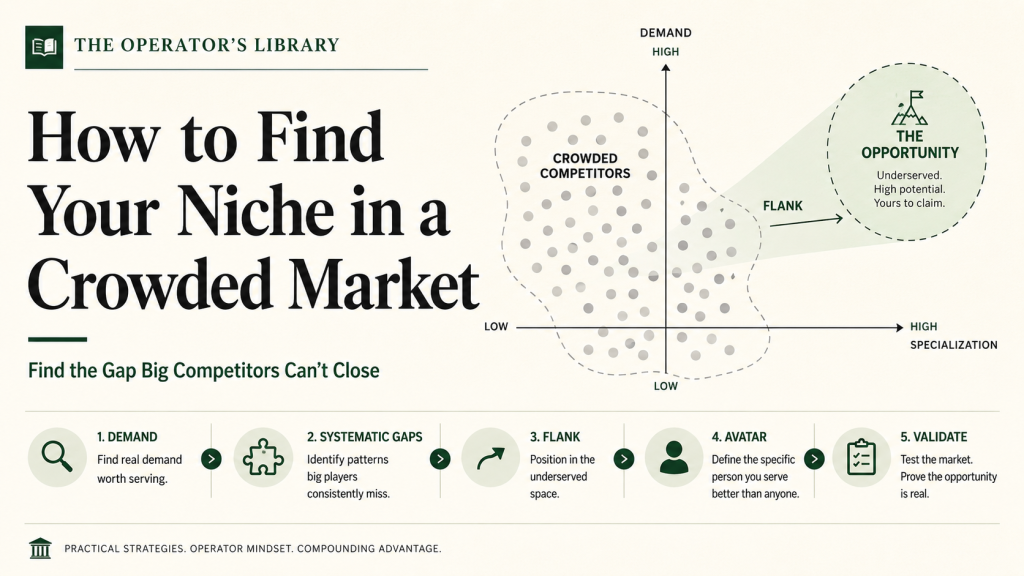
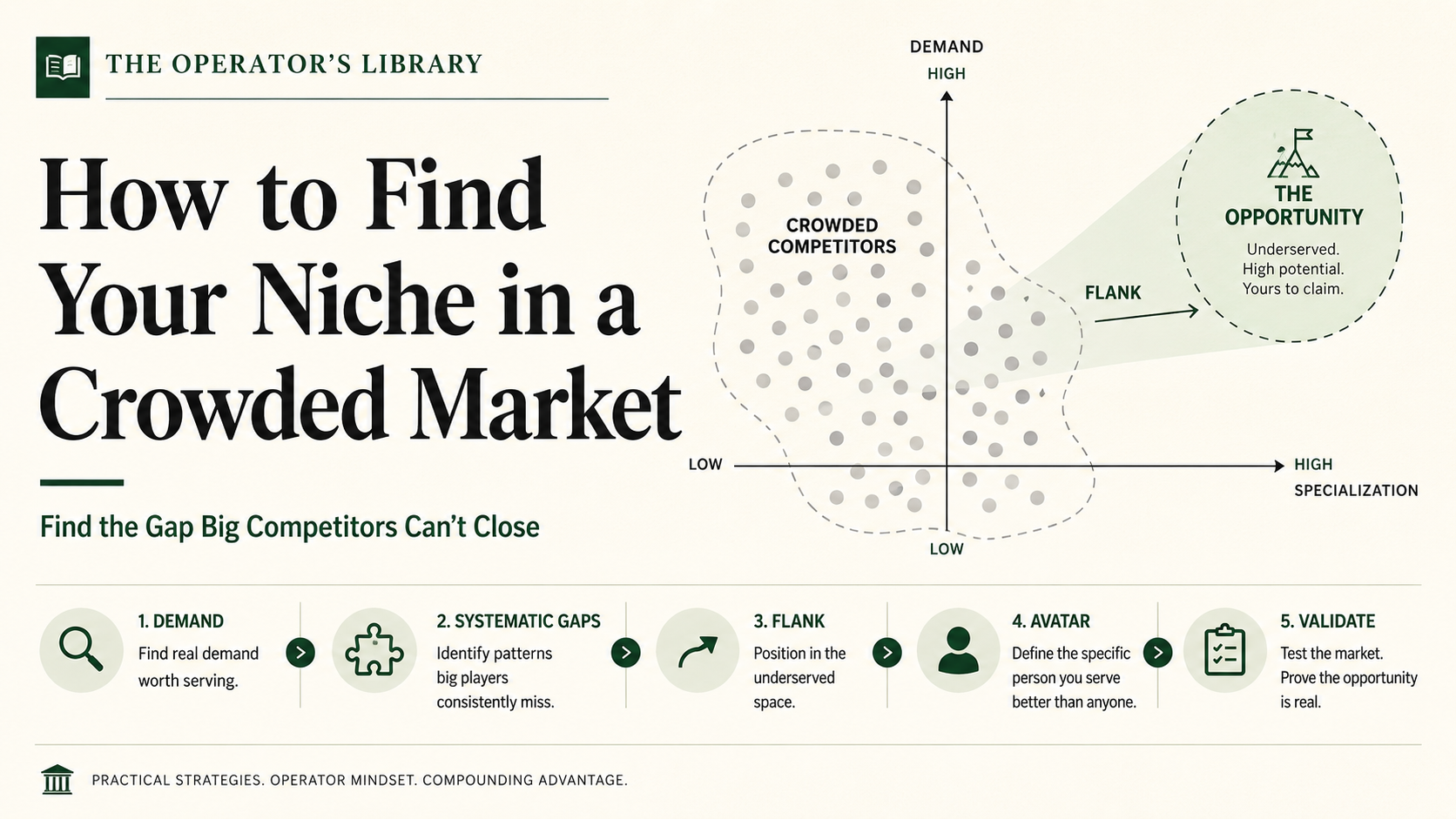
Table of contents
- The 30-second answer
- A crowded market is good news, read it that way
- Where the niches actually hide: the gaps big competitors can’t close
- Flanking, take the position the leader would have to self-destruct to contest
- How to read the competition without a research budget
- Narrow until it’s one person, not a demographic
- Validate before you commit: the 50-signup test
- A worked example: how to find your niche in a crowded market
- Frequently asked questions
You looked at the market you want to enter and saw fifty competitors already in it, so you assumed the door was closed. It isn’t. Learning how to find your niche in a crowded market starts with flipping that instinct on its head: a crowded market isn’t a warning sign, it’s a receipt. It proves people are already spending money on this problem. The empty market you were hoping for usually isn’t undiscovered, it’s empty because nobody will pay. Competition means demand, and demand is the hard part to find.
The real question isn’t “is this market too crowded?” It’s “where in this crowded market is everyone systematically failing the same customer?” Big competitors leave gaps the way a parked truck leaves a blind spot, predictably, structurally, and right where they can’t easily look. This is the flanking playbook for finding that gap and owning it, as one person, without a research department.
The 30-second answer
To find your niche in a crowded market, look for systematic failure, not empty space:
- Treat competition as proof of demanda market with money moving in it beats an “untapped” market with no buyers.
- Find what big competitors consistently fail atthey’re optimized around their core customer, which leaves everyone else under-served by design.
- Flank, don’t chargetake the position the market leader would have to dismantle their own business to contest.
- Narrow to one avatara niche is a specific customer with a specific problem, not a slightly smaller version of “everyone.”
- Validate cheaply firstabout 50 email sign-ups says the niche is real; two weeks of silence says move on before you build.
A crowded market is good news, read it that way
Most advice about niches starts in the wrong place: “find an untapped market.” It sounds smart and it’s usually a trap. Markets with no competition are markets where people don’t spend money. If you’ve found a space with no one in it, the most likely explanation isn’t that you’re a visionary, it’s that someone already tried and discovered there’s no wallet behind the interest.
Markets with competition are markets where people spend money. That’s the reframe that changes everything downstream. The fifty competitors you were intimidated by are fifty proofs that this audience pays to solve this problem. Your job isn’t to find a room nobody’s in. It’s to find the seat in a crowded room that nobody’s sitting in, the specific customer or specific problem that the crowd, for structural reasons, can’t serve well. Once you see crowding as a demand signal, you stop looking for empty markets and start looking for gaps inside busy ones. That’s a much easier search, and a far more profitable one.
Where the niches actually hide: the gaps big competitors can’t close
Here’s the structural insight that makes flanking work: large companies are optimized around their core customer, which means they’re systematically under-optimized for everyone else. That’s not a failure of effort. It’s the cost of scale. A company built to serve the broad middle of a market has to make choices, defaults, packaging, support scripts, pricing tiers, that fit the average buyer and quietly fail the buyer who’s a little different. Those failures are consistent and predictable, which is exactly what makes them a business you can build.
So you stop looking for what competitors do badly in general and start looking for what they fail at consistently for a specific kind of customer. The enterprise tool that’s overkill and overpriced for a one-person shop. The “family restaurant” that has nothing a serious vegetarian wants. The bank built for businesses with a CFO, leaving sole proprietors to fend for themselves. Each of those is a market leader’s blind spot, a customer they’re under-serving by design because serving them well would mean compromising the core offer they’re optimized around. You don’t have a core to protect. That’s your advantage.
Finding these gaps is research, and it’s the kind of research that used to take a month and now takes an afternoon. The companion piece on market research with AI walks through the full workflow; here we’ll focus on the specific competitive read that surfaces a niche.
Flanking, take the position the leader would have to self-destruct to contest
Flanking is a military idea borrowed into marketing: you don’t attack the strong point head-on, you go around it to the position the defender can’t easily turn to face. In business, the test for a real flanking position is precise, you want to find the position the market leader would have to dismantle their existing business to contest. If they could just copy you next quarter, it’s not a flank. It’s a feature they’ll absorb.
Two classic examples make it concrete. Southwest didn’t try to out-American-Airlines American Airlines. It took the low-cost, high-reliability, no-frills position, and the legacy carriers couldn’t follow without unwinding their hub-and-spoke, assigned-seat, multi-class businesses. To match Southwest, they’d have had to stop being themselves. FedEx did the same to the incumbents with one owned promise: “absolutely, positively overnight.” Overnight reliability became their territory, and a competitor optimized around ground shipping couldn’t claim it without rebuilding their whole operation.
That’s the bar for your niche. Not “I’ll do what they do, a bit better”, better is copyable and gets erased. The flanking position is the one where the leader’s own structure is the thing stopping them from following you. When you find it, you’re not competing in the crowded market anymore. You’ve quietly stepped out of it and started your own smaller one, where you’re the obvious choice. Owning that position then becomes a positioning job, and it’s how you stop competing on price before you’ve even launched.
Run the competitive read yourself. The free prompt library that ships with Build a Complete Marketing Department includes the Competitive Analysis prompt used below, it maps table stakes, systematic gaps, and positioning windows from your three closest competitors. Grab the prompt library →
How to read the competition without a research budget
You don’t need a market-research firm to do this. You need your three closest competitors’ public material, their homepages, pricing pages, top reviews, the complaints in their one- and two-star ratings, and a structured way to read it. The book’s Competitive Analysis prompt organizes the read into a few parts worth stealing wholesale.
Table stakes: what every competitor offers and says. This isn’t your opportunity, it’s the price of admission. Note it so you don’t waste your differentiation budget on things the market already assumes.
Systematic gaps: what they all fail at, or fail at for a particular customer. Read the negative reviews especially, they’re a free, honest list of unmet needs. When the same complaint shows up across every competitor (“great product, support is useless for beginners”), you’re not looking at a one-off. You’re looking at a structural gap, which is to say a niche.
Positioning windows: the specific customer-plus-problem combinations nobody is claiming cleanly. This is where your “Only We” statement comes from, the sentence “we’re the only [business] that [specific thing] for [specific customer]” that a generalist can’t contest. Feed the model the raw material, ask it to separate table stakes from genuine gaps, and pressure-test each gap with: could the market leader fill this without abandoning their core customer? The ones where the answer is no are your candidates. You’re collaborating with the model here, not delegating, the sharper the competitor material you put in, the sharper the gaps it finds.
Narrow until it’s one person, not a demographic
A niche isn’t a smaller slice of “everyone.” It’s a specific person. The mistake that keeps people stuck in the crowded market is defining the target as a demographic, “small business owners, 30 to 55”, which is just the broad market with a haircut. Demographics tell you who someone is on paper. Psychographics tell you what keeps them up at night, what they’ve already tried, what they’re afraid of, and what they actually want. The niche lives in the psychographics.
The discipline the book insists on is narrowing to one avatar, a single, vivid customer you understand well enough to picture their day. Not because only one type of person will buy, but because writing to one specific person produces marketing that resonates, and writing to “everyone” produces marketing that resonates with no one. When you can describe one customer’s exact frustration with the current options in the crowded market, in their words, you’ve found both your niche and the message that sells to it. Building that profile is the other half of the research workflow in market research with AIand it’s what every page and email you write afterward points back to.
Validate before you commit: the 50-signup test
You’ve found a gap and a person. Before you build the whole business around it, test that the niche will actually pay attention, cheaply, before you invest. The book’s validation shortcut is blunt and useful: put up a simple page describing the specific offer for the specific customer, drive a little traffic to it, and ask for an email address. Roughly 50 sign-ups in a couple of weeks tells you the niche is real and reachable. Two weeks of near silence tells you something’s wrong, the gap you found isn’t one people feel, or you’re describing it in language they don’t use. Either way, you learned it for the cost of an afternoon instead of a launch.
The principle underneath is one to keep: a hundred people who asked to hear from you will out-earn a thousand you bought. A validated niche with a small, genuinely interested list beats a big speculative market every time, because interest you earned converts and interest you rented doesn’t. Once the signal’s there, you wire the page to capture and the sequence that follows it, the mechanics live in build a sales funnel without a team and the welcome email sequence. Once the signal is there, FunnelKit can handle the capture and follow-up mechanics, while Make can automate the research pull later if the workflow becomes repetitive, that’s an advanced step, not a starting one. The FunnelKit guides cover the capture side.
A worked example: how to find your niche in a crowded market
Say you want into the meal-prep space, about as crowded as markets get, packed with national delivery brands, apps, and local cooks. Charging the middle of that market head-on is suicide. So you flank.
Read the crowd: the big delivery services are optimized around the broad customer who wants variety and convenience. Scan their reviews and the same systematic complaints repeat, repetitive options, useless for anyone with a real dietary restriction, portion sizes built for one. Those aren’t bugs. They’re the cost of serving the average eater well.
Find the flank: the customer the giants structurally fail is the one with a non-negotiable, specific need, say, an endurance athlete who needs precise macros and large portions, or someone managing a specific medical diet. A national brand can’t serve them well without fragmenting the standardized menu their whole operation runs on. That’s a position they’d have to dismantle their business to contest.
Narrow to one person: not “health-conscious eaters” but “the marathoner in heavy training who’s tired of weighing chicken at 9pm and wants their week’s macros handled.” One avatar, vivid enough to write to.
Validate: a one-page offer, “macro-exact meal prep for endurance athletes, built for your training block”, and an email capture. Fifty runners sign up in two weeks and you’ve confirmed the niche before cooking a single meal. You didn’t beat the meal-prep giants. You stepped out of their market and started a smaller one where you’re the only real choice.
Frequently asked questions
Isn’t a crowded market a reason to stay out?
No, it’s usually a reason to go in. A crowded market is proof that people are already spending money to solve the problem, which is the single hardest thing to verify about any business idea. The genuinely empty markets are usually empty because there’s no willingness to pay. Instead of avoiding the crowd, find the specific customer the crowd serves badly and own that seat.
How is finding a niche different from just picking a smaller audience?
A smaller audience is still “everyone, but fewer of them.” A niche is a specific customer with a specific problem that bigger competitors fail at for structural reasons. The test is whether a market leader could serve your customer well without compromising their core business, if they can’t, you’ve found a real niche; if they could just add it as a feature next quarter, you’ve only found a smaller slice of the same crowded market.
What is flanking in marketing?
Flanking means taking a position the market leader can’t follow you into without dismantling their existing business. Southwest took low-cost, high-reliability air travel that legacy carriers couldn’t match without unwinding their hub model; FedEx owned “absolutely, positively overnight.” You’re not trying to beat the leader at their strength, you’re claiming ground their own structure prevents them from defending.
How do I find the gaps without a market research budget?
Use your three closest competitors’ public material, homepages, pricing, and especially their one- and two-star reviews, which are a free list of unmet needs. Sort what you find into table stakes (what everyone offers), systematic gaps (what they all fail at, especially for a specific customer), and positioning windows (customer-plus-problem combinations nobody owns). An AI model will do the sorting fast if you feed it the raw material and ask it to separate the genuine gaps from the price of admission.
How do I know the niche is real before I commit?
Validate cheaply. Put up a simple page describing the specific offer for the specific customer, send a little traffic to it, and ask for an email. Around 50 sign-ups in a couple of weeks is a strong signal the niche is real and reachable; two weeks of near silence means the gap you found isn’t one people feel, or you’re not describing it in their language. You learn either answer for the cost of an afternoon instead of a full launch.
Sources
Grounded in Build a Complete Marketing Department for a Few Bucks a Day by Brian Kasday, Chapter 6 (Flanking, reading the competition for systematic gaps, the Competitive Analysis prompt, the Southwest and FedEx examples), Chapter 5 (How to Tell if a Market Is Worth Your Time, market sizing and the validation shortcut), Chapter 7 (The Customer Avatar, psychographics and the single-avatar discipline), and Chapter 4 (Market Research in an Afternoon).
Brian Kasday spent 40 years in direct-response marketing before rebuilding the entire capability as a one-person operation, strategy, funnels, copy, and automation, using classic discipline and a few-dollars-a-day AI stack. He writes The Operator’s Library for MMS Vegas.
Find your niche, then own it. Build a Complete Marketing Department for a Few Bucks a Day is the full system, market selection, positioning, offers, and the prompt library that runs them. Get the book → | Download the free prompt library →
More Marketing guides
Free · Marketing Operator Toolkit
Running marketing on your own?
Get the free toolkit — the templates and the expensive mistakes behind a one-person marketing department, plus a note when this guide changes.
Get the free toolkit →