
Last updated: July 2026
The strategy of preeminence is Jay Abraham’s argument that the most powerful position any business can occupy isn’t cheapest, fastest, or most feature-rich, it’s most trusted. By the end of this page, you’ll have a clear picture of what that shift looks like in practice, why it quietly drives referral businesses more than any formal referral program, and how to tell whether your operation is actually living it or just saying you are.
Most small businesses compete on what they do and what it costs. The strategy of preeminence says that’s the wrong race entirely. The business that wins long-term isn’t the one with the best price sheet, it’s the one clients think of as their advisor, their protector, the person they call before they make a decision. That position isn’t advertised into. You earn it interaction by interaction, and once you have it, competitors can’t buy it away from you.
That’s the promise. It’s also, frankly, where a lot of operators misread the idea, so let’s start from the beginning and get precise about what it actually means.
The idea in 30 seconds
- Jay Abraham’s strategy of preeminence means positioning yourself as your client’s most trusted advisor, not a vendor competing on price or features.
- The core shift: stop thinking about making sales; start thinking about protecting your client’s best interests in every interaction, even when that costs you a transaction.
- Preeminence isn’t a marketing tactic you run, it’s a stance that governs how you hire, communicate, recommend, and follow up.
- The mechanism that makes it pay: clients who genuinely trust you refer others without being asked and return without needing to be re-sold.
- It works especially well for small operators because trust is harder for large, faceless businesses to manufacture, and you can out-trust any national chain in your market.
- The risk is confusing preeminence with servility, this isn’t about being agreeable; it’s about being the person who tells clients what they actually need, not what they want to hear.
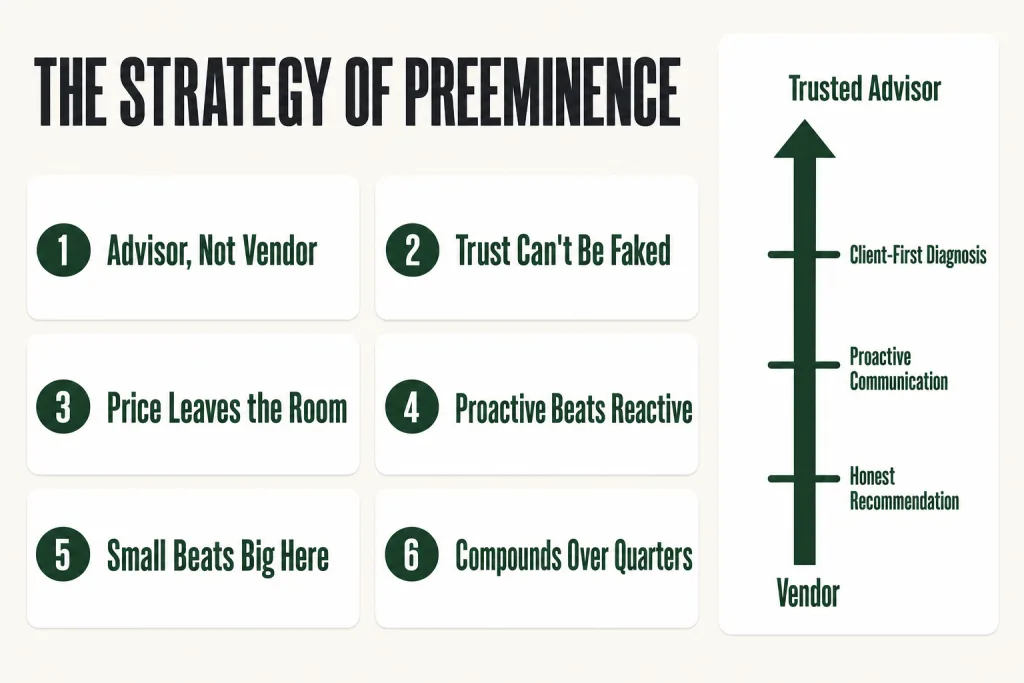
Where the Idea Came From
Jay Abraham built his consulting career the hard way, getting paid based on results, not retainers. That model forced a discipline most consultants avoid: you can’t optimize for your own revenue when your revenue depends entirely on your client’s outcome.
The strategy of preeminence as a named framework reached a wide audience through Abraham’s 2000 book Getting Everything You Can Out of All You’ve Got (St. Martin’s Press). Chapter four, titled ‘Your Business Soul, the Strategy of Preeminence’, tells you exactly how central he considered it to everything else in the book. Abraham has said publicly that preeminence is the framework that has transformed more businesses than anything else in his catalog.
What’s interesting about the origin: Abraham didn’t develop this from theory. He learned it from a client, a company that was dramatically out-selling its closest competitor while running meaningfully higher margins in a fiercely competitive industry. He watched, formalized what he saw, and built a teaching career around it. That’s a different lineage than most marketing frameworks, which tend to emerge from academic research or pure theorizing.
Since 2000, Abraham has continued developing the idea through seminars and teaching. In 2025, he co-authored a dedicated book on the subject with Dr. Villy Abraham, PREEMINENCE: How to Become the Only Choice Your Market Can Trust: A Philosophy for Earning Loyalty, Leadership, and Lasting Advantage (paperback ISBN 9798253562345; Kindle ASIN B0GS7HNN9D). Dr. Villy Abraham is a marketing professor whose work connects behavioral science and decision-making to real-world business; the collaboration extends the original framework into modern client psychology. The framework is old enough to have a real track record and recent enough that most small operators still don’t apply it consistently.
What the Strategy of Preeminence Actually Says
Strip it down and the strategy of preeminence makes one big claim: your clients should experience you as their most trusted advisor, the person who has their best interests at heart, not as a vendor who wants their money. That’s the first-order idea. Everything else follows from it.
Abraham uses the word ‘client’ deliberately. He distinguishes it from ‘customer’, someone who buys a commodity, and frames a client as someone under your care, protection, and well-being. That word choice isn’t polish. It’s an operational instruction: treat every person you interact with as someone whose interests you’re responsible for protecting.
That stance has real operational teeth. Here’s what it actually requires.
You don’t let clients do less than what they should
This one surprises people. Abraham’s position is that if you genuinely believe your product or service will help a client, letting them buy less than they need, or not buy at all out of excessive deference, is a disservice to them. The analogy he uses is medical: a doctor who knows a patient needs surgery but says ‘well, it’s your call’ isn’t being kind. They’re being negligent. The preeminent business operates with the same sense of professional obligation. You advocate for what the client actually needs, even when that requires uncomfortable directness.
That’s not a license to up-sell everyone. It’s a license to stop tiptoeing around the truth of what would genuinely help someone and to say it plainly.
You start from the client’s perspective, not your own
Every interaction, not just sales conversations, begins from the question: what does this person actually need right now? Not ‘what can I say to move this deal forward,’ but ‘what outcome is best for them?’ When you hold that consistently, clients feel it. Most people are surprisingly good at detecting when someone is genuinely trying to help them versus performing helpfulness while chasing a commission.
You think in relationships, not transactions
Most businesses treat every sale as a discrete event. Money changes hands, file closes, next customer. The preeminent business understands that each interaction is one moment in a long relationship, and that the relationship is the asset, not the transaction. This changes what you optimize for at every touchpoint: onboarding, follow-up, how you handle a complaint, whether you proactively share information that helps the client even when it doesn’t directly benefit you.
You add value before money changes hands
Abraham’s framing on this is consistent across his teaching: the opportunity, responsibility, and obligation in any interaction is to make the other person’s situation better because you were in it. That applies to a prospect inquiry, a complaint email, a chance conversation at a trade show. The preeminent business earns its position in the prospect’s mind before the sale happens, not during the pitch.
These four expressions of preeminence are what separate it from a positioning slogan. A lot of businesses say they put clients first. The strategy of preeminence describes what it actually looks like to do it, and what you have to give up to pull it off.
Why It Works, and Why Most Businesses Can’t Fake It
Trust is hard to manufacture and impossible to fake at scale. That’s the simple reason the strategy of preeminence produces durable results that conventional advertising can’t replicate.
When a client genuinely experiences you as someone who has their back, who has steered them away from a bad decision, told them something they didn’t want to hear, recommended a competitor when you weren’t the right fit, your position in their mind changes completely. You stop being a vendor they compare against three alternatives. You become the default. They stop shopping when they have a need in your category. And critically: they start referring without being asked, because referring you feels like doing their friends a favor rather than promoting a product.
That referral mechanism is the most underappreciated consequence of practicing preeminence consistently. Formal referral programs, gift cards, cash incentives, ‘give one get one’ structures, work fine when the underlying relationship is transactional. But they tend to produce one-off referrals from people who were mildly satisfied. Preeminence produces a different thing: clients who become unprompted ambassadors because they trust you enough to stake their own reputation on the recommendation. That’s a different quality of referral, and it compounds. The referred prospect arrives pre-sold rather than pre-skeptical.
There’s also a pricing dimension that operators often miss. The most trusted advisor in a category doesn’t compete on price, because their clients aren’t shopping the category anymore. When you own the trusted advisor position in a client’s mind, the purchasing decision is already made before price enters the conversation. Price becomes a detail to work out rather than the primary decision lever. That margin protection is real, and it’s hard to put a number on, but any operator who’s experienced it knows exactly what it feels like when clients stop asking for quotes from three vendors and just call you.
The reason most businesses can’t execute this consistently is that it requires subordinating short-term gain to long-term relationship value, and most business incentive structures punish that. Sales reps are measured on closed revenue, not on client outcomes twelve months later. Marketing campaigns are measured on lead volume, not on whether the clients they attracted were genuinely well-served. Preeminence requires restructuring those incentives, which is an organizational commitment, not just a messaging choice.
For a small operator running their own business, this is an advantage. You don’t have a sales team optimized for closing at the expense of fit. You have one voice, yours, that can hold the trusted advisor posture across every client relationship. That’s not a consolation prize for being small. It’s a structural edge that scales with you if you protect it deliberately.
The Strategy of Preeminence in Practice: What It Looks Like Day-to-Day
The concept sounds clean in the abstract. The execution is where most operators get vague. Here’s what actually practicing this looks like in the work week of a small business:
The honest recommendation, including the one that costs you
A client asks if they need the premium package or if the standard one will do. If the standard one genuinely fits their situation, you tell them, clearly and without performing reluctance. The short-term revenue loss is real. The long-term trust deposit is larger. The client you steered away from an unnecessary upgrade becomes the client who refers three people without you ever asking, because they experienced something rare: a business that didn’t try to upsell them when it had the opportunity.
This doesn’t mean underselling yourself chronically. It means your recommendations are driven by what’s right for the client rather than what’s best for the current period’s numbers. There’s a difference, and your clients can tell.
The proactive call or email they didn’t ask for
A supplier price change is coming. A regulation in your industry is shifting. You spotted a gap, a risk, or an opportunity in a client’s situation that they probably haven’t thought about. The preeminent operator mentions it, emails it, calls about it, without being asked and without an obvious commercial angle. You’re doing it because you’d want someone to tell you. That’s the litmus test: would you want your own advisor to bring this to your attention? If yes, bring it.
Two concrete examples of what this looks like: an HVAC contractor who emails clients in September to say heating season demand will tighten service windows by October, book maintenance now if you want to avoid the rush. No upsell attached. Just useful timing. Or an accountant who flags a new deduction category in a three-line email before year-end, knowing the client won’t read the IRS notice themselves. The specific form varies. The discipline, sending it whether or not it benefits you commercially right now, is the practice.
This is one of the simplest and most consequential behaviors in the whole framework. Most operators don’t do it consistently because it has no immediate payoff. It does, it’s just deferred by a quarter or two.
Your intake process as diagnostic, not sales theater
The preeminent operator treats the first client conversation as a genuine diagnosis of what this person actually needs. Not a discovery call designed to funnel toward a pre-packaged offer. An actual attempt to understand the situation, including what they might need that you don’t offer, what might disqualify them from being a good fit for your service, what they should do before hiring anyone including you. Prospects feel the difference immediately. A conversation that’s clearly focused on their situation rather than on your offer is rare enough to be memorable.
Handling complaints as relationship investments
Something goes wrong, and it will. The preeminent response isn’t to minimize liability or shift blame. It’s to treat the complaint as a signal worth following seriously, respond faster than the client expects, and fix the issue more generously than they asked. Most clients don’t expect perfection. They expect honesty when something breaks and responsiveness when it matters. The complaint that’s handled well often produces a stronger relationship than the one that never had a problem.
The client you refer out
Sometimes the honest answer is that you’re not the right fit for this person’s need, and someone else is better positioned to serve them. The preeminent operator says so, names the person, and makes the connection. That referral out feels counterintuitive every time you do it. It works every time you do it, the goodwill it generates, the reputation it builds, and the reciprocal referrals it tends to produce consistently exceed the value of the client you declined.
Putting this to work? The ideas in the Canon are the foundation under the tactical playbook in Build a Complete Marketing Departmentgrab the free companion kit at mmsvegas.com/resources.
Where You See It Working in the Real World
Preeminence doesn’t have a press release. You don’t see ‘we practice the strategy of preeminence’ in anyone’s about page. But you see the results of it everywhere you look, and you notice its absence just as clearly.
The independent financial advisor who sends clients a one-page note every quarter, not a sales email, just a summary of what’s changed in their situation and what they should know, is practicing it. The advisor who only reaches out when it’s time to renew isn’t. The first one gets referrals to every peer and family member the client has. The second one gets a polite conversation about whether to switch firms.
The mechanical shop that calls a customer to say ‘I looked at your brakes and they’re fine, you’ve got at least a year on them, no need to replace now’ is practicing it. Most shops don’t make that call. The ones that do build a waiting list of customers who tell everyone they know. The ones that don’t wonder why Google reviews aren’t converting to loyalty.
At scale, you see it in businesses like Costco, which pulls products from its shelves when it believes a vendor has compromised on quality, acting in the member’s interest even when the member didn’t know there was an issue. That’s not a marketing campaign. It’s a policy that costs money in the short run and generates extraordinary member loyalty over decades. Costco’s U.S. and Canada membership renewal rate has held around 92% through fiscal year 2025 and into fiscal 2026, that’s what the trusted advisor position looks like when it’s held at institutional scale.
In B2B professional services, accounting, law, consulting, IT, the dynamic is even more pronounced. The accountant who proactively identifies a deduction the client missed, the IT provider who calls to flag a vulnerability before it’s a problem, the attorney who emails to say ‘this regulation changed and here’s what it means for your contracts’, these are the practices that build a book of business that largely runs on referrals. The practitioners who only respond when called tend to compete on price and spend significant time on client acquisition. The ones who practice preeminence spend that time on client work instead.
The pattern is consistent: businesses that operate from the trusted advisor stance tend to grow by referral even when they’re doing no formal referral marketing. The clients do the acquisition work for them. That’s the compound effect Abraham was pointing at, and it’s more powerful in a small business than in a large one, because the trusted advisor in a small business has a name and a face, which makes the trust transferable in ways that a corporate policy never quite achieves.
Why the Strategy of Preeminence Matters More Right Now
Here’s the context that makes preeminence not just a timeless idea but a timely one: the market is currently being flooded with generic, AI-generated content, outreach, and offers that all sound roughly the same. Every inbox, every feed, every search result is louder and less differentiated than it was five years ago. The question buyers are increasingly asking isn’t ‘which of these options is the right one’, it’s ‘which of these can I actually trust.’
The trust deficit is real and measurable. Only 7% of consumers say visible AI-generated marketing content makes them trust a brand more, while 31% say it actively makes them trust a brand less, according to December 2025 data from Klaviyo and Datalily via eMarketer. In an environment where the barrier to generating polished content is essentially zero, the content itself is no longer the differentiator. The relationship is. The judgment behind the content is. Those are human things, and specifically, they’re things a small operator can do better than a large one running automated outreach at scale.
Abraham was making this argument long before generative AI existed. His point was that most markets already have too many vendors and not enough advisors, that the gap between ‘someone who sells this’ and ‘someone I trust to guide me through this’ is almost always wider than operators realize, and that closing that gap is the most consequential business move available. In 2026, that gap is wider than it’s ever been. The small operator who genuinely holds the trusted advisor position in their market is competing in a category of one.
There’s also an AI-in-your-own-business angle worth flagging. AI tools can help a preeminent operator punch well above their weight, drafting the proactive client update, organizing follow-up sequences, surfacing information a client might need before they ask for it. The judgment about what to say, how honest to be, and when to make the uncomfortable recommendation stays with you. AI cuts your dependence on outside help for the operational pieces; the advisor relationship itself remains irreducibly human. That’s not a limitation, it’s the moat.
Where Preeminence Fits (and Where It Doesn’t)
The strategy of preeminence works best in categories where the buying decision is complex, repeated, or consequential enough that trust is a real factor, which covers more of the small business world than you might initially think.
High-fit contexts: professional services of any kind (accounting, law, consulting, insurance, financial planning), home services where clients make recurring decisions (HVAC, pest control, plumbing, landscaping), B2B relationships where the vendor touches the client’s operations, healthcare-adjacent services, any business where clients have alternatives and the switching cost is low but the relationship quality is high. In all of these, the trusted advisor position is the difference between a client who price-shops you annually and a client who introduces you to their whole network.
Lower-fit contexts: pure commodity purchases where price is genuinely the only variable and the buyer has no interest in a relationship (fuel, undifferentiated raw materials, basic consumables bought through purchasing departments). Preeminence doesn’t produce results when the client doesn’t want an advisor, they want a price. No amount of proactive communication will create relationship value with a buyer who has been explicitly tasked with minimizing cost and has no discretion over who they buy from.
It also fits less neatly in very high-volume, low-touch businesses, not because the philosophy is wrong, but because the personalization it requires becomes harder to execute at scale without deliberately building systems to support it. A restaurant can practice preeminence with regulars. A fast-food franchise probably can’t, at least not in the same way.
The honest assessment: for probably 80% of small business operators, service businesses, professional practices, B2B companies, local trades, consultants, this is the single highest-ROI positioning shift available. It doesn’t require a marketing budget. It requires a consistent stance.
What People Get Wrong About the Strategy of Preeminence
Misunderstanding 1: Preeminence means never selling aggressively. This is the most common misread. The preeminent advisor has an obligation to advocate for what the client actually needs, including actively steering them toward buying more when more is genuinely what serves them. The anti-selling posture is a corruption of the idea. If you believe your product will genuinely help someone, allowing them to not buy it, or to buy a lesser version that won’t serve them as well, is a failure of care, not an expression of it. Preeminence gives you permission to be more assertive in advocacy, not less. The difference is that the advocacy is driven by the client’s outcome, not by your revenue target.
Misunderstanding 2: It’s just a mindset, so there’s nothing to implement. The mindset matters, but the strategy of preeminence has real operational expressions. How you structure your intake process. Whether you proactively communicate relevant information. How you handle complaints. Whether you refer clients out when you’re not the right fit. These are practices, not attitudes. An operator who says ‘I have the preeminence mindset’ but never makes the uncomfortable honest recommendation or the proactive phone call is not practicing preeminence. They’re just thinking nice thoughts about their clients.
Misunderstanding 3: Preeminence only works for high-end or luxury businesses. It’s most powerful in commodity-ish categories, where the default client assumption is that all vendors are interchangeable, because the contrast with competitors is sharpest. The electrician who calls to explain what was found in the panel, what it means, and what the options are (including the option to defer) is practicing preeminence in a category most people treat as pure commodity. The contrast with the three other electricians who just showed up, did the work, and left is enormous.
Misunderstanding 4: You have to wait until you’re established to practice this. Abraham’s own framing inverts this. You start treating prospects as clients, acting in their interest, providing value, offering your honest perspective, before money has changed hands. The ‘most trusted advisor’ position is something you earn by behaving like an advisor from the first contact, not something you unlock after a certain revenue threshold. Starting from day one is how you build the position in the first place.
Misunderstanding 5: Preeminence and positioning are the same thing. They’re related but distinct. Positioning is about the claim you occupy in the market’s mind, what you’re known for and how you’re differentiated. Preeminence is about how you behave in every client relationship. A business can be well-positioned without practicing preeminence (it just competes on the strength of its claim). A business can practice preeminence without particularly sophisticated positioning. They reinforce each other, a well-positioned preeminent business is formidable, but they’re not the same move.
Common Mistakes
- Practicing preeminence only with existing clientsStart treating prospects like clients from the first touchpoint, offer honest perspective, useful information, and genuine diagnostic questions before any money changes hands.
- Confusing agreeable with advisorThe preeminent stance requires telling clients what they need to hear, not what they want to hear, including recommending less, pushing back on bad decisions, and declining work that isn’t a good fit.
- Doing it inconsistently when the cost is low, abandoning it when the cost is realBuild the uncomfortable moments, the honest recommendation, the referral out, the proactive problem flag, into your explicit process so they happen by design, not just when it’s convenient.
- Treating it as a messaging choice rather than an operational onePreeminence isn’t a tagline or an about-page claim; audit your intake process, complaint handling, follow-up cadence, and proactive communication practices, those are where it either exists or doesn’t.
- Expecting it to produce short-term resultsPreeminence compounds over quarters and years, not weeks, track referral rate and client retention as your primary KPIs, and give it a minimum of six months before evaluating whether it’s working.
Operator’s Take
My honest read after watching a lot of operators try to apply this: preeminence is nearly impossible to argue with as a concept, genuinely hard to execute with any consistency, and massively underutilized, not because operators don’t believe in it but because the daily pressure of running a business constantly pulls in the other direction. You intend to be the trusted advisor. Then a slower month hits, a renewal is on the line, and suddenly the ‘right’ recommendation starts to sound a lot like the one that keeps the deal alive.
That’s where the rubber actually meets the road. Not in some aspirational future state, this week, when the client asks if they need the full scope or if a lighter version would do. When you spot something in their situation that has nothing to do with your service and you have to decide whether it’s worth mentioning. When a complaint comes in and the path of least resistance is to half-apologize and move on. Those moments happen weekly. How you handle them either builds or erodes the trusted advisor position, one interaction at a time.
So here’s what I’d actually change if I were starting fresh with this framework. Don’t try to overhaul everything at once. Pick one behavior and build it into your calendar before you layer anything else on.
The best starting point I’ve seen: once a week, pick one client and send them a short message about something useful to them right now. Not a check-in. Not a promotion. Something targeted, a regulation that affects their industry, a vendor shift you know they’ll care about, a timeline they probably don’t realize is coming. One client, one message, one useful thing. Do that every week for six months and watch what happens to your referral rate. It’s the behavior that compounds fastest, costs nothing, and your competitors are least likely to replicate because it looks like it has no immediate payoff. It does. It’s just deferred by a quarter or two.
After that’s a habit, add the second behavior: a diagnostic gate in your intake process. Before you quote anything, spend fifteen minutes asking questions you’d want answered if you were in the client’s position, including questions that might reveal they need something other than what they came in for. Write those questions down. Use them every time. Put them in a shared doc, a CRM field, a sticky note on your monitor, doesn’t matter. The discipline of running the same diagnostic on every prospect is what separates ‘I sometimes practice preeminence’ from ‘I’ve built it into how we operate.’
A quick self-audit you can run right now: in the last 30 days, how many times did you proactively contact a client about something that wasn’t a sale, a renewal, or a problem they’d already flagged? If the answer is zero or one, that’s your starting point. Make it five. Then ten. You’ll feel the shift in how clients talk to you before you see it in any revenue number, and that leading indicator matters.
A word on the referral mechanism, because it’s the part people underestimate most. Most small operators either have no referral system or rely on incentives, discounts, gift cards, the occasional ‘if you know anyone’ ask. Those produce mild results. What preeminence produces is different: clients who refer you because recommending you reflects well on them. They’re staking their own reputation on the recommendation. That isn’t a program you design. It’s a reputation you earn. And the prospect who arrives that way is worth far more than the one who came in through a paid incentive, because they arrive pre-disposed to trust you rather than pre-disposed to evaluate you.
One thing I want to push back on specifically: don’t mistake this for a ‘be nice and it all works out’ strategy. The obligation to not allow clients to do less than what serves them has real edge to it. A preeminent advisor tells clients things they don’t want to hear. They push back on bad decisions. They say ‘I don’t think that’s right for your situation’ even when it costs them a sale. That’s a harder posture than straight selling, straight selling just requires you to overcome objections. Preeminence requires you to put your actual judgment on the line and stand behind it.
One practical note on where AI fits here: use it for the operational pieces that preeminence requires but that are easy to let slip, drafting the proactive client update, tracking where each relationship is in the follow-up cycle, surfacing information a client might need before they ask for it. Think of it as the system that keeps your advisor habits running when you’re heads-down on a project. But the judgment calls stay yours. The uncomfortable recommendation, the honest assessment, the referral out, those don’t get delegated to a workflow. AI sharpens your capacity to practice this. It doesn’t practice it for you.
This is the one marketing philosophy that wins clients and keeps them without requiring a budget. The payoff compounds. Most of your competitors won’t stick with it long enough to find out what it produces, which is, not coincidentally, the exact gap it’s designed to exploit.
Used in
- ✓ Build a Complete Marketing Department
Used as the relational foundation for customer retention and referral strategy, the book draws on preeminence to define how operators should structure follow-up, communication cadences, and client-facing messaging to build trust over time rather than just close transactions. - ✓ The Missing Manual for FunnelKit
Applied at the post-purchase funnel stages, the automation sequences for onboarding, check-ins, and re-engagement are built on the preeminence principle of continuing to deliver value and honest guidance after the sale, not just before it. - ✓ The Missing Manual for Make
Used to design automation workflows that surface proactive client communications, triggering updates, check-ins, and relevant information based on client behavior so operators can practice preeminence at scale without manually tracking every relationship.
FAQ
Is the strategy of preeminence just about being nice to clients?
No, and that’s one of the most important distinctions to get right. Preeminence means acting in the client’s genuine best interest, which sometimes requires difficult honesty: telling them they don’t need what they’re asking for, pushing back on a bad decision, or declining work you’re not the right fit for. It’s a more demanding posture than simply being agreeable.
How long before preeminence produces measurable results?
Realistically, six to eighteen months before you see it clearly in referral rates and client retention figures. The compound effect is real but slow, trust is built across many interactions, not one. The operators who abandon it after two months are the ones who never find out what it produces.
Does this work for product businesses or only service businesses?
It works in both, but it’s most powerful in service and professional contexts where client relationships are ongoing and the buying decision involves trust. Product businesses can apply it through proactive communication, honest product recommendations, and transparent complaint handling, Costco is often cited as a retail example of preeminence at scale.
Can a small business compete with large companies using preeminence?
Yes, and this is one of the genuine structural advantages small operators have. The trusted advisor position requires a name, a face, and consistent human judgment across every client relationship. A large company can build a policy around it, but a small operator can actually live it. That difference is detectable, and it matters to clients who’ve been burned by impersonal vendor relationships before.
How do I know if I’m actually practicing preeminence or just telling myself I am?
Ask yourself one diagnostic question: in the last month, how many times did I give a client advice or information that cost me a sale, an upsell, or a referral opportunity, because it was the right advice for them? If the answer is zero, you’re probably performing preeminence rather than practicing it.
Is there a tension between practicing preeminence and running effective direct response marketing?
Less than most people think. Direct response and preeminence operate at different layers: direct response governs how you attract and convert prospects; preeminence governs how you serve them once they’re in a relationship with you. The best operators use direct response to fill the pipeline and preeminence to keep clients for years, they’re complementary, not competing.
Further reading
- Getting Everything You Can Out of All You’ve Got by Jay Abraham (St. Martin’s Press, 2000), The book that introduced the strategy of preeminence to a wide audience. Chapter 4, ‘Your Business Soul, the Strategy of Preeminence,’ is the most direct treatment of the idea, and the surrounding chapters on the three ways to grow a business provide important operating context.
- PREEMINENCE: How to Become the Only Choice Your Market Can Trust: A Philosophy for Earning Loyalty, Leadership, and Lasting Advantage by Jay Abraham and Dr. Villy Abraham (2025; paperback ISBN 9798253562345; Kindle ASIN B0GS7HNN9D), Abraham’s dedicated book-length treatment of the philosophy, co-authored with a behavioral science lens that extends the original framework into modern client psychology. The paperback is listed as a March 5, 2025 release per Amazon; confirm current availability before citing in print. Available in paperback and Kindle editions.
- The Trusted Advisor by David Maister, Charles Green, and Robert Galford (Free Press, 2000), A complementary work from the professional services world that arrives at similar conclusions about the trusted advisor position from a completely different direction; useful for operators in B2B and consulting contexts.
Sources: Jay Abraham, Getting Everything You Can Out of All You’ve Got (St. Martin’s Press, 2000); Jay Abraham and Dr. Villy Abraham, PREEMINENCE: How to Become the Only Choice Your Market Can Trust: A Philosophy for Earning Loyalty, Leadership, and Lasting Advantage (2025; paperback ISBN 9798253562345, listed March 5, 2025 per Amazon; Kindle ASIN B0GS7HNN9D); Jay Abraham official website (abraham.com); Forbes, ‘The Single Secret to Preeminence, According to Jay Abraham: Think Differently,’ by Cheryl Snapp Conner (January 21, 2018); eMarketer, ‘Visible AI in marketing is four times more likely to cost brands trust than build it’ (citing December 2025 survey data from Klaviyo and Datalily, published May 2026); Costco Wholesale Corp Form 10-Q, Q1 FY2026 (filed with SEC EDGAR, period ended November 23, 2025), U.S. and Canada renewal rate 92.2%; Costco fiscal 2025 annual report via The Spokesman-Review (October 2025), U.S. renewal rate approximately 92%; Costco Q3 FY2026 earnings (period ended May 10, 2026, reported May 28, 2026), U.S. and Canada renewal rate 92.2% per Longfield Capital / SEC filing data.
Brian Kasday spent forty years in direct-response marketing before rebuilding the whole operation as a one-person shop. He writes The Operator’s Library, including “Build a Complete Marketing Department”, for operators who’d rather build it themselves than wait on someone else.
Build the department these ideas describethe free companion kit: mmsvegas.com/resources.
More The Operator's Canon guides
Free · Operator Toolkit
Want the tools, not just the guide?
Get the free operator toolkit — templates and checklists for the systems you actually run, plus a note when this guide changes.
Get the free toolkit →How to cite: Strategy of Preeminence. Associated with Jay Abraham, 2000. The Operator’s Canon, MMS Vegas. https://mmsvegas.com/library/strategy-of-preeminence-explained/