
Last updated: July 2026
An irresistible offer is not a discount. It’s not a clever headline, a slick landing page, or a bundle of random extras stapled to your core product. The irresistible offer is the complete package a prospect evaluates, consciously and in the first few seconds, to decide whether buying from you is an obvious move or a risky one.
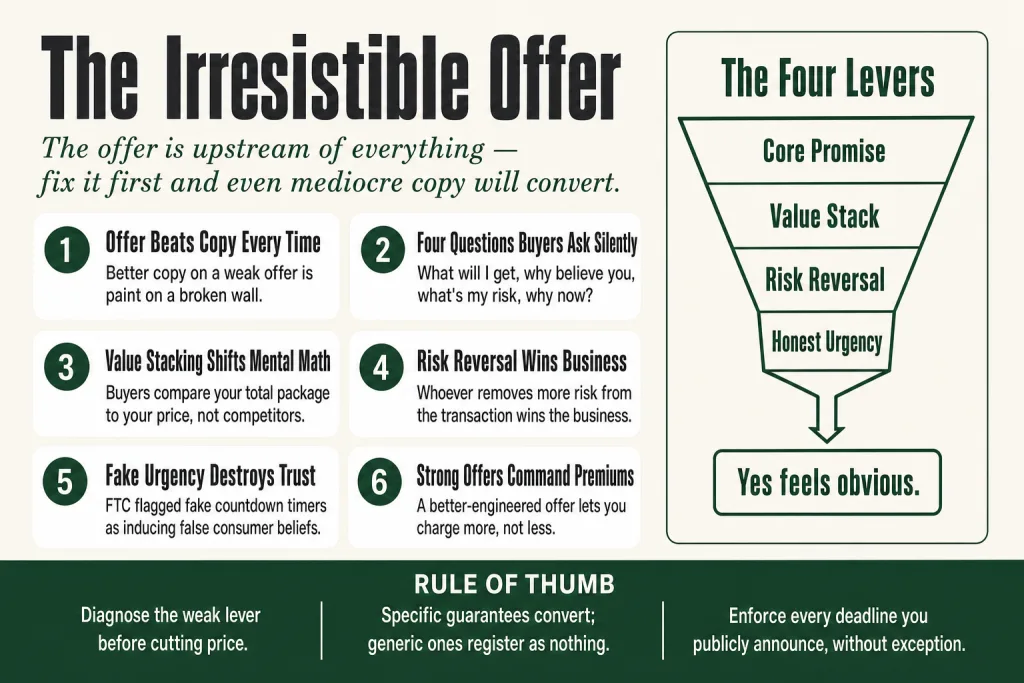
There’s an uncomfortable truth most operators learn too late: you can have the best service in your market, the sharpest copywriter money can rent, and a perfectly targeted ad, and still watch the phone not ring. Because if the offer itself is weak, all that other machinery is just amplifying a weak signal. The offer is upstream of everything. Fix it first and even mediocre copy will convert. Leave it soft and no amount of creative genius rescues you.
What’s changed over the last two decades isn’t the underlying principle, every generation of direct-response practitioners arrives at the same conclusion. What’s changed is how precisely we can now diagnose and engineer the individual components. That precision is what this page is about.
The idea in 30 seconds
- An irresistible offer is a package, price, value, risk reversal, and urgency, that makes saying yes feel obvious and saying no feel foolish.
- The offer is the lever, not the copy. Better writing on a weak offer is paint on a broken wall.
- Value stacking means mapping every problem your customer faces before, during, and after purchase, then solving each one explicitly inside the offer.
- Risk reversal transfers the fear of a bad decision from the buyer to you. A strong guarantee isn’t a cost center; it’s a conversion tool.
- Honest urgency works. Fake urgency destroys trust, and the FTC’s Bringing Dark Patterns to Light staff report (September 2022) identified fake countdown timers as a design element that induces false beliefs in consumers.
- The goal is an offer so clearly advantageous that price becomes a secondary question, not the first one.
Where the Idea Came From
The phrase got its clearest early codification in 2005, when Mark Joyner published The Irresistible Offer. His argument was pointed: most marketing was built around brand image, clever slogans, or feature lists, none of which answered the question a buyer actually asks the moment they encounter your business. That question runs something like: What’s in this for me, why should I believe you, and what happens if it doesn’t work? Joyner’s framing centered on ROI clarity and believability over features or credentials.
Dan Kennedy had been drilling the same idea into small-business owners for decades before that, through newsletters, coaching programs, and a long shelf of books. His version: every ad, every letter, every piece of marketing must carry a specific offer, not a brand impression, a defined exchange with a clear reason to act now. Alex Hormozi’s $100M Offers (2021) brought a more systematic treatment to a new generation, mapping customer problems, stacking solutions against each one, building guarantees that explicitly transfer risk from buyer to seller. Each of them was circling the same root truth: the offer is the unit of commerce, and copy, creative, and channel are just delivery infrastructure for it.
What an Irresistible Offer Actually Is, and What It Isn’t
Strip away the theory and an irresistible offer is the answer to four questions your prospect is silently asking. Get all four right, and you have something that sells. Miss any one, and you have friction.
Question 1: What will I get? The deliverable, stated in outcome terms, not feature terms. ‘Twelve sessions with a certified coach’ is a feature. ‘Lose 20 lbs in 90 days without giving up alcohol or weekends’ is an outcome. These are not the same offer even if the sessions are identical. Outcome language earns attention; feature language earns comparison.
Question 2: Why should I believe you? The believability layer, proof, specificity, social evidence, or a track record. An extraordinary claim with no credibility mechanism is a red flag, not a hook. Specificity is the most underused credibility tool available. ‘Most clients see results’ is vague. ‘Eleven of our last fourteen HVAC clients reduced their call-back rate by more than 30% in the first quarter’ is specific enough to be checked, and that checkability is what makes it believable.
Question 3: What do I have to do or risk? The friction and risk layer. Every buyer is running a mental calculation: the expected value of buying minus the downside if it doesn’t work. A strong offer reduces perceived risk directly, through guarantees, trials, transparent terms, or anything else that transfers the ‘what if this goes wrong’ weight from the buyer to you.
Question 4: Why now? The urgency layer. Not manufactured, not a fake countdown timer that resets when you reload the page. Real urgency, a cohort that fills, a price that changes, a window that closes for operational reasons. Without some reason to decide now, ‘I’ll think about it’ is where most offers die.
What the irresistible offer is not: a discount. Discounting is what you do when your offer is weak and you’re trying to compensate with price. A well-engineered offer commands a premium because the value case is obvious. Hormozi’s argument in $100M Offers is that the goal is to create a situation where the customer feels they’re receiving far more in value than what they’re paying, not to lower the price until they relent.
And it’s not a list of bonuses. Stacking add-ons on a weak core offer is like stacking toppings on bad pizza. The value stack only works when the core promise is strong enough to justify the purchase alone. The extras remove residual objections and increase perceived value, they aren’t the reason someone buys.
The Four Levers of an Irresistible Offer
Every strong offer can be engineered by working four variables. They’re not independent, they interact, but you can improve each one separately and measure the result.
Lever 1: The Core Promise
The core promise is the one thing your customer is buying. Not the mechanism, not the deliverable list, not the process, the outcome. The cleaner you can state it, and the more specifically it maps to what your buyer already wants, the less selling you have to do. Job-to-be-done thinking helps here: the buyer isn’t hiring your HVAC service, they’re hiring ‘not being cold in January and not having a surprise $400 bill.’ Build the promise around that.
Specificity is a force multiplier. ‘We help businesses grow’ is not a promise. ‘We help home-service businesses in their first three years add their second location within 18 months’ is a promise. It’s narrower, which means fewer prospects qualify, and that’s fine, because the ones who do are much more likely to say yes.
Lever 2: The Value Stack
Value stacking isn’t adding random bonuses. It’s systematically mapping every problem, fear, and obstacle your customer faces before, during, and after using your product, then designing a specific solution or deliverable for each one. Bundled together, this stack of solutions becomes the actual offer. Each piece of the stack serves a purpose: removing a reason not to buy.
The mechanism that makes stacking work: when you separate and name the components, and assign a believable standalone value to each, you shift the mental math. The prospect stops comparing your price to your competitor’s price and starts comparing your total package to your asking price. Those are very different comparisons. When the total stated value of the stack substantially exceeds the price, the price starts to feel small. The goal isn’t to inflate numbers dishonestly; it’s to make visible the value that already exists but was previously invisible because you bundled it all together without labeling it.
Lever 3: Risk Reversal
Every transaction involves risk, and before the sale, almost all of that risk sits with the buyer. They risk their money, their time, their reputation (especially in B2B), and their hope that this is finally the thing that works. Risk reversal transfers that burden explicitly from the buyer to you. The most common form is a money-back guarantee, but the most effective form is a guarantee specific enough to feel real.
‘Satisfaction guaranteed’ is so generic it registers as nothing. ‘If you haven’t booked at least three qualified discovery calls in your first 60 days, we’ll work with you for free until you do’ is specific enough to create real reassurance. The specificity signals confidence. It also signals that you’ve thought about what success looks like for the customer, which is itself a differentiator.
On the ASBN Strategic Edge podcast, Jay Abraham, founder of the Abraham Group, has argued that most businesses treat guarantees as an afterthought, something tacked onto legal boilerplate, when they should be a core part of the pitch itself. His position: the business, not the customer, should carry the risk, because the business is in a far better position to control quality and outcomes. Whoever removes more risk from the transaction wins the business. That’s competitive positioning through guarantee design, not just customer service policy.
For B2B operators specifically: business buyers aren’t only risking money. They’re risking their reputation internally, their credibility with their boss, their job in some cases. Risk reversal that acknowledges that specific fear, ‘we’ll present the ROI case to your leadership team if you need it’, hits differently than a generic refund policy.
Lever 4: Honest Urgency
Urgency is the most abused lever in marketing. The internet is littered with countdown timers that reset when you reload, ‘only three spots left’ banners that never change, and ‘this price expires Friday’ emails sent every Friday. Buyers have developed acute radar for manufactured urgency, and when they smell it, they lose trust not just in the urgency claim but in everything else you’ve said.
Real urgency exists in nearly every business. Cohort-based programs fill. Equipment has limited availability. Your bandwidth actually has a ceiling. Prices change when costs change. Seasonal demand is real. Name what the limit is and make it verifiable, then enforce it. If you say the price goes up on the 15th, the price must go up on the 15th. Every time you don’t follow through, you train your audience not to believe you.
The FTC’s September 2022 staff report Bringing Dark Patterns to Light specifically identified countdown timers designed to make consumers believe they have a limited time to purchase a product or service, when the offer is not actually time-limited, as a design element that induces false beliefs. That’s not just a legal footnote. Buyers burned by fake timers are more skeptical than ever, which means honest urgency, consistently applied, is now a genuine differentiator.
Why the Irresistible Offer Beats the Copy, Every Time
There’s a hierarchy in marketing that most operators get backwards. They hire a copywriter or spend three weekends on their website, then wonder why conversion rates are flat. They’re polishing the delivery vehicle while ignoring the payload.
Copy’s job is to communicate the offer clearly and compellingly. A skilled copywriter can make a mediocre offer sound better than it is, for about one read. Then the buyer’s experience either confirms or contradicts what the copy promised, and the gap between those two things is where your refund rate, your churn, and your review score live. Better copy on a weak offer is a short-term patch that creates a long-term reputation problem.
Flip it: take a genuinely strong offer and put it in plain, competent prose. It converts. Not as well as the same strong offer in polished copy, but it converts. The offer is doing the heavy lifting. The copy is just making sure the offer gets seen and understood.
This also means that split-testing copy variables, button color, headline phrasing, email subject lines, on top of a weak offer is the marketing equivalent of rearranging deck chairs. The variable with the most leverage is the offer itself. Test the core promise, the guarantee structure, the price point, the stack composition. Those tests move numbers.
Kennedy’s position on this was blunt: the first job of any piece of marketing is to carry a specific, actionable offer. Not a brand impression, not a mood, not an aspiration. Everything else is decoration until that’s done.
Putting this to work? The ideas in the Canon are the foundation under the tactical playbook in Build a Complete Marketing Departmentgrab the free companion kit at mmsvegas.com/resources.
Modern Examples Worth Studying
The cleanest modern illustration of offer engineering at scale is Hormozi’s early Gym Launch model. As Hormozi has described publicly, the core offer to gym owners was essentially: I’ll fill your gym for free in 30 days. He fronted the ad costs, ran the campaigns, and trained staff on sales, so the gym owner carried none of the execution risk upfront. Later iterations formalized this into a paid program with a performance-based guarantee structure. The offer worked because the core promise was specific enough that a gym owner could immediately picture what success looked like, the value stack included every piece of the execution, and the risk reversal made it nearly impossible to rationally say no. Hundreds of competitors sold marketing services to gyms. The offer was singular.
Amazon Prime is the large-scale version of the same pattern. What started as free two-day shipping gradually expanded into a stacked membership: shipping, Prime Video, Amazon Music, unlimited photo storage, exclusive deals, and more, all for a flat annual fee. The stack made any individual component feel cheap to evaluate in isolation. You’re not really buying streaming; you’re buying a bundle where the shipping savings alone arguably justify the price for most households. Prime members spend significantly more annually with Amazon than non-members, which is what happens when the value stack makes staying easy and leaving feel irrational.
At the small-business level, the same logic scales down precisely. A local HVAC company that offers ‘same-day service guaranteed or the diagnostic fee is waived, plus a 2-year parts-and-labor warranty on any repair, plus a free annual tune-up for the next two years’ is not competing on price with the company that offers ‘HVAC service, call for a quote.’ They’re not even in the same conversation in the buyer’s mind. One is a commodity transaction; the other is a solved problem.
Offer naming is where more operators should spend time than they do. Hormozi’s MAGIC framework from $100M OffersMagnet, Avatar, Goal, Interval, Container, is a structure for building names that carry information: who the offer is for, what outcome it promises, how long it takes, and what kind of thing it is. A named offer feels like a product, and products feel more substantial than services. ‘The 90-Day Revenue Reset’ and ‘our consulting engagement’ could be the same twelve weeks of work. Only one of them has weight before the sales conversation starts.
The most-cited historical example in offer design circles is Domino’s. In 1979, the chain formalized a guarantee that had been developing informally, pizza in 30 minutes or it’s free, and built its entire growth model around it. The chain had reached 200 stores by 1978, before the guarantee launched; by the end of the 1980s it had grown to around 5,000 locations, an expansion fueled heavily by a promise so specific and verifiable that it defined the brand, not pizza quality or price. (These figures come from secondary business sources, not Domino’s official historical filings, so treat the growth trajectory as directionally accurate rather than exact.)
The cautionary coda is equally instructive, and it’s worth getting the details right, versions of this story get garbled in the retelling. By 1989, news outlets were reporting that Domino’s drivers had been involved in over 20 fatalities, with compensation and bonuses tied directly to meeting the 30-minute window. The legal pressure built across multiple cases. In late 1993, a jury awarded a woman who had been struck by a Domino’s driver roughly $78 to 79 million in punitive damages, though a settlement was later reached for less. Shortly after the verdict, Domino’s owner Tom Monaghan announced the guarantee was being dropped, citing, in his words, a ‘public perception of reckless driving and irresponsibility.’ The offer had created operational pressure the business couldn’t honor safely. That’s the actual lesson: not that guarantees are dangerous, but that engineering a guarantee you can’t deliver on without breaking something else is a meaningfully different problem, and a more expensive one.
Where an Irresistible Offer Has the Most Impact
Offer engineering isn’t equally valuable everywhere. Here’s where it moves numbers hardest for a small-business operator:
New customer acquisition. This is the highest-friction moment in the buyer relationship. The prospect doesn’t know you, doesn’t trust you, and is comparing you (consciously or not) against doing nothing. A strong offer, clear promise, risk-reversed, honestly time-sensitive, cuts through that friction better than anything else. This is where weak offers cost you the most, because a prospect who bounces here never enters your world.
Premium pricing. Counterintuitive but real: a better-engineered offer lets you charge more, not less. When the value case is explicit and the risk is reversed, price stops being the primary variable. Hormozi’s argument in $100M Offersthat charging more, backed by a genuinely stronger offer, attracts better customers, funds better service, and removes you from a race to the bottom, is well-supported by operator experience. The operators who chase price competition are usually the ones with the weakest offers.
Reactivation campaigns. Existing customers who’ve gone quiet are high-probability buyers, they already like you enough to have bought once. A strong reactivation offer to this list, built around a specific new outcome rather than a generic ‘we miss you’ email, consistently outperforms cold acquisition efforts.
Referral programs. The reason most referral programs underperform isn’t that customers don’t like you, it’s that the referral offer is weak. ‘Give $50, get $50’ is barely memorable. An offer with a specific, meaningful outcome for both referrer and referee is something people actually mention to their friends.
Where Offer Engineering Doesn’t Save You
A brilliant offer does not fix a fundamentally broken product or service. If the core experience doesn’t deliver on the promise, the offer gets you the sale once, and then the review, the refund request, and the word-of-mouth work against you. Hormozi is explicit on this in $100M Offers: the framework assumes a product that actually works. It’s a multiplier on real value, not a replacement for it. Stack value you can’t deliver and you’re just scaling your churn rate.
It also doesn’t work well when the market has no urgency for the outcome you’re promising. If you’re selling something nobody’s actively thinking about, a strong offer structure can’t manufacture demand from scratch. Offer engineering converts existing demand efficiently, it doesn’t conjure demand that doesn’t exist. That’s a different problem, closer to category creation or education marketing, and no amount of value stacking fixes it.
Offer design is not a one-time event. Markets adapt, competitors copy your structure, and what felt differentiated in year one becomes table stakes in year three. The operators who treat their offer as a permanent fixture rather than a living document are the ones who watch conversion rates slowly erode and can’t figure out why.
Common Misunderstandings About the Irresistible Offer
‘A stronger offer means a cheaper price.’ No. Price is one variable in the value equation, and it’s usually not the most important one. The irresistible offer framework is explicitly about making price feel small relative to perceived value, which often means charging more while making the case more clearly. If the first thing you reach for when an offer isn’t converting is a price reduction, you’re treating a positioning problem as a math problem.
‘The guarantee will cost me a fortune in refunds.’ Operators who’ve tested this report the opposite. Reducing perceived risk increases the total number of buyers, and the increase in conversion almost always exceeds the cost of whatever percentage actually claims the guarantee. There’s also a selection effect: a strong guarantee tends to attract buyers who are serious about getting the result. The refund-happy buyer who buys on impulse and immediately regrets it is often deterred by a performance-based guarantee that implies they’ll need to actually engage with the product to qualify.
‘Value stacking is just adding bonuses.’ Random bonuses added to pad the page are noise. Value stacking, done properly, is a systematic exercise: map every obstacle between the prospect and the outcome they want, then design a named deliverable that removes each obstacle. The difference is whether each component earns its place by solving a real problem or is just there to inflate the perceived price.
‘Urgency is manipulation.’ Fake urgency is manipulation. Real urgency, a cohort that genuinely fills, a price that legitimately increases after a date, a service window that closes, is honest information. Withholding it from a buyer who would have acted on it isn’t ethical restraint; it’s leaving money on the table while being polite about it. The ethical test is simple: if the deadline passes and nothing changes, you lied. If the deadline passes and the thing you said would happen actually happens, you told the truth.
‘This only works for online businesses or high-ticket offers.’ Kennedy built his model around dentists, chiropractors, and carpet cleaners. The principles don’t care about the channel or the price point. What changes at different price points is the weight each lever carries, lower-ticket offers lean harder on instant clarity and risk reversal; higher-ticket offers rely more on specificity of promise and the depth of the value stack.
Common Mistakes
- Discounting instead of diagnosingBefore reducing price, run the four-question test on your offer out loud: what exactly will I get, why should I believe that, what do I risk, why now. Find the weak point first. A 10% discount on a confusing offer produces a slightly cheaper confused prospect. The actual problem is almost always a vague promise or a toothless guarantee, and neither of those gets fixed by dropping the number.
- Writing a guarantee so narrow it blends into the backgroundLead with the guarantee in your headline, not your FAQ. Rewrite it in outcome-specific terms: ‘If you haven’t booked three qualified discovery calls in 60 days, we’ll keep working with you at no charge.’ If you can’t write that version, you have either a copy confidence problem or a product problem. Find out which one it is before you spend more on ads.
- Building a value stack by adding items until the page looks fullBefore each component stays in the stack, it needs to pass one test: which specific fear or obstacle between the prospect and the outcome does this remove? If you can’t answer that clearly, cut it. A stack of three precisely targeted components outconverts a stack of nine padded ones, and a leaner stack is easier to price-anchor credibly.
- Setting deadlines you extendEvery extended deadline you publicly set teaches your list that your urgency is negotiable. After two or three cycles, real urgency gets ignored alongside fake urgency. Only announce limits that are operationally enforced, cohort sizes that actually close, price changes that actually happen, capacity that actually fills. The first enforcement is uncomfortable. The compound interest is credibility.
- Treating the offer as a finished productAn offer that differentiated you in year one often becomes table stakes by year three as competitors copy the structure and market expectations shift. Put a recurring calendar block, annually at minimum, to review the structure, not just the copy: does the core promise still feel specific and distinctive, is the guarantee still meaningful relative to what competitors offer, is the urgency mechanism still credible? The offer is a living document, not a one-time build.
- Confusing a weak offer with a targeting problemWhen conversion rates are low, the instinct is often to narrow the audience, ‘we just need to find the right people.’ Sometimes true. But before you change who sees the offer, change what the offer says. A weak offer stays weak regardless of how precisely it’s targeted. Run the four-question diagnostic first. If the offer can’t pass it, better targeting just means more people encounter a thing that doesn’t convert.
Operator’s Take
Most operators who come to me saying their offer isn’t converting have already tried the same thing: cutting the price. It almost never works, and here’s the specific reason, a discount doesn’t fix a vague promise or a timid guarantee. It makes a confused offer slightly cheaper. The prospect is still confused; they’re just being asked to risk less money on their confusion.
So before you touch the price, do this one diagnostic. Read your offer out loud and ask whether a first-time prospect, someone who’s never heard of you, could answer all four questions from it. What exactly will I get? Why should I believe that? What happens if it doesn’t work? Why should I decide now? Write down the answers. If any answer is fuzzy or missing, that’s your conversion problem. Nine times out of ten it’s either the core promise (too broad to mean anything) or the guarantee (too vague to signal real confidence).
On guarantees: write the version you’d actually lead with in a one-on-one sales conversation, the one that would make a skeptical prospect sit up straight. ‘Satisfaction guaranteed or your money back’ does no conversion work. ‘If you haven’t closed two additional clients in 60 days, we’ll run a second campaign at no charge’ does. If you can’t write the bolder version, ask yourself whether that’s a copy problem or a product problem, because both are worth knowing, and the answer changes what you do next. Put whichever version you can honestly commit to in the headline, not buried three screens down.
On value stacks: don’t do this in your head. The mental version always skips steps. Sit down with a blank page and map every moment between ‘I’m thinking about buying this’ and ‘I’ve gotten the result I paid for.’ Every fear, every question, every thing that could go wrong or feel confusing. Then look at your current offer and mark which ones you’ve actually addressed. Most operators are solving three of eight problems and presenting it as a complete solution. The other five aren’t missing from your product, they’re missing from your offer. Name them. Give each one a specific deliverable. The ‘I need to think about it’ response usually means one of those five hit them on the way out the door.
On urgency: pick constraints that are operationally real and enforce them without exception. The first time you extend a deadline you publicly announced, you’ve told your entire list that your urgency is negotiable, and that lesson sticks longer than the original urgency did. Cohort closes, genuine price changes, real capacity limits. Let them expire when you said they would. Uncomfortable once. Credibility-building over time.
A practical sequencing note: work on the guarantee first, then the value stack, then the core promise language. That order feels backwards but it isn’t. Getting specific about what you’ll guarantee forces you to get clear on what you can actually deliver, which sharpens the promise. The stack fills in around both. Most operators do it in the opposite order, they write a headline, then add bonuses, then slap a generic guarantee at the bottom, and that’s exactly why the bottom of the page doesn’t do any work.
One more thing, said plainly: AI tools can help you draft value stacks, write guarantee language, generate offer names, and iterate on promise framing faster than any previous generation of operator had access to. That’s genuinely useful for a small team without a copywriter on retainer. The judgment calls stay with you, does this promise reflect what we can actually deliver, is this guarantee specific enough to mean something, is this urgency real or am I rationalizing a fake deadline? The tool compresses the time between idea and draft. Your read on what’s actually true about your business doesn’t get outsourced.
Used in
- ✓ Build a Complete Marketing Department
Used as the foundation for structuring acquisition campaigns, the offer is designed first, then copy, channel, and targeting are built around it. - ✓ The Missing Manual for FunnelKit
Applied at the funnel-design stage to determine what the entry-point offer, core offer, and bump or upsell offers should be before any page is built. - ✓ The Missing Manual for Make
Used to automate offer delivery and follow-up sequences, the value stack components and guarantee terms are built into automated workflows so every prospect gets the full offer experience consistently.
FAQ
What’s the difference between an offer and a product?
The product is what you make or deliver. The offer is everything around it, the promise, the price, the guarantee, the urgency, and the packaging. Two businesses can sell the same underlying product with completely different offers, and the one with the stronger offer wins most of the time.
How do I know if my current offer is weak?
Ask yourself: if you stripped out the price reduction and ran the offer at full price with no discount, would it still convert? If the honest answer is no, the offer is weak and you’re using price to compensate. A strong offer holds its conversion rate at premium pricing because the value case is clear regardless of price.
Is a money-back guarantee really necessary?
No, but some form of risk reversal almost always helps. If a money-back guarantee doesn’t fit your business model, say, you deliver time-based services that can’t be ‘returned’, consider a performance-based guarantee, a partial credit, a free redo, or a try-before-you-commit structure instead. The goal is to move the fear of a bad outcome from the buyer’s shoulders to yours.
How specific does the core promise need to be?
Specific enough that a prospect can picture exactly what success looks like and tell whether it applies to their situation. ‘We help businesses grow revenue’ is not specific enough. ‘We help independent financial advisors add two to four new households per month through referral systems’ is. The more specific you get, the narrower your addressable market, and the higher your conversion rate within it.
Can I use this framework for a service business, not just products?
Yes, in fact, service businesses often benefit more because their offers are typically less tangible and harder for buyers to compare. Making the deliverables explicit, naming the components, and reversing the risk turns an abstract ‘engagement’ into something that feels concrete and evaluable before the sale.
How often should I change my offer?
Don’t change the offer while it’s working. When conversion rates start slipping, and they will, as competitors adapt and market expectations shift, that’s the signal to revisit the structure. Cosmetic changes like new naming or visual presentation are low-risk experiments. Structural changes to the guarantee or core promise should be tested deliberately, not made reactively.
Further reading
- Mark Joyner, The Irresistible Offer (2005)The book that named the idea for a modern audience; worth reading for Joyner’s framework around ROI clarity and the single-sentence ‘touchstone’ that captures the whole offer.
- Alex Hormozi, $100M Offers (2021)The most systematic operator-facing treatment of offer engineering available; particularly strong on value stacking methodology, guarantee design, and the MAGIC naming framework.
- Dan Kennedy, No B.S. Direct MarketingThe foundational text for understanding why the offer must come before copy, creative, or channel in every direct-response campaign.
- Jay Abraham, Getting Everything You Can Out of All You’ve GotAbraham’s treatment of risk reversal and guarantee design is among the most thorough in the literature; read it specifically for how to frame guarantees as a competitive positioning tool rather than a customer service afterthought.
Sources: Mark Joyner, The Irresistible Offer (Wiley, 2005); Alex Hormozi, $100M Offers (Acquisition.com, 2021); Dan Kennedy, No B.S. Direct Marketing; Jay Abraham, ASBN Strategic Edge‘Risk reversal: How a more specific guarantee can guarantee more sales’ (June 2026); Domino’s 30-minute guarantee history sourced from secondary outlets including Ranker (March 2025), The Hustle (April 2024), Tasting Table (September 2025), Yahoo News (September 2025), The Daily Meal, and Snopes, store-count and timeline figures are directional and not drawn from Domino’s official historical filings; FTC Bringing Dark Patterns to Light staff report (September 15, 2022); National Law Review analysis of FTC dark patterns report (September 2022); Amazon Prime benefits via About Amazon (July 2025).
Brian Kasday spent forty years in direct-response marketing before rebuilding the whole operation as a one-person shop. He writes The Operator’s Library, including “Build a Complete Marketing Department”, for operators who’d rather build it themselves than wait on someone else.
Build the department these ideas describethe free companion kit: mmsvegas.com/resources.
More The Operator's Canon guides
Free · Operator Toolkit
Want the tools, not just the guide?
Get the free operator toolkit — templates and checklists for the systems you actually run, plus a note when this guide changes.
Get the free toolkit →How to cite: The Irresistible Offer. Associated with Mark Joyner, 2005. The Operator’s Canon, MMS Vegas. https://mmsvegas.com/library/irresistible-offer-explained/