
Table of contents
- The 30-second answer
- Why you ended up competing on price in the first place
- Stop being a vendor: the one shift that ends the price war
- The “Only We” test, find the ground you can own
- Build an offer where price is the smallest number on the page
- Price is a message: what a low number actually says
- A worked example: the same business, repositioned
- How to stop competing on price as a solo operator
- Frequently asked questions
You dropped your price to win the job, and it worked, once. Now the customer expects that price every time, your competitor has matched it, and the next person who calls is shopping you against three other quotes with a spreadsheet open. This is the treadmill, and almost every small business ends up on it. If you want to know how to stop competing on price the answer isn’t a clever discount or a loyalty punch-card. It’s positioning, and it’s the one part of marketing a solo operator can do better than the agency you can’t afford, because it costs thinking, not budget.
Here’s the uncomfortable truth underneath the price war: when a customer can’t tell you apart from the alternatives, you’ve handed them exactly one tool to decide with, price. They’re not cheap. They’re confused. Give them a real reason to choose you and the conversation stops being about who’s cheapest. That’s the whole game, and you can change it this week.
The 30-second answer
To stop competing on price, make yourself un-comparable:
- Diagnose the real problem price pressure is a symptom of weak differentiation, not a pricing flaw. Fixing the price won’t fix it.
- Become a trusted advisor, not a vendor sell the outcome and the relationship, not the deliverable. Vendors get compared; advisors get chosen.
- Pass the “Only We” test finish the sentence “We are the only [type of business] that [specific thing] for [specific customer].” If you can’t, that’s your homework.
- Wrap the product in an offer stack the value so the price feels small, then back it with a guarantee that removes the risk.
- Let the price signal quality a higher, confident price tells the market you’re the premium choice. A scramble to the bottom tells them you’re the discount one.
Why you ended up competing on price in the first place
No one sets out to be the cheap option. You get there by default. When your offer looks like everyone else’s offer, the customer has no other axis to judge on, so they reach for the only number that’s different. Competing on price isn’t a strategy you chose, it’s what’s left when differentiation is missing.
This matters because the instinct, cut the price to close the deal, makes the problem worse. Every discount trains the market that your real price is negotiable, anchors the next customer lower, and quietly tells everyone that even you don’t think your work is worth full freight. You can’t discount your way to a healthy business. There’s no point pouring water into a leaky bucket. The leak is upstream, in how you’re positioned, and that’s where the fix lives too.
If you’re still deciding whether to hand all of this to an agency, that’s a fair question with a real answer, we walk through it in do I need a marketing agency. Short version: positioning is the highest-leverage work in your whole business, and it’s the part you should keep your hands on no matter what else you outsource. A small business marketing audit is a good first check for where the differentiation gap is actually costing you.
Stop being a vendor: the one shift that ends the price war
The single most useful idea here comes from Jay Abraham, and it’s called the Strategy of Preeminence. The shift is this: stop thinking of yourself as a vendor selling a thing, and start acting as the trusted advisor whose job is to get the customer the result they actually want, even when that’s inconvenient for you.
A vendor answers the question that was asked and quotes a price. An advisor asks the question behind the question. A customer calls a vendor for a website; the vendor quotes the website. The same customer calls an advisor, and the advisor says, “Before we talk about a site, what’s the site supposed to do for you, and how will we know it worked?” One of those people is being compared on price against four other quotes. The other one is being trusted. Trust doesn’t shop around.
This isn’t a sales trick you bolt on at the end. It changes what you sell. The vendor sells deliverables, hours, pages, posts, and deliverables are commodities you can line up side by side and price-compare. The advisor sells outcomes and judgment, and there’s no comparison chart for judgment. You move yourself off the spreadsheet entirely. That move, vendor to advisor, is the thing that ends the price war, and it costs you nothing but a change in how you show up.
The “Only We” test, find the ground you can own
Positioning sounds abstract until you put it through a test that forces a concrete answer. The book calls it the “Only We” test, and it’s the most valuable diagnostic in the whole positioning chapter. You finish this sentence, truthfully:
“We are the only [type of business] that [specific differentiator] for [specific kind of customer].”
The discipline is in the word only. “We offer great service” fails, everyone claims it, and a claim everyone makes is worth nothing. “We’re the only bookkeeping service that works exclusively with independent cannabis retailers and speaks their compliance language” passes, because it’s specific enough that a real competitor would have to dismantle their general practice to contest it. If you can’t finish the sentence yet, you haven’t found your position, and that’s not a failure, it’s your assignment for the week.
The reason this kills price competition is structural. A position that’s specific to a kind of customer and a kind of problem can’t be price-compared against a generalist, because they’re not selling the same thing. The cannabis-retail bookkeeper isn’t competing with “any bookkeeper” on rate. They’re the obvious choice for one group and irrelevant to everyone else, which is exactly what you want. Trying to be acceptable to everyone is how you ended up acceptable-but-cheap.
There’s a related rule worth holding onto: in positioning, there’s no neutral ground. Every position you don’t take is one a competitor can. The territory you own is the territory you claimed deliberately and then backed up everywhere, your page, your emails, the way you answer the phone. Owned territory is what makes the “Only We” statement believable instead of slogan. If you’re choosing a market to own from scratch, the companion piece on how to find your niche in a crowded market walks through finding the gap before you plant the flag.
Build an offer where price is the smallest number on the page
Positioning gets you off the spreadsheet. The offer keeps you off it. There’s a difference between a product and an offer that most small businesses never internalize: the product is the thing you deliver; the offer is everything around it that makes buying it feel like a steal. You’re not competing on price when the price is plainly the smallest number a customer is looking at.
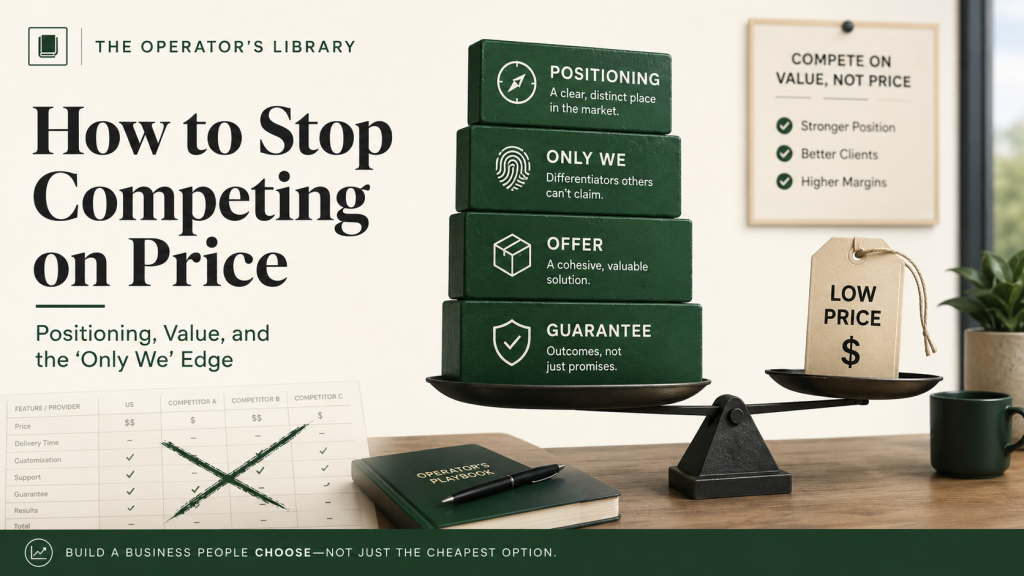
The book lays out five elements of an irresistible offer, and two of them do the heavy lifting against price pressure. The first is the value stack. You itemize everything the customer actually gets, the deliverable, yes, but also the planning, the templates, the onboarding, the thing-you-do-that-they-didn’t-know-to-ask-for, and you stack it so the total perceived value lands at four to ten times the price. When the page shows two thousand dollars of value for a few hundred, the price stops being the headline. It becomes the punchline.
The second is risk reversal, a guarantee strong enough to make you slightly uncomfortable. The counterintuitive finding from decades of direct response is that the businesses offering the strongest guarantees report the lowest refund rates, because a confident guarantee signals confidence in the work, and confidence is the opposite of a discount. A bold guarantee says “I’m not worried.” A discount says “please.” Customers can tell the difference. Wiring the value stack and the bump that pays for it into your checkout is an execution job, the FunnelKit guides cover the mechanics, and the strategy behind a page that converts is in how to write a sales page yourself. Once that page is live, collecting customer testimonials gives you the social proof that makes the value stack credible.
Want the operator’s toolkit? The free prompt library that ships with Build a Complete Marketing Department includes the Positioning & “Only We” prompt and the Irresistible Offer Design prompt, the exact prompts referenced in this article. Grab the prompt library →
Price is a message: what a low number actually says
Here’s the part that trips up careful people: most small businesses don’t have a problem of charging too much. They have a problem of charging too little, and a low price does damage you can’t see on the invoice. Price isn’t just what you collect. It’s information the market reads.
Put two courses side by side, identical content, one at $97 and one at $997. A meaningful number of buyers will assume the $997 version is the serious one and the $97 version is the throwaway, before reading a word, because in the absence of other signals, price is the quality signal. When you race to the bottom, you’re not just earning less. You’re actively telling the market you’re the discount option, which makes the premium position you wanted even harder to claim later.
Value-based pricing is the antidote, and the math is plainer than it sounds. If your service saves a client four hours a week and their time is worth $100 an hour, you’re handing them $400 a week, north of $20,000 a year. Against that number, a $997 price isn’t expensive. It’s a rounding error on the value delivered. You price against the outcome you create, not the hours you spend or what the cheapest competitor charges. The cheapest competitor is solving their pricing problem. Don’t let them solve yours. The deeper mechanics of setting that number are in how to price your product or service without guessing.
A worked example: the same business, repositioned
Take a freelance bookkeeper competing in a sea of freelance bookkeepers, quoting hourly, losing jobs to whoever’s $5 cheaper. Nothing about the work changes in what follows. Only the positioning does.
Before: “Bookkeeping services. Reasonable rates. 15 years’ experience.” This is a vendor. It’s comparable to every other listing on price and a vague experience claim, so price is the only lever left. The market obliges and grinds the rate down.
The “Only We” pass: “We’re the only bookkeeping practice that works exclusively with independent e-commerce sellers and reconciles your Stripe, your marketplace payouts, and your inventory in one monthly close.” Specific business, specific customer, specific problem a generalist routinely botches. A general bookkeeper can’t contest this without abandoning their general book of clients.
The offer: not “hourly bookkeeping” but a “Month-End Close package”, the reconciliation, a one-page cash-flow read, a quarterly tax-set-aside number, and a 20-minute call to explain it. Value stacked well past the price. Backed by a guarantee: “If your books aren’t clean and filed-ready by the 10th, that month is free.”
The price: a flat monthly fee, priced against the panic and penalties of messy e-commerce books, not against the hourly rate of the bookkeeper down the street. Same person, same skills. Off the spreadsheet, and charging what the outcome is worth. That’s what stopping competing on price looks like in practice, and it started with a sentence, not a discount.
How to stop competing on price as a solo operator (no strategist required)
Big companies pay strategists to run this exercise. You don’t have one, and you don’t need one, you have an AI model and the right prompts, which is the whole premise of running a marketing department as a force of one. Positioning is thinking work, and a good model is a tireless thinking partner when you put real material in.
The workflow is unglamorous and it works. Feed the model your real situation, what you sell, who buys it, what your three closest competitors say on their pages, what customers actually thank you for. Then ask it to draft ten “Only We” statements, pressure-test each for whether a competitor could honestly claim the same, and flag the ones that are specific enough to defend. You don’t delegate the decision to it, you collaborate, and the quality of what you get back depends entirely on the quality of what you put in. Garbage situation in, garbage positioning out; a vivid, honest brief in, and it’ll surface angles you were too close to see. The same approach drives the market research that tells you which customer is worth owning, and feeds the funnel you build in build a sales funnel without a team.
Stop interrogating the model for one perfect answer. Start working with it across a few rounds, and you’ll leave with a position you can defend, an offer that buries the price, and a number you can say out loud without flinching. That’s a marketing department’s worth of strategy, done by one person, for the cost of a software subscription.
Frequently asked questions
How do I stop competing on price without losing the customers I have?
You don’t cut your existing customers loose, you reposition the offer they’re buying. Keep serving them, but reframe what they’re paying for around the outcome, add a value stack and a guarantee, and introduce the new positioning on the next quote rather than retroactively. New customers meet the repositioned business first; existing ones migrate as you renew. The goal is to stop letting price be the only thing anyone compares, not to fire everyone and start over.
Won’t a higher price just send customers to a cheaper competitor?
Some, yes, and those are the customers keeping you on the treadmill. A higher, confident price is a filter: it repels the bargain-hunters who’d leave you the moment someone undercut you anyway, and it signals quality to the buyers who can tell the difference. You’re not trying to win everyone. You’re trying to be the obvious choice for the customers who value the outcome, and price-shoppers were never that customer.
What is the “Only We” test?
It’s a positioning diagnostic: finish the sentence “We are the only [type of business] that [specific differentiator] for [specific kind of customer].” The word “only” forces specificity. If you can complete it truthfully, you’ve found a position a competitor can’t price-compare against. If you can’t, you’ve found your most important piece of marketing work, that’s the gap to close before you touch anything else.
Does positioning actually beat just lowering my price?
Lowering price is a one-time move your competitor can copy in an afternoon, and it permanently lowers what the market expects to pay you. Positioning changes what you’re being compared against, ideally nothing, so the price stops being the deciding factor at all. One is a discount you can never take back; the other is an asset that compounds. Positioning wins, and it’s cheaper to do.
Can one person really do this without hiring a strategist?
Yes. Positioning is thinking work, not budget work, and that makes it the most level part of the playing field for a solo operator. With a clear, honest brief and an AI model used as a collaborator, not a vending machine, you can run the same “Only We” and offer-design exercises a paid strategist would, iterate across a few rounds, and arrive at a defensible position in a single focused afternoon.
How do I know if a competitor can claim the same position I’m considering?
Do a quick check before you commit. Search their site for the exact language you’re considering, look at what they put in headlines and taglines, and ask whether a customer reading both pages would see a real difference. If the answer is no, your statement isn’t specific enough yet. A competitor analysis you run yourself takes an afternoon and gives you the evidence to sharpen the claim until it’s genuinely yours to own.
Sources
Grounded in Build a Complete Marketing Department for a Few Bucks a Day by Brian Kasday, Chapter 9 (Positioning, the Strategy of Preeminence, the “Only We” test, Owned Territory), Chapter 18 (the Five Elements of an Irresistible Offer, value stack and risk reversal), Chapter 19 (Pricing Psychology, value-based pricing and the price-quality signal), and Chapter 10 (authority). The Strategy of Preeminence is credited in the manuscript to Jay Abraham.
Brian Kasday spent 40 years in direct-response marketing before rebuilding the entire capability as a one-person operation, strategy, funnels, copy, and automation, using classic discipline and a few-dollars-a-day AI stack. He writes The Operator’s Library for MMS Vegas.
Stop competing on price for good. Build a Complete Marketing Department for a Few Bucks a Day is the full system, positioning, offers, funnels, and the prompt library that runs them. Get the book → | Download the free prompt library →