
Last updated: July 2026
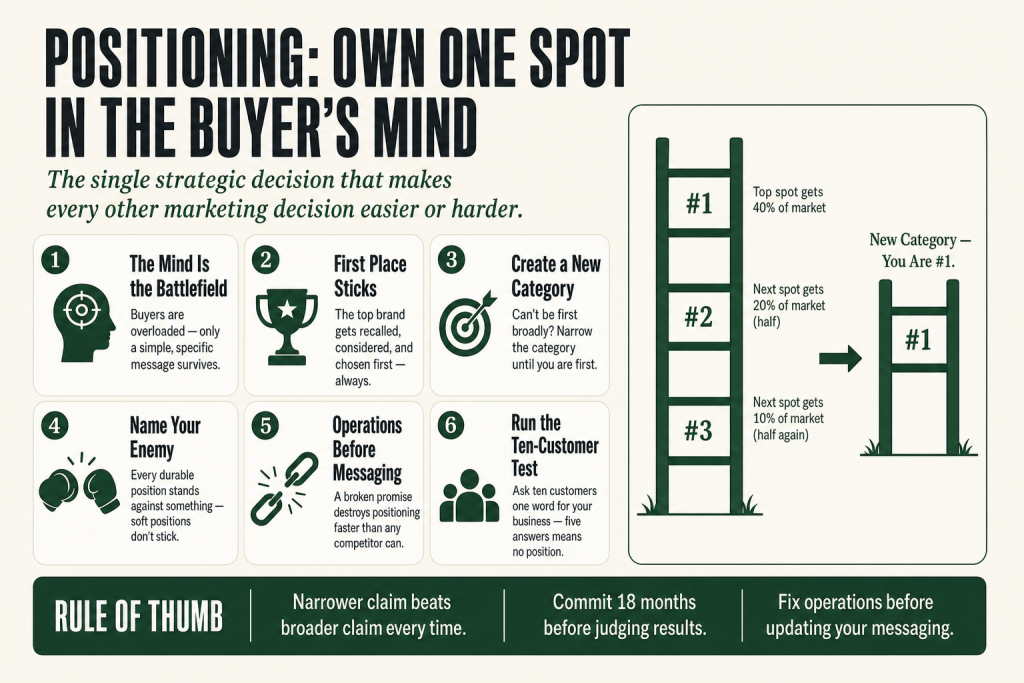
Positioning in marketing is the decision that makes every other marketing decision either easier or harder. By the end of this page, you’ll be able to identify the one place your business can credibly own in a buyer’s mind, and see clearly why the vague, everything-for-everyone approach costs you more than it saves.
Here’s the problem positioning solves: your prospects are drowning. Not in bad options, in too many options that all sound the same. Every plumber says they’re reliable. Every accountant says they’re accurate. Every restaurant says the food is fresh. When everyone claims the same things, nobody’s claim lands. The buyer defaults to price, or to whoever they heard of first, or to whoever a friend mentioned. None of those outcomes are ones you controlled.
Positioning is the discipline of occupying a specific, ownable place in a buyer’s mental filing system, and making sure that place belongs to you before a competitor claims it. Most operators don’t do it, not because it’s complicated, but because it requires them to say no to things. And saying no feels like leaving money on the table. It almost never is.
The idea in 30 seconds
- Positioning in marketing means the single thing your business is first at, best known for, or most narrowly identified with, in the buyer’s mind, not yours.
- You can’t install a position through advertising alone. You earn it through consistent action, messaging, and time.
- The core rule: be first in a category, or create a narrower category where you can be first.
- A specialist almost always beats a generalist in the prospect’s mind, narrower is stronger, not weaker.
- Your position isn’t what you say you are. It’s the word that comes to mind when someone thinks of your business in your category.
- Changing a position takes years. Getting it right once and holding it is nearly always the better play.
Where the Idea Came From, and What It Actually Says
The word ‘positioning’ got its current marketing meaning from two advertising men working out of New York in the Mad Men era. The origin story has a bit of a ‘who named it first’ wrinkle worth clearing up, because the dates get garbled constantly.
Al Ries had founded his own agency, Ries Cappiello Colwell, in 1963, and had been wrestling with a problem he saw everywhere: advertising was getting louder and working less. More products, more claims, more noise. His internal concept was something he called the ‘rock’, the single idea a brand needed to stake out in the market. One of his account executives, Jack Troutsuggested calling the rock a ‘position’ instead. That rename stuck.
Trout published the first use of the term in print under his name alone, a June 1969 article in Industrial Marketing titled ‘Positioning Is a Game People Play in Today’s Me-Too Marketplace.’ By Trout’s own account, the earth didn’t tremble. The article went largely unnoticed. Trout and Ries subsequently co-authored work refining the concept, but the idea sat dormant until Ries presented it at the Sales Executives Club of New York in 1972. That speech caught the attention of Advertising Age editor Rance Crain, who commissioned a series, and that April-and-May 1972 run, ‘The Positioning Era Cometh,’ was when the industry finally paid attention. By December of that year, the concept had landed on the front page of The Wall Street Journaland over 150,000 reprints circulated globally. Their 1981 book, Positioning: The Battle for Your Mindwent on to sell over four million copies. The 1972 Advertising Age series is the right answer when someone asks when positioning ‘entered’ marketing, not 1969, when the first article appeared in relative obscurity.
The key shift Ries and Trout forced onto the industry was a change in question. USP thinking asked: what’s genuinely different about your product? Ries and Trout asked something harder and more prior: even if you have something different, can a buyer’s already-overloaded brain actually store it? The mind, they argued, is not a blank container waiting to be filled. It’s already full, already filing things, and already skeptical. You don’t compete with your product. You compete for a slot.
Strip the framework to its operating logic and you get three rules. Deceptively tidy. Every one has teeth.
Rule 1: The mind, not the market, is the battlefield
Most operators think about positioning in terms of what they offer. Ries and Trout forced a harder question: what does the prospect already believeand how does your offer fit, or fight, that existing belief? The mind isn’t neutral. It’s already full. Buyers are overstimulated, markets are noisy, and the only message that survives is a simple one. The task is never to pour a new idea into a blank container. It’s to attach your idea to something already in there.
Rule 2: The ladder, and why first place sticks
Ries and Trout described the mind as organizing competing brands like rungs on a ladder, one ladder per category. The top brand gets recalled first, considered first, chosen first, all else being roughly equal. Their observation across categories: the leader tends to hold roughly twice the market share of number two, which holds roughly twice the share of number three, a pattern that has shown up across industries for decades. It’s a descriptive tendency, not a mathematical law, but the directional truth is hard to argue with.
Their argument was that brand success is often less about marketing acumen than about the simple fact of being first in the category. That’s a provocative claim, and it’s not always right, but the structural advantage of being first to claim a position is real, and money alone struggles to erase it later.
Rule 3: Be first, or create a new ladder
Own a single word or concept in the customer’s mind. Volvo owns ‘safety.’ FedEx owns ‘overnight.’ Google owns ‘search.’ The core logic: if you can’t be first in an existing category, create a tighter one where you can. Being narrow isn’t shrinking, it’s focusing. And focus is how you get to be first at something.
Consistency is the part everyone agrees with in theory and violates in practice, usually at the first sign of a slow quarter. A position accumulates over years of consistent product decisions, consistent messaging, and consistent behavior. Operators who try positioning and conclude it doesn’t work usually quit after six months. That’s like planting a tree, pulling it up at three months to check the roots, and concluding trees don’t grow.
What about when you’re not first?
Ries and Trout weren’t naive about this. Most businesses aren’t first in their category. Their answer: reframe the category until you are first. That’s not spin, it’s genuine strategic thinking about what category you’re actually competing in. The other path is repositioning the leader, making the incumbent look incomplete, complacent, or wrong for a specific buyer. That requires courage, specificity, and usually a defined enemy.
The Campaigns That Made Positioning Famous
Three examples appear in almost every serious treatment of positioning. The mechanics in each one translate directly to a small business operating today, so they’re worth understanding, though the history is the setup, not the point.
Avis: owning ‘number two’
In 1962, Avis was a distant second to Hertz in car rentals and losing $3.2 million annually. The conventional move would have been to advertise harder on service or price, competing on Hertz’s terms without acknowledging the gap. Instead, Doyle Dane Bernbach made the number-two position the entire point. Hertz’s dominance was unchallengeable head-on. But a brand that openly acknowledged being second could own entirely different territory: hustle, effort, customer care. Within a year, Avis turned that $3.2 million loss into a $1.2 million profit. From 1963 to 1966, as Hertz largely ignored the campaign, the market-share gap between the two brands shrank from 61 to 29 to 49 to 36.
The key move: Avis didn’t try to beat Hertz. They built a sub-position, the rental company that tries harder because it’s number two. A new rung on the same ladder, owned cleanly. Notice what made it stick: the position had an implicit enemy. Hertz’s comfort as the market leader was the argument for choosing Avis.
7-Up: the Uncola
7-Up couldn’t be the top cola, Coke and Pepsi had that locked. In 1967, the brand was losing steam; most consumers thought of it as a mixer or an upset-stomach remedy. J. Walter Thompson did something smarter than competing on cola terms: they created a different category entirely. The ‘Uncola’ campaign positioned 7-Up as the antithesis of cola, everything cola was not. Without directly attacking any single competitor, 7-Up grouped Coke, Pepsi, and RC together as one undifferentiated category. On the new ‘non-cola’ ladder, 7-Up was first by definition. Estimates for the campaign’s sales impact range from 30 to 56 percent in the first year; by the early 1970s, 7-Up had become the only non-cola in America’s top three soft drinks. The position was created by defining what 7-Up was against not just what it was for.
Volvo: owning a single word for decades
The Volvo case is the most instructive for any operator thinking long-term. Al Ries used Volvo as his go-to example of the one-word strategy: a company that, for decades, never deviated from ‘safety’ as its core message. While competitors cycled through performance, luxury, technology, and sustainability, Volvo stayed anchored. The consistency compounds. Competitors can’t credibly claim the territory, no matter how many airbags they install. In a market where BMW owns ‘performance’ and Mercedes owns ‘luxury,’ Volvo’s lock on safety delivers premium pricing, fierce loyalty, and a natural bridge to newer sustainability messaging.
There’s also a cautionary note. Brand tracking conducted during a period under Ford’s ownership showed Volvo’s association with safety eroding, not because competitors had overtaken them on actual safety performance, but because the brand had stopped reinforcing the association consistently. A position is not a permanent asset. Stop feeding it and it weakens, regardless of the underlying product reality.
Notice what all three cases share: clarity, consistency, and a willingness to be against something. Avis was against complacency. 7-Up was against cola. Volvo was against the idea that exciting driving dynamics mattered more than your family getting home safe. A position without an implicit enemy is usually too soft to stick.
Putting this to work? The ideas in the Canon are the foundation under the tactical playbook in Build a Complete Marketing Departmentgrab the free companion kit at mmsvegas.com/resources.
Positioning in Marketing for a Small or Local Business
Here’s where most Canon-readers will either get excited or get skeptical. ‘That’s fine for Volvo and Avis,’ you might say. ‘I run a landscaping company in Henderson, Nevada.’ Fair. So let’s translate.
The mechanics are identical. The scale is different. What Volvo did over 70 years with billions of dollars, you can do in your city or your niche in three to five years with a consistent message and the discipline not to chase every opportunity that walks in the door.
The first-or-new-category rule works at local scale
You don’t need to be first globally. You need to be first in the mind of your specific buyer, in your specific geography or niche. If three landscaping companies serve your metro area and all three say ‘licensed, insured, reliable service,’ you have an open position waiting. Nobody owns ‘the only landscaping company that specializes exclusively in water-wise desert landscaping for HOAs in the southwest valley’, because nobody’s said it plainly enough, long enough, for it to stick.
That example is long. The position itself isn’t, it’s: desert landscaping for HOAs. Two words, one claim, one audience. Now you’re first at something real.
Ries and Trout described positioning as an antidote to the overcommunicated society in which consumers were drowning in advertising messages. For a local operator, that’s the game precisely. You don’t need awareness at scale. You need to be the obvious answer when a specific buyer with a specific problem goes looking.
Niche vs. position, don’t confuse them
Your niche is who you serve. Your position is what you’re first at or best known for within that niche. A chiropractor who serves athletes is in a niche. The chiropractor who is the only one in town certified in sports injury recovery and who only accepts athletes as patients, that’s a position. The niche gets you in the conversation. The position wins it.
This distinction matters practically. When you’re deciding where to spend your marketing budget, your niche tells you where to show up, sports leagues, gyms, coaches. Your position tells you what to say when you get there.
The category creation move
If you’re not first in an existing category in your market, don’t try to out-shout whoever is. Create a tighter category. A home cleaning company that positions as ‘the only cleaning service in Las Vegas using non-toxic, fragrance-free products safe for chemotherapy patients’ isn’t competing against Molly Maid anymore. They’ve built a new ladder in a category of one. Every oncology center in the city is now a referral partner, not just a Facebook ad target. The position does strategic work that no amount of broad-market advertising can replicate.
What one word do you own?
Here’s a practical test. Ask a handful of your best customers, not what they think of you, but what word comes to mind when they think of your business in your category. If you get five different words, you don’t have a position. If you get the same word from nearly everyone, you do. That word is your anchor. Everything in your marketing, your offers, your copy, your website headline, your sales conversation, should deposit into that same account.
If your customers can’t give you a clear word, that’s not their failure. It’s yours. You haven’t repeated one thing clearly enough, long enough, for it to land.
B2B operators: this is your sharpest edge
In B2B and professional services, positioning is even more powerful than in consumer markets, because the buying decision is deliberate and involves comparison. When you’re doing Dream 100 outreachthe operator who is known as ‘the accountant who specializes in HVAC companies’ will get a different, better, response than the accountant who serves ‘small businesses of all kinds.’ Buyers remember specialists. They feel safer choosing specialists. They refer specialists. Referrals within a niche travel faster than referrals across a general market, because the recipient of the referral instantly understands why it’s relevant to them.
Where Positioning Works Best, and Where It Struggles
Positioning isn’t a universal solution to every marketing problem. Knowing its limits saves you from applying it where it won’t pay off.
Where it’s strongest
Markets where buyers comparison-shop. Anywhere a buyer is evaluating more than one option, a clear position is a decisive advantage. Legal services, financial services, home improvement, healthcare, specialty retail, these are all positioning-rich environments.
Long buying cycles. When the average buyer takes weeks or months to decide, the brand that owns a position in the mind during the research phase wins disproportionately. Understanding where buyers are in their awareness cycle tells you how aggressively to push the position at each stage.
Word-of-mouth-driven businesses. A clear position makes you easy to refer. ‘Oh, you need a plumber? Call the guy who does only new construction in this zip code’ is a sentence that works. ‘Oh, call this plumber, they’re pretty good’ is one that doesn’t.
When you’re entering an established market. If the category has incumbents, positioning is your tool for carving out survivable ground without a direct head-on war you’ll probably lose.
Where it gets harder
Commodity markets with little buyer deliberation. If someone buys your service impulsively or out of pure convenience, a gas station, a quick-service restaurant on a commute route, position matters less than location and price. Positioning still exists; it just operates differently and carries less strategic weight.
Very early-stage businesses. Before you have enough customers to test what actually resonates, premature positioning can lock you into a claim that turns out to be wrong. Do enough real customer work first. Get 20 or 30 customers, ask them why they chose you, and let a position emerge from evidence before you chisel it into your website header.
Fast-pivoting product categories. In markets where the category definition itself is shifting rapidly, think generative AI tools in 2024 to 2025, positions can become outdated faster than you can build them. In those environments, your position needs to be more durable than the specific technology. Build it around the outcome you deliver, not the tool you use to deliver it.
Positioning in Practice: Modern and Small-Scale Examples
The classic examples, Volvo, Avis, 7-Up, are useful because the mechanics are clean. But let’s look at what positioning looks like at a scale closer to where most operators are actually working.
Powell’s Books, the independent as a destination
Powell’s Books in Portland built its position as the bookstore experience you genuinely cannot get from Amazon or a chain. The store is enormous, famously large enough that you need a map, and that’s a feature, not an apology. Nobody goes to Powell’s because it’s efficient. They go because it’s the place where book people go. Every competitor is an online retailer or a chain. Powell’s isn’t competing on those terms. That’s the position.
Square, first for micro-merchants
Square’s original position was tight: card processing for tiny merchants that banks wouldn’t touch and existing processors wouldn’t serve cost-effectively. That tight position built the trust base that allowed the company to expand into hardware, payroll, and banking services. They didn’t start by going after everyone. They started by being undeniably first for one group, the food-cart owner, the craft-fair vendor, the one-person service business. The breadth came later, because the foundation was solid.
The local niche operator
Here’s the version that applies to most readers. A realtor who positions as the specialist for first-time homebuyers in a specific suburb doesn’t get every deal in the area. They don’t get clients who’ve bought and sold ten times. They don’t need them. They get the referrals, the repeat business as those buyers upgrade, and the reputation that makes them the only logical call for that buyer profile. The first-time buyer couple, two years out of college, hears that message and responds, because the offering is unmistakably aimed at them. Not smaller ambition. A sharper aim.
Common Mistakes
- Positioning too broadly to avoid turning anyone awayPick the buyer type where you win most often and most profitably, then build every message around that buyer, the rest will still find you, but your ideal clients will find you faster.
- Declaring a position without aligning operations to itBefore you put a position on your website, make sure your delivery, pricing, and team can actually back the claim, a position is a promise, and a broken promise destroys positioning faster than any competitor can.
- Switching positions after one slow quarterSet a minimum 18-month commitment before evaluating whether a position is working, and measure leading indicators (referral source, close rate, average deal size) not just total revenue.
- Confusing internal self-image with how the market actually sees youAsk ten recent customers, unprompted, what word describes your business; if you get five different answers, you don’t yet have a position, regardless of what your website says.
- Treating positioning as a messaging exercise rather than a strategic oneYour position has to be backed by actual product, service, or specialization decisions, change what you do and who you serve first, then let the messaging follow from the reality.
- Mistaking a price point or quality tier for a position‘Premium’ and ’boutique’ are pricing signals, not positions, a real position names the specific thing you’re first at or best known for, in a way that a competitor isn’t already saying.
Operator’s Take
Most operators treat positioning as a messaging task, update the website, tweak the tagline, post something on LinkedIn. Then six months later, nothing changed, and the conclusion is that positioning doesn’t work. What actually happened is that the position never made it past the homepage. It lived in the copy and died in the operations.
Here’s what I’d push you to do differently, and some of this runs counter to how the standard framework gets taught.
Name your enemy before you finalize anything. Every durable position in marketing history had something it stood against. Avis against Hertz’s complacency. 7-Up against cola. Volvo against the idea that performance matters more than your kids getting home. Most operators write a position that sounds good but doesn’t push back on anything. Ask yourself: what belief, approach, or type of experience does my position argue against? If the answer is ‘nobody in particular,’ the position is too soft to stick. Your enemy doesn’t have to be a competitor by name, it can be a category assumption or a common bad outcome. But something has to be wrong for your offering to be the right answer.
Fix the operations before you fix the messaging. Ries and Trout spend most of their book on the mind of the buyer. They spend almost none of it on your delivery. That’s the gap. Before you put anything new on your website, ask honestly: does how we actually operate back this claim up? If you’re positioning as the specialist for dental practices but you’re also doing bookkeeping for restaurants and landscapers on the side, the claim falls apart the moment a dental client shows up and finds a team that isn’t oriented around their world. A position is a promise. A broken promise destroys positioning faster than any competitor can. The sequencing matters: delivery first, then message.
Know the difference between a position and a price point. This one trips up service businesses constantly. ‘Premium’ is not a position. ‘Boutique’ is not a position. These are pricing signals without a claim attached. A position tells buyers what specific thing you’re first at or best known for. If your answer to ‘what’s your position?’ is ‘high-end service,’ that’s not a position, it’s an aspiration. What specifically are you the best at, for whom, that a competitor isn’t already saying? Answer that, and you have a position. Stop at ‘premium’ and you’ve just raised your prices without giving buyers a reason to believe it.
Set a clock and watch the right numbers. Commit to 18 months minimum before you evaluate whether the position is working. Revenue lags, it’s the wrong leading indicator and evaluating it too early will cause you to abandon something that was about to compound. Watch referral source instead. Are referrals coming from inside your target niche? Watch close rate on qualified prospects. Watch average deal size. Those move first. If they’re improving at month six or nine, stay the course even if total revenue hasn’t shifted yet. Most operators bail right before the flywheel catches.
Push back on the one-word rule where it doesn’t serve you. Ries and Trout argue you should own a single word in the buyer’s mind. For a global consumer brand running millions of impressions, that’s probably right, the memory constraints of a mass audience demand maximum compression. But a local operator talking to a few hundred ideal buyers a year can own a short phrase without it dissolving into noise. ‘The accountant for dental practices’ is four words. It works fine at that scale. Don’t let the one-word rule paralyze you into a claim so broad it says nothing, that’s the opposite of what the rule is trying to accomplish.
Use AI for gap analysis, not strategy. Drop your current website copy and your top three competitors’ websites into a capable AI tool and ask it where your messaging sounds identical to theirs. That’s a real shortcut to spotting where you’ve drifted back into generic category language, the places where you’re describing what everyone does instead of what only you do. What AI can’t tell you: whether you can actually deliver on a position, whether your referral network will support it, or whether your market will believe the claim from you specifically. That judgment stays with you. AI shortens the analysis. It doesn’t make the call.
Run the ten-customer test before you assume you have a position. Ask ten recent customers, unprompted, no coaching, no leading question, what word describes your business in your category. If you get five different words, you don’t yet have a position, regardless of what your website says. If you get one answer consistently, especially one you didn’t plant, you’re further along than you think. Build from that word outward. That’s the fastest legitimate signal that something has actually landed, and it costs you nothing but an afternoon of calls.
Used in
- ✓ Build a Complete Marketing Department
Used as the foundational strategic decision that precedes all messaging, offer design, and channel selection, the position you choose determines what the department is built to say and to whom. - ✓ The Missing Manual for FunnelKit
Applied at the funnel architecture stage: the positioning claim becomes the central headline and value statement that governs landing pages, opt-in offers, and checkout copy throughout the funnel. - ✓ The Missing Manual for Make
Referenced when building automated messaging sequences, consistent positioning language must carry through every automated touchpoint so that repetition builds the mental association rather than diluting it.
FAQ
What is positioning in marketing, in plain terms?
It’s the specific place your business occupies in a buyer’s mind, the one thing you’re most associated with, most known for, or first at in your category. It’s not your tagline. It’s what buyers think of when they think of you.
Does positioning in marketing apply to small local businesses, or just big brands?
It applies equally, arguably more powerfully, to small and local businesses, because a local operator can dominate a narrow category without a large budget. You don’t need national awareness; you need to be the obvious answer for a specific buyer in your geography or niche.
How long does it take for a positioning strategy to work?
Expect 12 to 24 months before you see the full compounding effect in referrals, close rates, and reputation. You’ll often see faster improvement in qualified lead quality within 3 to 6 months if your messaging and outreach are consistent.
What if I’m not first in my category? Is positioning still useful?
Yes, the strategy is to either create a tighter sub-category where you can be first (‘the only accountant in Phoenix who exclusively serves restaurant groups’), or to reposition the current leader as wrong for a specific buyer segment. You don’t have to be first in the broad category, only in a category narrow enough to be winnable.
What’s the difference between positioning and branding?
Positioning is the strategic decision about what place in the mind you want to own. Branding is the visual and verbal expression that signals that position. Brand without position is decoration. Position without brand can still build a business, though more slowly.
Can I use AI to help develop my positioning?
AI can help you compare your current messaging against competitors to spot where you sound identical, generate positioning hypothesis options to evaluate, and test whether your stated position is clear to someone reading it cold. The judgment call, whether you can genuinely deliver on a position and whether your market will believe it from you, requires your own operational knowledge and customer insight.
Further reading
- Positioning: The Battle for Your MindAl Ries & Jack Trout (1981). The source document. Read it for the cases; they’re still the clearest illustrations of the mechanics.
- 22 Immutable Laws of MarketingAl Ries & Jack Trout (1993). A faster read that distills the positioning rules into operating principles; useful as a quick-reference checklist before making strategic decisions.
- Play BiggerAl Ramadan, Dave Peterson, Christopher Lochhead & Kevin Maney (2016). The modern extension of the ‘create a new category’ idea into a full strategic framework; recommended once you’ve absorbed the Ries/Trout fundamentals and are ready for the next layer.
Sources: Al Ries and Jack Trout, Positioning: The Battle for Your Mind (McGraw Hill, 1981; 20th Anniversary Edition, 2001); Jack Trout, ‘Positioning Is a Game People Play in Today’s Me-Too Marketplace,’ Industrial MarketingJune 1969; Ries and Trout, Advertising Age series ‘The Positioning Era Cometh,’ April, May 1972 (three-part series, Crain Publications); Al Ries official site, ‘History of Positioning’ (ries.com/about/history-of-positioning); Al Ries official site, ‘Positioning: The Battle for Your Mind’ (alries.com/positioning); QuickMBA.com positioning summary (quickmba.com/marketing/ries-trout/positioning/); Branding Strategy Insider, ‘Great Moments in Marketing: Ries, Trout & Positioning’; Grokipedia, ‘Jack Trout’ (January 2026); Innis Maggiore, ’55 Years Later: Revisiting Jack Trout’s Original Article on Positioning’ (March 2024); Slate, ‘Was “We Try Harder” the Most Brilliant Ad Slogan of the 20th Century?’ (August 2013); East Oregonian, ‘What Happened to 7 Up? How the Uncola Faded into Obscurity’ (May 2024); marketingwithdave.com, ‘7-Up Uncola Campaign Case Study’ (April 2026); Duke University / Rubenstein Library, ‘Uncola: Seven-Up, Counterculture and the Making of an American Brand’ (December 2017); Wikipedia, ‘Al Ries.’
Brian Kasday spent forty years in direct-response marketing before rebuilding the whole operation as a one-person shop. He writes The Operator’s Library, including “Build a Complete Marketing Department”, for operators who’d rather build it themselves than wait on someone else.
Build the department these ideas describethe free companion kit: mmsvegas.com/resources.
More The Operator's Canon guides
Free · Operator Toolkit
Want the tools, not just the guide?
Get the free operator toolkit — templates and checklists for the systems you actually run, plus a note when this guide changes.
Get the free toolkit →