
Last updated: July 2026
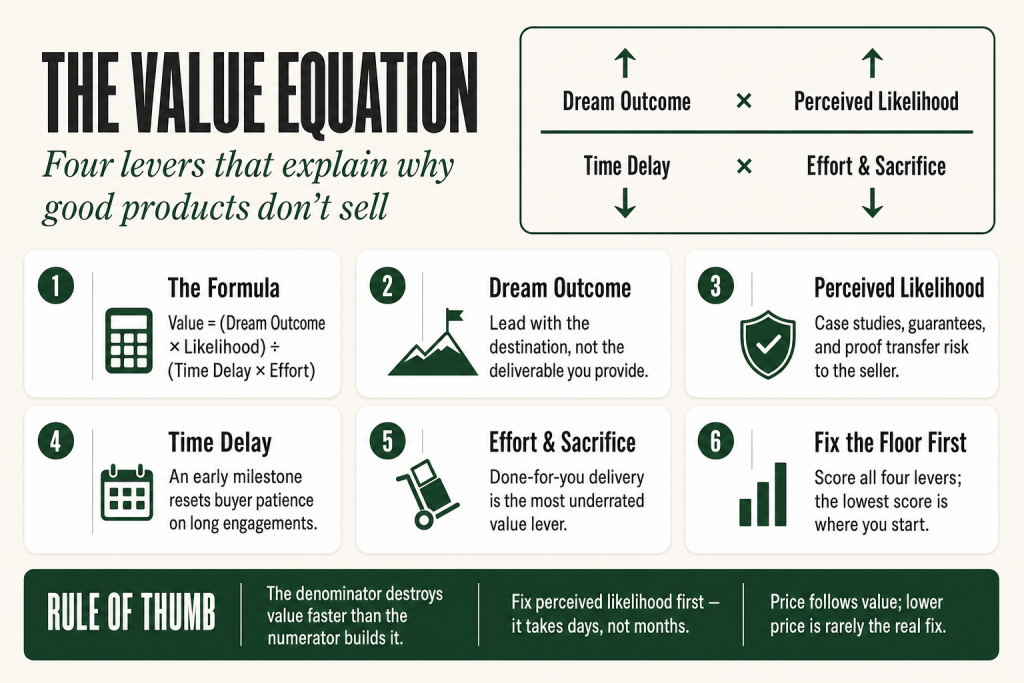
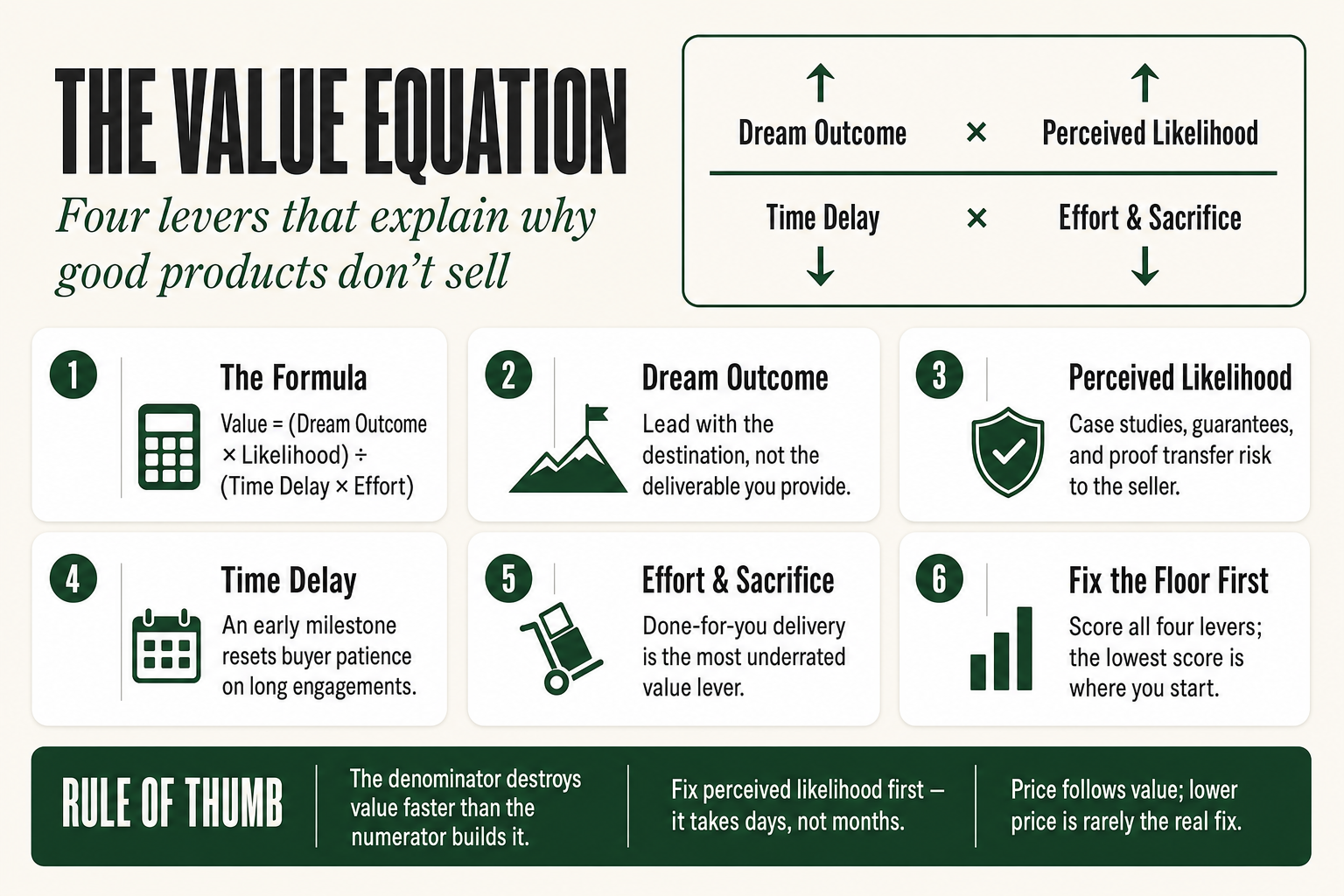
The value equation is the clearest single framework I’ve seen for diagnosing why a good product doesn’t sell. The formula, (Dream Outcome × Perceived Likelihood of Achievement) ÷ (Time Delay × Effort & Sacrifice), sounds like a math problem, but it’s really a four-question checklist you can run on any offer in about ten minutes. By the end of this page, you’ll know exactly which lever is dragging your conversions down and what to do about it.
Most operators who struggle with conversions assume the price is the problem. Lower the price, see if it moves. Doesn’t move much. Lower it again. Now they’re cheap and still not selling well, which is the worst of both worlds. The value equation reframes the whole question: price isn’t the obstacle, perceived value is. And perceived value has four specific inputs you can actually change.
This isn’t a vague principle about ‘delivering more value.’ It’s a structured way to look at your offer from the buyer’s point of view and ask: what do they believe they’ll get, how confident are they it’ll work, how long will it take, and how hard will it be? Any one of those four, if it’s weak enough, can kill an otherwise solid offer. The equation tells you which one to fix first.
The idea in 30 seconds
- The value equation is: Value = (Dream Outcome × Perceived Likelihood of Achievement) ÷ (Time Delay × Effort & Sacrifice).
- Two levers go up, dream outcome and perceived likelihood. Two go down, time delay and effort & sacrifice.
- Use it as a four-question diagnostic on any offer you’re about to launch or that’s currently underperforming.
- The denominator is the most underused half of the equation, most operators obsess over the outcome and ignore friction.
- It works on pricing pages, sales conversations, proposals, guarantees, and onboarding, not just the initial pitch.
- By the end of this page, you’ll be able to run any offer through all four levers and identify exactly which one is killing your conversions.
Where the Value Equation Came From
Alex Hormozi introduced the value equation in $100M Offerspublished in July 2021 through his Acquisition.com imprint. The book came out of his experience scaling gym businesses, environments where you’re selling a result the buyer can’t evaluate in advance, which is exactly when perceived value does the heavy lifting.
The equation’s structure is what made it spread: Value = (Dream Outcome × Perceived Likelihood of Achievement) ÷ (Time Delay × Effort & Sacrifice). It’s multiplicative and divisive, not additive. A high enough time delay swamps whatever you’ve built in the numerator, you can’t stack features and ignore the bottom half. Hormozi distributed the core frameworks freely through social media, which is why the book passed hand to hand among operators faster than most business titles. People don’t share frameworks that don’t work on Monday morning.
The Four Levers of the Value Equation
The formula has four variables. Two of them need to go up; two need to go down. Here’s what each one actually means in practice, because two are slightly misnamed in ways that matter.
Lever 1: Dream Outcome
This is the result your buyer actually wants, not what your service does, but the life or business change they’re imagining when they consider buying. The operative word is dream. Not the deliverable. The destination.
A bookkeeping client doesn’t want clean books. They want to stop dreading tax season, stop guessing at cash flow, stop feeling like the financial side of the business could cave in at any moment. Clean books is the mechanism. Peace of mind and control is the dream. If your offer is named after the deliverable, ‘Monthly Bookkeeping Package’, you’re already underselling. Lead with the dream. The deliverable is evidence; the dream is the sale.
Lever 2: Perceived Likelihood of Achievement
This is the trust variable, not ‘is your thing good?’ but ‘how confident is the buyer that your thing will get them there?’ That gap between believing the outcome is possible in theory and believing you specifically can produce it is where most high-ticket offers die.
Perceived likelihood is moved by proof: case studies, testimonials, credentials, track record, guarantees. A guarantee is powerful here because it transfers risk from buyer to seller, which is exactly what a low-likelihood perception needs. Note the word ‘perceived’, you can have the best results in your industry and still score low on this lever if you’ve done a poor job communicating the evidence.
Lever 3: Time Delay
How long between purchase and the moment the buyer feels something working. Shorter is more valuable, and this lever is more powerful than most operators give it credit for.
Two things collapse time delay in practice. First, speed to the actual result. Second, and this is what operators miss, an early emotional win. If the full result takes six months, can you engineer a meaningful milestone at week two? That early signal tells the buyer the thing is working, which resets their patience and reduces perceived delay dramatically. Think about why Uber works: the blue dot on the map collapses psychological waiting time even when the actual wait is unchanged.
Lever 4: Effort & Sacrifice
Everything the buyer has to do, change, give up, or endure to get the result, literal work, learning curves, lifestyle changes, and the things they have to stop doing.
This is the most underrated lever. Operators spend enormous energy amplifying the dream outcome and almost none reducing friction. Done-for-you delivery is the canonical friction reducer. Every task you take off the buyer’s plate directly moves this lever. So does faster onboarding, pre-filled intake forms, and clearer instructions on exactly what the buyer needs to do, and equally: what they don’t.
Why the Division Sign Is the Most Important Character in the Formula
Most people look at the value equation and instinctively think ‘add more to the top.’ Better outcome, stronger credibility, done. That’s not wrong, but it’s half the game, and it’s the half everyone else is playing too.
The division structure means the denominator can destroy value faster than the numerator can create it. A time delay of ‘you’ll see results in twelve to eighteen months’ is a devastating drag on perceived value, no matter how spectacular the dream outcome is. An effort level that requires the client to reorganize their entire operation just to onboard will kill deals that would otherwise close.
There’s also a ceiling on the numerator. You can only credibly promise so large a dream outcome, and you can only prove likelihood so far. But if you drive time delay and effort toward zero, value approaches infinity. That’s a thought experiment, not an operational target, but the direction it points is real: you can often unlock more value through friction reduction than through benefit amplification, and it’s usually cheaper to do.
Consider Netflix versus the video rental store. The dream outcome (watch a movie tonight) was identical. Perceived likelihood was identical, both would definitely deliver the movie. What Netflix obliterated was time delay (immediate, no drive required) and effort (no late fees, no trip, no browsing a physical shelf). The denominator dropped toward zero, and it won the market. That’s the value equation running in real time.
For a small service business, this cashes out as a concrete question: ‘What does the client have to do between saying yes and getting the first meaningful result, and what can I remove from that list?’
Using the Value Equation as an Operator’s Checklist
Here’s how to actually run this on your offer, not as a theoretical exercise but as a working diagnostic.
Pull up your current offer. Could be a proposal template, a services page, a sales deck, or just a mental model of ‘what you sell.’ Score each lever from one to ten. One is broken, ten is exceptional.
Scoring Dream Outcome
Is the stated outcome specific and emotionally resonant, or is it generic and process-focused? ‘We manage your payroll’ is a two. ‘You stop spending Friday afternoons fixing pay errors and your team gets paid on time, every time’ is an eight. If you’re selling a functional deliverable rather than a transformation, score this low and rewrite the positioning first. Everything else builds on this.
Scoring Perceived Likelihood
What proof does a skeptical buyer see before they have to decide? Count your specific case studies, named results, testimonials with actual numbers, guarantees, and credentials. If a prospect could read your website and still reasonably wonder ‘but will it work for me?’, you’re below a six. Add a result-based guarantee, money-back, performance-based, or milestone-tied, and at least two or three case studies that mirror your buyer’s situation. Both moves directly raise this score.
Scoring Time Delay
When does the buyer first feel something working? Not when the project completes, when do they get their first signal? If you can’t name a specific early win within the first two weeks of engagement, your time delay score is probably a four or five regardless of how good your final results are. Engineer an early deliverable, a quick audit, a first draft, a first payment run, a first report, specifically to create that early signal. Then communicate it in your offer before the sale.
Scoring Effort & Sacrifice
List everything the client has to do to work with you. Onboarding forms, data gathering, meetings, access credentials, internal introductions, change management. Now ask honestly: is any of that on your list because it’s easier for you, not because it’s necessary? Move everything you can off their plate. Document the remainder explicitly so ‘what the client does’ is clear and bounded, uncertainty about effort is almost as bad as high effort.
Once you’ve scored all four, the lowest score is where you work first. That’s the broken lever. Fixing it will do more than doubling down on a lever that’s already a seven.
Running It on a Proposal Before You Send It
This is where the checklist becomes a habit rather than a one-time exercise. Before any proposal goes out, run the four questions: Does this document lead with their dream outcome? Does it give them enough evidence to believe we’ll deliver? Does it give them a sense of how soon they’ll see results? Does it make clear how little they have to do? If the answer to any of those is ‘not really,’ fix it before it sends. Takes fifteen minutes. Closes more deals than a lower price would.
Putting this to work? The ideas in the Canon are the foundation under the tactical playbook in Build a Complete Marketing Departmentgrab the free companion kit at mmsvegas.com/resources.
Where the Value Equation Works Best
The value equation is most powerful in three situations.
High-consideration purchases. Any time the buyer is spending significant money or making a significant commitment, hiring a contractor, signing a retainer, engaging a consultant, they’re doing a version of this calculation in their head. Making it explicit in your offer simply makes the math come out in your favor. The bigger the decision, the more each lever matters.
Service businesses and B2B offers. When the buyer can’t fully evaluate quality before they buy (which is almost always true in services), perceived likelihood does enormous work. They’re not buying a product they can hold and inspect, they’re buying a promise of a result from a person they’ve just met. Proof, guarantees, and specificity aren’t nice-to-haves here; they’re load-bearing.
Competitive markets where the offer itself is undifferentiated. If your core service looks identical to five competitors’, the value equation tells you exactly where to compete without cutting price. You can out-certify them on perceived likelihood, out-speed them on time delay, or make your onboarding radically easier. Any of those creates a perceived value difference that a price comparison won’t capture.
Where It Has Limits
The value equation is a framework for perceived value, not actual value. That distinction matters more than it might seem.
A buyer’s perception of time delay can be manipulated by promising early wins that aren’t meaningful, a ‘quick start call’ that doesn’t actually accelerate results, a ‘week one report’ that shows activity but not progress. You can game the equation in ways that increase sales and decrease satisfaction. That’s a short game and a bad trade, but it’s available, so it’s worth naming.
The equation also doesn’t help much with awareness, it assumes the buyer already knows they want the outcome and is evaluating whether your offer will deliver it. If your buyer doesn’t yet recognize they have the problem, no amount of value equation optimization will get them there. That’s a different problem (see: Market Awareness Levels).
And it’s multiplicative, which means a zero in any variable collapses the whole equation. If the buyer flatly doesn’t believe the dream outcome is possible at all, not just with you, but anywhere, no amount of guarantee or speed improvement will save the sale. You’re fighting a belief problem, not a value problem, and that requires different tools.
Finally: the equation describes a snapshot in time. Value perception changes post-purchase, based on what actually happens. You can sell well on value equation optimization and still churn clients if the delivery doesn’t back it up. The equation is a sales tool, not a delivery substitute.
What People Get Wrong About the Value Equation
‘It’s about making bigger promises.’ The dream outcome lever is about articulating the outcome the buyer already wants, not inflating the promised result beyond what you can deliver. A bigger promise that’s not credible tanks perceived likelihood and costs you more than it gains.
‘Time delay just means deliver faster.’ Often you can’t deliver the final result faster without compromising quality. But time delay in the equation is about perceived time to result, which is heavily influenced by early signals, progress updates, and milestone visibility, none of which require the project to actually finish faster. A client who sees a meaningful deliverable in week one will feel very differently about a six-month engagement than one who hears nothing for eight weeks.
‘Effort & sacrifice is just about workload.’ Effort includes uncertainty. A client who doesn’t know what they’re going to have to do experiences that uncertainty as anticipated effort, it weighs on the decision even before the work starts. Clearly documenting ‘here’s your role, here’s ours, here’s the three things you’ll need to provide’ reduces perceived effort before any actual work happens. Clarity is a friction reducer.
‘This only applies to the initial offer.’ The value equation runs on repeat. Every renewal conversation, every upsell, every referral request is subject to the same four variables. If your client feels like results came slower than expected or that they did more work than they anticipated, they won’t renew and won’t refer, even if the dream outcome was delivered. The equation governs the whole relationship, not just the front door.
The Value Equation Running Inside Real Offers
You don’t have to look hard to see this framework operating in well-known businesses, once you’re looking for it, it’s everywhere.
FreshBooks vs. traditional accounting software. Same dream outcome (accurate financial records). But FreshBooks competed almost entirely on effort & sacrifice, setup in minutes, no accounting degree required, mobile-friendly. They didn’t win on features; they won by taking tasks off the owner’s plate and making the complexity disappear. That’s pure denominator play.
Weight-loss programs generally. The dream outcome (lose weight, feel good) is identical across hundreds of products. The market differentiator is almost always time delay (‘Lose 10 pounds in 30 days’) or effort (‘Without giving up your favorite foods’). The programs that promise fastest results with least sacrifice consistently outsell better-designed programs with longer timelines and stricter protocols, even when the science doesn’t support the quick-and-easy version. Hormozi’s own example in $100M Offers is pointed: liposuction versus the gym. Same dream outcome, radically different time delay and effort. Liposuction charges a premium for collapsing the denominator.
A solo consultant getting into B2B. Small consulting firms often struggle not because their work is bad but because perceived likelihood is low. A solo operator with no case studies, no named clients, and no guarantee is asking a buyer to take a lot on faith. The fix isn’t better marketing, it’s building the proof stack: write up two or three client results in specific, named detail, offer a pilot engagement with a clear deliverable and a money-back option if it doesn’t deliver, and document the process so the client knows exactly what ‘working with you’ involves. Three moves, three levers, probably doubles close rate.
Onboarding as a value equation lever. A regional IT managed services firm that gets clients live in 48 hours instead of the industry-standard two to three weeks has a massive time-delay advantage, even if their ongoing service is identical to competitors’. A law firm that sends clients a clear ‘here’s what happens next and here’s what we need from you’ packet on day one reduces perceived effort dramatically compared to firms where the process feels opaque. These aren’t marketing tricks; they’re operational decisions that directly move the value equation.
Common Mistakes
- Sending proposals that lead with deliverables instead of outcomesBefore a proposal goes out, check the first paragraph. If it describes what you do rather than what the client gets, rewrite it. ‘We’ll build a custom CRM integration’ is a deliverable. ‘You’ll stop losing deals to slow follow-up, starting in week three’ is an outcome. The rest of the proposal can explain how, but it has to open with why the client should care.
- Adding a guarantee with no teethA blanket money-back guarantee does very little for perceived likelihood, buyers assume you’ll find a reason not to honor it. Tie your guarantee to the specific result the client actually cares about: ‘If we haven’t reduced your close-of-books time by at least 30% within 60 days, we work free until we do.’ Now you’re putting skin in the game on a measurable outcome.
- Treating onboarding friction as the client’s problem to absorbMost operators design onboarding for their own workflow, then hand the client a twelve-step checklist and call it ‘simple.’ Audit every client-facing step between signed contract and first meaningful result. For each step, ask: could we do this for them, pre-fill it, or cut it entirely? The steps that survive should be ones the client genuinely cannot delegate, not the ones that are just easier for your team to receive.
- Mistaking a long delivery timeline for an unfixable time delay problemThe timeline for the final result and the perceived time delay are not the same number. A six-month engagement where the client gets a substantive deliverable in week one feels radically different from a six-month engagement where nothing visible happens until month three. Engineer at least one early milestone, an audit, a diagnostic report, a first campaign live, and put that milestone in your proposal so the buyer knows it’s coming before they sign.
- Scoring your offer as a best-case scenario instead of a skeptic’s viewWhen operators score their own four levers, they almost always score from the inside, they know the results are good, they know the process works, they know clients end up happy. The scoring exercise only works if you score it the way a stranger reading your website would score it. If the proof isn’t visible, it doesn’t count. If the process isn’t documented, effort & sacrifice is unknown, and unknown reads as high.
Operator’s Take
Five out of five for small-business operators. I almost never give that score. The reason is specific: most frameworks tell you what to do, then leave you guessing at which part of your offer to actually touch. The value equation points at a broken lever. That’s a different kind of useful.
So here’s how I’d actually apply this, not as a reflection on the framework, but as a working sequence for right now.
Step one: score your offer tonight, before you do anything else. Open a blank doc. Write the four levers. Give each one a number from one to ten based on what a skeptical buyer would see if they hit your website or received your last proposal. Don’t be generous. If you can’t point to a specific case study with a named result, perceived likelihood is not a seven. If your onboarding involves more than five client-facing steps, effort & sacrifice is not an eight. The point of the scoring isn’t precision, it’s finding the floor. The lowest number is the only number that matters right now.
Don’t start with dream outcome. It’s the first variable in the formula, so operators assume it’s the first thing to fix. It almost never is. If you’ve been in business a year or more and you’re getting meetings but not closing, buyers already understand what they’d get from you. What’s killing you is that they don’t believe you’ll deliver it, or they’re quietly running the math on how much of their own time this will consume. Those are perceived likelihood and effort problems. Dream outcome is probably a six already. Fix the fours first.
The order that actually works for most small operators: perceived likelihood → time delay → effort & sacrifice → dream outcome.
On perceived likelihood: the fix is almost always documentation you haven’t done yet. You have results, you just haven’t written them up. Do three case studies with specific numbers: client type, the problem, what you did, the measurable outcome. Named if possible. Then look at your guarantee. A performance-based guarantee, ‘if X doesn’t happen by day 90, we keep working until it does’, signals more confidence than a blanket refund policy, because it ties your skin to a specific result. That’s a week of work. Changed close rates show up within the next few sales cycles.
On time delay: this is an operations problem, not a messaging problem. The question isn’t ‘how do I communicate speed?’, it’s ‘what can I actually move to week one?’ A kickoff summary delivered 48 hours after signing, a first audit, a one-page quick-win report, something tangible before buyer’s remorse has time to set in. Clients who feel early momentum rarely second-guess the purchase. Clients who hear nothing for six weeks sometimes cancel before the project is half done.
On effort & sacrifice: you have to be honest with yourself here. Friction in your process usually exists for your convenience, not your client’s. Audit your onboarding. Count every step the client takes before they get their first result. Ask a recent client what felt like more work than they expected, and actually sit with the answer instead of explaining it away. You will find things to cut.
One lever at a time. Don’t try to move all four in a single redesign. Pick the lowest-scoring one, fix it, run it through your next five or ten sales conversations. Changing everything at once means you won’t know which lever was actually broken, and you’ll likely introduce new friction while removing old friction.
AI is useful here in specific, bounded ways. Feed it your raw client results and it can draft a case study in the right format quickly. It can rewrite a deliverable description to lead with dream outcome instead of mechanism. It can map your onboarding step by step and flag anything that looks like unnecessary client burden. What it can’t do is tell you which lever is actually broken for your specific offer in your specific market, that requires knowing your buyers, knowing where your sales conversations stall, and making a judgment call. The judgment stays with you.
Run this quarterly on your core offer. Markets shift, buyer expectations change, and competitors raise the bar. A lever that scored a seven last year can erode to a four without any change on your end. An IT managed services firm launches 48-hour onboarding and suddenly your two-week standard looks slow. Treat the value equation like a quarterly oil change, not a one-time engine rebuild.
Used in
- ✓ Build a Complete Marketing Department
Used to evaluate and redesign core offers before building campaigns around them, ensuring the offer itself converts before spending on traffic. - ✓ The Missing Manual for FunnelKit
Applied at the page and sequence level, specifically to landing page headline framing (dream outcome), social proof placement (perceived likelihood), and checkout friction reduction (effort & sacrifice). - ✓ The Missing Manual for Make
Used to identify automation priorities, automating the steps that reduce client effort and shorten time-to-first-result are the highest-ROI targets in any service workflow.
FAQ
Is the value equation an actual mathematical formula I should calculate numerically?
Not literally. Think of it as a structured diagnostic, the multiplication and division relationships tell you which variables amplify or cancel each other, but you’re not plugging in real numbers. Score each lever qualitatively, identify the weakest, and work on that one first.
Does the value equation apply to low-ticket or commodity products?
It applies everywhere, but the dominant levers shift. For low-ticket purchases, time delay and effort tend to matter most, convenience is king. For high-ticket services, perceived likelihood usually does the most work because the stakes are higher and the buyer scrutinizes proof more carefully.
How is the value equation different from just ‘selling benefits over features’?
Benefits-over-features is about the dream outcome lever only. The value equation adds three more variables, how believable the promise is, how long it takes to materialize, and how hard the buyer has to work. A benefit-focused pitch with poor proof, a long timeline, and a complex onboarding still loses.
Can I use the value equation to justify raising prices?
Yes, and this is one of its most direct applications. If you’ve demonstrably moved all four levers, tightened the outcome framing, added strong proof, created an early-result milestone, and reduced client burden, you have a structurally more valuable offer than before. Price should follow value, not lead it.
What’s the fastest lever to move for a service business that needs results now?
Perceived likelihood, almost always. Write up two or three client results in specific detail, add a clear guarantee, and put both visibly in your proposal or sales conversation. This is days of work and typically produces measurable conversion improvements within the next few sales cycles.
Does the value equation apply to retention and renewals, or just new sales?
It governs the entire relationship. A client who experienced a longer time delay than expected, or who felt the engagement required more of their effort than promised, will not renew and will not refer, even if the final result was good. Run the equation on your delivery experience, not just your pitch.
Further reading
- $100M Offers by Alex Hormozi (2021), the source text; chapters on the value equation and offer construction are the most directly applicable sections for operators.
- Influence: The Psychology of Persuasion by Robert Cialdini, useful background on the psychological mechanisms (especially social proof and authority) that drive the perceived likelihood lever.
- Obviously Awesome by April Dunford, pairs well with the dream outcome lever; Dunford’s positioning framework helps you articulate the outcome in language that resonates with the buyer’s actual context.
Sources: Alex Hormozi, $100M Offers (Acquisition.com Publishing, 2021), primary source for the value equation framework and formula. Publication details confirmed via Apple Books (released July 17, 2021) and Goodreads. Formula structure and variable definitions cross-referenced across multiple practitioner sources including alexhormozi.wiki, uplify.ai, and chatterbuzzmedia.com.
Brian Kasday spent forty years in direct-response marketing before rebuilding the whole operation as a one-person shop. He writes The Operator’s Library, including “Build a Complete Marketing Department”, for operators who’d rather build it themselves than wait on someone else.
Build the department these ideas describethe free companion kit: mmsvegas.com/resources.
More The Operator's Canon guides
Free · Operator Toolkit
Want the tools, not just the guide?
Get the free operator toolkit — templates and checklists for the systems you actually run, plus a note when this guide changes.
Get the free toolkit →