
Last updated: July 2026
Permission marketing is the practice of earning an audience’s explicit consent before you send them marketing messages, and then keeping that permission by consistently delivering something worth receiving. By the end of this page, you’ll be able to build a permission-based audience from scratch, structure the opt-in so it actually converts, and design the follow-up sequence that turns new subscribers into buyers without torching the relationship in the first thirty days.
The reason this matters more now than it did in 1999, when Seth Godin first named the idea, is that the alternative has gotten dramatically worse. Digital advertising costs have risen for over a decade. Organic social reach keeps shrinking. Cold outreach reply rates hover in the low single digits. And since February 2024, Gmail and Yahoo have enforced authentication and engagement standards that effectively penalize anyone still running a spray-and-pray email program. The small-business operator who is still entirely dependent on rented, interrupted, or bought attention is one platform algorithm change away from a very bad quarter.
An owned, permission-based audience is the one growth channel you can’t have taken away by a third party. That’s the whole argument. Everything else is detail, important detail, but detail.
The idea in 30 seconds
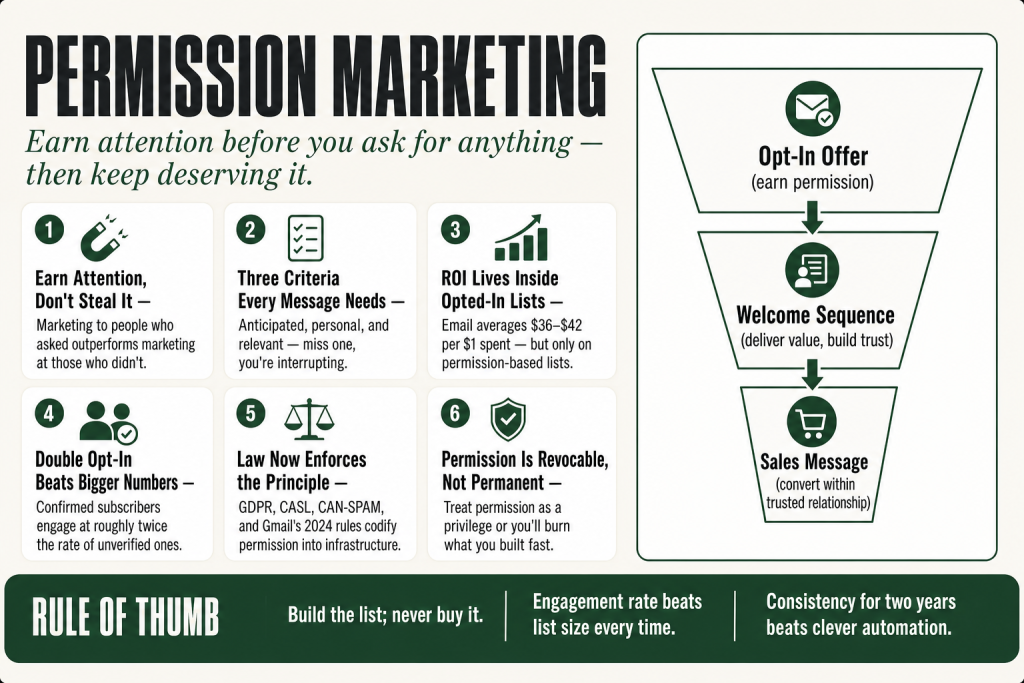
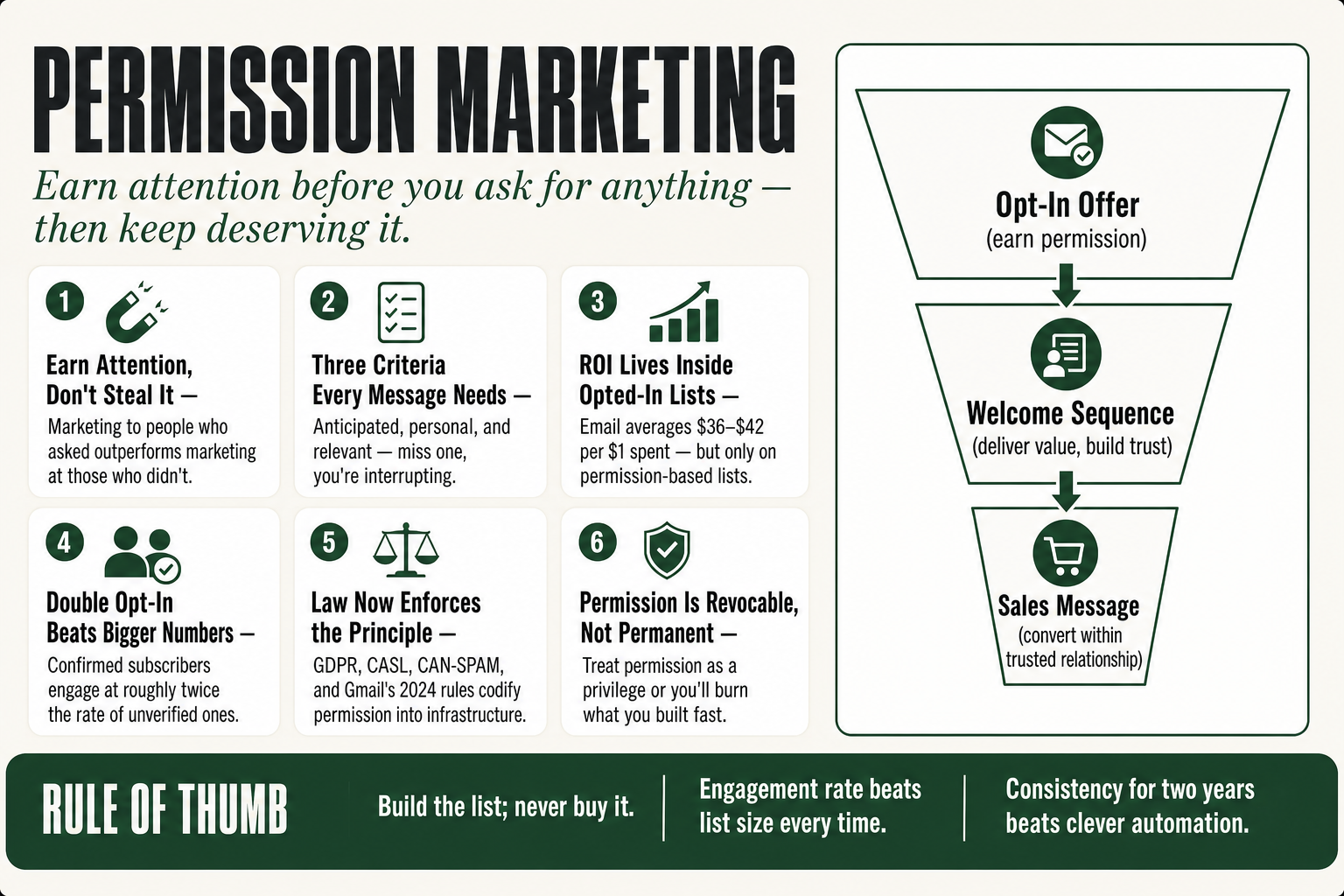
- The core idea: Marketing to people who asked to hear from you outperforms marketing at people who didn’t, in engagement, conversion, and cost.
- The three criteria: A permission-based message must be anticipated (they’re expecting it), personal (it relates to them specifically), and relevant (it covers something they actually care about).
- What you’re building: An owned list, email, SMS, or equivalent, that no algorithm or ad platform can take away from you.
- The modern legal floor: GDPR, CAN-SPAM, CASL, and Gmail/Yahoo’s 2024 bulk-sender authentication requirements have essentially codified permission marketing into law; operating without it is now a compliance risk, not just a strategic choice.
- The operator payoff: Email marketing averages around $36, $42 return per $1 spent, but that ROI sits almost entirely inside opted-in, permission-based lists. Bought lists collapse those numbers to roughly zero.
- The trap to avoid: Collecting a list and then blasting it with promotions is not permission marketing. Permission is revocable, and treating it as a right rather than a privilege burns what you’ve built fast.
Where Permission Marketing Came From
Seth Godin coined the term in his 1999 book Permission Marketing: Turning Strangers into Friends and Friends into Customers. He’d spent the mid-1990s running Yoyodyne, an online promotional marketing company that ran email-based contests, and, critically, only messaged people who had opted in first. That one step, which most direct marketers skipped entirely, became the seed of everything that followed.
His structural insight: traditional advertising steals attention. A TV spot breaks into a show. A cold call interrupts dinner. As media fragmented through the late 1990s, the cost of stealing that moment rose while its value fell. Godin saw the math turning against interruption before most practitioners noticed. His alternative was simple in concept, earn attention rather than grab it. He defined a permission-based message as one that is anticipated, personal, and relevant. Miss any one of those three and you’ve slipped back into interruption by another name.
A decade later, HubSpot formalized content-driven lead generation under the label “inbound marketing” and built a technology business on top of Godin’s philosophical foundation. The terms get conflated, but they’re different: permission marketing refers specifically to the consent relationship, while inbound is a broader content and SEO strategy for attracting that permission in the first place. The distinction matters when you’re deciding where to invest time.
The Attention Economy Problem, and Why It Only Gets Worse
In 1999, Godin estimated the average consumer saw roughly 3,000 marketing messages per day. That number has at least doubled since, with social feeds, push notifications, retargeting pixels, and pre-roll video layered on top of traditional broadcast and print. Every one of those messages competes for the same fixed resource: your customer’s attention.
Here’s the operator-level implication. When you run a paid ad, you’re bidding against every other advertiser in your vertical for a slice of an attention budget already stretched thin. You win the bid, you get the impression, and you’ve got about three seconds to make a case before the person scrolls. Your conversion rate is a tiny fraction of the traffic you paid for. You run the ad again tomorrow and pay again.
When someone is on your email list, and they signed up because they wanted what you promised, the economics flip. They’re expecting to hear from you. A well-maintained opted-in list produces open rates that dwarf what cold outreach achieves. The conversion rate on a warm subscriber who has read four of your emails is meaningfully higher than on a cold click from a paid channel. You don’t pay per send.
This is the underlying math of permission marketing: shifting from variable-cost interruption (pay per impression, pay per click, pay per call) toward a fixed-cost owned channel (build the list once, communicate for near-zero marginal cost). The comparison isn’t that one is good and the other is bad, smart operators use both. But the operator with no permission-based audience is entirely at the mercy of platforms, algorithms, and auction dynamics they don’t control.
There’s a structural reason email keeps outperforming every other digital channel on ROI. The $36, $42 return per $1 spent that benchmarks consistently report isn’t spread evenly across all email programs, it sits almost entirely inside opted-in lists. Bought lists collapse those numbers to roughly zero. The permission is what creates the economics, not the channel itself.
The Three Principles of Permission Marketing, and What They Actually Demand
Godin’s three-word summary, anticipated, personal, relevant, sounds simple. It is deceptively hard to execute, because each word eliminates something operators commonly do.
Anticipated
Anticipated means the subscriber is expecting to hear from you, not merely tolerating it. This is a higher bar than “they didn’t unsubscribe.” A truly anticipated email is one the reader notices in a crowded inbox and opens before finishing the other messages. Think about the handful of newsletters you personally open within minutes of arrival, the ones where missing an issue would feel like a small loss. That’s anticipated. Most business emails land somewhere between “I’ll get to that later” and a quiet unsubscribe.
To be anticipated, you need to set the expectation at the point of opt-in and then consistently meet it. Tell the person exactly what they’re signing up for, how often it will arrive, and what’s in it for them. If you promise a weekly dispatch of practical tips and deliver a monthly product promotion, you’ve broken the anticipation contract.
Personal
Personal does not mean inserting the person’s first name into the subject line. That trick is so common it’s become invisible. Personal means the message connects to the specific situation, interest, or stage of relationship the subscriber is in. A roofing contractor’s follow-up email to someone who downloaded a “storm damage checklist” should address the problem that person brought to the conversation, not a generic brand story that could have been sent to anyone.
This is where segmentation earns its keep. An email list is not one audience; it’s a collection of people at different stages of awareness, with different problems, who opted in via different entry points. The closer your message maps to where the reader actually is, the more personal it feels, and the more it converts.
Relevant
Relevant means the message covers something the subscriber cares about right now, not something your business happens to want to talk about right now. This is the hardest discipline for operators, because the natural tendency is to send emails when there’s something to announce, a promotion, a product launch, a company update. Relevant means asking first: does this person want this information? If your list signed up for home renovation tips and you’re sending a newsletter about your staff Christmas party, you’ve broken relevance. The content isn’t bad; it just isn’t what they signed up for.
Before sending any message, ask whether a subscriber who joined yesterday, with no other context about your business, would find this useful given exactly what they signed up for. If the honest answer is no, you’re spending permission without replenishing it.
How to Build a Permission-Based Audience as a Small-Business Operator
This is where most of the work actually lives. The philosophy is easy to agree with; the mechanics are where operators stall.
Step one: Define what you’re trading for permission
Nobody hands over their email address as an act of pure goodwill. They trade it for something: information they need, a discount they want, a tool they’d use, or access they can’t get elsewhere. The quality of what you offer at the opt-in determines the quality of the subscriber who joins, which is why a lead magnet that promises “$500 off your first project” attracts very different people than one that offers “The 7-Question Checklist for Hiring a Contractor.” The first attracts deal-seekers. The second attracts people who are actively in a buying process and trust you enough to want guidance.
Your opt-in offer should signal what the relationship will look like afterward. If the freebie is a discount, every subsequent email will be measured against a price expectation. If the freebie demonstrates your expertise, every subsequent email will be measured against that standard, which is exactly where you want to compete.
Step two: Earn explicit consent, not implied consent
There’s a legal floor here now, and it matters practically as well as legally. Under GDPR, the old practice of assuming that anyone who ever bought from you or handed you a business card is fair game for your marketing list isn’t just ineffective, it can be actively illegal depending on where your subscriber lives. GDPR requires explicit opt-in: an unchecked box, not a pre-checked one. CAN-SPAM requires a functional unsubscribe link and physical postal address in every commercial email. CASL in Canada carries similar requirements.
Beyond those laws, Gmail and Yahoo began enforcing bulk-sender authentication standards in February 2024, requiring SPF, DKIM, and DMARC configuration along with one-click unsubscribe for senders above 5,000 emails per day. As of November 2025, non-compliant emails face temporary and permanent rejections. The legal and technical infrastructure now both point the same direction: permission-based list management is the only configuration that holds up.
The practical implementation is double opt-in. A subscriber enters their email, receives a confirmation message, and clicks to confirm. The extra step filters out typos and casual clickers. According to GetResponse data, double opt-in produces roughly a 20 to 30% lower initial subscriber count than single opt-in, but the subscribers who confirm engage at roughly twice the rate. A smaller verified list beats a bigger unverified one, and that gap has widened since Gmail and Yahoo began weighting engagement signals more heavily in their spam-filtering decisions.
Step three: Design the first 30 days
New subscribers are most engaged right after they opt in. This is the window where anticipation is highest and goodwill is freshest. Most operators waste it by doing nothing, or by immediately pitching. The smarter move is a short welcome sequence, four to six emails over two to three weeks, that delivers on the promise of the opt-in, introduces your approach, and gives the subscriber a chance to self-identify their situation before any sales message appears.
A welcome sequence for a bookkeeping firm might look like: email one delivers the promised checklist; email two shares a specific scenario where the checklist prevented a costly mistake (a real story, not a generic one); email three asks a question, “which of these three problems sounds most familiar?”, and links to three different resources depending on the answer; email four mentions the service, framed around the problem the subscriber has already identified. By the time any selling happens, the reader knows you, trusts you, and has told you something about themselves. That’s not a blast list. That’s a permission-based relationship.
Step four: Maintain permission over time
Permission expires if you don’t use it, and it gets burned if you abuse it. A subscriber who hasn’t heard from you in eight months has essentially reset to cold. A subscriber who gets three promotional emails a week will unsubscribe or, worse, mark you as spam, which damages your sender reputation and reduces deliverability for everyone else on your list. The discipline is finding the frequency and content mix that keeps your list engaged without exhausting it, then sticking to it consistently enough that the subscriber develops a reliable expectation.
List hygiene matters more than list size. Only 35% of marketers regularly delete unengaged subscribers, the rest are quietly dragging down their own open rates and deliverability scores while paying their email platform to store addresses that haven’t opened anything in a year. Removing subscribers who haven’t opened in six months improves inbox placement for the people who do want to hear from you. Small, engaged, and actively permissioned beats large, cold, and inherited every time.
Permission Marketing Beyond Email, and What Actually Counts
Email is the canonical permission channel because it has the lowest distribution cost and the most established infrastructure for managing consent. But the principle applies anywhere a prospect actively invites you into their communication channel.
SMS/text marketing is, if anything, a higher-permission channel than email, the inbox is more personal, open rates are substantially higher, and the expectation of relevance is correspondingly more demanding. Getting a text from a business you didn’t specifically invite to that channel feels much more intrusive than an unsolicited email. The same logic applies in reverse: a subscriber who opts into your SMS list has granted you something unusually valuable. Treat it accordingly, be rare, specific, and genuinely useful.
Newsletter platforms like Beehiiv and Substack have added a new category to the permission landscape over the past few years. Substack reported 5 million paid subscriptions in early 2025, a 67% increase over the prior year. Beehiiv grew its newsletter count by over 60% in 2025 to reach 140,000 publications, with paid-subscription revenue on the platform hitting $19 million in 2025, up 138% from 2024. What’s driving that? Operators and creators who want direct, owned access to an audience that explicitly opted in, no algorithm standing between the sender and the reader. The model is pure permission marketing, and its growth reflects exactly what the underlying economics predict: owned audiences outperform rented reach.
Podcast subscriptions, YouTube subscribers, and social media followers are softer forms of permission. They represent interest and some tolerance for your content, but the platform owns the relationship, controls the feed algorithm, and can cut your reach at any time without notice. These channels build awareness; they should funnel toward an owned channel (usually email or SMS) where the permission relationship is direct. The goal of your social presence, from a permission marketing standpoint, is to convert followers into subscribers.
In-person and physical-world permission matters for local operators. A customer who writes their name on a sign-in sheet at your event has granted implied permission for follow-up. A business card handed across a table has not, not unless there’s a clear shared understanding that marketing messages will follow. The principle is the same regardless of medium: the other person needs to have specifically invited the communication that follows.
Retargeting pixels and browser-based tracking are a gray area. A visitor to your website has not explicitly opted into anything, but they have voluntarily arrived, which is a weak form of interest signal. Most marketers treat pixel-based retargeting as compatible with permission marketing in spirit, because you’re following up with people who already showed interest rather than cold-targeting the general population. But it’s worth being honest: pixel retargeting sits closer to the interruption end of the spectrum. It’s a useful tool; it’s not a substitute for an owned permission channel.
Putting this to work? The ideas in the Canon are the foundation under the tactical playbook in Build a Complete Marketing Department — grab the free companion kit at mmsvegas.com/resources.
Permission Marketing in Practice: What It Looks Like When Operators Do It Well
The best small-business examples of permission marketing tend to be invisible because they don’t look like marketing at all, they look like a useful resource that a business happens to publish.
A residential HVAC company that sends a monthly email about seasonal maintenance, “here’s what to check on your system before the first cold snap”, is doing permission marketing. Subscribers opted in, they expect it, the content is personal to homeowners in a specific geography, and it’s relevant to a real concern. When that company sends an annual check-up promotion in October, the conversion rate is dramatically higher than it would be on a cold postcard to the same zip code, because the relationship is already there.
A B2B consultant who maintains a weekly email to 800 past clients and prospects, sharing one honest observation about a problem their clients commonly face, is doing permission marketing. Eight hundred people is not a large list by any broadcast standard. But if those 800 people open at 45 to 50% because they trust the perspective, a single email announcing a new engagement can close meaningful revenue in 48 hours. Zero ad spend. That outcome is what a healthy permission rate actually looks like, and it’s the kind of thing a 10,000-person cold list with a 12% open rate can’t replicate.
Publications like The Pour OverGarbage Dayand TIME, all on Beehiiv as of the platform’s 2026 State of Newsletters report, are treating their opt-in lists as their core business asset, not a marketing afterthought. Independent operators are building six-figure businesses on lists of 5,000 to 15,000 subscribers because the permission relationship is clean, the engagement is real, and the monetization options (paid tiers, sponsorships, product sales) layer directly onto the trust they’ve built. The medium isn’t the point. The opted-in relationship is.
The Motley Fool built an entire media business on this model: free opt-in financial commentary that builds an audience, then paid premium newsletters and services offered to that audience. Free content earns the permission; paid product monetizes it. This structure, free useful content as the entry point, paid product as the monetization, is one of the most proven models in information-based businesses, and it runs on exactly the same logic today as it did twenty years ago.
What these examples share is that the value exchange is legible. The subscriber knows what they signed up for, the operator delivers it consistently, and sales messages arrive inside an already-trusted communication stream rather than out of nowhere.
Where Permission Marketing Works Best
Permission marketing has a high floor and works across almost every business type, but it has the highest relative advantage in markets where:
- The purchase cycle is long. If a typical customer takes weeks or months to make a buying decision, the ability to stay present in their inbox during that period without paying per touch is enormously valuable. Professional services, B2B, home services, financial advice, and healthcare are natural fits.
- The relationship compounds. If customer lifetime value is meaningful, if a customer who makes one purchase is likely to make five more over three years, the ability to maintain a permission-based communication channel with that customer is worth a significant investment. Repeat-purchase businesses have more to gain from owned audiences than one-and-done transaction businesses.
- Trust precedes purchase. For any business where the customer needs to trust the operator before handing over money or access to their home, finances, or health, a permission-based sequence that demonstrates expertise over time is a structural sales advantage. The sequence does the trust-building that previously required repeated in-person touchpoints.
- Paid acquisition is expensive or unreliable. If your primary paid channels have high CPCs, limited inventory, or policy-level restrictions on your category (financial services, healthcare, legal), building an owned permission-based audience as an alternative is especially high-value.
Where It Struggles, and Who Gets Less Out of It
Permission marketing is not a universal solution. Some operators will get less from it.
Pure impulse or one-time-purchase businesses. If you sell fireworks, Christmas trees, or anything else a person buys once per year on the basis of location and price, the economic case for a deep permission-based marketing program is weaker. The investment in building and maintaining the list may not be justified by the slim likelihood of a repeat purchase. You’re better off spending that energy on local SEO and paid local ads that capture the moment of need.
Very early-stage businesses with no existing audience. Permission marketing is a compounding strategy. The list gets more valuable over time as trust accumulates. A brand-new business with zero contacts has to build from scratch, which takes time. You can’t replace paid acquisition with permission marketing at day one; you need paid and organic channels to generate the initial traffic that then converts to subscribers. Permission marketing is the retention and compounding layer, not typically the initial acquisition engine.
Businesses that can’t consistently create useful content. The permission model requires feeding the list. If you sign up subscribers and then have nothing useful to say, the relationship decays. Operators who are genuinely stretched too thin to commit to a consistent communication cadence are better off with simpler owned channels, a well-maintained Google Business Profile and active review management, for instance, before trying to maintain a newsletter program. A neglected list is worse than no list because it trains people to ignore your sender address.
SMS/text for the wrong products. High-permission channels require genuinely high-value, relevant content to justify the intimacy. Businesses that use SMS lists for frequent promotional messages typically see rapid subscriber drop-off and deliverability issues. The channel works well for transactional alerts, appointment reminders, and very sparse promotional messages, not as a broadcast vehicle.
What People Get Wrong About Permission Marketing
These aren’t tactical slipups, they’re conceptual errors that shape how operators build (or fail to build) a permission-based audience in the first place.
Misunderstanding 1: “I have their email address, so I have permission.” You don’t. A customer who bought from you once has granted permission for transactional communication about that purchase. They haven’t granted ongoing permission for promotional marketing, and in certain jurisdictions that distinction has real legal weight. More importantly, even where the law is ambiguous, a customer who gets promotional emails they didn’t sign up for will associate your brand with that irritation. Permission is an earned relationship, not a legal technicality and not a checkbox you tick at purchase.
Misunderstanding 2: Permission, once granted, is permanent. It isn’t. Permission is revocable at any time, via unsubscribe, via spam report, or just via ignoring. And permission that isn’t actively maintained depreciates. A subscriber who hasn’t heard from you in a year isn’t warm; they’ve forgotten who you are. Godin’s framing is clarifying here: permission is a privilege, not a right. You stay in that inbox by continuing to deserve it.
Misunderstanding 3: A big list is a good list. A list of 50,000 addresses where 80% haven’t opened in twelve months is not a valuable channel, it’s a deliverability liability. When you send to addresses that consistently don’t engage, inbox providers (Google, Microsoft, Apple) start routing your messages to spam, including for the subscribers who do want to hear from you. Gmail now enforces a spam complaint rate ceiling of 0.3%, and recommends staying under 0.1% for reliable inbox placement. List size is a vanity metric. Engagement rate is what a healthy permission-based audience actually looks like.
Misunderstanding 4: Permission marketing only means email. The principle applies to any channel where explicit consent can be obtained and honored, SMS, in-app push notifications, browser push notifications, and even direct mail with opt-in list management. Email is just the most commonly managed example.
Misunderstanding 5: An opt-in form is the hard part. The form is the easy part. The hard part is being consistently useful enough that the relationship stays alive after the initial opt-in. Most operators get the technical mechanics of a sign-up form right and then have no clear plan for the following six months. The form captures permission; everything after determines whether that permission remains active.
The Legal Infrastructure That Now Enforces Permission Marketing
Godin wrote about permission marketing as an ethical and strategic choice. The past two decades have turned it into a legal requirement for anyone marketing to consumers in most major markets, and since 2024, a technical requirement enforced by the inbox providers themselves.
The CAN-SPAM Act (2003) established baseline rules for commercial email in the United States: honest subject lines and sender information, a physical postal address in every email, a functional unsubscribe mechanism, and prompt honoring of opt-out requests. The current maximum civil penalty is $53,088 per individual email, set by the FTC’s January 2025 inflation adjustment, and applied per message, not per campaign. CAN-SPAM covers any commercial message going to a U.S. recipient, including B2B email.
GDPR (2018) raised the bar significantly for anyone with European subscribers. It requires that consent be freely given, specific, informed, and unambiguous, which means a pre-checked box doesn’t qualify, and bundling email consent into terms-of-service acceptance doesn’t qualify. Under GDPR, you must be able to demonstrate consent for each subscriber, and fines can reach 4% of global annual revenue for serious violations.
CASL (2014, Canada) is widely considered the strictest of the three, requiring express consent for most commercial messages before they are sent. Penalties can reach $10 million per violation for businesses.
And then there’s the 2024 shift that many operators still haven’t fully internalized: starting in February 2024, Gmail and Yahoo began enforcing bulk-sender requirements that include SPF, DKIM, and DMARC authentication, mandatory one-click unsubscribe for senders above 5,000 emails per day, and a hard spam complaint rate ceiling. As of November 2025, non-compliant senders face throttling, spam placement, or outright rejection. This is not a compliance edge case, it’s the inbox itself enforcing permission marketing principles at the infrastructure level.
The practical takeaway: building a double opt-in, permission-based list is no longer just good strategy, it’s the structure that keeps your marketing program legally defensible and technically deliverable. The businesses getting fines and deliverability problems are the ones that built their lists by scraping, purchasing, or assuming permission from past customer contacts. Permission marketing is now the compliant path as well as the effective one.
Common Mistakes
- Buying or importing a contact list instead of building one — A purchased list has no established relationship, no anticipation, and no legal standing under GDPR or CASL. It will also damage your sender reputation from the first send, inbox providers flag high bounce rates and spam complaints, which degrades deliverability across your entire domain, including for subscribers who did opt in. The Verkada settlement is the instructive case here: $2.95 million in FTC penalties, in part for sending commercial email without functional opt-out mechanisms. Build the list; don’t buy it.
- Launching an opt-in form with no follow-up plan — Have at least four emails drafted before you turn the form on. New subscribers are most engaged in the first two weeks, if nothing arrives, that window closes and you’ve trained them to ignore your sender address. When you eventually resurface with a promotion, there’s no relationship to support it.
- Sending the same message to every subscriber regardless of how they joined — Someone who downloaded a checklist for storm-damaged roofs and someone who signed up for a general home maintenance newsletter have different problems. Treating them identically collapses the ‘personal’ criterion and produces higher unsubscribe rates than basic segmentation by opt-in source alone. Most platforms now offer AI-assisted segmentation that makes this tractable even for a solo operator.
- Ignoring list hygiene until deliverability breaks — Suppress or remove subscribers who haven’t opened in six months on a regular schedule, quarterly is manageable. Stale addresses drag down sender reputation and affect inbox placement for your engaged subscribers. A quarterly clean on a consistent schedule beats a scramble after open rates have already collapsed.
- Writing opt-in copy that describes the freebie without setting expectations for what comes next — ‘Get your free guide’ is not a permission contract. ‘Get the guide, plus a weekly tip on avoiding the three most common contractor billing mistakes’ is. Specify format, frequency, and topic at the point of opt-in, it keeps the unsubscribe rate low and starts the relationship honestly.
Operator’s Take
Most operators nod along to permission marketing and then build something that looks like it from the outside but isn’t. They collect emails, send a welcome message, blast a promotion six weeks later when something comes up, and wonder why the list never converts. I’ve seen this pattern enough times to have opinions about where it breaks, and the breaks are usually earlier and more specific than people expect.
Measure your opt-in offer at 90 days, not at sign-up. Sign-up rate tells you about your headline copy and your traffic source. Revenue per subscriber at 90 days tells you whether the people who joined actually buy. This distinction matters because discount-based opt-in offers consistently produce larger lists that convert at a fraction of the rate expertise-based offers do. A checklist, a short diagnostic, a specific guide targeted at a real problem, these attract people who are already in a buying mindset. The discount offer attracts deal-seekers who are not. Run both simultaneously against the same traffic source for 90 days and measure purchases, not subscribers. In almost every case I’ve seen tested, the expertise-based offer produces a smaller list and two to three times the revenue per contact. That number should permanently change how you think about lead magnet strategy.
Write your first twelve emails before you turn the opt-in on. Not because you need twelve queued up, because the exercise tells you something you need to know before you launch. If you hit email seven and start reaching for topics, your list will feel it before you do. The drop in opens at weeks four through six, which almost every operator experiences, is usually an early-content problem, not a subject line problem. You’ve run out of things worth saying. Diagnosing that before you’ve trained three hundred people to ignore your sender address is considerably better than diagnosing it after.
Pick a send day and treat it like a standing appointment, not a goal. The operators with healthy lists aren’t the ones with the most sophisticated automation. They’re the ones who have shown up every Tuesday, or every other Tuesday, or every Thursday morning, for eighteen months without skipping. Predictability is what turns a subscriber into a reader. Readers are who buy. An elaborate welcome sequence that collapses at day thirty builds nothing. A boring, consistent schedule running for two years builds something you can actually sell from.
When open rates drop for three consecutive weeks, read your last five emails before you touch anything else. The reflex is to test subject lines, adjust the send time, add an emoji. Sometimes those things nudge numbers marginally. But a sustained three-to-four-week decline is almost always a signal that recent content missed the anticipated/personal/relevant mark, not that you picked the wrong preview text. Read your last five emails as if you were a new subscriber who has never heard of your business. Would you keep reading? If the honest answer is no, fix what you’re saying before you optimize how you’re saying it. Subject line testing on bad content is rearranging deck chairs.
Use AI for the time-consuming mechanics, not for judgment calls about what to say. Platforms like ActiveCampaign and Klaviyo now have AI-assisted segmentation that used to require a marketing coordinator or an agency retainer. ActiveCampaign can surface audience segments from behavioral signals in seconds; Klaviyo’s predictive analytics flag churn risk and next-purchase probability at the contact level. For a solo operator running a B2B service business, that’s real reduction in overhead. But the platform doesn’t know what your subscribers are actually worried about this month. It can’t replicate the specificity that makes an email feel written for one person rather than blasted at a thousand. The AI handles the mechanics. You still have to know what to say and to whom, and that judgment doesn’t get outsourced.
Don’t skim the compliance piece because you think it only applies to big senders. The CAN-SPAM maximum is $53,088 per non-compliant email, per message, not per campaign. Verkada paid $2.95 million to settle FTC charges for violations that included flooding prospects with commercial email and failing to provide an unsubscribe option, the largest CAN-SPAM penalty the FTC has ever secured. GDPR fines can reach 4% of global annual revenue. CASL penalties can hit $10 million per violation. And since February 2024, Gmail and Yahoo enforce spam complaint rate ceilings that will throttle or reject your mail before any regulator gets involved. Use double opt-in. Configure SPF, DKIM, and DMARC on your sending domain. Honor unsubscribes within ten business days. Include your physical address in every commercial email. Clean your list quarterly. The Verkada outcome is avoidable, and building the permission relationship correctly from the start is what makes it avoidable. This isn’t a separate compliance project layered on top of your marketing; it’s just doing the marketing right.
Used in
- ✓ Build a Complete Marketing Department
Used as the foundational rationale for owning an email list as a core marketing channel, the book’s traffic and nurture architecture is built on the assumption that you are building a permission-based audience rather than depending solely on paid channels. - ✓ The Missing Manual for FunnelKit
Applied directly in the opt-in funnel design and automation sequences, FunnelKit’s lead-capture, welcome email, and broadcast workflows are the technical implementation of permission marketing principles. - ✓ The Missing Manual for Make
Used to automate the maintenance of permission, Make workflows handle list segmentation, re-engagement triggers, and consent-based subscriber lifecycle management that would otherwise require manual oversight.
FAQ
Is permission marketing just email marketing?
Email is the most common channel, but permission marketing applies anywhere explicit consent is obtained and honored, SMS, push notifications, and even opt-in direct mail lists all qualify. The principle is about the consent relationship, not the delivery mechanism.
How is permission marketing different from inbound marketing?
Inbound marketing is a broader strategy for attracting traffic through content, SEO, and social media. Permission marketing is specifically about what happens once someone raises their hand, the opt-in relationship and the ongoing communication within it. Inbound creates the conditions for earning permission; permission marketing governs what you do with it.
Do I need permission to email past customers?
In the United States under CAN-SPAM, an existing business relationship creates some implied permission for transactional follow-up, but promotional emails still require an easy unsubscribe option. Under GDPR (Europe) and CASL (Canada), the bar is higher and you generally need demonstrable express consent. When in doubt, ask them to opt in explicitly rather than assuming.
How big does my list need to be before permission marketing pays off?
Size matters much less than engagement and intent. A list of 300 highly engaged, recently opted-in subscribers in your specific niche will typically outperform a list of 10,000 cold or stale addresses. Start building immediately, even if the initial numbers are small, the compounding value begins from the first subscriber.
What’s the fastest way to build a permission-based list from zero?
Create one specific, genuinely useful opt-in offer targeted at your ideal buyer’s most pressing question or problem, drive traffic to it via paid ads or social content, and deliver it immediately via email. The speed of list growth is a function of how targeted the offer is and how much traffic you’re sending to it, not a function of the list technology.
How often should I email my list?
The right frequency is the one you can sustain consistently while delivering genuine value each time, for most small businesses that means weekly or biweekly. Inconsistency is more damaging than frequency; going silent for months and then reappearing with a promotion is the fastest way to get marked as spam.
What’s changed about permission marketing since 2024?
Two things that matter operationally. First, Gmail and Yahoo began enforcing bulk-sender authentication requirements (SPF, DKIM, DMARC) and spam complaint rate ceilings in February 2024, non-compliant senders now face throttling or rejection at the inbox level, not just regulatory risk. Second, engagement-based deliverability has become the dominant signal inbox providers use to decide where your email lands. Unengaged subscribers don’t just sit there harmlessly; they actively drag down inbox placement for your entire list. These shifts make permission-based list management more consequential than it was even three years ago.
Further reading
- Seth Godin, Permission Marketing (1999)The source document. Still worth reading for the framing of interruption vs. permission, even though the tactical examples predate modern email platforms by two decades.
- Seth Godin, This Is Marketing (2018)Godin’s update for the current landscape; the permission principle runs throughout, with more emphasis on finding the smallest viable audience and serving them well.
- Ann Handley, Everybody WritesThe most practical guide to producing email content good enough to stay anticipated; directly applicable to keeping a permission list healthy.
Sources: Seth Godin, Permission Marketing (Simon & Schuster, 1999), originating source for the anticipated/personal/relevant framework cited throughout this page. Supporting data: Litmus/Omnisend/Mailsoftly (2026) email ROI benchmarks ($36, $42 per $1 spent); FTC Federal Register Document No. 2025-01361 (CAN-SPAM maximum civil penalty of $53,088, effective January 17, 2025); FTC v. Verkada (proposed settlement August 30, 2024, $2.95 million penalty, largest CAN-SPAM fine in FTC history); Government of Canada CASL compliance guidance; GetResponse double opt-in vs. single opt-in engagement data (2024); Gmail/Yahoo bulk-sender authentication enforcement timeline (February 2024 start, November 2025 full enforcement per PowerDMARC); Mailgun bulk-sender requirement specifications (one-click unsubscribe within two business days); Beehiiv State of Newsletters 2026 (140,000 publications, $19M paid-subscription revenue in 2025, 138% YoY increase); Substack paid subscription data (5 million paid subscriptions, early 2025, 67% YoY increase, via Whalesbook/Digital Applied); GrowthNavigate email list churn data (2024: 9% unsubscribe rate, 7% bounce rate, 35% of marketers regularly clean lists).
Brian Kasday spent forty years in direct-response marketing before rebuilding the whole operation as a one-person shop. He writes The Operator’s Library — including “Build a Complete Marketing Department” — for operators who’d rather build it themselves than wait on someone else.
Build the department these ideas describe — the free companion kit: mmsvegas.com/resources.
More The Operator's Canon guides
Free · Operator Toolkit
Want the tools, not just the guide?
Get the free operator toolkit — templates and checklists for the systems you actually run, plus a note when this guide changes.
Get the free toolkit →