
Last updated: July 2026
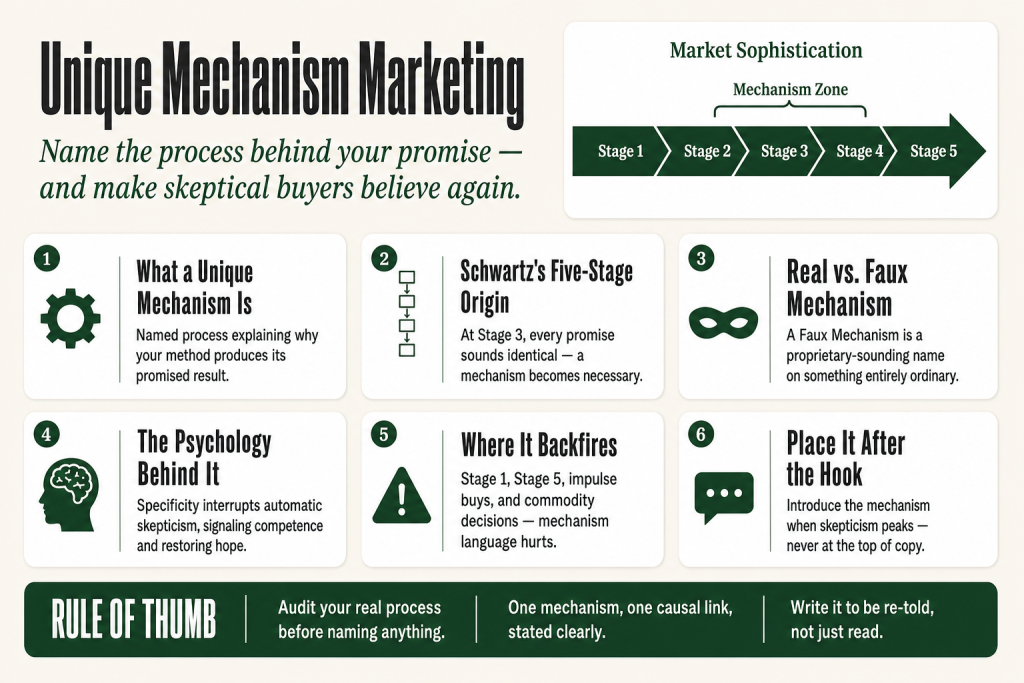
Unique mechanism marketing is the practice of naming and explaining the specific process behind your offer so that buyers understand why it works, not just that you say it does. By the end of this page, you’ll be able to identify the mechanism already embedded in your offer (or build one that’s credible), name it so it sticks, and use it to answer the most corrosive question in any saturated market: ‘Why is this different from the last five things I tried?’
That question matters more than most operators realize. When someone lands on your site, reads your email, or watches your ad, they’re not a blank slate. They’ve already heard a version of your promise. Maybe several versions. Weight loss. Business growth. Better skin. Faster HVAC service. Whatever your category, your prospect has likely tried something that didn’t deliver. That failure didn’t just disappoint them, it installed skepticism. And skepticism doesn’t respond to bigger promises. It responds to explanations.
This is the core problem that a unique mechanism solves. Not the ‘how do I stand out’ problem in the generic branding sense, the specific persuasion problem of making a familiar promise feel new and believable again. Once you see it that way, the whole idea snaps into focus. You’re not just differentiating. You’re re-opening a door the buyer thought was closed.
The idea in 30 seconds
- A unique mechanism is the specific, named process or method that explains how your offer produces its promised result, not just that it does.
- It turns vague superiority claims (‘we’re better’) into credible, believable explanations (‘here’s why it works when others don’t’).
- The concept traces to Eugene Schwartz’s Breakthrough Advertising (1966) and entered modern direct-response practice through Todd Brown’s E5 Method, which sharpened the idea and gave operators a practical framework to apply it.
- A real unique mechanism is proprietary, meaning only you use this named combination of steps, ingredients, or approach. A fake one is just a fancy label on something generic. Brown calls the fake version a Faux Mechanism.
- Works best for saturated markets where claims alone no longer cut through, which, in 2025, is most markets. But there are real situations where it backfires, and those matter just as much.
Where the Idea Came From
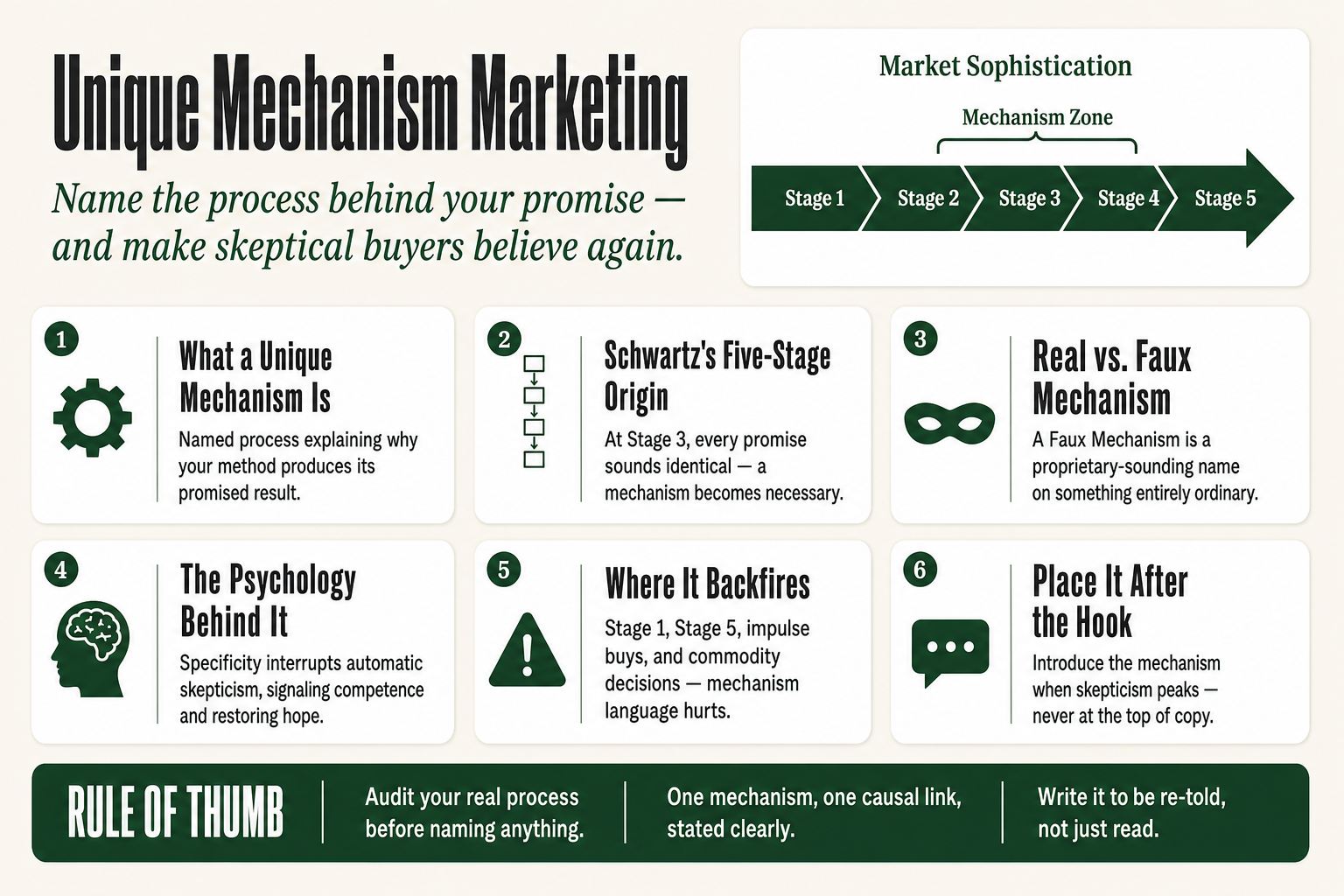
Eugene Schwartz diagnosed this problem in Breakthrough Advertising in 1966. His market sophistication model describes five stages a market moves through as it matures. At Stage 1, naming the solution wins. By Stage 3, every promise sounds identical, which is exactly when a mechanism becomes necessary. As Schwartz put it, what the market needs at that point is ‘a new mechanism, a new way of making the old promise work.’ Stage 4 improves on that mechanism. Stage 5 abandons claims entirely and competes on identity.
Todd Brown brought the framework into modern direct-response practice and drew one critical line Schwartz left implicit: the difference between a real mechanism and what Brown calls a Faux Mechanism, a proprietary-sounding name applied to something entirely ordinary. That distinction is where most operators go wrong, and it’s the sharpest practical contribution to the original idea. Schwartz diagnosed the problem. Brown operationalized the fix. The rest of this page is mostly about the fix.
What a Unique Mechanism Actually Is (and Isn’t)
Strip away the copywriting vocabulary and here’s the plain version: your unique mechanism is the named, specific reason why your method produces the result it promises. Not the result itself. Not the benefit. The causal story, the ‘here’s what’s actually happening under the hood’ explanation that makes the promise believable.
Think of it in three parts: a claim (the result the buyer wants), a mechanism (the process or method that delivers it), and a name (the term that makes the mechanism ownable and memorable). All three need to work together. A claim without a mechanism is just an assertion. A mechanism without a name is hard to refer back to. A name without a real mechanism is marketing theater, and buyers, especially experienced ones, can smell it.
Here’s what the three parts look like in practice across different business types:
- Product example: Invisalign doesn’t just claim ‘straighter teeth without braces.’ Its mechanism is SmartTrack, a highly elastic aligner material that delivers gentle, more constant force to improve control of tooth movementswhere conventional materials relax and lose a substantial percentage of their energy in the initial days of wear. The claim is the outcome. The material science is the mechanism. ‘SmartTrack’ is the name.
- Service example: An accountant who claims ‘we reduce your tax bill’ is making an assertion. An accountant who says ‘we use our Profit-First Tax Sequencing system, where we restructure the order in which revenue hits your accounts before any tax event triggers’ now has a mechanism, and that explanation justifies higher fees before the prospect even asks for a quote.
- Software example: A project management tool claiming ‘you’ll hit your deadlines’ is unremarkable. One that says ‘our Constraint-Forward Scheduling engine builds your timeline backward from the deadline, automatically flagging the single task that will break everything else’ has a mechanism that makes the claim feel earned.
Notice what’s consistent: the mechanism answers the prospect’s internal question, ‘How does it actually do that?’ That question is always running in the background when a skeptical buyer reads your copy. The unique mechanism is your answer, not ‘trust us,’ but ‘here’s the process.’
One more distinction worth making: a unique mechanism is different from a USP. The Unique Selling Proposition is the competitive claim, what makes you better or different, stated at the benefit level. The unique mechanism is the explanation that makes that claim credible. The USP says what. The mechanism says why and how. You can have a strong USP that collapses under the first skeptical question if there’s no mechanism behind it. Both working together is the goal.
Why Unique Mechanism Marketing Works: The Psychology Behind It
There’s a concrete psychological reason this approach converts better than pure benefit claims, and it’s not complicated. When a prospect encounters your promise, ‘lose 20 pounds,’ ‘double your close rate,’ ‘cut your energy bill by 30%’, they instantly run it against their prior experience. If they’ve heard similar promises and been let down, skepticism activates. Their brain categorizes you with everything else that didn’t work, before you’ve made a single argument.
What a unique mechanism does is interrupt that automatic sorting. When you introduce a named process that sounds different from anything they’ve encountered, the brain can’t immediately file you under ‘same old thing.’ There’s enough novelty that the prospect stays open, not convinced yet, but not closed. That window of openness is where persuasion becomes possible.
There’s also a credibility signal at work. An explanation that describes a real process implies the operator understands what they’re doing at a deeper level than someone who can only state outcomes. Even if the buyer doesn’t fully understand the process, and often they don’t need to, the presence of a specific explanation signals competence. Same reason a doctor explaining your diagnosis in precise terms feels more trustworthy than one who just says ‘you’ll be fine.’ Specificity implies mastery.
And then there’s hope. A prospect who has tried and failed is not just skeptical, they may have given up on the category entirely. ‘I’ve tried everything’ is as much a statement about hopelessness as experience. A genuine new mechanism says: what you tried before worked differently than this. Here’s the actual reason this succeeds where those didn’t. That’s not a bigger promise. It’s a reframing of why previous attempts failed, which, paradoxically, is more persuasive than promising a bigger result.
Putting this to work? The ideas in the Canon are the foundation under the tactical playbook in Build a Complete Marketing Department — grab the free companion kit at mmsvegas.com/resources.
How to Build a Unique Mechanism for Your Business
Here’s the part most explanations of this concept skip, because it’s harder than naming the idea: you have to actually find or build your mechanism before you can name it. And finding it starts with an honest inventory of what you actually do differently, not what you claim to do differently.
Step 1: Audit Your Actual Process
Go through your service delivery, product formulation, or methodology step by step. Ask: where does our process diverge from the standard industry approach? What do we do that most competitors don’t? What sequence, combination, or emphasis makes our approach genuinely different? If your answer is ‘nothing, really’, that’s important information, and it points to a product development question before a messaging question.
Don’t confuse ‘proprietary name’ with ‘proprietary process.’ Naming something that’s generic doesn’t make it unique. That’s the Faux Mechanism trap. A plumber who calls his service the ‘FlowMax Drain System’ when he’s doing what every other plumber does has a name with no substance. A plumber who pre-inspects the full system with a camera before quoting, maps pressure differentials across the line, and guarantees no re-dig within 24 months has a real process, it just needs a name.
Step 2: Find the Causal Story
For each step or component that’s genuinely different, ask: why does this step produce a better result? The causal story, the explanation of how the mechanism leads to the outcome, is what gives the mechanism its persuasive power. Without the causal story, you just have a label. With it, you have an argument.
The causal story doesn’t have to be exhaustive. It has to be specific enough to be credible and simple enough to be understood without a degree in the field. Think: one mechanism, one causal link, stated clearly. ‘Our fermentation process runs 18 hours longer than industry standard, which allows more of the beneficial bacteria to colonize before bottling, so you’re getting three times the live culture count compared to most shelf products.’ Specific, followable, and compelling to anyone who cares about the outcome.
Step 3: Name It
Once you have a real mechanism with a real causal story, naming it is the final step, and it matters. A good mechanism name is descriptive enough to hint at the process, distinctive enough to feel ownable, and short enough to use naturally in conversation. The name doesn’t need to be trademarked (though it can be). It needs to be consistent across your messaging so it builds recognition.
Formats that tend to work: [Descriptive Adjective] + [Process Noun] (Constraint-Forward Scheduling, Thermal-Lock Bonding), or [Outcome] + [Method] (Clear-Path Pricing System, Deep-Root Soil Protocol). Avoid names so generic they could belong to anyone (‘Advanced Process,’ ‘Proven System’) and names so clever they confuse (‘The Helix Method’ with no indication of what helix refers to).
Step 4: Test for Authenticity
Before you roll it into your messaging, stress-test it: Can your best technician, therapist, or team member explain this mechanism in their own words? Does it hold up when a skeptical customer asks a follow-up question? Would a journalist writing about your business recognize this as something real about how you operate? If the answer to any of those is no, you’re not finished yet. Go back to the process audit.
Unique Mechanism Marketing in Practice: What It Looks Like When It’s Working
P90X is probably the most-cited mechanism example in direct-response circles, and it’s worth a close look, because it shows both the power and the risk of the approach. ‘Muscle confusion’, the idea that constantly switching workout routines prevents plateaus, helped the program sell to millions of buyers. In 2005, Tony Horton trademarked the phrase ‘muscle confusion’ and sold it via late-night infomercial to people who had never heard of Tudor Bompa, the Romanian exercise scientist whose periodization research had been quietly reshaping how American strength coaches prepared athletes since the 1980s. The mechanism didn’t need to be scientifically novel to work as a marketing differentiator, it needed to be named, explained, and credible enough to hold up under a buyer’s first question. P90X clears that bar.
What makes it instructive: ‘muscle confusion’ sounds scientific without being science, implies proprietary insight without containing any, and most importantly severs the idea from its inventor. No periodization in the materials, no Bompa. But the name was memorable, the causal logic was followable, vary the workout, prevent plateau, and it gave skeptical buyers a reason to believe this home workout was different from every previous one they’d abandoned. That’s the mechanism doing its job, whatever you think of the science.
At the local and small-business level, the most honest examples often come from operators who back into mechanism-building by describing their process and realizing it is distinctive. A car cleaning business that uses dry steam instead of water and chemical solvents doesn’t need much copywriting sophistication, the process itself is the differentiator, and naming it (‘Dry-Steam Detailing’) does the rest. Clients who’ve tried conventional detailing and found their interior still smelling of chemicals will immediately understand why this works differently.
A concrete home services example: a pest control company that positions against standard chemical spray services by describing its ‘Integrated Perimeter Assessment’, a walk of the full property boundary before treatment, mapping entry points rather than just applying product, has a mechanism. Standard pest control says ‘we’ll handle your bug problem.’ This company says ‘we stop pests at their entry points rather than chasing them once they’re inside.’ That’s a mechanism-led claim, and it answers the implicit buyer question: ‘Why do I keep calling the same exterminator if the bugs keep coming back?’
What makes these work isn’t complexity. It’s specificity plus a followable causal link. The prospect can trace the explanation. They can see why the process leads to the outcome. And because they can see it, they believe it, without the operator having to ask them to.
Where This Applies, and Where It Actively Hurts You
Unique mechanism marketing earns most of its value in markets at Stage 3 or beyond on Schwartz’s sophistication scale, which, in 2025, is most consumer and professional services categories. If prospects have seen enough competing claims that they automatically discount yours, a mechanism isn’t optional. It’s what restores believability.
It works particularly well for:
- Service businesses where the process is the product, consulting, medical practices, legal, home services, financial advisory. Your method is what clients are hiring. Name it.
- Supplement, health, and wellness products where the active ingredient or formulation process can be named and explained in lay terms.
- Software and SaaS where a specific algorithm, data source, or workflow structure genuinely differs from competitors’ approaches.
- High-consideration purchases where the buyer will do research and needs your mechanism to hold up to scrutiny, not just sound good in an ad.
Now here’s the part most mechanism-marketing guides skip: there are real situations where mechanism language backfires. Not just ‘doesn’t help’, actively makes things worse.
- Stage 1 markets. If you’re first to solve a problem, don’t overcomplicate the message with mechanism language. Just state what you do and prove it works. Mechanism detail at Stage 1 adds friction before the buyer even understands the category. The first energy drink didn’t need to explain adenosine receptor mechanics, it said ‘gives you wings’ and dominated.
- Pure price-driven commodity decisions. Someone sourcing bulk industrial fasteners doesn’t care about your ‘Precision Torque Alignment System.’ They care about spec, price, and lead time. A mechanism that explains superior process is wasted on a buyer whose decision is already made on cost.
- Stage 5 markets, and this is the one operators miss most often. Supplements claiming ‘new science,’ financial products with ‘proprietary algorithms,’ business coaching programs with numbered ‘systems’, these markets have heard so many mechanisms that another one just adds to the noise. When claims are exhausted, identity and belonging outperform process explanation every time. The audience isn’t looking for a better mechanism. They’ve stopped believing mechanisms.
- B2C impulse purchases. A $12 lip gloss, a novelty kitchen gadget, a movie ticket, these buyers aren’t asking ‘how does this work?’ They’re buying on feeling. A mechanism explanation doesn’t build trust here; it slows the transaction and introduces doubt where none existed.
- When you don’t have a real mechanism yet. This deserves repeating. Naming a generic process is a risk, not a strategy. Sophisticated buyers ask follow-up questions. If your mechanism can’t survive ‘interesting, how exactly does that work?’, the whole positioning collapses. Better to describe your process in plain terms while building toward a genuine differentiator than to stake your credibility on a label you can’t back up.
Common Mistakes
- Naming a generic process (the Faux Mechanism) — Audit your actual delivery process first. If competitors run the same steps under a different label, you have a product distinction problem, not a naming problem. No amount of clever branding fixes a mechanism that isn’t there.
- Putting the mechanism at the top of the copy — Lead with the claim and the buyer’s desire. Introduce the mechanism at the moment skepticism peaks, after the promise lands, before the offer closes. Opening with the mechanism is like answering a question nobody asked yet.
- Making the mechanism too technical to follow — Reduce to one specific causal link, ‘X produces Y because Z’, and test whether a non-expert can follow it in under 30 seconds. Jargon doesn’t build trust; it creates distance.
- Using the mechanism only in ads and ignoring it in sales conversations — Train your team to use the mechanism name and explanation verbally. A mechanism that lives only in your ad copy loses compounding value, consistency across every touchpoint is where the credibility effect actually builds.
- Misreading your market’s sophistication stage — Stage 1 needs a direct claim. Stage 5 needs identity. Mechanisms belong in Stages 3 and 4. Applying mechanism language to the wrong stage either adds unnecessary friction or disappears into a category already full of competing mechanisms.
- Writing the mechanism for internal use instead of for re-telling — In B2B especially, your buyer has to sell your decision internally. A mechanism nobody can re-explain in three sentences won’t survive the room you’re not in. If it takes a paragraph to describe verbally, it’s not ready yet.
Operator’s Take
Before you write a word of mechanism copy, call your three best clients and ask them to describe, in their own words, what you do differently. Would they be able to explain it? Do their answers rhyme with each other? If yes, you probably have a mechanism. If what comes back is ‘they really care’ or ‘they’re super responsive,’ you have a culture. Worth something, but not a mechanism, and mixing those two up is a very common, very expensive mistake.
Most operators who do this audit find more than they expected. The mechanism is usually already there, just unnamed and undersold. The accountant who reviews three years of prior returns before onboarding has a mechanism. The landscaper who maps soil drainage and sun exposure before designing any planting has a mechanism. The IT firm that runs a 47-point network audit before proposing a single change has a mechanism. Real processes producing better outcomes, described in generic terms like ‘we’re thorough.’ Name it, explain the causal link, and that one move changes how prospects respond, before you touch anything else in your marketing.
On placement: most operators get this wrong. They put the mechanism at the top, as if it’s the hook. It isn’t, it’s the answer to the objection that forms after the hook lands. Lead with the promise. Let the prospect feel the desire. Then, at the exact moment their internal voice says ‘yeah, but I’ve heard that before,’ the mechanism arrives. You’re not introducing it cold. You’re answering a question the reader was already forming. In long-form copy, that’s usually the third or fourth paragraph. In a 60-second video, it’s the moment right after the problem is named. Early mechanism placement is a reliable tell that the writer doesn’t trust their hook.
Here’s a judgment call that comes up constantly: how much technical detail is enough? The instinct is to go deep, prove you know your stuff. Resist it. A mechanism explanation that requires a glossary loses the prospect before the offer appears. The test I use: can someone who wants the result, but knows nothing about how you deliver it, follow this explanation without stopping to Google something? If not, cut until they can. Precision signals competence. Jargon signals insecurity.
A specific use case B2B operators often miss: your mechanism is part of your client’s internal sales process, not just yours. When a buyer at a mid-size company decides to work with you, they often have to go sell that decision internally, to a CFO, a procurement team, a skeptical partner. If your mechanism is clear enough that your client can re-explain it in a three-sentence hallway conversation, you’ve just armed them to close the deal without you in the room. Pure outcome claims, ‘they do great work’, don’t travel. A named, explained mechanism does. Write it to be re-told, not just read.
One more thing on retainers and recurring work specifically: mechanism language helps you hold price. When a client is evaluating whether to renew, or comparing you to a cheaper alternative, ‘we do great work’ doesn’t survive the conversation. A named, explained process gives them something concrete to defend to themselves and to their boss. It’s the difference between ‘we use Agency X’ and ‘we use Agency X because their Attribution-First Reporting approach tracks revenue by channel before we allocate next month’s budget.’ The second version is a decision that sticks. The first is one that gets renegotiated at renewal.
On AI tools: once you’ve documented your actual process in writing, feed those steps to an AI and ask for mechanism name candidates. You’ll get a long list worth reacting to, much faster than starting cold. What AI can’t do is tell you whether your process is actually distinctive. It has no idea what your competitors do. Use it to accelerate the naming phase. Keep the audit to yourself.
And know the ceiling. If you’re in a market where every supplement has a ‘Proprietary Blend System’ and every coaching program has a ‘6-Step Framework,’ adding yours to the pile won’t move anything. At that point you’re better off competing on proof, on community, on track record. The tool has real limits. The operators who use it best are the ones who also know when to put it down.
Used in
- ✓ Build a Complete Marketing Department
Used to define the central messaging architecture of the business, the mechanism becomes the proof layer that sits beneath every claim across channels, from ads to proposals to onboarding. - ✓ The Missing Manual for FunnelKit
Applied in the persuasion layer of funnel pages, specifically in landing page copy and email sequences where the mechanism is introduced after the hook to close the credibility gap before the offer. - ✓ The Missing Manual for Make
Referenced when automating mechanism-delivery across touchpoints, for example, triggering mechanism-explanation emails at the exact point in a sequence where prospect skepticism is highest.
FAQ
Does my business actually have a unique mechanism, or is this only for big brands?
Most businesses have one, they just haven’t articulated it. The mechanism is whatever your process does differently that produces your result. A solo consultant’s diagnostic sequence, a contractor’s pre-job site audit, a retailer’s curation criteria: all are mechanism candidates. Start with an honest audit of your actual delivery steps and look for where you diverge from the industry standard.
What’s the difference between a unique mechanism and a USP?
The USP is the competitive claim, what makes you better or different, stated at the benefit level. The unique mechanism is the causal explanation that makes that claim believable. The USP says what; the mechanism says how and why. They work as a pair, not as substitutes.
Do I need to patent or trademark my mechanism?
No. Legal protection can be valuable if you develop a genuinely novel process, but marketing novelty doesn’t require legal novelty. What matters is that the named process is real, is yours in practice, and that competitors aren’t already using the same description. A trademark on the name adds protection but isn’t required to use the mechanism in marketing.
Where in my copy should the mechanism appear?
After you’ve made the promise and skepticism is highest, not at the top, not buried in bullets. The mechanism answers the internal objection ‘why should I believe this works?’ so it needs to arrive precisely when that objection would form. In long-form copy, that’s typically after the hook and before the offer.
Can I use a unique mechanism in B2B selling, not just consumer copy?
Absolutely, and it may matter more in B2B because business buyers often have to justify the purchase to someone else. When your mechanism can be explained clearly, the buyer can re-explain it internally to a skeptical manager or procurement team. That makes your mechanism part of your client’s internal sales process, which is a significant advantage.
What if my market is so saturated that no mechanism sounds new anymore?
That’s Schwartz’s Stage 5, and the honest answer is that mechanism-led messaging loses effectiveness there. At Stage 5, competing on claims and mechanisms just adds to the noise. The better move is to compete on identity, community, and experience rather than process differentiation. The unique mechanism tool has a ceiling; recognizing that ceiling is part of using it well.
Does unique mechanism marketing work for impulse purchases or commodity products?
Rarely, and sometimes it actively works against you. If the buyer’s decision is driven by price, convenience, or pure emotion, introducing a mechanism explanation adds friction. It implies a complexity that slows a transaction that was going fine without it. Mechanism marketing earns its keep in high-consideration, results-driven purchases, not in categories where the buyer just wants the thing and isn’t asking ‘why does this work?’
Further reading
- Breakthrough Advertising by Eugene Schwartz (1966), The origin source. The market sophistication framework is where mechanism thinking begins. Read it for the diagnosis logic: how to read your market’s stage and decide what type of message it actually needs.
- E5 Method by Todd Brown (also published as the E5 Customer Acquisition Marketing Protocol), The modern direct-response formulation. Brown’s distinction between a real mechanism and a Faux Mechanism is the sharpest practical refinement of Schwartz’s original idea. Available at toddbrown.me.
- Market Sophistication: Schwartz’s 5 LevelsSelfstorming framework library entry that operationalizes Schwartz’s stages for practical campaign diagnosis. Available at selfstorming.com.
Sources:
Concept origin and market sophistication framework: Eugene Schwartz, Breakthrough Advertising (1966). Modern unique mechanism formulation and Faux Mechanism distinction: Todd Brown, E5 Method / E5 Customer Acquisition Marketing Protocol; Todd Brown, published teaching at toddbrown.me. P90X ‘muscle confusion’ mechanism, Tony Horton trademark, and Tudor Bompa periodization background: Physical Culture Study, May 13, 2026 (physicalculturestudy.com). Invisalign SmartTrack material science: Align Technology press release, October 2012 (investor.aligntech.com); Align Technology, aligntech.com/solutions. Market sophistication stage definitions and framework summary: Selfstorming, Market Sophistication: Schwartz’s 5 Levels, selfstorming.com.
Brian Kasday spent forty years in direct-response marketing before rebuilding the whole operation as a one-person shop. He writes The Operator’s Library — including “Build a Complete Marketing Department” — for operators who’d rather build it themselves than wait on someone else.
Build the department these ideas describe — the free companion kit: mmsvegas.com/resources.
More The Operator's Canon guides
Free · Operator Toolkit
Want the tools, not just the guide?
Get the free operator toolkit — templates and checklists for the systems you actually run, plus a note when this guide changes.
Get the free toolkit →