
Last updated: July 2026
Hook story offer is the three-part structure that underlies most of what you see working in direct-response marketing today. By the end of this page you’ll be able to build each element deliberately, diagnose a broken one quickly, and wire the whole pattern into every ad, email, and page you run.
Most small-business marketing fails not because the product is bad or the business is underqualified, but because one of three things is missing, either nobody stopped to pay attention, or they didn’t trust what they saw, or the thing being sold wasn’t packaged compellingly enough to act on. Hook story offer names those three failure modes and fixes them in sequence.
Russell Brunson, co-founder of ClickFunnels, popularized this framework after watching his own funnels succeed and fail and noticing that every conversion problem traced to one of three places. He first taught it publicly as the opening keynote at Funnel Hacking Live 2019 in Nashville, then wove it through the updated editions of his Secrets Trilogy, making it the only framework that appears across all three books. Be honest about what it is, though: a distillation of techniques that predate ClickFunnels by decades, organized into a label simple enough to actually use. Copywriters have always opened with an attention grab, built with a narrative, and closed with a proposition. Brunson gave that sequence a handle most operators can grab without a copywriting degree.
This page is about using the framework operationally, as a repeatable skeleton for your marketing output, a diagnostic when something stops working, and a quality filter for everything you publish.
The idea in 30 seconds
- Hook story offer is a three-part copywriting structure popularized by Russell Brunson that works across ads, emails, landing pages, and video scripts.
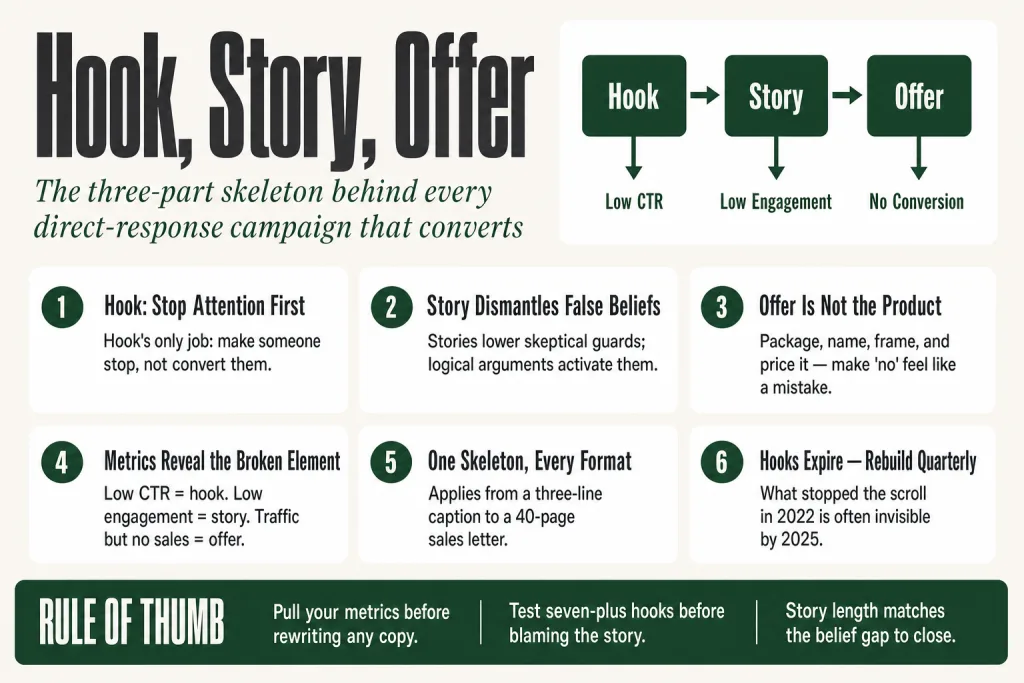
- The hook stops attention, a headline, image, or opening line that creates enough curiosity to earn the next five seconds.
- The story builds belief by dismantling the prospect’s false assumptions and replacing them with a new frame that makes the offer feel inevitable.
- The offer closes, a packaged proposition with perceived value high enough that saying no feels like a mistake.
- Brunson’s diagnostic is blunt: if a funnel, ad, or email sequence isn’t converting, the problem is always the hook, the story, or the offer. Fixing conversion is a process of isolating which one is broken.
- A solo operator who masters this pattern owns a universal skeleton they can drop into any format, paid ad, nurture email, sales page, DM follow-up, and troubleshoot it methodically.
Where Hook Story Offer Came From
Brunson has said he stumbled onto hook story offer while watching his own funnels succeed and fail, his conclusion being that every conversion problem traced to one of three places. He first taught it publicly at Funnel Hacking Live 2019, then released it as a four-part series on his Marketing Secrets podcast that March. He later included it in all three updated volumes of his Secrets Trilogy, the only framework to appear across all three books.
The underlying logic is older than ClickFunnels by a long shot. Direct-response copywriters from the mid-20th century, Eugene Schwartz, John Caples, Claude Hopkins, understood that you had to earn attention before you could earn belief, and earn belief before you could earn money. Robert Collier’s Letter Book (1931) is essentially a manual on hooks and story construction. Brunson’s contribution was compression, not invention: three words, one diagnostic. An operator running a business alone doesn’t have time to study Claude Hopkins. But they can remember hook, story, offer, and check all three when conversion drops.
Hook Story Offer: What Each Element Actually Does
The Hook
The hook’s only job is to make someone stop. Not convert them, not inform them, stop them. On a Facebook feed, that’s measured in fractions of a second. In an email inbox, it’s the subject line. On a landing page, it’s the headline and hero image combination. Whatever sits in that first-impression position has to do one thing: create enough curiosity or resonance that the person decides to give you another few seconds.
Strong hooks do one of three things: they name a specific pain the reader is already feeling, they make a promise so specific it creates curiosity about how, or they pattern-interrupt, saying something unexpected enough that the brain flags it as worth pausing for. The weakest hooks do none of these. They open with the business name, a generic tagline, or a benefit so vague it could apply to anyone. “We help businesses grow” is not a hook. “The HVAC company in Henderson that posts its prices online” might be.
Notice what the strong version does: it names a specific group, makes a specific claim, and implies a tension, most HVAC companies don’t post prices. That implied contrast is doing a lot of work. A good hook often succeeds because it says something the reader suspects is true but hasn’t heard said out loud.
One more thing most operators miss: you need more hooks than feels reasonable. A hook that works brilliantly on a 45-year-old homeowner in Nevada may land flat with a 32-year-old renter in Austin. Test many hooks against the same story and offer before concluding your story or offer is the problem. The hook is the highest-leverage variable to test first, cheapest fix, most variables to run.
The Story
If the hook is the open door, the story is what’s on the other side of it. And this is where most operators get it wrong, they think “story” means autobiography. It doesn’t. The story’s job is to shift the prospect’s beliefs. Specifically: identify the false assumption they’re carrying that would keep them from buying, and dismantle it without arguing.
This is why stories work when logical arguments don’t. A logical argument about your product’s features activates the skeptical, critical part of the brain. A story activates pattern recognition and empathy, the part that’s trying to understand what happened and what it means. People let their guard down inside a story in ways they don’t inside a pitch. That’s not manipulation; it’s how human cognition has always worked.
For a small-business operator, the most useful story types are usually three: your origin story (how you discovered what you now sell, ideally because you had the same problem your customer has), a customer transformation story (a real client’s before-and-after), and a mechanism story (how your specific approach works differently). You don’t need all three in every piece of content. A short email can run a single transformation story. A sales page might use all three in sequence. Match story length and complexity to the format and to how warm the audience is.
The Offer
The offer is not the product. That distinction matters more than anything else in this section. The product is what you make or deliver. The offer is how you package, name, frame, and price it, plus everything that makes someone feel the value they’re getting is obviously greater than what they’re spending.
A mediocre product in a brilliant offer package will outperform a brilliant product in a mediocre package every time, at least in initial conversion. The offer answers the prospect’s final question, “okay, so what do I actually get, exactly, and why is it worth it?”, in a way that makes the decision feel like an obvious yes. That requires specificity: not “coaching program” but “six weekly sessions, a custom meal plan, and a 14-day check-in protocol.” The bundle makes the value visible in a way that a single generic service description never does.
Offer construction is its own deep topic (see the Godfather Offer and Irresistible Offer entries in the Canon for the full treatment). Short version: name everything the customer gets, make the value of each component feel concrete, and reduce or eliminate the perceived risk of saying yes. Price anchoring, bonuses, guarantees, and limited availability are all offer-level tools, they don’t fix a bad hook or a missing story, but they’re what closes the deal once the story has done its job.
The Diagnostic That Makes This Framework Actually Useful
The real operational power of hook story offer isn’t in building, it’s in diagnosing. When a campaign underperforms, most operators don’t know where to look. They change everything at once, or abandon it and start over, or blame the platform. None of those moves generate learning.
Brunson’s core claim, that every funnel problem traces back to the hook, the story, or the offer, gives you a systematic place to look. And each element leaves its own data signature.
A weak hook shows up in top-of-funnel metrics: low click-through rate on ads, low open rate on emails, high bounce rate on landing pages. People aren’t making it past the first impression. A weak story shows up in the middle: people land but don’t engage, scroll depth is low, video view rates drop early, email replies are absent. They were interested enough to show up but not convinced enough to continue. A weak offer shows up at the bottom: you’re getting traffic and engagement but few conversions. People are reading, watching, maybe even clicking the buy button, then leaving.
That’s the diagnostic map. Check your metrics, find where people are dropping out, and you’ve localized the problem to one of the three elements. Fix that element specifically, retest, measure again. This is what separates operators who actually improve over time from those who just run campaigns and hope.
One caveat worth naming: the elements interact. A great story can somewhat compensate for a mediocre hook if the audience is warm enough. A remarkable offer can get shared even when the hook is weak. But in a cold-traffic environment, paid ads reaching people who don’t know you yet, all three have to be functional. You can’t outrun a broken hook with a great offer if nobody made it far enough to see the offer.
How Hook Story Offer Applies Across Every Format You Use
One of the most useful things about this framework is that it scales up and down without changing shape. The three-part logic applies whether you’re writing a three-line Instagram caption or a 40-page sales letter. Here’s how it maps across the formats a small-business operator actually uses.
Paid Ads
Short-form ads, Facebook, Instagram, Google display, are hook-heavy. You often have space for the hook and a compressed version of the story, with the offer handled on the landing page. Think of the ad as doing the first two-thirds of the job: stop the scroll, create enough belief-shift to make the click feel worth it, and let the landing page carry the full offer. In a video ad, the hook is usually the first three to five seconds, a specific statement, a visual pattern-interrupt, or a direct call-out of the target audience. The story runs through the body. The offer and CTA land at the end or in the caption.
Email Sequences
Email gives you more room to build story across multiple messages. A five-email welcome sequence is often: hook (subject line and first paragraph that earns the open), origin story (your reason for doing what you do and why it matters to them), mechanism story (how your approach works differently), social proof story (a real customer result), and offer (the specific ask, packaged and priced). Each email has its own hook in the subject line and its own micro-story, but the sequence builds cumulatively toward the offer.
Landing Pages and Sales Pages
A landing page in hook story offer terms is: headline (hook), body copy (story, origin, mechanism, or proof depending on page length), and offer block (what’s included, the price, the guarantee, the CTA). Short landing pages for cold traffic may compress the story to a single testimonial or a two-sentence credibility statement. Long-form sales pages for higher-priced products or colder audiences need more story. The rule of thumb: story length should be proportional to the size of the belief gap you have to close before someone will buy.
Webinars and Video Sales Letters
A 60-minute webinar runs: hook (the title, registration page, opening statement), story (usually the bulk of the presentation, your origin, the mechanism, case studies, belief-breaking), and offer (the pitch, the stack, the close). The same structure applies to a 15-minute video sales letter, just compressed. The ratio of hook-to-story-to-offer shifts based on audience temperature and format length, but the order never changes.
Social Media Content
A single short-form post or Reel follows the same structure in miniature: the first line or first frame is the hook, the body tells a brief story, usually a before/after or a single insight framed as narrative, and the CTA is the offer. Often not a purchase offer but a content offer or a relationship offer. Training yourself or your content team to write every post this way raises baseline engagement without changing platform or budget.
Putting this to work? The ideas in the Canon are the foundation under the tactical playbook in Build a Complete Marketing Departmentgrab the free companion kit at mmsvegas.com/resources.
What Hook Story Offer Looks Like in the Real World
It’s one thing to explain the structure. It’s more useful to see it running in actual campaigns.
ClickFunnels itself is the clearest demonstration. Brunson’s free-plus-shipping book offers are textbook hook story offer at scale. The hook is the offer itself, a free book stops the scroll because it feels too good to pass up. The landing page runs his origin story: stumbling onto sales funnels, building a nine-figure company, wanting to share what worked. The offer is the book plus a stack of digital bonuses, framed against a retail-value anchor. The structural bones are completely transparent once you know what to look for.
Most DTC skincare and supplement brands running profitably on Meta in 2024 to 2025 run a version of this. Hook: a specific before/after visual or a “stop doing X” statement aimed at a narrow pain. Story: a founder or customer narrative that names the frustration and introduces the mechanism, usually a specific ingredient or process framed as proprietary. Offer: the product bundled with a free gift, a subscription discount, or a money-back guarantee that eliminates risk. The ones that fail usually have a mismatch, a great hook driving to a page where the story is a product feature list instead of a narrative.
Professional service businessesaccountants, attorneys, consultants, contractors, use hook story offer too, though they rarely call it that. A roofing company whose Facebook ad opens with “If your roof is more than 15 years old and you’re in [city], you need to read this” is running a hook. The story might be a video walkthrough of what a failing roof looks like before it becomes a $40,000 interior water damage claim, a narrative that reframes the decision from “do I spend money on a new roof” to “do I want to risk a much larger expense.” The offer is the free inspection plus a financing option. That’s the full structure, deployed by a trade business operator who may never have heard Brunson’s name.
The pattern is everywhere once you see it. The operator’s job is to build it deliberately rather than stumble into it accidentally.
Where Hook Story Offer Works Best
This framework is at its most powerful in a specific set of conditions, and knowing those conditions helps you decide when to use the full structure versus a lighter version.
Cold or warm traffic that doesn’t know you yet. Hook story offer was built for this scenario. When someone has no prior relationship with your business, you need all three elements working. The hook earns the first second. The story builds the trust that your brand reputation would otherwise provide. The offer has to close without a sales conversation. That’s the full pattern’s native environment.
Higher-consideration purchases. The more the prospect has to think before buying, whether because of price, because the category is unfamiliar, or because the purchase requires behavior change, the more story you need. A $19 impulse purchase might need only a hook and a clear offer. A $3,000 coaching program needs a full story arc that dismantles objections and builds genuine belief in the mechanism.
Formats with enough room. A 30-second pre-roll YouTube ad can run a hook and a compressed offer. It probably can’t run a full story arc. Hook story offer is most potent when you have enough format length to actually build belief: a 5-minute video, a 600-word email, a 1,200-word landing page, a 60-minute webinar.
Any market with heavy skepticism. If your category has been burned by bad actors, MLM-adjacent products, quick-fix health claims, financial advisory, home services with a history of shady contractors, your prospects arrive with their guards up. Story is the mechanism that lowers that guard without asking them to disarm it. It’s meeting someone where they are emotionally and giving their skepticism a narrative to process before asking for trust.
Where Hook Story Offer Falls Short
No framework works everywhere, and this one has real limits worth naming.
Repeat buyers and existing customers. Someone who already bought from you and had a good experience doesn’t need the full story arc. They need a clear offer. Sending your established customer base through a heavy story-first sequence designed for cold traffic wastes their time and signals that you don’t know who they are. Segment your list. Existing customers get an offer. Cold leads get the full structure.
Commodity or utility purchases. If someone is searching for “electrician near me” at 11pm because they blew a breaker, they don’t need a story about how you discovered your love of electrical work. They need a hook (available now, 24/7), a micro-story (licensed, insured, local, enough to establish trust fast), and a clear offer (call this number, price ranges available). Hook story offer still applies, but compressed almost to nothing on the story side because decision urgency has already done the belief-building work.
Relationship-first B2B sales. If you’re selling into an enterprise account where the buyer needs to run your proposal past three departments, a VSL-style hook story offer isn’t going to close the deal. The framework helps you build the deck, write the proposal intro, and structure the discovery call, but the sales process is longer and more relationship-dependent than a funnel can handle end-to-end.
When you don’t have a real story. Uncomfortable but true. If your story is manufactured, a founder narrative that didn’t actually happen, testimonials that are vague or unverifiable, a mechanism that’s really just the same process everyone in your category uses with a different name, the story will feel thin. Sophisticated buyers sense it. The framework doesn’t generate stories; it organizes real ones. If you don’t have compelling raw material, the first job is creating the experience and results that will eventually become the story.
Common Misunderstandings About Hook Story Offer
“The story has to be mine.” It doesn’t. Your origin story is one option, but a customer’s transformation narrative often works better, especially with cold traffic that has no reason to care about you personally yet. Customer stories tend to land harder because the prospect sees themselves in the customer, not in the founder.
“The hook is the headline.” Partially true. The hook is a functional concept, whatever stops attention in the format you’re using. On a landing page, the headline is the hook. In a video, the hook might be a visual, a sound, or the first spoken phrase. In a direct mail piece, it might be a teaser on the outer envelope. The hook is the mechanism; the specific execution depends on the format.
“A strong offer can compensate for a weak story.” Sometimes, briefly, with warm audiences. But on cold traffic with no prior trust, a weak story leaves the prospect skeptical, and skepticism makes even a great offer feel like a trap. The story’s job is to build enough belief that the offer feels like a logical conclusion, without that, you’re just hoping the offer is so irresistible that skepticism gets overridden. That works less often than it should.
“This is for online businesses.” The structure is medium-agnostic. A radio ad has a hook (the opening line), a story (the 20-second narrative), and an offer (the call to action). A direct mail letter has all three. A trade show booth conversation has all three. What Brunson taught in a digital funnel context is really a universal persuasion structure that maps onto any format where you’re trying to move a stranger from awareness to action.
“Once I build it, it’s done.” Hooks expire. What stopped a scroll in 2022 has often been copied enough by 2025 that it’s invisible. Stories age out. Offers go stale when competitors match your bonuses or your guarantee stops feeling unusual. Hook story offer is a repeating production process, not a one-time construction project.
Common Mistakes
- Treating the story as a brand paragraphOpen your story copy and find the first sentence where the subject switches from ‘you’ (the reader) to ‘we’ or ‘I’ (the business). Cut everything before it and rewrite from the reader’s problem forward. The story should name the specific false belief the prospect arrived with, ‘services like this never worked for me before’, and walk through why that belief made sense, then why it no longer does. A brand paragraph explains who you are. A belief-changing story explains why their current worldview is costing them something.
- Testing one or two hooks and declaring the campaign deadTwo hooks is a coin flip, not a test. Build at least seven to ten variants off entirely different angles, not just word-swaps on the same frame, but genuinely different entry points: a pain call-out, a contrarian claim, a named demographic, a specific before/after compressed to one line, a pattern-interrupt visual. The hooks that stop attention in your category are rarely the ones that sound cleverest in your head. Run all of them before you conclude the story or offer is the problem. Hooks are the cheapest variable to test and the one most operators exhaust last.
- Running the cold-traffic story sequence on warm or existing customersA customer who already bought from you and had a good experience doesn’t need your origin story, they need a clear, specific offer with a strong reason to act now. Sending warm buyers through a cold-traffic nurture arc signals that you don’t know who they are, and it wastes the credibility you already earned. Segment before you send: existing customers get an offer-forward message with a loyalty hook; cold leads get the full structure. These are different jobs, and the same email can’t do both well.
- Describing the product instead of packaging the offerCount the distinct components a prospect receives if they buy. If you can’t name at least three concrete deliverables with a tangible value attached to each, you have a description, not an offer. Rename each component so it sounds like a thing, ‘the 90-day roadmap session,’ ‘the async review channel,’ ‘the pricing audit checklist’, and assign a standalone value to it. Then add one risk-removal mechanism at the top of the offer block, not the bottom. The prospect’s anxiety peaks right before they decide; that’s where the guarantee earns its keep.
- Building it once and leaving itSchedule a quarterly audit, not a quarterly inspiration session. Hooks expire as competitors copy them, what stopped the scroll in Q1 2024 may be invisible by Q4. Stories age out when the market context changes or when the before/after stops feeling aspirational. Offers go stale when competitors match your bonuses or your guarantee stops feeling unusual. The audit question for each element is specific: Is this hook still generating the CTR it did when we launched it? Does this story still name the dominant fear this audience actually has right now? Does this offer still look differentiated against what a prospect sees in three competitor tabs? If any answer is ‘not clearly,’ that element gets rebuilt this quarter.
Operator’s Take
Pull up your numbers before you touch a single word of copy. That’s the whole point of this diagnostic. Most operators skip straight to rewriting and end up changing the wrong thing, which tells them nothing and costs them time they didn’t have.
If your ad CTR is under 1% on cold traffic, you have a hook problem. Full stop. Don’t rewrite the landing page. Don’t adjust the offer. Write five completely new hooks, not just swapped adjectives on the same angle, but entirely different entry points into the same idea. Try a specific pain call-out, a contrarian claim, a before/after in one line, a named target audience, a pattern-interrupt visual. Run them against the same story and offer. You’ll know within a few hundred dollars of spend which angle the audience actually responds to. Changing the landing page before you’ve done this is putting new furniture in a house nobody’s walking into.
If your CTR is solid but your email sequence isn’t converting, read the first paragraph of every message in that sequence. Find the sentence where you stop talking about the reader and start talking about yourself. That’s where belief-building stops. A story that actually shifts a prospect’s frame names the specific false belief they walked in with, “I’ve tried services like this before and they don’t work,” “this is for people more technically skilled than me,” “I can’t afford to get this wrong again”, and walks through why that belief made sense before, and why it doesn’t anymore. If your story doesn’t name a specific false belief in the first 100 words, it’s probably a brand paragraph wearing a story’s clothes.
If people are engaging, clicking, scrolling, watching, but not buying, open your offer block and count the components. If you can’t name at least three concrete deliverables with visible value attached to each, your offer isn’t packaged, it’s described. There’s a difference. “Six-week program” is a description. “Six weekly 90-minute sessions, a custom roadmap built in session one, and a 30-day Slack channel for async questions” is a package. The latter gives the prospect something to evaluate. The former gives them nothing to hold.
A few scenario-specific notes worth keeping separate:
E-commerce operators on Meta: your hook rate on creatives determines who even reaches your landing page, low-quality clicks suppress every downstream metric regardless of how clean your page is. Before you change your page, check whether your creative is actually stopping the right people or just stopping people. A hook that generates high reach with low purchase intent is an expensive distraction.
Service businesses running webinars: the classic 40-minutes-of-story-before-the-pitch ratio made sense when webinars felt novel. In most markets now, a significant chunk of your audience recognizes the format by minute ten. For service-business operators, a tighter story arc with a faster offer reveal and a clear risk-reversal will often outperform the original FHL-era structure. Test your format length before assuming the classic ratio fits your audience.
Local and trade businesses: your story doesn’t need to be long, it needs to be specific. A roofing company that says “we’ve inspected over 400 roofs in Clark County and the most common mistake homeowners make is waiting until they see interior damage” has just run a credible mechanism story in two sentences. That specificity does more trust-building work than a three-paragraph founder bio.
Course creators and coaches: your offer is where most of the money is leaking. Not because you’re underpriced, but because you’re underpacked. The prospect can’t evaluate a “12-week coaching program”, there’s nothing to compare. Give every deliverable a name, a format, and a concrete outcome. Then put the most anxiety-reducing piece, the guarantee, the access policy, the refund window, at the top of the offer block, not buried in the FAQ.
On using AI to produce this work: language models can draft hook variants quickly, which matters because you need more of them than you’d naturally write. They can shape a real client result into a usable narrative if you feed them the before, the mechanism, and the after. What they can’t do is identify which false belief your specific audience is actually carrying, that requires time with real customers. Read their reviews on Google and Amazon. Listen to the objections on sales calls. Watch the questions they ask in DMs. Feed that raw material to the AI; let it draft and organize. The judgment about what the story needs to say stays with you.
The pre-launch filter, used every time: before anything goes live, run three questions against it. Would this hook stop me if I weren’t the one who wrote it? Does the story name and dismantle a specific false belief, or does it fill space? Is the offer specific enough that a prospect could compare it line-item for line-item against a competitor? If any answer is “not really,” fix that element before you spend a dollar sending it to strangers.
Used in
- ✓ Build a Complete Marketing Department
Used to structure every outbound content asset, ads, emails, and landing pages, around a single repeatable copywriting skeleton that any solo operator can execute without a dedicated copywriter. - ✓ The Missing Manual for FunnelKit
Applied as the copy architecture for each funnel stage: the hook governs headline and opt-in copy, the story drives the email nurture sequence, and the offer block structures the checkout and upsell pages. - ✓ The Missing Manual for Make
Referenced when building automated content workflows, the framework determines what copy elements each automation step needs to generate or pull, keeping hook, story, and offer logically separated in templated outputs.
FAQ
Is hook story offer the same as AIDA?
They cover similar ground but aren’t identical. AIDA (Attention, Interest, Desire, Action) is a response-state model, it describes the mental states you’re trying to move a prospect through. Hook story offer is a content-structure model, it tells you what to produce and in what order. Story does the work of Interest and Desire simultaneously, and it gives you a mechanism (narrative) for doing that, which AIDA doesn’t specify. Use AIDA to understand where a prospect is; use hook story offer to build the content that moves them.
Do I need a personal founder story, or can I use customer stories?
Customer stories often outperform founder stories with cold traffic, because the prospect identifies more easily with someone who had their problem than with the business owner who solved it. Your origin story is one tool, a useful one for establishing credibility and mission, but a well-documented client transformation is frequently the more persuasive story in a selling context.
How long should the story be?
Proportional to the size of the belief gap you need to close. A $47 impulse buy needs a short story, maybe two or three sentences of social proof and a quick mechanism explanation. A $5,000 program needs a longer arc that dismantles major objections and builds genuine trust. Cold traffic always needs more story than warm traffic. Format also constrains length: a 30-second ad compresses story to almost nothing; a webinar can sustain 40 minutes of it.
What’s the fastest way to diagnose which element is broken?
Look at where people drop out. Low click-through or open rates point to a broken hook, people aren’t making it past the first impression. Low engagement or high early bounce rates point to a broken story, they showed up but didn’t stick around. Traffic with engagement but no conversions points to a broken offer, they were interested but the packaged proposition didn’t close them.
Can I use this framework for B2B or service businesses, not just e-commerce?
Yes, and it maps naturally to both. The hook in a B2B context is often a very specific pain point or claim that names a problem the prospect knows they have. The story is usually a case study or mechanism explanation. The offer is a scoped service or proposal, often with a low-risk entry point like a free audit or diagnostic. The same three-element structure applies; the content of each element shifts for the audience and sale type.
How does hook story offer relate to Russell Brunson’s other concepts like the Value Ladder?
They operate at different levels. The Value Ladder describes the overall product architecture, the sequence of offers at ascending price points. Hook story offer describes how you communicate any single offer at any rung of that ladder. Every email, ad, or page promoting a Value Ladder product needs its own hook, story, and offer. The two frameworks work together rather than competing.
Further reading
- DotCom Secrets by Russell Brunson (2015, updated 2020), the original Secrets Trilogy entry; the updated edition includes material on hook story offer not present in the first edition.
- Expert Secrets by Russell Brunson (2017, updated 2020), the deeper treatment of story: how to build belief-changing narratives, identify false belief patterns, and construct narrative bridges between a prospect’s current worldview and your offer.
- Traffic Secrets by Russell Brunson (2020), the book where Brunson most systematically codified hook story offer in print across all three elements.
- Scientific Advertising by Claude Hopkins (1923), the direct-response ancestor that established many of the principles hook story offer codifies; reading Hopkins makes clear how old the underlying logic is and how durable it has proven.
- The Robert Collier Letter Book by Robert Collier (1931), the original manual on structuring long-form sales narrative; still the best treatment of story-as-selling-mechanism available.
Sources: Russell Brunson, DotCom Secrets (2015, updated 2020), Expert Secrets (2017, updated 2020), Traffic Secrets (2020); Brunson’s Marketing Secrets podcast, four-part keynote series released March 2019 (Funnel Hacking Live 2019, Gaylord Opryland Resort, Nashville, Tennessee); Brunson’s Marketing Secrets podcast, ‘Mastering the Hook, Story, Offer Framework’ episode, October 2, 2024; ClickFunnels blog; On The Map Marketing recap of Funnel Hacking Live 2019; Breakthrough Marketing Secrets analysis of the hook story offer formula.
Brian Kasday spent forty years in direct-response marketing before rebuilding the whole operation as a one-person shop. He writes The Operator’s Library, including “Build a Complete Marketing Department”, for operators who’d rather build it themselves than wait on someone else.
Build the department these ideas describethe free companion kit: mmsvegas.com/resources.
More The Operator's Canon guides
Free · Operator Toolkit
Want the tools, not just the guide?
Get the free operator toolkit — templates and checklists for the systems you actually run, plus a note when this guide changes.
Get the free toolkit →How to cite: Hook, Story, Offer. Associated with Russell Brunson, 2019. The Operator’s Canon, MMS Vegas. https://mmsvegas.com/library/hook-story-offer-explained/