
Last updated: July 2026
The service recovery paradox is one of those ideas that sounds like it can’t possibly be true, that a customer who hits a problem and gets it resolved can walk away more loyal to you than a customer who had a smooth experience from start to finish. By the end of this page, you’ll be able to design a recovery system your team can execute without escalating every incident, and you’ll know exactly when the service recovery paradox applies and when it absolutely doesn’t.
Every operator who has been in business more than six months has had this experience: something goes sideways, you fix it well, and the customer becomes one of your most reliable advocates. That’s not a fluke. There’s a mechanism behind it. The problem is that a lot of people hear about the service recovery paradox and draw the wrong lesson, either dismissing it as a quirky lab finding with no real-world legs, or half-believing that failures are actually fine because they create recovery opportunities. Neither reading is useful.
What the idea is really telling you is something more practical: how your business responds to a failure is one of the few moments in a customer relationship where trust moves fast and far. In most transactions, trust accumulates slowly. Under pressure, it moves in big jumps, for better or for worse. Design for that, and the paradox takes care of itself.
The idea in 30 seconds
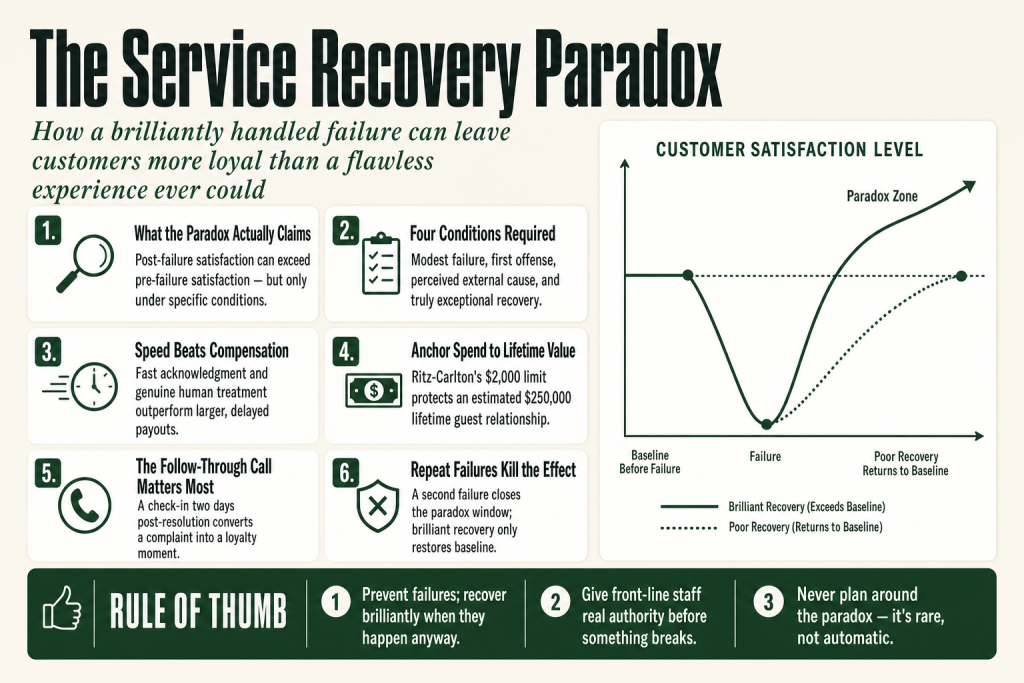
- The service recovery paradox is the finding that customers who receive an outstanding recovery from a failure can end up more loyal than customers who never experienced a problem at all.
- It was named in 1992 by researchers McCollough and Bharadwaj, who described it as a situation where post-failure satisfaction exceeds pre-failure satisfaction, building on Hart, Heskett & Sasser’s 1990 Harvard Business Review argument that recovery is a profit lever, not just damage control.
- The paradox is real but conditional, it requires the failure to be modest, the recovery to be fast and personal, and ideally for it to be the customer’s first bad experience with you.
- Large or repeat failures rarely produce the paradox; at best, good recovery gets you back to baseline. Never plan around the paradox, plan to prevent failures and recover brilliantly when they happen anyway.
- The most practical takeaway isn’t the paradox itself, it’s that a designed, empowered recovery system consistently outperforms ad-hoc apologies, refunds, and silence.
Where the Service Recovery Paradox Came From
The term service recovery paradox was coined in 1992 by marketing researchers Michael McCollough and Sundar Bharadwaj. Their paper, published in the American Marketing Association’s Marketing Theory and Applicationsdescribed a situation where a customer’s post-failure satisfaction exceeded their pre-failure satisfaction. What they were documenting wasn’t just that good recovery was nice to have; they were arguing it could actually overshoot baseline.
Two years earlier, Hart, Heskett, and Sasser had made a compatible argument in the Harvard Business Review (July, August 1990) titled ‘The Profitable Art of Service Recovery.’ Their case was practitioner-focused: that effective recovery could push satisfaction above its prior level and was a genuine profit opportunity, not crisis-management busywork. That HBR piece is still the most readable entry point into this topic.
The academic decades that followed were less kind to the paradox as a universal rule. Some studies found strong evidence for it. Others found none, McCollough’s own 2000 airline research found no paradox effect even with first-rate recovery. A meta-analysis by De Matos, Henrique, and Rossi (2007) found the effect on repurchase intentions fell short of statistical significance. The honest read: the service recovery paradox is real under specific conditions, but it is not a reliable or automatic outcome of every good recovery. What is consistent across the literature, and the part worth actually building a system around, is the sturdier finding underneath: good recovery beats poor recovery by a wide margin.
What the Service Recovery Paradox Actually Requires
Magnini, Ford, Markowski, and Honeycutt’s 2007 study in the Journal of Services Marketing is the clearest synthesis of when the service recovery paradox is most likely to emerge. Their analysis found four conditions: the failure has to be modest in severity, it has to be the customer’s first bad experience with your business, the customer needs to perceive the cause as somewhat outside your direct control, and the recovery has to be genuinely exceptional, not adequate, exceptional. Strip any one of those conditions and the effect weakens. Strip two and you’re usually just hoping to get back to zero.
Severity is the biggest gate. A minor billing error recovered with speed and warmth can produce the paradox. A missed project deadline that cost a client real money probably can’t, no matter how well you respond, the failure is too material. This matters for how the idea gets applied: the service recovery paradox isn’t a blanket license to fail confidently. It’s a narrow window that opens when the stakes are moderate and the response is remarkable.
The first failure condition matters more than most operators realize. The Magnini et al. research is consistent that repeat failures with the same business close that window almost entirely. A customer who has experienced two bad outcomes with you in sequence doesn’t experience a brilliant recovery as evidence of your reliability, they experience it as a pattern that happened to resolve this time. Their mental model of you is already written. That’s why the most durable recovery system is one that prevents failures from becoming a habit while recovering the ones that slip through with real speed and care.
On the recovery side, Wirtz and Mattila’s 2004 work on the three dimensions of service fairness, distributive (what you get back), procedural (how fast it happens), and interactional (how you’re treated), found that these operate together. A compensation payment on its own, without a fast response and genuine acknowledgment, tends not to move satisfaction much. A delayed apology still underperforms. The finding that sticks for operators: compensation is a poor substitute for a good recovery process. Speed and human treatment carry more weight than most businesses budget for them.
The Disconfirmation Mechanism
One reason the service recovery paradox works at all is expectation disconfirmation. Customers in a problem moment have recalibrated their expectations downward, they’re preparing for friction, for defensiveness, for the runaround. When the recovery dramatically exceeds that revised expectation, the emotional lift is disproportionate. The bar is temporarily lower and your jump clears it more visibly. This is the same engine the Peak-End Rule describes: memory of an experience is disproportionately shaped by its most intense moment and its ending. A well-executed recovery is both, the most memorable moment of the interaction and, if you close it well, its end. That’s why recovery done right tends to stick in a way that smooth, uneventful transactions rarely do.
The Service Recovery Paradox in Practice: Real Operators, Real Systems
The real-world example of designed recovery empowerment that gets referenced more than any other is Ritz-Carlton’s policy authorizing every employee, not just managers, every employee, to spend up to $2,000 per guest per incident to resolve problems without asking anyone for approval. The authority belongs to whoever is standing in front of the problem. What’s often missing from coverage of this policy is the number that justified it: the average Ritz-Carlton guest spends roughly $250,000 with the brand over their lifetime. They didn’t arrive at $2,000 through optimism, they studied their customers, calculated the lifetime value of those relationships, and set the limit accordingly. Against a $250,000 relationship, $2,000 isn’t generous. It’s just math.
And the $2,000 is rarely actually spent. Most employees don’t come close to that figure. The real value is the freedom to act, the signal to staff that they are trusted to do the right thing without navigating an approval chain. That trust shapes how employees show up for customers, not just in failure moments but in every interaction.
Zappos built a comparable reputation through a different route: front-line discretion rather than a fixed dollar authority. A best man ordered shoes for a wedding, the courier routed the package to the wrong address, and he called Zappos the day before. They overnighted a replacement pair at no charge, issued a refund, and upgraded him to a VIP account. The carrier’s routing error, not Zappos’ fault by any technical measure, and Zappos treated it as their problem anyway. He declared himself a customer for life, and the story has circulated for years, doing brand work far exceeding the cost of the shoes. What made it work wasn’t the dollar amount. It was the speed, the surprise, and the sense that someone actually cared about his problem.
Amazon’s no-return policy on certain low-value items is a quieter version of the same logic. Telling a customer they can keep a $12 damaged item rather than making them ship it back for a refund costs almost nothing and removes an irritant entirely. The recovery is frictionless because friction is the enemy, not the cost.
For a small-business operator, the lesson from all three isn’t to match their budget. It’s to match their decision architecture. Recovery at Ritz-Carlton works because whoever sees the problem can act on it immediately. Recovery at Zappos works because agents have real latitude and aren’t reading from a script. The common failure at the small-business level isn’t insufficient spend, it’s that the person in front of the problem has to go find a manager, who has to check a policy, and by the time any response arrives the customer has already decided what they think of you.
What an Operator’s Recovery System Actually Looks Like
A workable recovery system for a small business has four components. First, a trigger definition: what counts as a failure that activates the system? Not every complaint is a failure, some are requests in disguise. A real failure is a gap between what you promised and what the customer got. Second, a first-response protocol: who responds, in what timeframe, and with what opening? Research on interactional fairness is unambiguous that acknowledgment before solution matters. Getting to the customer fast with genuine recognition of what happened beats a polished apology that arrives two days later. Third, a resolution authority: what can your front-line person do without asking? Even a small defined budget, $50, $100, a comp service, a credit, gives your staff the ability to close a recovery on the spot instead of leaving the customer in limbo. Fourth, a close: the follow-up contact after resolution that confirms the problem is gone and signals that the customer matters past the transaction. Most operators do the first three imperfectly and skip the fourth entirely.
Putting this to work? The ideas in the Canon are the foundation under the tactical playbook in Build a Complete Marketing Department — grab the free companion kit at mmsvegas.com/resources.
Where the Service Recovery Paradox Holds, and Where It Doesn’t
Service businesses are the natural home of the service recovery paradox, HVAC, professional services, agencies, restaurants, hospitality, healthcare-adjacent services, any context where delivery is human, variable, and impossible to fully standardize. These are also the contexts where failures are most visible to the customer and where recovery is most personal. A human who shows up, owns the problem, and fixes it with care is doing something a product return or automated refund can’t replicate.
The paradox applies less cleanly in pure product retail (where the fix is usually just a swap and the emotional component is lower) and almost not at all in catastrophic or public failures. If a failure becomes a social media incident, the dynamic changes: you’re not recovering a relationship, you’re managing a reputation, and the rules are different. The service recovery paradox is a one-on-one phenomenon.
It’s also limited in B2B relationships where multiple stakeholders have observed the failure and where the emotional component is subordinate to the business impact. Hübner, Wagner, and Kurpjuweit’s research, published in the Journal of Business & Industrial Marketing (2018), examined 25 B2B logistics cases across three continents and found evidence of the service recovery paradox in only nine of them, meaning in nearly two-thirds of B2B failures studied, there was no paradox effect at all. Notably, even in the nine cases where satisfaction improved, none showed evidence of increased loyalty. Recovery still matters in B2B; it just needs to be evaluated against a more practical standard of restoring the working relationship rather than expecting a lift above baseline.
Chronic operational failures don’t produce the paradox under any conditions. If a customer has already experienced the same class of problem with you before, a brilliant recovery reads as a one-off, not as evidence of your character. The underlying problem they’ve mentally categorized as ‘how this business operates’ doesn’t get revised by a single good response. This is where the concept connects most directly to Customer Journey Mappingthe only sustainable answer to repeat failures is finding and fixing the root cause in the process, not getting better at apologizing.
What People Get Wrong About the Service Recovery Paradox
Misunderstanding #1: The paradox means failures are secretly fine. This is the reading that gets operators in trouble. The idea that a well-recovered failure produces high satisfaction does not mean the expected value of a failure is positive. Recovery is costly, in staff time, goodwill, margin, and attention. The paradox describes what can happen at the good tail of recovery outcomes, not what happens on average. Research is consistent that it’s a rare event even when recovery is excellent. Plan to prevent failures. Recover brilliantly when they happen anyway.
Misunderstanding #2: The recovery has to be expensive to work. Compensation matters, but research is clear that interactional fairness, how you treat the person, and procedural fairness, how fast and cleanly the resolution happens, do at least as much work as the tangible make-good. An immediate, warm, accountable response with a modest gesture often outperforms a delayed, bureaucratic response with a larger payout. Throwing money at a slow, cold recovery doesn’t salvage it.
Misunderstanding #3: It works the same way in all categories. Some categories are structurally more forgiving than others. Hospitality, personal services, and relationship-heavy B2B accounts create more emotional context for recovery to work within. Commodity services with thin relationships and high price sensitivity are more likely to produce churn regardless of recovery quality. Know which type of relationship you’re actually operating in.
Misunderstanding #4: The paradox is about satisfaction scores. Operators sometimes optimize for post-recovery survey scores and miss the actual goal: retention and lifetime value. A customer can give you a high recovery satisfaction score and still not return. The research on repurchase intentions after recovery is less encouraging than the research on satisfaction scores. Design your recovery to rebuild the relationship, not to close the survey loop.
Misunderstanding #5: Good recovery erases the memory of the failure. It doesn’t. What the Peak-End Rule actually tells us is that the most intense moment and the ending carry outsized memory weight, which is an argument for making the recovery the most intense positive moment. But the failure itself still happened. The goal is not to make customers forget; it’s to change the story they tell about you.
Designing Recovery as a System, Not a Response
The difference between businesses that capitalize on the service recovery paradox and those that consistently miss it is almost always a systems question, not a generosity question. Most small operators have people who would do the right thing if they knew what the right thing was and had the authority to do it. Most failures happen not because staff don’t care but because the system leaves them without options, no resolution authority, no clear first-response protocol, no framework for what an acceptable make-good looks like.
Start with your failure taxonomy. Not all failures are equal, and treating them equally leads to both over-response (compensating lavishly for minor inconveniences that didn’t really damage anything) and under-response (treating material failures with the same scripted apology as a minor one). Tiered failures require tiered authority. A level-one failure, a minor delay, a small miscommunication, should be resolvable by any front-line person without escalation. A level-three failure, something that cost the customer real money or real inconvenience, needs a manager and a more substantive response. Define this before the failure, not during it.
Speed is probably your biggest lever as a small operator. You can’t match the systems and budgets of large businesses, but you can almost always match them on response time, and in many cases beat them easily. Most customers in a failure moment are not in a failure moment for long if someone picks up the phone or replies within the hour. The window during which fast response moves satisfaction dramatically is short. Once a customer has spent six hours trying to reach you, the conversation that eventually happens starts from a worse position no matter what you say.
The follow-through contact, after the resolution, not during it, is where most operators leave real loyalty on the table. A quick check-in two days after a recovery: did everything work out? Is there anything else you need? That contact costs almost nothing and signals something specific: this customer mattered beyond the transaction. It’s the short paragraph after a story’s ending that tells you the character is okay. Customers notice when it’s absent more than you’d expect.
AI tools are genuinely useful in this system, but only in defined places. An automated first-response acknowledgment, ‘We’ve seen your message and someone will contact you within two hours’, is worth doing because it sets a clock and takes a little weight off the customer’s anxiety. AI-assisted drafting can cut the time it takes a manager to write a thoughtful response. What AI can’t do is replace the human judgment call about what this specific customer needs and what the relationship is actually worth. That call stays with you.
On compensation calibration: research from Edström et al. in the Journal of Service Theory and Practice (2022) found that triggering the service recovery paradox in a hotel context required compensation equivalent to roughly 80% of the original service price, a meaningful gesture, not a token one. A 10% discount on a future purchase after a material failure isn’t a recovery; it’s an insult wearing an apology costume. But overcompensation has its own problem, it can feel disproportionate, signal desperation rather than care, and set a precedent for what customers learn to expect. The goal is proportionate-to-conspicuous: a response that’s clearly more than the minimum, clearly personal, and clearly intended to make the specific wrong right.
Recovery, the Halo Effect, and the Loyalty You’re Actually Building
There’s a contrast worth spelling out between the service recovery paradox and the Halo Effect. The Halo Effect says that positive impressions in one area color perception of all other areas, customers who think highly of you generally will rate individual interactions more favorably than they deserve. The service recovery paradox operates in the opposite direction: a single event (the recovery) can improve the overall perception of the relationship, even though everything else stays constant. Both are real. Both have implications for retention. But they point to different things.
The Halo Effect is a reason to invest in your brand’s overall standing, reputation, proof, social presence, so that individual failures are interpreted more charitably by customers who already have a positive impression of you. The service recovery paradox is a reason to design your response system to create a specific emotional event that moves the relationship forward. Neither substitutes for the other, and neither is a reason to deprioritize quality delivery in the first place.
What both share is a connection to the Strategy of Preeminence: the idea that your goal is to function as the customer’s most trusted advisor, not just their vendor. A business operating under that ethic treats a failure as a problem it owns regardless of technical fault, the way Zappos took responsibility for a carrier routing error because the customer was their customer, not the carrier’s. That is not naive generosity; it’s a deliberate positioning choice. Customers who trust you give you the benefit of the doubt at failure moments, stay longer, and tell more people about you.
The connection to Customer Lifetime Value is direct. Recovery budget decisions should be anchored to LTV, not to the cost of the current transaction. Ritz-Carlton’s $2,000 figure makes no sense evaluated against a single night’s room rate. Evaluated against a $250,000 lifetime relationship, it’s barely worth tracking. Most small operators make recovery decisions against the cost of today’s transaction and wonder why their recovery feels insufficient. Know what a customer relationship is worth over its full life before you set any recovery policy.
Common Mistakes
- Treating the paradox as permission to fail — Run recovery as a defensive system for inevitable failures, never as a conscious strategy, the conditions that produce the service recovery paradox require a generally reliable operation as their foundation.
- Front-line staff have no resolution authority — Define a clear, pre-approved recovery budget or action set (a comp, a credit, a complimentary service) that any team member can use on the spot without escalating, speed and human treatment do most of the work.
- Leading with compensation before acknowledgment — Open with genuine recognition of what happened and what it cost the customer; research consistently shows interactional and procedural fairness carry as much weight as the tangible make-good.
- Skipping the follow-through contact — Send a brief personal check-in two to three days after a recovery closes, this converts a resolved complaint into a relationship moment and is the most cost-efficient step most operators omit.
- Applying the same recovery to every failure severity — Build a tiered failure taxonomy before anything goes wrong; modest failures need fast personal response, material failures need manager involvement and proportionate compensation, conflating them produces both over-spend and under-response.
Operator’s Take
The service recovery paradox is one of the most quoted and least used ideas in customer experience. People cite it in training decks, nod along, and then build organizations where the person who encounters the failure has exactly zero tools to do anything about it. The idea lands, the system never changes.
So here’s what I’d actually do differently, and what I’d tell a new operator before their first real failure lands on them.
Run the LTV math first, and be honest about it. Not an estimate you made up on a napkin, an actual calculation based on your average customer lifespan, your average purchase frequency, and your real margins. Most operators have never done this. When you do, the recovery spend question becomes almost trivial. If a customer is worth $8,000 to you over three years and you’re agonizing over whether to comp a $200 service call, you’re doing the math wrong. The Ritz-Carlton’s $2,000 per-incident rule looks bold until you know the guest relationship it’s protecting is worth $250,000. Against that number it looks almost conservative. Run your number first. It changes every downstream decision, not just recovery spend, but how you price, how you staff, and how you talk to customers when things go sideways.
One thing most operators miss: the follow-through call is where the recovery actually pays off. Not the apology. Not the comp. The check-in two or three days later, did everything get sorted? Is there anything else you need? That call is where a resolved complaint becomes a story the customer tells. It costs three minutes. It signals something specific: you weren’t just managing an incident, you were thinking about them as a person. Customers notice when it’s absent. They really notice when it’s there.
Give your staff a defined authority level before something breaks. Not ‘use your judgment’, a real, written dollar amount or action set they can deploy without finding a manager first. Even $75 and two pre-approved gestures is enough to let whoever is standing in front of the problem actually close it. The data is consistent: the customer forms their opinion of how this is going to go within the first hour of a failure. If your staff can only promise to escalate, you’ve already lost most of that window, no matter how well the eventual conversation goes.
Watch for the repeat-failure pattern. The service recovery paradox is essentially a one-time chit per customer. A brilliant recovery after a first failure is a genuine opportunity, the disconfirmation lift, the story, the loyalty. The same recovery after a second failure with the same customer is just catch-up, and the research bears that out. So what you’re actually managing isn’t individual incidents, it’s the sequence of experiences a customer has with you over time. Track which failure types recur. If the same class of problem comes back, no amount of recovery skill fixes it. That’s a process problem, and it needs to be treated as one.
One more thing, specifically for operators running AI-assisted follow-up workflows: automated first-response acknowledgments are genuinely worth setting up, they set a clock, cut the customer’s anxiety, and buy your team a window to respond thoughtfully. But there’s a trap that’s easy to fall into: using AI to handle the whole recovery conversation because it’s faster. A customer who got a real wrong done to them and receives a well-structured AI response can usually feel it. The acknowledgment can be automated. The human judgment call, what does this specific customer need, and what is this relationship actually worth, stays with you. AI cuts the administrative friction. It doesn’t replace the thing that actually produces the paradox.
Used in
- ✓ Build a Complete Marketing Department
Used to frame retention investment decisions, showing operators that recovery systems belong in the marketing budget because they directly affect referral rate, repeat purchase, and LTV. - ✓ The Missing Manual for FunnelKit
Applied in post-purchase automation sequences, designing triggered follow-up and recovery communications that activate at failure signals like abandoned orders or support tickets. - ✓ The Missing Manual for Make
Used to build automated failure-detection and first-response workflows, routing service failure signals to the right team member and triggering follow-through contact after resolution closes.
FAQ
Does the service recovery paradox always work?
No. Research shows it’s a real but rare effect that requires the right conditions: a modest failure, a customer’s first bad experience with you, and an exceptional recovery. Large or repeated failures rarely produce it. The more reliable outcome is that good recovery restores the relationship to baseline, which is itself worth building a system for.
Should I try to engineer failures to trigger the paradox?
Never. Researchers and practitioners are consistent on this: deliberately causing failures to manufacture recovery opportunities is a high-risk strategy with no empirical backing. The goal is to prevent failures and recover brilliantly when they happen despite your prevention efforts.
What’s the single most important element of a good service recovery?
Speed and human acknowledgment, ahead of compensation. Research consistently shows that a fast response combined with genuine recognition of what happened outperforms a larger delayed compensation. Getting to the customer quickly with an accountable, personal response does most of the work.
How much should I spend on a recovery?
Anchor the figure to customer lifetime value, not transaction cost. Ritz-Carlton’s $2,000 policy makes sense against an estimated $250,000 lifetime guest value. For your business, calculate what a customer relationship is worth over two to three years and set a recovery budget as a percentage of that, not as a percentage of the current order.
Does the service recovery paradox work differently in B2B?
Yes, the effect is weaker in B2B contexts. Research published in the Journal of Business & Industrial Marketing found the paradox present in only nine of twenty-five B2B logistics cases investigated, and even those nine cases showed improved satisfaction but no increase in loyalty. Recovery still matters greatly in B2B, but the realistic goal is restoring the working relationship, not expecting satisfaction to exceed its pre-failure level.
What role can AI or automation play in service recovery?
Automation works well for the first-response acknowledgment, setting a clock and reducing initial anxiety, and for triggering follow-through contacts after resolution. The judgment calls about what this specific customer needs and what the relationship is worth remain with the operator and their staff. AI cuts the administrative friction; it doesn’t replace the human element that produces the paradox.
Further reading
- Hart, Heskett & Sasser, ‘The Profitable Art of Service Recovery,’ Harvard Business Reviewvol. 68, no. 4 (July, August 1990), pp. 148 to 156the practitioner case that preceded the academic naming and remains the most readable argument for recovery as a profit lever.
- McCollough & Bharadwaj, ‘The Recovery Paradox: An Examination of Consumer Satisfaction in Relation to Disconfirmation, Service Quality, and Attribution Based Theories,’ in Marketing Theory and ApplicationsAmerican Marketing Association (1992)the original academic coining of the term; short and worth reading for context on the specific claims it does and doesn’t make.
- Magnini, Ford, Markowski & Honeycutt, ‘The Service Recovery Paradox: Justifiable Theory or Smoldering Myth?,’ Journal of Services Marketingvol. 21, no. 3 (2007), pp. 213 to 225defines the four conditions under which the paradox is most likely and provides a useful calibration on the earlier, more optimistic claims.
- Hübner, Wagner & Kurpjuweit, ‘The Service Recovery Paradox in B2B Relationships,’ Journal of Business & Industrial Marketingvol. 33, no. 3 (2018), pp. 291 to 302the most rigorous look at how the paradox behaves in B2B contexts; essential reading if your business operates in that space.
- Edström, Nylander, Molin, Ahmadi & Sörqvist, ‘Where Service Recovery Meets Its Paradox: Implications for Avoiding Overcompensation,’ Journal of Service Theory and Practicevol. 32, no. 7 (2022), pp. 1 to 13establishes an empirical compensation threshold (roughly 80% of original service price) required to trigger the paradox in hotel contexts; useful for calibrating recovery spend.
Sources: McCollough, M.A. and Bharadwaj, S.G. (1992), ‘The Recovery Paradox: An Examination of Consumer Satisfaction in Relation to Disconfirmation, Service Quality, and Attribution Based Theories,’ in Allen, C. and Madden, T. (Eds), Marketing Theory and ApplicationsAmerican Marketing Association, Chicago, IL; Hart, C.W.L. Heskett, J.L. and Sasser, W.E. (1990), ‘The Profitable Art of Service Recovery,’ Harvard Business Reviewvol. 68, no. 4, pp. 148 to 156; Magnini, V.P. Ford, J.B. Markowski, E.P. and Honeycutt, E.D. Jr. (2007), ‘The Service Recovery Paradox: Justifiable Theory or Smoldering Myth?,’ Journal of Services Marketingvol. 21, no. 3, pp. 213 to 225; Wirtz, J. and Mattila, A.S. (2004), ‘Consumer Responses to Compensation, Speed of Recovery and Apology After a Service Failure,’ International Journal of Service Industry Management; Michel, S. and Meuter, M. (2008), ‘The Service Recovery Paradox: True But Overrated?,’ International Journal of Service Industry Management; De Matos, C.A. Henrique, J.L. and Rossi, C.A. (2007), ‘Service Recovery Paradox: A Meta-Analysis,’ Journal of Service Researchvol. 10, pp. 60 to 77; Edström, A. Nylander, B. Molin, J. Ahmadi, Z. and Sörqvist, P. (2022), ‘Where Service Recovery Meets Its Paradox: Implications for Avoiding Overcompensation,’ Journal of Service Theory and Practicevol. 32, no. 7, pp. 1 to 13; Hübner, D. Wagner, S.M. and Kurpjuweit, S. (2018), ‘The Service Recovery Paradox in B2B Relationships,’ Journal of Business & Industrial Marketingvol. 33, no. 3, pp. 291 to 302; Ritz-Carlton Leadership Center, Art of Service Recovery program documentation.
Brian Kasday spent forty years in direct-response marketing before rebuilding the whole operation as a one-person shop. He writes The Operator’s Library — including “Build a Complete Marketing Department” — for operators who’d rather build it themselves than wait on someone else.
Build the department these ideas describe — the free companion kit: mmsvegas.com/resources.
More The Operator's Canon guides
Free · Operator Toolkit
Want the tools, not just the guide?
Get the free operator toolkit — templates and checklists for the systems you actually run, plus a note when this guide changes.
Get the free toolkit →