
Last updated: October 2026
The elaboration likelihood model is a framework for understanding why a technically brilliant argument gets ignored while a logo redesign or a celebrity quote moves things. It answers a question every operator eventually runs into: why do two buyers see the exact same ad and have completely different reactions to it? One changes her mind; the other barely registers it. Same message. Different processing.
The answer isn’t about your copy being good or bad in some absolute sense. It’s about whether your buyer is in a state to evaluate your argument at all. That state, what Petty and Cacioppo called elaboration likelihood, determines everything: how much evidence to show, when trust signals matter more than specs, and why the beautiful case study you spent three weeks writing might be doing less persuasion work than your founder’s headshot.
This isn’t abstract psychology. It’s one of the most practically useful lenses in marketing, especially for operators who have limited media budget and need every piece of content to pull real weight. Match the route to the buyer’s state, and your message works. Mismatch it, and you’re burning time producing things that land wrong, not because of execution, but because of premise.
The idea in 30 seconds
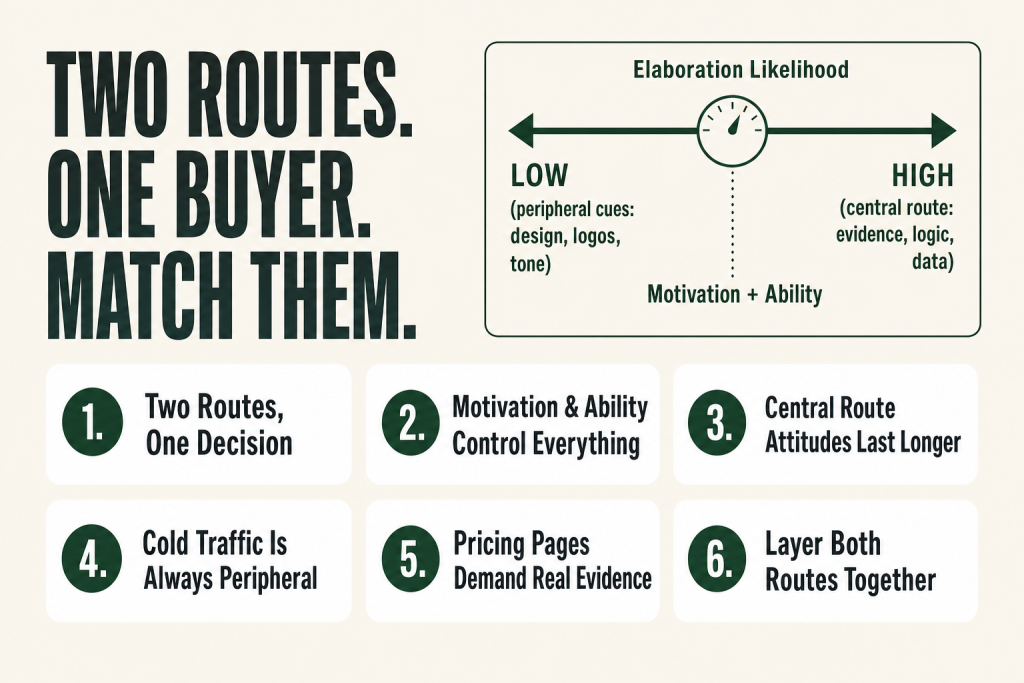
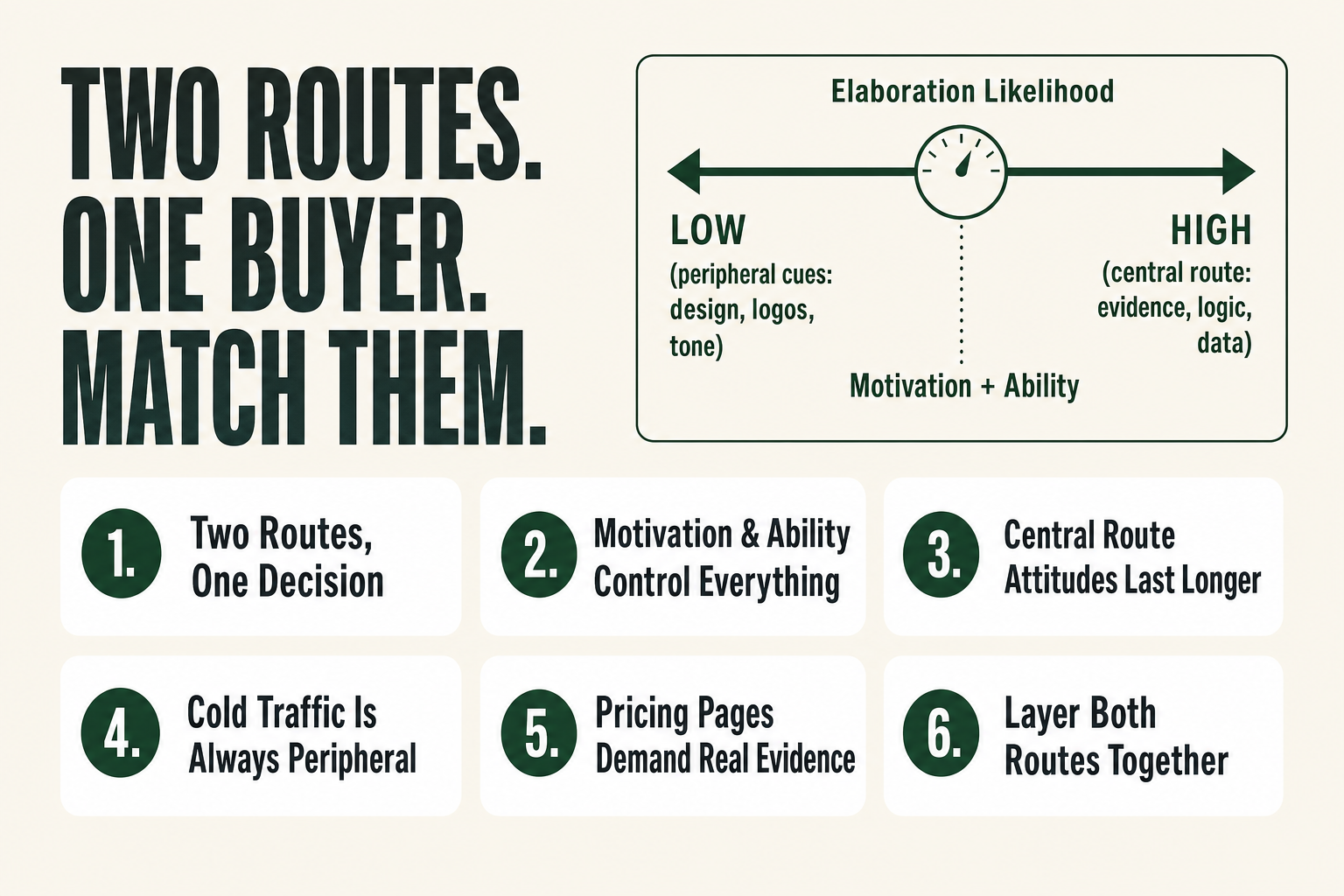
- The elaboration likelihood model says buyers process your message through one of two routes: they either think carefully about your arguments (central route) or they take mental shortcuts based on surface cues like your credentials, design, or tone (peripheral route).
- Which route they take depends on two things: how motivated they are to care about your message, and whether they have the abilitytime, focus, prior knowledge, to evaluate it.
- Attitudes formed through the central route are more durable, more resistant to competitors, and more predictive of actual purchase behavior than attitudes formed through the peripheral route.
- The practical payoff: audit your audience’s motivation and ability before you decide how much argument depth, social proof, or source credibility to lean on.
- Mismatching route to audience is the most common messaging mistake, sending complex feature comparisons to low-involvement browsers, or leading with mood-based imagery to high-stakes B2B buyers.
- By the end of this page, you’ll be able to diagnose where your buyer sits on the elaboration spectrum and build messages that match, instead of guessing and hoping.
Where the Elaboration Likelihood Model Came From
Petty and Cacioppo developed ELM while they were graduate students at Ohio State University in the mid-1970s, trying to solve a specific puzzle: persuasion research was a mess of contradictions. Source credibility helped in some studies and did nothing in others. More arguments worked sometimes and backfired in others. Their answer was that context, specifically, whether the recipient is motivated and able to think carefully, determines which factors matter and how much.
The framework got its name in 1981, when John Harvey, editor of the book series in which their textbook would appear, told them the idea needed a formal label to survive in the literature. Their 1983 paper with David Schumann in the Journal of Consumer Research“Central and Peripheral Routes to Advertising Effectiveness: The Moderating Role of Involvement”, anchored ELM to consumer involvement, and the full model was codified in their 1986 book, Communication and Persuasion. More than forty years of subsequent research and the core finding hasn’t cracked.
A September 2026 paper in the Journal of Business EconomicsBažantová, Novák, and Šimůnek conceptually replicating and extending Petty et al.’s original 1983 experiment in the context of AI-generated advertising, found that ELM’s persuasive mechanisms remain relevant even in synthetic media contexts, though the authors note that persuasion processes from traditional advertising don’t transfer automatically to AI-generated ads. Worth knowing; the model holds directionally, but the AI context introduces new wrinkles the original couldn’t anticipate.
That’s the history. The rest of this page is about what it means for your messaging.
The Two Routes, and What Actually Controls Which One Fires
The elaboration likelihood model describes two paths for processing a persuasive message. Under the central routea person carefully evaluates the actual arguments, the evidence, the logic, the quality of reasoning. Under the peripheral routethey form or shift their attitude based on surface-level cues: who’s talking, how confident the presenter sounds, how polished the design looks, how many testimonials appear on the page, whether the brand feels familiar.
Neither route is irrational. The peripheral route exists because humans can’t scrutinize every claim they encounter, we outsource judgment to proxies all the time, and those proxies often track real quality pretty well. The problem is durability. Attitudes formed via the peripheral route are less sticky, more vulnerable to a competitor’s counter-argument, and less likely to predict actual behavior. A buyer who picked you on a heuristic, “their website looked more professional”, will leave you on a heuristic too.
What controls the route? Two factors, and both have to be present for central processing to happen:
- Motivation: Does this purchase matter enough to the buyer to invest cognitive effort? Personal relevance is the biggest driver, someone actively shopping for accounting software because their current system is failing is far more motivated to read your comparison table than someone who wandered in from a retargeting pixel. Need, urgency, and identity-relevance all raise motivation.
- Ability: Even a motivated buyer can’t process deeply if they’re distracted, time-pressed, or lack the background knowledge to evaluate what you’re saying. A technically dense white paper lands differently on a CTO than on a first-time buyer with no prior experience in your category.
Some frameworks add opportunity as a third factor, the situational space to actually process the message. A banner ad clocked at 1.5 seconds of average view time isn’t an opportunity for central-route processing, regardless of how motivated the viewer is. That’s a design constraint, not a minor footnote.
One more wrinkle: the same variable can operate through both routes depending on the elaboration state. Source attractiveness works as a pure peripheral cue when elaboration is low, “she seems credible, I’ll trust it”, but as a genuine argument when elaboration is high: for a skincare product, the fact that a dermatologist endorses it is actually evidence. Petty and Cacioppo called this the “multiple roles postulate,” and it’s why simple rules like “always use social proof” or “always lead with credentials” produce inconsistent results. Context determines the role.
What the Elaboration Likelihood Model Actually Means for Your Messaging
The practical translation of ELM: before you decide what to say, diagnose where your buyer is on the elaboration spectrum. That diagnosis should drive format, depth, content type, and which trust signals you lead with.
High-elaboration audiences: lead with argument quality
When your buyer is motivated and able, they have a real problem, they’re actively researching, they have enough domain knowledge to evaluate claims, weak arguments will hurt you. A high-elaboration buyer isn’t just ignoring your fluff; they’re forming a negative attitude toward it. They can smell the vague testimonial, the unsubstantiated “#1 rated” claim, the case study with no numbers. Your job is to make the actual argument. Comparison tables, specific ROI data, detailed methodology explanations, third-party validation with named sources, these do real persuasion work here. The aesthetic of the page matters less than the quality of the evidence on it.
High-involvement purchase contexts: enterprise software, professional services engagements, medical decisions, significant capital equipment, B2B vendor selection. If your buyer is going to live with this decision for three years, they’re elaborating.
Low-elaboration audiences: peripheral cues carry the load
When your buyer is browsing, distracted, early-stage, or simply not yet convinced this purchase matters enough to study, your arguments will mostly bounce. Not because they’re bad arguments, but because the buyer isn’t processing them. In this state, peripheral cues do the persuasion: design quality, brand familiarity, the presence and tone of social proof, the confidence of your voice, the visual hierarchy that signals “this is a legitimate operation.” A recognizable logo of a client they respect does more in three seconds than a paragraph of feature bullets.
Low-involvement purchase contexts: consumer packaged goods, impulse purchases, awareness-stage content, cold traffic, and most social media advertising, where a viewer decides to stop scrolling or keep going in under two seconds.
The elaboration spectrum is not binary
This is where most people’s mental model of ELM breaks down. The model doesn’t say buyers are either “thinking hard” or “not thinking at all.” It describes a continuum. A buyer can be moderately engaged, enough to notice a strong argument if you lead with it, but likely to revert to cue-based shortcuts if the argument gets complex. Most real-world marketing operates in this middle zone, which is why the best executions layer both: they give the motivated processor enough argument to work with while using peripheral signals, design, social proof, source credibility, to carry the less-engaged visitor.
Think about how a strong landing page actually works. The headline and hero image handle peripheral cues, they need to pass the “does this seem legit and relevant?” check in under two seconds. The copy beneath does central-route work for the buyer who’s now leaning in. The client logos handle both: peripheral shortcut for the skimmer, and evidence of market validation for the reader who’s evaluating.
Putting this to work? The ideas in the Canon are the foundation under the tactical playbook in Build a Complete Marketing Department — grab the free companion kit at mmsvegas.com/resources.
The Elaboration Likelihood Model in Practice: Real Contexts, Real Decisions
A few domains where this plays out with real stakes for operators:
B2B sales and landing pages
Enterprise and mid-market B2B is about as high-elaboration as it gets. Buyers are evaluating multiple vendors, navigating procurement processes, and pulling in multiple stakeholders. The buying committee adds a wrinkle: different members may be at different elaboration states simultaneously. The technical evaluator is high-elaboration on product architecture; the CFO is high-elaboration on financial risk and ROI; the end-user champion might be relatively low-elaboration on vendor selection criteria and more moved by peripheral cues, like how polished your demo environment looks. One message can’t serve all three. This is why the best B2B operators build distinct content by role, not just by stage.
Email sequences
Cold email is almost always a peripheral-route moment. The recipient hasn’t opted in, isn’t actively researching, and is scanning for reasons to delete. Peripheral cues dominate: the sender name, the subject line’s tone, whether the email looks personal or templated. Loading a cold email with five paragraphs of product argument is a central-route message delivered into a peripheral-route moment, it will fail not because the argument is wrong, but because you misread the elaboration state. A warm lead who downloaded your comparison guide is in a completely different state. Now the detailed argument works.
Pricing pages
Visitors who reach your pricing page have cleared a self-selection filter. They know enough to want to see numbers. Elaboration is higher here than anywhere else in your funnel. This is where weak social proof, vague quotes from unnamed “happy customers”, actually hurts you, because a high-elaboration buyer notices the absence of specifics and interprets it as you hiding something. Specific, named case studies with hard numbers are central-route ammunition. Treat your pricing page like a closing argument, not a billboard.
Awareness-stage content and ads
The opposite context. Someone encountering your business for the first time through a Facebook ad or a Google display placement is not elaborating. They owe you nothing, have no prior stake in your category, and are doing something else. Peripheral cues are essentially all you have. Brand coherence, visual quality, an emotionally resonant hook, a sharp one-sentence positioning claim, that’s the work. The argument comes later, if you earn the click.
Website design as a persuasion system
For high-elaboration visitors, argument quality, content completeness, evidence, logical structure, drives attitude formation. For lower-elaboration visitors, design variables take over: image appeal, navigation clarity, social presence signals. Your site is serving both simultaneously. A beautiful but content-thin site works fine for impulse purchases and brand-driven consumer products. It falls flat for professional services or high-ticket B2B, where the visitor is trying to actually evaluate you.
How to Diagnose Your Buyer’s Elaboration State
“Match the message to the buyer’s elaboration state” is good advice. Without a diagnostic framework, it’s just guessing. Here’s a set of questions to run before building or auditing any piece of marketing:
1. What are the purchase stakes?
High financial risk, long commitment, or significant life-impact drives motivation automatically. Someone choosing an accountant, a contractor, or a cloud platform for their business is elaborating whether you want them to or not. Someone choosing a coffee subscription, not so much.
2. Where are they in the buying journey?
Early-stage, just became aware of a problem, means low elaboration, even for high-stakes categories. They haven’t decided they’re in the market yet. Late-stage, comparing vendors, requesting proposals, already in your pipeline, means high elaboration. The same buyer shifts routes as they move through the funnel. Your messaging should shift with them.
3. What’s the content format and context?
A 30-second pre-roll ad creates a peripheral-route moment regardless of how motivated the viewer is, there isn’t enough time or control for deep processing. A long-form case study accessed via a direct search is a central-route moment. A retargeting banner is peripheral. A live demo is high-elaboration by design. Format constrains or enables elaboration; it isn’t neutral.
4. How much domain knowledge does your buyer have?
Ability requires prior knowledge to engage with complex claims. A first-time buyer in your category might be highly motivated but lack the vocabulary to evaluate your technical argument, they’ll fall back on peripheral cues even when they want to think hard. Meet them at their actual level. Jargon aimed at a low-ability audience isn’t central-route evidence, it’s a signal you don’t understand your customer. This is where the curse of knowledge bites hardest: you know too much to remember what it’s like to be your customer in month one.
5. What’s the distraction environment?
Mobile vs. desktop matters. Social scroll vs. dedicated research session matters. Time-pressured vs. unhurried matters. An ad served on Instagram Stories is competing with the next story. A page visited after a high-intent Google search is not. The same person’s elaboration state can swing on 60 seconds of context.
Where ELM Works Well, and Where It Gets Messy
ELM is one of the most durable frameworks in persuasion research. A September 2026 study by Bažantová, Novák, and Šimůnek in the Journal of Business Economicsconceptually replicating and extending the Petty et al. 1983 experiment in an AI-generated advertising context, found that ELM’s persuasive mechanisms remain relevant in synthetic media environments, though persuasion processes don’t transfer automatically from traditional to AI-generated ads. Forty-plus years of extension, and the directional finding is intact. The nuances are evolving.
That said, honest limitations operators should know about:
It tells you the route, not the content
ELM tells you whether to lean on argument quality or peripheral cues. It doesn’t tell you which arguments are strong, which emotions resonate, or which peripheral cues will land for your specific audience. You still need customer research, message testing, and category knowledge to fill those gaps. The model is a diagnostic, not a creative brief.
The continuum is real but hard to measure precisely
Elaboration isn’t something you can A/B test directly. You infer it from proxies, traffic source, content type, session depth, funnel stage. Those proxies are useful but imperfect. A visitor from a branded search term is probably in a higher elaboration state than one from a broad interest-based audience, but “probably” is doing real work there.
Emotions are not purely peripheral
A common misread of ELM is treating emotion as a peripheral cue and logic as central-route. It’s not that clean. Emotional responses can deepen elaboration, fear of a real risk, excitement about a genuine outcome, and when they’re relevant to the product’s actual value, they function as substantive arguments. A testimonial from a customer who describes exactly the frustration your buyer is feeling right now is doing both central and peripheral work simultaneously. Don’t read “peripheral” as “emotional” or “central” as “rational.” The dividing line is whether the cue is relevant to the actual quality of the argument, not whether it has emotional content.
Both routes can be gamed, and buyers know it
Peripheral cues work because they’re efficient proxies for quality. But once a category fills with operators who all use the same cues, everyone has a “4.9 stars” badge, everyone has a “featured in Forbes” line, everyone has a wall of logos, the cues lose signal value. Buyers in saturated markets get more skeptical of peripheral cues precisely because they’ve been burned by them. This is why earning peripheral signals matters more than manufacturing the appearance of them: a real feature in a real publication, an actual award from a credible body, a named client with a verifiable quote.
Common Mistakes
- Running cold ad creative loaded with product arguments — Here’s what this looks like in practice: a Facebook ad with a headline claim, three feature bullets, and an ROI percentage, built like a landing page, served to someone who has never heard of you and is in the middle of scrolling past vacation photos. The elaboration state of a cold-traffic audience is low almost by definition. They haven’t opted in, they’re not actively researching, and they’re doing something else. The fix isn’t better copy; it’s a different brief. Strip to one hook that names a problem they recognize and one credibility signal, a client name they might know, a positioning line sharp enough to create curiosity, a visual proof-of-concept. Save the ROI claim and feature comparison for the landing page, where the buyer’s click has already raised their elaboration. Run this version against your current creative. The shorter one will usually win.
- Publishing central-route content to audiences who can’t use it yet — Your named case study with the 40% cost reduction and the CFO quote, that’s your best central-route asset. If it’s sitting on your blog being discovered primarily by new visitors who landed there cold, you’re distributing a high-elaboration piece to a low-elaboration audience. The fix is segmentation. Build a retargeting audience of people who’ve already shown engagement signals: three or more page views, a video watch past 50%, at least two email opens. These are the people whose elaboration has already risen. Serve the case study to them as a retargeting ad, not a discount, not a brand reminder, the actual argument. That’s the audience ready to process it.
- Using the same argument depth from cold ad through to proposal — Pull your last cold ad and your last proposal side by side. If they’re making the same type of claims at roughly the same level of specificity, your funnel has a single elaboration voice, and that’s almost certainly costing you at both ends. The cold ad is probably too detailed for a peripheral-route moment (see above). The proposal is almost certainly not specific enough for a buyer who’s already compared you against two competitors and has objections you could name if you tried. The proposal should answer those objections by name, with numbers the buyer gave you or that you found in their public reporting. The ad should stop a scroll. They require completely different briefs, even if the voice is the same person.
- Padding a landing page or proposal with weak supporting claims — This one is counterintuitive. The instinct is that more evidence equals more persuasion. Under high elaboration, it works exactly backward: a motivated buyer reads your weak supporting points and counts them against you. Three thin bullet points that don’t hold up to scrutiny do more damage than no bullet points at all, because the high-elaboration reader notices you padded the argument. The fix is subtraction. Cut the three weak claims. Replace them with one specific, verifiable claim, a named source, a published number, an outcome a buyer can confirm. Shorter and tighter beats longer and padded every time when the reader is actually evaluating you.
- Using unverifiable trust signals as peripheral cues — Test every badge and social-proof element on your homepage right now: how long would it take a skeptical visitor to confirm this claim exists? A named client at a recognizable company, under 30 seconds via LinkedIn. A press mention with a live link, immediate. “Trusted by 500+ businesses” or “4.9 stars” with no linked review source, unconfirmable. In any market where competitors have also plastered their pages with badges, the unverifiable ones produce no meaningful lift for high-elaboration buyers and may actively raise suspicion. Swap one generic signal this week for something specific: the name of a client willing to be quoted publicly, a press mention with a real URL, an outcome with a number attached. That single swap does more persuasion work than adding two more generic badges.
Operator’s Take
Most ELM explainers stop at the theory and summarize what you just read. I’d rather give you the calls I’d actually make this week.
Your cold ad is almost certainly doing the wrong job. Pull your last Facebook or LinkedIn cold-traffic creative. Count how many claims it’s making. If the answer is more than one or two, you’ve built a central-route message for a peripheral-route audience. Cut it. One hook. One credibility signal, a recognizable client name, a sharp category-positioning line, a proof-of-concept visual. Move the ROI argument and the feature comparison to the landing page, where elaboration is higher because the buyer just self-selected by clicking. That’s not a creative opinion; it’s a route mismatch you’re paying for in CPL.
Your best content is probably sitting unread. The detailed case study with the named client and the hard numbers. The methodology walkthrough that would actually change a skeptic’s mind. I’d bet it’s on your site, seen by the small percentage of visitors who search it out. Your warm retargeting pool, people who’ve already visited, watched the demo, or opened every email, is exactly the audience whose elaboration has risen enough to process it. Run that case study as a retargeting ad. Don’t offer a discount. In my experience, matching the right content to the right elaboration state outperforms a 20%-off offer to the same audience, because you’re not competing on price, you’re completing the argument they were already ready to hear.
Stop treating your pricing page like a billboard. Visitors there have cleared a filter. They know they want to see numbers, which means elaboration is at its peak for your funnel. That’s precisely where vague social proof, “hundreds of happy clients!”, does the most damage, because a high-elaboration buyer reads the absence of specifics as evasion. Replace one generic testimonial with one named client, a verifiable outcome, and a company the buyer might recognize. That’s a more honest and more effective use of the space.
If your funnel sounds the same at every stage, that’s the problem. Cold ad, nurture email, proposal, if they’re all running at the same argument depth, you’ve got a single-elaboration-state funnel. The proposal going to a buyer who’s already compared you against two competitors should answer the objections you know they have, with numbers you’ve confirmed, by name. It shouldn’t read like the cold ad that introduced you. Same voice is fine. Same argument depth is a mistake.
Build one elaboration bridge piece if you don’t have one. This is mid-funnel content whose only job is to raise a buyer’s elaboration before you make the argument. Not to persuade, to prime. A short piece that names their specific problem, quantifies the cost of staying put, or shows a before/after that makes the decision feel concrete. Most operators jump from cold acquisition straight to hard sell for the already-warm. That gap is where conversions quietly disappear, and a single well-placed bridge piece is often the cheapest fix in the funnel.
Audit your trust signals for verifiability. Pick any badge or social-proof element on your homepage and time how long it takes a skeptical visitor to confirm it. Named client at a recognizable company, fast. Specific published outcome with a number, fast. “Trusted by 500+ businesses”, can’t be confirmed. In a market where every competitor has a badge, the unverifiable ones do approximately nothing for a high-elaboration buyer and quietly raise suspicion. The short-term fix is swapping one generic signal for one specific, confirmable one. The longer-term answer is to earn the kind of peripheral cues that hold up when someone goes looking.
Used in
- ✓ Build a Complete Marketing Department
Used to determine message depth and content type at each funnel stage, specifically, when to lead with argument quality versus trust signals and peripheral cues across the buyer journey. - ✓ The Missing Manual for FunnelKit
Applied to landing page architecture decisions, which elements serve peripheral-route visitors in the first two seconds, and which elements serve high-elaboration buyers who stay to read. - ✓ The Missing Manual for Make
Applied when automating content sequencing, which message type (evidence-heavy vs. cue-driven) to trigger at which stage of a subscriber or lead nurture flow.
FAQ
What does ‘elaboration’ actually mean in the elaboration likelihood model?
Elaboration refers to the degree to which someone thinks about and evaluates the arguments in a persuasive message. High elaboration means they’re scrutinizing your claims carefully. Low elaboration means they’re responding to surface cues without deep analysis. The ‘likelihood’ part is simply the probability that elaboration will occur, given that person’s motivation and ability in that moment.
Is the central route always better for persuasion?
Better at producing durable attitude change, yes, attitudes formed through careful argument evaluation last longer and predict behavior more reliably. But the peripheral route is often all you have in low-involvement contexts, and it still works for generating awareness, familiarity, and initial positive associations. The goal is to match the route to what your audience is actually capable of in that moment, not to force central-route processing where it can’t happen.
How do I know if my buyer is in a high or low elaboration state?
Use these proxies: traffic source (branded search = higher elaboration; cold social = lower), funnel stage (demo request = high; first ad exposure = low), purchase stakes (high-cost or high-commitment = higher motivation to elaborate), and content format (long-form research session = higher opportunity; mobile scroll = lower). No proxy is perfect, but combining them gives you a workable read.
Can emotion and the central route coexist?
Yes, and this is a common misconception worth correcting. Emotional content is not automatically a peripheral cue. An emotionally resonant case study from a customer who had exactly your prospect’s problem is doing central-route work, the emotion is relevant to the actual argument. What makes something peripheral is that it’s disconnected from the logical quality of the claim, not that it has emotional content.
Does the elaboration likelihood model apply to email marketing?
Absolutely. Cold email is a low-elaboration moment, recipients aren’t opted in, aren’t actively researching, and are scanning for reasons to delete. Peripheral cues (sender name, subject line credibility, personal tone) drive open and reply rates there. Emails to an engaged subscriber list or a late-funnel lead are higher-elaboration moments where detailed arguments, specific data, and named case studies do real work.
What’s the biggest mistake operators make when applying ELM?
Treating it as binary, either all central or all peripheral, instead of layering both across the same piece of content or sequence. Most real-world marketing reaches buyers at mixed elaboration states. The craft is in sequencing: use peripheral signals to earn the time and attention, then use central-route arguments to close the persuasion with buyers who are ready to evaluate.
Further reading
- Petty, R.E. & Cacioppo, J.T. Communication and Persuasion: Central and Peripheral Routes to Attitude Change (1986)the definitive primary source; worth reading their 1983 Journal of Consumer Research paper with Schumann first if you want the condensed, advertising-focused version.
- Cialdini, R. Influence: The Psychology of PersuasionCialdini’s six principles mostly operate as peripheral cues; reading him alongside ELM clarifies when each principle is doing its real work versus when it’s window dressing.
- Heath, C. & Heath, D. Made to Stickexplores what makes messages memorable and credible; maps naturally onto ELM’s question of which route a given message will travel through, and why some messages survive both.
Sources: Richard E. Petty and John T. Cacioppo, Communication and Persuasion: Central and Peripheral Routes to Attitude ChangeSpringer, 1986; Petty, R.E. Cacioppo, J.T. & Schumann, D. (1983), “Central and Peripheral Routes to Advertising Effectiveness: The Moderating Role of Involvement,” Journal of Consumer Research10(2), 135 to 146; Petty, R.E. & Briñol, P. (2012), ELM chapter in Van Lange et al. (eds.), Handbook of Theories of Social Psychologyavailable at richardepetty.com; Bažantová, S. Novák, M. & Šimůnek, M. (2026), “Central and peripheral routes in the age of AI: replicating and extending the elaboration likelihood model in advertising,” Journal of Business Economicspublished 25 September 2026, doi:10.1007/s11573-026-01286-7; Wikipedia entry on Elaboration Likelihood Model (cross-referenced with primary sources); Simply Psychology, ThinkInsights, and Psychology Town ELM reference pages consulted for application examples.
Brian Kasday spent forty years in direct-response marketing before rebuilding the whole operation as a one-person shop. He writes The Operator’s Library — including “Build a Complete Marketing Department” — for operators who’d rather build it themselves than wait on someone else.
Build the department these ideas describe — the free companion kit: mmsvegas.com/resources.
More The Operator's Canon guides
Free · Operator Toolkit
Want the tools, not just the guide?
Get the free operator toolkit — templates and checklists for the systems you actually run, plus a note when this guide changes.
Get the free toolkit →