
Last updated: August 2026
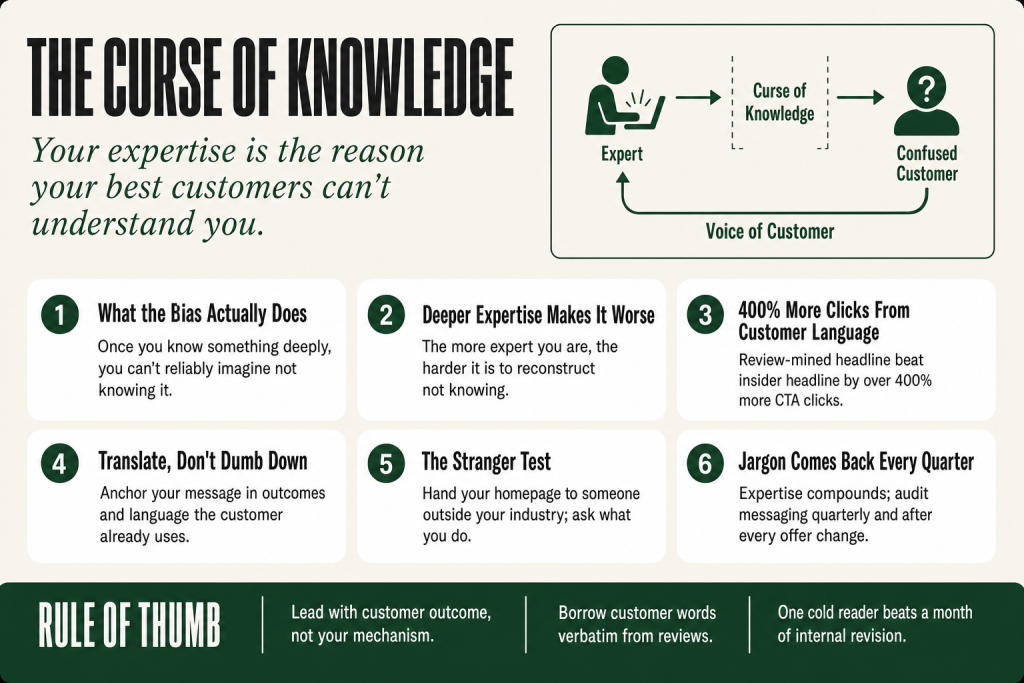
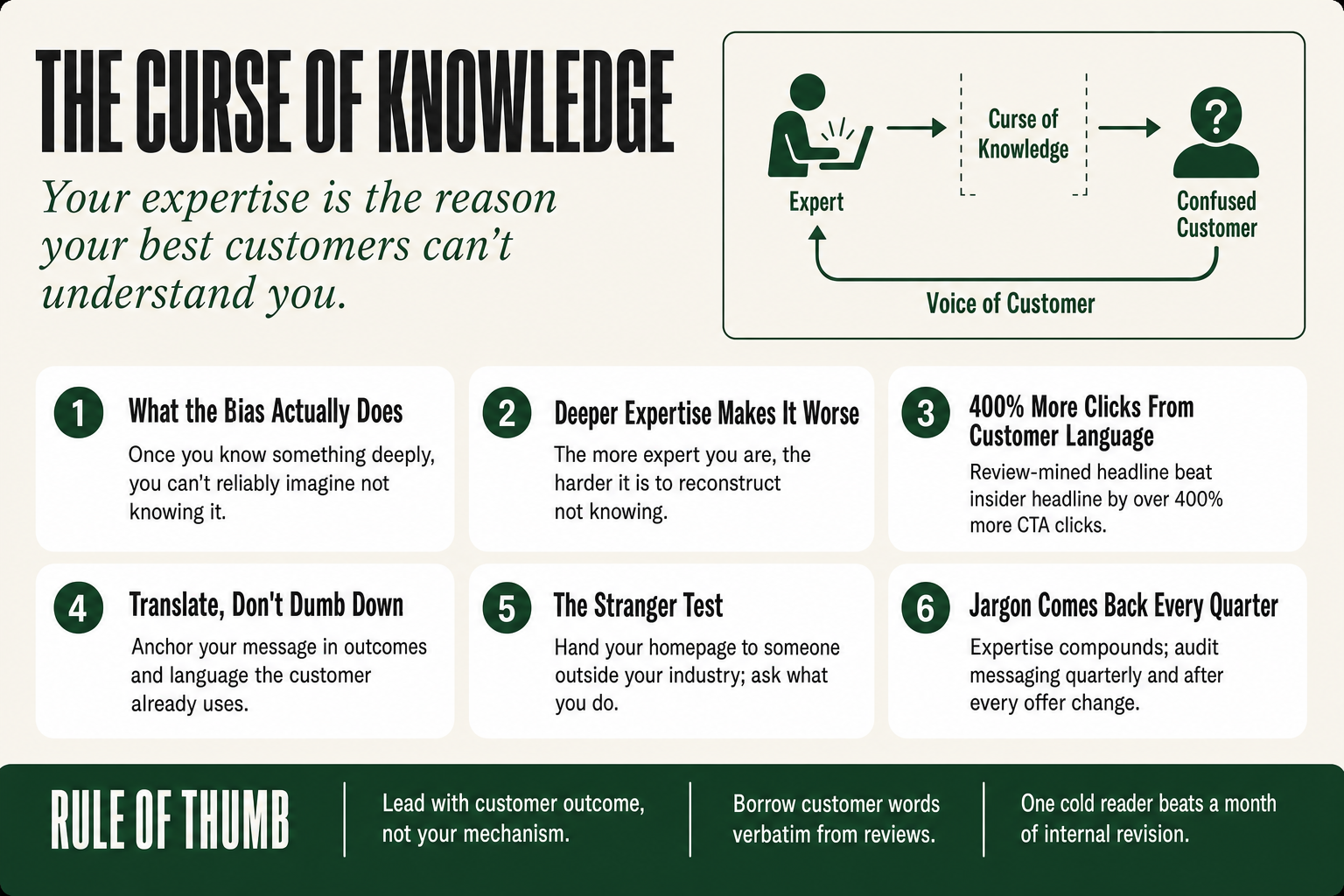
The curse of knowledge is the reason you can write a homepage that makes complete sense to you and total nonsense to the person you’re trying to sell to. By the end of this page, you’ll be able to audit any piece of messaging, an ad, a landing page, a sales email, a proposal, and identify exactly where your expertise is working against you, then rewrite it in language that actually lands.
The bias doesn’t feel like a problem from the inside. Your messaging feels clear to you. Your features feel obviously valuable. Your process feels self-evidently logical. That invisibility is precisely what makes it expensive. You’re not confusing anyone on purpose, you’ve just forgotten what it was like not to know what you know.
For a small-business operator, this cuts deeper than copywriting theory. You are usually the expert in your business. You built it. You know the trade cold. And that expertise, the very thing that makes you good at the work, is what makes it hard to talk about the work to someone who hasn’t lived in it. Your instincts about what’s obvious, what needs explaining, and what customers care about are systematically skewed by everything you’ve learned. The curse of knowledge is not a writing problem. It’s a perspective problem that shows up in writing.
The idea in 30 seconds
- The curse of knowledge is a cognitive bias: once you know something deeply, you can’t reliably imagine not knowing it, and that makes you a worse communicator to people who don’t share your expertise.
- It shows up in your copy, your homepage, your sales pitch, and your onboarding, anywhere you assume context the customer doesn’t have.
- The fix isn’t “dumb it down.” It’s translate: anchor your message in outcomes and language the customer already uses, not the vocabulary your industry invented.
- Voice of Customer research, reviews, interviews, sales call transcripts, gives you the words your customers actually use. Borrow them directly.
- Your website’s highest-traffic pages are almost always the ones you consider too basic to be worth writing. The curse hides your best acquisition content from you.
- AI tools can help you draft customer-perspective audits and flag jargon fast, but the judgment about what to keep belongs to the operator, not the tool.
Where the Curse of Knowledge Came From
Three economists, Colin Camerer, George Loewenstein, and Martin Weber, named and tested it in a 1989 Journal of Political Economy paper. Standard economic theory assumed that better-informed agents could accurately simulate the perspective of less-informed ones. Camerer and his co-authors showed that assumption was wrong: informed agents couldn’t ignore their own private knowledge even when it was clearly in their financial interest to do so. Market forces reduced the bias by about 50%, but didn’t eliminate it. That last part matters: awareness of the bias, and even financial pressure to correct for it, still isn’t enough to make it go away.
The concept reached a wider audience through Elizabeth Newton’s tappers-and-listeners study at Stanford, a psychology demonstration in which tappers who knew the song could almost never predict how few listeners would guess it correctly. And Chip and Dan Heath’s 2007 book Made to Stick brought the whole thing into marketing. What the Heaths recognized is that the curse doesn’t live only in economics papers, it lives in every piece of copy you write and every sales conversation you have.
The Problem the Curse of Knowledge Creates for Operators
Not in the abstract, in the specific.
Your homepage opens with a phrase your industry uses every day. Something like “integrated workflow solutions” or “full-spectrum digital presence” or “evidence-based treatment modalities.” To you, those words mean something real. To a first-time visitor, the person you most need to convert, they mean approximately nothing. They click away. You never knew they were there.
Your sales pitch explains your process in the order that makes sense to someone who already understands the category. You explain step three before the prospect has understood why step one matters. They nod politely and then don’t respond to your follow-up. You assume they weren’t serious buyers. They were, they just couldn’t follow the thread.
Your onboarding documentation assumes users know what your key terms mean. They don’t. They muddle through, use the product wrong, get frustrated, and churn. You see the churn number. You don’t see the moment the confusion started.
None of these failures feel like communication failures from the inside. They feel like the prospect wasn’t paying attention, or wasn’t the right fit, or didn’t read the docs. The curse of knowledge is nearly always present when expertise-heavy operators blame customers for not getting it.
The economic dimension is direct. When messaging doesn’t connect, you don’t just lose that sale, you lose the data that would tell you why you lost it. The curse makes the problem invisible and the feedback loop useless. That’s what makes it the highest-priority messaging problem for most small businesses: it’s already working against you right now, at scale, silently.
How the Curse of Knowledge Actually Works in Your Messaging
The bias runs through two related channels. The first is what researchers call inhibitory control failureyour brain literally cannot suppress the knowledge it has when trying to reason about someone who doesn’t have it. You try to imagine your customer’s perspective, but your own context floods in and displaces it. Not a lack of effort or empathy. A structural cognitive limitation.
The second is fluency misattribution: information that’s deeply familiar to you feels easy and obvious, so you assume it will feel that way to others too. Your terms feel plain because you’ve used them a thousand times. That fluency is yours, not theirs. And the gap between those two experiences is where conversions die.
In practice, the curse shows up in three distinct forms.
Jargon and insider language
Every industry develops shorthand. Plumbers talk about P-traps and wax rings. Accountants talk about EBITDA and accrual basis. SaaS companies talk about endpoints and API rate limits. This vocabulary exists for good reason, precision and efficiency among people who share it. The problem arrives the moment you use it with customers who haven’t yet earned fluency in your category. A local farm owner who uses “CSA” throughout their website is assuming their customers already know what a Community Supported Agriculture subscription is. Most don’t. The farm loses the prospect before the value proposition even registers.
Unstated assumptions and missing context
Subtler than jargon, and harder to catch. It’s the assumption that customers know why your differentiator matters, not just that it exists. An HVAC company that leads with “we use a 27-point inspection process” is leaving out the thing that makes that number interesting: most companies skip most of those points, and that’s why systems fail early. The expert knows the context. The headline skips it. The reader sees a number with no meaning attached.
Skipping the problem statement
Experts jump straight to solutions. They’ve heard the problem articulated so many times that restating it feels tedious, they assume the customer already frames it the same way. But a prospect who is early in their awareness doesn’t yet have language for what’s wrong. If your messaging doesn’t reflect their description of the problem back to them before offering a solution, they don’t recognize the message as being for them. They keep scrolling.
All three forms share the same root: you’re writing from inside the message, not from the receiver’s position. You’re tapping out the rhythm of a song only you can hear.
Why the More Expert You Are, the Worse It Gets
This is the part that catches people off guard. Deeper expertise doesn’t make the curse more manageable, it makes it worse. The more completely you understand a domain, the harder it is to reconstruct what it was like not to understand it. You’ve not only learned the vocabulary; you’ve internalized it. It no longer sounds like vocabulary. It just sounds like thinking.
There’s a second-order effect operators rarely discuss: marketing fatigue compounds the curse. The longer you’ve been running your business, the more tired you are of your own message. You’ve heard your elevator pitch so many times it feels worn out. So you rotate to more sophisticated phrasing, adding nuance, adding caveats, finding more precise ways to describe what you do. You’re essentially moving the language further from the customer while telling yourself you’re improving it.
Expert-led businesses with the strongest claim to quality and differentiation are often the ones with the least accessible messaging. The smarter the team, the deeper the expertise, the harder it often is to explain what the business does to someone encountering it cold. Nobody talks about this enough.
There’s a content strategy dimension to this that operators rarely see clearly. Ask the team at an expert-led B2B company what content performs best, and you’ll usually hear about their contrarian pieces on emerging methodology. Ask which pages drive the most traffic, and you’ll almost always find the foundational stuff, the definitions, the category overviews, the honest “what is this and why does it matter” pieces. The team underrates that content because they can’t imagine needing it. Their buyers search for it constantly. The curse is hiding your best acquisition content from you by making it look beneath you.
Putting this to work? The ideas in the Canon are the foundation under the tactical playbook in Build a Complete Marketing Department — grab the free companion kit at mmsvegas.com/resources.
The Curse of Knowledge in Practice: Where It Actually Bites
The clearest way to understand this isn’t through hypotheticals, it’s through what happens when you fix it.
Conversion copywriter Joanna Wiebe of Copyhackers worked with a rehabilitation center and tested two homepage headlines. The operator’s headline, “Your Addiction Ends Here”, was written from the inside out: solution-first, insider framing. The challenger was sourced from Amazon book reviews written by people who were themselves struggling with addiction: “If you think you need rehab, you do.” The review-mined headline brought in more than 400% more clicks on the primary call to action and more than 20% more completed lead-form submissions on the next page. The difference wasn’t cleverness. It was whose perspective shaped the language. One headline was written from what the operator knew. The other was written from what the customer had already said out loud, in their own words, in a moment when they weren’t trying to sound professional.
The CSA farm pattern is painful in how predictable it is. An operator who has run a Community Supported Agriculture subscription for a decade uses “CSA,” “share,” “half-share,” and “flex share” throughout their website as if these are standard terms. To the food-curious prospect who just searched “local farm delivery,” the site reads like an internal memo. They’re not the wrong customer, they just got lost in language that assumed they’d already done the orientation.
In SaaS onboarding, the pattern is close to universal. Product teams who know their software deeply stop narrating it for first-timers. They’ve forgotten what it actually feels like to open the product on day one. The counter-move is deliberate: write the confirmation emails and follow-up sequences as if the user is seeing everything fresh, because they are. It feels unnecessary from the operator’s chair. From the new user’s seat, those emails are the only thing standing between them and confusion.
In B2B professional services, the curse tends to kill deals at the proposal stage. The proposal is written from the provider’s perspective, methodology, team structure, process phases, deliverable names, rather than the prospect’s. What were they worried about before they picked up the phone? What does success look like to them personally? What are they comparing you against? The expert writes the document they’d find impressive. The buyer needs the one they’d find reassuring. Those are often not the same document.
Where the Curse of Knowledge Shows Up First
Prioritize your audit in this order. Not because the others don’t matter, but because some surfaces cost you more per cursed sentence than others.
Your homepage headline and first screen
This is ground zero. The headline is usually written by someone inside the business, reviewed by other people inside the business, and then posted, with no meaningful test of whether a cold first-timer understands it. Most homepage headlines fail because they describe what the business does in the business’s vocabulary rather than what the customer gets in the customer’s vocabulary. The first screen either earns attention or wastes it. There’s no middle outcome.
Your offer description
How you name and describe your service or product tiers is a curse-of-knowledge minefield. Names that feel descriptive to you, “Essentials,” “Advanced,” “Enterprise”, communicate very little to a buyer who hasn’t been through your sales process. What’s in Essentials? Why would I upgrade? Feature lists written in your terminology don’t answer those questions for a first-time buyer.
Your sales conversation
Live and async. The curse shows up in how you answer the question “what do you do?”, because experts almost never answer that question the way a customer would phrase the problem. Record a sales call and listen back. Count how many terms you use that you never define, how many steps you reference that assume prior context, how many times you assume the prospect knows what you mean before you’ve established that they do. It’s almost always more than you expect.
Your ads
Ads written by experts tend to lead with mechanism, how you do it, rather than outcome, what the customer gets. “AI-powered compliance automation” describes the mechanism. “Stop failing audits” describes the outcome. Your prospect cares about the outcome first. The mechanism is interesting only after the outcome lands.
Your onboarding and documentation
Often the last place operators look, and frequently the most expensive. Poor onboarding driven by the curse is a direct driver of churn, customers can’t get the value they paid for, so they leave. The expert who wrote the docs skipped the steps that felt too basic. Those are the steps the new user needed most.
Where the Curse of Knowledge Isn’t the Problem
This is worth saying clearly, because “simplify everything” is the wrong lesson. The curse of knowledge describes a communication mismatch, expertise deployed at the wrong level for a specific audience. It doesn’t mean expertise itself is a liability.
When you’re talking to customers who are deep in the category, technical buyers, sophisticated procurement, specialist decision-makers, using precise industry language is correct. Simplifying to avoid the curse in that context makes you look inexperienced. A cybersecurity firm talking to a CISO doesn’t need to explain what a vulnerability scan is. A commercial real estate broker doesn’t need to define cap rate in a pitch to an institutional investor. Context determines where the knowledge gap exists, and messaging should be calibrated accordingly.
There’s also a version of anti-curse messaging that oversimplifies so aggressively it erases real differentiation. If every HVAC company says “we show up on time and fix it right,” none of them are saying anything useful. The goal is to translate expertise into customer language, not sand off the expertise entirely. Clear, not contentless.
What People Get Wrong About the Curse of Knowledge
“It means I need to dumb down my messaging.” No. It means you need to translate it. The distinction matters. Dumbing down loses specificity and credibility. Translation preserves both, it just anchors the message in the customer’s frame of reference rather than yours. “Helps your HVAC system run 23% more efficiently” is not dumb. “Reduces heat exchanger thermal load through duct impedance correction” is expert language that loses most of the population before they know why they should care. Both can be true. Which one you lead with depends on who’s reading.
“It only affects my copywriting.” The curse affects every communication surface: sales conversations, proposals, onboarding emails, support documentation, pricing pages, FAQs. Copy is the easiest place to spot it because it’s static and auditable, but the live versions of the bias, in sales calls and client meetings, often cost more in real dollars.
“I can fix this by trying harder to think like my customer.” Mostly no. The original research found that informed agents couldn’t fully correct for the bias even when they were aware it was affecting them. The fix is structural, external inputs like customer language from reviews, recorded calls, and first-time-user testing, not internal effort to think more openly.
“Voice of Customer research is expensive and time-consuming.” Not at the operator level. Read your own Google reviews and pull recurring phrases. Listen back to three recorded sales calls and note what the prospect said about their problem before you started presenting. Ask a recent customer what they were worried about before they hired you and write down the exact words they use. None of that costs anything. It also beats internal wordsmithing, reliably and by a wide margin.
“The curse only affects technical or complex businesses.” Local restaurants write menus that make sense to the chef and confuse the first-time diner. Fitness studios describe class formats in terms only regulars understand. Real estate agents use MLS terms in consumer-facing listings. Anywhere expertise accumulates and customers are outside of it, the risk exists.
How to Fix the Curse of Knowledge in Your Messaging
The structural answer is to stop writing from your own perspective and start writing from documented evidence of the customer’s perspective. That’s Voice of Customer research, and it doesn’t require a research budget.
Mine what customers already said
Your Google reviews, Yelp, Trustpilot, or Amazon reviews are transcripts of how customers describe the problem your business solves, in the words they chose when they were not trying to be professional. That language is worth more than you think. A review that says “I had no idea what I was doing and they walked me through every step without making me feel stupid” tells you that competence and patience are the selling points, not certifications or methodology. Use their words, not yours.
Joanna Wiebe of Copyhackers has demonstrated this approach systematically. Her review-mining method pulls language directly from how customers describe a problem on review platforms, including Amazon, then tests it as headline copy. The rehabilitation center case is the most-cited proof that customer language outperforms insider language, even when the insider has good intentions and deep expertise.
Record and review your sales calls
If you use Zoom, Teams, or any call recording tool, you already have a Voice of Customer archive you’re probably not using. Go back through three to five calls from the last 90 days. For each one, note: how does the prospect describe their problem in the first two minutes? What words do they use? What are they worried about that you didn’t address until later? The delta between their opening language and your standard pitch language is exactly where the curse lives.
Run the stranger test
Print out your homepage. Hand it to someone who has no context for your business, ideally someone outside your industry entirely. Ask them: after reading just the first screen, what do you think this company does, who is it for, and what happens if you click the button? You’ll learn more from that five-minute exercise than from a month of internal revision. The stranger is the listener. You’ve been acting like the tapper.
Use AI as a perspective auditor
Paste a piece of your copy into a language model and ask it to identify terms or phrases that assume prior knowledge the reader might not have, then suggest plain-language alternatives. This won’t replace the customer research, AI doesn’t know what your specific customers actually say, but it catches obvious jargon fast and gets you to a cleaner draft before you run external tests. The judgment about what stays and what goes remains yours.
Match copy to awareness level
Eugene Schwartz’s market awareness framework gives you the calibration tool the curse demands. A prospect who doesn’t yet know they have the problem needs different language than a prospect who is actively comparing vendors. The ad reaching cold traffic needs to lead with symptoms and outcomes. The email going to someone who just requested a demo can get specific. The mistake is using late-stage language on early-stage audiences, which is exactly what the curse pushes you toward.
Build in a first-time-reader checkpoint
Before publishing anything significant, a landing page, a proposal template, a new email sequence, have someone who knows nothing about your business read it cold. Ask them to pause wherever something confuses them or requires assumed context. Mark every pause. Fix every mark. Make it standard practice, not an occasional favor.
Common Mistakes
- Leading with mechanism instead of outcome on the homepage — Swap your first headline to describe what the customer gets, the result they care about, before you explain how you produce it. Run the revised version past someone outside your industry before publishing. If they can describe your value in one sentence, you’ve got it.
- Using category terms in calls to action without realizing they’re category terms — Audit every button and link label on your highest-traffic pages. Replace any label that uses your industry’s vocabulary with language that describes what happens next from the customer’s point of view. “Learn about our CSA” becomes “See how our farm delivery works.” The change takes ten minutes and the lift is often immediate.
- Sending proposals that read like internal project scopes rather than client-facing reassurance — Restructure the proposal opening around the problem the prospect described on the call, using their words, not yours. Move methodology to a supporting section. Buyers sign proposals that make them feel understood, not ones that demonstrate process mastery.
- Skipping the first-time-reader check before publishing new pages — Build a rule: nothing significant goes live without one cold read from someone outside the business. Ask them what the company does and who it’s for. If they hesitate or answer wrong, you have a revision to make before a real prospect sees it.
- Treating the voice-of-customer fix as a one-time project rather than an ongoing input — Set a calendar reminder every quarter to pull the last 90 days of reviews and the last five recorded calls. Your copy will re-accumulate jargon as the business evolves, the audit isn’t a fix, it’s maintenance.
Operator’s Take
Here’s what I’d actually do if I were picking this up fresh in a business I’d been running for a few years.
Start with call recordings, not because they’re the most dramatic fix, but because they show you the gap in the starkest possible terms. Pull up your last five sales calls and only listen to the first two minutes of each one. Don’t listen to your pitch. Listen to how the prospect describes what’s wrong before you start presenting. Write down their exact phrases. If the same description shows up in three different calls from three different people, that phrase belongs in your headline. Not paraphrased. Not polished into something that sounds more like marketing. Verbatim, or close enough that the next prospect who searches that phrase recognizes themselves immediately.
No call recordings? Your Google reviews from the past 12 months will do. Paste them into a document. Highlight every phrase where a customer describes the problem they had before finding you, or the thing that made them relieved once they did. That document is a copy brief. Write the next version of your homepage from those highlights, not from what you think you do well, but from what they said you did for them.
Two habits worth building permanently. Before any significant page goes live, print it out and hand it to someone outside your industry. Ask them two questions: What does this company do, and who is it for? If they hesitate, the curse is in there. That test takes ten minutes and catches more than a week of internal revision. The second habit: paste new copy into a language model and ask it to flag anything that assumes prior knowledge. It won’t tell you what your customers actually say, that’s still your job, but it surfaces obvious jargon in a few minutes and gets you to a cleaner draft before you do any external testing. You make the calls; the AI just runs the first pass.
One thing worth watching: don’t overcorrect so far that you strip out what makes you credible. If your buyers are technical, a CFO evaluating software, a procurement director comparing service contracts, your copy needs to be accessible and rigorous. Stripping your message down to pure plain-speak can signal that you don’t really understand the domain. That’s also a form of the wrong register for the wrong audience. The goal is translation, not subtraction.
And the last thing: the curse comes back. Your team learns new language as the business grows. You add features and describe them in internal shorthand. Your longtime clients start using your vocabulary back at you, which feels great, and then you forget that vocabulary isn’t on your website. Block time for a messaging audit every quarter, and run one any time you significantly change an offer. Not because your copy failed. Because expertise compounds, and this bias compiles with it.
Used in
- ✓ Build a Complete Marketing Department
Used as the diagnostic lens for auditing every customer-facing message, the curse of knowledge is framed as the primary reason strong operators produce weak copy, and eliminating it is presented as the prerequisite step before any channel optimization begins. - ✓ The Missing Manual for FunnelKit
Applied at the funnel-stage level: each stage of a FunnelKit sequence must be written at the correct awareness level for the visitor arriving at that point, which requires checking for curse-of-knowledge assumptions before publishing any page or automation. - ✓ The Missing Manual for Make
Relevant to workflow documentation and client-facing automation outputs, automated messages and reports generated via Make must be written in customer language, not operator or platform vocabulary, to avoid confusing the end recipients.
FAQ
Is the curse of knowledge the same as using too much jargon?
Jargon is one symptom, but the curse is broader. It includes unstated assumptions, skipped context, and wrong-level explanations, anywhere you assume the customer shares knowledge they don’t have. You can use plain words and still be deeply cursed if you’re skipping the problem setup or assuming awareness the customer hasn’t developed.
Can I overcome the curse of knowledge just by trying to think like my customer?
Mostly no. The original research by Camerer, Loewenstein, and Weber found that people couldn’t correct for the bias even when they knew it was affecting them. The reliable fix is external inputs, actual customer language from reviews, call recordings, and interviews, not internal effort to think more openly.
Does the curse apply to B2B businesses selling to expert buyers?
Yes, but the relevant gap is different. Even technical buyers can be unfamiliar with your specific approach, methodology, or the problem framing you use. The curse still applies whenever you assume shared context that hasn’t been established. Calibrate to where the specific audience actually is, not where you’d like them to be.
How do I use Voice of Customer research if I’m just starting out and don’t have many customers yet?
Read reviews of your competitors and of adjacent businesses serving the same audience, the language customers use to describe problems and outcomes is usually consistent across providers in a category. Amazon reviews, Google reviews, Reddit threads, and forum comments in your niche are all legitimate sources before you have your own review base.
Is the curse of knowledge why my homepage isn’t converting, or could it be something else?
It’s frequently a factor, but not always the only one. A weak offer, wrong traffic, poor design, or misaligned pricing can all suppress conversions independently. The fast diagnostic: hand your homepage to three people who don’t know your business and ask them to describe what you do and who it’s for. If their answers are vague or wrong, the curse is almost certainly part of the problem.
How often should I audit my messaging for the curse of knowledge?
At minimum, quarterly, and every time you significantly change an offer, add a service, or enter a new market. Your messaging will naturally re-accumulate jargon and insider assumptions over time as your team grows more expert. The audit isn’t a one-time fix; it’s ongoing maintenance.
Further reading
- Made to Stick by Chip Heath and Dan Heath, the book that brought the curse of knowledge into mainstream marketing. The tapper-listener experiment is worth the read on its own; the six principles that follow give you an affirmative framework for making ideas clear and memorable.
- ‘The Curse of Knowledge in Economic Settings: An Experimental Analysis’ by Camerer, Loewenstein, and Weber (Journal of Political Economy1989), the original paper. Worth reading if you want to understand why market forces reduce but don’t eliminate the curse, and what the original economic framing actually showed.
- Breakthrough Advertising by Eugene Schwartz, the foundational text on market awareness levels, which gives you the calibration framework the curse demands; knowing which assumptions are wrong for a given audience is the practical extension of understanding the curse.
Sources: Camerer, C. Loewenstein, G. & Weber, M. (1989). ‘The Curse of Knowledge in Economic Settings: An Experimental Analysis.’ Journal of Political Economy97(5), 1232 to 1254. Newton, E. (1990). ‘Overconfidence in the Communication of Intent: Heard and Unheard Melodies.’ Unpublished doctoral dissertation, Stanford University. Heath, C. & Heath, D. (2007). Made to Stick: Why Some Ideas Survive and Others Die. Random House. Wiebe, J. ‘How to Find Your Message Using Review Mining.’ Copyhackers.com (copyhackers.com/2014/10/amazon-review-mining/).
Brian Kasday spent forty years in direct-response marketing before rebuilding the whole operation as a one-person shop. He writes The Operator’s Library — including “Build a Complete Marketing Department” — for operators who’d rather build it themselves than wait on someone else.
Build the department these ideas describe — the free companion kit: mmsvegas.com/resources.
More The Operator's Canon guides
Free · Operator Toolkit
Want the tools, not just the guide?
Get the free operator toolkit — templates and checklists for the systems you actually run, plus a note when this guide changes.
Get the free toolkit →