
Last updated: September 2026
Psychological reactance is what happens when your persuasion flips into pressure and your customer stops moving toward you and starts moving away. By the end of this page, you’ll be able to identify the specific moments in your marketing where you’re accidentally triggering resistance, and know exactly what to change so customers feel pulled toward a decision rather than pushed into one.
Here’s the uncomfortable truth: most of the tactics that feel powerful from the seller’s side, the countdown timer, the ‘only 3 left’ badge, the email subject line that says YOU NEED TO ACT NOW, register as coercion on the buyer’s side. And coercion triggers a wiring in human beings that’s older than marketing by several hundred thousand years. We resist. We pull back. We do the opposite. Not because we don’t want the thing, but because we want to be the one who decided to get it.
For a small-business operator, this matters more than it does for a Fortune 500 brand. You don’t have the brand equity to absorb distrust. You don’t have the ad budget to replace every customer who walked because your pop-up felt like a trap. And you probably can’t run a 30-day A/B test on your checkout flow. What you can do, starting today, is learn to read your own customer touchpoints through the lens of reactance, remove the triggers you’ve been told are ‘best practices,’ and replace them with approaches that actually convert.
The idea in 30 seconds
- Psychological reactance is the motivational pushback customers feel when they sense their freedom to choose is being threatened, by pressure, urgency, forced options, or overpersuasion.
- Jack Brehm described it formally in 1966: when freedom is threatened, people are driven to reclaim it, often by doing the opposite of what you asked.
- The triggers small-business operators create most often: fake countdown timers, heavy-handed copy, pop-ups that trap, and offers that feel manipulative rather than helpful.
- Reactance is not the same as simple disinterest. The customer wanted to buy, your tactics turned them against you.
- The fix is nearly always the same: give the customer their autonomy back. Name options, not ultimatums. Use real scarcity, not manufactured panic. Let them say no.
- When you can’t remove the pressure, say, an actual deadline, frame it as information about the world, not a command about what the customer must do.
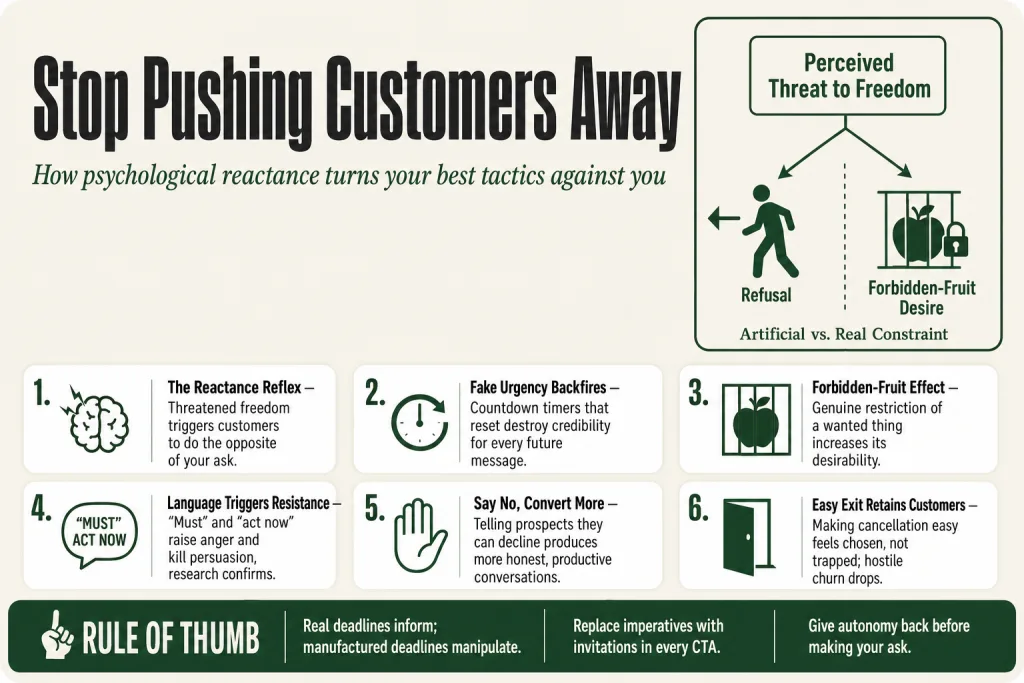
Where Psychological Reactance Comes From
Jack W. Brehm published A Theory of Psychological Reactance in 1966, and the theory rests on two deceptively simple premises: people carry a sense of which behaviors are available to them, and when those behaviors are threatened or eliminated, motivation to restore them fires up. That motivation is reactance.
The research didn’t stop there. S. S. Brehm and Brehm’s 1981 restatement of the theory broadened its application to clinical psychology and introduced the idea of trait reactance, the notion that some people have a stable, dispositional tendency to read situations as autonomy threats, not just a one-time situational response. That distinction matters for operators: your cold-traffic audience skews higher in state reactance than your existing buyers, and a message that lands fine with one group can alienate the other. By 2006, Miron and Brehm’s review brought the motivational dimensions back to center, clarifying that reactance isn’t diffuse frustration but a directed drive aimed at something specific. Then Rosenberg and Siegel’s 2018 fifty-year review consolidated decades of evidence and confirmed what practitioners had long suspected: implied threats work as well as explicit ones. The customer doesn’t need to consciously think ‘I feel coerced.’ They just feel it, and then they leave.
What makes all of this useful for operators is the directionality. The customer who hits reactance isn’t just disengaged; they’re actively motivated to do the thing you didn’t want, leave, dismiss, choose a competitor on principle. Reactance intensity scales with how important the threatened freedom is and how much of the person’s option range is being closed off. A mildly repetitive ad produces a flicker. A sales rep who won’t accept ‘I need to think about it’ produces something much closer to anger, and disengagement that outlasts the call.
The Two Faces of Psychological Reactance: Refusal and Forbidden-Fruit Desire
Reactance produces two opposite-seeming behaviors, both rooted in the same drive to restore freedom.
The first is refusal. When someone feels pushed toward a choice, they push back, declining what they were considering, abandoning the cart, ignoring the email, mentally dismissing the salesperson. This is the one most operators experience as a conversion problem they can’t explain. The offer was good. The price was right. They were interested. And then they disappeared.
The second is desirability inflation, what we colloquially call the forbidden-fruit effect. When access to something is restricted, that thing becomes more attractive. Banning a product makes people want it more. Telling customers a class has a waiting list makes them more motivated to get in. Patagonia ran a full-page ad in The New York Times on Black Friday 2011 telling customers not to buy the jacket it was advertising, and the campaign became one of the most studied examples of the effect. Patagonia is privately held and does not publish revenue, so the sales figures that circulate alongside this story trace back only to secondary marketing write-ups rather than to the company, and we do not repeat them here. The move worked because the message felt like genuine information rather than a command, and Patagonia had a documented, operational commitment to sustainability that made the refusal credible. The autonomy was real, not performed. A brand without that track record running the same ad would get found out quickly.
Both faces matter differently for operators. The refusal face is the problem to audit and remove from your current touchpoints. The desirability-inflation face is occasionally something you can design around, but it’s easily misread as a license to manufacture fake scarcity, which triggers refusal instead. The mechanism isn’t a simple ‘restriction creates desire’ switch. It’s more specific: restriction of something the person already wants and already has some access to creates desire. And if the restriction feels artificial, refusal dominates.
The line between them is whether the customer’s brain reads the situation as a genuine constraint in the world, supply really is limited, the deadline really does exist, or a manufactured pressure from a seller trying to take away their choice. Human beings are remarkably good at detecting the second. Not perfectly, which is why some fake-urgency tactics produce short-term conversion lifts, but good enough that the long-term cost usually outweighs the gain.
What Triggers Psychological Reactance in Your Marketing
Before you can fix reactance in your business, you need a working map of where it tends to come from. There are five main categories for small-business operators.
1. Freedom-Threatening Language
Persuasion research draws a clear line between ‘controlling language’ and ‘autonomy-supportive language.’ Controlling language, words like ‘must,’ ‘should,’ ‘you need to,’ ‘don’t miss out,’ ‘act now or lose access’, signals to the reader that their behavioral freedom is being constrained. Autonomy-supportive language, ‘you might consider,’ ‘one option is,’ ‘here’s what some people do’, frames the same information as input the person can use to make their own call.
A 2026 meta-analysis across 33 studies published in Human Communication Research found that high freedom-threatening language significantly increased anger, negative cognitions, and psychological reactance compared to low freedom-threatening language, and both anger and negative cognitions were negatively associated with persuasion outcomes. You can give someone excellent advice and have them reject it because of how you phrased it. For copywriters trained in direct response traditions, where strong imperatives are considered ‘confident’, this is genuinely inconvenient news.
The practical translation: audit your CTAs, email subject lines, pop-up copy, and sales scripts for explicit commands and replace them with invitations. ‘Get your free assessment’ outperforms ‘You MUST get your free assessment before Friday.’ ‘See if this fits your situation’ outperforms ‘Don’t wait, you need this.’ The second version of each pair isn’t wrong in principle; it’s just phrased in a way that makes the customer want to prove you wrong by not complying.
2. Fake or Inflated Urgency
This one is epidemic, and it’s gotten worse as urgency-as-a-tactic became a standard recommendation in conversion optimization circles. The theory was sound: real deadlines compress decision windows, help people commit, and get things done. The practice devolved into resetting countdown timers, perpetual ‘sale ends midnight tonight’ banners that restart the next day, ‘only 3 left’ badges on items with 500 in stock, and cart timers that count down to nothing.
Customers notice. Not all of them, not immediately, but enough of them, often enough. The FTC’s 2022 report Bringing Dark Patterns to Light specifically called out countdown timers that falsely imply limited-time offers as deceptive practices under Section 5 of the FTC Act. Enforcement has escalated since, the FTC secured a $2.5 billion settlement with Amazon in September 2025, with Amazon’s Prime cancellation process reportedly requiring consumers to navigate a four-page, six-click, fifteen-option sequence before they could exit. Once a customer catches your urgency signal as manufactured, it doesn’t just fail; it actively damages your credibility for every future communication.
Real deadlines, actual inventory limits, genuine promotional windows, event-based cutoffs like shipping-before-Christmas, work without triggering reactance because they represent facts about the world, not pressure from you. A customer who understands that a flight actually has two seats left doesn’t feel manipulated by the display. A customer who sees a countdown timer reset when they refresh the page feels deceived. Those are not equivalent experiences, even if the surface-level mechanism looks similar.
3. Forced Choices and Opt-Out Traps
Pre-checked boxes. Mandatory upsells. Pop-ups with ‘no thanks, I hate saving money’ as the dismiss option. These are opt-out designs that feel coercive because they are coercive, they load the default in the seller’s favor and make the customer feel they have to fight to make their own choice.
Research consistently finds that opt-out designs are rated as more manipulative, less autonomy-preserving, and more coercive, even when the objective restriction of choice is identical to an opt-in design. The customer’s perception of whether you gave them a real choice matters as much as the mechanics of whether you did. And from a regulatory standpoint, the FTC and state attorneys general have been increasingly focused on exactly these design patterns, with California’s privacy authority issuing specific guidance in 2024 cautioning businesses to audit their interfaces for this kind of manipulation.
4. Over-Personalization That Reads as Surveillance
Highly personalized ads and emails can feel less like helpful suggestions and more like the company was watching you. When someone sees an ad for a product they only browsed briefly, or worse, only mentioned aloud, the reaction is frequently discomfort rather than delight. That discomfort is reactance: a sense that autonomy is being operated on without consent.
The operator implication is that retargeting frequency matters. One well-timed retargeting touch is useful; our own working ceiling is that conversion probability stops improving meaningfully somewhere around the seventh impression while irritation keeps climbing past it. That is an operating heuristic drawn from our own campaigns, not a published finding, and you should test it against your own frequency data rather than adopt the number. On Meta, click-through rates drop roughly 45% after the fourth exposure to the same creative within a single week. The customer isn’t going to email you to say ‘please stop.’ They’re going to tune you out, or actively avoid the product. Frequency caps exist to manage this. Operators who don’t set them are choosing reactance over revenue.
5. Overpersuasion, When the Effort Itself Signals Manipulation
There’s a threshold beyond which the quantity of persuasion, rather than its quality, becomes the problem. If a prospect receives a 12-email follow-up sequence, four retargeting ads a day, two cold calls, and a LinkedIn request within a week of an initial inquiry, the sheer volume signals ‘this company needs me more than I need them’ and ‘I am being managed.’ Both are reactance triggers, and neither is fixed by making the emails better. The fix is fewer, better-timed contacts, not more optimized contacts at the same frequency.
Putting this to work? The ideas in the Canon are the foundation under the tactical playbook in Build a Complete Marketing Department — grab the free companion kit at mmsvegas.com/resources.
Psychological Reactance Applied Today: Where It Shows Up in Your Business
Theory covered, now let’s map it to the actual points in a small-business customer journey where reactance tends to accumulate.
Website and Landing Pages
Pop-ups that fire in the first eight seconds of a visit. Chat windows that open automatically before the person has read a word. CTAs that use imperative commands and underline the consequence of inaction. Pricing pages where every option except the one you want them to buy is visually suppressed. All of these can produce sub-threshold reactance that doesn’t show up in your analytics as anything except a high bounce rate and low time-on-page. You’ll see the symptom without understanding the cause.
The audit question for any landing page element: does this give the visitor information to use, or does it remove their ability to choose? If a pop-up offers something genuinely useful and can be dismissed easily, it passes. If it’s timed to appear precisely when someone moves their cursor toward the back button, it reads as ambush, and reactance follows.
Email Sequences
Automated email sequences are one of the most reactance-prone systems a small business operates, precisely because volume is easy to ramp up and the individual messages aren’t obviously connected from the sender’s perspective, but the recipient experiences them as a single relentless stream. The standard advice to ‘send more touches’ is sometimes right and often wrong, and reactance is the reason it fails.
In email, controlling language in subject lines is one of the fastest ways to earn unsubscribes without understanding why. Subject lines that imply the reader has made a mistake, is missing out, or needs to act immediately can increase open rates through mild anxiety, and increase unsubscribe rates for exactly the same reason. Short-term metric, long-term cost.
The counter-approach: write subject lines and openers that frame your email as something you thought the person might actually want, ‘Saw this and thought of you’, rather than something they need to do. The shift feels softer from the writing side. The customer-side experience is night and day.
Sales Conversations
This is where reactance is most immediately visible, because you can watch it happen. A prospect who walked in warm starts crossing their arms, giving shorter answers, and eventually tells you ‘I need to think about it.’ That last phrase is almost always a reactance exit, it’s how people get out of a situation that feels like pressure without having to say ‘you’re pushing too hard.’
The proven counter-move is autonomy acknowledgment: saying out loud that the decision is entirely theirs, that there’s no pressure, and that it’s completely fine to say no. When prospects feel safe to decline, they’re much more likely to tell you what’s actually going on, budget concerns, internal politics, timing. They no longer need to flee to reclaim autonomy; you just gave it back. ‘It’s completely fine if this isn’t the right fit’ is not a weak close. It’s a reactance-dissolving signal that tends to produce more honest, more productive conversations, and often, a warmer decision.
Subscription and Retention Contexts
Reactance doesn’t only affect acquisition. It shows up at renewal time when customers feel like they’re being kept rather than choosing to stay. Cancellation flows that are deliberately difficult, hiding the cancel button, requiring a phone call, surfacing seven retention offers before letting someone through, are high-reactance designs. Customers who successfully navigate them often feel so manipulated that they leave a negative review, tell their network, or dispute the charge. Customers who can’t navigate them dispute the charge immediately.
The operator who makes it easy to leave is counterintuitively more likely to retain customers, because the relationship feels chosen rather than trapped. That’s not a marketing softness argument; it’s a reactance argument.
Real Examples of Psychological Reactance, and Its Inverse
Patagonia’s ‘Don’t Buy This Jacket’ Campaign (2011). This Black Friday ad in The New York Times told customers not to buy the jacket it was advertising, framing the case around environmental impact. Patagonia is privately held and publishes no revenue, so treat the sales numbers attached to this campaign elsewhere with suspicion; what is well documented is the reaction, not a verified sales lift. It worked because Patagonia already committed 1% of sales to environmental initiatives, used organic cotton, and had built its supply chain around those values. The brand handed control to the customer and trusted its actual track record to do the persuading. A brand with no such history running the same ad would face backlash worse than a normal campaign.
Retargeting Overexposure. Dynamic retargeting makes intuitive sense: person showed interest, show them the product until they decide. From the customer’s side, it reads as surveillance. After the fourth exposure to the same creative in a single week, click-through rates on Meta drop roughly 45%. The worst implementations follow users with the same creative for weeks after they’ve already purchased elsewhere, reactance plus lasting negative brand association. Frequency caps exist to prevent this. Operators who don’t set them are paying for impressions that actively push people away.
Saturn’s No-Haggle Pricing. Saturn built its go-to-market around eliminating the negotiation that shoppers found most reactance-inducing about car buying. Fixed, published prices meant customers didn’t feel their autonomy was being tested or outsmarted. J.D. Power ranked Saturn first overall in sales satisfaction in 2007, and the brand consistently outranked luxury marques in the sales experience itself. Saturn eventually folded for unrelated reasons inside GM, but the reactance-informed customer experience worked for exactly what it was designed to do. Tesla and Carvana operate on similar no-haggle principles today.
Amazon’s Dark-Pattern Settlement (2025). In September 2025, Amazon settled with the FTC for $2.5 billion after the agency alleged the company used deceptive methods to sign up consumers for Prime and made cancellation exceedingly difficult, internally described as the “Iliad Flow.” The cancellation process reportedly required a four-page, six-click, fifteen-option sequence before users could exit. This is reactance-triggering design at enterprise scale. Small operators rarely face FTC action directly, but the customer experience damage, chargebacks, one-star reviews, hostile word-of-mouth, is identical regardless of company size.
Where Psychological Reactance Awareness Pays Off Most
Not every business has the same reactance exposure. Here’s where it tends to matter most.
High-consideration purchases. The higher the ticket and the longer the decision, the more time the customer has to accumulate reactance from multiple touchpoints. A $50 online purchase made on impulse has almost no reactance window. A $5,000 consulting engagement researched over six weeks has a dozen potential reactance moments, every follow-up email, every pricing conversation, every ‘special offer that expires this week.’ High-ticket operators who manage reactance carefully often find that patience and autonomy-acknowledgment outperform urgency as closing tools.
Repeat-purchase and subscription businesses. Customers who feel their loyalty is taken for granted, whose prices quietly increase, whose cancellation is made artificially difficult, whose complaints are met with scripted deflection, accumulate slow-burn reactance that eventually tips into churn. The trigger isn’t usually a single event. It’s the feeling, built up over months, that the company is managing them rather than serving them.
B2B sales with long cycles. The B2B buying committee context makes reactance particularly acute because you’re persuading multiple people simultaneously, and any one of them can become the internal voice that says ‘this feels like pressure’ and stops the deal. Sales sequences calibrated to the speed of a single motivated buyer often move too fast for the full committee’s comfort, producing a kind of institutional reactance that looks like ‘still evaluating’ on the CRM.
Small-business operators who rely on referrals and community reputation. Reactance damage doesn’t stay inside your conversion funnel. A customer who felt manipulated tells people. In a small local market, a neighborhood, a professional community, an industry niche, the information travels faster than your next ad campaign. Operators who compete on trust and referrals have more to lose from reactance-triggering tactics than operators competing purely on price and volume through anonymous digital channels.
Where Reactance Awareness Can Mislead You
Being conscious of reactance can make you second-guess every persuasive element you’ve ever deployed, which is overcorrection. Some distinctions worth keeping.
Urgency that’s real isn’t reactance-triggering. A genuine end-of-season sale, a workshop with twelve actual seats, a service window that closes because the operator is booked, these are facts, not manipulation. Communicating them clearly and with appropriate emphasis is not pressure. Customers understand real constraints and don’t resent them. The reactance risk is not ‘urgency’ as a category; it’s manufactured urgency specifically.
Strong CTAs aren’t the same as controlling language. ‘Get started today’ is a directive, but a mild one, it implies an invitation more than a command. The research on controlling language focuses on phrases that eliminate choice or imply negative consequences for non-compliance. There’s meaningful ground between ‘you might consider starting’ and ‘you MUST act now before it’s too late.’ Don’t neuter your copy trying to remove every trace of assertiveness.
Reactance varies by person and situation. Researchers distinguish between trait reactance, a stable personality disposition toward autonomy protection, and state reactance, triggered by a specific situation. Your targeting and messaging calibration should account for this. An audience that self-selected into your world because they trust your brand will have lower state reactance to the same message than a cold audience exposed to your ad for the first time. The same email that feels comfortable to existing customers can feel invasive to a fresh cold list.
Giving choices can paradoxically create its own problem. Too many options produce decision fatigue and often lead to no decision, a different psychological effect entirely. Reactance is about feeling your autonomy is threatened; the paradox of choice is about feeling overwhelmed by autonomy. Both lead to inaction, but they need different fixes. Reactance needs fewer constraints; paradox of choice needs fewer options. Conflating them and ‘adding more choices’ to fix what is actually a reactance problem is a common error.
Common Mistakes
- Running perpetual fake urgency — Before you publish any urgency signal, ask: would a skeptical customer who refreshed this page in 24 hours find the same claim still true? If not, pull it. Replace it only with a constraint that’s real, actual inventory, a genuine date, a true capacity limit. When the deadline passes, let it pass.
- Writing off a lost deal as a lead-quality problem — Before closing out a lost deal as a lead-quality problem, audit the touchpoints that prospect actually saw: subject lines, follow-up frequency, CTA language, how you handled ‘I need to think about it.’ Look for the pattern across five or ten losses before concluding it’s a targeting issue. If the same sequence keeps losing warm prospects at the same stage, the sequence is the problem.
- Using the same email sequence for cold leads and existing customers — Segment by relationship stage. Cold traffic gets more autonomy language, more context, and fewer commands. At minimum, separate people who’ve never bought from you from people who have, and write different subject lines for each group.
- Making cancellation deliberately hard — Build a clean cancellation path: three clicks or fewer, no call required. Track churn for 60 days afterward. Satisfied customers mostly stay. The ones who leave were going to leave anyway, now they leave without the hostility.
- Piling on persuasion elements and calling it ‘optimized’ — Pick the two or three highest-impact elements and remove the rest. A real deadline needs one clear mention, not five. When every element on the page is shouting, none of them land.
Operator’s Take
Here’s my honest read on reactance in 2026: most small-business operators don’t have a targeting problem or a traffic problem. They have a trust-erosion problem, and they’ve been accidentally building it one fake-urgency email and one aggressive follow-up at a time. The good news is that the fixes aren’t expensive. They mostly require restraint, which is harder than it sounds when you’ve been told that more touches equals more revenue.
So let me give you five things you can actually do differently, not a recap of what you just read, but the places where the rubber meets the road.
1. Rewrite your opt-out dismiss copy, this week. Go find every pop-up, interstitial, and overlay on your site right now. Look at what happens when someone clicks ‘no.’ If the dismiss button says anything like ‘No thanks, I love paying full price’ or ‘I don’t want to save money,’ delete it. That copy is called a ‘shame click’, it’s designed to make the customer feel bad about exercising their autonomy. It registers as manipulation even to people who don’t consciously identify it, and it poisons the interaction regardless of how good the offer is. Replace it with a plain ‘No thanks’ or simply an X. You’ll lose nothing. The people who wanted the offer already took it.
2. Call your own follow-up sequence, literally. Pull out your phone and read your automated email sequence out loud, all of it, in order, the way a prospect experiences it. Not one email. The whole thing. You’ll notice the shift around email three or four where the tone moves from ‘here’s something useful’ to ‘why haven’t you responded yet.’ That shift is where your reactance problem lives. Cut the sequence there, or reframe everything after that point as genuinely new information, a case study you hadn’t shared, an angle on the problem they haven’t seen. If you can’t justify the email with a fresh reason to send it, don’t send it.
3. Put a real number on your frequency caps, today, not eventually. Log into your ad platform and set a hard cap. For cold audiences on Meta or Google Display, 3 impressions per user per week is a reasonable starting ceiling. For retargeting warm audiences, you can push to 5, but you should also be rotating creative, because the same image plus the same headline is what triggers the surveillance feeling, not just the frequency. Pick a number, set it, and leave it for 30 days before you adjust. The operators who never set caps are the ones paying for impressions that are actively teaching people to dislike them.
4. Add a ‘you can absolutely say no’ line to your sales scripts, and put it before the ask. This one feels counterintuitive, so I’ll say it plainly: telling someone they can decline before you make your pitch reduces defensive posture. It’s not weakness; it’s a reactance release valve. The prospect who knows they’re safe to say no doesn’t need to build a wall. Try it verbatim: ‘Before I walk you through this, there’s genuinely no pressure here. If it’s not the right fit for you right now, just tell me and we’ll save each other the time.’ Then watch what opens up. You get honesty instead of a polite stall. That’s more useful to you than a reluctant ‘I’ll think about it.’
5. Audit your cancellation flow for click count, not ‘best practices.’ Count the clicks it takes a customer to cancel your subscription or retainer. If the answer is more than three, you have a reactance trap, and a growing regulatory exposure. The FTC’s $2.5 billion settlement with Amazon in September 2025 centered partly on a cancellation process that required consumers to navigate four pages, six clicks, and fifteen options before they could exit. That’s the extreme version, but the dynamic is the same at any scale. Customers who escaped your friction don’t come back. Build a clean path out, then track your churn numbers for 60 days. The customers worth keeping mostly stay. What drops is the hostile churn, the chargebacks, the one-star reviews, the people who felt trapped and made sure their network knew it.
On the AI angle: your email platform, FunnelKit, or a Make workflow can be configured to scan outgoing sequences for controlling-language patterns before they go live, flagging ‘you must,’ ‘expires tonight,’ ‘don’t miss out’ phrases before they hit a list of 4,000 people. It’s a mirror, not a replacement for your judgment. The call on what to change is still yours. But catching it before it sends is a lot cheaper than rebuilding a burned list.
One last thing. Some operators read about reactance and strip all urgency and all strong CTAs from their marketing. Don’t. Real scarcity and genuine deadlines are service, not pressure, they help customers make decisions they were already inclined to make. The discipline is keeping your urgency honest enough that customers believe it when they see it. That’s what your list is actually tracking, whether you realize it or not.
Used in
- ✓ Build a Complete Marketing Department
Used to audit copy, email sequences, and offer framing for pressure-coded language, ensuring that each stage of the marketing system generates pull rather than triggering the pushback that kills conversions quietly. - ✓ The Missing Manual for FunnelKit
Applied when designing automation sequences and popup triggers, specifically to calibrate timing, frequency, and CTA language so that automated touchpoints feel like useful prompts rather than coercive pressure. - ✓ The Missing Manual for Make
Referenced when building multi-step customer communication workflows, ensuring that escalating follow-up sequences don’t cross the frequency or tone threshold that produces reactance-driven unsubscribes and disengagement.
FAQ
Is psychological reactance the same as buyer’s remorse?
No, buyer’s remorse happens after a purchase and involves regret about the decision made. Reactance happens before or during the decision when the customer feels their freedom is being pressured, and it typically results in refusal or withdrawal rather than a completed purchase.
Can I use scarcity and urgency without triggering reactance?
Yes, as long as the scarcity and urgency are real. Genuine inventory limits, honest deadlines, and actual capacity constraints are information customers use to make decisions, they don’t trigger reactance. Manufactured urgency (timers that reset, perpetual sales, fictional stock counts) reads as manipulation and triggers reactance reliably.
How do I know if my marketing is triggering reactance?
Look for these signals: high traffic with unexpectedly low conversion, email lists that burn out fast (high unsubscribes relative to opens), sales conversations that end in ‘I’ll think about it’ repeatedly, and churn that doesn’t correlate with product dissatisfaction. None of these are definitive proof, but together they suggest your persuasion is working against you.
Does reactance affect B2B buyers the same way as consumers?
Yes. B2B buyers are still people with the same autonomy-protection wiring. The visible response may be more professional, slower ghosting rather than an immediate exit, but the underlying dynamic is identical. High-pressure B2B tactics reliably produce delayed decisions, expanded evaluation timelines, and harder contract negotiations.
What’s the simplest copy change I can make to reduce reactance?
Replace imperatives with invitations in your calls to action and email subject lines. ‘You must act before midnight’ becomes ‘This offer closes tonight if you want it.’ ‘Don’t miss out’ becomes ‘Here’s what’s available.’ The information is the same; the autonomy signal is very different.
Does explicitly telling someone they can say no actually help conversion?
Counterintuitively, yes. When prospects know it’s okay to decline, they’re much more likely to tell you what’s actually going on, budget concerns, timing, internal politics. You get a real conversation instead of a polite escape. The customer no longer needs to flee to reclaim their autonomy; you just gave it back.
Further reading
- Jack W. Brehm, A Theory of Psychological Reactance (1966)The original academic monograph. Dense, but the first two chapters give any operator the mechanistic grounding they need.
- Robert Cialdini, Influence: The Psychology of PersuasionCialdini’s principles (scarcity, authority, commitment) are the toolkit that reactance most often complicates; reading them together tells you both how persuasion works and exactly where it breaks.
- BJ Fogg, Tiny HabitsFogg’s Behavior Model frames motivation, ability, and prompt as the three levers of behavior change; reactance operates primarily on the motivation lever by creating counter-motivation, making his model a useful complement.
Sources: Jack W. Brehm, A Theory of Psychological Reactance (Academic Press, 1966); Miron & Brehm, ‘Reactance Theory, 40 Years Later,’ Zeitschrift für Sozialpsychologie (2006); Rosenberg & Siegel, ‘A 50-Year Review of Psychological Reactance Theory,’ Motivation Science (2018); Li & Shi, ‘Message effects on psychological reactance: meta-analyses,’ Human Communication ResearchVol. 52, No. 1, pp. 38 to 52 (2026); ‘Consumer flexibility and the effectiveness of limited time offers: the role of psychological reactance,’ Journal of Business Research vol. 200 (2025); FTC, Bringing Dark Patterns to Light (September 2022); FTC v. Amazon.com, Inc. $2.5 billion settlement, September 25, 2025; Hwang and Lee, ‘“Don’t buy this jacket”: Consumer reaction toward anti-consumption apparel advertisement,’ Journal of Fashion Marketing and Management 20(4), doi:10.1108/JFMM-12-2014-0087, on the Patagonia campaign; ‘When Everyone Wins? Exploring Employee and Customer Preferences for No-Haggle Pricing,’ Frontiers in Psychology (2018), doi:10.3389/fpsyg.2018.01555; J.D. Power sales satisfaction rankings, Saturn Corporation (2002, 2007); Knowledge@Wharton, ‘Saturn: A Wealth of Lessons from Failure.’ The frequency-cap numbers, the email-sequence limits and the diagnostic questions in this article are our own operating defaults, not findings from any source above.
Brian Kasday spent forty years in direct-response marketing before rebuilding the whole operation as a one-person shop. He writes The Operator’s Library — including “Build a Complete Marketing Department” — for operators who’d rather build it themselves than wait on someone else.
Build the department these ideas describe — the free companion kit: mmsvegas.com/resources.
More The Operator's Canon guides
Free · Operator Toolkit
Want the tools, not just the guide?
Get the free operator toolkit — templates and checklists for the systems you actually run, plus a note when this guide changes.
Get the free toolkit →How to cite: Psychological Reactance. Associated with Jack W. Brehm, 1966. The Operator’s Canon, MMS Vegas. https://mmsvegas.com/library/psychological-reactance-explained/