
Last updated: July 2026
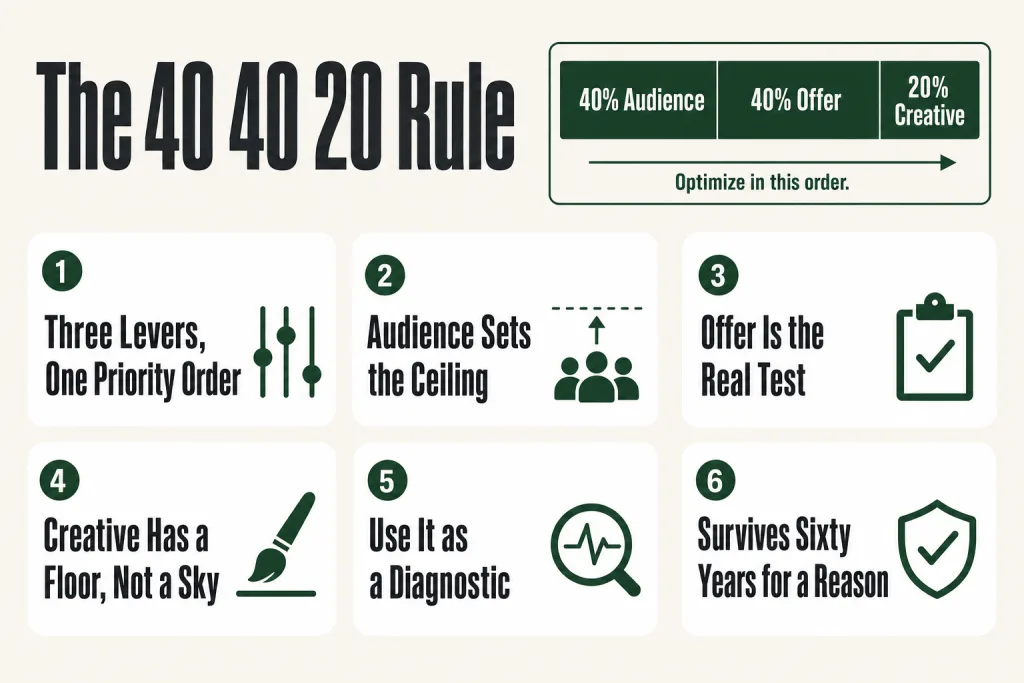
The 40 40 20 rule is a direct-response diagnostic framework that breaks campaign success into three weighted variables: roughly 40% on who you’re reaching, 40% on what you’re offering them, and only 20% on how it looks and reads. By the end of this page, you’ll be able to run a pre-flight audit on any campaign, email, paid social, direct mail, SMS, and identify which of the three levers is most likely killing your results, so you stop redesigning ads when you should be rethinking your list.
Here’s what most operators get exactly backwards. When a campaign underperforms, the first instinct is to fix the creative, rewrite the headline, swap the image, try a different color on the button. Designers get briefed, copywriters get blamed, and another two weeks pass. The real problem sits untouched: the people receiving the message were never going to respond, or the offer wasn’t worth responding to. It’s a bit like repainting the exterior of a house with a cracked foundation, looks better from the street, but nothing has changed.
The 40 40 20 rule forces you to work in the right order. It doesn’t say creative doesn’t matter; it says creative is the last thing to optimize, not the first.
The idea in 30 seconds
- Campaign success breaks down roughly as 40% audience, 40% offer, and 20% creative, in that priority order.
- Most operators spend 80% of their time on creative (copy, design, video) and almost none on whether the offer is compelling or the targeting is right.
- Fix targeting and offer first; only then polish the creative, reversing this wastes money and time.
- The rule functions as a diagnostic: when a campaign underperforms, audit audience and offer before you rewrite a single line of copy.
- It applies equally to direct mail, email, paid social, Google Ads, and any other channel where you’re pushing a message to a defined group.
- The 20% creative bucket still matters, bad creative can kill a great offer, but it’s the last lever to pull, not the first.
Where the 40 40 20 Rule Came From
The rule is attributed to Ed Mayer, a direct mail practitioner and educator who died on December 1, 1975. According to the Copywriters Podcast, his New York Times obituary noted that he had taught more than 20,000 college students and business executives the hands-on craft of direct mail. Marketing EDGE, the nonprofit he helped found, named its Education Leadership Award after him, which has been given annually for over three decades. His 1950 book, How to Make More Money with Your Direct Mailwas described by used-book sellers as having been ‘the bible of the business.’
The honest version of the attribution is this: every source placing the 40/40/20 split with Mayer is secondhand, trade publications, industry commentators, printing and mail-house blogs. The 1960s dating is consistent across those sources, and the attribution has held for sixty-plus years without a credible counter-claim. But no one has publicly pointed to the page in a Mayer manuscript where he typed out the 40/40/20 breakdown in those exact terms. It’s a well-accepted industry attribution, not a primary-source citation. That’s worth knowing, and it doesn’t change how the rule works.
The Problem It Was Built to Solve
Before this framework existed, direct mail campaigns mostly lacked strategic triage. Marketers invested heavily in production, the look and feel of the piece, the persuasiveness of the copy, while treating list quality and offer strength as afterthoughts. The result was predictable: beautifully executed campaigns that generated nothing, followed by post-mortems that blamed the wrong variable.
That misattribution problem is not a historical artifact. It’s the default failure mode of almost every small business running campaigns today. The operator redesigns the Facebook ad. The email subject line gets A/B tested for the fourth time. A new landing page hero image gets commissioned. Meanwhile, the targeting is still too broad, or the offer is a modest 10% discount that nobody feels compelled to act on.
The 40 40 20 rule solves misattribution by giving operators a forced ranking. It tells you, before you spend diagnostic energy, that you’re probably looking in the wrong place. Think of it as a Bayesian prior for campaign troubleshooting: if something is broken, the odds favor audience or offer, not creative. That prior should change where you look first.
The Three Levers of the 40 40 20 Rule
The First 40%: Audience
Audience means who receives your message. In Mayer’s era, that was a physical mailing list. Today it covers email lists, ad targeting parameters, custom audiences, lookalike audiences, LinkedIn targeting, and any other mechanism that determines who sees what you’re saying.
Wrong audience, dead campaign. An operator selling commercial HVAC services who runs a geo-targeted Facebook ad to homeowners isn’t going to get where they want to go, regardless of how good the copy is. The targeting sets the ceiling on everything else. The rule assigns 40% weight here because list quality has historically been the single biggest variable in direct-response results, more predictive than execution, more predictive than offer strength in isolation.
For small businesses, the most valuable audience is almost always an existing customer list or a warm prospect list: people who have bought before, requested a quote, attended a webinar, or otherwise signaled intent. These lists respond at multiples of cold lists, and they cost nothing extra to use. RFM segmentationsorting your customer base by recency, frequency, and monetary value, is one of the sharpest tools for identifying which subset of your existing audience to target first.
The Second 40%: Offer
Offer means the specific value exchange you’re proposing, what the prospect gets, at what terms, in exchange for what action. This is distinct from your product or service. Your product is what you sell; your offer is what you’re asking someone to do right now, under these specific conditions.
A weak offer asks for a commitment without reducing perceived risk, without creating urgency, or without making the value obvious enough to override inertia. ‘Schedule a consultation’ is weak on its own. ‘Free 30-minute audit, we’ll identify your top three revenue leaks and give you a written summary to keep’ is stronger, because it names the outcome and removes ambiguity about what you’re actually getting.
The offer carries equal weight to audience for a clear reason: even a perfect list can’t overcome an offer nobody wants to take. A dental practice mailing to confirmed local residents who haven’t seen a dentist in three years will still underperform if the offer is ‘10% off your next cleaning.’ The friction of making an appointment isn’t reduced enough to break inertia. Change it to ‘Free new patient exam + X-rays, no insurance required’ and the same list converts at a materially higher rate. Same audience. Different offer. Different result.
The offer is also where your value proposition gets stress-tested in the real world. A compelling offer connects what you uniquely provide to a felt need the audience already has. If that connection isn’t obvious in two or three seconds, the offer fails regardless of how tight the targeting was.
The Final 20%: Creative
Creative covers the entire execution layer: copy, design, format, visual hierarchy, channel, timing. Everything that isn’t who you’re reaching or what you’re offering, from whether you’re using a postcard or a letter, a video or a static image, a long-form email or a short SMS, to whether the CTA button is above the fold.
Twenty percent is not zero. Bad creative can sabotage an otherwise strong campaign, a confusing layout that buries the offer, copy so dense nobody reads to the CTA, or design so amateurish it kills trust before the prospect considers your terms. The creative has to clear a basic competence threshold. Beyond that threshold, incremental creative improvement yields diminishing returns compared to improvements in targeting or offer strength.
Read the 20% as a floor and a ceiling. Your creative needs to be readable, credible, and clear. Once it’s there, you’re probably not going to double your response rate by making it prettier. You might move it 10 to 15%. Do that work, but only after you’ve maximized the 80%.
Putting this to work? The ideas in the Canon are the foundation under the tactical playbook in Build a Complete Marketing Department — grab the free companion kit at mmsvegas.com/resources.
Why the 40 40 20 Rule Has Survived Sixty Years
A lot of frameworks from the 1960s didn’t make it this far. This one did because it describes something true about how campaigns actually work, not something specific to a channel or a format.
It survived because it reflects a real asymmetry in campaign economics. Changing your audience targeting costs almost nothing at the margin, you adjust a parameter, swap a list segment, upload a new custom audience. Changing your offer costs a little more, you rethink the terms, adjust the price point or the bonus, but it’s still a strategic decision, not a production cost. Changing your creative is where most of the actual production dollars go: design hours, copywriting, photography, video. Read that way, the rule is also a capital allocation guide: don’t spend on production until the underlying strategy is right.
There’s a compounding logic that makes the sequencing matter more than the individual weights. If your list and offer are both strong, you have roughly 80% of the success conditions in place before creative touches the work. If your list and offer are both weak and your creative is world-class, you’ve got roughly 20% of the success conditions, and no amount of brilliant execution rescues a campaign built on a bad foundation.
Grant Swain, then-senior vice president and executive creative director at Rapp Collins, once argued publicly that the equation had shifted to 40-40-40, that the volume of competing messages meant exceptional creative was now table stakes. He had a point about noise levels. But the counterargument holds: the solution to a crowded, noisy market is tighter audience definition and a more differentiated offer, not more polished creative. You can’t outdesign your way out of wrong targeting.
The rule also transferred across channels. Email marketingpaid search, direct mail, paid social, SMS, even podcast ads, all of them have some version of an audience, an offer, and creative. The proportions are rough approximations, not precise engineering, but the priority ordering holds across all of them. The channel changes; the hierarchy doesn’t.
Applying the 40 40 20 Rule in Digital Marketing Today
Digital advertising introduced a wrinkle Mayer never had to deal with: on platforms like Meta and Google, the creative itself can function as targeting. When you write ad copy that speaks directly to a specific pain, the algorithm uses those signals to find people who respond to that content. Some practitioners have used this to argue that the 20% creative bucket has expanded for paid social.
It adds nuance, but it doesn’t flip the priority order. What it means is that your creative needs to be specific enough to attract the right people, which is still an audience problem, solved partly through creative execution. An ad that speaks clearly to a narrow, well-defined pain point isn’t proof that creative outweighs targeting; it’s proof that good creative is audience-aware. The targeting logic is embedded in the message.
For email, the framework maps almost perfectly. List quality (audience) is the deliverability and engagement history of your subscriber base. Your offer is the specific ask in each email, the reason to click, not just the fact that you sent something. Creative is the subject line, preview text, body copy, and visual layout. Operators who obsess over subject line variations while mailing to unengaged lists with weak calls-to-action are optimizing the 20% while ignoring the 80%.
For Google Ads, audience is keyword targeting and match types, are you capturing people who are actually in the market for what you sell? Offer is your landing page’s actual proposition: what does the person get for clicking? Creative is the ad copy, extensions, and landing page design. Fix the keyword targeting and the landing page offer before you A/B test ad headlines.
The rule is also useful for diagnosing why a previously working campaign has degraded. If email open rates have held steady but click rates dropped, the offer has gone stale, the audience is still engaged, the creative is still getting eyes, but what you’re asking them to do no longer resonates. If opens have dropped, it’s likely a list problem: your subscriber base has gone cold, or you’re hitting the wrong segment. Knowing which variable moved tells you which one to fix.
Where It Applies, Where It Gets Complicated
The 40 40 20 rule is most reliably useful in direct-response contexts, campaigns with a specific, measurable ask, a defined audience, and a discrete piece of creative. Direct mail, email marketing, paid social with a conversion objective, SMS campaigns, Google Ads, cold outreach sequences. If you can measure the response rate and attribute it to a campaign, the framework applies.
It gets less precise in brand-building contexts. A billboard on I-15 isn’t structured around a specific offer, and the ‘audience’ is essentially anyone who drives past it. Long-form content marketing, blog posts, podcasts, YouTube videos, operates on a different time horizon and a different success metric than direct response. The rule still informs brand decisions (who are you building awareness with? what’s the core message?) but the 40/40/20 weighting isn’t where you’d apply it mechanically.
It also doesn’t fully account for the economics of very small lists. If your email list has 200 people and you know most of them personally, ‘audience’ in the Mayer sense isn’t really the variable, creative and offer become relatively more important because the targeting ceiling is already fixed. The rule assumes you have meaningful variance in who you can reach; when that variance is limited, the weights shift.
One honest caveat: the 40/40/20 breakdown is a heuristic derived from industry observation, not a controlled empirical study with error bars. The actual proportions in any given campaign will vary. Some markets are so underserved that almost any offer to the right audience converts. Some offers are so compelling they pull response from moderately targeted lists. Use the rule to set priorities, not to predict exact outcomes.
Using the 40 40 20 Rule as a Campaign Diagnostic
This is where the rule pays off most directly for a small-business operator. Run every underperforming campaign through a three-question audit before you change anything:
- Audience audit: Is this message reaching people who are plausibly in the market for what I’m offering? Have they demonstrated relevant prior behavior, past purchases, search intent, list opt-in related to this topic, demographic fit? Or am I reaching a broad, cold, undifferentiated group because it was convenient or cheap?
- Offer audit: Is what I’m asking someone to do clear, specific, and worth doing right now? Does it reduce their risk and lower their activation barrier? Would a qualified prospect read this and immediately understand what they’d get and why it’s worth acting on today?
- Creative audit: Is the execution clear and credible? Does the design make the offer easy to find and easy to act on? Is the copy free of jargon and friction?
Most operators who run this audit honestly find the problem in questions one or two, almost never exclusively in question three. That finding alone is worth the five minutes the audit takes.
The diagnostic also works prospectively. Before you launch, score yourself on each dimension: How confident are you in the audience definition? How strong is the offer, not in your opinion, but by the standard of what a qualified prospect would find compelling? How polished is the creative? If your audience and offer scores are both low, no amount of creative work is going to save the campaign.
AI tools can accelerate the creative layer, drafting copy variants, generating image options, iterating on subject lines faster than any human team. That’s genuinely useful. But the judgment calls on audience definition and offer strength stay with you. Knowing which zip codes or list segments to target, what price point creates urgency for your specific market, whether a free consultation or a money-back guarantee is the right risk-reducer, those decisions require operator knowledge that no tool supplies. The 20% gets faster with AI; the 80% still requires your thinking.
Common Mistakes
- Calling a stale offer a creative problem — When click-through rates drop on a campaign whose open rates are holding steady, the offer has gone stale, not the subject line. Before you rewrite any copy, look at what you’re actually asking people to do: has the discount expired, has the bonus lost relevance, has a competitor made your terms look weak? Try replacing the offer entirely, same list, same creative structure, new ask, and measure before you touch a headline.
- Seeding a lookalike audience from your full customer list — A lookalike audience is only as good as the customers you seed it with. If your seed list includes freebie-seekers, one-time buyers from a heavily discounted promotion, or cold contacts who never converted, your lookalike will find more of the same. Run a quick RFM pass, sort by recency and total spend, and seed your lookalike from the top 10 to 20% of buyers only. The resulting audience will be smaller but will convert at a materially higher rate.
- Sending the same offer to your entire list — A single offer sent to all contacts assumes everyone has the same objection, the same urgency, and the same risk threshold. They don’t. Start with just a two-way split: people who have purchased in the last 90 days versus everyone else. Write one offer for each. The re-engagement offer for cold contacts needs a lower friction ask and more risk-reduction. The offer for recent buyers can lean harder on upsell or cross-sell. Even that rough split changes response rates.
- Concluding that low response means the market doesn’t want the product — Low response usually means one of the three variables is broken, not that demand doesn’t exist. Isolate before you conclude. Send the same offer to a warmer, smaller segment and measure separately. If response jumps, the original audience was the problem. If it stays flat, rework the offer terms, lower the friction, name a specific outcome, add a guarantee. Pull the ‘market doesn’t want this’ conclusion only after audience and offer have both been tested cleanly.
- Letting list decay erode results invisibly — An email list that hasn’t been cleaned in six months is a different asset than the one you think you have. Unengaged contacts drag down sender reputation and suppress delivery to the people who do want to hear from you. Run a re-engagement sequence every 90 days. Anyone who doesn’t open or click gets removed. Track your spam complaint rate; anything above 0.1% is a flag that your list health is actively hurting you.
- Cutting the creative budget because ‘it’s only 20%’ and then blaming the rule when the campaign flops — The 20% has a floor. If your creative is confusing, visually amateurish, or buries the CTA below three paragraphs of throat-clearing, you’ve failed the floor test, and a strong audience and offer won’t save it. The rule tells you where to put your optimization energy, not where to cut corners. Get creative to a readable, credible standard first; after that, redirect your time toward improving the 80%.
Operator’s Take
Start with the list file before you touch anything else. Open it. When was it last cleaned? If you’re running an email sequence that’s been live for more than six months without a re-engagement purge, you’re likely mailing to 20 to 30% dead contacts who are tanking your deliverability and dragging down open rates. Pull everyone who hasn’t opened in 90 days into a separate segment. Send one re-engagement email with a blunt subject line, something like ‘Should I stop emailing you?’, and remove anyone who doesn’t respond within a week. That single step, no creative work, no offer revision, routinely moves open rates 8 to 12 percentage points. Pure audience work, zero production cost.
Then check what you’re leading with in the offer. Not the product description, the first thing someone reads. Most operators have a stronger offer than they’re showing. A full refund guarantee buried in paragraph five. A free bonus mentioned as an afterthought. The risk-reversal, often the most persuasive element in the whole piece, treated like fine print. Move your strongest offer element to the first or second sentence. No redesign required. If that one move doesn’t lift your click rate in the next send, that’s worth knowing too.
Before you call an agency or brief a copywriter, answer two questions on paper. Who, specifically, is this campaign going to? Not ‘small business owners’, the actual segment, with a behavioral or transactional characteristic attached: someone who bought in the last 90 days, someone who requested a quote but didn’t convert. And: what is the offer, in one sentence, that would make a qualified person in that segment feel like an idiot for ignoring it? If you can’t answer both cleanly, you’re not ready to spend money on production. You’ll produce something that can’t work yet, and then blame the creative.
Watch how agencies open the first conversation. One that leads with brand refresh, video package, and social content calendar before asking hard questions about your list quality and offer structure is solving the 20% while leaving the 80% untouched. The tell: did they ask to see your current campaign data before quoting you anything? If not, ask them why. Their answer will tell you whether they’re the right partner.
Stop using ‘we don’t have bandwidth to test’ as an excuse. AI has made it largely irrelevant. You can now spin up three different offer framings and run them as separate email variants in an afternoon, something that would have taken a week of copy and design cycles two years ago. Ship at least two offer variants on any campaign above $500 in budget. Score them at 72 hours. Kill the loser. The winner tells you more about your market than six months of brand strategy will.
Used in
- ✓ Build a Complete Marketing Department
Used as the campaign planning and diagnostic framework, operators apply the 40/40/20 audit to prioritize where to allocate effort before launching any outbound or paid campaign. - ✓ The Missing Manual for FunnelKit
Informs how to structure automation sequences, audience segmentation (who triggers the flow), offer mechanics (what the flow is asking for), and creative (the email or page execution) are built in that order. - ✓ The Missing Manual for Make
Used when building automated campaign workflows, the rule defines which data inputs (audience filters, offer triggers) to automate first, before building creative delivery logic.
FAQ
Does the 40 40 20 rule apply to digital advertising, or only direct mail?
It applies to any channel where you’re pushing a defined message to a defined group with a specific ask, email, paid social, Google Ads, SMS, and direct mail all follow the same hierarchy. The specific mechanics of ‘audience’ and ‘offer’ vary by channel, but the priority ordering holds.
Does 20% creative mean I should spend less on design and copywriting?
Not exactly. Creative still needs to clear a quality threshold, below that threshold, poor creative actively undermines the campaign. The rule’s point is that creative is the last lever to optimize, not that it requires minimal investment. Fix audience and offer first, then invest in execution.
How do I know if my offer is strong enough?
Test it mentally: would a qualified prospect read the offer and immediately understand what they’d get, why it’s worth more than the risk of acting, and why they should act now rather than later? If the honest answer is ‘probably not,’ the offer needs work before you touch the creative.
If Meta and Google’s algorithms use creative to find audiences, does that change the weighting?
It adds nuance, specific, audience-aware creative does influence who the algorithm shows your ad to, which means creative choices bleed into targeting. But this doesn’t invert the hierarchy; it means your creative needs to be specific enough to signal the right audience to the algorithm, which is still an audience-first decision embedded in creative execution.
Can I use AI tools to help with the 40 40 20 rule?
AI can accelerate the 20% (creative) significantly, drafting copy variants, generating headline options, iterating faster than any human team. It can also help analyze audience data and surface patterns in what offers resonate. The final judgment calls on who to target and what terms make a compelling offer still require operator knowledge about your specific market, customers, and competitive position.
How is the 40 40 20 rule different from the Dream 100 approach?
Dream 100 is about identifying and systematically cultivating relationships with a specific set of high-value targets over time, it’s a long-game acquisition strategy, not a campaign diagnostic. The 40 40 20 rule is about how to structure and troubleshoot any individual campaign once you know who you’re reaching. They operate at different time horizons and scales.
Further reading
- Edward N. Mayer Jr. How to Make More Money with Your Direct Mail (1950)Mayer’s own book, out of print but findable secondhand. Worth saying plainly: the 40/40/20 breakdown has never been publicly located inside it. It is listed here as the closest primary material by the practitioner the rule is attributed to, not as the page the rule came from.
- David Ogilvy, Ogilvy on Advertising (1983)Ogilvy’s treatment of direct response thinking overlaps heavily with the 40/40/20 logic; his insistence on offer and audience clarity over aesthetic judgment is the same instinct in a different voice.
- Claude Hopkins, Scientific Advertising (1923)The intellectual ancestor of the whole framework; Hopkins’ insistence on measurability and response rates is the foundation this kind of thinking is built on.
Sources: Ed Mayer biographical details and December 1, 1975 death date: Copywriters Podcast (blastpod.com), episode referencing Mayer’s New York Times obituary; Marketing EDGE Education Leadership Award named for Mayer: Marketing EDGE (marketingedge.org), Ed Mayer Award archive; book publication record: Open Library (openlibrary.org), Edward Newton Mayer, How to Make More Money with Your Direct MailFunk & Wagnalls in association with Printers’ Ink, 1950; used-book descriptions: AbeBooks (Trench Books listing), Biblio, multiple independent sellers describe the title as ‘the bible of the business’; rule definition and attribution to Mayer in the 1960s: PrintPlace, TMR Direct, Phoenix Innovate, Progressive Data, Tendo Communications, Franklin Madison Direct, MBA Skool, Walker360; all attribution sources are secondhand, no primary Mayer manuscript has been publicly cited; 40-40-40 argument: Chief Marketer, Grant Swain (then-SVP/executive creative director, Rapp Collins), Kansas City Direct Marketing Days keynote; digital adaptation analysis: Tendo Communications, Phoenix Innovate.
Brian Kasday spent forty years in direct-response marketing before rebuilding the whole operation as a one-person shop. He writes The Operator’s Library — including “Build a Complete Marketing Department” — for operators who’d rather build it themselves than wait on someone else.
Build the department these ideas describe — the free companion kit: mmsvegas.com/resources.
More The Operator's Canon guides
Free · Operator Toolkit
Want the tools, not just the guide?
Get the free operator toolkit — templates and checklists for the systems you actually run, plus a note when this guide changes.
Get the free toolkit →How to cite: 40 40 20 Rule. Associated with Ed Mayer. The Operator’s Canon, MMS Vegas. https://mmsvegas.com/library/40-40-20-rule/