
Last updated: July 2026
The bullseye framework is a method for systematically testing acquisition channels, finding the one with real traction, and concentrating your limited resources there instead of scattering them across a dozen half-hearted efforts. By the end of this page, you’ll be able to run a structured channel test, read what the results are telling you, and make the kind of focused bet that actually builds momentum.
Most small operators don’t have a product problem. They have a distribution problem. They built something real, showed up on Instagram three times a week, handed out a few cards at a networking event, boosted a Facebook post once, and wondered why nothing moved. That’s not a strategy, it’s anxiety expressed as marketing activity. The bullseye framework is the antidote to that pattern.
It won’t tell you which channel to pick. That’s the point, nobody can tell you that in advance, and anyone who claims they can is selling something. What the framework gives you is a process for finding out, fast and cheaply, so you stop guessing and start knowing.
The idea in 30 seconds
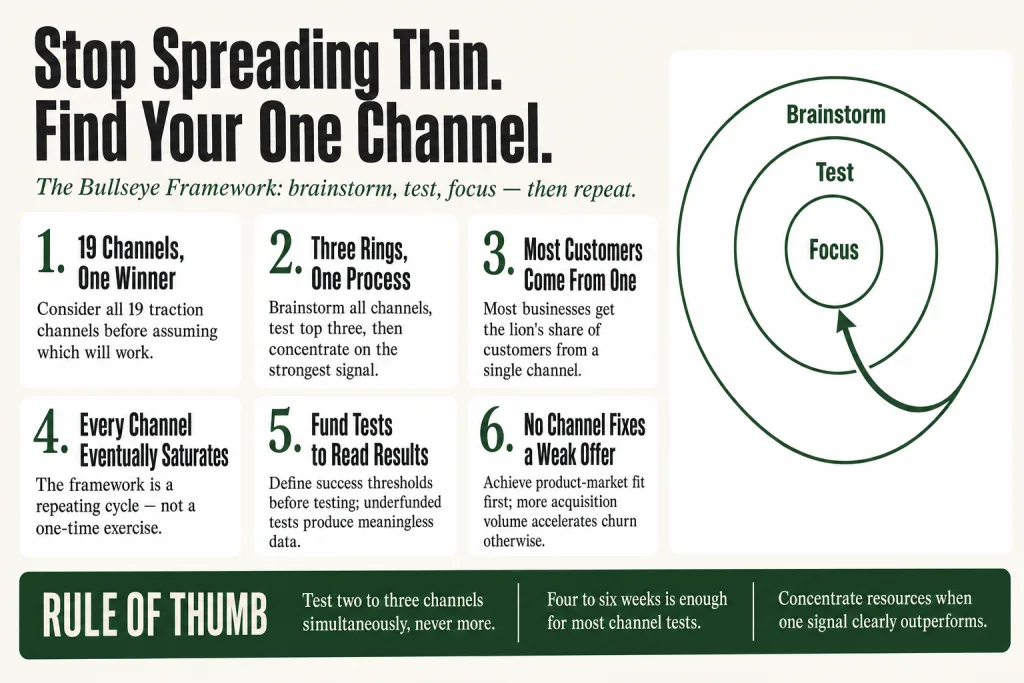
- The bullseye framework is a three-step process, brainstorm, test, focus, for finding the single acquisition channel most likely to drive your next stage of growth.
- There are 19 recognized traction channels (SEO, email, paid ads, PR, speaking, referrals, community, and more); the framework forces you to consider all of them before assuming which will work.
- Run small, fast experiments on your top three candidates simultaneously, then concentrate almost everything on whichever produces the strongest signal.
- Most businesses get the majority of their customers from one channel at any given stage; diversifying too early kills momentum.
- Every channel eventually saturates, the framework is a repeating cycle, not a one-time exercise.
- For small operators, the biggest win isn’t the framework’s mechanics, it’s the discipline of making a real choice instead of spreading thin across everything.
Where It Came From
Gabriel Weinberg launched DuckDuckGo in 2007, a few years after selling NamesDatabase, a social networking site acquired by Classmates.com in March 2006 for approximately $10 million. He assumed he understood customer acquisition. He didn’t, or at least not well enough. Early traction came from SEO, getting DuckDuckGo to rank for searches like ‘new search engine’, but that channel hit a ceiling faster than he expected. What followed was a cycle of channel testing that eventually became the framework itself.
Justin Mares was running growth at Exceptional, a developer-tools company Rackspace acquired in March 2013. He came to the same frustration from a different direction and approached Weinberg about a book. Together they interviewed dozens of successful founders about how they’d actually found their customers. The result was Traction: A Startup Guide to Getting Customersfirst published in August 2014 by S-curves Publishing, with a Portfolio/Penguin edition following in October 2015. The book catalogued 19 traction channels and introduced the bullseye framework as the operating process for navigating them.
The authors were writing about startups, and a lot of the examples skew toward B2C consumer companies. Real limitation for operators in professional services, B2B, or local markets. The framework itselfthough, translates cleanly. Brainstorm → test → focus is essentially the scientific method applied to marketing, and that holds regardless of industry.
Peter Thiel had put the underlying thesis bluntly in Zero to One: “If you can get just one distribution channel to work, you have a great business. If you try for several but don’t nail one, you’re finished.” Weinberg and Mares took that intuition and gave it a practical operating system.
The Problem: Most Operators Default to Familiar, Not Effective
Here’s the trap. You start a business, you’re pressed for time, and you default to the channels you’re already comfortable with or that look like what competitors are doing. You’re a natural networker, so you go heavy on referrals. You’re a bit of a writer, so you start a blog. You see everyone else running Facebook ads, so you run Facebook ads. None of this is based on evidence, it’s based on habit, bias, and what’s visible to you.
The consequence is mediocre results from channels that might never work for your particular business model, while channels that could be wildly productive go untested. A B2B service provider grinding away on Instagram might be three blocks from a trade association where ideal clients meet monthly. A local contractor spending $1,500 a month on display ads might be a few solid Google reviews away from dominating local search. The issue often isn’t effort, it’s that effort is pointed at the wrong target.
Weinberg and Mares documented the pattern clearly: most founders only ever use the channels they’re already familiar with, or assume they should use. That familiarity bias is expensive. The bullseye framework’s biggest practical contribution isn’t the three-ring structure, it’s the forced act of inventorying all 19 channels and asking honestly: ‘Have I actually tested this one, or have I just assumed it won’t work?’
For a small operator with a constrained budget and no dedicated marketing team, that question is clarifying. You can’t do everything. You need to find the one or two channels worth going deep on. That’s the call this framework helps you make with evidence rather than gut feeling alone.
The 19 Traction Channels: Your Starting Inventory
Before the framework’s process makes sense, you need the full list, because the whole point is that you consider every option before narrowing down. The 19 channels Weinberg and Mares identified are: Viral Marketing, Public Relations, Unconventional PR, Search Engine Marketing (paid search), Social & Display Ads, Offline Ads, SEO, Content Marketing, Email Marketing, Engineering as Marketing, Targeting Blogs, Business Development, Sales, Affiliate Programs, Existing Platforms, Trade Shows, Offline Events, Speaking Engagements, and Community Building.
A few things to know about this list as an operator. First, it hasn’t aged out. The tactics within each channel have evolved, the mechanics of SEO in 2025 look nothing like 2014, but the channels themselves are still the right buckets. Second, most of these channels subdivide. ‘Social & Display Ads’ could mean LinkedIn, Meta, YouTube, or programmatic display, those behave very differently in practice. When you’re brainstorming, get specific about which strategy within a channel you’d actually run, not just check a box next to the parent category.
Third, and this is the part operators overlook: the most underused channels in your industry are often the most promising. If every competitor in your space is doing content marketing and SEO, what happens if you go hard on speaking engagements or trade shows instead? You might find a clear lane with far less noise. The book makes this point explicitly, real competitive advantage often comes from acquiring customers through channels your competitors aren’t using.
For a small service business in particular, channels like speaking engagements, offline events, existing platforms, and direct sales through business development often get dismissed as ‘too slow’ or ‘not scalable.’ Sometimes that’s right. Often it isn’t, and the only way to know is to run a test.
How the Bullseye Framework Actually Works
The framework uses the visual of a bullseye target, three concentric rings, as a sorting mechanism. You’re moving channels from the outer ring inward based on what testing reveals, until one (or occasionally two) lands in the center circle. The three rings map to three distinct phases.
Outer Ring: Brainstorm
This is where you consider all 19 channels without filtering. For each one, force yourself to generate at least one realistic way it could work for your business. Don’t analyze yet, the whole point is to surface options you’d normally dismiss before giving them a fair hearing. Many operators skip this step and miss the less obvious channels that turn out to be their best fit.
A useful exercise: for each channel, ask three questions, How many customers could I realistically reach here? What would it cost to run a meaningful test? How well do I think these customers would convert, given what I know about my buyers? You don’t need precise answers. You’re calibrating, not calculating.
Middle Ring: Test
From your brainstorm, pick the two or three channels that score best on those three questions. Run small, fast experiments, the kind you can design in an afternoon and read results from within a few weeks. A $250 Google Ads test. A guest post on a niche industry blog. Three speaking inquiries sent to local associations. A cold outreach sequence of 30 emails. You’re not trying to prove scalability. You’re looking for a signal, evidence that this channel can cost-effectively bring in customers at all.
Watch four things during middle-ring tests: rough cost per acquired customer, the number of customers reachable through this channel, quality of the leads it produces, and time-to-conversion. You want to know not just whether the channel generates response, but whether the people it generates are actually worth serving.
Inner Ring: Focus
Once one channel shows a clearly stronger signal than the others, you move it to the center and redirect the majority of your acquisition resources there. The goal is to extract maximum value, optimizing, scaling, iterating, until the channel plateaus or you’ve pulled everything it has to offer. Only then do you run the framework again.
This is where the discipline gets hard. Most operators instinctively want to hedge. They find something working and immediately dilute attention by trying to add a second and third channel simultaneously. Resist that. The payoff from going deep on one working channel almost always exceeds the payoff from going shallow on three promising ones.
Putting this to work? The ideas in the Canon are the foundation under the tactical playbook in Build a Complete Marketing Departmentgrab the free companion kit at mmsvegas.com/resources.
Why the Logic Holds
The framework’s core claim is that customer acquisition follows something like a power law: a small number of channels generate the vast majority of customers, and the rest contribute almost nothing in comparison. The data supports this, most companies, at any given stage, get the lion’s share of new customers from a single channel. Spreading effort equally across all channels isn’t just inefficient; it’s almost guaranteed to underperform concentrated effort on the right one.
The subtler insight, and operators miss this one more, is that which channel is right changes over time. Every traction channel has a lifecycle: it grows, peaks, then flattens as it becomes saturated and competition intensifies. Facebook advertising in 2012 was unusually cheap and effective. By 2019, nearly every business was on it and costs had multiplied. Same dynamic, every channel, every scale.
So the bullseye framework isn’t something you run once. It’s a recurring cycle. When your primary channel starts to plateau, when you’re optimizing harder for diminishing returns, that’s the signal to run the outer and middle rings again and find what comes next. The most operationally mature small businesses have done this two or three times by the time they hit real scale.
There’s also a psychological reason it works: it makes the decision concrete. ‘We’re going to test these three channels over the next six weeks and pick one to concentrate on’ is a real plan. ‘We’re going to try to get more customers’ is not. The framework converts vague intention into a specific experimental agenda, and that alone outperforms most competitors who never get that specific.
The Bullseye Framework in Practice: Named Examples
The most direct case study is DuckDuckGo itself. Weinberg launched in 2007, found early traction in SEO, then cycled through the framework repeatedly as each channel plateaued. PR and community building emerged as critical channels, reaching privacy-conscious users already frustrated with Google, then letting that community amplify the message. By leaning into a specific, underserved grievance through unconventional PR and community rather than generic paid acquisition, DuckDuckGo built a growth engine that didn’t require outspending Google. It crossed 1 billion total searches in 2013 and now processes roughly 3 billion queries per month, growth driven by cycling through multiple traction channels over many years, not a single bet.
A sharper example of unconventional channel thinking: spreadsheet startup Rows ran billboard campaigns near Microsoft’s headquarters with a sign reading ‘Dear Microsoft, your spreadsheet has been at it for 36 years. It’s time to retire’, and gave Google the same treatment. The stunt was inexpensive by any conventional advertising standard and generated organic pickup across social media and tech press, including coverage in TechRadar. A small operator reading that shouldn’t think ‘I need a billboard near a tech campus.’ They should think: ‘What’s my version of a highly specific, provocative move that costs almost nothing but reaches exactly the right people?’
For local and B2B service businesses, speaking engagements illustrate the power of picking the right channel over the popular one. A professional services firm that genuinely tests three channels, content marketing, paid search, and speaking at regional industry conferences, often finds the speaking channel produces higher-quality leads at better conversion rates. The audience is self-selected; they’re already in the room where decisions get made. This kind of result is common for operators who force themselves to actually test speaking rather than assuming it’s ‘too slow.’
The genealogy service Ancestry is cited in the Traction literature as a company that used Google AdWords even before its product was fully built, using paid search to validate which features people actually wanted, then continuing with paid search as its core traction channel. The lesson: the channel test isn’t just about customer acquisition. It can tell you whether your offer is resonating at all.
Where the Bullseye Framework Fits Best
This framework earns its keep in specific operator situations. The most obvious: you’re early-stage and haven’t yet found reliable, repeatable customer acquisition. You know you need to grow but aren’t sure which direction to go. That’s the framework’s home territory, it was literally built for that moment.
It also applies, maybe more importantly, when an operator who has found a working channel starts to see it plateau. Paid social worked beautifully for two years; now CAC has doubled and ROAS has compressed. That’s your signal to run the outer ring again and start testing what comes next, before you’re desperate, not after.
Operators moving into a new market, launching a new service line, or targeting a new customer segment should treat themselves as effectively early-stage again with respect to acquisition. The channel that works for your existing customer base may not be where your new target audience lives or how they make decisions.
It’s also a useful diagnostic for operators who’ve been ‘doing marketing’ without clear results. Running through the 19-channel brainstorm often surfaces an uncomfortable truth: they’ve only genuinely tested two or three channels, most of which they chose by default. The framework turns that realization into a structured next step rather than just a bad feeling.
Where it works best of all: any business where customer acquisition is the binding constraint. If you’re turning away work, you don’t need this right now. If you’re not finding enough of the right customers, this is where to start.
Where It Falls Short
The framework was developed in a startup context, and it shows. Startups can run rapid channel experiments relatively easily, they have technical resources, aren’t beholden to existing customer relationships, and often have investor capital to absorb test costs. Small operators in professional services, trades, or local retail don’t always have those conditions.
A solo consultant or a two-person HVAC company can’t necessarily run three parallel channel experiments in six weeks, at least not without some of those ‘tests’ being dangerously underfunded. The principle holds, but the cadence needs to be realistic. One channel test at a time, cheaper and slower, still beats zero tests.
The framework also says relatively little about what to do with the traffic or leads a channel produces. Finding that SEO works for you is useful, but it doesn’t help you convert those organic visitors once they arrive. Acquisition and conversion are separate problems, and the bullseye only addresses the first one. You still need good offers, good messaging, and a functioning follow-up system on the back end.
There’s also a risk in the ‘focus on one channel’ mandate for very small operators: if that channel has an outage, a platform rule change, or a cost spike, you’re suddenly exposed. The right response isn’t to abandon focus, it’s to run light-touch maintenance tests on your second-ranked candidate even while going hard on your primary. Not as an excuse to diffuse attention, but as operational insurance.
Finally, the framework is a poor fit if you haven’t yet achieved product-market fit. If customers who do find you aren’t sticking around, aren’t referring others, and aren’t getting clear value, more acquisition volume just accelerates your churn problem. Nail the product first, find a handful of genuinely happy customers, and then use the bullseye to figure out how to find more of them.
Applying the Bullseye Framework Today: A Practical Operator’s Guide
The abstract version of the framework is easy to describe. The real question is what it looks like in practice for an operator running a business with limited time, a small team, and no dedicated growth function.
Step 1: Run the real brainstorm, with someone else in the room
Block two hours. Go through all 19 channels. For each one, write down at least one specific, realistic tactic you could execute. Not ‘do SEO’, something like ‘write three comparison articles targeting keywords where our competitors have weak pages.’ Not ‘do PR’, ‘pitch three regional business journals with the angle that we’re the only local operator offering X.’ If you can’t think of a tactic for a channel, write ‘don’t know how yet’ and move on. Having a second person in the room, an employee, an advisor, anyone, helps catch the channels you’re reflexively dismissing.
Step 2: Score your top candidates honestly
After brainstorming, force-rank all 19 channels by three criteria: expected impact (how many quality customers could this reach?), confidence (how much evidence do I have that it works for businesses like mine?), and cost to test (what would a meaningful experiment actually cost?). Your top three scorers go to the middle ring. Be honest about confidence, ‘I’ve heard this works’ is not the same as ‘I’ve seen it work for someone with my exact customer profile and price point.’
Step 3: Design specific, time-bounded experiments
Each middle-ring experiment should answer one question: ‘Can this channel cost-effectively acquire customers for my business?’ Define success in advance, a specific cost-per-lead threshold, a conversion rate, a number of quality inquiries within a set timeframe. Run each experiment for long enough to get meaningful data but not so long that you’re bleeding budget on something that isn’t working. Four to six weeks is usually right for most small-business channel tests. Keep a simple log: what you spent, what you tested, what results came back, what you’d need to see to call it a success.
Step 4: Make the call and commit
After the tests, pick the channel with the strongest signal and go all-in. More budget, more time, more iteration within that channel. Set a quarterly goal for what ‘all-in’ looks like, a specific volume target, a CAC you’re aiming for, a number of experiments within the channel you’ll run to optimize it. The worst outcome is finishing the test phase and hedging: ‘they all showed some promise, let’s do a little of each.’ That’s the exact pattern the framework is designed to break.
Step 5: Track, optimize, and know when to run it again
Once you’re in the focus phase, your job is to squeeze every bit of value out of the channel while it’s working. Watch for the plateau signals: rising CAC, declining conversion rates, diminishing marginal returns on increased spend or effort. When those appear, and they will, that’s your cue to run the outer and middle rings again in the background. You want your next channel candidate already in testing before the primary one fails, not after.
AI tools can meaningfully accelerate the brainstorm and scoring phases, quickly generating channel-specific tactic ideas, researching what’s working in adjacent industries, drafting ad copy or email sequences for middle-ring tests, and pulling early results into readable form. That cuts the time from ‘I should test this channel’ to ‘I have something running’ from days to hours. The judgment calls, which channels fit your specific customer, what signal counts as real traction, when to call a test and move on, stay with you. AI handles the research and execution load around those calls. The thinking is still yours.
Common Mistakes
- Brainstorming only the channels you’re already usingBefore moving on from any channel, write down the specific reason you’re passing on it. ‘I don’t know how’ and ‘we’ve never tried it’ don’t count as reasons, those channels stay on the list. The non-obvious winners hide in the ones that feel awkward to even consider, not the comfortable defaults.
- Funding tests too small to produce a readable resultBefore a test starts, define your success threshold: a specific number of qualified leads, a conversion rate, a cost-per-acquisition target. Then work backward to how much spend and how much time it takes to actually hit or miss that threshold. A test that can’t reach its own pass/fail line isn’t a test, it’s a gesture.
- Treating activity as a completed testA middle-ring test has four things written down before it starts: a specific tactic (not just a channel name), a budget, a timeframe, and a pre-set threshold for what counts as a green light. All four. If any are missing, you don’t have a test, you have a marketing activity with no feedback loop.
- Hedging after the test phase instead of committingBefore tests begin, decide what ‘clearly stronger signal’ means in actual numbers, not just ‘better than the others.’ When the tests close, apply that pre-committed threshold. One channel clears it; the others don’t. Redirect acquisition resources there and treat the rest as background maintenance at most. The pre-commitment is what makes this real.
- Writing off a channel based on a single flawed testBefore retiring a channel, separate the channel from the execution. Was the landing page specific and credible? Was the offer competitive? Was the targeting accurate? A failed experiment tells you one approach didn’t work at this stage, it says nothing about the channel’s ceiling. Run a post-mortem on what could have been different before you close the door entirely.
- Running the framework once and treating the result as permanentSet a standing review at quarterly planning: is our primary channel’s CAC trending up for three or more months in a row? Are we seeing diminishing returns on additional spend? If yes to either, start the outer and middle rings again, alongside the primary channel, not instead of it. You want your next candidate already in testing before the primary one fails.
Operator’s Take
Here’s my honest read on where most operators blow this: they treat the brainstorm like a formality and the commitment like a suggestion. They go through the 19-channel list, nod politely at the unfamiliar ones, and end up with the same three channels they were running before they started. Nothing actually got reconsidered. If you finish the brainstorm and your top three picks are exactly what you were already doing, something went wrong, run it again with someone in the room who’ll actually push back.
The scoring step is where self-deception gets expensive. ‘Content marketing sounds promising for us’ is not a hypothesis. A hypothesis sounds like: ‘Two competitors in adjacent niches have grown to seven figures publishing bottom-funnel comparison content targeting keywords I could plausibly rank for, and our average deal size means a 2% conversion rate covers six months of content production.’ One of those gives you something to test. The other gives you something to feel good about while nothing happens.
Fund the tests to match the hypothesis. A $150 ad campaign with a weak landing page doesn’t tell you the channel doesn’t work, it tells you that you were afraid to spend money. Before the test starts, work backward from your success threshold: if you need 50 clicks to get a readable conversion rate, calculate what that costs at realistic CPCs and spend it. Underfunded tests produce inconclusive data. And inconclusive data is how good channel candidates get quietly killed off because someone didn’t want to commit to a real experiment.
Then there’s the focus phase, and this is where I’ve watched smart operators stumble more than anywhere else. ‘Going all-in on SEO’ is not a plan. ‘Publishing two bottom-funnel comparison pages per month targeting these three keywords, measuring organic conversions to consultation booking, with a 90-day target of 15 booked calls from organic’, that’s a plan. The framework gets you to the channel. You still have to engineer what you actually do inside it, and that specificity is where most people run out of gas.
Two things worth flagging before you go hard on anything. First: the ‘one channel’ directive is right as a prioritization principle, but it’s fragile as a literal rule for a solo operator. Algorithm shifts, platform changes, and cost spikes are real and they happen fast. Keep light-touch tests running on your second-ranked channel even while you’re concentrated on the primary, not to dilute focus, but so you’re not starting from scratch the day your main channel chokes. Second: the framework does nothing for a weak offer. A bad offer pushed through an excellent channel just means more people say no, faster. Before you invest serious time finding more traffic, make sure you can clearly explain what you’re selling and why someone should pick you over the obvious alternatives. The bullseye finds the door. You still have to build something worth walking through it for.
One more thing. Run this again every time your primary channel starts plateauing, not when it’s already in freefall, but when CAC has been trending up for three straight months and you’re working harder for shrinking returns. That’s your signal. The operators who treat the bullseye as a one-time exercise eventually find themselves in a hole. The ones who treat it as a standing quarterly question tend to stay ahead of the problem instead of chasing it.
Used in
- ✓ Build a Complete Marketing Department
Used to structure the acquisition audit, identifying which channels the business has genuinely tested versus assumed, and building the experiment roadmap that follows. - ✓ The Missing Manual for FunnelKit
Applied when selecting which traffic source to connect to each funnel sequence, ensuring the funnel is built to convert the specific audience a tested channel actually delivers. - ✓ The Missing Manual for Make
Referenced when automating the tracking and reporting layer for channel experiments, so middle-ring test results flow into dashboards without manual collection.
FAQ
How many channels should I test at once?
The framework recommends testing two to three simultaneously in the middle ring, enough to compare, not so many that you can’t run each experiment properly. Running more than three usually means each test is underfunded and the results are meaningless.
How long should a middle-ring channel test run?
Four to six weeks is a reasonable default for most small-business channel experiments. The test should run long enough to produce meaningful results but short enough that you’re not wasting months on something that’s clearly not working. Define your success threshold before the test starts, not after you’ve already seen the numbers.
What if none of my tested channels show any signal?
Go back to the outer ring and test different candidates, but also examine your offer and positioning. If multiple channels produce no response at all, the problem is often that the message or the offer isn’t compelling enough, not that you’ve chosen the wrong delivery mechanism. No channel fixes a weak offer.
Is the bullseye framework only for businesses that are struggling?
No, it’s also the right tool when a working channel starts to plateau and you need to find what comes next. Running it proactively, before your primary channel saturates, is smarter than running it reactively when growth stalls.
Do I need a marketing team to use this framework?
No. A solo operator can run it, though the brainstorm phase benefits from having at least one other person to challenge your default assumptions. The experiments themselves can be small enough that no team is required, a $250 ad test or a handful of outreach emails is within reach of any operator.
How does the bullseye framework relate to SEO and content marketing specifically?
SEO and content marketing are two of the 19 traction channels, they go through the same brainstorm, test, focus process as any other. Many operators treat them as automatic defaults rather than candidates to be validated; the framework asks you to test whether they’re actually the right fit for your business before committing years of effort to them.
Further reading
- Traction: A Startup Guide to Getting CustomersGabriel Weinberg & Justin Mares (S-curves Publishing, first edition August 2014; Portfolio/Penguin edition October 2015). The source text. Read it for the channel-by-channel detail and the case studies, not the framework mechanics, those you now have.
- Zero to OnePeter Thiel (Crown Business, 2014). Thiel’s distribution argument, that most businesses fail not from product problems but from distribution problems, is the philosophical foundation the bullseye framework builds on. His line that you’re finished if you try for several channels without nailing one is the sharpest single-sentence case for focus you’ll find anywhere.
Sources: Gabriel Weinberg, ‘The Bullseye Framework for Getting Traction,’ Medium (medium.com/@yegg); Growth Method, ‘Bullseye Framework: The Traction Method to Find Your Best Marketing Channel’ (growthmethod.com); Sprints & Sneakers, ‘The Bullseye Framework: What It Is and How to Apply It’ (sprintsandsneakers.com); Brian Balfour, ‘Strategize, Test, Measure: The Bullseye Framework’ (brianbalfour.com); LaunchLane, ‘Traction: A Practical Guide to Finding Your Growth Channel’ (launchlane.com); Goodreads editions page for Traction (goodreads.com), confirms first edition August 2014 by S-curves Publishing, Portfolio/Penguin edition October 2015; Wikipedia, ‘Names Database’ (en.wikipedia.org), confirms Classmates.com acquisition March 2006 for approximately $10 million; Amazon author page for Justin Mares (amazon.com), confirms Director of Revenue at Exceptional, acquired by Rackspace 2013; Udemy profile for Justin Mares (udemy.com), confirms Exceptional acquired by Rackspace March 2013; Backlinko, ‘DuckDuckGo Usage Stats’ (backlinko.com), confirms DuckDuckGo ~3 billion monthly searches; VenueLabs, ‘DuckDuckGo Statistics 2026’ (venuelabs.com), confirms DuckDuckGo crossed 1 billion searches in 2013 and processes roughly 3 billion queries per month; TechCrunch, DuckDuckGo 30 million daily searches milestone (techcrunch.com, 2018); Design With Value, ‘Bullseye Framework: The Definitive Guide to Traction Channels’ (designwithvalue.com); Readingraphics, ‘Book Summary, Traction’ (readingraphics.com); SaasClub, ‘The Bullseye Framework for Startup Traction’ (saasclub.io); TechRadar, ‘The Tyranny of Microsoft Excel May Finally Be Over’ (techradar.com), confirms Rows billboard campaign near Microsoft HQ; AskCory, ‘Marketing Success: The Bullseye Framework Channels’ (askcory.ai); Rows, ‘Three Ways Rows Got Media Attention’ (rows.com/blog).
Brian Kasday spent forty years in direct-response marketing before rebuilding the whole operation as a one-person shop. He writes The Operator’s Library, including “Build a Complete Marketing Department”, for operators who’d rather build it themselves than wait on someone else.
Build the department these ideas describethe free companion kit: mmsvegas.com/resources.
More The Operator's Canon guides
Free · Operator Toolkit
Want the tools, not just the guide?
Get the free operator toolkit — templates and checklists for the systems you actually run, plus a note when this guide changes.
Get the free toolkit →How to cite: Bullseye Framework. Associated with Gabriel Weinberg & Justin Mares, 2014. The Operator’s Canon, MMS Vegas. https://mmsvegas.com/library/bullseye-framework-explained/