
Last updated: July 2026
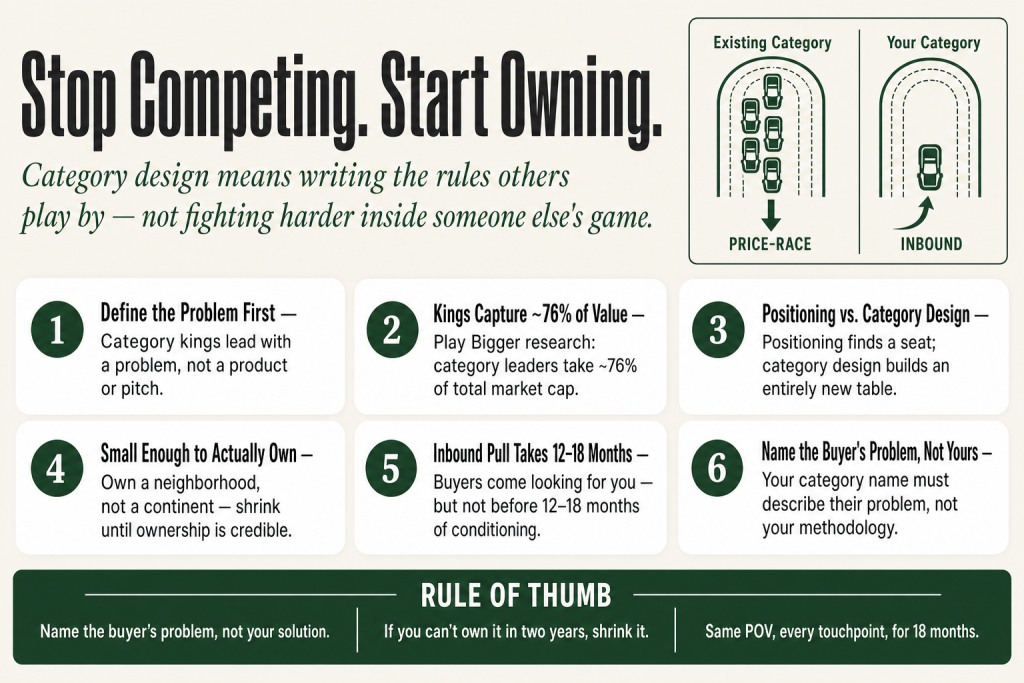
Category design is the discipline of creating and dominating a new market category rather than competing harder in an existing one. By the end of this page, you should be able to tell whether your business is fighting for scraps in a category someone else defined, or whether you have a credible shot at owning a frame that’s actually yours.
That distinction matters more than most operators realize. If you’re a web designer, you’re competing with every other web designer, on price, on portfolio, on who ranks higher on Google. If you’re ‘the conversion-focused designer for independent financial advisors,’ you’re in a category of one, or close enough that it doesn’t matter. Nobody else wrote that rule. You just did.
That’s the heart of category design. Not a louder version of the same pitch. A different game entirely.
The concept was formalized by Al Ramadan, Dave Peterson, Christopher Lochhead, and Kevin Maney in their 2016 book Play Biggerbuilt on research into how technology companies like Salesforce, Uber, and Airbnb achieved outsized market dominance. The underlying logic applies far below the venture-backed stratosphere. A single-location service business can design a category. A consultant can design a category. A specialty retailer can design a category. The mechanism scales down, it just requires honesty about what you can actually own versus what you’re pretending to invent.
The idea in 30 seconds
- Category design means defining and dominating a new market category instead of fighting for share in an existing one, you write the rules others play by.
- The core idea from Play Bigger (Ramadan, Peterson, Lochhead, Maney, 2016): category leaders capture a disproportionate share of value. Play Bigger’s own Time-to-Market-Cap research, analyzing VC-funded public tech companies since 2000, found category kings capturing around 76% of total market cap across their dataset. That’s a tech-company finding, not a universal law, so treat it as directional. The direction itself is hard to argue with.
- For a small operator, ‘category design’ usually means a tightly scoped niche you can credibly own, not a billion-dollar market disruption.
- The three moves: define the problem in language you control, build a Point of View (POV) that makes the old way look broken, and execute visible moments that condition your market to see you as the reference point.
- Where it goes wrong: operators define categories too broadly (‘I’m in marketing’), too narrowly (‘I’m the only one who does this exact obscure thing’), or they never commit long enough for the market to learn the new frame.
- Category design is a long game, plan 12 to 18 months before it starts pulling customers to you rather than the other way around.
Where the Idea Came From
The formal framework arrived with Play Bigger in 2016, but it had intellectual predecessors. Ries and Trout made the foundational argument in 1981 in Positioning: being first in a category beats being better inside one someone else already owns. Peter Thiel made a related case in Zero to One (2014), start in a small market you can monopolize, then expand.
What Ramadan, Peterson, Lochhead, and Maney added was a name for the discipline and a data set from their Silicon Valley advisory work. Their research team analyzed VC-funded public technology companies going back to 2000 and found a consistent pattern: in any given category, one company captures a disproportionate share of total market capitalization. Their Time-to-Market-Cap report put that share at around 76% across the full dataset, though they also noted the range ran 70 to 80%, and that certain companies (Facebook in particular) skewed specific eras. The study was conducted on public tech companies, not service firms or small businesses, so treat the number as directional rather than a precise benchmark for your market.
The direction, though, is hard to argue with. Apple took around 93% of smartphone profits while Android manufacturers divided the rest. Uber was valued at roughly 25 times Lyft despite an almost identical service. Once you’re the reference point, the economics compound in your favor in ways that have almost nothing to do with product quality. That’s the insight that made Play Bigger land.
Category Design vs. Positioning: Not the Same Thing
This is the most common confusion, so let’s be direct about it. Positioning and category design are related, but they’re not interchangeable, treating them as synonyms will send you down the wrong path.
Positioning, in the Ries and Trout sense, is about occupying a specific place in the buyer’s mind within a market that already exists. You take a known category, say, ‘accounting software’, and stake out a specific claim inside it: most affordable, easiest to use, best for freelancers. The category is already defined. Your job is to find the best slot and own it more clearly than anyone else.
Category design operates at a different level. It doesn’t ask ‘where do we sit inside this market?’ It asks ‘is this the right market to be in?’ You’re deciding which problem you own and naming a frame that either didn’t exist before or reframes an existing problem so thoroughly that the old solutions start to look insufficient. Positioning is a competitive decision. Category design is a strategic one that comes first.
A clean way to hold the distinction: positioning finds you a seat at the table. Category design builds a new table. You can be well-positioned inside the ‘accountant’ category without doing any category design at all. Category design would mean arguing that ‘accountant’ is the wrong frame for what you do, and naming the right one.
The correct sequence, when you’re doing both, is category first, then positioning, then messaging. Many operators invert this. They craft messaging, try to build a position around it, and never explicitly examine the category they’ve inherited by default. The market ends up placing them somewhere, in the comparison set that best matches their language, and that placement is almost never the one that serves their commercial interests.
One more thing: most businesses at any given moment need sharp positioning far more urgently than they need category design. If buyers already understand the problem you solve and you just aren’t the obvious answer to it, that’s a positioning problem, solve it first. Category design is what you reach for after you’ve answered the positioning questions cleanly and decided the whole market frame needs to shift.
The Problem: You’re Competing on Someone Else’s Terms
Here’s what most small businesses actually do: they identify an existing market, look at what the established players offer, and try to be a slightly better or slightly cheaper version of that. They compete on features, price, Google reviews, fastest turnaround. It’s exhausting, and the economics stay brutal because every new competitor plays the same game and presses prices down further.
The deeper problem is cognitive. When buyers shop for something they already have a mental category for, say, ‘website designers’ or ‘business accountants’, they use that category to filter candidates. You get evaluated on criteria the category already established. Speed, price, reviews, portfolio size. The category is the judge, and you didn’t write the rules.
Category design argues that the way out of this trap isn’t to win the existing comparison, it’s to change what the buyer is comparing. If you’re a business accountant who specializes in helping e-commerce founders understand their true unit economics before they scale, you’re not just an accountant anymore. You’re something the standard ‘accountant’ category doesn’t fully describe. That’s an opening.
In plain terms: category design gets you out of a race you can’t win on someone else’s track, and puts you on a track you designed. Whether that track is big enough to matter is a separate question, and one the original book doesn’t spend enough time on for the non-startup reader.
The Core Principles of Category Design
The Play Bigger framework has a few central moves. Worth understanding on their own terms before you start adapting them for your scale.
Define the Problem, Not the Product
Category kings don’t lead with what they sell. They lead with a problem the market either hasn’t named yet or has accepted as unavoidable. The Point of View, what the authors call the POV, is the overarching narrative that frames the problem, explains why existing solutions fall short, and positions your approach as the natural answer. A strong POV forces a choice, not a comparison. That’s the test: does your framing invite a buyer to compare you to competitors on standard criteria, or does it reframe the question entirely?
Your POV names the category problem, explains the cost of leaving it unsolved, presents a vision of what better looks like, and declares your approach as the answer. It’s not a tagline. It’s closer to a manifesto, short enough to say out loud, clear enough that a customer could repeat it, pointed enough that it implicitly makes the old way look insufficient.
The Lightning Strike
Once you have a POV, you need a moment, or a series of moments, that announce the category. These are high-impact events designed to introduce the category and the category king simultaneously. For an operator, that might be a signature piece of original research, a podcast series with a sharp point of view, a landmark client case study, or a free tool that only makes sense in the context of the category you’re defining.
Lightning strikes are category announcements, not product announcements. When Apple introduced the iPhone, the presentation opened not with specs but with the problem: existing smartphones were too hard to use. That framing came first. The product was the proof.
Build the Ecosystem
Category kings don’t just sell to customers, they build networks of supporters, partners, and evangelists who have a stake in the category’s success. For a small operator, ‘ecosystem’ might mean a handful of referral partners, a small but loyal audience, a community, or a set of complementary businesses that reinforce your definition of the problem.
Condition the Market Over Time
This is the part most operators underestimate. Category design is not a campaign. It’s a posture you hold consistently over months and years until the market adopts your language. The moment your target buyer starts describing their problem using your words, that’s when you know the category is sticking.
Putting this to work? The ideas in the Canon are the foundation under the tactical playbook in Build a Complete Marketing Departmentgrab the free companion kit at mmsvegas.com/resources.
Why the Economics Are Tilted So Far Toward the King
The reason category kings capture such a disproportionate share isn’t magic, it’s cognitive shortcuts. When buyers don’t know much about a category, they default to whoever seems to have defined it. There’s an anchoring effect: the first entity to frame a problem tends to set the reference point against which all alternatives are judged. Once you’re the reference point, your competitors are always playing catch-up, responding to your definition of the space rather than setting their own.
This matters for pricing. The category king sets price expectations. Everyone else has to justify why they’re cheaper, or more expensive, relative to the king’s benchmark. The king is never asked to justify its price against a competitor; the competitor is asked to justify its price against the king.
Talent, too. The best specialists want to work with or for whoever is perceived as leading their field. If you’re the recognized reference point for HR consulting in veterinary practices, the best HR consultants in that niche will find their way to you, because you’ve defined the space they want to operate in.
And it matters most for customer acquisition cost. As the category becomes real in buyers’ minds, they come looking for you specifically instead of searching generically and landing on you and five competitors. That shift, from outbound hunting to inbound pull, is probably the most operationally significant outcome of successful category design for a small business. It doesn’t happen fast. But when it does, the economics of your business change meaningfully.
Category Design in the Wild: Real Examples at Different Scales
HubSpot is the cleanest category design case study for operators to study, partly because the company was targeting small and medium-sized businesses from the start. Brian Halligan coined the term ‘inbound marketing’ in 2005, named outbound tactics (cold calls, email blasts, direct mail) as the problem, then built HubSpot around the solution when he and Dharmesh Shah co-founded it in 2006. A conference, a book, and a partner ecosystem all followed, each one conditioning the market to see HubSpot as the place where inbound marketing lived. By the time competitors woke up, HubSpot was inbound marketing in buyers’ minds. The category did the selling.
Dave Asprey and Bulletproof Coffee is the other instructive case, because it happened without venture capital and at a more accessible scale, at least at the start. Asprey claims to have coined the term ‘biohacking’ after a trip to Tibet where he drank butter-infused tea, and the concept eventually grew into a recognized industry. His POV was simple and sharp: your biology is a system you can optimize, and conventional diet advice is leaving massive performance on the table. That framing made butter coffee make sense in a way it never would have inside the ‘diet’ or ‘nutrition’ category. By the time competitors followed, Asprey was already the reference point, so much so that ‘biohacking’ entered the Merriam-Webster dictionary in 2018. Fair caveat: Asprey’s health claims have drawn criticism from dietitians, and his origin story leans heavily on self-promotion. But as a category design case study, the structure is real regardless of whether you’d put butter in your own coffee.
Neither HubSpot nor Bulletproof led with a product. They led with a problem frame, named it, and let the product serve as proof that the category was real.
The Small-Business Version, Where It Actually Gets Interesting
The tech examples are useful as illustrations. They don’t tell an operator much about how to execute at their scale.
Take a bookkeeper who stops marketing as a bookkeeper and starts positioning as the person who fixes ‘silent cash drain’ in e-commerce businesses under $3M in revenue, meaning the unit-economics problems that look fine on a P&L but are quietly killing margin. That’s not bookkeeping. It’s a different category, named around a problem the buyer already feels but can’t articulate. The competitor set collapses: you’re no longer on Yelp next to 40 other bookkeepers. You’re the person who solves that specific thing.
Or a residential cleaning company that explicitly markets as the post-construction cleanup specialist for residential general contractors. Every GC in their market needs someone who can be trusted to clear a job site before the client walkthrough, not someone who cleans kitchens. The cleaning company that names that problem and builds their entire operation around it stops competing on Yelp reviews and starts getting warm referrals from every GC they’ve ever worked with. The category is small. It’s also entirely owned.
A financial planner who specializes exclusively in physicians transitioning out of clinical practice, not ‘financial planning for doctors,’ but a specific phase of a specific type of buyer’s life, has drawn a boundary around a real problem nobody else has claimed as their explicit focus. The buyers who find her already know they’re in the right place. Pre-sold before the first conversation.
An HR consultant who works only with multi-location veterinary practices has done the same thing. Narrow enough to own, specific enough that it can’t easily be copied without conceding your definition of the space.
In every case: the category is small enough to credibly dominate, and the name describes the buyer’s problem, not the provider’s methodology.
Where Category Design Is Your Sharpest Tool
Category design is most powerful in three operator scenarios.
When your market is commoditized. If you’re in an industry where buyers primarily shop on price and you can’t realistically be the low-cost operator, redefining the category is one of the few exits available. You can’t win a race to the bottom. You can step off that track entirely by reframing what buyers should be optimizing for.
When you serve a specific audience no one else is naming. Most generalist businesses serve everyone poorly rather than someone specifically well. If there’s a definable audience, an industry, a life stage, a workflow, a pain pattern, that nobody has claimed as their explicit focus, that’s a category waiting to be named. Name it first. Build your messaging, your content, your partnerships, and your case studies entirely around that audience. Over time, you become the default.
When you’re launching something genuinely new. If your product or service genuinely doesn’t fit an existing mental category buyers use, and this is rarer than people think, category design isn’t optional. If you don’t name what you are, the market will either ignore you or file you in whatever existing box is closest, which may not serve you at all. You have to be the one to define the frame.
It’s also useful for any business that wants to build a content or thought leadership presence. Owning a category gives your content a home, a consistent frame that makes every piece reinforce the same central idea rather than scattering across topics. That coherence compounds over time into authority.
Where Category Design Doesn’t Work, and When to Stop Trying
Category design gets oversold, and a certain kind of enthusiastic operator applies it where it genuinely doesn’t fit.
When the category you’re defining is too big to own. ‘I’m redefining the customer experience’ is not a category. It’s a vague aspiration. For category design to work, the category has to be small enough that you can plausibly become its reference point within a realistic time frame and budget. ‘Customer experience’ is a continent. ‘Post-purchase communication for direct-to-consumer supplement brands’ is a neighborhood. Own the neighborhood first.
When the problem doesn’t actually exist yet. Sometimes operators confuse ‘I have an innovative approach’ with ‘there’s a market ready to be organized around a new frame.’ Category design requires that buyers actually feel the problem, or can be quickly educated into feeling it. If you’re spending most of your time convincing people the problem exists and nobody’s buying it, you might be ahead of the market by years. That’s a different problem than category design solves.
When you’re a tiny operation that needs revenue now. Category design is a 12-to-18-month minimum investment before it generates meaningful pull. If your pipeline is dry and you need paying clients next month, this is not your move right now. Close the gap with direct outreach, referrals, and solid offers first. Come back to category design once you have enough stability to think about 18-month work.
When there’s no real differentiation underneath the label. You can name a category, but if your actual service isn’t meaningfully different from everyone else’s, the label won’t stick. Buyers aren’t stupid. They’ll try you, find out you’re the same as the other guys, and stop using your language. Category design amplifies what’s already distinctive, it doesn’t manufacture distinction from thin air.
Common Misunderstandings About Category Design
‘If I name my niche, I’ll scare away potential customers.’ This is the most common fear, and it’s mostly backwards. The customers you’d lose by being specific are almost always the worst customers, low margins, high expectations, poor fit, prone to churn. The customers who find you because you’ve named their exact situation are pre-sold before they’ve ever spoken to you. Specificity is a filter, and the filter is working in your favor.
‘Category design requires a big budget and a PR firm.’ It requires consistency and patience, not money. A weekly newsletter with a sharp POV, a handful of well-placed pieces of original thinking, a small community of engaged buyers, these are all low-cost moves accessible to any operator. The budget barrier is lower than people assume. The commitment barrier is higher.
‘I should name my category after my company or methodology.’ Almost always wrong. Your category name should describe the problem or the type of buyer, not your solution. ‘Biohacking’ is the problem space. ‘Bulletproof’ is the brand. The category name needs to be something your buyer would use even if they’d never heard of you. If you name the category after yourself, you’re doing personal branding, not category design.
‘Once I define my category, the work is done.’ Defining the category is the starting gun. The work is conditioning the market over time, consistently using the same language, publishing from the same POV, partnering with people who reinforce the frame, and executing enough visible moments that the market associates the category with your name. That takes years, not weeks.
Common Mistakes
- Naming the category after your methodology instead of the buyer’s problemTest your category name by asking: would a buyer use this phrase to describe their own situation, before they’d ever heard of you? If the answer is no, you’ve named your solution, not their problem. Rewrite it from their chair.
- Picking a category scope you can’t realistically own within two yearsRun the two-year credibility test: given your current resources and reach, could you become the first name this specific audience thinks of in two years? If the honest answer is no, cut the scope in half and run the test again.
- Treating the POV as a one-time branding exerciseSet a calendar rule, every piece of content, every sales deck, every referral partner conversation runs through the same POV for a minimum of 12 months. Category conditioning is repetition; without the repetition, there’s no conditioning.
- Launching the category before the substance backs it upBefore you name anything publicly, audit your actual client results: do you have three to five case studies that only make sense inside your new category frame? If not, build those first. The label only sticks when the substance is already there.
- Evaluating results on a campaign timeline instead of a category timelineStop checking whether the category is ‘working’ at the 90-day mark. The early signal to watch isn’t inbound leads, it’s the language prospects use when they reach out. When they describe their problem using your words, the category is taking hold. Leads follow later.
Operator’s Take
My honest read: the idea is real, and the economics behind it are real. But Play Bigger was written for venture-backed startups with full marketing teams and an 18-month runway. A lot of operators who pick it up either try to apply it at the wrong scale or treat it as permission to slap a fancier job title on their LinkedIn bio and call it a day. Neither works.
Here’s what I’d actually do if I were starting this from scratch at the small-business level. Not the theory, the specific moves, in order.
Step one: find your belief gap before you name anything. What do you believe about your buyers’ problem that your direct competitors either don’t believe or won’t say out loud? That gap is where your category lives. Write it out in 200 to 300 words. Then put it in front of three of your best current clients and ask them to read it cold. If they say ‘yes, that’s exactly why I hired you,’ you’re on the right track. If they look puzzled, keep refining. A POV that doesn’t resonate with existing clients has zero chance of landing with strangers.
Step two: run a two-year credibility test before you commit to a name. Given your current resources and reach, could you become the first name your target audience thinks of in this specific space within two years? If the honest answer is no, cut the scope in half and run the test again. ‘The go-to firm for mid-market HR consulting’ isn’t a neighborhood, it’s a state. You can’t own a state from a four-person shop. Shrink until the answer to the credibility test is yes.
Step three: pick one lightning strike per quarter and actually do it. You don’t need a keynote at Dreamforce. What you need is one high-visibility moment every quarter where your POV gets in front of the right people, a guest post on the publication your buyers actually read, a webinar with an association they belong to, a case study that circulates in their Slack group or gets mentioned on a podcast they trust. Each one conditions the market a little more. They compound. A practical calendar looks like: Q1 original data or research piece, Q2 co-authored post with a complementary partner, Q3 speaking slot at a niche association event, Q4 annual round-up that reinforces your POV with fresh examples. Rotate and repeat.
Step four: audit your case studies before you go public with the category name. Do you have three to five client outcomes that only make sense inside your new category frame? If not, build those first, quietly, without fanfare. The label sticks when the substance is already there. Announcing the category before the proof exists is just marketing noise, and buyers smell it.
Step five: use AI to accelerate the language work, not the judgment calls. AI is genuinely useful here, drafting POV variations, testing whether your problem framing is clear, producing consistent content across channels without hiring a full team. Run five different framings of your category problem through an AI tool and stress-test each one. It cuts the iteration time from months to days. The judgment about whether the category is real, ownable, and worth your next 18 months stays with you, AI sharpens how you say it, not what to say.
What to ignore: the ecosystem-building and company-wide mobilization chapters of Play Bigger are written for a 200-person startup. At four people, you don’t mobilize, you decide, then hold the line. The discipline isn’t organizational. It’s editorial: same POV, every touchpoint, for 18 months straight without flinching every time a shinier positioning idea shows up.
And set the right finish line. Most operators don’t need to invent a brand-new market category from nothing. They need to define a niche, a specific audience, a specific problem, a specific moment in a buyer’s life, narrow enough to own. More modest goal. Completely reachable. The payoff is the same: lower customer acquisition costs, better pricing power, a client mix that actually fits, and referrals that start bringing buyers to you. That last part is the one worth waiting for.
Used in
- ✓ Build a Complete Marketing Department
Used to set the strategic frame for all marketing activity, the category POV governs which audience you speak to, what problem you lead with, and how you differentiate across every channel. - ✓ The Missing Manual for FunnelKit
Informs how landing pages and funnel sequences are framed, category design determines whether your opt-in and sales pages open with the buyer’s problem or with your product’s features. - ✓ The Missing Manual for Make
Shapes how automated workflows are built and sequenced, a defined category POV ensures that every automated touchpoint reinforces the same central claim rather than sounding generic.
FAQ
Is category design only for startups and tech companies?
No, the underlying logic applies to any business. A local service business, a consultant, or a specialty retailer can all define a niche they credibly own. The difference is scale: small operators aren’t creating billion-dollar markets, they’re defining a specific problem for a specific audience in a way no one else has claimed.
How do I know if my category idea is viable?
Ask two questions: do real buyers actually feel the problem you’re naming, and can you realistically become the first name they think of in this space within two years? If the answer to both is yes, you have a viable category. If buyers don’t feel the problem yet, you’re either ahead of the market or the problem isn’t real, and you need to find out which before investing heavily.
How is category design different from niching down?
Niching down means narrowing your audience. Category design means naming and framing a problem in a way that reframes what buyers should be comparing, often making existing solutions look insufficient by contrast. You can niche without doing category design. Category design almost always requires niching first, though.
How is category design different from positioning?
Positioning finds a place for your brand inside a market that already exists. Category design argues the existing market is the wrong frame and builds a new one. Think of it this way: positioning finds you a seat at the table; category design builds a new table. The two aren’t opposites, category design uses positioning as a tool, but they operate at different levels. Most businesses need sharp positioning before they’re ready for category design.
How long does it take for category design to generate business results?
Expect 12 to 18 months before the market reliably uses your language and comes looking for you. Early indicators, content engagement, referral language, how prospects describe their problem when they reach out, show up sooner. Meaningful inbound pull usually takes longer than operators expect.
Can I use AI tools to help build my category POV?
AI is genuinely useful for drafting, testing, and refining the language of your POV, running different framings, checking whether the problem description resonates, producing content consistently. Run five or six variations of your problem framing through an AI tool and stress-test each one; it cuts iteration time from months to weeks. The judgment about whether your category is real, ownable, and worth pursuing stays with you, AI can sharpen how you say it, not decide what to say.
Do I have to coin a new term to define a category?
Not necessarily. Coining a term can help, it gives buyers a handle and makes the category stickier, but it’s not required. What matters more is a consistent point of view that reframes the buyer’s problem in a way no one else is framing it. Sometimes a new term helps that land; sometimes it just adds jargon.
Further reading
- Play BiggerAl Ramadan, Dave Peterson, Christopher Lochhead, Kevin Maney (2016). The source document for the formal category design framework; most useful for understanding the POV and lightning strike concepts, even if you translate them down to your scale.
- Positioning: The Battle for Your MindAl Ries and Jack Trout (1981). The predecessor that established why being first in a category matters; still the sharpest treatment of how buyers use categories as cognitive shortcuts.
- Zero to OnePeter Thiel (2014). Makes a related case from a venture capital perspective: start in a small market you can monopolize, then expand. The logic complements category design without duplicating it.
- Obviously AwesomeApril Dunford (2019). The clearest practical guide to positioning, the discipline that category design builds on top of. If you’re unclear on your positioning, start here before attempting category design.
Sources:
Play Bigger (Ramadan, Peterson, Lochhead, Maney, HarperBusiness, 2016); Play Bigger Time-to-Market-Cap Report (playbigger.com), source of the 76% figure, derived from analysis of VC-funded public tech companies since 2000; the report notes a range of 70 to 80% across eras, with Facebook skewing one period’s data; Christopher Lochhead interview, Marketing Journal (September 2016); Category Pirates newsletter (Lochhead et al.); Dave Asprey / Bulletproof origin reporting via Inc. and SF Standard; Brian Halligan coined ‘inbound marketing’ in 2005; HubSpot co-founded by Halligan and Dharmesh Shah in 2006 (Sequoia Capital Crucible Moments podcast; GrowthHackers.com); ‘biohacking’ entered Merriam-Webster in 2018 (SF Standard, January 2023); April Dunford, Obviously Awesome (2019); Venturoxx, Category Design vs Positioning; Pitchkitchen.com, Category Design vs Positioning vs Strategic Narrative (2026).
Brian Kasday spent forty years in direct-response marketing before rebuilding the whole operation as a one-person shop. He writes The Operator’s Library, including “Build a Complete Marketing Department”, for operators who’d rather build it themselves than wait on someone else.
Build the department these ideas describethe free companion kit: mmsvegas.com/resources.
More The Operator's Canon guides
Free · Operator Toolkit
Want the tools, not just the guide?
Get the free operator toolkit — templates and checklists for the systems you actually run, plus a note when this guide changes.
Get the free toolkit →