
Last updated: July 2026
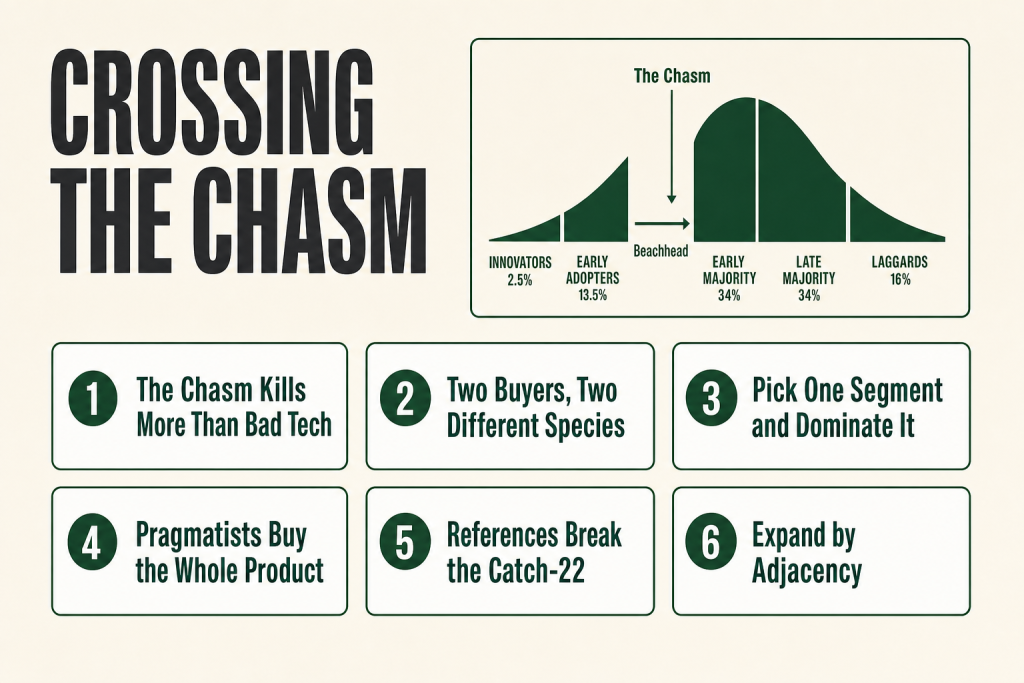
Crossing the chasm, explained simply: it’s the framework that describes why a product can be genuinely popular with early adopters and still die in the market, and it gives you a map for what to do instead. By the end of this page you’ll be able to diagnose whether your business is stuck in the chasm right now, pick the right beachhead segment, and sequence your expansion so that each new market funds the next.
Here’s the part nobody tells you at first: early-adopter momentum feels exactly like success. The phone is ringing. Referrals are coming in from a tight community. Your first ten or twenty customers are evangelists. Then, somewhere around customer thirty or fifty, it stops. The pipeline goes mushy. Prospects who seemed interested go quiet. You’re not doing anything wrong, you’re doing the same things that worked in month one. The problem is you’ve run out of early adopters, and the next wave of buyers is a completely different animal who doesn’t respond to any of the same signals.
That’s the chasm. And it has killed more promising products than bad technology, bad pricing, or bad timing combined.
The idea in 30 seconds
- The chasm is the dangerous gap between your early adopters, who buy on vision, and the pragmatic mainstream, who buy on proof.
- Early-adopter traction is real, but it doesn’t predict mainstream success. The two groups have fundamentally different buying motivations.
- Moore’s answer is the beachhead strategy: pick one tightly defined segment, dominate it completely, then use those references to expand outward.
- Pragmatists don’t buy features, they buy a whole product: your core offering plus the support, integrations, training, and ecosystem it takes to actually solve their problem.
- The reference catch-22 is at the heart of the chasm: mainstream buyers won’t buy without references, and you can’t get references without mainstream buyers. The beachhead breaks the loop.
- Expand by adjacency, the beachhead’s satisfied customers become the reference base for the next segment, and so on down the bowling-pin line.
Where the Idea Came From
Crossing the Chasm was published in 1991 by Geoffrey A. Moore, then a consultant at Regis McKenna Inc. (RMI), and revised twice since, most recently in 2014. The tactical playbook is Moore’s. The core observation, though, appears to predate him.
According to Warren Schirtzinger, founder of High Tech Strategies and a former RMI consultant, he and colleague Lee James developed what they called the ‘marketing chasm’ framework in the late 1980s while working at RMI’s Pacific Northwest office. In Schirtzinger’s own account, he and James introduced the model to Moore, who was working from RMI’s California office, in 1990. Schirtzinger’s firm (hightechstrategies.com) publishes this history alongside internal RMI client engagement documents it says support the prior-art claim. The Diffusion Research Institute, a third-party research organization, conducted a concept-formation study it describes as drawing on those internal documents, case studies, and observable verification; their account corroborates the James-Schirtzinger origin.
A fair disclosure: the two primary sources for this history, High Tech Strategies and the Diffusion Research Institute, are connected. Schirtzinger is affiliated with both, and neither source is fully independent. Moore has not publicly disputed the account in detail, but he has not endorsed it either. Treat the prior-art claim as contested-but-documented rather than settled fact. What isn’t contested: the underlying Rogers adoption curve dates to 1962, and Moore’s contribution was building the full strategic playbook, beachhead selection, whole-product thinking, bowling-pin expansion, around an observation that the gap between early adopters and the early majority is categorically different from the other transitions on the curve.
The book sold over a million copies. Its influence extended well beyond tech: any operator selling a genuinely new category of product or service, something that requires buyers to change behavior, not just switch brands, is operating in chasm territory.
Why Early Momentum Lies to You: The Chasm Problem Explained
The five groups on Rogers’ adoption curve aren’t just separated by how quickly they buy. They’re separated by why they buy. Innovators buy because they love new things. Early adopters buy because they see a strategic vision, they can imagine what your product will enable before you’ve fully built it. Those are your first customers, and they’re forgiving. They’ll tolerate rough edges, missing integrations, and spotty support because they believe in the destination.
The early majority, Moore’s pragmatists, are a different species. They don’t buy vision. They buy proof. They want to see that someone like them, with a similar-sized organization and a similar problem, already bought your thing and got a measurable result. They consult their professional network. They read case studies. They ask for references before they’ll take a meeting seriously. And here’s the catch-22 that sits at the center of the chasm: the only reference a pragmatist trusts is another pragmatist, but no pragmatist will buy without references first. You need mainstream customers to get mainstream customers.
The gap shows up in revenue data as a plateau or a slow fade. The early-adopter market is, by definition, a minority of the total addressable market. Once you’ve largely exhausted it, growth stalls, not because demand has dried up, but because your go-to-market motion is still calibrated for visionaries while the mainstream buyers in front of you need something different.
This is also why the strategies that win early adopters actively work against winning the mainstream. Visionary buyers love a roadmap presentation, a demo of what’s coming, a conversation with the founder about long-term potential. Pragmatist buyers want to know which version is in production, who else is running it, and whether your support team answers the phone on a Tuesday afternoon. Same product, completely incompatible pitch.
Crossing the Chasm Explained: Three Interdependent Ideas That Drive the Framework
Moore’s framework isn’t a single tactic, it’s three ideas that work together, and skipping any one of them is why most operators who know the book still fail to execute it.
1. The Beachhead Strategy: Pick One Segment and Win It
The instinct when growth stalls is to go broader, try more segments, more use cases, more messages. Moore says do the opposite. Pick one narrow, precisely defined segment of the early majority and concentrate everything on dominating it. Not being good at it. Dominating it, to the point where you become the obvious, default choice for that specific buyer with that specific problem.
The beachhead has to be small enough that you can actually win it with the resources you have, and connected enough internally that references spread by word of mouth. It has to have a real, acute problem, not a vague preference, that your product solves completely. There also has to be a clear path from that beachhead to an adjacent segment you’d move into next. One practical detail most summaries skip: the budget should already exist in your target segment. You’re not trying to invent a new spending category; you’re redirecting budget that’s already being spent on an inferior solution.
Moore used a D-Day analogy: the Allies didn’t try to liberate all of Europe at once. They concentrated overwhelming force on a small stretch of beach in Normandy, secured it, and expanded outward from a position of established strength. The goal was never the beach. But without the beach, there was no Europe. Your beachhead is the same thing, not the destination, but the entry point that makes everything else possible.
Amazon started with books. Not “retail.” Books. Salesforce initially targeted small and mid-sized businesses with cloud CRM before expanding into enterprise. Slack launched in 2013 targeting small technology teams, built its reference base inside a community where word of mouth traveled fast, and was eventually acquired by Salesforce for $27.7 billion in December 2020. Facebook sequenced from Harvard, to Ivy League schools, to all colleges, to the general public. The pattern is consistent: pick something you can actually own, own it completely, then move.
2. The Whole Product: What Pragmatists Actually Buy
This is the concept operators most consistently miss, and it matters as much as the beachhead itself. Moore’s point is that early adopters will buy your core product even when it’s incomplete, because they’re willing to assemble the surrounding pieces themselves. They’ll write the integration. They’ll train their own team. They’ll build the workaround. Pragmatists won’t. They expect a complete solution that works reliably inside their existing operation, without them having to become your implementation consultant.
The whole product is the sum of everything your beachhead customer needs to actually achieve the outcome they’re buying, not just the thing you ship. It includes training and onboarding, documentation that doesn’t require a developer to read, integrations with the tools they already use, a support channel with a human on the other end, and partnerships with adjacent vendors who cover the gaps you don’t. If a dental practice buys your practice management software, the whole product isn’t the software, it’s the software plus the data migration help, the staff training, the integration with their billing system, and the ability to call someone when something breaks on a Monday morning.
Assembling the whole product requires honest inventory: what does your beachhead customer need to feel 100% successful? What’s currently missing? Who fills those gaps today, and could you partner with them or build it yourself? The whole product isn’t a feature list. It’s a promise that your beachhead customer won’t have to figure the hard parts out themselves.
3. The Bowling-Pin Expansion: Turning Beachhead Wins into Adjacent Market Entry
Once you’ve dominated the beachhead and built a genuine reference base inside it, the expansion playbook is what Moore sometimes called the bowling-pin strategy. Each satisfied beachhead customer is a lead pin. Knock it over, and the adjacent segments, which share similar buyers, similar problems, or similar whole-product requirements, become much easier to enter, because the reference credibility transfers. One set of pragmatist customers leads to the next. The key is to pick adjacent pins that share enough characteristics with your beachhead that your existing references genuinely resonate there, not segments that feel similar to you internally but look nothing alike to the buyers themselves.
Why the Crossing the Chasm Framework Has Held Up for Thirty Years
The chasm concept has held up for thirty-plus years not because it’s theoretically elegant but because the underlying psychology it describes is persistent. Mainstream buyers are risk-averse. They have budgets to protect, reputations to maintain, and bosses to answer to. The cognitive distance between ‘this looks interesting’ and ‘I will stake something on this’ is enormous for a pragmatist in a way it simply isn’t for an early adopter.
The credibility gap runs in a particular direction: each adopter group trusts references from within its own group rather than from adjacent ones. Your most enthusiastic early adopters often make your worst salespeople to pragmatists, because the things that make them enthusiastic, the vision, the potential, the excitement of being first, are exactly the things that make pragmatists nervous. Social proof only works when the source looks like the person being asked to act.
The beachhead strategy works because it manufactures the specific kind of credibility pragmatists actually trust: proof from people who look like them, in situations that resemble their own. Dominate one niche, and you don’t just get customers, you get a reference library. That reference library is the primary asset you’re building on the other side of the chasm, and it’s what lets you enter adjacent markets at a fraction of the cost and effort it took to establish the first one.
The whole-product requirement persists because organizations, especially in B2B, can’t tolerate incomplete solutions. The cost isn’t just the money; it’s the organizational exposure when something doesn’t work and someone has to explain why. A pragmatist buyer who signs off on an incomplete solution has to own every gap, personally. They won’t do it.
Putting this to work? The ideas in the Canon are the foundation under the tactical playbook in Build a Complete Marketing Departmentgrab the free companion kit at mmsvegas.com/resources.
Crossing the Chasm in Practice: Slack, Salesforce, and Tesla
The clearest modern illustration of the beachhead-to-expansion pattern is Slack. When the company launched in 2013, it targeted small technology teams and startups, people already comfortable with real-time, chat-based communication who would adopt a new tool without needing organizational approval. That bottom-up, small-team beachhead gave Slack a dense reference base inside a community where word of mouth traveled fast. From there, the expansion moved upmarket into larger engineering organizations, then broader enterprise teams, until the whole-product offer, integrations with Jira, Google Drive, Salesforce, and dozens of others, was complete enough for mainstream enterprise adoption. Salesforce acquired Slack for $27.7 billion in December 2020.
Salesforce ran the same pattern in CRM. They started with small and mid-sized businesses, organizations where a single champion could decide without a lengthy procurement cycle, and built their reference base there. Once they had proof of scale and reliability across hundreds of SMBs, the enterprise doors opened.
Tesla’s approach to the EV market followed the same sequencing logic, even if it was consumer-facing. Elon Musk’s original plan, articulated publicly in a 2006 Tesla blog post, was explicit about it: build a high-end sports car first to appeal to enthusiasts willing to pay a premium, use the revenue to build a more affordable sedan, then use that to build a high-volume mass-market car. The Roadster was the beachhead, not where the volume was, but where the brand credibility and capital came from. The Model S was the move toward a broader premium buyer. The Model 3 was the mainstream crossing, priced to compete directly with BMW 3-Series and Mercedes C-Class buyers.
None of these companies tried to appeal to everyone at once. They sequenced. They built the whole product for each segment before moving to the next.
Where Crossing the Chasm Still Applies, Including for Small Operators
The chasm framework was written for high-tech B2B companies, and that’s where it’s most precisely applicable. But the underlying dynamic, that early-adopter energy doesn’t automatically translate to mainstream traction, and that pragmatist buyers need a fundamentally different offer, shows up well beyond software.
If you’re running a managed IT services firm and you’re trying to expand from your first dozen clients (typically tech-savvy founders who trusted you before you had a track record) into the broader SMB market, you’re crossing a chasm. If you’re a marketing agency that built your client base on referrals from other agency owners and now wants to expand into a specific vertical, you’re crossing a chasm. If you offer a SaaS tool to independent professionals and you’re trying to reach practices or firms that have never heard of you, you’re crossing a chasm.
The questions Moore’s framework forces you to answer are useful regardless of industry:
- Which segment of mainstream buyers is in the most acute pain? Not a diffuse preference, a real, pressing problem they’d fund a solution for today.
- Can you dominate that segment completely with the resources you actually have?
- What’s the whole product for that segmenteverything they need to feel successful, not just your core offer?
- Do you have or can you build references that will resonate with adjacent segments when it’s time to expand?
A solo operator or small team applies this with lower stakes and faster feedback cycles than a VC-backed startup. If you’re a professional services provider, ‘dominating a beachhead’ might mean being the go-to firm for a single industry in a single city. It might mean having ten outstanding client success stories in one vertical before you spend a dollar marketing to another. The principle scales down cleanly even when the execution looks different.
AI-enabled tools are going through a classic chasm dynamic right now. Many are enthusiastically adopted inside tech-forward companies, but the broader SMB market still treats them with skepticism. The operators who will win the mainstream aren’t the ones with the most sophisticated features, they’re the ones who’ve assembled the whole product for a specific segment and can show a pragmatist buyer that someone exactly like them has already done it successfully.
When the Crossing the Chasm Framework Doesn’t Apply, and Where It Gets Misread
Moore himself has noted that the framework was built for discontinuous innovations, products that require buyers to change their behavior significantly, not just switch from one vendor to another. It applies less cleanly, or not at all, in a few situations.
Incremental improvements and commodity substitutes. If you’re offering a cheaper or faster version of something buyers already buy, you’re not introducing new behavior, you’re competing on price and performance. The chasm model doesn’t describe your problem. Positioning and pricing frameworks are more relevant there.
Products with strong viral or network-effect mechanics. Consumer apps where adoption is social, where bringing in one user automatically creates pressure on others to join, can bypass the traditional chasm dynamic. WhatsApp didn’t need a beachhead strategy in the same sense; it needed to reach critical mass within social networks. The adoption mechanics are different.
Pure local service businesses with no new-category education required. If you’re opening a third barbershop in a neighborhood that already has two, there’s no behavior change required, no new category to explain. The adoption curve applies to innovation, not to commodities.
The most common misreading worth flagging: the chasm applies to specific applicationsnot to technologies in the abstract. The fact that ‘AI is mainstream’ in industry surveys doesn’t mean any given AI product has crossed its chasm. AI used for legal document review, AI used for customer service triage, and AI used for predictive maintenance are three separate applications, each with its own adoption curve and its own chasm to cross. Mainstream adoption is always segment-specific and use-case-specific, never a blanket technology claim.
What People Get Wrong About Crossing the Chasm
‘The chasm is a sales problem.’ It isn’t. It’s a market-positioning and sequencing problem. Hiring more salespeople or running more outbound doesn’t help when the message is calibrated for visionaries and the prospects in front of you are pragmatists. The problem is structural, and it requires structural answers, a different segment, a different positioning, a different whole product.
‘More early-adopter traction will eventually carry us across.’ No. The early-adopter market has a ceiling. Once you’ve largely exhausted it, more of the same effort produces diminishing returns. The motion that fills your pipeline with early adopters actively repels pragmatists, because it emphasizes vision and possibility at the expense of proof and reliability.
‘The beachhead limits our growth.’ Backwards. Trying to appeal to everyone at once limits your growth, because you don’t have the resources to build a complete whole product, generate a credible reference base, or dominate the positioning in any single segment. The beachhead accelerates growth by concentrating force where you can actually win, then using that win as the foundation for expansion. Focus is the growth strategy, not the constraint.
‘Early adopter customers are the same as early majority customers, just earlier.’ They’re not. They have different motivations, different buying processes, different risk tolerances, and different reference networks. The messaging, the sales motion, and the whole product that wins a visionary will frequently disqualify you in the eyes of a pragmatist, and vice versa.
‘We’ve crossed the chasm because our ARR is growing.’ Revenue growth inside the early-adopter segment feels like crossing the chasm, but it isn’t. The diagnostic question is whether your mainstream customers, people who didn’t already know you through an early-adopter community, are buying at scale, and whether they’re arriving through references from people who look like them rather than through your founder network.
Common Mistakes
- Trying to appeal to all segments at oncePick one tightly defined beachhead segment and put your marketing, product, and support resources there. Stay until you have genuine reference cases, then move to the adjacent segment. Spreading thin is how you end up owning nothing.
- Mistaking early-adopter traction for mainstream readinessCheck how your new customers are arriving. If it’s still through your early-adopter network rather than pragmatist-to-pragmatist referrals, you haven’t crossed yet, regardless of what the revenue chart looks like.
- Shipping the core product and calling it doneMap every step a beachhead customer has to take, on their own, to get from signed contract to actual success. Integrations, onboarding, support, partner services. Every gap you find is a gap in your whole product, not a support ticket.
- Running early-adopter messaging at pragmatist buyersCount how many times your sales deck uses the words ‘roadmap,’ ‘vision,’ or ‘potential.’ If it’s more than once, rewrite it. Lead with case studies, outcomes, and references. Proof beats promise every time with this buyer.
- Chasing new segments before dominating the beachheadThat warm lead in a new vertical is tempting. Take the meeting. Don’t restructure your go-to-market around it. Your reference base in the current segment has to be strong enough to carry credibility into the next one before you commit resources there.
Operator’s Take
My honest read: the chasm is one of those frameworks that sounds obvious until you’re in it, and then it explains everything retroactively, including that year when deals got slower and nobody could figure out why.
Most operators I talk to who are stuck in growth have the same story. Strong first year, referrals, inbound, deals that closed fast. Somewhere in year two, the pipeline got murkier. Proposals that used to convert started dying in committee. The team blamed the economy, or the competition, or the pricing. The actual culprit was usually simpler: they ran out of early adopters and changed nothing about how they sell.
So. What do you actually do with this?
Do the whole-product audit this week, not next quarter. Write down everything a customer in your target segment has to do, or figure out, to get from signing your contract to actually achieving the result they paid for. Every step. Every gap. Every place where they’ve had to call you in a panic or hire someone else to fill in. Those gaps are the distance between your core product and the whole product. A pragmatist buyer won’t cross that distance themselves, you have to close it before you ask them to buy. If you find more than two or three genuine gaps, that’s your roadmap. Not your features list.
Stop pitching the roadmap. If you’re still leading sales conversations with what’s coming rather than what already works, you’re speaking early-adopter. Swap that out. Lead with a case study of a customer who looks exactly like the prospect sitting across from you, not a logo, a story. Enough detail that they can see themselves in it. That recognition is what moves a pragmatist from ‘interesting’ to ‘I want to talk to that customer.’
If you’re a solo operator or small team with maybe a dozen clients: your beachhead isn’t a market segment in the VC-backed sense. It’s a specific type of client in a specific geography or vertical where you already have two or three strong outcomes. Don’t dilute that. Get to five outstanding stories in that one lane before you go anywhere else. Five case studies in one niche are worth more than fifteen scattered across seven industries, because the sixth prospect in that niche can see themselves in all five of your stories. That’s what converts.
If you’re in a growth stall with a more established product: the chasm diagnosis usually points to one of two things. Either your messaging is still pitched at visionaries when the buyers in front of you are pragmatists, fix that by repositioning around proof, reliability, and references rather than roadmap and potential, or your whole product has gaps you’ve been papering over with heroic customer service. The second one is harder to fix but more important. You can’t scale heroics. You can scale a complete product.
On the discounting trap: a lower price doesn’t reduce a pragmatist’s risk. It might raise it, because it signals you’re not confident in your own value. What reduces their risk is references from people who look like them. Invest that energy in getting one more extraordinary case study from a customer who looks exactly like the prospect in front of you. That case study will move your close rate more than a 15% discount ever will.
One conflict most operators ignore: your most vocal existing customers may be pulling your roadmap toward edge cases and custom integrations that your beachhead segment doesn’t need. Building for both simultaneously is how you end up building for neither. That’s a sequencing decision, not a product failure. Serve the beachhead. Build the reference library. Use AI to help document, systematize, and deliver the whole product at scale without adding headcount to do it, the judgment about which gaps to close first stays with you. Expansion follows from that, not from trying to please everyone in the room at once.
Used in
- ✓ Build a Complete Marketing Department
Used to sequence go-to-market expansion, which segment to pursue first, what whole-product gaps to close, and how to build a reference architecture that funds entry into adjacent markets. - ✓ The Missing Manual for FunnelKit
Informs how to segment and sequence funnel targeting, pragmatist-specific messaging, social proof architecture, and reference-heavy conversion flows for mainstream buyers. - ✓ The Missing Manual for Make
Applied when automating whole-product delivery, using Make to build the onboarding, support, and integration workflows that close the gap between core product and full customer success.
FAQ
Does crossing the chasm apply to service businesses, or only software?
It applies to any offering that requires buyers to change their behavior or adopt a new category, consulting, agencies, managed services, professional practices. If your early-adopter clients arrived through personal trust and your growth has stalled when trying to reach buyers who don’t already know you, the chasm dynamic is probably in play. The execution looks different than for a SaaS company, but the sequencing logic is the same.
How do I pick the right beachhead segment?
Start with the problem, not the segment. You want buyers who have an acute, specific problem your product already solves, or nearly solves, and who are currently spending money on an inferior fix. The segment should be small enough to dominate with your actual resources, and its buyers should talk to each other so references travel naturally. One more filter: there has to be a clear path from that beachhead to an adjacent segment you’d want next. If there isn’t, you’re not choosing a beachhead, you’re choosing a ceiling.
What’s the difference between an early adopter and a pragmatist buyer?
Early adopters buy on vision, they can see what your product will eventually enable and they’re willing to live with gaps, rough edges, and missing integrations to get there first. Pragmatists buy on proof, references from similar organizations, a complete solution that fits inside their existing systems, evidence that the adoption risk is low. Same product. Completely different pitch required.
How long does it take to cross the chasm?
Depends on the beachhead size, your sales cycle, and how fast you can build a reference base. For a B2B software company with a 60-to-90-day sales cycle, dominating a tight beachhead and accumulating enough mainstream references to expand could take 12 to 24 months of focused work. Operators who try to move faster usually do so by expanding before the reference base is strong enough, and they pay for it when the next segment doesn’t close the way the first one did.
Can you cross the chasm without the whole product?
You can close individual deals without it. You won’t build the reference base you need to expand. Mainstream buyers who struggle with an incomplete product rarely refer, and an unhappy pragmatist in a tight segment will actively damage your ability to win adjacent segments in the same vertical. The whole product isn’t a nice-to-have. It’s what converts beachhead customers into your expansion engine.
What happens after you cross the chasm?
Moore describes a ‘tornado’ phase, rapid mainstream growth as word-of-mouth accelerates across adjacent segments and the market tips toward a dominant player. Strategic priorities shift from beachhead focus to operational scale: channel development, platform extension, defending market position. Moore covers this in his follow-up, Inside the Tornado. For most small operators, the more immediate question is how to sequence into one or two adjacent segments, tornado dynamics come later, if at all.
Further reading
- Crossing the Chasm by Geoffrey A. Moore (3rd ed., 2014), the primary source; read it for the beachhead selection framework and the whole-product concept, not for the adoption curve, which you can absorb in a summary.
- Inside the Tornado by Geoffrey A. Moore, Moore’s sequel, covering what to do once you’ve crossed: managing hypergrowth, gorilla vs. chimp competition, and platform dynamics.
- Diffusion of Innovations by Everett M. Rogers (1962), the foundational research Moore built on; worth reading if you want to understand why adoption curves look the way they do and where the psychographic segmentation originally came from.
- Disciplined Entrepreneurship by Bill Aulet, MIT’s go-to-market framework formalizes the beachhead market selection process with a step-by-step scoring methodology that operationalizes Moore’s concept.
- High Tech Strategies (hightechstrategies.com)Warren Schirtzinger’s firm; publishes the ‘marketing chasm’ prior-art history alongside internal RMI client engagement documents from 1989 that it cites in support of the James-Schirtzinger origin claim. Read critically alongside the Diffusion Research Institute study, both sources are Schirtzinger-affiliated.
Sources: Geoffrey A. Moore, Crossing the Chasm (1991, revised 1999 and 2014); Warren Schirtzinger, ExpertFile profile (expertfile.com), first-person account of the ‘marketing chasm’ framework developed at RMI in the late 1980s and introduced to Moore in 1990; High Tech Strategies, ‘Crossing the Chasm Summary’ and ‘Chasm Crossing Confusion: Six Mistakes to Avoid’ (hightechstrategies.com, accessed July 2025), publishes internal RMI client engagement documents from 1989 cited in support of James-Schirtzinger prior-art claim; Diffusion Research Institute, ‘Chasm Theory Development: The Complete History’ (diffusion-research.org, updated April 2026), concept-formation study drawing on internal RMI documents, case studies, and observable verification; note that the Diffusion Research Institute and High Tech Strategies share affiliation with Warren Schirtzinger, and both sources should be read as connected rather than fully independent; Predictable Innovation, ‘Crossing the Chasm: Framework, Meaning & The 6 Mistakes Everyone Makes’ (predictableinnovation.com, January 2026); Everett M. Rogers, Diffusion of Innovations (1962); Salesforce investor relations press release, ‘Salesforce Signs Definitive Agreement to Acquire Slack,’ December 1, 2020 (investor.salesforce.com), enterprise value of $27.7 billion; Slack Technologies Form 8-K, SEC filing, December 2020 (sec.gov); CNBC, ‘Salesforce buys Slack for $27.7 billion,’ December 1, 2020; Elon Musk, ‘The Secret Tesla Motors Master Plan,’ Tesla blog, August 2006.
Brian Kasday spent forty years in direct-response marketing before rebuilding the whole operation as a one-person shop. He writes The Operator’s Library, including “Build a Complete Marketing Department”, for operators who’d rather build it themselves than wait on someone else.
Build the department these ideas describethe free companion kit: mmsvegas.com/resources.
More The Operator's Canon guides
Free · Operator Toolkit
Want the tools, not just the guide?
Get the free operator toolkit — templates and checklists for the systems you actually run, plus a note when this guide changes.
Get the free toolkit →