
Last updated: July 2026
Product market fit is the single condition that separates businesses with real traction from businesses that are just staying busy. By the end of this page, you’ll be able to read your own operation’s signals, the pull indicators that confirm you have it and the push symptoms that warn you don’t, and you’ll understand exactly why throwing more marketing at a fit problem makes things worse, not better.
The phrase gets used casually, often as a post-mortem excuse (‘we just never found product-market fit’) or a fundraising signal (‘we’ve achieved product-market fit’). Strip away the startup vocabulary and the idea is blunt: are enough people in your market sufficiently desperate for what you do that they come looking for you, buy without heavy convincing, come back, and tell others? If yes, you have fit. If you’re spending most of your energy persuading people the problem is real in the first place, you probably don’t, and that’s a different problem than a marketing one.
For a small-business operator, product market fit matters even more than it does for a venture-backed startup. A startup can burn investor money searching for fit over three or four years. You’re burning your own time and savings. Getting clear on whether you have fit, or where exactly the gap is, is the most important diagnostic you can run on your business.
The idea in 30 seconds
- Product market fit means your market actively pulls your offer toward it, customers buy faster than you can fulfill, word-of-mouth does the selling, and retention holds without constant intervention.
- Andy Rachleff coined the term while teaching at Stanford, crediting Sequoia’s Don Valentine as the source of the underlying idea: that market pull matters more than team or product. Marc Andreessen broadcast the concept to a mass audience in a 2007 blog post, naming it ‘Rachleff’s Corollary of Startup Success.’
- Pull signals, inbound inquiries, unsolicited referrals, customers who resist canceling, are more reliable than push signals like ad-driven traffic and discounted closes.
- Sean Ellis’s 40% test gives you a fast, survey-based proxy: if 40% or more of active customers say they’d be ‘very disappointed’ without you, you likely have fit. Ellis developed the benchmark in 2009 after surveying hundreds of startups.
- Marketing can amplify fit; it cannot create it. Pouring spend into a fit problem makes the churn problem bigger and more expensive.
- Fit isn’t permanent. Markets shift, competitors appear, and customer expectations change, operators who treat fit as a one-time milestone get caught flat-footed.
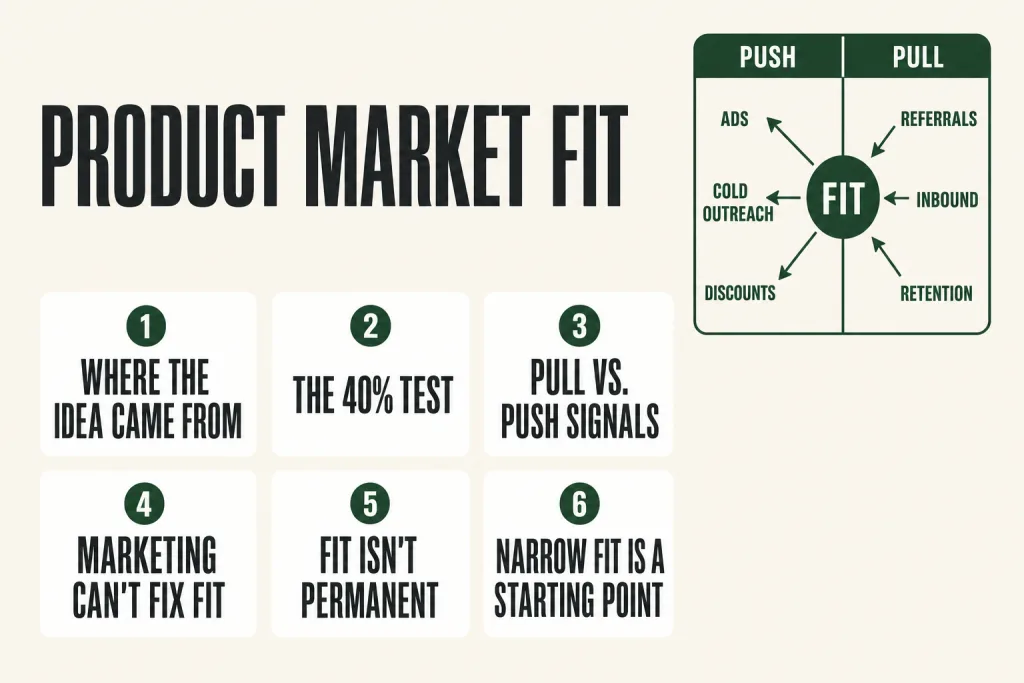
Where the Idea Came From
The thinking predates the phrase by decades. Sequoia Capital’s Don Valentine built his entire investing philosophy around a single conviction: market pull is the one force strong enough to overcome a startup’s inevitable mistakes. As Rachleff has recounted it, Valentine believed you want to find companies that could screw up nearly everything and still succeed because the customer pulls the product out of their hands. The team mattered, but the market mattered more.
Andy Rachleff, who co-founded Benchmark Capital in 1995 and later taught entrepreneurship at Stanford, put a name to Valentine’s core idea. He coined the term ‘product market fit’ in 2005 while developing his Stanford course after retiring from Benchmark, formalizing the concept from his years of VC experience. Marc Andreessen then carried it to a far wider audience. In Part 4 of his PMarca Guide to Startupspublished in 2007 and archived at pmarchive.com, Andreessen named the idea ‘Rachleff’s Corollary of Startup Success’ and offered the definition that still gets quoted everywhere: ‘being in a good market with a product that can satisfy that market.’ Andreessen broadcast it; Rachleff built it; Valentine seeded the underlying logic.
The quantitative layer came from Sean Ellis, who was the first marketer at Dropbox. In 2009 he published a survey methodology built around a single question, ‘How would you feel if you could no longer use this product?’, and after benchmarking hundreds of startups, found a consistent pattern: companies where 40% or more of active users said ‘very disappointed’ almost always achieved sustainable growth. Below that threshold, they almost always struggled. That benchmark has been the standard shorthand for measuring fit ever since.
What Product Market Fit Actually Feels Like (From Both Sides)
Andreessen’s original description of the two states is still the clearest anyone has written it. When fit isn’t happening, customers aren’t quite getting value, word of mouth isn’t spreading, usage isn’t growing that fast, press reviews are ‘kind of blah,’ and the sales cycle drags. When fit is happening, customers buy as fast as you can make it, money piles up in the checking account, and you’re hiring support staff as fast as you can find them.
The operative frame is push versus pull. Before fit, the work feels like pushing, you’re convincing each customer individually, scrambling to make every meeting count, and the product moves only when you move. After fit, the work shifts to managing pull. Customers find you on their own, retention holds without your constant intervention, and the question shifts from ‘how do I get more users?’ to ‘how do I keep up with the ones I already have?’
For a local service business, translate this directly. Before fit: you’re chasing every lead, discounting to close, doing heroic work to keep accounts from leaving, and constantly explaining why your service category matters at all. After fit: the phone rings without an ad campaign, past clients refer new ones without being asked, and your biggest operational headache is capacity, not pipeline.
The transition isn’t usually a light-switch moment. More dependable indicators tend to emerge gradually, consistent retention within a specific customer group, shorter sales cycles, clearer and more repeatable use cases, customers integrating your work more deeply into their own operations. You’re looking for a direction of travel, not a single event.
Pull Signals vs. Push Signals: How a Small Business Reads the Room
Most of the product market fit literature was written for SaaS founders with dashboards, cohort analysis tools, and a team to run surveys. You might have a spreadsheet and thirty minutes on Friday afternoon. Here’s how to read the signals without a data team.
Pull signals, the ones that matter
- Unsolicited referrals. Customers are sending you people without you asking. Not because you have a referral program, but because they’re genuinely embarrassed to let someone they know use anything else. When word of mouth starts doing the work of a marketer, the market is telling you the problem is real and your name has started to stick.
- Inbound beating outbound. Qualified inbound leads are exceeding a meaningful portion of your pipeline without paid promotion. If the only leads you get are from ads you’re running, that’s push. If people are finding you through search, referrals, or reputation, that’s pull.
- Customers using your language. On discovery calls, prospects describe the problem using the exact phrasing your website uses. They arrive already convinced the pain is worth solving. You’re negotiating on price, not on whether the need is real.
- Retention without heroics. If you can sell your service but clients leave quickly, losing more customers than you’re gaining, you likely don’t have true fit yet. Sustainable businesses see customers stick because the value proposition holds on its own.
- Customers adapting around you. Clients ask you to expand scope, or rearrange their own processes to accommodate yours. They’re integrating you. That’s the service-business equivalent of a SaaS product becoming part of someone’s daily workflow.
- Pricing power. You can raise prices without triggering mass cancellations. Announcing a 20 to 30% price increase to a small cohort and seeing churn stay under 10% is a meaningful fit signal.
Push signals, the warning signs
- Every new client required a long persuasion process where you explained why the problem mattered.
- Discounts close deals that full-price pitches couldn’t.
- You’re cold-emailing and running ads to generate every lead. That’s push, not pull.
- Clients churn quickly when a cheaper option appears, they never became dependent on your specific approach.
- Prospects say your service is interesting or impressive, but hesitate to change their behavior or pay for it. Interest without conversion isn’t fit.
None of these signals in isolation is definitive. Read them as a pattern. Three or four pull signals pointing the same direction is meaningful. One enthusiastic client is not.
The Sean Ellis test adapted for a service business
The product market fit survey centers on one question: ‘How would you feel if you could no longer use this product?’ Ellis published the methodology in 2009 after benchmarking hundreds of startups and finding that companies where 40% or more of active users answered ‘very disappointed’ consistently went on to scale. Below that threshold, they consistently struggled.
For a service business, send this to your last 30 to 50 active clients, people who’ve used your service at least twice in the past few months. Survey your actual users, not everyone who ever signed up. Including people who bounced after one interaction drags the score down and masks real signals.
Above 40% ‘very disappointed’ is the widely used threshold. Between 25% and 40% means you’re approaching fit, build harder for the clients in the ‘very disappointed’ group. Under 25% means you should be asking what would need to change about the service, the price, or the target client before someone would be devastated to lose you.
One caveat: the 40% number is a directional benchmark, not a strict pass/fail gate. A service business at 38% with strong referral patterns and healthy retention is in a very different position than one at 38% with no organic inbound and high churn. Pair the number with your other signals before drawing conclusions.
Why Marketing Can’t Fix a Product Market Fit Problem
This is the part operators most need to hear, and most resist, because the reflex when growth stalls is to spend more on marketing.
Here’s what actually happens when you pour budget into a fit problem: you acquire more customers at higher cost, those customers churn at the same rate your existing ones do, and your cost structure gets worse while your revenue stays flat or declines. Scaling before you have fit burns cash acquiring customers who leave. You’re filling a leaky bucket.
Marketing’s job is to put the right message in front of the right people at the right time. It can do that well. What it cannot do is make people need something they don’t need, or make a service worth keeping when it isn’t. When your network of warm relationships runs dry and you hand off to cold outreach or paid ads, missing fit shows up fast.
The spend-more trap goes like this: a service business isn’t growing fast enough, so the operator launches Google ads. The ads bring leads. Some convert. But churn stays high and referrals stay rare. So the operator runs more ads, maybe hires an agency. Same result at higher cost. They conclude marketing doesn’t work. Marketing didn’t fail, it surfaced the demand that was there. The problem was that the service didn’t hold customers once it had them.
Without good product market fit, you won’t be able to sustain your marketing and operational spending long-term. That’s not a knock on marketing, it’s a sequencing argument. Get the fit first. Then market into it.
There’s a subtler version of this trap too. Sometimes an operator has genuine fit with a narrow group, say, a bookkeeping service that’s genuinely beloved by solo-practitioner lawyers, but tries to market broadly to all small businesses. The message gets diluted trying to speak to everyone, conversion drops, and the operator concludes the offer is wrong. The offer is fine. The audience is wrong. If a product is resonating with a small but passionate group of early customers who fit a particular mold, the right move is to go find more people exactly like them, not to sand down the offer until it appeals to no one specifically.
The honest operator question isn’t ‘how do I get more leads?’ It’s ‘why don’t the clients I already have stay longer and refer more?’ Answer that second question first and the first one becomes a lot easier.
Putting this to work? The ideas in the Canon are the foundation under the tactical playbook in Build a Complete Marketing Departmentgrab the free companion kit at mmsvegas.com/resources.
Product Market Fit for Service and Local Businesses (It’s Not Just for SaaS)
Almost everything written about product market fit uses SaaS as the reference point, retention curves, cohort analysis, monthly active users. If you run a service business, a retail shop, or a local operation, the framing seems designed for someone else. It isn’t. The underlying question is identical: does your market pull your offer toward it, or are you pushing uphill?
For a service business, ‘product’ means the service package, the process, the team, and the experience wrapped around the result you deliver. Fit means a specific type of client, with a specific problem, values what you do at the price you charge, comes back, and tells people. That’s it. You don’t need cohort charts to feel when that’s true. Or when it isn’t.
A few service-business translations of the classic PMF signals:
- Scope creep as a positive signal. When clients keep asking you to do more, adjacent things you hadn’t offered, that’s a pull signal. They trust you and they’ve run out of reasons to go anywhere else.
- Long tenures over short spikes. A client who pays for 36 consecutive months matters more than three clients who each paid for one month. If people are buying once but never coming back, you don’t have a business; you have a gimmick.
- The referral source pattern. Track where your best clients came from. If a disproportionate number come from one industry, one type of referral source, or one geography, that’s your market telling you something. It’s pointing at your fit segment.
- Price resistance disappearing. Before fit, price is always the objection. After fit, good clients negotiate on timeline and scope, not on whether your rate is worth it.
The most common cause of high churn at the early stage is a lack of product market fit. The easiest way to spot it: a preternaturally high rate of clients who finish one project and never call again, or who cancel after the first retainer month. If that pattern repeats across different clients, it’s not a client problem. It’s a fit problem.
The fix isn’t always a complete reinvention. Sometimes it’s a narrower target: the same service, offered only to the segment where you consistently see retention, referrals, and easy closes. Finding fit often means deliberately shrinking your stated audience before you can grow your actual one.
What Good Fit Looked Like in Practice
Named examples are instructive because they remind you fit isn’t magic, it’s the collision of a real problem and a good-enough solution, at a moment when the market was ready.
Slack is the most-cited case for a reason. By addressing the genuine pain of internal communication fragmentation, and expanding functionality only when it was relevant and wanted, the company achieved retention numbers that were almost unheard of at that scale. Teams that adopted Slack almost never left. The marketing came after the fit, not before.
Dropbox is the cleaner operator lesson. Ellis was the first marketer at Dropbox, which means the product reached significant scale before anyone with ‘marketing’ in their title showed up. It grew because syncing files across devices was a genuinely painful problem, and Dropbox solved it simply enough that users explained it to each other. Pull, not push.
The inverse example is instructive too. Google+ launched into a market that didn’t need another social network, Facebook already had the pull. No amount of Google’s marketing muscle could manufacture fit that wasn’t there. The product was technically competent. The market didn’t care. That’s as clean a demonstration as you’ll find of why marketing cannot create fit.
For smaller operators: a bookkeeper who niched into e-commerce sellers found that her clients had one specific, painful problem, inventory-based accounting, that generic bookkeepers handled poorly. She didn’t change her credentials or her software. She changed who she targeted. Referrals inside that niche became her primary growth channel within eighteen months. Fit discovered through narrowing, not through building something new.
Where the Idea Applies, and Where It Gets Misused
Product market fit is the right frame when you’re asking whether your core offer deserves to exist in its current form for its current market. That’s a question worth asking hard at the beginning of a business, during a pivot, after a growth plateau, or when you’re preparing to scale marketing spend. Those are exactly the moments when clarity about fit saves you real money.
It’s the wrong frame for a few situations operators commonly apply it to:
- When you already have fit and the real problem is execution. Some operators use ‘we haven’t found product-market fit’ as a perpetual excuse to avoid the harder work of sales, operations, and delivery. If you have evidence of pull, loyal clients, referrals, decent retention, fit is probably there. The problem is somewhere in the machine, not in the market.
- When the business is established in a proven category. If you’re opening a second pizzeria, or a third location of an established service, you don’t have a fit problem. Fit is proven in your category. You have a marketing and operations problem, which is specific and solvable, not existential.
- When the ‘fit’ question is being used to avoid commitment. Many founders expect PMF to feel like a breakthrough, a sudden, clean alignment between what they’ve built and what the market wants. It usually doesn’t work that way. Fit tends to emerge over time; you spot it by recognizing patterns, making course corrections, and measuring the right things. If you’re waiting for a moment of clarity before committing to anything, you’ll wait a long time.
Also worth saying: fit is not permanent. If you operate in a dynamic market, you can’t afford to shelve your fit-monitoring the moment things seem to be working. The clients who loved your service five years ago may now have different problems, different alternatives, or different expectations. Fit is a condition to maintain, not a trophy to hang on the wall.
Common Misunderstandings About Product Market Fit
‘Fit means everyone loves you.’ The concept is often conflated with broad market approval. It doesn’t require that. Fit means a specific, describable group values what you do enough to come back, pay full price, and tell others. Broad appeal with thin retention is not fit. Narrow appeal with fierce loyalty is, and it’s often more durable.
‘The 40% test is a hard threshold.’ The benchmark was developed by Ellis in 2009 from patterns observed across hundreds of startups. Think of it as a compass reading, not a certification. What it’s actually measuring is emotional dependency, whether your clients would feel genuine loss if you disappeared, not just mild inconvenience. That distinction matters more than the exact number.
‘Fit is about the product, not the market.’ This is a conceptual error, not just a tactical one. The word ‘market’ is literally in the name of the idea. A well-designed service sold to the wrong buyer profile will never find fit no matter how many iterations you run on delivery. The pivot you need is often not in what you offer, it’s in who you’re offering it to. Rachleff’s framing is useful here: a great team in a bad market loses every time.
‘Once you have fit, you keep it automatically.’ Markets evolve. A company that had genuine fit with a specific segment in 2019 may find that segment’s needs have shifted, new technology changed the problem, a competitor arrived, or the segment itself shrank. The operators who stay sharp run informal fit diagnostics periodically, not just at launch. This is distinct from the mistake of not running the diagnostics correctly in the first place, that’s a measurement error. Assuming you don’t need to measure anymore is a strategic one.
Common Mistakes
- Scaling marketing spend before auditing retentionBefore increasing any ad budget, calculate what percentage of clients from 12 months ago are still active. If it’s below 60%, you’re about to pour money into a leaky bucket. Run the retention number first, if it’s low, the marketing dollar is the wrong dollar to spend. Fix the delivery or expectation gap that’s causing early exits, then scale.
- Mistaking enthusiastic early feedback for confirmed fitA prospect who calls your pitch ‘exactly what I’ve been looking for’ and then ghosts on the proposal is not a fit signal, it’s a sales signal that needs follow-up. Fit is confirmed by repeat purchases, unprompted referrals, and clients who resist canceling when a cheaper option appears. Track those three things separately from your sales pipeline, because they measure something your pipeline doesn’t.
- Surveying the wrong clients with the Ellis test and getting a misleading scoreA bookkeeper who surveyed all 200 people on her email list, including leads who never converted and clients who churned after one month, got a score of 19% and nearly pivoted her entire service model. The actual score among her active, repeat clients was 51%. Survey only clients who have used your core service at least twice in the past 90 days. Churned clients and one-time buyers drag the score down and mask real fit signals.
- Treating a narrow fit as a problem instead of a starting pointOperators regularly find that one specific niche, say, e-commerce founders, or family-owned manufacturers, responds dramatically better than the rest of their audience. The instinct is to keep searching for broader fit. The right move is to go deeper into the niche that’s already pulling: tighten the messaging, build case studies from that segment, and find referral paths inside it. Narrow fit that’s real beats broad fit that isn’t.
- Treating fit as permanent once the business feels like it’s workingA commercial cleaning company that had strong fit with small medical offices in 2020 watched that segment consolidate into larger health networks by 2023, networks with procurement departments and preferred-vendor lists. The fit eroded, but the owner didn’t notice until revenue started dropping. Run a lightweight fit check, referral rate, churn rate, and the Ellis question, at least once a year. Markets move; fit doesn’t maintain itself.
Operator’s Take
Most fit discussions stop at ‘do you have it or not.’ That’s fine for an early-stage founder. It’s not enough for an operator who’s three or five years into running a real business. The more useful question by then is: where is your fit, and is it drifting?
Fit isn’t evenly distributed across your client base. Almost every service business I’ve watched closely has a small pocket, maybe 20% of clients, where everything runs easily: short sales cycles, long retention, referrals without asking, upsells that happen naturally. Then a much larger group where none of that is true. Most operators treat both groups as ‘clients’ and try to serve them with the same offer, same messaging, same onboarding. That’s the mistake. The 20% is your actual fit segment. The other 80% is drag, consuming capacity, depressing your satisfaction scores, muddying your own sense of what the business is for.
For solo service operators and freelancers
If your client base is small enough that you know everyone by name, skip the Ellis survey entirely and go analog. Call your five best clients, the ones you’d most hate to lose, and ask them directly: what would you do if I stopped offering this? If the answer is ‘I honestly don’t know, you’re the only person I trust with this,’ that’s your fit signal. If the answer is ‘I’d probably find someone else,’ that’s your fit gap. You don’t need a spreadsheet. You need an honest conversation.
The move for solo operators: identify the one client type where everything works, the niche where you close fast, retain well, and get referrals. Then build your next three months of outreach exclusively around finding more people exactly like them. Don’t try to fix the clients where fit is weak. Just stop chasing that profile.
For established service businesses with a team
Here the problem is usually subtler. You have fit somewhere in the book, but it’s been diluted. Staff turned over. The founder stopped doing client work. A cheaper tier got introduced that confused the positioning. The market didn’t stop wanting what you originally offered. You stopped delivering it consistently. Before concluding you’ve lost fit, audit whether the thing that originally created pull is still actually showing up in the client experience today. Often it isn’t, and that’s a delivery problem, not a fit problem. Fixable, but only if you name it correctly.
A concrete move here: pull your last three years of pricing history. Which client segments accepted price increases without pushing back? Those are your fit clients, they’re paying more because your specific approach is difficult to replicate elsewhere. Which segments churned or threatened to? Those are your commodity clients, they’re buying on price, not on fit. Stop marketing to the second group and put that budget toward more of the first.
For operators approaching a growth plateau
This is where most fit conversations go wrong. The plateau hits, the instinct is to fix marketing. But before you spend a dollar on ads or hire an agency, map your referral graph by client type. Not just volume, structure. Are your best referrers sending you people who also become good referrers? When referrals compound, client A sends client B, who sends client C, you’re inside a community with a shared problem. That’s your market. When referrals are single-hop and random, they’re relationship favors, not fit signals. The compounding chain is worth far more than any ad campaign. Protect it. Build into it. Run the Ellis test on that sub-segment specifically and watch how much higher the score is than your overall book.
One thing I’d actively resist regardless of stage: managing your Ellis score rather than understanding it. Operators who only email happy clients get a false positive and let a real fit problem fester. Survey the uncomfortable clients too. Let the score drop if it needs to. A score that’s honestly 28% and trending toward 35% is more useful than a massaged 42% that hides the real diagnosis.
Used in
- ✓ Build a Complete Marketing Department
Used as the diagnostic checkpoint before scaling any marketing channel, the book treats PMF signals as a prerequisite for committing budget to paid or content programs. - ✓ The Missing Manual for FunnelKit
Informs funnel architecture decisions: funnels built before fit is confirmed are treated as discovery tools, not growth engines, with offer and messaging tested before spend is committed. - ✓ The Missing Manual for Make
Used to decide which automations are worth building, automating retention and referral workflows is prioritized only after fit signals confirm the underlying offer is worth keeping customers in.
FAQ
Can a service business achieve product market fit the same way a software company does?
Yes, the signals are the same, just expressed differently. Retention, referrals, unsolicited inbound, and pricing power all apply. The Sean Ellis test works for service businesses too: email your active clients, ask the one question, and track the responses. The 40% threshold is the same.
What’s the fastest way to tell if I have a fit problem or a marketing problem?
Look at retention and referrals before you look at acquisition. If clients who do find you tend to stay and refer others, you have a marketing problem, you just need more people to find you. If clients churn quickly regardless of source and referrals are rare, you likely have a fit problem that more marketing will only make more expensive.
Is 40% on the Sean Ellis test a hard rule?
It’s a widely used benchmark, not a law. Ellis developed it in 2009 by observing patterns across hundreds of startups, companies above 40% tended to scale and companies below it tended to stall. Use it as a directional signal, and pair it with your referral rate and churn data for a fuller picture.
What should I do if I have fit with a very small niche?
Go deeper into that niche before going broader. Serve that segment exceptionally well, build referral density within it, and document exactly what makes those clients different from everyone else. That profile becomes your ideal customer definition for all future marketing and offer design.
Can you lose product market fit after you’ve achieved it?
Yes, markets shift, competitors improve, and customer expectations change. A business with strong fit in 2020 may find that the specific problem it solved has been commoditized or automated away by 2025. Treating fit as a permanent achievement rather than a condition to maintain is how long-running businesses get caught flat-footed.
How is product market fit different from positioning?
Fit is the underlying condition, your offer genuinely solves a real problem for a real market. Positioning is how you communicate that in your buyer’s mind. You can have good fit and poor positioning (people who try you love you, but few find you). You cannot have good positioning without fit, no amount of clever messaging makes an offer worth keeping.
Further reading
- PMarchive.com, Marc Andreessen’s original ‘Guide to Startups’ series (2007). The source document. Part 4, ‘The only thing that matters,’ is the product market fit essay. Read it for the original framing, then come back to the operator translation on this page.
- Hacking Growth by Sean Ellis and Morgan Brown. Ellis expands the 40% test into a practical growth system. Most directly useful for the measurement and iteration sections after you’ve established baseline fit.
- The Lean Product Playbook by Dan Olsen. Builds a five-layer pyramid from target customer through feature set. Useful if you want a structured process for diagnosing where the fit gap is, not just whether one exists.
Sources: Marc Andreessen, PMarchive.com, ‘The only thing that matters,’ Part 4 of the PMarca Guide to Startups (2007, archived); Wikipedia entry on Product-market fit; Wikipedia entry on Sean Ellis (entrepreneur); Reforge, ‘Measure and Improve Product/Market Fit with the 40% Test’; Lenny’s Newsletter, ‘The original growth hacker reveals his secrets, Sean Ellis’ (November 2025); IdeaPlan, ‘Product-Market Fit Score: The Sean Ellis 40% Test’ (2026); FitSignal, ‘The Sean Ellis 40% Test: The Ultimate Guide’ (March 2026); Koji, ‘Sean Ellis Test: The 40% Rule for Product-Market Fit’ (May 2026); a16z, ’12 Things About Product-Market Fit’; Vertex Ventures US / Medium, ‘What startups get wrong about product-market fit, according to the legendary investor who coined the term’ (April 2024); Floodgate / Starting Greatness podcast transcript, ‘Andy Rachleff on How to Know If You’ve Got Product Market Fit’; Unusual Ventures, ‘Andy Rachleff on coining the term product-market fit’ (October 2025); Wing VC Founder Docs, ‘What Is Product-Market Fit for Startups?’; Athenic, ‘Product-Market Fit: 12 Signals You’ve Actually Found It’ (September 2025); Entrepreneur.com, ‘5 Key Signals Your Startup Is Finally Hitting Product Market Fit’ (April 2026); Mercury, ‘Finding Product-Market Fit: When the Journey Isn’t Straightforward’ (May 2026); Maine Venture Fund, ‘The Fundamentals of Product-Market Fit’ (September 2025); Bokardo, ‘The Origin of Product-Market Fit’ (2014); Visible.vc, ‘How to Easily Achieve Product-Market Fit’; Productboard, ‘Defining, Finding and Measuring Product Market Fit’; WePitched, ‘7 Proven Product Market Fit Indicators for Small Businesses’ (March 2026); LearningLoop, ‘Sean Ellis Score’ (notes 2009 blog post publication); Clarity.fm / Sean Ellis profile (first marketer credits); a16z Speedrun, ‘How to Measure Product-Market Fit’ (March 2025); Holloway, ‘Fundamentals of Product-Market Fit’.
Brian Kasday spent forty years in direct-response marketing before rebuilding the whole operation as a one-person shop. He writes The Operator’s Library, including “Build a Complete Marketing Department”, for operators who’d rather build it themselves than wait on someone else.
Build the department these ideas describethe free companion kit: mmsvegas.com/resources.
More The Operator's Canon guides
Free · Operator Toolkit
Want the tools, not just the guide?
Get the free operator toolkit — templates and checklists for the systems you actually run, plus a note when this guide changes.
Get the free toolkit →How to cite: Product Market Fit. Associated with Andy Rachleff / Marc Andreessen, 2007. The Operator’s Canon, MMS Vegas. https://mmsvegas.com/library/product-market-fit-explained/