
Last updated: July 2026
Problem agitate solution is the copywriting formula that has quietly structured more successful sales messages than any other framework in direct response history, and by the end of this page, you’ll be able to write a PAS message for any offer you run, identify exactly where your current copy goes limp, and know when the formula is the wrong tool for the job.
Three beats. Name the problem your prospect already feels. Make the cost of ignoring it visceral. Then show them the door out. That’s the whole thing.
And yet most small-business marketing completely bypasses it. Instead of starting where the buyer is, already living with a frustration, the copy starts where the owner is: excited about the product. That’s the miss. The prospect doesn’t care about your solution until they feel the weight of their problem. PAS is the structure that earns the right to pitch.
The idea in 30 seconds
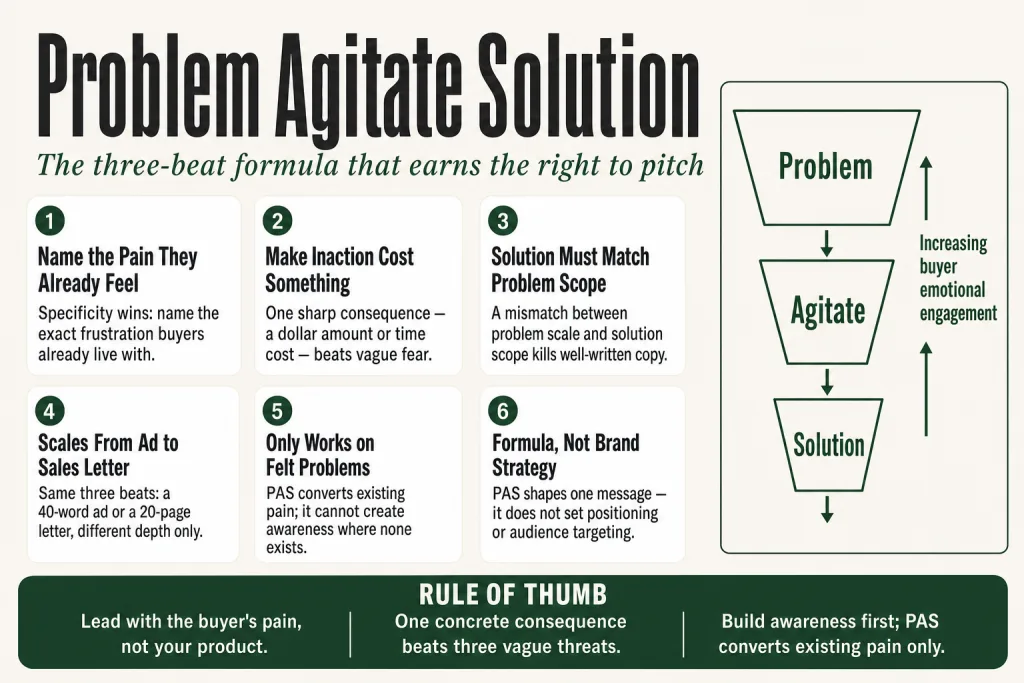
- Problem agitate solution (PAS) is a three-step copywriting formula: name the problem your buyer already feels, intensify the cost of leaving it unsolved, then present your offer as the exit.
- Dan Kennedy popularized the formula in The Ultimate Sales Letterarguing it works because humans are wired to avoid loss more than they pursue gain.
- The agitation step is where most small operators go wrong: they either skip it entirely or overdrive it into manufactured fear. The goal is vivid consequence, not panic.
- PAS scales from a two-sentence Facebook ad to a multi-page sales letter, same structure, different depth.
- It works best when a real, recognized problem already exists. If your buyer doesn’t feel the problem yet, you need to build awareness before PAS will land.
- PAS is a copywriting formula, not a brand strategy, it shapes a single message, not your entire positioning.
Where PAS Came From
PAS grew out of the direct-response tradition, the world of sales letters and mail-order ads where every word had to justify its existence because printing wasn’t free. Eugene Schwartz laid the intellectual groundwork in Breakthrough Advertising (1966), arguing that copywriters don’t create desire, they channel desire that already exists in the market. His five awareness levels gave practitioners a map for meeting buyers exactly where their understanding stopped. Problem-first thinking was already in the water.
But the name, the acronym, and the popularization belong to Dan Kennedy. In The Ultimate Sales Lettercopyright 1990, physical first edition shipping in 1991, Kennedy named PAS his first and best copywriting formula and applied it across more than 136 industries. His reasoning was direct: people act more readily to avoid pain than to pursue gain. He didn’t invent that psychology, Kahneman and Tversky had documented loss aversion in Prospect Theory a decade earlier, but he built a repeatable messaging scaffold on top of it that any operator can follow. That’s the real contribution.
The formula has outlasted every medium it’s been applied to. Social ads, cold emails, landing pages, TV spots, sales conversations, same three beats, every time. That kind of durability is usually a sign something is touching a real nerve.
The Three Beats of Problem Agitate Solution
Simple enough to sketch on a napkin. Deep enough to spend a career mastering. Each beat has one job, and the formula falls apart when any of the three is soft.
Problem: Meet your buyer where they already are
You’re not informing buyers of a problem they’ve never considered. You’re naming something they already live with. The restaurant owner doing books on Sunday nights after a 60-hour week. The HR manager who got a compliance violation because a policy update slipped through a spreadsheet. The consultant whose proposals look identical to every competitor’s, decent work, nothing that makes the shortlist.
Specificity is everything here. “Struggling with marketing?” is not a problem statement, it’s a category. “Spending three hours a week writing social posts that generate two likes, both from people you already know?” That’s a problem. Voice of Customer research is where this language comes from: the exact phrasing your customers use in reviews, intake forms, and support tickets is your raw material. Mine it before you write a word.
Agitate: The cost of doing nothing
This is the beat most operators either skip or overdo. The point isn’t cruelty, it’s consequence. Agitation asks the reader to sit with what happens if they keep ignoring the problem they’ve just recognized.
One practical test: if your agitation paragraph could apply to any business in any industry, it’s too vague. The right reader should think “how do they know that?”, not “I guess that could be a problem for someone.” Avoid dramatic adjectives. A dollar amount or a time cost lands harder than “devastating” ever will.
Solution: The credible exit
The solution shouldn’t feel stapled on, it should feel inevitable, like relief after pressure. If the problem and agitation are doing their job, the solution section doesn’t need to be loud. It needs to be specific, credible, and answering exactly the problem you named. A mismatch between problem scale and solution scope is one of the most reliable ways to watch well-written PAS copy fail anyway.
Why Problem Agitate Solution Works at the Neurological Level
The cynical answer is that PAS manipulates fear. That explanation sells the formula short and also isn’t quite right.
PAS works because it matches the way people actually make decisions, particularly decisions about change. Behavioral economics has documented consistently that people are more averse to pain than they are attracted to equivalent gain. Kahneman and Tversky demonstrated this in 1979. Kennedy built a messaging scaffold on top of it. The formula doesn’t exploit human psychology so much as work with the grain of it.
There’s also a simpler explanation. With PAS, you’re not trying to build desire from scratch the way AIDA does. You’re not crafting a narrative arc. You’re meeting someone exactly where they already are, in pain, and showing them the door out. That’s a much shorter persuasion journey than starting from zero awareness, which is why PAS tends to convert faster in paid media where you’re buying attention by the click.
Finally, the formula works because it forces the writer to understand the buyer before trying to sell to them. You can’t write a real problem statement without knowing what your customers actually struggle with. You can’t write real agitation without understanding the downstream consequences they feel. The discipline the structure imposes is half the value. It stops you from leading with features before the reader has any reason to care.
Problem Agitate Solution in Practice: Formats and Contexts
The formula doesn’t care about length. It scales from a three-line social ad to a 20-page sales letter, same structure, different depth.
Here’s how the structure changes by format:
- A three-line social ad: The problem is the headline. One sentence of agitation in the body. The solution is the call to action. The whole thing is 40 words.
- A cold email: One short paragraph per beat. The problem hook earns the open; agitation earns the scroll; the solution earns the reply. Under 150 words total.
- A landing page: The hero section handles the problem. The next section deepens agitation, consequences, objections, the cost of the status quo. Then the offer section handles the solution, usually supported by proof (testimonials, data, credentials). Lemlist’s homepage is a real-world example worth studying: its hero section opens with the core problem, getting actual replies from cold outreach, and the next section lists four distinct agitations: difficulty finding relevant prospects, frustration personalizing contact info without sounding robotic, inability to manage multiple email sequences from one platform, and messages landing in spam. Four specific, recognizable pains. Not one of them is vague.
- A long-form sales letter: Each beat can span multiple sections and thousands of words, layering evidence, stories, and specificity. Kennedy’s native territory.
One format operators underuse: the sales conversation itself. PAS isn’t just a writing framework. It works as a verbal script. Name the problem you solve, not your process, the problem. Ask a question that surfaces the consequence of leaving it unsolved. Then introduce your offer as the resolution. Most small-business sales conversations lead with capabilities. PAS-structured ones lead with understanding. That distinction changes who does most of the talking.
A concrete small-business example
A bookkeeper targeting small restaurants:
Problem: “Most restaurant owners are doing their books themselves, on Sunday nights, after a 60-hour week.”
Agitate: “Which means they’re catching errors months late, paying more in taxes than they owe, and going into every quarter-end not knowing if they actually made money. The IRS doesn’t give credit for being busy.”
Solution: “We handle all of it, weekly reconciliation, quarterly estimates, and a monthly P&L that takes 10 minutes to understand, so you can walk out of Sunday knowing exactly where you stand.”
No manufactured fear. No claim the business will collapse without help. Just the real consequence of the real problem, and a specific exit. That’s PAS done right.
Putting this to work? The ideas in the Canon are the foundation under the tactical playbook in Build a Complete Marketing Departmentgrab the free companion kit at mmsvegas.com/resources.
Modern Examples of Problem Agitate Solution
The formula is everywhere once you train your eye to see it. A few deployments worth studying:
Basecamp’s homepage copy (various iterations): The company has consistently led with the chaos of managing work across email, spreadsheets, and scattered apps, a concrete operational problem that most small teams recognize immediately. The agitation surfaces the communication overhead, the context that gets lost, the decisions that happen in someone’s inbox instead of somewhere visible. The solution is a single place. No inflated claims. The problem is real, the agitation is descriptive, the solution is proportionate.
Lemlist (cold outreach SaaS): As noted above, their landing page runs four distinct agitation points, each one a specific failure mode their target user has already experienced. Failing to find prospects, writing personalized copy that sounds like a robot wrote it, juggling five platforms, watching good emails land in spam. Any one of those lands. All four together makes the reader feel seen rather than lectured.
KlientBoost + B2B software: KlientBoost used PAS to help a B2B software company increase conversions by 132%. The company’s original copy failed to communicate clearly. KlientBoost’s research found that potential customers were struggling with slow, inefficient software that hurt productivity and profitability, so they agitated with phrases about “frustrated with slow software” and “losing money due to outdated tools” before presenting the fix. The specificity of the pain drove the result.
PandaDoc (document SaaS): A clean B2B example of specific agitation, rather than vague “inefficiency,” PandaDoc’s messaging uses measurable problems like manual processes consuming 15 hours per week of team time. That’s the difference between agitation that converts and agitation that slides past. A number anchors the consequence. It makes the cost real.
The common thread across examples that work: the problem is specific and recognizable, the agitation is consequence-based rather than fear-based, and the solution is credible and proportionate to the problem named. When all three are true, the formula disappears, it just feels like an honest conversation with someone who understands your situation.
Problem Agitate Solution vs. AIDA and StoryBrand
Every operator ends up needing to choose between these three frameworks at some point, and the choice matters. They’re not interchangeable.
PAS vs. AIDA
AIDA, Attention, Interest, Desire, Action, is the older model, and it approaches persuasion from the opposite direction. AIDA builds desire from scratch: grab attention, cultivate interest, generate desire, then drive action. PAS starts with desire that already exists in the form of pain. You’re not trying to create a need, you’re acknowledging one that’s already costing the buyer something.
The practical implication: AIDA tends to work better when you’re introducing something new, a product category the buyer hasn’t encountered, a benefit they haven’t imagined. PAS works better when the problem is already felt but unsolved. For most small-business offers targeting aware buyersPAS is faster and more direct. You’re not educating them about why the problem matters. They already know.
PAS vs. StoryBrand
Both frameworks center on problems, which is where the confusion starts. But they operate at completely different altitudes.
StoryBrand is a brand positioning framework, it tells you how to think about your entire brand narrative: who the hero is, what they want, what stands in the way, how you play the guide role. PAS is a single-message formula. It tells you how to structure one email, one ad, one landing page hero. You can use StoryBrand to clarify your brand’s core narrative and then use PAS to write each individual piece of copy inside that narrative. They complement each other when used that way. Conflate them and you’ll get shallow application of both.
Another meaningful contrast: StoryBrand is deliberately optimistic, it emphasizes the transformation available and positions the brand as a guide. PAS spends more time in the problem before offering relief. Neither is inherently better. For short-form ads, emails, and landing page heroes, PAS is usually faster. For an entire website or brand narrative, StoryBrand’s architecture is more complete. Use the right tool for the scope of the job.
Where Problem Agitate Solution Still Applies, and Where It Doesn’t
PAS is the right tool in a specific set of conditions:
- The buyer already feels the problem. A plumber searching for scheduling software already knows the pain of double-bookings. A therapist in private practice already knows the feeling of chasing unpaid invoices. PAS lands when you’re meeting someone mid-sentence, they’re already thinking about this problem, and you’re the first message that named it precisely.
- You’re working in short formats. The constraint of a Facebook ad or cold email forces clarity. PAS provides a ready-made structure for that constraint.
- You’re selling a solution to a recognized category of problem. Bookkeeping software, HR compliance headaches, slow websites, leaking pipes, these are problems with established language. PAS works when you can speak that language back fluently.
- You need to warm up a prospect fast. In any funnel where you’re paying per click, PAS-structured copy accelerates emotional recognition, which means faster decisions and more efficient spend.
Where PAS runs into trouble:
- When the buyer doesn’t feel the problem yet. A preventive health product, a new software category, a process improvement the buyer doesn’t know they need, these require education first. You can’t agitate a pain that hasn’t been registered. Build awareness content first; PAS fits later in the sequence when recognition is established.
- When the problem is sensitive. Financial distress, relationship breakdown, health anxiety, these categories respond poorly to aggressive agitation. The formula still works, but the agitation step requires restraint and clinical specificity rather than amplified emotion. The line between “I understand what you’re going through” and “you’re going to suffer if you don’t act” is real, and crossing it damages trust permanently.
- When you’re trying to build a brand rather than close a sale. Brand advertising operates on familiarity and identity, not on urgency. A series of PAS-heavy ads for a premium brand can undercut the aspiration the brand is trying to build, you end up associated with anxiety rather than aspiration.
- When the problem is exaggerated or fabricated. Manufactured urgency produces short-term conversions and long-term churn. A client who buys under pressure and finds the solution doesn’t match the problem you described is not a client who renews, refers, or reviews you well. The formula only performs sustainably when the problem is real and the agitation is accurate.
Common Misunderstandings About Problem Agitate Solution
Misunderstanding 1: Agitation means fear-mongering. This is the most damaging misread of the formula. Agitation isn’t about terrifying your buyer, it’s about making the consequence of inaction vivid and concrete. There’s a difference between “your business could fail without this” (vague fear) and “at the current conversion rate, you’re paying $47 per lead and closing 8%, that’s $588 in ad spend for every client you land” (specific consequence). The second one agitates without manufacturing panic. It’s also more persuasive, because it’s demonstrably true.
Misunderstanding 2: PAS is manipulative by nature. The formula is neutral. Manipulation enters when you invent or exaggerate the problem. When the problem is real, the agitation is accurate, and the solution is genuinely capable of delivering relief, that’s not manipulation. That’s clear communication that helps a buyer make a faster, better decision. The ethical test isn’t the structure; it’s the accuracy of what you put in it.
Misunderstanding 3: PAS only works for B2C or “pain” categories. The PAS framework works well for B2B precisely because it mirrors how buyers experience and prioritize problems, you identify a specific pain, highlight the cost of ignoring it, then present your product as the direct fix. B2B buyers feel problem-awareness in terms of cost, risk, and operational drag rather than personal frustration. The formula adapts; the vocabulary changes. A CFO doesn’t feel “overwhelmed”, she feels “exposed to audit risk because three departments are running their own expense approval processes.” Same structure, different register.
Misunderstanding 4: The formula is the same as Before-After-Bridge (BAB). BAB moves from the current painful state to an imagined better state and then bridges to the product as the mechanism. PAS spends more time in the problem before offering relief, BAB tends to be more aspirational and softer, PAS more problem-intensive. For cold traffic, PAS often lands harder because it’s rooted in present pain. For warm audiences who are ready to envision change, BAB can be more effective.
Misunderstanding 5: More agitation is always better. There’s a point of diminishing returns. Pile on enough consequence language and the reader either numbs out, disbelieves you, or decides the situation is so hopeless your solution can’t possibly fix it. Agitation should produce productive discomfort, “I need to address this”, not paralysis or resentment toward the message. One or two sharp, specific consequences land harder than five diluted ones. Pick the most painful point and go deep on it rather than cataloguing every downstream risk.
Common Mistakes
- Writing the problem in your vocabulary, not the buyer’sPull the exact phrases customers use in reviews, onboarding calls, and support emails, then use those words verbatim in the problem statement. A dentist’s patients don’t say ‘oral health neglect’; they say ‘I keep putting off getting that tooth looked at.’ That gap between your language and theirs is costing you recognition at the top of every ad and email you run.
- Skipping agitation entirely and jumping straight to the pitchWrite one specific paragraph on what happens to the buyer if the problem goes unsolved for another year. For a staffing firm: uncovered roles mean overtime costs, team morale erosion, and a client delivery that slips. Name those downstream costs explicitly, that paragraph is your agitation. Without it, the solution arrives before the reader has any reason to want one.
- Overdriving agitation into vague threat languageReplace adjectives like ‘devastating’ or ‘catastrophic’ with one concrete, factual consequence, a dollar amount, a time cost, a specific missed outcome. A payroll SaaS isn’t selling against ‘devastating compliance risk’; it’s selling against the $1,100 average IRS penalty for a late 941 deposit. One real number does more work than three alarming adjectives.
- Mismatching solution scope to problem scopeIf your problem statement names a small, specific pain, invoices going out two weeks late, your solution must answer that specific pain, not pivot to a broader pitch about overall business health. Reread your problem statement, then reread your solution section. If you have to pause to connect the two, the reader already left.
- Applying PAS to buyers who don’t recognize the problem yetRun awareness-building content first, educational posts, comparison guides, explainer videos, then deploy PAS once buyers are in the ‘problem-aware’ stage. A cybersecurity product selling to small retailers can’t lead with agitation if the buyer doesn’t yet believe a breach is a realistic risk for a business their size. PAS converts existing pain; it doesn’t create it.
Operator’s Take
PAS is probably the most useful single writing structure a small-business operator can learn. Not because it’s magic. Because it forces the right sequence: understand the buyer’s problem before you open your mouth about your solution. Most small-business marketing fails earlier than that, it starts with “here’s what we do” before the reader has any reason to care. PAS fixes that sequencing problem even when everything else is mediocre.
Here’s where to actually focus, depending on where you’re stuck:
If your paid social cost per acquisition won’t come down, don’t touch the landing page yet. Go back to the problem statement in your ad creative. Weak CPAs in paid social almost always trace to a problem statement that’s either too broad or aimed at the wrong buyer. A home services company targeting contractors doesn’t need a problem statement about “marketing challenges”, it needs one about the last time a job ran three hours over estimate because the crew showed up without the right materials. Run two ad variants: one broad problem statement, one hyper-specific. Measure click-through rate at the ad level. The winner tells you which problem your buyer actually recognizes. Do that before you blame the landing page or the offer.
If your B2B sales cycle stalls at the proposal stage, stop leading with capabilities. Most operators who can’t convert proposals walk into discovery calls and explain what they do before the prospect has articulated what’s wrong. Try a different opening: name the problem you solve, then ask one question, “Is that something you’re dealing with right now?” Then ask what happens if it goes unsolved for another year. Let the prospect do the agitation out loud. You’re not manipulating them; you’re helping them say what they already know. The proposal you write after that conversation will be substantially better, because it answers real language instead of assumed pain. You’ll also notice the prospect owns the problem by the time you present, which changes the entire close dynamic.
If you’re building an email sequence for a warm list, split the beats across three emails, not one. Email one names the problem and earns the nod, one or two sentences, nothing more. Email two is the agitation: a story, a specific downstream cost, a before-and-after that isn’t yours. Email three delivers the solution with proof attached. The sequence works because it earns each step. Cramming all three beats into one email is why click rates are low, the reader hasn’t been warmed to the agitation yet, so the solution lands before they’ve felt the problem.
If your agitation keeps feeling either flat or manipulative, ask one question. “What happens to my buyer if this problem goes unsolved for another 12 months?” For an HR SaaS company: twelve more months of tracking PTO in three different spreadsheets, two more employees who quit partly because of payroll errors, one more potential FLSA exposure nobody caught until someone filed a complaint. That’s agitation. Factual, industry-specific, and the right buyer reads it and feels it. The moment you reach for dramatic adjectives, “devastating,” “catastrophic”, you’ve left agitation and entered hype. The facts are usually alarming enough on their own.
If your solution section isn’t converting even when problem and agitation land, look for a scope mismatch. If you named a small, specific problem (invoices going out two weeks late), your solution needs to answer that specific problem, not pivot to a broader pitch about overall financial health. If you named a large systemic problem (your agency has no repeatable client onboarding and every engagement starts from scratch), your solution needs proof: a case study, a number, a before-and-after that shows the system actually works. Reread your problem statement, then reread your solution. If you have to pause to make the connection, so will your reader.
On AI and PAS copy: AI can draft structurally correct PAS copy in minutes. The output quality depends entirely on what you feed it, real customer language describing the problem. Give it a transcript from a sales call or a batch of one-star reviews from a competitor, and the draft will be usable. Give it a vague brief and you’ll get vague output that technically follows the structure and convinces nobody. Which problems to name, how hard to push the agitation, whether the solution claim holds up, that judgment stays with you.
One thing worth saying plainly: PAS is not a brand strategy. It structures a message. It doesn’t tell you which problem to focus on, which audience to target, or what your actual positioning is. Those decisions live upstream. PAS is the execution layer. If you don’t have a credible USP and a real understanding of your buyer’s situation, PAS will help you write clearer copy about an unclear offer, which is marginally better, but not by enough to matter.
Used in
- ✓ Build a Complete Marketing Department
PAS is used to structure individual campaign messages, ads, emails, and landing page heroes, so each piece of copy earns attention before pitching the offer. - ✓ The Missing Manual for FunnelKit
PAS maps directly onto FunnelKit landing page sections: the above-the-fold hero handles the problem, the middle sections carry the agitation, and the offer block delivers the solution. - ✓ The Missing Manual for Make
PAS informs the copy inside automated email sequences built in Make, each triggered message is structured to meet the subscriber at their recognized pain before presenting the next step.
FAQ
Is Problem Agitate Solution manipulative?
The formula itself is neutral, manipulation enters when you invent or exaggerate the problem. When the problem is real, the agitation is accurate, and the solution is credible, PAS is simply clear communication that helps a buyer make a faster decision. The ethical test is the accuracy of what you put into the structure, not the structure itself.
How long should each section of a PAS message be?
It depends on the format. In a short social ad, each beat might be one sentence. In a landing page, the problem might be the headline and a short paragraph, agitation another paragraph or two, and the solution a full offer block. The ratio roughly holds regardless of length: problem earns attention, agitation earns emotional engagement, solution earns the click or purchase.
Can I use PAS for B2B sales?
Absolutely. B2B buyers feel problem-awareness in terms of cost, risk, and operational drag, the vocabulary is different but the structure works identically. A CFO reading about audit exposure responds the same way a consumer reading about a leaking roof does: they want the problem gone. Kennedy applied the formula across more than 136 industries.
What’s the difference between PAS and Before-After-Bridge (BAB)?
BAB moves from the current state to an imagined better state, then bridges to your product as the mechanism, it’s more aspirational. PAS spends more time in the problem before offering relief, making it more effective for cold traffic or buyers who need to feel understood before they’ll consider a solution. For warm audiences ready to envision change, BAB can be more effective.
When should I use AIDA instead of PAS?
Use AIDA when you’re introducing something new, a product category the buyer hasn’t encountered, or a benefit they haven’t imagined yet. PAS works better when the problem is already felt. If your buyer is already searching for a solution, PAS gets to the point faster.
Can AI tools help me write PAS copy?
AI can produce structurally correct PAS copy quickly, but the quality of the output depends entirely on the quality of the inputs, specifically, real customer language describing the problem. Feed it Voice of Customer research: review mining, interview notes, support transcripts. It can accelerate drafting substantially. The judgment call on which problem to name, how hard to agitate, and whether the solution claim is credible stays with you.
Further reading
- The Ultimate Sales Letter by Dan Kennedy, the primary source on PAS as a complete sales message structure, with worked examples across multiple industries.
- Breakthrough Advertising by Eugene Schwartz, the precursor thinking on problem-first messaging and market awareness that PAS draws from; dense but worth the effort for any serious operator.
- Influence: The Psychology of Persuasion by Robert Cialdini, the behavioral science underlying why problem-first persuasion works, particularly the loss aversion principles that make agitation effective.
Sources: Dan Kennedy, The Ultimate Sales Letter (copyright 1990, physical first edition 1991, updated editions 2000, 2006, 2011); CopyHackers, “Copywriting Formulas, the Ultimate Guide” (copyhackers.com); Crazy Egg, “How to Use the PAS Framework Without Being Cringy” (crazyegg.com, October 2024); CopyAdsContent, “Why the PAS Framework is #1 for Copywriting” (copyadscontent.com, February 2026); Kahneman & Tversky, Prospect Theory (1979); SaaS Funnel Lab, “PAS Framework: Structure Your Copy for Maximum ROI” (saasfunnellab.com, 2025); Wordbrew, “How to Use the PAS Framework for B2B Writing” (wordbrew.com, 2024); SaaSHero, “B2B SaaS Value Proposition Strategy Examples” (saashero.net, February 2026).
Brian Kasday spent forty years in direct-response marketing before rebuilding the whole operation as a one-person shop. He writes The Operator’s Library, including “Build a Complete Marketing Department”, for operators who’d rather build it themselves than wait on someone else.
Build the department these ideas describethe free companion kit: mmsvegas.com/resources.
More The Operator's Canon guides
Free · Operator Toolkit
Want the tools, not just the guide?
Get the free operator toolkit — templates and checklists for the systems you actually run, plus a note when this guide changes.
Get the free toolkit →How to cite: Problem Agitate Solution (PAS). Associated with Dan Kennedy, 1990. The Operator’s Canon, MMS Vegas. https://mmsvegas.com/library/problem-agitate-solve-explained/