
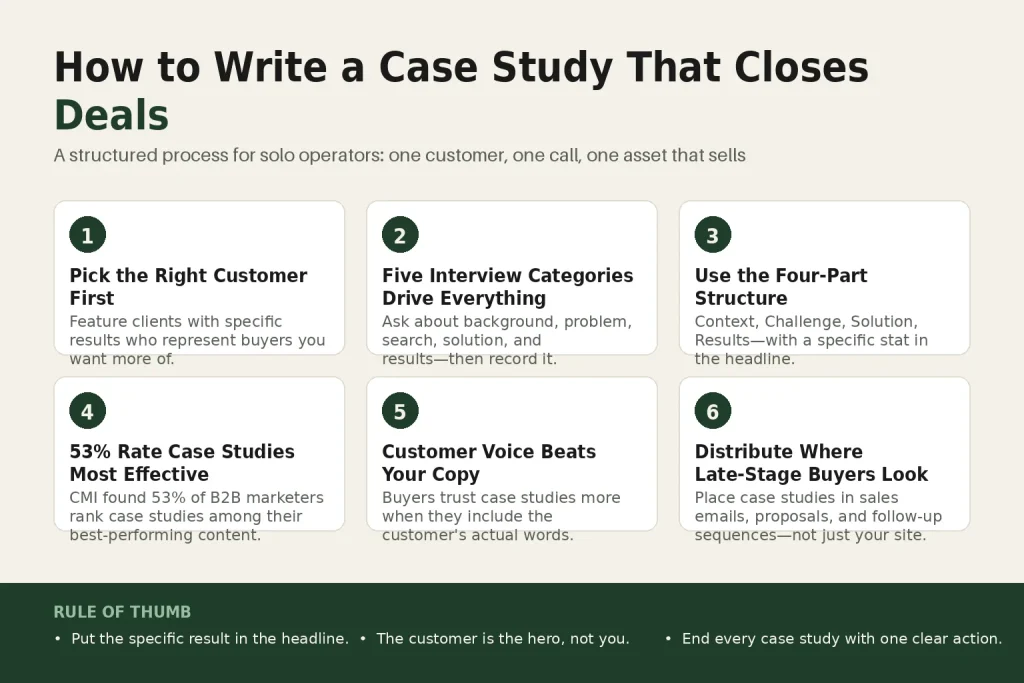
The 30-second answer
- Pick the right customer first. Choose someone whose result is specific, provable, and matches the type of buyer you want more of.
- Run a structured 30-60 minute interview. Ask five question categories: background, problem, search, solution, results. Record it.
- Use the four-part structure: Context, Challenge, Solution, Results. Put a stat in the headline.
- Lead with their outcome, not your features. The customer is the hero. You are the tool that made the win possible.
- Get a real quote for every section that needs one. Direct customer language is more credible than anything you write about yourself.
- End with a forward-looking quote and a single, clear call to action. Give the reader an obvious next step.
- Distribute it where late-stage buyers look: your sales emails, proposals, and a dedicated page on your site.
Take this fix into your next scenario. The free Builder’s Companion Kit collects the checklists and templates that pair with this guide — so next time, you start from a template, not a blank page. Grab it free →
- Why Case Studies Close Deals That Other Content Can’t
- Step 1: Pick the Right Customer to Feature
- Step 2: Run the Interview With Five Question Categories
- Step 3: How to Write a Case Study Using the Four-Part Structure
- A Worked Example: From Raw Interview Notes to Finished Case Study
- Using AI to Draft Without Outsourcing Your Judgment
- The Four Mistakes That Make Case Studies Useless
- Where to Put Your Case Study Once It Exists
- FAQ
Knowing how to write a case study that actually closes deals is one of the highest-return skills you can own as a solo operator. A case study is not a testimonial padded to two pages, and it is not a brochure disguised as a story. It is a documented before-and-after with a real person’s name on it, specific numbers in the results section, and enough detail that a prospect reading it thinks: “that’s my situation.”
The stakes are real. Sales pages do the broad persuasion work, but case studies step in at the exact moment a buyer is comparing you to two other options. The Content Marketing Institute’s B2B Content Marketing Benchmarks, Budgets, and Trends: Outlook for 2025 (fielded with MarketingProfs, June, August 2024, n=980 B2B marketers) found that 75% of B2B marketers used case studies and customer stories as a content type in the prior 12 months, making it the third most widely deployed format behind short articles and video. That same report found that 53% of B2B marketers rated case studies and customer stories among their most effective content types. Separate analysis from Demand Gen Report’s 2024 B2B Buyer’s Survey consistently points to peer proof and in-depth research as the most trusted guidance for late-stage buying decisions. That is a different job than a blog post or a social ad. Those assets create awareness. A case study creates confidence.
The good news: you do not need an agency, a ghostwriter, or a big production budget. You need a willing customer, a one-hour call, and a process. This guide gives you the process.
Why Case Studies Close Deals That Other Content Can’t
Most marketing content answers the question “what do you do?” A case study answers the question a buyer is actually trying to answer late in the process: has this worked for someone like me?
The Content Marketing Institute’s B2B Content Marketing Benchmarks, Budgets, and Trends: Outlook for 2025 (fielded with MarketingProfs, June, August 2024, n=980 B2B marketers) found that 75% of B2B marketers used case studies and customer stories as a content type in the prior 12 months, placing them third on the list of most widely deployed content formats, behind only short articles (92%) and video (76%). That same report found that 53% of B2B marketers rated case studies and customer stories among the content types that deliver their best results. Demand Gen Report’s 2024 B2B Buyer’s Survey points to peer proof and in-depth research as the most trusted guidance for late-stage buying decisions. That is a different job than a blog post or a social ad. Those assets create awareness. A case study creates confidence.
There is also a trust dimension that no amount of feature copy can replicate. When a real customer says, in their own words, what changed for them, that carries more weight than anything you write about yourself. Buyers consistently say they trust case studies more when they include the customer’s actual voice, not a paraphrase.
The mistake most solo operators make is skipping case studies entirely, or writing them as vague “client spotlight” pieces with no numbers and no conflict. Those do nothing. A case study with a specific result in the headline (“How [Customer] cut onboarding time by 60% in six weeks”) is a different asset entirely. It pre-sells your ability to deliver before a prospect ever speaks to you.
Step 1: Pick the Right Customer to Feature
The customer you choose shapes everything downstream. A great subject has three qualities.
- A specific, measurable result. “They were really happy” is not a result. “Revenue from repeat customers grew 40% in 90 days” is a result. If you cannot find a number, look for a percentage, a time saved, a cost avoided, or at minimum a clear directional change with a timeline.
- They represent a buyer you want more of. The case study will attract people who see themselves in it. If you want more e-commerce clients, feature an e-commerce client. If you want more professional service firms, feature one of those. Publishing a case study about a client who was a one-off exception is a waste of both your time and your customer’s goodwill.
- They are willing and able to go on record. Willing means enthusiastic enough to give you a real hour and a real quote. Able means no legal or compliance wall blocking them from naming numbers. If they can’t share hard figures, ask for percentages or directional language (“revenue roughly tripled”). If they can’t share even that, focus on qualitative wins and save the case study slot for a client who can be more specific.
One thing I’ve gotten wrong myself: I once featured a client because the result was genuinely impressive, but their business was so niche that almost no one reading the case study could relate to the situation. The case study sat there looking polished and did very little for pipeline. Relatability matters as much as the size of the win.
If you are not sure which customers to approach, your recent retention data is a good starting point. The clients who stayed, expanded, or referred others are natural candidates. The article on reducing customer churn covers how to identify your highest-value relationships, which maps directly onto who to ask for a case study.
Step 2: Run the Interview With Five Question Categories
The interview is where your case study gets written, even if you do not know it yet. A 30-to-60-minute recorded conversation, transcribed afterward, gives you everything: the quotes, the before-state details, the specific numbers, and the language your customer uses to describe the problem. That last part is gold. Their words are almost always clearer and more persuasive than anything you would write from scratch.
Structure the call around five categories:
- Background. Who are they, what do they do, what did their situation look like before they found you? Keep this brief. Two or three minutes of context.
- The problem. What was in the way? What was the cost of the problem, in time, money, or stress? What had they already tried that did not work? This is the “before state,” and it needs to be specific enough that a reader with the same problem feels it.
- The search. What were they looking for in a solution? What made them choose you over alternatives? This section is where competitive differentiation lives, and it often contains your best marketing copy because it is their authentic reasoning, not yours.
- The solution. How did implementation go? What specific things did they do or use? Ask about both the smooth parts and the friction, because a case study that acknowledges some bumps reads as more credible, not less.
- The results. What specific metrics changed? What does their situation look like now versus before? Ask for before-and-after numbers. If they resist giving hard figures, ask: “If you had to give a rough percentage, what would it be?” Often that unlocks a usable number.
Record the call (with permission) and use a transcription tool to turn it into searchable text. You are not mining for words to put in their mouth. You are mining for the most precise version of what they already said. Pull out the two or three quotes that best represent the before state, the decision to choose you, and the result. Those three quotes become the spine of the case study.
If you need a model for how to gather structured customer input before the interview, the process in the customer survey guide is directly applicable to building a pre-interview questionnaire.
Step 3: How to Write a Case Study Using the Four-Part Structure
Once you have the interview transcript and your key quotes pulled, the writing is mostly assembly. The four-part structure works because it mirrors how a buyer’s brain processes a decision: it wants to know who this is about, what the problem was, what was done about it, and whether it worked.
The headline
Put the result in the headline. This is not a place for a brand tagline or a clever turn of phrase. It is a place for a specific, scannable outcome. Format: “How [Customer Name/Type] [achieved X result] in [timeframe]”. Examples: “How a 12-person accounting firm cut proposal prep time by half,” or “How a regional HVAC company grew service contract renewals by 35% in one quarter.” If you cannot write a specific headline, you do not yet have a specific result. Go back to the customer and dig deeper.
Part 1: Context
Introduce the customer in two to four sentences. Name, industry, company size, and the relevant thing they were trying to do. You are giving the reader enough to decide whether this person is like them. Do not pad this section. A reader who does not see themselves in the customer will stop reading.
Part 2: Challenge
Describe the problem they faced, including the cost or consequence of leaving it unsolved. Use their words where possible. This section needs to feel like it was written by someone who lived the problem, because it was. A thin challenge section (“they were having trouble with X”) gives the reader nothing to connect with. A specific challenge section (“every Monday they rebuilt the same report by hand, which took three hours and still had errors that cost them client credibility”) makes a reader nod.
Part 3: Solution
Explain what they did, not what you offer. The distinction matters. Describe the specific steps, the sequence, and any decision points along the way. Include one quote from the customer about why they chose you over alternatives. If there were bumps in implementation, acknowledge them briefly. Authenticity here pays off in reader trust.
Part 4: Results
This is the section that sells. Lead with the hardest number you have. Follow with supporting metrics. Then close with a forward-looking quote from the customer, something about where they are headed now or what they would tell someone in their previous situation. That quote becomes the last thing a prospect reads before deciding whether to contact you.
Keep the whole piece between 600 and 1,200 words for a written version. Break it up with subheadings, short paragraphs, and a pull-quote box highlighting the strongest stat. A skimming buyer needs to extract the key result in under 30 seconds.
A Worked Example: From Raw Interview Notes to Finished Case Study
Here is the full process in action, from the first question on the call to the finished piece. Suppose you run a bookkeeping service for small product businesses.
The customer and the situation
Who you’re featuring: A 6-person outdoor gear brand that sells through three channels: their own Shopify store, a major online marketplace, and a wholesale account with a regional retailer.
Why you approached them: They had been a client for eight months, their month-end close time had dropped significantly after onboarding, and they had referred two other clients. All three signals pointed to a strong case study candidate.
Raw interview notes (condensed)
You run the 45-minute call and record it. After transcription, your notes look something like this:
- Background: Six-person team. Founder handles ops and finance. No dedicated bookkeeper before hiring you. Been in business four years.
- Problem (their words): “We were spending about two full days every month just chasing down which numbers were right. It was holding up invoices and making our accountant charge us extra because we always handed things over late.” Every month-end was a scramble. Reconciling three sales channels by hand. Sales tax was a recurring headache. Errors on invoices cost them client credibility twice in one quarter.
- What they tried before: A part-time bookkeeper who quit after three months. A spreadsheet system the founder built that worked fine until the marketplace added a new fee category.
- Why they chose you: “You were the only one who already knew how [marketplace name] reports commission splits. Everyone else said they’d ‘figure it out.’”
- Implementation: Setup took one afternoon. First month had one correction on a marketplace fee classification. Resolved in 20 minutes on a call. No issues since.
- Results (their words): Month-end close went from 14 days after the period to 4 days. Accountant’s monthly bill dropped by roughly $400 because they were no longer handing things over late. “I didn’t expect it to be that fast. I wish we’d done it two years ago.”
What you pull from the transcript
From those notes, you identify three anchor quotes:
- Before state: “We were spending about two full days every month just chasing down which numbers were right.”
- Why they chose you: “You were the only one who already knew how [marketplace name] reports commission splits.”
- Result: “I didn’t expect it to be that fast. I wish we’d done it two years ago.”
Every number you use (14 days, 4 days, $400/month) came directly from what they said on the call. You verify each one before it goes in the draft. If anything is fuzzy, you email them to confirm before publishing.
The finished case study
- Headline: How a 6-person gear brand cut month-end close from 14 days to 4
- Stat box (top of page): 10 days faster. $400/month saved. Setup: one afternoon.
- Context (2 sentences): [Customer] makes and sells outdoor gear through their own site, a major marketplace, and a wholesale account. With six people on the team, everyone wore multiple hats and no one had dedicated time for bookkeeping.
- Challenge (4 sentences): Every month-end turned into a two-day investigation. Reconciling three sales channels by hand left room for errors that slowed invoice delivery and cost them extra in accountant fees. A part-time bookkeeper and a founder-built spreadsheet had both failed to keep up as the business grew. “We were always handing things over late,” [Customer] said. “It was embarrassing and it was costing us money.”
- Solution (4 sentences): They brought on [your service] to handle the channel-by-channel reconciliation automatically. Setup took one afternoon. There was one fee-classification correction in the first month, resolved on a 20-minute call. “You were the only one who already knew how [marketplace] reports commission splits,” [Customer] said. “Everyone else said they’d figure it out.”
- Results (4 sentences): Month-end close now takes four days instead of fourteen. Their accountant’s bill dropped by roughly $400 a month. The team no longer touches the reconciliation at all. “I didn’t expect it to be that fast,” [Customer] said. “I wish we’d done it two years ago.”
That finished version runs to about 280 words. Add the stat box and subheadings and a prospect can extract the core result in under 90 seconds. The three quotes do the credibility work. The numbers do the persuasion work. You assembled it; the customer wrote it.
One last step before it goes live: send the finished draft to the customer for approval. They confirm the numbers are accurate, the quotes sound like them, and nothing is misrepresented. That sign-off protects both of you and keeps the case study credible for as long as it lives on your site.
Using AI to Draft Without Outsourcing Your Judgment
AI can cut the time between “I have a transcript” and “I have a first draft” from two hours to twenty minutes. That is where its value lives in this workflow. What it cannot do is decide which quotes carry the most weight, verify that a number is accurate, or determine whether the customer’s story will resonate with the specific buyer you are trying to reach. Those calls stay with you, always. The judgment, the fact-checking, and the final sign-off are yours. AI gives you a faster path to a first draft. It does not reduce what you owe the reader in accuracy and care.
A practical approach: paste the transcript into your AI tool of choice, and give it this prompt structure: “You are writing a case study. Here is the transcript. The target reader is [describe your ideal prospect in one sentence]. Extract the three strongest quotes, one from the before state, one about why they chose us, and one about the results. Then draft a 700-word case study in four sections: Context, Challenge, Solution, Results. Use the customer’s language wherever possible. Do not add results, numbers, or quotes that are not present verbatim in the transcript.”
That last instruction is not optional. AI will occasionally smooth out vague answers into confident-sounding specifics. It fills gaps the way a good writer would, except it has no way to know whether what it filled is true. Read every draft carefully against the transcript before you touch a word. Three things to verify on every pass:
- Every quote. Did the customer actually say that, in those words? If the AI paraphrased, rewrite it to match the transcript exactly or cut it.
- Every number. Where did it come from? If it is not in the transcript or a document you provided, delete it and go back to the customer to confirm.
- Every characterization. Would the customer recognize how their situation is described? If not, fix it before it ships.
The draft is a structural scaffold and a time-saver. You are the editor, the fact-checker, and the person who signs off on accuracy. AI speeds up the mechanical work of getting words onto a page. The harder work, knowing what matters, what rings true, and what a real buyer in your market will find credible, stays with you and does not get faster just because a tool helped. If anything, AI assistance raises the bar on your review, because it can generate plausible-sounding errors faster than you can catch them on a quick skim.
For more on this kind of human-in-the-loop workflow, the piece on writing marketing copy with AI covers the same principle across other content types.
The Four Mistakes That Make Case Studies Useless
Most case studies that fail do so for one of four reasons.
- No specific result in the headline or summary. If a prospect has to read the whole piece to find out whether it worked, many of them will not bother. The result goes at the top.
- Too much sales spin, not enough customer voice. Buyer research consistently identifies over-polished marketing language as a primary reason a case study loses credibility. Write it like a journalist, not a brochure copywriter. Let the customer carry the story.
- The challenge section is vague. “They were struggling with growth” tells a reader nothing. The challenge needs to be specific enough to hurt a little. If a reader with the same problem reads it and does not feel recognized, the case study has failed at its most important job.
- No call to action. A case study that ends with the results section and nothing else leaves the reader with nowhere to go. End with a single, direct next step. “If this sounds like your situation, here’s how to talk to us.” That is all it needs to be.
There is also a fifth mistake that is less about writing and more about distribution: publishing a case study and leaving it only on a hidden corner of your website. Late-stage buyers do not always browse your resources page. Put your case studies in your sales emails, in your proposals, and in the follow-up sequence you send after a discovery call. The lead follow-up process guide covers exactly where in a follow-up sequence a case study belongs.
Where to Put Your Case Study Once It Exists
A written case study page on your site is the foundation. It is indexable, shareable, and linkable. But it should not be the only place the case study lives.
Sales emails and proposals. This is where case studies do their heaviest lifting. When a prospect is comparing you to two other vendors, a one-line reference (“See how [Customer Name] solved this same problem”) with a link to the full case study is one of the highest-converting things you can drop into an email.
A one-page PDF summary. Create a stripped-down version with the headline stat, a short challenge/solution/result summary, and the strongest quote. Use this as an attachment in proposals. It is easy to forward inside a buying organization, which matters because late-stage B2B decisions often involve more than one person.
A short-form version for email. Pull the headline stat and a 75-word summary and use it in your regular email newsletter as a “client result” feature. Link to the full piece. This works well as part of a structured welcome email sequence for new subscribers who are evaluating you for the first time.
Social proof on landing pages. A case study excerpt, formatted as a pull-quote with the customer’s name, company, and result, functions as social proof on any page where you are asking someone to take action. The principles in the customer testimonials guide apply here: attribution is what makes a quote credible. “A customer said X” is not the same as “[Full Name], [Title], [Company] said X.”
FAQ
how long should a case study be
For most solo operator use cases, 600 to 1,200 words works well for the written version. Shorter than that and you lose the challenge-and-solution detail that makes a case study credible. Longer than that and most buyers will not finish it. A one-page PDF summary (around 250-300 words) is a separate asset, not a replacement.
how do you ask a customer for a case study
Be direct and make it low-friction. Tell them you want to share their story to help others in a similar situation, that it will take about 45 minutes on a call, that you will do all the writing, and that they will approve the final piece before it goes anywhere. Timing matters: ask right after a milestone result, not months later when the win feels distant.
can you write a case study without hard numbers
Yes, but you have to work harder to be specific. Use time saved, percentage improvements, directional language with a timeframe, or qualitative wins that are described concretely. ‘The process that used to take a full Monday now takes two hours’ is not a hard number, but it is specific enough to be useful. Vague wins (‘they saw significant improvement’) are not.
what is the difference between a case study and a testimonial
A testimonial is a short statement of satisfaction. A case study is a documented story with a before state, a specific problem, a solution, and measurable results. A testimonial tells a buyer that someone was happy. A case study tells them why, how, and what changed. They serve different jobs, and the case study is the one that moves late-stage buyers.
how do you write a case study title
Put the result in the title, not a clever phrase. The format ‘How [Customer/Customer Type] [achieved X result] in [timeframe]’ works reliably. If you can include a specific number, use it. Titles with concrete outcomes get read; titles without them get skipped.
should a case study include negative information or setbacks
Including a brief acknowledgment of friction, implementation challenges, or a bump in the road actually increases credibility rather than hurting it. A case study that reads as entirely frictionless feels polished to the point of being unbelievable. One or two sentences about what was harder than expected, followed by how it was resolved, makes the rest of the story more trustworthy.
Sources:
Research and methodology claims in this article are grounded in the following sources, verified as of October 2026: Content Marketing Institute, B2B Content Marketing Benchmarks, Budgets, and Trends: Outlook for 2025 (fielded with MarketingProfs, June 25, August 16, 2024, n=980 B2B marketers), which documents that 75% of B2B marketers used case studies and customer stories as a content type in the prior 12 months (third most widely deployed format, behind short articles at 92% and video at 76%), and that 53% of B2B marketers rated case studies and customer stories among the content types delivering their best results (second-highest effectiveness rating in the category, behind video at 58%). Both figures are published on the CMI live research page at contentmarketinginstitute.com/b2b-research/b2b-content-marketing-trends-research-2025 and are verified against that source as of October 2026. Content Marketing Institute, B2B Content and Marketing Trends: Insights for 2026 (fielded with MarketingProfs, June 24, August 14, 2025, n=1,015 B2B marketers), which confirms continued high adoption and effectiveness ratings for case studies and customer stories in the B2B content mix; Demand Gen Report, “2024 B2B Buyer’s Survey” (full title: Discerning B2B Buyers Rely On Vendor Knowledge, In-Depth Research and Peer Reviews to Guide Buying Decisions), which documents buyer reliance on peer proof and in-depth research as primary guidance for purchase decisions; Forrester, The State of Business Buying, 2026 (press release January 21, 2026, based on Forrester’s Buyers’ Journey Survey of nearly 18,000 global business buyers), which documents buying group size and buying cycle complexity; Salesforce Small Business Blog, “How to Write a Case Study That Builds Trust” (salesforce.com/blog); ClickUp Blog, “How to Write a Case Study” (clickup.com/blog); MarketHire Blog, “47 Marketing Case Study Questions” (markethire.com); Senja Blog, “45 Case Study Questions” (senja.io); RingCentral Blog, “How to Write a Case Study” (ringcentral.com); StoryFlow, “How to Write a Case Study, Step-by-Step 2026” (storyflow.so); Fryerhq, “Case Study Statistics 2025” (fryerhq.co.nz). Note: the article’s earlier attribution of a “73% of decision-makers” figure has been removed. No such figure appears in the CMI 2025 or 2026 B2B research verified against live CMI documentation. The Forrester claim that case study consumption is “concentrated in the final third of the buying cycle” is not attributed to a specific Forrester stat that could be independently verified in current public documentation; the article instead characterizes Forrester’s documented findings on buying complexity and buyer risk-aversion directionally, without assigning a specific percentage to case study consumption timing.
Brian Kasday spent forty years in direct-response marketing before rebuilding the whole operation as a one-person shop. He writes The Operator’s Library — including “Build a Complete Marketing Department” — for operators who’d rather build it themselves than wait on someone else.
Get the Builder’s Companion Kit — the free checklists and templates that pair with this guide: mmsvegas.com/resources.
This guide handles one marketing job. Build a Complete Marketing Department builds the whole department. See the manual →
More Marketing guides
Free · Marketing Operator Toolkit
Running marketing on your own?
Get the free toolkit — the templates and the expensive mistakes behind a one-person marketing department, plus a note when this guide changes.
Get the free toolkit →