
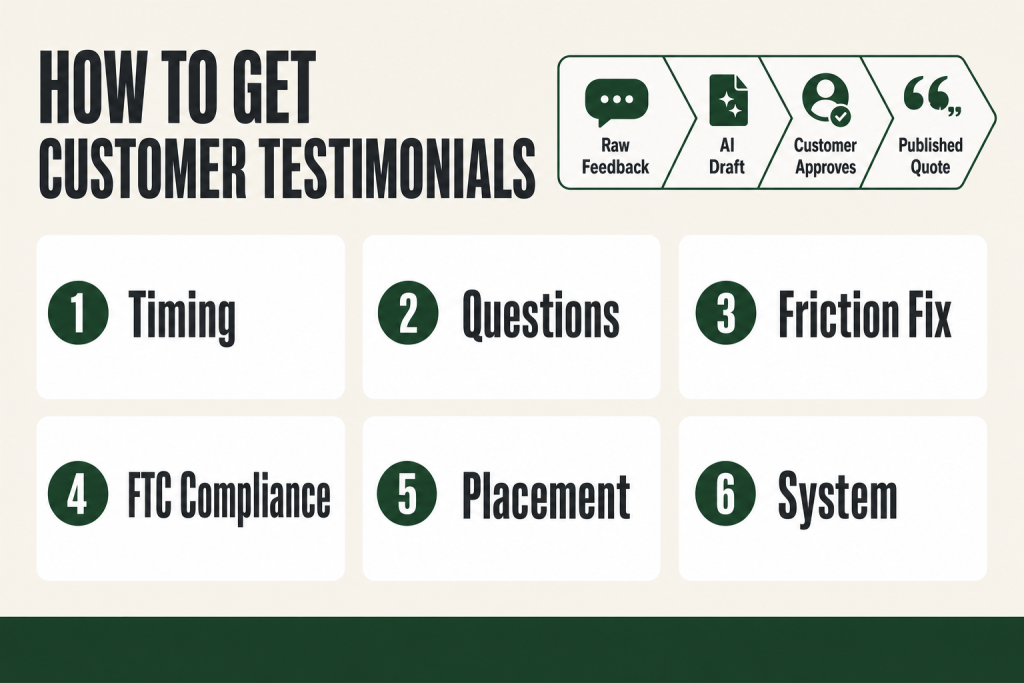
The 30-second answer
- Ask at the peak moment: right after a deliverable lands, a result shows up, or the customer says something positive out loud.
- Make it specific: send three short questions instead of an open-ended invite. Questions produce quotes; invites produce silence.
- Kill the blank page: offer to draft a short testimonial from their answers and send it back for approval. Response rates rise sharply when customers only have to say yes or make a small edit.
- Get explicit permission: confirm in writing where the quote will appear (website, sales page, email). It is required and it removes hesitation.
- Place it where doubt lives: next to your CTA, beside your pricing, and just above the form. Proof belongs at the moment of decision, not buried at the bottom of an about page.
- Build a repeatable trigger: add one step to your post-project workflow so the ask goes out automatically after every win, not just when you remember it.
Take this fix into your next scenario. The free Builder’s Companion Kit collects the checklists and templates that pair with this guide — so next time, you start from a template, not a blank page. Grab it free →
- Why the Ask Feels Awkward (and Why That Feeling Is Wrong)
- When to Ask: Find the Peak Moment
- What to Ask: Three Questions Beat One Open Box
- How to Get Customer Testimonials Faster With AI (Without Faking Anything)
- Get Permission and Stay on the Right Side of the FTC
- Worked Example: A Service Business Collects Three Usable Testimonials in One Week
- Where to Put Testimonials Once You Have Them
- Build a Repeatable System So You Never Have to Remember
- FAQ
Knowing how to get customer testimonials is less a persuasion problem and more a timing and friction problem. Most solo operators wait too long, ask the wrong question, then feel awkward because they sense they are imposing. They are not imposing. They are asking a happy customer to spend two minutes helping other people make a good decision. The awkwardness comes from the ask landing at the wrong moment, or landing with no structure, so the customer stares at a blank text box and quietly closes the tab. This article fixes both.
Why the Ask Feels Awkward (and Why That Feeling Is Wrong)
The discomfort is not irrational. You are asking someone to spend their time on your behalf. But notice what is happening when the ask feels worst: you are sending it cold, with no context, and no direction. The customer has to figure out what to write, how long it should be, and what you actually want. That is a cognitive chore disguised as a favor.
Flip the frame. You are not asking for a favor. You are offering to amplify a win they already had. When a client is genuinely thrilled with a result, sharing that story costs them almost nothing and often benefits them: their name and company appear on a site that new buyers visit. A well-placed quote on your sales page or service page is real exposure for the person quoted, especially in B2B contexts where a backlink or mention has value.
The other reason operators feel awkward is that they ask too late. Reaching out long after working together may not yield the best results, as the client may have forgotten key details. Vague timing turns a warm memory cold. Ask while the result is still in front of them.
When to Ask: Find the Peak Moment
Timing does more work than wording. If you want better testimonials, improve your timing before you improve your wording. One of the biggest reasons testimonial requests fail is simple: the ask comes at the wrong moment, not when the customer feels most positive, but whenever the business happens to remember to send it.
Think of it like catching a wave. There is a short window where everything is moving in the right direction. For service businesses, that window is usually within 24 to 48 hours of a successful delivery or a visible result. A “high moment” is a point in the customer journey where satisfaction peaks. This often happens after a significant achievement, a successful project completion, or the resolution of a difficult issue.
For product businesses, the timing is a bit different. Product-based businesses must balance timing between allowing sufficient usage time and maintaining purchase enthusiasm. Research suggests 14 to 30 days post-purchase hits the sweet spot for most consumer products, providing enough time for genuine experience while avoiding the fade of initial excitement.
There is one more trigger that most operators miss: unsolicited praise. When a client sends a “just wanted to say thank you” email or mentions how happy they are on a call, that is your cue. Right after you have pleased your client and they seem grateful, you can directly ask: “Do you mind if I post your words as a testimonial? It’d mean a lot for my business.” That is not pushy. That is reading the room.
If you run any kind of subscription or recurring service, tie requests to milestones rather than arbitrary calendar dates. Subscription-based businesses find success with milestone-based requests, tying testimonial asks to customer achievements such as hitting usage milestones. These milestone moments create natural opportunities for reflection on value received.
What to Ask: Three Questions Beat One Open Box
The number one reason testimonial requests go unanswered is what you might call the blank-page problem. Customers open your form, see an empty text box, and close the tab. They are not uninterested. They just do not know where to start.
The fix is to replace the open invitation with three short, specific questions. Instead of asking for a generic testimonial, ask specific questions: “What was your biggest challenge before using our product?” and “What results have you seen?” This produces testimonials that tell a story rather than offering empty praise.
Here is a set of questions that consistently produces usable quotes. Send two or three, not all five at once:
- “What was going on before you started working with us, and what made you look for help?”
- “What specific result surprised you most?”
- “If a friend asked whether to work with us, what would you tell them and why?”
- “What is one thing that is easier now than it was before?”
- “Can you put a rough number on the time or money this saved or made you?”
That last question matters. A testimonial that says “Our team went from 12 missed deadlines a quarter to zero” carries far more weight than one that says “Great product, highly recommend.” Specificity is what transforms a generic compliment into social proof that actually converts.
Do not polish away the rough edges in the customer’s reply. A customer testimonial may not always be slick or refined, and that is perfectly okay. Real language works. Accommodating imperfections and quirks makes the testimonial appear real. Edit for clarity. Never edit out the personality.
Also: when asking for a testimonial, personalization matters. Address your client by name and reference specific projects or interactions to show you value their input. A personalized request makes clients feel appreciated and increases the likelihood of a positive response.
How to Get Customer Testimonials Faster With AI (Without Faking Anything)
AI does not replace your judgment here, and it does not replace the need for a real human to own this process. You still decide who to ask, when to ask, and what to do with what you get. What AI cuts is the friction: yours and your customer’s. The judgment and all final calls stay with you.
Use 1: Generate the right questions for this specific customer. Feed your AI assistant a quick description of who the client is, what you did for them, and what outcome they got. Ask it to produce five specific questions targeting before-and-after results. The typical request, “Can you write us a testimonial?”, produces generic praise. Instead, use AI to generate specific questions by telling it the customer’s use case and the outcomes you want the quote to mention. Better questions produce better testimonials.
Use 2: Draft the request email itself. If writing the ask feels awkward, prompt your AI to draft a short, casual email that explains what you need, includes the three questions, and offers to turn their replies into a draft they can approve. Keep your voice in the edit. The AI handles structure; you handle tone.
Use 3: Turn rambling feedback into a clean quote. Customers often send genuine but scattered feedback: a few sentences in a reply email, a comment on a call, a paragraph in a satisfaction survey. Customers rarely write polished testimonials; they send rambling emails or give scattered verbal feedback. AI cleans it up: paste the raw feedback and ask the tool to turn it into a polished testimonial under 50 words that highlights the key result, keeping the customer’s voice and not making it sound corporate.
Here is a prompt you can copy and adapt:
Here is raw feedback from a customer: [paste their words].

Turn this into a clean testimonial under 60 words. Lead with the result. Keep their voice. Do not add any claim they did not make. Also write a one-sentence pull quote I can use as a callout on my sales page.
Then send the draft back to the customer with a note like: “I turned your feedback into a short quote, feel free to edit anything or approve it as is.” The customer always reviews, edits, and approves the final version before it is published. That is the hard line. AI shapes the words; the customer owns the truth. Publishing an AI-generated quote as a real testimonial without customer approval violates both Google’s policies and FTC guidelines, so never skip this step.
For more on building a wider AI-assisted copy workflow, see the solo operator’s method for writing marketing copy with AI.
Get Permission and Stay on the Right Side of the FTC
This is not optional and it is simpler than it sounds. Two things matter.
First: get explicit written permission. Tell the customer exactly where the quote will appear: your website, a sales page, email newsletters, ads. Tell clients exactly where their words will appear. They will appreciate knowing about any backlink to their website, and this transparency makes them more likely to participate. A one-line reply saying “yes, go ahead” is enough. Keep it.
Second: testimonials must reflect genuine experience. Endorsements must reflect the honest opinions, findings, beliefs, or experience of the endorser and may not convey any representation that would be deceptive if made directly by the advertiser. The FTC’s Rule on the Use of Consumer Reviews and Testimonials went into effect on October 21, 2024 (the proposed rule was published in June 2023 and the Endorsement Guides were updated in July 2023), and it addresses deceptive conduct involving reviews and testimonials. The rule authorizes courts to impose civil penalties for knowing violations, because fake, false, or otherwise deceptive reviews and testimonials have, according to the agency, polluted the marketplace.
In practice this means: do not invent results, do not cherry-pick an outlier result without disclosing it is atypical, and if you offered any incentive for the testimonial, you need to say so clearly wherever you display it. Most small service businesses are not offering incentives, so this is usually not an issue. But if you ran a discount or gift in exchange for a review, disclose it. The FTC is serious about this, and the Endorsement Guides were updated in 2023 while the final Rule on Consumer Reviews and Testimonials took effect in October 2024. When in doubt, read the current guidance at ftc.gov or ask a lawyer.
Worked Example: A Service Business Collects Three Usable Testimonials in One Week
Here is how this plays out end to end. Say you run a bookkeeping service. You just finished a client’s quarterly close and they sent you an email that says: “Really appreciate you catching that payroll discrepancy. Saved us a headache.”
Step 1: Reply immediately. Do not wait. Write something like: “Really glad that helped, it was a good catch. Would you be willing to share a short quote I could use on my website? No pressure at all. If yes, here are three quick questions you can just reply to:”
- “What was the situation that made you look for a bookkeeper?”
- “What has changed most since we started working together?”
- “What would you tell someone who was on the fence about hiring help?”
Step 2: Paste their reply into your AI assistant. Prompt: “Turn this into a clean testimonial under 60 words. Lead with the concrete result. Keep their voice. Do not add anything they did not say. Also write a one-sentence pull quote.”
Step 3: Send the draft back for approval. Something like: “I pulled this together from your answers, feel free to edit anything or just say ‘looks good.’ Also, would you be okay with me using your name and company?”
Step 4: Publish and place it correctly. One quote goes next to your pricing or inquiry form. Another goes in your email welcome sequence. A third goes on your landing page near the CTA. Placing testimonials just before or after the main call to action reduces last-minute hesitation. When visitors see proof right before clicking or submitting a form, they feel more confident taking the next step.
That is the whole system. It takes maybe 20 minutes across two or three emails. The testimonial does the selling for months.
Where to Put Testimonials Once You Have Them
Collecting is only half the job. Placement decides whether the proof actually converts anyone.
The core principle: put proof where doubt lives. Match the testimonial to the specific fear it answers at the exact spot on the page where that fear arises.
- Just above or beside your CTA button. Placing testimonials near key call-to-action buttons or in prominent sections of the landing page increases visibility and influences visitors’ decision-making.
- Beside your pricing. Use a quote from someone who mentions ROI, savings, or value. That is the objection your pricing page has to handle.
- Near your contact or inquiry form. Forms create friction. Testimonials placed beside or below forms reassure visitors that others have taken the same action successfully, reducing anxiety around sharing personal or business information.
- In your welcome email sequence. New subscribers do not know you yet. One specific client story in the second or third email does more work than another feature list. See how to structure a welcome email sequence for where this fits.
- On your lead magnet landing page. A quote from a past client who found the free resource genuinely useful adds credibility before anyone has spent a dollar. Building a lead magnet landing page that converts is a separate skill, but testimonials are one of the fastest ways to lift an existing page.
One thing to get right on specificity of placement: place testimonials at the point in the page where the related objection is most likely to arise. A quote about ROI goes on the pricing page. A quote about easy setup goes in the features section. A quote from someone in the reader’s exact industry goes wherever you describe your target customer.
Even three to five specific, named testimonials beat a wall of anonymous one-liners. Quantity helps on social proof bars, but a handful of credible, detailed quotes will move conversions more than dozens of vague ones.
On the credibility signals: include the customer’s full name, role, and company where they are willing. Research on perceived credibility shows that including a photo of the person who left the testimonial increases perceived credibility. If you can get a short video, even better. Video testimonials convert two to three times better than text because they are harder to fake. Keep videos short, show the customer’s face, and ensure good audio quality. But do not wait for video to publish. A named, specific written quote beats an anonymous video every time.
If you want to think about where testimonials fit within a broader funnel, building a complete solo-operator sales funnel covers the full map.
Build a Repeatable System So You Never Have to Remember
One testimonial collected in a moment of inspiration is nice. A steady flow of them is a marketing asset. The difference is a trigger, not willpower.
Add a single line to your post-project checklist or your offboarding email template: “Send testimonial ask within 48 hours of final delivery.” That is it. The trigger does the reminding; the template does the asking. You make the final judgment call on which clients to prioritize for a personal ask versus a templated one.
Personal outreach yields higher response rates than automated emails, but does not scale. The most successful approach combines both: automated requests for general testimonials, and personal outreach for high-value clients or detailed case studies.
Keep a running document or a simple folder where approved testimonials live, tagged by industry, result type, and objection they answer. When you write a sales page, a landing page brief, or a new email sequence, you go there first and pull the right proof for the right moment. You will be surprised how often a quote you collected three months ago is exactly what your current page needs.
For a broader look at systematizing your marketing tasks this way, see how to build a one-page marketing SOP so nothing like this falls through the cracks.
FAQ
how to get customer testimonials when you’re just starting out and have no clients yet
Do a handful of beta or pilot engagements at a reduced rate in exchange for a detailed testimonial and permission to use it publicly. Be explicit about the trade upfront. Even two or three specific quotes from real people change the conversion math on a new sales page dramatically.
is it okay to write the testimonial for the customer and have them approve it
Yes, and it is often the most effective approach. Customers struggle with the blank page, not with their genuine satisfaction. You draft from their real words and feedback, send it back, and they approve, edit, or reject it. The final published version must reflect their actual experience. Never publish without their explicit approval.
can you offer a discount or gift to get a testimonial
You can offer an incentive, but the FTC requires you to disclose it wherever you display the testimonial. An incentivized review that appears unsponsored is a deceptive trade practice under the current rules. The safer and more credible path is to ask without incentives and rely on good timing and low-friction process instead.
how many testimonials do you actually need
Quality beats quantity. Three to five specific, named testimonials on a well-placed sales or landing page will outperform twenty vague anonymous ones. Build toward a small library of quotes that each answer a different common objection, and you will have what you need for every major page and email on your site.
what do you do if a customer says the testimonial but won’t put it in writing
Ask permission to write up what they said and send it to them for sign-off. Most people who said a kind thing verbally will approve a written version of it quickly. Keep the email trail. That approval email is your paper record.
how often should I ask existing happy customers for updated testimonials
Revisit long-term clients at natural milestones: a year in, after a major result, or at renewal. An updated quote often captures a richer result than the one you got right after the initial project. Just note the date on the testimonial so you are not running a five-year-old quote as if it were fresh.
Sources:
Sources consulted: FTC Endorsement Guides (16 CFR Part 255, updated July 2023, current via eCFR) and FTC Rule on the Use of Consumer Reviews and Testimonials (16 CFR Part 465, effective October 21, 2024), available at ftc.gov; FreshBooks guide to asking for testimonials (updated March 2025); Testimonial.to resources on timing and question strategy; testimonialstar.com on post-purchase timing windows; shoutjar.com on specificity and credibility signals; sayabout.us on testimonial versus case study conversion mechanics; Testimonix.io on AI-assisted draft-and-approve workflows; aimadefor.com on AI prompts for testimonial collection; wiserreview.com on landing page placement; elocent.com on objection-matched placement.
Brian Kasday spent forty years in direct-response marketing before rebuilding the whole operation as a one-person shop. He writes The Operator’s Library — including “Build a Complete Marketing Department” — for operators who’d rather build it themselves than wait on someone else.
Get the Builder’s Companion Kit — the free checklists and templates that pair with this guide: mmsvegas.com/resources.
This guide handles one marketing job. Build a Complete Marketing Department builds the whole department. See the manual →
More Marketing guides
Free · Marketing Operator Toolkit
Running marketing on your own?
Get the free toolkit — the templates and the expensive mistakes behind a one-person marketing department, plus a note when this guide changes.
Get the free toolkit →