
Last updated: July 2026
Price elasticity of demand is the measure of how sensitive your customers are to a change in your price. By the end of this page, you should be able to look at any product or service you sell, diagnose whether demand is elastic or inelastic, and make a confident, data-informed call about whether to raise prices, discount, bundle, or hold the line.
That sounds academic. It isn’t. Think about the last time you wrestled with a pricing decision. Do I run a sale? Will a price increase drive customers away? Should I add a package deal? Every one of those questions has the same root: how much does the price actually matter to my buyer? Elasticity is the answer to that question, stated precisely.
The operators who understand this, even loosely, have a real edge over the ones just guessing. They know which products can absorb a price increase without a volume hit. They know which discounts will actually move units versus which ones just train customers to wait for sales. And they know how to use positioning to change their elasticity over time, not just react to it.
This isn’t about running regression models. It’s about thinking clearly about the relationship between your price and your customer’s decision, so you stop leaving money on the table and start protecting the margin that keeps your business alive.
The idea in 30 seconds
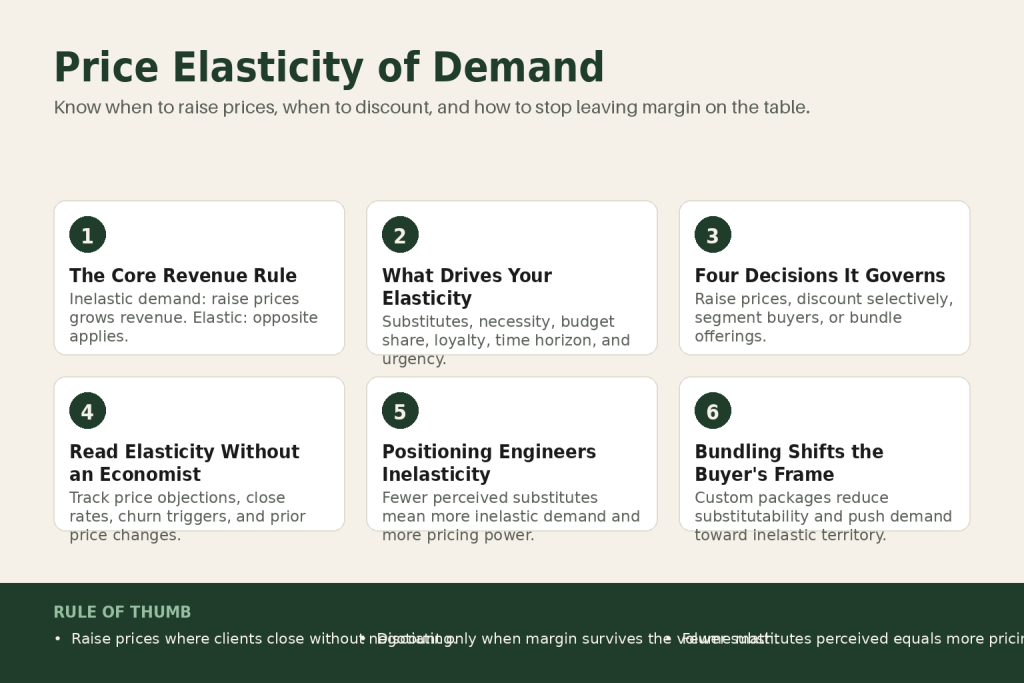
- Price elasticity of demand measures how much your sales volume changes when you change your price, and by how much.
- Elastic demand means a price increase loses you more in volume than you gain in margin. Inelastic demand means the opposite.
- Your goal as an operator is to understand where you sit on that spectrum, and then either exploit inelasticity (raise prices) or engineer it (through positioning, branding, and switching costs).
- Four levers flow from this: raise prices on inelastic products, discount selectively on elastic ones, bundle to shift perceived value, and segment to charge different buyers differently.
- Most small operators discount when they should raise prices, and raise prices when they have no positioning to support it. This page is about getting that call right.
Where Price Elasticity of Demand Came From
The formal concept dates to 1890, when British economist Alfred Marshall published Principles of Economics. Marshall gave elasticity a name, a formula, and a framework, turning what had mostly been folk observation into a calculable ratio that became a pillar of microeconomics.
The formula is straightforward: price elasticity of demand equals the percentage change in quantity demanded divided by the percentage change in price. An elasticity of 2 means a 10% price increase produces a 20% drop in sales. An elasticity of 0.4 means that same 10% increase only shrinks sales by 4%. The dividing line is elasticity = 1, called unit elastic, where the math is a wash.
For most of the 20th century, elasticity stayed in academic and corporate strategy circles. What changed was data. Point-of-sale systems, e-commerce analytics, A/B pricing tools, and CRM software have made it possible for a solo operator to observe their own demand curve in near real-time. The concept didn’t change. The access to it did.
The Core Mechanics: Elastic, Inelastic, and Everything In Between
The ratio is simple: divide the percentage change in units sold by the percentage change in price. The sign is almost always negative (price up, demand down), so by convention most people drop the negative and work in absolute values.
That gives you three zones. Elastic demand (above 1) means a price increase shrinks volume by a larger percentage than the price rose, you lose more in units than you gained in margin. Inelastic demand (below 1) means a price increase shrinks volume by a smaller percentage than the price rose, you keep most of your buyers even at the higher number, which is where raising prices actually makes you more money. Unit elastic (exactly 1) is the wash case, where gains in price cancel losses in volume dollar for dollar. In practice, almost nothing sits here permanently.
The revenue rule that follows directly, and it’s the most practically important thing on this page, is this: inelastic demand means raising prices grows total revenue; elastic demand means the opposite. Lower prices in elastic territory can grow total revenue, but only if your margins survive the math.
Most products land between 0.5 and 1.5 in real markets. Averages hide everything, though. Your best customer segment might be far more inelastic than your worst. Your signature service might be highly inelastic while your commodity add-ons are brutally elastic. The goal isn’t to calculate a single number for your whole business, it’s to think elastically about each product, service tier, and customer segment you actually serve.
One caution: elasticity isn’t fixed. It shifts with time horizon, competitive context, economic conditions, and, the part operators can actually influence, how you’ve positioned your offer. A product with three close substitutes and no differentiation is elastic by default. That same product with a clear story, strong reviews, and a loyal customer base can become meaningfully inelastic. That’s the whole logic behind brand building, stated as a pricing mechanic.
What Actually Drives Your Elasticity
Knowing the number is less useful than understanding why it is what it is, because the ‘why’ tells you whether you can change it.
Substitutes
The single biggest driver. The more options your buyer has that they perceive as equivalent, the more elastic your demand. A generic cleaning service in a city with forty competitors has elastic demand almost by definition. A highly specialized consultant with a documented method and client results starts to lose substitutes in the buyer’s mind. The operative word is perceivedtwo offers can be objectively similar but if one has stronger positioning, it faces less elastic demand.
Necessity vs. Discretionary
Products and services a buyer genuinely can’t easily skip, accounting, payroll software, essential medical supplies, tend toward inelastic demand. Things a buyer wants but can delay or forgo, a new website redesign, a conference ticket, an upgrade, are elastic. If your offering is framed as discretionary, you’ll fight price pressure forever. Reframe it as an operational necessity that solves a recurring painful problem, and your pricing power changes.
Proportion of the Buyer’s Budget
A $12 monthly software subscription barely registers. A $120,000 equipment purchase gets scrutinized from every angle. Smaller-ticket items tend to be less price-sensitive even when there are substitutes, because the cognitive cost of switching exceeds the savings. This is one reason SaaS companies often price at the low end of what their value justifies, renewals become nearly automatic when the line item barely registers.
Brand Loyalty and Switching Costs
When a customer has invested time, data, or workflow into your product or service, switching has a real cost, and that cost functions as a price buffer. Marketing that builds familiarity, trust, and habit creates loyalty that holds even when prices move. It’s one of the only levers operators control directly.
Time Horizon
Demand is almost always more inelastic in the short run and more elastic over time, as buyers find alternatives. Raise prices suddenly and dramatically, and short-run volume may hold, but watch the 6-month retention numbers. Gradual increases typically trigger less backlash than sudden large jumps, partly because of that short-run inertia.
Urgency
A plumber at 11pm on a holiday weekend has near-perfectly inelastic demand. That same plumber on a Tuesday afternoon in a competitive market? Much more elastic. Urgency compresses the buyer’s window for comparison shopping and locks in their decision at your price. Services positioned around urgency, emergency response, time-sensitive outcomes, fast turnaround, carry inherent pricing power most operators never fully use.
Price Elasticity of Demand: The Four Operator Decisions It Governs
Once you have a working sense of whether your demand is elastic or inelastic, even a rough, intuitive one, four major pricing decisions become much clearer.
Decision 1: Whether to Raise Prices
If your demand is inelastic, a price increase grows revenue. A media company documented in The Manager’s Mic raised a premium movie channel from $9.75 to $11.50 per month. They lost a couple thousand subscribers off a base of around 15,000, but monthly profit climbed to roughly $78,000, more than at the lower price. Volume loss was proportionally smaller than the revenue gain. That’s inelastic demand doing exactly what the formula predicts.
Most small operators undercharge for exactly the services where their demand is most inelastic, usually their most specialized, most results-driven, most-referred work. That’s where raising prices is the correct move, not a gamble. The test: raise your price on one SKU or service tier. Watch volume for 60 to 90 days. If you lose fewer customers than the math requires to break even on the increase, your demand is inelastic and you should probably keep going.
Decision 2: Whether to Discount
Discounts make sense when demand is elastic and you have margin to spare, lower prices grow volume by more than the margin you give up. They almost never make sense when demand is inelastic, because you’re surrendering margin for volume that would have come at the higher price anyway.
The trap: operators discount inelastic products out of nervousness, not necessity. A sale on something customers were going to buy regardless just trains them to wait for the next one. If your retention is high and your referrals are strong, those are signals of inelastic demand, and discounting in that environment destroys margin without adding customers.
One legitimate use: acquiring a new segment that’s price-sensitive while protecting existing pricing for your established base. That’s segmented pricing, which is the next decision.
Decision 3: Whether to Segment Prices
Different customer segments often have meaningfully different elasticities. Airlines charge business travelers a premium for last-minute fares because that segment is highly inelastic, they need to travel now and have no viable alternative. Leisure travelers book months out, comparison-shop obsessively, and are highly elastic. Airlines charge them less because the alternative is an empty seat.
An agency might charge a retainer premium for rush timelines (inelastic urgency) while offering a lower entry price for clients who can plan ahead (elastic, price-shopping). A software company might offer a stripped-down free tier for price-sensitive users and a fully-featured enterprise tier for buyers whose switching cost is high. Identify where elasticity differs across your buyer base, and price each segment near its own ceiling.
Decision 4: Whether to Bundle
Bundling is one of the most underused elasticity tools in a small operator’s kit. Package multiple products or services together and you shift the buyer’s frame of reference from individual item prices to the bundle’s overall value. A buyer who would have balked at a $400 add-on might accept a $1,200 package that includes it alongside things they were going to buy anyway, because the comparison point changed.
Bundling also reduces the perceived substitutability of your offer. A competitor can price-match a single service. It’s much harder to match a custom-packaged solution with specific inclusions, timelines, and guarantees. That reduced substitutability pushes demand toward inelastic.
Look at your two or three most commonly purchased services and your one or two highest-margin add-ons. Create a named package at a combined price that’s slightly better than buying separately, but protects your margin on the high-value items. Test it against existing à la carte pricing for 90 days.
Putting this to work? The ideas in the Canon are the foundation under the tactical playbook in Build a Complete Marketing Departmentgrab the free companion kit at mmsvegas.com/resources.
How to Read Your Own Elasticity Without Hiring an Economist
You don’t need a dataset the size of Amazon’s to get a working read on your elasticity. A few signals that are probably already in your business will do it.
Look at Your Price-Change History
Have you raised prices before? What happened? If you raised prices 15% two years ago and barely lost a customer, your demand was inelastic. If a 20% off sale barely moved units, your demand was probably inelastic too, and you gave margin away for nothing. Both are data points.
If you’ve never raised prices, that’s its own signal, you’ve been assuming elastic demand without evidence. Test it on new clients first. Quote higher. Watch close rates. That’s a real-world elasticity probe with no econometric model required.
Watch Your Close Rate vs. Price Objections
How often does price come up as the stated objection? If buyers rarely push back and close at or near your asking rate, that’s inelastic behavior. If price is the constant friction, every deal involves negotiation, every lost deal cites cost, you’re in elastic territory, either because you have real substitutes or because your positioning hasn’t made those substitutes irrelevant yet.
Track Churn Triggers
For recurring revenue businesses, churn data is gold. If customers leave when you raise prices (and say so), demand is elastic. If they leave for reasons unrelated to price, solved the problem, changed direction, left the market, demand was inelastic and you probably had room to charge more throughout the relationship.
Use AI as a Sounding Board
If you’re wrestling with a pricing decision, AI tools can help you structure the analysis, running through what elasticity factors apply to your specific market, flagging signals to look for, or helping you build a simple pricing experiment. The judgment and final call stay with you. But AI can cut the time it takes to go from ‘I’m nervous about raising prices’ to ‘here’s the specific test I should run.’
Run a Price Test
For e-commerce and digital services, A/B pricing tests are the most direct signal. Show different prices to different cohorts and measure conversion rate. The difference in conversion across price points is your elasticity made visible. For service businesses, raise prices on new clients while holding for existing ones, then compare close rates over a 90-day window.
How Real Businesses Use This, Named Examples
Apple is the clearest case. iPhone demand is consistently described as inelastic, the brand, the ecosystem, and the switching costs have collectively made buyers resilient to price increases. An Android user switching ecosystems loses their apps, their muscle memory, and their integration with other Apple devices. That friction doesn’t happen by accident. It’s the product of decades of positioning, product design, and ecosystem lock-in, all of which function as deliberate elasticity engineering.
Netflix raised prices on its plans in late 2024 and simultaneously added 19 million new subscribers in Q4 2024, reaching over 302 million globally. Revenue jumped 16%, topping $10 billion in a single quarter for the first time in the company’s history. Customers accepted the higher price because the content library, live sports, flagship originals, a growing ad-supported tier, made the service feel hard to replace. That’s a textbook inelastic demand outcome. The lesson isn’t that Netflix is invincible; it’s that they built enough perceived value and switching cost to absorb the increase without proportionate churn.
Uber’s surge pricing is the most visible real-time elasticity application in consumer services. When demand spikes, prices rise dynamically. Riders who need a car right now face inelastic demand, the urgency removes the option to wait. Drivers who see higher fares come online. The whole mechanism only works because Uber understands that demand elasticity shifts with urgency and time of day.
At the small-business scale: a specialized tax accountant serving business owners in a niche industry faces very different demand dynamics than a general bookkeeper. The specialist has fewer substitutes, serves clients for whom a mistake is genuinely costly, and operates in a context where switching is friction-heavy. That’s inelastic demand by the structural definition, and the specialist who understands this stops competing on price with people whose service is genuinely more substitutable.
Salesforce is the SaaS version of the same logic. After holding list prices flat from 2016 to 2023, Salesforce raised prices 9% in August 2023, and then again by 6% in August 2025. The reason they can do this repeatedly is switching cost. Once a company has built workflows, trained teams, and stored years of data inside Salesforce, the exit cost for a large enterprise is typically 18 to 36 months of disruption. Modest churn follows each increase. But for most customers, the exit cost far exceeds the price increase, which is inelastic demand in its most structural form.
Where Elasticity Thinking Applies for Small Operators
This isn’t a concept that only applies to product-based businesses or high-volume retail. It’s relevant any time you set a price.
Service businesses and agencies typically underestimate how inelastic their best work is. If you’ve built a reputation, have strong referrals, and work with clients who’d lose more by switching than by paying your rate, your demand is more inelastic than you probably assume. The fear of losing clients by raising prices is often not supported by what actually happens when operators test it.
Local retail and hospitality often face genuinely elastic categories, price comparison is happening, substitutes are visible, and the buyer has alternatives. But specific items can still be inelastic. The signature dish, the house coffee blend, the product you’re known for, those can hold a higher price when commodities around them can’t, because they’ve accumulated loyalty the generic category hasn’t.
E-commerce sits in elastic territory by default, because price comparison is one click away. The routes to inelasticity are brand (people who specifically want your product), curation (assembled value that reduces the substitutability of individual items), or recurring relationships that build switching cost over time.
Subscription and SaaS businesses have a peculiar dynamic: acquisition is elastic (people trial-compare and price-shop), but retention is often inelastic once the product is embedded. That asymmetry suggests low-friction entry pricing and aggressive value delivery early, then price increases after the switching cost has accumulated.
B2B professional servicesconsultants, lawyers, accountants, specialized contractors, often operate in some of the most naturally inelastic markets available. The cost of a bad outcome from the wrong provider far exceeds the cost difference between providers. Competing on price here is not just unnecessary, it actively signals the wrong thing.
Where This Framework Breaks Down
A few honest caveats.
You can’t always measure it. The formula requires actual data on volume responses to price changes. If you’ve never changed your price, you don’t have that data. You can make educated inferences, from close rates, from churn triggers, from how often price comes up in objections, but you’re working from signals, not measurements. Approximate understanding beats confident ignorance. Just don’t confuse your estimate with a calculated number.
Elasticity isn’t stable across time. A service that was inelastic in a seller’s market can become elastic when three new competitors enter. A luxury item that was discretionary can become essential-feeling as it shifts from novelty to habit. Economic downturns compress budgets and push buyers toward elastic behavior even in categories where they previously weren’t price-sensitive. The read you take today might not hold in 18 months.
Raising prices doesn’t always work, even with inelastic demand. If your price increase exceeds what the market perceives your value to be, regardless of the elasticity math, you’ll lose customers and damage your reputation. Inelastic demand has a ceiling. Even the most loyal customers have a number that makes them re-examine the relationship. The move is to raise prices alongside genuine value delivery, not to use inelasticity as a blank check.
Discounting elastic products can become a trap. If you lower prices to grow volume and it works, you’ve trained your customer base to expect that price. Returning to higher prices becomes its own elasticity test, and now you’re working against entrenched expectations. Promotional discounting should have a defined end date and a clear purpose.
The concept doesn’t tell you what to charge. It tells you how demand will respond to a change from wherever you currently are. You still need to know your costs, your positioning, and what the market can sustain. Elasticity is directional, not a price-setting formula.
Common Misunderstandings About Price Elasticity of Demand
Misunderstanding 1: Inelastic demand means customers don’t care about price. They do. Inelastic just means a price change doesn’t dramatically shift their buying decision, it doesn’t mean they’re indifferent. Even inelastic buyers have a ceiling. The lesson isn’t ‘charge whatever you want’; it’s ‘you have more room than you think before volume drops significantly.’
Misunderstanding 2: Elastic demand means you should compete on price. It means price matters to your buyers in this category, not that undercutting is your only option. You can differentiate enough to reduce substitutability, or find a sub-segment of the market that’s less price-sensitive than the average buyer. Competing purely on price in an elastic market is a race to the bottom.
Misunderstanding 3: Elasticity is an inherent property of your product. It’s shaped by perception, context, and marketing, not just what the product is. A commodity can become more inelastic through branding and switching cost creation. A differentiated service can become more elastic if the market doesn’t perceive the differentiation. Operators have more influence here than they typically realize.
Misunderstanding 4: You need lots of historical data to use this concept. The formula requires data. The thinking doesn’t. Even asking ‘what would happen to my close rate if I raised prices 20%?’, and reasoning from what you know about your buyers, your substitutes, and your positioning, is elasticity thinking applied practically.
Misunderstanding 5: Elasticity is the same across your whole business. It almost never is. Your most specialized service and your commodity add-on can have radically different demand curves even if they’re sold to the same client. Price each offer on its own terms.
Common Mistakes
- Applying one blanket pricing decision across the entire businessA consultant raised her retainer for all clients simultaneously, including the low-volume commodity work and the high-value specialized engagements. She lost two clients she could have kept by being selective. The fix: map your offerings by elasticity signals first. Price objections common? Elastic. Close without negotiation, renew without prompting? Inelastic. Raise prices only on the inelastic pocket. Leave the rest alone until you’ve tested.
- Running a sale on products or services your customers were already going to buyA home services company ran a 15% off promotion during their peak booking season, a period when their calendar was already nearly full. Total revenue dropped. Volume barely budged. The discount went entirely to buyers who had already decided to book. The fix: before any promotion, do a simple holdout test. Take a slice of your list, don’t send them the offer, and compare their purchase rate to those who received it. The gap is your actual incremental lift. If it’s small, you’re gifting margin.
- Treating a price increase as an all-or-nothing move on existing clientsMost operators either raise prices for everyone at once or avoid raising them at all. Both are wrong. The safer path: quote your higher rate to every new prospect first. Once three new clients accept, you have market proof, and a much easier conversation with existing clients at renewal. The new-client close rate is your elasticity probe. It costs you nothing to run it.
- Competing on price in an elastic category instead of escaping itA web design agency kept cutting rates to match cheaper competitors, compressing margin without improving win rates. The underlying problem wasn’t price, it was that buyers couldn’t tell them apart from the alternatives. The fix isn’t to undercut further; it’s to pick a specific client type, industry, or outcome you’re built for, and position around that. Fewer perceived substitutes means less elastic demand, and that change shows up in pricing power faster than most operators expect.
- Discounting without a defined exit plan, and accidentally making it permanentA SaaS founder offered a 30% launch discount to early users. Two years later, the segment was still on that pricing, and attempts to move them to standard rates triggered more churn than expected. The discounted price had become the anchor. The fix: any discount at launch or promotion should have an explicit end date in the agreement or communication, a clear reason tied to the circumstance (early adopter, off-peak booking, new-customer-only), and a stated return-to-standard price. Set the exit before you open the door.
Operator’s Take
Here’s what I actually think: most operators have the fear pointed in exactly the wrong direction. They’re most afraid to raise prices precisely where demand is most inelastic, on the best, most specialized, most-referred work. And they discount aggressively on things that are already elastic, making a structural margin problem worse. Same misread, two directions, both expensive.
The tell is usually in the close rate. Pull up your last 20 proposals. Where did clients say yes without negotiating? Where did they renew without being chased? Where do referrals come in already sold? That cluster is your inelastic pocket, and if you haven’t raised prices there in the last 12 months, you’re not being humble, you’re being imprecise. The fear of losing those clients is loudest exactly where they’re least likely to leave.
My actual recommendation: raise your price on the next three new-client quotes for that one service only. Don’t touch existing clients yet. Just quote higher to new prospects and track your close rate for 60 days. If you’re closing at roughly the same rate, or the deals you’re losing are ones you wouldn’t have wanted anyway, you were underpriced, and now you have market data rather than anxiety. Take that to existing clients at renewal. It’s a very different conversation when you can say ‘we’ve tested this.’
On discounting: before you run any promotion, answer one question honestly, would these buyers have purchased at full price anyway? If the answer is probably yes, you’re not running a marketing campaign, you’re gifting margin to people who didn’t ask for it. One pattern worth paying attention to: clients who fight hardest on price upfront often turn out to be the hardest to work with. Clients who accept your rate without much friction tend to be the better long-term relationships. Not a universal law, but consistent enough to be a signal.
On bundling: treat it as positioning, not discounting. A named package with a clear outcome is harder to comparison-shop than two line items on a quote. It shifts the buyer’s question from ‘how much does X cost?’ to ‘does this package solve my problem?’, which is a much better place to negotiate from. If your best clients almost always end up buying two things together, you already have a bundle. You’ve just been letting them assemble it piecemeal instead of pricing it intentionally.
One hard thing I’d push operators on: don’t confuse client loyalty with price tolerance. Your clients aren’t staying because your price is fine, many of them are staying because switching costs them time and risk they don’t want to absorb right now. That buffer is real, but it’s not infinite, and you won’t know its depth until you’ve pushed past it. Raise prices before the value is obvious to the client and you’ll find out the inelasticity was shallower than you thought. Deliver the value first. Move the number second. That order matters more than the size of the increase.
Used in
- ✓ Build a Complete Marketing Department
Used to guide offer and pricing architecture decisions, specifically, which services to position as premium and protect from discounting versus which to use as elastic entry-point offers for new customer acquisition. - ✓ The Missing Manual for FunnelKit
Applied when structuring order bumps, upsells, and pricing tiers in a funnel, elasticity thinking determines where to place price-sensitive offers versus high-margin inelastic ones in the sequence. - ✓ The Missing Manual for Make
Informs automation logic for dynamic pricing rules, segmented discount flows, and renewal sequences, knowing which customer segments are elastic versus inelastic determines what triggers a retention offer versus a standard renewal.
FAQ
How do I know if my business has elastic or inelastic demand without running a formal study?
Look at three signals: how often price comes up as a stated objection in sales conversations, what happened the last time you raised or lowered prices, and how much churn you see after price increases on renewals. Together those give you a working read without any formal econometric analysis.
Should I always try to make my demand more inelastic?
Generally yes, inelastic demand means more pricing power and more stable revenue. But the path there is genuine differentiation and positioning, not just raising prices and hoping buyers don’t notice. Without the underlying value to support it, manufactured inelasticity collapses the moment a credible competitor appears.
Can the same product have different elasticity for different customers?
Absolutely. A $500/month software tool might be highly inelastic for an enterprise user whose whole team uses it and highly elastic for a solo operator evaluating it against free alternatives. Segmented pricing, charging different tiers different amounts, is the operational response to this reality.
Is discounting ever the right move for an inelastic product?
Rarely. The main legitimate case is using a discount to acquire a new customer segment that’s price-sensitive, while protecting your established pricing for existing clients. Even then, have an exit plan, discounts have a way of becoming the permanent expectation.
How does bundling affect elasticity?
Bundling reduces the perceived substitutability of your offer, a custom package is harder to price-compare than individual line items, and shifts the buyer’s reference point from individual prices to overall value. Both effects tend to make the bundled offer more inelastic than the components sold separately.
What’s the relationship between positioning and price elasticity?
Positioning is the primary marketing lever that controls elasticity. A clear, credible position reduces the number of substitutes a buyer perceives, and fewer substitutes means more inelastic demand. Strong positioning and pricing power are not coincidental; one produces the other.
Further reading
- Principles of EconomicsAlfred Marshall (1890). The source text. Book III is where the elasticity framework lives for anyone who wants the original context.
- Pricing with ConfidenceReed Holden and Mark Burton. A practitioner-oriented treatment of B2B pricing that applies elasticity thinking to real sales and negotiation situations without burying the reader in academic formalism.
- The Psychology of PriceLeigh Caldwell. Covers how perceived value, anchoring, and framing affect price sensitivity, the behavioral side of what drives elasticity in practice.
Sources: Alfred Marshall, Principles of Economics (1890), via EconLib; The Manager’s Mic, ‘Price Elasticity Explained: A Practical Guide for Pricing Decision’ (2026), source for the premium movie channel case study ($9.75/$11.50, ~15,000 subscribers, ~$78,000 monthly profit); Netflix SEC Form 10-K (FY2024) and ABC News (January 22, 2025), source for Q4 2024 Netflix subscriber growth (19 million new paid members, 302 million global total) and 16% revenue increase to $10.25 billion for the quarter; LowCode.Agency, source for Salesforce list price freeze (2016 to 2023), 9% increase in July 2023, and 6% increase effective August 1, 2025; NosavenNoPay.com and LowCode.Agency, source for enterprise switching cost estimate (18 to 36 months of disruption); Kangaroo Rewards and Nebulab, sources for discount conditioning dynamics and full-price customer cannibalization; NetSuite Business Strategy resource on elasticity of demand; Pipedrive blog on price elasticity of demand; Federal Reserve Bank of St. Louis Open Vault on price elasticity and celebrity brands (June 2024); Symson pricing strategy resources; Priceva demand elasticity guide.
Brian Kasday spent forty years in direct-response marketing before rebuilding the whole operation as a one-person shop. He writes The Operator’s Library, including “Build a Complete Marketing Department”, for operators who’d rather build it themselves than wait on someone else.
Build the department these ideas describethe free companion kit: mmsvegas.com/resources.
More The Operator's Canon guides
Free · Operator Toolkit
Want the tools, not just the guide?
Get the free operator toolkit — templates and checklists for the systems you actually run, plus a note when this guide changes.
Get the free toolkit →How to cite: Price Elasticity of Demand. Associated with Alfred Marshall, 1890. The Operator’s Canon, MMS Vegas. https://mmsvegas.com/library/price-elasticity-of-demand-explained/