
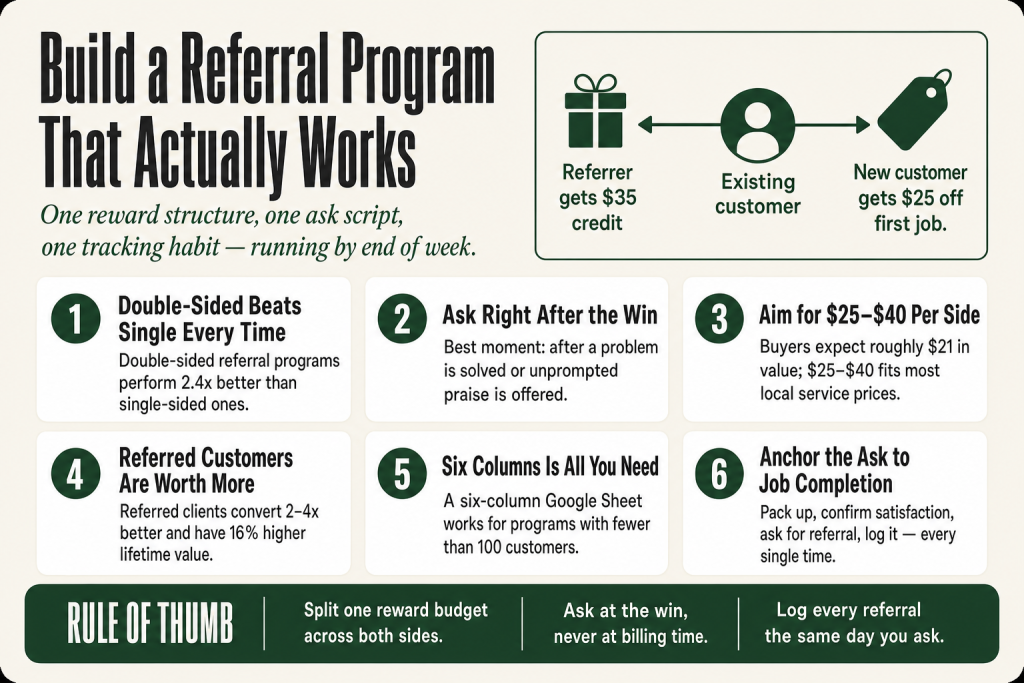
The 30-second answer
- The reward: Give both sides something. Referrer gets a credit toward their next service; new customer gets a discount off their first. Data from the top 1,000 referral campaigns shows that double-sided referral programs perform 2.4x better than single-sided ones.
- The ask: Deliver it right after the visible win, not at billing time. The absolute best moment is right after the customer recognizes the value you’ve provided, after a problem is solved or they offer unprompted praise.
- The tracking: A six-column Google Sheet is enough to start. You don’t need software until you’re processing more than 20 referrals a month.
- The habit: Anchor the ask to job completion so it fires every time, not just when you remember.
- The math: Keep total reward cost inside your normal customer acquisition budget. Double-sided is not automatically twice as expensive. The cost only doubles if you add a friend reward on top of what you were already paying the referrer without rebalancing.
Take this fix into your next scenario. The free Builder’s Companion Kit collects the checklists and templates that pair with this guide — so next time, you start from a template, not a blank page. Grab it free →
- Why One-Sided Rewards Leave Half the Room Cold
- The Two-Sided Reward Structure That Works for Local Services
- Referral Program for Service Business: A Worked Example With Real Numbers
- The Ask Script and the Only Moment It Should Be Delivered
- One No-Software Way to Track Who Referred Whom
- The One Habit That Makes This Consistent
- FAQ
A referral program for service business is the lowest-cost acquisition channel you have, and most operators let it run on luck. A customer loves the work, tells a friend, the friend calls. Great. But you had nothing to do with the timing, the incentive, or the consistency. Luck isn’t a system. What follows is a system: one two-sided reward structure, one ask script, and one tracking habit. You can have all three running by end of week.
Why One-Sided Rewards Leave Half the Room Cold
Most service businesses run a one-sided program without realizing it. They offer existing customers $25 for every friend they send over, and they wonder why participation stays thin. The math feels right. The psychology doesn’t.
People are far more likely to refer when the friend gets something meaningful. This is why double-sided referral rewards consistently outperform single-sided offers. Customers want to feel they’re giving value first. When your referrer walks up to a neighbor and says, “Hey, use my name and you’ll get $30 off,” the conversation is easy. When all they can say is “I’ll get $25 if you call them,” it sounds like they’re asking a favor for themselves. That’s a harder sell, and most people won’t bother.
Two-sided incentives give referring customers a boost of confidence and a sense of ease, knowing that the brand will take care of their friends and family. That’s the social lubricant a referral needs. The referrer becomes the generous one, not the salesperson.
The cost concern is real but often overstated. A double-sided referral extends the standard model so that when a friend completes the qualifying action, both the referrer and the friend receive a reward, turning “Refer a friend and get $20 credit” into “Give $10, get $10.” You split the existing budget across two people instead of stacking a second reward on top. Same line item, better result.
The Two-Sided Reward Structure That Works for Local Services
Here’s the structure. Referrer gets a credit toward their next service. New customer gets a discount off their first booking. Neither reward should feel like a coupon clipped from a Sunday paper. It should feel like a genuine gift.
Set the referrer reward as a dollar-amount credit, not a percentage. Dollar amounts are concrete. “$40 off your next visit” is real money. “10% off” requires math at an inconvenient moment. Brands that use cash, store credit, or simple fixed discounts tend to see more consistent referral activity because customers can instantly visualize the benefit.
Set the new-customer reward as a discount off the first job, not a free add-on they have to ask for. Asking creates friction. A discount that applies automatically when they book removes it.
One sizing guideline: buyers expect referral rewards to be worth around 11% off their purchase or roughly $21 in value. For a $200 cleaning or a $350 lawn service, that puts you in the $25 to $40 range per side, which is well inside what most operators spend acquiring a cold lead through paid search.
Keep the qualifying event simple: the new customer completes and pays for their first appointment. Not “books,” not “inquires.” Completes and pays. That’s the trigger for both rewards.
Referral Program for Service Business: A Worked Example With Real Numbers
Let’s make it concrete. Sarah runs a residential cleaning service. Her average first job is $180. Her average customer lifetime value, counting repeat visits over two years, runs about $1,400. She currently spends roughly $60 acquiring a new customer through Google Local Services ads.
Her two-sided structure:
- Referrer reward: $35 credit applied to their next cleaning, issued the day the new customer’s first job is completed and paid.
- New customer reward: $25 off their first cleaning, no code required, noted in the booking confirmation.
- Total reward cost per successful referral: $60, identical to her current paid-search cost per acquisition.
The difference: the referred customer arrives pre-sold. Research shows referred clients convert 2 to 4 times better than cold leads and have 16% higher lifetime value. Sarah’s ad-generated customer costs the same $60 but converts at a lower rate and churns faster. The referral customer is already warmer before the first visit.
Sarah decides her qualifying event is job completion. She issues the $35 credit manually via a one-line note in her booking system (or a text message) the same afternoon. She hands the new customer’s discount directly in the booking confirmation email. No app. No code. No portal. The whole thing runs on a Google Sheet and a text message template she saved in her phone.
In the first three months she closes 11 referred jobs this way. Revenue from those 11: $1,980 on first visits alone, before repeat bookings. Reward cost: $660. Net after rewards: $1,320 from a channel that cost her nothing but the habit of asking. Her previous three months of Google ads delivered 9 first-time bookings at a $540 ad spend, so the math isn’t close.
Your numbers will differ. The principle holds: referral incentives are far more cost-efficient than paid ads, where you pay upfront regardless of results. It is a performance-based acquisition model with predictable ROI.
If you’re still building out the rest of your acquisition engine, the solo operator’s sales funnel guide covers how referrals fit into a complete lead flow without a team.
The Ask Script and the Only Moment It Should Be Delivered
Timing is everything. Most operators ask for referrals at billing time, when the customer’s brain is doing math. That’s the worst possible moment. The best time to ask for a referral is right after a win. Don’t wait. When a customer experiences a clear, positive outcome, the value of your partnership is impossible to ignore.
For a service business, the win is specific and observable. The freshly cleaned house. The new lawn edge. The fixed HVAC before summer. The completed website build. If you’re a landscaper, plumber, HVAC professional, or other service professional, it makes sense to ask after the conclusion of service, after you know you’ve done a stellar job. That’s your window. It closes quickly.
Here’s the script. Read it out loud once, then make it sound like you:
“I’m really glad this came out the way it did. Can I ask you something? We grow almost entirely through people like you telling their neighbors and coworkers. If you know anyone who could use [specific service], I’d love the intro. As a thank-you, you’d get $35 off your next visit, and they’d get $25 off their first one. Totally no pressure, but if someone comes to mind, I’d really appreciate it.”
Three things that make this script work:
- It opens with acknowledgment of the result, not a pitch. You’re riding the emotional high of the visible win.
- It names the specific reward for both sides immediately. 65% of referrers prefer to share rewards. People feel more inclined to refer a brand when their friend benefits too.
- It removes pressure explicitly. “No pressure” isn’t weakness. It’s the thing that keeps the relationship intact whether they refer or not.
Never ask at invoice time. Never ask in the same breath as a complaint resolution. A poorly timed request can undo the goodwill you’ve built.
If the job happens to end with written feedback or a five-star review, that’s another green light. When a customer says something nice in a compliment or thank-you, or after they leave a five-star review, satisfaction is at its peak. Those are moments to ask. Billing time is not.
Need help writing a version of this for email follow-up? The welcome email sequence guide has a structure you can adapt for post-job follow-up messages, and the AI copywriting method shows you how to draft and refine scripts like this one in under twenty minutes.
One No-Software Way to Track Who Referred Whom
You don’t need a referral platform to start. Using spreadsheets and manual processes works for small-scale programs with fewer than 100 customers. Set up software when you’re overwhelmed by volume. Start with a six-column Google Sheet.
The six columns:
- Referrer name (the existing customer who made the introduction)
- Referrer credit status (“pending” until the new job closes, “issued” once you send the credit)
- New customer name
- New customer first job date
- New customer discount applied? (yes/no)
- Notes (anything relevant, like “referred two people this month”)
That’s it. A simple referral tracking spreadsheet includes the advocate’s name, contact information, and their referral source. When their friends complete a job, you manually update the corresponding columns with transaction and reward data. Takes about ninety seconds per entry.
One practical rule: log the referral the same day you complete the ask. Don’t trust your memory for two days. Open the sheet on your phone while you’re still in the driveway, add one row, close it. The whole system fails if logging happens “later.”
Referral tracking shines light on the individuals sharing the most and bringing you the highest number of referrals, your best advocates. After a few months you’ll see two or three names appear repeatedly. Those are your best-referral customers. They deserve a personal thank-you, maybe a larger credit, and they’re the first people you call when you have capacity to fill.
One honest caveat: this method depends on customers self-reporting or you asking directly. You’ll miss a handful of referrals where someone mentions your name but the new customer never brings it up. Accept that imperfection now. A system that captures 85% of referrals and actually runs beats a perfect system you never built.
The One Habit That Makes This Consistent
The reason most referral programs die isn’t a bad reward. It’s that the ask happens sometimes, which is almost the same as never. You ask when you remember, you forget when you’re rushed, and three weeks go by without a single ask. The program isn’t a program at that point. It’s an occasional impulse.
Fix this with an anchor. An anchor is a behavior you already do every single time, linked to the new behavior you want to make automatic. For a service business, the natural anchor is job completion. Every job ends with the same sequence: pack up, confirm the customer is happy, ask for the referral, log it.
Write that sequence on a physical index card and keep it on your dashboard or in your service bag for the first thirty days. Not because you’ll forget the steps, but because seeing the card is the environmental trigger. Once the sequence is automatic, ditch the card.
If most of your customer contact happens over text and email rather than in person, build the ask into a follow-up text template you send within two hours of completing the job. The structure is the same: name the win, offer the two-sided reward, make it easy to say yes. Save it as a draft in your phone so the friction of starting from scratch disappears.
Place your referral program prominently at high-satisfaction moments. For service businesses, that moment is job completion. Everything else, including the invoice, the thank-you email, the review request, comes after the ask or alongside it, never before.
Once your referral flow is producing consistent leads, the lead follow-up playbook will help you make sure none of those warm referrals fall through the cracks before they book.
FAQ
How much should I offer as a referral reward for my service business?
Aim for a reward worth roughly $20 to $40 per side, which aligns with research showing customers expect at least $21 in value before they’ll bother. For most local services priced between $150 and $400, that keeps your total two-sided cost at or below what you’d spend acquiring a cold lead through paid ads. Scale the reward up if your average job value is higher.
Do I need referral program software to run this?
Not to start. A six-column Google Sheet handles tracking cleanly for any program with fewer than 100 active customers. You only need software when manual logging takes more than a few minutes a day or when you’re processing upward of 20 new referrals a month. Start simple, add tools when volume justifies the cost.
When is the best time to ask for a referral from a customer?
Right after the visible win, before the invoice conversation starts. For a service business that means the moment the customer sees or experiences the completed result, the clean house, the finished landscaping, the repaired system. That’s when satisfaction peaks and the ask feels natural rather than self-serving.
What if a customer says yes but never actually sends anyone?
That’s normal. Most people who say yes genuinely intend to refer but don’t have someone top of mind right now. Follow up once, lightly, in a post-job email. Something like: “If you happen to think of anyone, here’s what to tell them and what they’ll get.” Don’t chase it beyond that. One follow-up is a reminder. Two is pressure.
Should the referral reward be a discount, a credit, or cash?
For the referrer, a credit toward their next service keeps them in your ecosystem and reinforces the relationship. For the new customer, a dollar-amount discount off the first job is clearest and removes friction at booking. Cash works too but can feel transactional in a trust-based service relationship. Avoid percentage discounts on either side since they require mental math at the worst moment.
Can I run a referral program without telling customers it exists?
Yes, and that’s basically what you’re doing if you rely on organic word-of-mouth. But it won’t perform like a real program. The difference between luck and a system is the ask: you name the reward explicitly, you make it easy for the referrer to pass along, and you deliver at the right emotional moment. Passive word-of-mouth and an active referral program look the same on the surface but produce very different results.
Sources:
Sources consulted: Referral Factory campaign data on double-sided vs. single-sided program performance (referral-factory.com, 2025); ReferralCandy analysis of referral reward psychology and timing (referralcandy.com, 2025/2026); Visu Network service business referral program benchmarks (visu.network, 2026); Impact.com referral marketing statistics report 2025 (impact.com, 2025); ReferralHero and ReferralRock guidance on manual tracking and spreadsheet methods (referralhero.com, referralrock.com, 2026); Bizclearai and Mixmax guidance on referral ask timing and scripts (bizclearai.com, mixmax.com, 2026); Voucherify analysis of double-sided referral cost structures (voucherify.io, 2025).
Brian Kasday spent forty years in direct-response marketing before rebuilding the whole operation as a one-person shop. He writes The Operator’s Library — including “Build a Complete Marketing Department” — for operators who’d rather build it themselves than wait on someone else.
Get the Builder’s Companion Kit — the free checklists and templates that pair with this guide: mmsvegas.com/resources.
This guide handles one marketing job. Build a Complete Marketing Department builds the whole department. See the manual →
More Marketing guides
Free · Marketing Operator Toolkit
Running marketing on your own?
Get the free toolkit — the templates and the expensive mistakes behind a one-person marketing department, plus a note when this guide changes.
Get the free toolkit →