
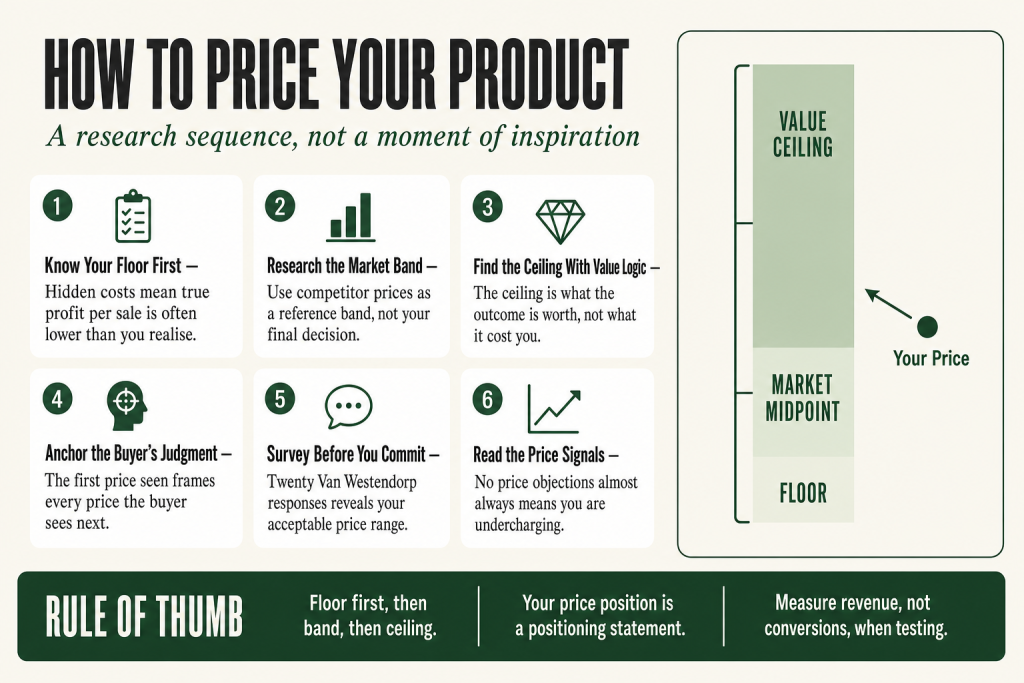
The 30-second answer
- Know your floor first. Your price must cover every real cost plus a margin that makes the business worth running. Hidden costs kill the math.
- Research the market band. Look at three to five competitors to establish where the market sits, but do not let their prices make your decision for you.
- Use value-based logic to find your ceiling. The ceiling is what a customer is willing to pay based on the outcome you deliver, not what it cost you to deliver it.
- Place your price inside the band with intention. Your position (below, at, or above market) is a positioning statement. Own it.
- Use anchoring when you have multiple offers. The first price a buyer sees sets the frame for every price they see next.
- Test before you commit. A simple before-and-after or a price survey beats a permanent guess every time.
- Read the signals. If prospects never push back on price, you are almost certainly undercharging.
Take this fix into your next scenario. The free Builder’s Companion Kit collects the checklists and templates that pair with this guide — so next time, you start from a template, not a blank page. Grab it free →
- Start With the Floor: What the Price Must Cover
- Research the Market Band Without Letting It Own You
- Find the Ceiling With Value-Based Logic
- Use Price Anchoring to Frame the Buyer’s Judgment
- Research Willingness to Pay Before You Commit
- Read the Signals That Your Price Is Wrong
- Worked Example: How to Price a Done-for-You Service Package
- The Rules for How to Price Your Product When You Have No Prior Data
- FAQ
Knowing how to price your product is one of the few decisions that flows into every other part of your business: your positioning, your margins, your marketing budget, and which customers you attract. Get it wrong and no amount of good copy rescues you. Price too low and you spend more time serving more customers for less net income. Price too high without the supporting story and prospects just leave. Neither outcome is strategic. Both are the result of guessing.
The good news: pricing is not a single moment of inspiration. It is a short research sequence followed by a decision, then a test. This article walks you through that sequence, method by method, so you can set a defensible number today and improve it over time.
Start With the Floor: What the Price Must Cover
Your floor is the minimum price at which the sale makes sense. If you do not know your floor, you can accidentally price below it and not notice until the bank account does.
To find it, add up every cost that touches this product or service: materials, software subscriptions, labor (including your own time at a real hourly rate), payment processing fees, refunds and chargebacks at their historical rate, and a share of fixed overhead. Cost-plus pricing is set by calculating all the expenses incurred to make the product and then adding a markup percentage. The typical costs include raw materials, packaging, labor, and overhead. That covers the mechanics, but hidden costs are easily forgotten, so your true profit per sale is often lower than you realise.
The markup you add on top of that floor is not a guess either. It should reflect the minimum return that makes this business worth running compared to other things you could be doing with your time. For a solo operator, that means asking: would I be better off doing something else for this hour?
Cost-plus thinking alone will not get you to the best price, but it gives you a hard lower bound. When prices are tied to cost rather than customer value, companies either overprice when costs spike or underprice when customers are willing to pay more. The floor is where you start. It is not where you land.
The most common floor mistake: forgetting your own time. Write your hourly rate into the cost model before you do anything else. If you would not work for free, the price should not assume that you are.
Research the Market Band Without Letting It Own You
Once you have a floor, you need a band. That means finding what the market currently charges for a comparable outcome.
Businesses choose one of three basic competitive pricing positions in the market: below, at, or above their peers. Each path tells a different story about your product, and each comes with its own set of trade-offs. To know which path you are choosing, you first need to know where the middle of the road sits.
The research is simple. Pick three to five real competitors who serve the same customer with a similar outcome. List their prices. Note whether they publish rates publicly or keep them behind a sales call. Note what is included at each price. That gives you a reference band: a low anchor, a high anchor, and a rough midpoint.
If you price purely to match or beat competitors, you are outsourcing your pricing decision to them. The moment they cut prices, you feel pressure to follow, and margin compression becomes structural. A better approach: use competitive pricing as a reference band (upper and lower bound), then position within it based on your own differentiation and cost structure.
A few practical research notes. For physical products, competitor prices are usually public. For services, look at published packages, proposal breakdowns shared in forums, and industry salary surveys (a useful proxy for what the market pays for that skill). For digital products, look at direct competitors’ pricing pages and at the prices of adjacent offerings in the same category.
Regularly research competitor prices, but don’t undervalue your unique selling points in the race to match or undercut them.
The band tells you what is normal. Your job is to decide, deliberately, where inside or outside that band you want to sit, and why. That decision is a positioning statement. It belongs in your one-page marketing plan, not in a spreadsheet cell you never revisit.
Find the Ceiling With Value-Based Logic
The ceiling is what a buyer is willing to pay before they walk. It is set not by your costs but by the outcome the customer gets.
Value-based pricing flips the equation. Instead of starting with your costs, you start with the customer’s perception of value. Willingness to pay represents the maximum price a customer will pay to obtain a particular product or service.
To estimate the ceiling without running a full research project, answer three questions about your best customer:
- What problem does this solve? Make it specific. “Saves time” is not specific. “Saves twelve hours a month on invoice reconciliation” is.
- What is the cost of not solving it? Time, lost revenue, fines, reputational damage, stress. Put a number on it, even a rough one.
- What is the nearest alternative? If the buyer did not buy from you, what would they pay instead, and what would they give up?
Your ceiling is somewhere below the cost of the problem and close to (or above) the cost of the alternative. Value-based pricing can be more profitable than cost-plus pricing, as it enables you to capture a larger share of the value you create for customers.
The practical limit: value-based pricing requires that you can articulate the value, not just that the value exists. If you cannot explain the outcome in concrete terms, the buyer cannot justify the price. This is where your copy and your pricing are the same conversation. A strong sales page is not decoration on top of a price, it is the argument that supports it.
Value-based pricing depends on the strength of the benefits you can prove you offer. If your proof is thin, the price feels arbitrary. If your proof is strong, the price feels obvious.
Use Price Anchoring to Frame the Buyer’s Judgment
Once you have your price, think about what comes before it in the buyer’s mind. That first number sets the frame for everything else.
Price anchoring is a psychological pricing strategy where the initial price presented to consumers serves as a reference point for all subsequent judgments about value. When businesses place a high-priced anchor alongside lower-priced items, consumers perceive the lower-priced items as more reasonable or affordable.
Research in behavioral economics suggests that consumers tend to rely heavily on the first piece of information they encounter when evaluating subsequent options. This anchoring effect can be leveraged by businesses to steer consumers toward preferred choices.
For a solo operator, anchoring shows up in two practical ways:
- Tiered offers. If you have a premium tier and a standard tier, show the premium first. The standard looks more accessible immediately after.
- The “do nothing” anchor. On a sales page, the cost of the problem (the status quo) is the highest anchor you have. Name that cost explicitly before you name your price.
One honest caveat: price anchoring becomes a manipulative tactic if you use it to deceive or exploit customers, for example by artificially inflating prices or creating false scarcity. That is unethical and, in some cases, illegal. Use a real premium option or a real problem cost, not a made-up number.
Anchoring also applies to how you present discounts. The original price is the anchor. If you discount from a price that was never real, you are misleading buyers and eroding trust when they find out.
Pricing and positioning are the same subject from two angles. If you are still working out where your offer sits in the market, the article on how to stop competing on price covers the positioning side in detail.
Research Willingness to Pay Before You Commit
You do not have to guess and then watch the market react. There are faster ways to learn what buyers will actually pay before you publish a number.
Option 1: The Van Westendorp Price Sensitivity Meter. The Van Westendorp Price Sensitivity Meter is a survey-based framework that estimates acceptable price ranges by asking customers four simple questions about price perception. By capturing when a price feels “too cheap,” “cheap,” “expensive,” and “too expensive,” the PSM generates a visual summary of price acceptability and suggests a corridor where most customers perceive price and value as aligned. You can run this with a simple form tool sent to your list or to a small panel. Twenty to thirty responses is enough to see the shape of the range.
It is fast, intuitive for executives, and inexpensive compared with more complex discrete-choice methods. On its own, PSM does not maximize revenue or profit; it is a directional, customer-centric lens that should be triangulated with other tools.
Option 2: Qualitative conversation. Call five to ten recent buyers or prospects and ask them: “At what price would this have felt too cheap to trust? At what price would it have been too expensive to seriously consider?” The answers bracket your range without a survey tool. Hypothetical questions like “how much would you pay for this product?” tend to produce unreliable answers, so ask the bracketing questions instead. They are harder to anchor to a social desirability response.
Option 3: The before-and-after test. Set a price, run it for a defined period, raise or lower it, and compare revenue (not just conversion rate) across the two periods. A before-and-after test involves changing a price for a set period and comparing the sales data to a previous baseline timeframe. This is the lowest-tech version and works for businesses with steady volume.
A note on live price A/B testing: showing customers different prices for the same product can damage your reputation when they find different prices every time they visit your site. For most solo operators, the before-and-after method or a survey is the safer and more practical starting point. If you do run a live test, measure revenue, not conversions. Measure revenue, not conversions, to determine which price wins out on an A/B test. Higher conversion at a lower price does not mean higher income.
AI tools can help you design the survey questions and analyze the results, but the judgment call, whether the range is right for your positioning and your cost structure, stays with you. The tool cannot know what your floor is or what your positioning story can support.
Read the Signals That Your Price Is Wrong
A published price is a hypothesis. The market responds to it. You just need to know what to look for.
You are probably undercharging if:
- Prospects almost never bring up price as an objection.
- You close a high percentage of inquiries without much back and forth.
- Customers frequently say some version of “this is way more than I expected for the price.”
- You are busy but not growing net income.
Three signals that you have room to raise prices: customers consistently say your price is lower than they expected; your conversion rate is very high but margins are thin; you are busy but not growing net profit meaningfully. All three suggest you have room to raise prices and should test doing so.
You are probably overcharging (or underselling the value) if:
- Price objections come early and often, even with qualified prospects.
- You are losing proposals at the final stage after they see the number.
- Conversion dropped significantly after your last price increase, and it did not recover.
The last signal is important to separate. A conversion drop after a price increase can mean the price is too high, but it can also mean the value story around the new price was not updated to match. Before you cut the price, check the copy. Cost-plus pricing does not take into account the value that customers place on the product or service or the prevailing market conditions. The same logic applies in reverse: if you raise a price without strengthening the value argument, prospects will resist even if the price is objectively fair. This is why pricing and your marketing copy are permanently connected.
The one signal that is often misread: a competitor charging less. That tells you what they charge. It does not tell you what your customers will pay, what that competitor’s margins are, or whether their lower price is sustainable. Competitive pricing involves setting prices based on what competitors charge, but that only helps you appear valuable on entry. It does not help you grow.
Worked Example: How to Price a Done-for-You Service Package
Here is how the full sequence looks for a real offer type, a done-for-you email marketing service sold to small e-commerce stores.
Step 1: Find the floor. The operator tracks real time: eight hours a month per client on average. At an internal rate of $75/hour, that is $600 in labor. Add $40/month in tool costs allocated per client, plus a 3% payment processing assumption on the invoice. Floor: roughly $660 before any margin. The operator adds a 30% margin to run the business sustainably. Floor price: $858. Round up to $900 as the true floor.
Step 2: Research the band. A quick survey of five competitors with public pricing shows a range of $800 to $2,500/month. The midpoint is around $1,400. The $900 floor is well inside the band, which is a good sign: there is room above cost.
Step 3: Apply value logic. The typical client doing email themselves spends six hours a month on it and sees $3,000 in attributed monthly email revenue. A better-run program (with better segmentation and tested sequences) could push that to $5,000. The value delta is $2,000/month. Charging $1,200/month for a $2,000-gain is a straightforward business case for the buyer.
Step 4: Set and frame the price. The operator sets the monthly retainer at $1,200, positions it above the market midpoint (justified by the outcome story), and offers a $1,800/month “growth” tier that adds a monthly strategy call and a quarterly audit. The $1,800 tier anchors the $1,200 option so it reads as the sensible choice for most buyers.
Step 5: Test and read signals. After ninety days at the new price, close rate is 55%. No one has mentioned price as a reason they didn’t move forward. That is a clear signal there is more room upward. The operator plans a test at $1,400 next quarter.
Every one of those steps required a judgment call. The research narrowed the options. The operator made the final call. That is how this works.
If you need a framework for thinking about where this offer fits in your broader go-to-market plan, the solo operator’s sales funnel guide covers how pricing fits into the funnel structure.
The Rules for How to Price Your Product When You Have No Prior Data
If you are launching something new with no prior sales history, the sequence tightens because you have no signals yet. Here is the condensed version for launch conditions.
- Calculate the floor before you talk to a single prospect. Do not let enthusiasm cloud the math.
- Run a five-question Van Westendorp survey with your list or a small panel of target buyers. Use the bracketing questions. Get at least twenty responses. This takes one afternoon.
- Look at three direct competitors. If none exist, look at the closest adjacent alternatives. Do not use this as your price; use it as your band.
- Set an opening price that is at or above the midpoint of the market band, inside your willingness-to-pay range, and comfortably above your floor. If all three conditions are met, publish it.
- Treat your first ten sales as data. Did price come up as a barrier? Did buyers move without hesitation? Both are information. Adjust after you have real signal, not before.
Test and refine. Start small, validate, adjust, and repeat. Over time, your model becomes self-correcting.
One more thing to verify yourself: if you are operating in a regulated industry (healthcare, financial advice, legal), some pricing structures have legal constraints. That check stays with you. No pricing framework substitutes for knowing the rules in your category.
For the market research that feeds into step two and three, the article on doing market research with AI in an afternoon walks through a practical workflow you can run before launch day.
FAQ
how do I price a product for the first time with no sales history
Start with the floor (your real costs plus a margin that makes the business worth running). Then run a short Van Westendorp survey with twenty or more target buyers to find the acceptable price range. Layer in competitor research to see where the market sits. Set your opening price at or above the market midpoint, inside your survey range, and above your floor. Treat your first ten to twenty sales as your real data set and adjust from there.
should I charge less than competitors to win customers
Not as a default strategy. Pricing below the market band signals low quality as often as it signals value. If you undercut competitors without a clear cost advantage, you compress your margins and attract price-sensitive buyers who leave the moment someone cheaper appears. Use competitor prices as a reference band, then position based on the outcome you deliver, not on being the cheapest option.
how do I know if my price is too low
Three strong signals: prospects almost never raise price as an objection, you close a high percentage of inquiries without friction, and customers comment that the price was lower than they expected. If all three are true at once, you have room to raise prices and should test doing so.
what is the Van Westendorp price sensitivity meter and how do I use it
It is a four-question survey that identifies the range of prices buyers find acceptable. You ask respondents to name the price at which your offer would feel too cheap to trust, a bargain, expensive but still worth considering, and too expensive to buy. The answers define the acceptable range for your market segment. You can run it with any basic survey tool and twenty or more responses gives you a usable picture.
is it ethical to A/B test prices on a live website
Showing different prices to different visitors for the exact same product can damage trust if buyers compare notes. For most solo operators, a before-and-after test (change the price, compare revenue over two comparable periods) is more practical and carries less reputational risk. If you do run a live split test, measure revenue per visitor, not conversion rate, and make sure the test groups are randomly assigned rather than segmented by demographics.
does raising my price hurt conversions
It depends on whether the value story around the new price keeps up with the increase. A price increase without stronger copy or positioning often does drop conversions. Before cutting back to the old price, update the proof: clearer outcomes, stronger testimonials, a better explanation of what the buyer gets. If conversions still do not recover after the story is improved, the price may genuinely be above the market’s willingness to pay for what you offer at your current level of trust and proof.
Sources:
- Intuit Enterprise Blog, “Value-Based Pricing vs. Cost-Plus Pricing” (intuit.com/enterprise)
- NI Business Info, “Cost-Plus Versus Value-Based Pricing” (nibusinessinfo.co.uk)
- Stripe, “A Guide to Competitive Pricing Strategies” (stripe.com/resources)
- PriceAgent, “Value-Based Pricing vs. Cost-Plus Pricing” (priceagent.com)
- Business Supervisor, “7 Pricing Strategies for Small Businesses” (businesssupervisor.com)
- DealHub AI, “What is Price Anchoring?” (dealhub.io)
- Michigan Journal of Economics, “Pricing Psychology: Deciphering Consumer Behavior” (sites.lsa.umich.edu)
- OpinionX, “Van Westendorp for Pricing Research” (opinionx.co)
- Umbrex, “Van Westendorp Price Sensitivity Meter” (umbrex.com)
- SurveyMonkey, “How To Use The Van Westendorp Price Sensitivity Meter” (surveymonkey.com)
- HubSpot Marketing Blog, “How to A/B Test Your Pricing” (blog.hubspot.com)
- Brillmark, “Price A/B Testing: Methods, Examples and Tools” (brillmark.com)
- Expensify Resource Center, “10 Pricing Strategies for Small Businesses” (use.expensify.com)
Brian Kasday spent forty years in direct-response marketing before rebuilding the whole operation as a one-person shop. He writes The Operator’s Library — including “Build a Complete Marketing Department” — for operators who’d rather build it themselves than wait on someone else.
Get the Builder’s Companion Kit — the free checklists and templates that pair with this guide: mmsvegas.com/resources.
This guide handles one marketing job. Build a Complete Marketing Department builds the whole department. See the manual →
More Marketing guides
Free · Marketing Operator Toolkit
Running marketing on your own?
Get the free toolkit — the templates and the expensive mistakes behind a one-person marketing department, plus a note when this guide changes.
Get the free toolkit →