
Table of contents
- The 30-second answer
- A launch is two jobs, not one
- The pre-launch checklist is a ritual, not a suggestion
- Soft launch to 50 to 100 people and watch four numbers
- The launch sequence: sell to warm, not cold
- How to launch a product by yourself with AI as your team
- A worked example: one person’s launch week
- Frequently asked questions
You built the thing. The page is up, the emails are written, and now you have to open the cart, by yourself, with no team to catch the broken link, no launch manager to tell you when to hit send, and no one to blame but you if the checkout is in test mode when the first order comes in. That fear is rational, and it’s also solvable. Learning how to launch a product by yourself isn’t about nerve. It’s about running a specific, boring pre-launch ritual, testing on a small group before you go wide, and timing your emails to people who are actually ready to buy. Do those three things and a solo launch can come out cleaner than many team launches, because nothing falls through the cracks between departments when there are no departments.
The premise of running a one-person marketing department is that work a company spreads across five specialists can be run by one disciplined operator with a checklist. A launch is where the lack of a checklist gets expensive fastest. So this is the checklist.
The 30-second answer
To launch a product by yourself without a team:
- Treat the launch as two jobsthe pre-launch prep (everything you test before the cart opens) and the launch sequence (the emails that sell during the window). Botch the prep and the sequence has nothing to land on.
- Run the pre-launch checklist as a ritualgo through your own funnel as a customer, complete a test purchase, confirm every email fires and every link works, and check that the payment processor is live, not in test mode.
- Soft-launch to 50 to 100 people firstsend to a small, engaged segment and watch four numbers before you go to your whole list.
- Sell to warm, not coldpresent the real offer to people who already know you and got value from you. Cold audiences need warming up first.
- Use AI as your launch teamrun a pre-launch audit, a pre-mortem, and a devil’s-advocate copy review to catch what a solo operator staring at the same pages for weeks can’t see.
A launch is two jobs, not one
Most first-time solo launches fail because the operator treats “launch” as a single event, hit publish, cross fingers. It isn’t. A launch is two separate jobs that fail in two separate ways. The first job is everything you do before the cart opens: the technical checks, the message checks, the contingency plans for what breaks. The second job is the email sequence that actually sells during the launch window. Botch the prep and the sequence has nothing solid to land on. Botch the sequence and all that prep was for nothing.
When you have a team, these two jobs belong to different people, and the handoff is where things get dropped. When you’re solo, both jobs are yours, which sounds harder but is actually cleaner, because there’s no handoff to fumble. You just have to be disciplined enough to do the first job completely before you let yourself get excited about the second. The rest of this guide takes them in order: prep first, then the sequence.
The pre-launch checklist is a ritual, not a suggestion
Launch day is the wrong time to discover that your checkout doesn’t work on mobile, or that the email automation is firing twice, or that the upsell link is broken, or that your payment processor is still in test mode. Every one of those is fixable. None of them is fixable on launch day without losing sales and sending a “this person is an amateur” signal to a chunk of your audience at the exact moment they were deciding whether to trust you.
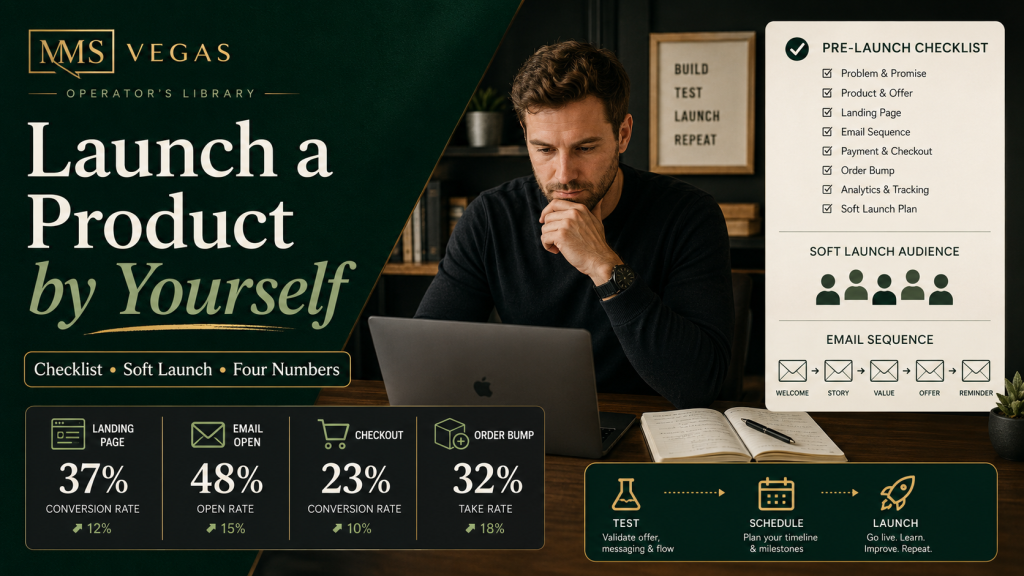
So the pre-launch checklist is not a suggestion you get to skip when you’re in a hurry. It’s a ritual. You run through every element of the system you built before a single dollar is on the table, not because you think it’s broken, but because the cost of finding out it’s broken in production is far higher than the cost of ten minutes of checking. Here’s the technical pass, done as a customer would do it:
- Walk the whole funnel as a customer. Click every button. Fill out every form with test data. Complete a real test purchase using a test payment method. Confirm the right emails fire in the right order.
- Read every email on mobile and desktopand click every link in every email to confirm it goes where it should.
- Check page load speed on both mobile and desktop with Google PageSpeed Insights, anything below 70 is a problem worth fixing before launch.
- Confirm mobile responsiveness on every funnel page, and that form-validation errors actually make sense to a real user.
- Verify the payment processor is live, not in test mode. This one has ended more launches than any other single item on the list.
- Confirm email deliverabilitysend to your own inbox and check whether it lands in the inbox or spam, and re-check every automation trigger condition.
Then do the one thing that’s hardest when you work alone: give the whole funnel to someone who has never seen it. Ask them to go through it as a customer while you watch. Note where they hesitate, where they get confused, what they don’t understand. Fresh eyes find the things you’ve gone blind to after staring at the same pages for weeks. If you don’t have a person handy, the AI audit later in this guide is the next best set of fresh eyes. Before the funnel goes live, make sure your landing page brief locked in the strategy so there’s nothing to second-guess on launch day. The checkout and automation mechanics themselves, the part that has to not break, live in the FunnelKit guidesand the funnel you’re testing is the one you stood up in build a sales funnel without a team.
Soft launch to 50 to 100 people and watch four numbers
Before you go to your full list, go to a small piece of it. Ten percent of your most engaged subscribers, or a specific segment you can target, or a small paid-traffic test, enough to let fifty to a hundred people through the funnel while you watch what happens to the numbers. This is the single most useful risk-reducer a solo operator has, because it turns launch day from a bet into a measurement.
In the first 48 hours of the soft launch, four numbers tell you whether the system works, and each one points at a specific thing to fix:
- Landing page conversion rate. Below fifteen percent on a warm audience is a problem with the page or the offer itself, not with your traffic.
- Email open rate on the first launch email. Below twenty percent is a subject-line problem or a sign your list has gone cold.
- Checkout completion rate. Below forty percent usually means friction in the checkout or a pricing-trust issue, people wanted it, then hesitated at the last step.
- Order bump take rate. Below ten percent suggests the bump isn’t positioned right, not that people don’t want it.
Fix what the soft launch surfaces before you open to your whole list. That’s not slowing down, it’s making sure that when you scale up, you’re scaling something that works instead of amplifying a leak. If a low open rate is your flag, the prioritized fixes for that problem are in low email open rates: a prioritized fix list for solo operators. Reading these four numbers like a diagnostic instead of a scoreboard is a skill in itself, and it’s the whole subject of how to read your marketing data without an analyst.
Want the operator’s launch toolkit? The free prompt library that ships with Build a Complete Marketing Department includes the Pre-Launch Audit prompt and the Pre-Mortem prompt referenced in this article, the exact prompts a solo operator uses to run a launch without a team. Grab the prompt library →
The launch sequence: sell to warm, not cold
Once the machine is tested, the second job is the selling, and the biggest mistake solo launchers make here is presenting the full offer to cold prospects and then wondering why conversion is low. Purchase intent varies enormously across the customer journey. Someone who just heard of you for the first time is at the lowest possible intent: they don’t know you, haven’t experienced your value, and have no particular reason to believe your promises. Someone who’s been on your list for months, read your emails, gotten real value from your lead magnet, and been waiting for exactly this, that person is at the highest intent. Matching how you present the offer to where the buyer sits on that journey is one of the biggest levers in the whole launch.
There are two ways to make the ask, and a solo launch needs both. A soft offer mentions the product in the context of value you’re already giving: “this is the principle I teach in , if you want to go deeper, here’s the link.” No pressure, no urgency, almost an aside. A hard offer is the direct pitch: here’s exactly what’s included, here’s what it costs, here’s the link, and it’s available until [deadline]. Soft offers belong early, while you’re still building trust; hard offers belong in the launch window, when the warm-up work is done and someone has shown they’re ready.
The ratio most email businesses aim for is three to five soft mentions or value emails for every hard-offer email. Trust is built through the steady delivery of value; revenue comes from the periodic, clear, well-timed hard offer. For a solo operator that ratio is freeing, it means most of your emails are just you being useful, and only a few have to do the uncomfortable work of asking for the sale. If your welcome sequence already did the warming, your launch is landing on prepared ground; that groundwork is laid in the welcome email sequence for small businessand the page the hard offer points to is the one you write in how to write a sales page yourself. If you’d rather the launch emails fire on their own triggers instead of you sending each one by hand, the automation layer for that lives in the Make automation guides.
How to launch a product by yourself with AI as your team
The real disadvantage of launching alone isn’t the workload, it’s that you have no one to tell you the emperor has no clothes. You’re too close to the offer to see its weak spots, and there’s no skeptical colleague to poke holes before a real customer does. This is exactly the gap a good AI model fills. Three prompts cover the three review roles a solo operator usually lacks.
The first is a pre-launch audit. You hand the model the full picture, the offer, the funnel, the email sequence, the traffic plan, the timeline, and ask it for a complete technical checklist for your specific stack, a critical review of your sales-page copy for unsupported claims and unanswered questions, an honest read on the weakest element of your offer, a soft-launch protocol with go/stop thresholds, and a contingency plan for the three most likely failures. That last part matters more than it sounds: a written response plan for “checkout is broken” means you handle it calmly in the moment instead of panicking, which is the difference between a professional problem and a visible disaster.
The second is a pre-mortem. Instead of asking “what could go wrong,” you tell the model to assume it’s twelve months from now and the launch failed badly, then work backwards to the ten most plausible reasons why. Assuming the failure already happened forces specificity that a normal risk assessment never produces, and if a particular failure mode makes you uneasy when you read it, that discomfort is your own judgment telling you there’s a real risk there. Address it before you launch, not after.
The third is a devil’s advocate review. Before you send a single launch email, paste your main page into the model and tell it to read the whole thing as your most skeptical potential customer, someone who’s been burned before, defaults to “no,” and isn’t impressed by marketing language. Ask for the ten things that would stop them buying, the claims that read as vague, the trust gaps, and the one change that would help most. It’s a humbling prompt, and that’s the point: it surfaces the objections you were too invested to notice. Running all three of these is a marketing team’s worth of scrutiny, done by one person, for the price of a software subscription. The craft of writing the prompts well enough to get useful answers is its own skill, covered in how to write marketing copy with AI.
A worked example: one person’s launch week
Here’s what the two jobs look like strung together for a solo operator launching a $199 digital course to a list of 1,800 people.
The week before. She blocks a morning for the ritual. She buys her own course with a test card, catches that the second upsell email links to the wrong product, and fixes it. PageSpeed flags the sales page at 61 on mobile; she compresses the header image and it clears 80. She hands her laptop to her partner and watches him stall on the order form because the coupon field looks required, she relabels it “optional.” Then she runs the pre-launch audit prompt and the devil’s advocate prompt, which tells her the guarantee is buried at the bottom; she moves it above the buy button.
Soft launch, Monday. She sends the first hard-offer email to her 180 most engaged subscribers. Landing page converts at 19 percent, fine. Open rate is 34 percent, fine. But checkout completion is 31 percent, under the forty-percent line. She reads the checkout as a customer again and realizes there’s no reassurance near the payment step, so she adds the guarantee and a one-line “secure checkout” note right there. Completion climbs.
Full launch, Wednesday to Sunday. Now she opens to the whole list, on a repaired funnel, with a sequence that mixed value into the days before so this ask lands on warm readers rather than cold ones. Five emails: two that lead with a useful idea and mention the course softly, three hard offers building to the Sunday-night deadline. No fire drills, because the fire drills already happened on Monday with 180 people watching instead of 1,800. That’s the whole trick, a solo launch isn’t braver than a team launch, it’s just tested earlier.
Frequently asked questions
How do I launch a product by myself without a team?
Split the launch into two jobs and do them in order. First, the pre-launch prep: walk your entire funnel as a customer, complete a test purchase, confirm every email fires and every link works, and verify the payment processor is live rather than in test mode. Second, the launch sequence: warm your audience with value, then present the offer to people who already know you. Soft-launch to 50 to 100 people before going wide, and use AI to run the audit, pre-mortem, and copy review a team would otherwise handle.
What should be on a pre-launch checklist?
Go through the funnel as a customer and test everything: every button, every form with test data, a complete test purchase, and every email firing in the right order. Verify page speed on mobile and desktop (below 70 on PageSpeed Insights is a problem), mobile responsiveness, sensible form-validation errors, the payment processor set to live not test, email deliverability to your own inbox, and every automation trigger. Then have someone who’s never seen the funnel walk through it while you watch for confusion.
How many people should I soft-launch to first?
Enough to let fifty to a hundred people through the funnel, typically your ten percent most engaged subscribers or a targeted segment. In the first 48 hours, watch four numbers: landing page conversion (below 15% on a warm audience is an offer or page problem), first-email open rate (below 20% is a subject-line or cold-list issue), checkout completion (below 40% signals friction or pricing trust), and order bump take rate (below 10% means the bump is positioned wrong). Fix what you find before opening to the whole list.
Should I send my launch offer to my whole list at once?
No, for two reasons. First, soft-launch to a small segment so you can catch problems on 50 to 100 people instead of your entire audience. Second, match the offer to purchase intent: cold contacts who don’t know you yet convert poorly, so warm them with value first and present the hard offer to people who’ve already gotten something useful from you. Aim for three to five value or soft-mention emails for every direct hard-offer email.
Can AI help a solo operator launch without a team?
For the review-and-catch work, yes, as long as you still make the final calls and manually test the funnel yourself. Three prompts cover most of what extra hands would provide: a pre-launch audit that builds your technical checklist and contingency plan, a pre-mortem that assumes the launch failed and works backward to the ten most likely causes, and a devil’s-advocate review that reads your copy as a skeptical buyer and lists what would stop them from purchasing. It won’t click the buttons for you, but it gives a one-person operation the second set of critical eyes a launch needs.
How do I keep my email open rates healthy going into a product launch?
Consistency before the launch matters as much as the launch emails themselves. If you’ve been emailing at a regular cadence and delivering real value, your list stays warm and your open rates hold. If you’ve gone quiet for months and then send a hard offer, expect cold numbers. The cadence that keeps a solo operator’s list healthy without burning you out is covered in how often to email your list.
Sources
Grounded in Build a Complete Marketing Department for a Few Bucks a Day by Brian Kasday, Chapter 22 (Launching: the pre-launch checklist and technical checklist, the soft launch and its four go/no-go metrics, the buyer journey and purchase intent, the soft offer vs. the hard offer and the 3 to 5:1 ratio, the pre-launch audit prompt) and Chapter 21 (Advanced AI Techniques: the Pre-Mortem and Devil’s Advocate prompts). The Google PageSpeed Insights threshold and all conversion thresholds are stated in Chapter 22.
Brian Kasday spent 40 years in direct-response marketing before rebuilding the entire capability as a one-person operation, strategy, funnels, copy, and automation, using classic discipline and a few-dollars-a-day AI stack. He writes The Operator’s Library for MMS Vegas.
Launch it yourself, without the fire drill. Build a Complete Marketing Department for a Few Bucks a Day is the full system, funnels, offers, the launch sequence, and the prompt library that runs them. Get the book → | Download the free prompt library →
More Marketing guides
Free · Marketing Operator Toolkit
Running marketing on your own?
Get the free toolkit — the templates and the expensive mistakes behind a one-person marketing department, plus a note when this guide changes.
Get the free toolkit →