
Last updated: July 2026
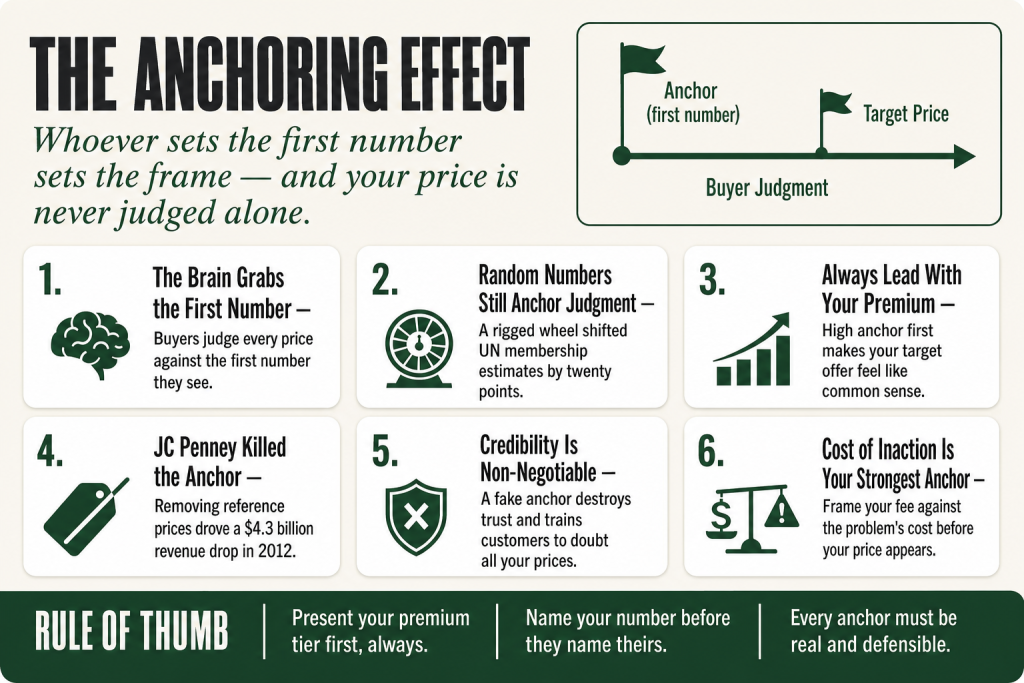
The anchoring effect is the reason a $79 entrée on a restaurant menu makes the $42 steak look reasonable, and why your pricing page may be costing you money every single day without you realizing it. By the end of this page, you’ll be able to set the reference point that all your prices are judged against, redesign a proposal or pricing page to move buyers toward your target offer, and spot the accidental low anchors you’re probably setting right now without intending to.
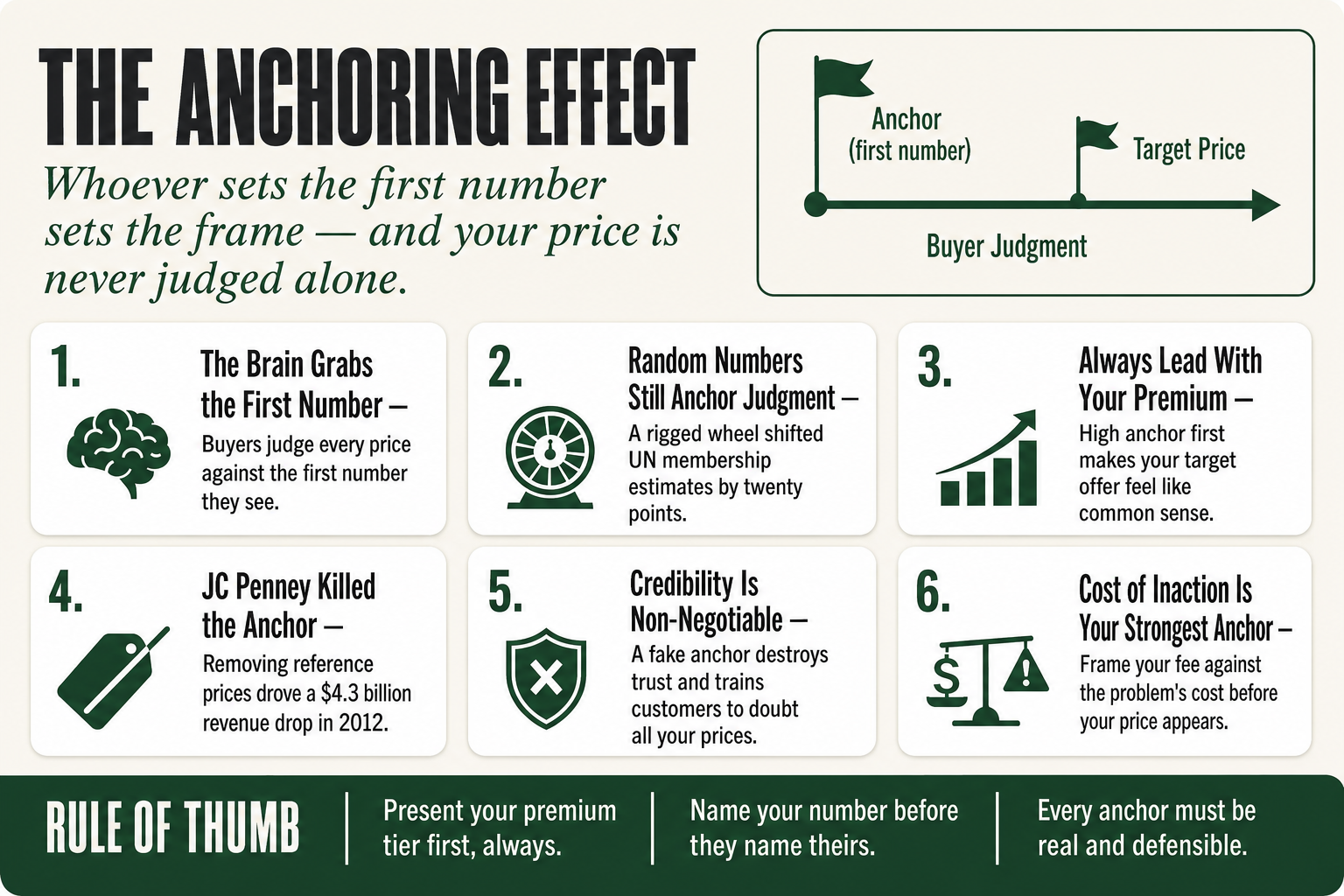
Here’s the problem the anchoring effect names: buyers don’t evaluate price in a vacuum. They don’t sit down, calculate the value your service delivers, and compare it objectively to the dollars you’re asking. That’s not how the brain works. Instead, they grab the first number they see, or the most salient number in the environment, and use it as a reference point. Every number that comes after gets judged as higher or lower than that anchor. The anchor doesn’t have to be relevant. It doesn’t even have to be your number. It just has to arrive first.
For a small-business operator, that single insight rewrites how you structure a proposal, design a pricing page, open a sales conversation, and frame a discount. You’re not just setting a price. You’re setting a context inside which your price will be felt.
The idea in 30 seconds
- The anchoring effect is the brain’s tendency to latch onto the first number it sees and judge every subsequent number against it, not on absolute merit.
- Introduced by Tversky and Kahneman in 1974, it’s one of the most replicated findings in behavioral economics and works even when the anchor is random and obviously irrelevant.
- For operators, the practical rule is simple: whoever sets the first number sets the frame. Present your premium tier first, your target offer second.
- The anchor doesn’t have to be your own price, a competitor comparison, a ‘was’ price, or a value-delivered figure all work.
- JC Penney eliminated price anchors in 2012 and watched full-year sales fall 24.8% to $12.985 billion, a $4.3 billion revenue drop, and post a net loss of $985 million. You don’t have to repeat that experiment.
- Anchoring works best when the anchor is credible; a fake or inflated anchor damages trust and trains customers to distrust your prices permanently.
Where the Anchoring Effect Came From
In 1974, Amos Tversky and Daniel Kahneman published ‘Judgment Under Uncertainty: Heuristics and Biases’ in Sciencea direct challenge to the rational-actor model that had dominated economics for decades. The anchoring effect, as they described it, is the tendency to rely too heavily on the first number encountered when making a judgment, with all subsequent estimates biased toward that initial value.
The experiment they used is almost too clean. They spun a rigged wheel of fortune, set to land on either 10 or 65, then asked participants what percentage of African countries were in the United Nations. The wheel had nothing to do with UN membership. It didn’t matter. When the wheel landed on 10, the median estimate was 25%; when it landed on 65, it jumped to 45%. A random number pulled the answer twenty points in either direction. People adjusted away from the anchor but stopped as soon as they hit something plausible, and ‘plausible’ was defined almost entirely by where they started.
Dan Ariely, George Loewenstein, and Drazen Prelec extended this into consumer pricing in their 2003 paper ‘Coherent Arbitrariness’ (Quarterly Journal of Economics). MIT MBA students were asked to write down the last two digits of their social security number before bidding on products at auction. Students whose SSN digits fell in the top fifth paid up to 346% more than those in the bottom fifth, for the exact same items. Ariely called the pattern ‘arbitrary coherence’: once a price takes root, it shapes not just the current transaction but future ones in the same category. That last part is what most operators miss. The anchor trains the customer’s entire valuation framework going forward, not just their decision on this deal.
How the Anchoring Effect Actually Works in a Buyer’s Brain
There are competing theories about exactly why anchoring is so powerful, but the practical core holds across all of them. People generate a preliminary judgment, their anchor, then adjust as new information arrives, but that adjustment is almost always insufficient. They stop as soon as they reach something that feels plausible, and that stopping point sits much closer to the anchor than the truth does.
The effect compounds when your buyer is busy, distracted, or making multiple decisions in sequence, which describes every normal buying situation. Mental load doesn’t neutralize anchoring; it amplifies it. Cognitive load and time pressure push people toward insufficient adjustment, leaving them anchored closer to the first number they saw (Epley & Gilovich, 2006). A buyer comparing three proposals on a Thursday afternoon while fielding Slack messages is more anchored than a buyer with perfect focus and unlimited time. You’ll almost never get the second type.
A second mechanism matters here: selective accessibility. When a high anchor lands, the brain actively retrieves reasons why that number makes sense, memories of expensive things in the same category, quality signals, competitor prices. The lower-priced tier then benefits from all that activated value information, while triggering almost none of the pain-of-paying response. So an anchor does two things at once: it makes your actual offer look cheaper by comparison, and it wakes up the value associations that justify spending in the category at all. You’re not just framing cost, you’re building perceived worth before the buyer consciously decides anything.
A $500 monthly fee looks like a lot in isolation. Positioned after a $2,000 anchor, it looks like a fraction. That’s the scale distortion a well-placed anchor produces, and it’s entirely within your control to set up.
The Anchoring Effect in Pricing: Where Operators Have the Most Control
Price is the most obvious and highest-leverage place to apply anchoring deliberately. The first price a customer sees becomes the anchor, and all subsequent prices are judged relative to it. Restructuring a pricing page or a proposal is one of the fastest, zero-cost levers a small operator has.
Lead with the Premium
Always present your highest-priced option first. This sets a high anchor, making your mid-tier and lower-priced options appear more attractive by comparison. Apple does this methodically with every product line, the iPhone Pro Max at $1,199 anchors the category, so the standard iPhone at $799 is evaluated not against the abstract question ‘is $799 a lot for a phone?’ but against a concrete $400 gap.
The same principle works at every price point. A home services company that opens a proposal with an annual maintenance plan at $4,800 before presenting the $1,600 quarterly option is using anchoring correctly. A consultant who mentions a $30,000 retainer engagement before discussing a $9,500 project fee is doing the same thing. The second number isn’t evaluated in isolation, it’s evaluated against the first.
The Strikethrough Price
Retailers show the original price crossed out next to the discounted price. The original price acts as the anchor, and the discounted price is measured against it. This works, but only if the original price is credible. A jacket marked down from $180 to $119 reads as a real discount. A jacket marked down from $699 to $119 reads as a scam, and you’ve now trained the customer to distrust every number you show them.
Value Comparison as an Anchor
The anchor doesn’t have to be your own price. One of the strongest anchors available to a service operator is the cost of the problem being solved, or the cost of the alternative. A bookkeeper who opens a conversation by noting that disorganized financials typically cost a small business $15,000, $40,000 at tax time in missed deductions and penalties has just set an anchor. The $4,800 annual fee that follows lands differently now. You haven’t inflated anything. You’ve simply made sure the relevant reference point is in place before the number arrives.
Setting your anchor too low, starting with your cheapest option, or opening a conversation with ‘we’re very affordable’, signals the opposite, and you’ll spend the rest of the conversation fighting that frame.
Putting this to work? The ideas in the Canon are the foundation under the tactical playbook in Build a Complete Marketing Department — grab the free companion kit at mmsvegas.com/resources.
What JC Penney Proves About Removing Anchors
The most instructive case study on anchoring in retail isn’t a success story, it’s a controlled demolition. In 2012, incoming JC Penney CEO Ron Johnson eliminated the chain’s decades-old system of high reference prices and coupon discounts in favor of ‘Fair and Square’ everyday low pricing. Less than 1% of revenues had been coming from full-price transactions, so why maintain those prices at all?
The results were swift and ugly. Full-year comparable-store sales fell 25.2%, total sales dropped 24.8% to $12.985 billion, a roughly $4.3 billion decline from the prior year, and the company posted a net loss of $985 million (JCK Online, 2013). Johnson was gone in under 18 months and later admitted that instituting ‘Fair and Square’ was a mistake.
What happened behaviorally was predictable. Customers who’d been conditioned to see items priced at $60 and buy them for $28 with a coupon no longer had a reference point. The everyday price of $28, the same actual number, felt expensive because there was nothing above it to make it feel like a deal. The ‘Fair and Square’ price wasn’t the problem. The missing anchor was.
Johnson’s instinct wasn’t crazy, the high-low pricing system is, objectively, a little theatrical. But he misread what the anchor was doing. It wasn’t deceiving customers. It was giving them a reference point that made the actual price feel like a win. Strip the anchor, and the win disappears. The price hadn’t changed. The context had.
For a small-business operator, the lesson is specific: if you’re simplifying your pricing and removing a reference price, don’t go live without replacing it. That’s not simplification, it’s removing the frame that makes your price make sense.
Anchoring in Proposals, Sales Conversations, and Negotiations
Pricing pages are only one arena. Anchoring matters equally, maybe more, in live sales conversations and written proposals. Whoever speaks first in a pricing conversation has an enormous structural advantage.
In B2B sales, the common mistake is letting the prospect anchor first by asking ‘what’s your budget?’ before you’ve presented anything. The moment you ask that question, you’ve handed them the frame. If they say $5,000 and your target is $12,000, you’re now negotiating against their anchor, not establishing your own. Lead with the scope and value of the work, present your full-service option first, then introduce tiered alternatives that descend from there.
The same $12,000 proposal can feel like a steal or a shock, the difference is pure context, not the number itself. That context is almost entirely constructed by what comes before the number.
For written proposals, structure matters. A three-option proposal should always lead with the largest, most involved engagement, even if you expect most clients to choose the middle. The goal isn’t to sell the top tier; it’s to make the middle tier feel obvious. A company that quotes $150,000 for a full system before introducing a modular version at $85,000 isn’t being manipulative, it’s being precise about sequencing.
One tactic worth testing: before presenting any number in a proposal, briefly describe the value or outcome being delivered, revenue impact, time saved, risk avoided. That description sets a value anchor that makes the price feel proportionate rather than absolute. The number hasn’t changed. The frame around it has.
In salary or fee negotiations, the research is consistent: anchor first, with a specific number, $14,400, not ‘around $15,000’, not a range. A specific number reads as calculated rather than estimated, which increases its credibility and makes it harder to dismiss as a placeholder.
Where the Anchoring Effect Still Applies for Small Operators
Anchoring is unusually versatile because it works across almost every industry and transaction type. Here are the operator scenarios where it pays off most reliably.
Service Packages and Tiered Offers
Any time you offer more than one option, which you should, the order and framing of those options matters. SaaS companies typically display their most expensive plan first, followed by cheaper options. The high price of the first plan anchors the category, making subsequent options feel more affordable. This works identically for a landscaping company, a law firm, a marketing agency, or a gym. The ‘platinum’ package at the top isn’t there because you expect most people to buy it. It’s there to make the middle option look like common sense.
Retail and E-commerce Product Placement
Brick-and-mortar stores place expensive items at the front or at eye level; as customers browse, they perceive other products as reasonable by comparison. Online, the same principle applies to product sort order and category pages. Lead with the expensive items, even if traffic gravitates toward the mid-range. The category experience sets an anchor before the customer ever clicks a product page.
Negotiation and Sales Calls
Anchoring is actually more powerful in genuine sales conversations than in most academic studies, real buying contexts, with real stakes and real uncertainty, make buyers more reliant on the reference point you provide, not less. Present your full scope first. Name your number before they name theirs.
Advertising and Promotional Copy
When a display ad or social post mentions a value before mentioning your price, ‘services valued at $2,400, available this month for $799’, the $2,400 functions as an anchor even in a two-second glance. The reader doesn’t need to consciously accept the $2,400 valuation. The number just needs to arrive first.
Where Anchoring Doesn’t Work (and Where It Backfires)
Anchoring is one of the most reliable effects in behavioral economics, but it’s not a universal override. A few places where operators miscalculate:
When the Anchor Destroys Credibility
An anchor that is obviously inflated doesn’t just fail, it damages the relationship. Buyers who catch a phantom reference price, and sophisticated B2B buyers often do, become permanently skeptical of every number you show them. The short-term anchor becomes a long-term trust problem. Your anchor must be defensible: a higher tier you genuinely offer, a competitor comparison you can substantiate, or a value calculation grounded in the buyer’s actual situation. In contexts where buyers have good information about actual market rates, an implausible anchor can trigger the opposite of what you intended.
When the Category Has a Well-Known Price Floor
Anchoring loses power when buyers already have a strong internal reference. If someone has bought web development services three times before, their prior experience is the anchor, and yours is competing against it. In commodity categories where prices are easily compared, anchoring on a high number can trigger price-shopping rather than value framing. The fix: anchor on the outcome and value delivered, not just the price tier.
When You’re Selling to Expert Buyers
Procurement professionals and experienced B2B buyers are trained to counter anchors. They’ll often respond to a high first number by anchoring in the opposite direction, low-balling the counteroffer to pull the midpoint down. The anchor still matters, but the dynamics are more adversarial. In these situations, anchoring on value (cost of the problem, ROI of the solution) tends to hold better than anchoring purely on price.
When Your Anchor Has No Supporting Evidence
The anchor works because the brain uses it to start a search for confirming information. A higher price signals premium quality and leads buyers to compare alternatives as inferior, but only if the rest of your presentation supports that signal. A $10,000 anchor followed by weak design, vague claims, and no social proof collapses. The anchor opens a door. Your offer has to walk through it.
Common Mistakes
- Leading with your cheapest option — Reorder your pricing page or proposal so your highest-priced tier appears first. Concretely: open your most recent proposal, find the first price that appears, and check whether the value framing above it runs for at least a full paragraph before the number shows up. If not, the anchor is landing cold. Flip the order.
- Asking ‘what’s your budget?’ before presenting your offer — Present scope, outcomes, and your anchor price before inviting the buyer’s response. A working sequence: walk through the full-service engagement and its price first, then say ‘depending on where you want to start, I can also show you a more focused version.’ Once a buyer names their budget, you’re negotiating against their number, and pulling from $5,000 back to $12,000 is far harder than letting $12,000 sit as the established reference from the start.
- Using an inflated or fabricated anchor price — Every anchor must trace back to something real: a higher tier you genuinely sell, a documented competitor rate, or a cost-of-problem calculation grounded in the buyer’s situation. Invented ‘original’ prices also carry FTC deceptive-pricing exposure. Build the tier first, price it honestly, then use it as the anchor.
- Eliminating a reference price without replacing it — If you’re simplifying pricing and removing a list price or promotional price, substitute it before going live. Add one sentence to your pricing page that states what the problem costs unsolved, or what a comparable solution runs through another channel. The buyer needs a reference point to feel like your price is a win, without one, they’ll supply their own, usually from the competitor’s page they visited right before yours.
- Presenting a high anchor with no supporting detail — Immediately after your premium tier, include at least one concrete proof element: a client outcome with a real number, a scope breakdown specific enough to feel substantive, or a one-line reference such as ‘a similar engagement for a 12-person firm cut billing leakage by $40K annually.’ Without proof, the buyer’s brain searches for evidence that the anchor is justified and finds nothing, which makes your mid-tier look expensive too.
Operator’s Take
Pull up your pricing page right now. Which number appears first? If it’s your cheapest option, you’ve already lost the frame, and no amount of clever copy further down the page recovers it.
The single highest-leverage change most operators never make: flip the order. Move your highest-priced tier to the top of the page or the front of the proposal, not as a fantasy tier you invented to make the middle look cheap, but as a real thing you actually sell and can defend. That reorder alone shifts close rates without changing a single word of offer language. Do it before anything else on this page.
Here’s what most anchoring advice skips entirely: the number alone isn’t enough. I’ve watched operators slap a $15,000 ‘premium’ tier onto a proposal with nothing supporting it, no outcome language, no case study, nothing specific about what’s actually included. The buyer’s brain searches for reasons why $15,000 makes sense and comes up empty. Then the $7,500 middle offer looks expensive too. You’ve poisoned both tiers. The anchor has to earn its position, and you earn it by building the value frame before the number appears, not after, not alongside it. What problem does this solve? What does it cost the client if nothing changes? What have you delivered for a comparable client? Answer those questions in the narrative, then put the price below them.
Don’t overlook external anchors. For most service businesses, the cost of inaction is a far more powerful anchor than any price tier you can construct. A $4,800 annual retainer reads completely differently once you’ve established that doing nothing, or hiring in-house, runs $18,000, $24,000 in loaded labor cost or missed recoveries. You haven’t changed your price. You’ve changed what it’s being compared to. That’s the whole game.
Three specific things to do this week:
Audit your proposal language for accidental low anchors. Phrases like ‘starting at,’ ‘as low as,’ and ‘budget-friendly options available’ are anchors, downward ones you placed there yourself, probably without thinking. If the story you’re telling is value, cut every one of them. They volunteer the wrong frame before the buyer even reads your offer.
Switch to a specific number on your next sales call. Not ‘roughly $15,000’, say $14,400. Precise figures read as calculated rather than estimated. They’re harder for a buyer to counter with a round number that drags the conversation down, and they signal that your pricing has a rationale behind it. Try it on the next proposal you send and compare how the negotiation goes.
If you use AI-assisted proposal tools, HubSpot, PandaDoc, Copilot, or any generative drafting tool, build the anchor sequence into your template as a structural rule, not an afterthought. AI can scan existing proposals for low-anchor language, flag ‘starting at’ constructions, suggest value-frame copy for specific client contexts, and keep the premium tier rendering first across every output you generate. What it won’t do is tell you whether your $15,000 top tier is actually defensible for this client, whether the cost-of-inaction framing is accurate, or whether your anchor will hold when the buyer pushes back. That judgment stays with you. The tools just stop you from making the same structural mistake on every proposal you send.
One last thing, and it matters more than the tactics: stop asking ‘what’s your budget?’ before you’ve presented anything. It sounds collaborative. What it actually does is hand the buyer the anchor and guarantee you spend the rest of the call negotiating against their number instead of yours. Present scope and value. Name your price. Then ask questions.
Used in
- ✓ Build a Complete Marketing Department
Used to structure pricing pages, proposal sequences, and offer tiers so the premium option anchors buyer judgment before the target offer is presented. - ✓ The Missing Manual for FunnelKit
Applied in order bump and upsell sequencing, the anchor established on the main offer page shapes how buyers evaluate price on the subsequent step. - ✓ The Missing Manual for Make
Referenced when automating dynamic pricing displays and proposal generation, ensuring the high-anchor tier renders first across all templates.
FAQ
What is the anchoring effect in simple terms?
The anchoring effect is the brain’s tendency to grab the first number it sees and use it as a reference point for every judgment that follows. In pricing, that means the first number your buyer sees shapes whether every subsequent number feels expensive or reasonable, regardless of what those numbers actually are.
Does anchoring work even when buyers know about it?
Yes. This is one of the most replicated findings in behavioral economics. Awareness of the bias reduces it slightly in some studies but does not eliminate it. The adjustment away from an anchor requires conscious, effortful processing, and buyers rarely have the time or motivation to fully override it.
How high should my anchor price be?
High enough to shift the frame, credible enough to be believable. The anchor should represent a real tier you offer or a genuine cost comparison, not a number you invented to look generous. If your buyer immediately dismisses the anchor as implausible, the effect reverses and they discount everything you show them.
Can anchoring work in service businesses, not just product pricing?
It may actually work better there. Service pricing is inherently more opaque than product pricing, which means buyers have fewer external reference points and rely more heavily on whatever you give them first. A consultant or agency that leads with its most involved engagement sets the frame for the entire conversation.
What’s the difference between the anchoring effect and the decoy effect?
Anchoring is about sequence, the first number shapes all subsequent judgments. The decoy effect is about choice architecture, a third option is structured to make one of the other two look better by comparison. They complement each other well: your premium tier can simultaneously serve as an anchor and as a decoy that steers buyers toward the middle option.
Is it ethical to use the anchoring effect in marketing?
Yes, provided your anchor is honest. Showing a legitimate higher-tier option first, referencing a genuine original price, or framing your fee against the cost of the problem you solve are all accurate representations of value. What crosses the line is fabricating reference prices, inflating an ‘original’ price that was never real, or inventing competitor costs to make yours look lower. The former is smart framing; the latter is deception, and in some jurisdictions, a regulatory problem.
Further reading
- ‘Judgment Under Uncertainty: Heuristics and Biases’Tversky & Kahneman (1974, Science). The original paper. Dense, but the anchoring-and-adjustment section is readable and worth 20 minutes.
- Predictably IrrationalDan Ariely. The chapter on arbitrary coherence is the most operator-relevant treatment of anchoring in popular behavioral economics; Ariely’s pricing experiments are the ones most directly applicable to how consumers evaluate your offers.
- Thinking, Fast and SlowDaniel Kahneman. Covers anchoring alongside the broader heuristics-and-biases framework; useful for understanding why the effect is so hard to override even with awareness.
- ‘Coherent Arbitrariness: Stable Demand Curves Without Stable Preferences’Ariely, Loewenstein & Prelec (2003, Quarterly Journal of Economics). The academic source behind arbitrary coherence; shows that anchoring effects on willingness to pay persist even after market exposure.
Sources: Tversky, A. & Kahneman, D. (1974). ‘Judgment Under Uncertainty: Heuristics and Biases,’ Science185(4157), 1124 to 1131. | Ariely, D. Loewenstein, G. & Prelec, D. (2003). ‘Coherent Arbitrariness: Stable Demand Curves Without Stable Preferences,’ Quarterly Journal of Economics118(1), 73 to 106. | Li, L. Maniadis, Z. & Sedikides, C. (2021). ‘Anchoring in Economics: A Meta-Analysis,’ Journal of Behavioral and Experimental Economics90, 101629. | Epley, N. & Gilovich, T. (2001). ‘Putting Adjustment Back in the Anchoring and Adjustment Heuristic,’ Psychological Science12(5), 391 to 396. | Epley, N. & Gilovich, T. (2006). ‘The Anchoring-and-Adjustment Heuristic,’ Psychological Science17(4), 311 to 318. | JC Penney fiscal year 2012 results: JCK Online (February 2013). Full-year comparable-store sales declined 25.2%; total sales decreased 24.8% to $12.985 billion; net loss of $985 million, per JCK Online reporting on company filings.
Brian Kasday spent forty years in direct-response marketing before rebuilding the whole operation as a one-person shop. He writes The Operator’s Library — including “Build a Complete Marketing Department” — for operators who’d rather build it themselves than wait on someone else.
Build the department these ideas describe — the free companion kit: mmsvegas.com/resources.
More The Operator's Canon guides
Free · Operator Toolkit
Want the tools, not just the guide?
Get the free operator toolkit — templates and checklists for the systems you actually run, plus a note when this guide changes.
Get the free toolkit →