
Last updated: July 2026
The endowment effect is the behavioral tendency for people to place higher value on something they already own, or merely feel they own, than on an identical thing they don’t. You’ll leave this page able to design trials, onboarding flows, and ownership cues that convert and retain customers by working with this bias honestly, and you’ll know exactly where it crosses into manipulation worth avoiding.
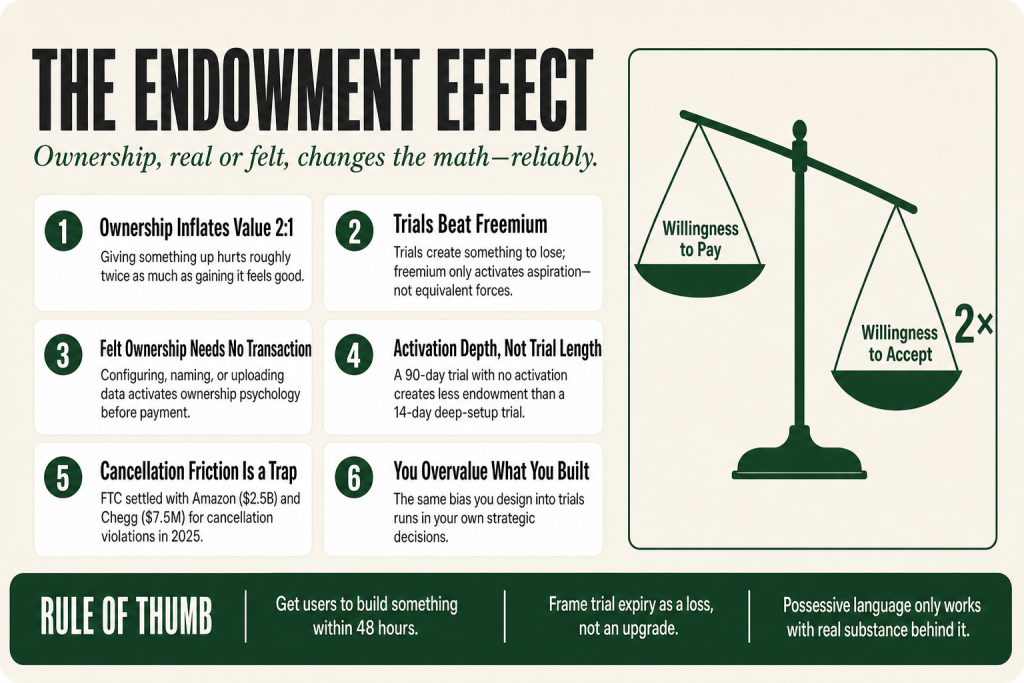
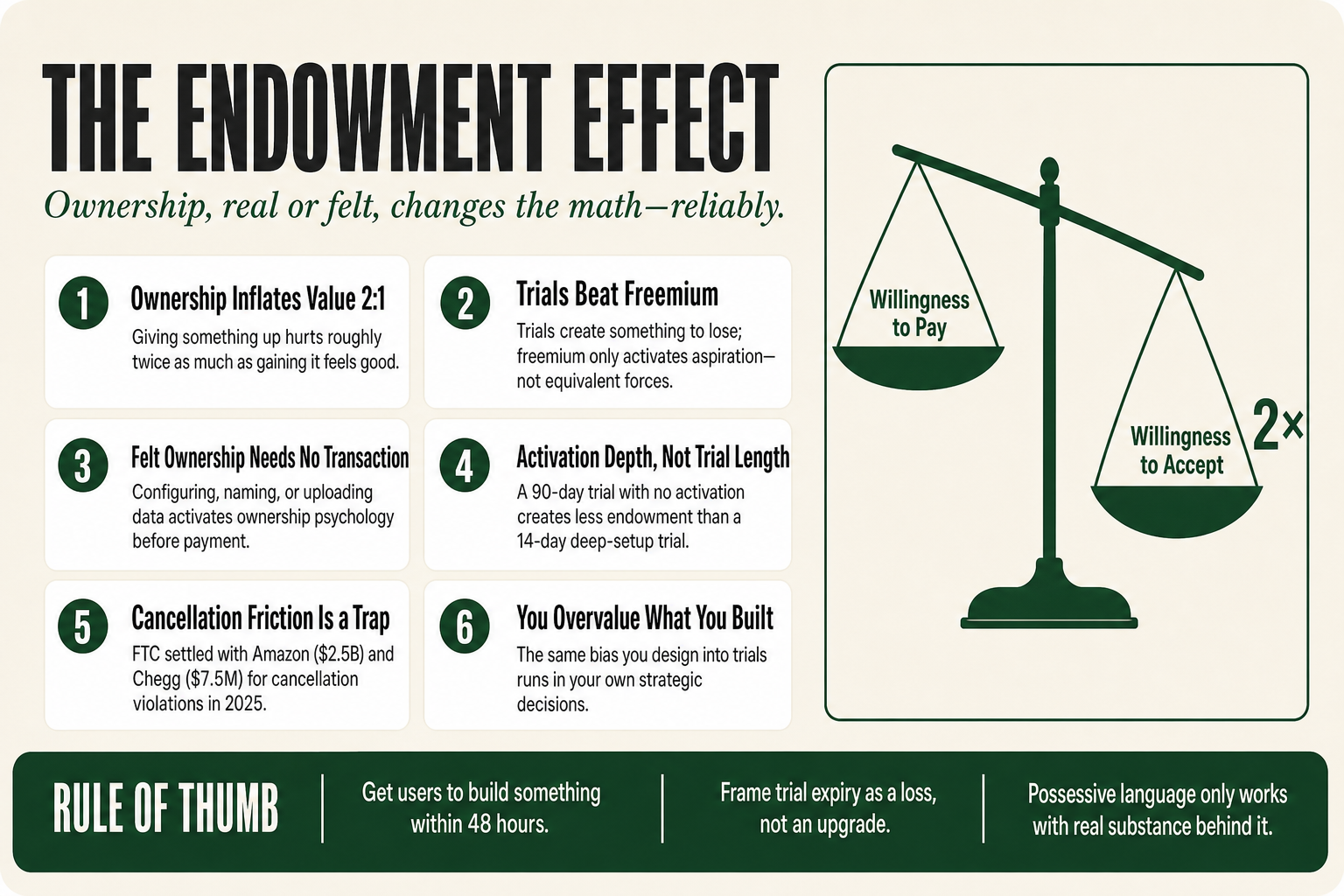
Plain version: if someone gives you a coffee mug, you’ll want more money to hand it back than you would have paid to buy it in the first place. The mug didn’t change. You did. The moment ownership enters the picture, the math shifts, not slightly, but reliably. Researchers have measured this asymmetry at roughly 2:1. Giving something up hurts about twice as much as acquiring the same thing feels good.
For a small-business operator, this is one of those ideas that looks simple on the surface and turns out to be load-bearing once you start pulling on it. It explains why your 30-day free trial converts better than a 30-percent discount. Why the client who spent two months loading their data into your platform almost never leaves. Why the prospect who got a personalized audit from you in a discovery call is far warmer than the one who just read your website.
Ownership, real or felt, is doing work in all of those situations. Most operators either stumble into it or miss it entirely.
The idea in 30 seconds
- The endowment effect is the tendency to demand more to give something up than you’d ever pay to acquire it, ownership inflates perceived value, reliably.
- Richard Thaler named it in 1980; Kahneman, Knetsch, and Thaler confirmed it experimentally in their 1990 Cornell mug study. Both Thaler and Kahneman eventually received Nobel Prizes in Economics.
- For operators, the main lever is psychological ownershipthe felt sense of possession created before money changes hands, through trials, samples, personalization, and onboarding investment.
- Free trials outperform freemium in conversion because trials create something to lose. Freemium only activates aspiration. Those are not the same motivational force.
- The same dynamic that converts trial users also retains paying customers, the more a client has built inside your system, the more painful leaving becomes.
- The dark side is real: manufacturing attachment through hidden cancellation friction, fake urgency, or phantom ownership without real value is a trust-killer and increasingly a legal one.
Where It Came From, The Short Version
Richard Thaler coined the term in a 1980 paper, building on Kahneman and Tversky’s prospect theory. His core observation: if losses are weighted more heavily than gains, then the moment you acquire something, any future sale of it registers as a loss rather than a foregone gain. You’re not choosing between the mug and the money. You’re choosing between keeping what’s already yours and giving it up, a psychologically distinct transaction, and a more expensive one.
Kahneman, Knetsch, and Thaler formalized the proof a decade later in a Cornell study. Some undergraduates were given mugs and offered the chance to sell or trade them; others were asked what they’d pay to acquire one. The mug owners required roughly twice as much to give them up as non-owners were willing to pay. Initial allocation mattered. Ownership created value from thin air.
Both Thaler (2017) and Kahneman (2002) received Nobel Prizes in Economics. The mug study is one of the most replicated findings in behavioral economics, and one of the most practically applicable, which is not always the same thing.
That’s the history. The rest of this piece is about what it means for your business.
Why It Matters: The Gap Between Paying and Giving Up
Classical economic models assumed that your willingness to accept a price for something you own and your willingness to pay for that same thing when you don’t own it should be roughly equal. Rational actors maximize utility. The origin of the asset, who handed it to you, shouldn’t affect its value.
Except it does. The gap between those two numbers is not noise; it’s signal. Ownership generates an emotional surcharge. The loss of giving something up registers differently than the gain of acquiring something equivalent. They’re processed asymmetrically.
For operators, this has a direct implication: the most effective way to increase someone’s willingness to pay isn’t to tell them more about your product. It’s to give them the felt sense of already owning it. That reframes the purchase decision entirely, from ‘should I acquire this?’ to ‘can I afford to lose what I’ve already built?’
How the Endowment Effect Actually Works, The Operator’s View
Three mechanisms drive the effect, and each one has a direct tactical implication.
Loss Aversion as the Engine
The endowment effect is, at root, an expression of loss aversion. Once you possess something, the prospect of losing it registers as a threat rather than a missed gain, roughly 2x stronger than the equivalent desire to acquire something. A free trial doesn’t just let someone evaluate your product; it gives them something to lose at the end of 30 days. That’s a fundamentally different motivational structure than a discount, which only addresses what they’d have to spend.
Psychological Ownership Without Legal Ownership
You don’t need a transaction for the endowment effect to kick in. Perceived ownership is enough. The moment someone starts thinking of something as theirsbecause they configured it, named it, uploaded their data into it, or simply heard it called ‘your plan’ in an email, the ownership psychology activates. Neuroimaging research has linked the endowment effect to brain regions associated with value and self-identity. When something becomes associated with who you are, giving it up costs more than its price tag.
This is why onboarding investment matters so much in services. The client who spent eight hours setting up their custom dashboard isn’t evaluating your software on price anymore. They’re evaluating the cost of losing what they’ve already built.
Time Amplifies the Effect, But Only With Engagement
The longer someone possesses, or feels they possess, something, the stronger the attachment. A trial user on day 27 is much harder to let go than a trial user on day 3. A client in month 18 has a different relationship with your service than a client in month 2. The caveat: time only amplifies the effect if the user is actually building something during that period. A 90-day trial with no activation doesn’t create more endowment than a 14-day trial with deep setup. Calendar duration is a proxy. What matters is the depth of psychological investment underneath it.
Putting this to work? The ideas in the Canon are the foundation under the tactical playbook in Build a Complete Marketing Department — grab the free companion kit at mmsvegas.com/resources.
The Endowment Effect in Action, Real Operators, Real Tactics
The clearest large-scale demonstration is the SaaS free trial. When a software company offers full-featured free access, they’re creating a felt possession, something the user will have to actively give up when the trial ends, rather than simply choosing not to buy. The conversion gap is real and well-documented: freemium products typically convert at 2 to 5%, while full-featured free trials convert in the 5 to 25% range, with the highest-activation products reaching 15% or better. Published analyses from ProductLed, Appcues, Lenny’s Newsletter, and a 2026 Growth Unhinged study of 200 software products all point the same direction. Freemium activates aspiration. Trials activate loss aversion. Not equivalent forces.
The most cited physical example is Warby Parker’s Home Try-On program, which shipped five frames to a customer’s home for five days, no credit card required. The insight behind it was behavioral: the barrier to buying eyewear online wasn’t price skepticism, it was the discomfort of choosing something that defines your face without physically experiencing it. Once those frames were in your house, on your face, worn around your apartment with your favorite outfit, returning them felt like a loss. The program ran for roughly 14 years from Warby Parker’s 2010 launch. The company announced it was winding it down by end of 2025, not because the psychology stopped working, but because it had grown to 300-plus physical stores, making the program redundant for most customers. The tactic served the moment, and the moment changed. That’s worth noting on its own.
In B2B, the endowment effect shows up most powerfully in onboarding depth. The goal isn’t just to get a client through setup, it’s to create the felt sense that they’ve built something inside your system that belongs to them. By day 90, the client who has imported their contact list, customized their workflow, trained their team, and integrated your tool into daily operations is not making the same purchase decision they made on day one. They’re not evaluating whether to buy. They’re evaluating whether to lose what they’ve already built.
There’s a framing case worth knowing from telecom retention research. Operators who told churning customers ‘stay and we’ll give you 100 free calls’ saw modest uptake. When they reframed the same offer, positioning those calls as already credited to the account rather than a future benefit to be earned, retention improved significantly. Same economic offer. The framing shifted from acquisition to loss, and that changed behavior. You can run a version of this in nearly any category.
A fitness studio that sends a new member a message saying ‘Your first 10 classes are loaded and ready’ is doing something meaningfully different from one that says ‘Come in 10 times before month-end.’ A marketing consultant who delivers a real mini-audit in the discovery call, specific to that business, not a generic template, has given the prospect something that feels like theirs. The conversion rate on the follow-up is not the same as the consultant who just described their service on a call.
Where the Endowment Effect Is Most Useful for Small Operators
The effect is strong wherever two conditions coexist: the product or service can be experienced or partially possessed before payment, and giving it up would feel like a concrete, felt loss rather than a neutral non-purchase.
Trials and freemium offers. Any software, subscription service, or platform that lets people configure and use it before paying is sitting directly on top of the endowment effect. The operator’s job is to accelerate ownership during the trial, drive setup completion, get their data in, get their team involved. A trial user who has done nothing with the product has no psychological ownership and will not convert for that reason. The trial gave them access, not possession.
Physical samples and home try-ons. Any product that can be handled, worn, or placed in someone’s environment benefits. A specialty food producer sending actual samples to wholesale buyers, a florist sending a small arrangement for a venue walkthrough, a print shop sending a paper swatch kit to a prospective client, all of these transfer possession before the invoice arrives.
Service previews and done-for-you samples. The under-used play for professional service businesses. A bookkeeper who prepares a one-page financial snapshot for a prospect’s business during the sales process. An agency that builds a rough landing page wireframe before the contract is signed. A contractor who provides a detailed scope with suggested materials and actual supplier names. Each of these creates something the prospect now has, not a proposal, but an artifact that feels like the beginning of something they own. Giving it up means losing a head start.
Personalization at any scale. The word ‘Your’ does real work. ‘Your saved items,’ ‘Your personalized plan,’ ‘Your financial roadmap’, possessive language activates ownership feelings before money changes hands. But the trigger has to be backed by something real. ‘Your custom plan’ that turns out to be the same three-tier pricing everybody gets is transparent enough to backfire. The framing works when it’s earned.
Onboarding investment for retention. Once a customer has paid, the endowment effect is working for you. The more they invest in customizing, configuring, and integrating your product or service into their operations, the higher the psychological cost of switching. A CRM with 400 contacts manually entered and five years of deal history isn’t just software, it’s a proprietary asset the client built. Onboarding isn’t just about activation; it’s about manufacturing endowment.
Where It Doesn’t Work, and Where It Works Against You
The endowment effect is not universal, and treating it as a magic formula will get you into trouble.
Commodities with transparent pricing. When buyers know the market price of something, fuel, bulk materials, exchange-traded goods, psychological ownership cues have little traction. The endowment effect is weakest where rational comparison is easy and the ownership premium can be benchmarked away. If your prospect can see three competing quotes in 90 seconds, the felt ownership of your proposal is unlikely to overcome a meaningful price gap.
Short, frictionless trials that create no real investment. A trial that lets someone poke around a product without doing anything meaningful creates no psychological ownership, and therefore no endowment. You need engagement, configuration, and habituated use. A product that takes three minutes to set up may also take three minutes to abandon, because there’s nothing accumulated to lose.
High-cost purchases with extended deliberation cycles. In big B2B deals with multiple stakeholders, formal procurement processes, and risk-committee sign-offs, the endowment effect is one input among many. The economic team evaluating a seven-figure software contract is not primarily operating on ownership feelings. Getting your product deployed in a pilot still helps, but the primary driver of the decision is rational ROI framing, not loss aversion from the pilot’s endowment.
The effect working against you: seller overvaluation. This is the endowment effect’s most dangerous face for operators, it inflates your own valuation of your business, your pricing, your offer, and your work. You’ve invested years building something and it feels irreplaceable to you, which is why most owners price their businesses too high, hold onto underperforming product lines too long, and resist pivots that a dispassionate outside observer would make in a heartbeat. The same bias you’re designing into your trials is also running in your own head when you evaluate your strategy. Customer discovery and honest market data are the antidote.
Common Mistakes
- Running a trial without driving any ownership action in the first 48 hours — Extend your trial if you want, but don’t expect calendar length to do the work that activation depth has to do. Pick one specific setup action that creates irreversible investment, a named project, an imported contact list, a connected integration, and engineer your entire welcome sequence around getting users there before day 3. Rewrite the first onboarding email as a single call to action: one thing, why it matters, how long it takes. If your welcome sequence is a feature tour, you’re building awareness, not endowment. Those produce different conversion numbers.
- Using possessive language without possessive substance — Audit every instance of ‘your’ in your trial and onboarding copy. For each one, ask: is this backed by something actually unique to this user? If the answer is no, either remove the possessive language or build the actual customization behind it. A SaaS tool that auto-names the user’s first project with their company name and industry has done more for felt ownership than three emails calling it ‘your workspace.’ A plan page that uses ‘your’ to describe the same three tiers everyone else sees will teach customers your framing is wallpaper, and they’ll stop reading it.
- Extending trial length when the real problem is activation depth — Before you move from a 14-day to a 30-day trial, pull your conversion cohort and identify what the users who did convert did in the first 72 hours that non-converters didn’t. Almost always, it’s a specific setup action rather than a feature. One B2B project management tool found that users who created a second project within 72 hours converted at 4x the rate of those who only ever used the default, the answer was an in-app prompt on day 2, not a longer trial window. More time without more activation is just delayed churn.
- Using cancellation friction to hold onto churning customers — This is the one where the short-term math looks right and the long-term math is brutal. Hiding the cancel button, requiring a phone call to end a digital subscription, and engineering guilt-shaming multi-step flows all generate chargebacks, complaint volume, and social backlash that cost more than the retained MRR they produce. The legal exposure is real and current: the Eighth Circuit vacated the FTC’s Click-to-Cancel rule in July 2025 on procedural grounds, but ROSCA and Section 5 of the FTC Act enforcement is actively ongoing. In September 2025, the FTC settled with Amazon ($2.5 billion) and Chegg ($7.5 million) for subscription cancellation violations. The FTC submitted a new ANPRM to OIRA on January 30, 2026, with the ANPRM published in the Federal Register on March 13, 2026, the rulemaking process has restarted. California’s automatic renewal law (Cal. Bus. & Prof. Code § 17600 et seq.), amended effective July 1, 2025, adds further requirements. Customers held in by friction churn the moment you make it easy and leave angry. Invest that energy in real endowment earlier in the relationship instead.
- Ignoring the endowment effect in your own strategic decisions — You overvalue your offer, your pricing, and your existing product lines because you built them, that’s the same bias you’re designing into your trials, running in your own head. The practical problem: you’ll hold onto a failing product line two quarters too long, price your services above what the market will bear, and resist a pivot that would be obvious to anyone without skin in the game. The fix is structural, not motivational. Run pricing assumptions past someone with no ownership stake in the answer. Use customer data as the tiebreaker, not conviction. When evaluating whether to kill a feature or service line, ask: ‘If I didn’t already have this, would I build it now?’ If the answer is no, that’s the endowment effect talking.
Operator’s Take
Here’s what I actually think, having watched operators apply this idea well and badly: the endowment effect is among the most reliably useful concepts in behavioral economics for businesses selling via trials, previews, or subscriptions, and it’s chronically misapplied. Most operators either scatter possessive language across their copy and call it psychology, or they reduce it to ‘run a free trial’ and stop there. Neither captures where the leverage actually lives.
Fix your day-1 onboarding before you touch anything else. Pull your trial cohort at the 72-hour mark. What percentage completed a setup action that created something irreversible, a named project, an imported contact list, a connected integration? If it’s under 40%, your conversion problem isn’t pricing or trial length. It’s that nobody has built anything yet, so nobody has anything to lose. The fix is a single-action welcome email: one thing, why it takes three minutes, what they’ll have at the end. Not a feature tour. Not five tips. One action that creates a concrete artifact. Slack’s onboarding has long been built around exactly this principle, from workspace naming to the first channel invite, the design consistently prioritizes getting users to create something before they’ve made a payment decision. The goal is ‘I built something here’ inside 48 hours. Engineer backward from that moment, not forward from signup.
For service businesses: deliver artifacts, not pitches. Something specific to that client’s situation that they hold in their hands. A one-page competitive gap analysis built from their actual website and three competitor sites. A draft email sequence written for their specific customer type. A rough scope document with real supplier names and line-item numbers. When you hand a prospect something real and specific, they’re holding an asset. Most would rather keep developing that thing with you than start the whole conversation over with someone else. If you’re not already doing this, try it on your next five discovery calls and track the close rate separately. The data will make the case faster than I can.
Map where ‘using your product’ becomes ‘this is mine.’ Those are not the same milestone, and most onboarding sequences treat them as if they are. A client who logs in daily but hasn’t renamed any fields, uploaded their own data, or customized a template is active but not endowed, they’re still effectively shopping. Draw the line: at which specific action does the experience shift from ‘evaluating a product’ to ‘I built something here’? If that moment never reliably arrives, month-three churn is not a mystery. Redesign backward from it.
Use loss framing in retention moments, but only where it’s true. When a trial expires, the email that says ‘your 14-day access ends Friday’ will outperform ‘upgrade now to keep going’, one frames a loss, the other frames a purchase. In win-back campaigns, ‘you still have 47 contacts saved in your account’ does more work than ‘come back and pick up where you left off’, the first makes the loss concrete, the second is vague goodwill. One rule: the framing has to be literally true. If there’s nothing saved, don’t imply there is. Fake loss framing is a lie that borrows behavioral vocabulary. It erodes trust faster than it converts.
On the legal side, know where things actually stand. The FTC finalized its Click-to-Cancel rule in October 2024, but it never took effect. On July 8, 2025, the Eighth Circuit vacated it in its entirety in Custom Communications, Inc. v. FTCthe court found the FTC had failed to conduct the preliminary regulatory analysis required under Section 22 of the FTC Act when costs exceeded the $100 million threshold. The FTC submitted a draft Advance Notice of Proposed Rulemaking (ANPRM) to OIRA on January 30, 2026, restarting the process; the ANPRM was published in the Federal Register on March 13, 2026. The rule is dead for now, but enforcement is not: in September 2025, the FTC settled with Amazon for $2.5 billion over Prime enrollment and cancellation practices, and with Chegg for $7.5 million over allegations it made cancellation of recurring subscriptions deliberately difficult, both under ROSCA and Section 5 of the FTC Act. California’s automatic renewal law (Cal. Bus. & Prof. Code § 17600 et seq.), amended effective July 1, 2025, adds requirements that in some respects go further than the vacated federal rule. Other states are moving in the same direction. The practical upshot: you cannot hide the cancel button, require a phone call to end a digital subscription, or engineer multi-step guilt flows without real legal exposure. Cancellation friction that generates chargebacks and regulatory complaints costs more than the retained MRR is worth. Let people leave cleanly, then invest that energy in real endowment earlier in the relationship, before they’re looking for the exit.
One last thing: the endowment effect doesn’t rescue a weak offer. It amplifies value that’s already there. Run the trial on a bad product and you’ve just accelerated the unsubscribe. Design for real value first, then layer the ownership mechanics on top. That order matters more than most operators think.
Used in
- ✓ Build a Complete Marketing Department
Used to design trial and onboarding sequences that convert prospects by creating psychological ownership before asking for a payment commitment. - ✓ The Missing Manual for FunnelKit
Applied when structuring free trial flows, upsell timing, and expiry-nudge email sequences so that end-of-trial messaging frames conversion as avoiding a loss, not making a purchase. - ✓ The Missing Manual for Make
Informs automated onboarding workflows that trigger ownership-building actions, data imports, setup completions, personalization steps, within the first 48 hours of a new customer relationship.
FAQ
What is the endowment effect in simple terms?
It’s the tendency to place higher value on something you own, or feel like you own, than you would pay to acquire it. Ownership, even temporary or perceived ownership, inflates how much something is worth to you. The mug doesn’t change; you do.
Who discovered the endowment effect?
Richard Thaler named and introduced the concept in a 1980 paper. Kahneman, Knetsch, and Thaler then provided the landmark experimental confirmation in their 1990 Cornell mug study, where mug owners required roughly twice as much to give up their mugs as non-owners were willing to pay. Both Thaler and Kahneman later received Nobel Prizes in Economics.
How does the endowment effect differ from loss aversion?
Loss aversion is the general principle that losses hurt more than equivalent gains feel good. The endowment effect is a specific form of loss aversion triggered by ownership, the act of possessing something converts any future loss of it into a psychologically amplified event. You can experience loss aversion without any ownership involved. The endowment effect specifically requires that something has been framed or experienced as already belonging to you.
Why do free trials convert better than freemium?
A full-featured free trial gives users something to lose at the end, access they’ve been building with. Freemium only withholds premium features users may never have had, which activates aspiration rather than loss aversion. Published SaaS benchmarks from ProductLed, Appcues, and a 2026 Growth Unhinged study of 200 software products consistently show freemium conversion clustering at 2 to 5% against free-trial conversion ranging from 5 to 25% depending on product type and activation depth. The structural cause is behavioral: trials create something to lose, freemium does not.
Can the endowment effect be used unethically?
Yes. Making cancellation deliberately difficult, auto-enrolling users into paid plans without clear disclosure, or using fake urgency to simulate ownership feelings are all dark-pattern applications. They generate chargebacks, reputation damage, and real legal risk. The FTC’s Click-to-Cancel rule was vacated by the Eighth Circuit on July 8, 2025 in <em>Custom Communications, Inc. v. FTC</em> on procedural grounds, but ROSCA and Section 5 of the FTC Act enforcement is actively continuing. In September 2025, the FTC settled with Amazon ($2.5 billion) and Chegg ($7.5 million) for subscription cancellation violations. The FTC submitted a new ANPRM on January 30, 2026, published in the Federal Register on March 13, 2026, restarting the rulemaking process. California’s automatic renewal law (Cal. Bus. & Prof. Code § 17600 et seq.), amended effective July 1, 2025, adds requirements that in some cases go further than the vacated federal rule.
Does the endowment effect work for service businesses, not just software?
Absolutely. Any service business can create psychological ownership before the sale, through a substantive free preview, a personalized audit, or a custom scope document. Clients who have invested time, shared information, and received something specific from a service provider have the same endowment calculus as a software user who loaded their data: leaving means losing a head start they’ve already built.
Further reading
- Thinking, Fast and SlowDaniel Kahneman. The definitive lay account of prospect theory and the research tradition behind the endowment effect; Part III covers loss aversion and the WTA/WTP asymmetry in depth.
- MisbehavingRichard Thaler. Thaler’s first-person account of developing behavioral economics, including the origins of the endowment effect concept and the Cornell mug experiments.
- NudgeThaler and Sunstein. Applies the endowment effect and status quo bias to policy and choice architecture design; useful for operators thinking about default settings and opt-in structures.
Sources: Richard Thaler, ‘Toward a Positive Theory of Consumer Choice,’ Journal of Economic Behavior and Organization, 1980. Kahneman, Knetsch, and Thaler, ‘Experimental Tests of the Endowment Effect and the Coase Theorem,’ Journal of Political Economy, 1990. Kahneman, Knetsch, and Thaler, ‘Anomalies: The Endowment Effect, Loss Aversion, and Status Quo Bias,’ Journal of Economic Perspectives, 1991. SaaS conversion benchmarks: Kyle Poyar, ‘The 2026 Free-to-Paid Conversion Report,’ Growth Unhinged (study of 200 software products, January 2026); Appcues, ‘Free Trial Conversion Rate: Benchmarks and Strategies’ (updated June 2026); Lenny Rachitsky, ‘What Is Good Free-to-Paid Conversion,’ Lenny’s Newsletter, 2023. Warby Parker Home Try-On program: Retail Dive, August 7, 2025; Modern Retail, August 14, 2025. Slack onboarding activation design: Appcues, ‘5 Ways Slack’s User Onboarding Strategy Has Evolved Since 2014’; Raw.Studio, ‘How Slack Uses 4 Onboarding UX Tactics to Drive Activation and Conversion’ (May 2026); UserPilot, ‘Slack Onboarding Flow: 6 Best Practices’ (June 2026). FTC legal and enforcement: Custom Communications, Inc. v. Federal Trade Commission, No. 24-3137, 2025 WL 1873489 (8th Cir. July 8, 2025) (vacating Click-to-Cancel rule in its entirety on procedural grounds under Section 22 of the FTC Act); FTC ANPRM submitted to OIRA, January 30, 2026; ANPRM published in Federal Register, March 13, 2026. FTC enforcement actions: Amazon settlement ($2.5 billion, final order entered September 25, 2025, U.S. District Court for the Western District of Washington) and Chegg settlement ($7.5 million, announced September 15, 2025) for ROSCA and Section 5 violations, confirmed via FTC.gov. California Automatic Renewal Law: Cal. Bus. & Prof. Code § 17600 et seq., amended effective July 1, 2025.
Brian Kasday spent forty years in direct-response marketing before rebuilding the whole operation as a one-person shop. He writes The Operator’s Library — including “Build a Complete Marketing Department” — for operators who’d rather build it themselves than wait on someone else.
Build the department these ideas describe — the free companion kit: mmsvegas.com/resources.
More The Operator's Canon guides
Free · Operator Toolkit
Want the tools, not just the guide?
Get the free operator toolkit — templates and checklists for the systems you actually run, plus a note when this guide changes.
Get the free toolkit →