
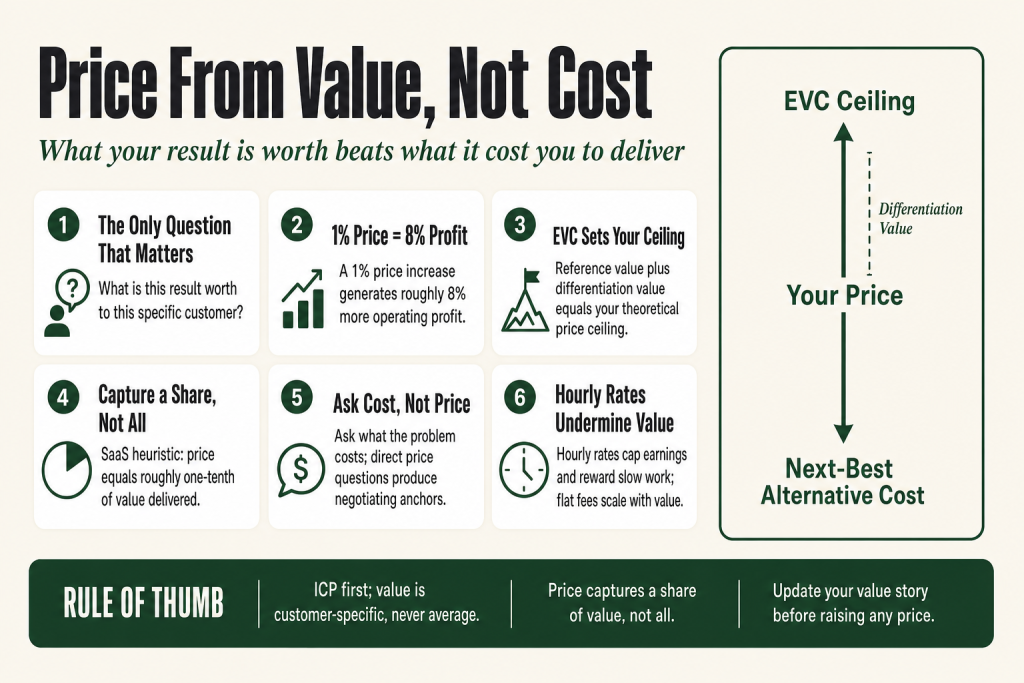
Last updated: July 2026
Value based pricing is the practice of setting your price from the economic value you create for a specific customer, not from what it cost you to deliver, and not from whatever your nearest competitor is charging. By the end of this page, you’ll be able to identify the real value your offer creates in concrete dollar terms, run the research conversation that reveals a customer’s willingness to pay, and construct a price that captures a defensible share of that value instead of leaving it on the table.
Most small-business operators set prices one of two ways. They add up their costs and tack on a margin, or they look at three competitors and land somewhere in the middle. Both feel responsible, systematic, defensible in a client conversation, easy to explain internally. The problem is that neither method has anything to do with value. Cost-plus answers how much do I need to charge? Competitor-based pricing answers what are others charging? Value based pricing answers the only question that actually matters for a differentiated business: what is this result worth to this customer?
That reframe sounds simple. It isn’t. It requires you to know your customer’s economics well enough to estimate the outcome you produce, in dollars, time, or risk avoided, and it requires the discipline not to flinch when that number is much higher than you’re used to seeing on your own invoices. It also requires knowing when value based pricing doesn’t apply: commodity markets, unproven outcomes, buyers who won’t open their books. This page covers all of it.
The idea in 30 seconds
- Value based pricing sets your price from the economic or emotional outcome a specific customer receives, not from your costs or competitors’ rates.
- Cost-plus pricing systematically undercharges differentiated operators; it rewards the commodity provider, not the specialist.
- The starting question is: what is this result worth to this customer?then you price as a share of that value.
- You must know your Ideal Customer Profile before you can price on value, value is always relative to a specific buyer’s situation, not an average buyer.
- The primary research tools are customer interviews, win/loss analysis, and, for more formal settings, the Van Westendorp Price Sensitivity Meter or conjoint analysis.
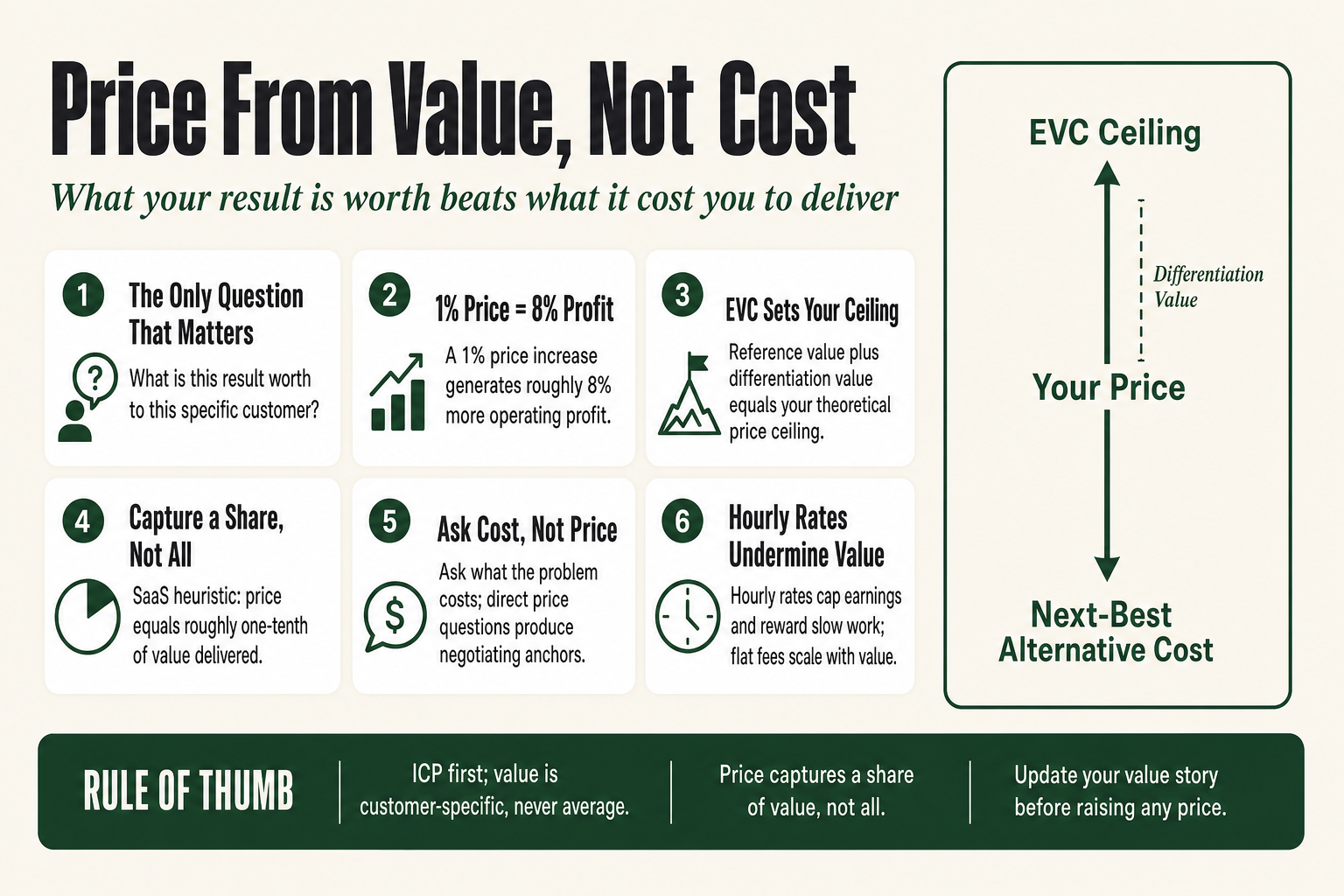
- Price is the highest-leverage number in your business: Marn, Roegner, and Zawada’s analysis of S&P 1500 income statements in McKinsey Quarterly (2003) found that a 1% price increase with stable volume generates roughly an 8% increase in operating profit, more leverage than any cost-cut or volume play.
Where Value Based Pricing Came From
The intellectual roots sit in microeconomics, specifically in the theory of consumer surplus. Formalizing that gap into a usable pricing tool took until 1979, when McKinsey consultants John Forbis and Nitin Mehta published a staff paper introducing the Economic Value to the Customer (EVC) framework. The core logic: start with the price of the best available alternative, then add or subtract the monetary value of every differentiating attribute your offering carries. The result, the EVC, is the theoretical ceiling a rational economic buyer should pay.
Thomas Nagle, then a professor at the University of Chicago and Boston University, built on that foundation in The Strategy and Tactics of Pricing (1987), still the canonical practitioner text on the subject. His argument was that cost-plus and competitor matching consistently misprice the differentiated portion of an offer, which is exactly the part that creates value. He founded the Strategic Pricing Group the same year, which joined Monitor in 2005 and became Monitor Deloitte in 2011.
The case for pricing precision moved from theory to urgency when McKinsey partners Michael Marn, Eric Roegner, and Craig Zawada published their analysis of S&P 1500 income statements in McKinsey Quarterly No. 1, 2003. Their finding: a 1% price increase, with volume held steady, generates roughly an 8% increase in operating profits, nearly 50% more impact than a 1% reduction in variable costs, and more than three times the impact of a 1% volume gain. Price stopped being a back-office calculation after that.
The Problem Cost-Plus Actually Creates
Cost-plus pricing is seductive because it feels safe. Your costs are knowable. Your margin is your call. The math is a spreadsheet, not a conversation. For commodity businesses, contract manufacturing, wholesale distribution, markets where the product is interchangeable, it’s probably the right method. When customers can substitute freely, the market sets price and your job is cost management.
The problem is that most small-business operators are not in commodity markets, even when they price like they are. A bookkeeper who saves a restaurant owner four hours a week and catches $8,000 in missed deductions is not competing on equivalent commodity terms with the bookkeeper down the street. A web developer who builds a lead-generation funnel producing 40 qualified inquiries a month is not equivalent to one who builds a brochure site producing four. The outcomes are radically different. Cost-plus erases that difference, it prices the input (hours, materials, overhead) instead of the output (revenue recovered, leads generated, risk eliminated).
There’s a second, subtler trap. Cost-plus anchors your price to your own efficiency. Invest in getting better at your craft, faster process, proprietary framework, sharper diagnostic, and your costs drop. Your cost-plus price either drops with them, or you quietly pocket the margin while telling yourself nothing changed. Neither outcome sends the right signal. The customer who benefits most from your expertise is the one who should be paying the most for it, not the one rewarded because you got faster.
Competitor-based pricing has a different flaw. It rewards whoever set the market rate first, usually the least-differentiated provider, and assumes your offer is equivalent to theirs. If you’re genuinely better, you’re subsidizing customers who should be paying more. If you’re specialized, you’re hiding that behind a generic price that signals generic work.
The Core Principles of Value Based Pricing
Four principles hold this framework together. Miss any one of them and you’re doing cost-plus with a story attached.
1. Value is always relative to a specific customer and situation
Value isn’t a property of your product or service. It’s a function of the gap between where a customer is now and where your offer takes them, and that gap varies enormously across segments. A CFO at a $10M professional services firm values the same cash-flow consulting engagement very differently than the founder of a $400K solo practice. Pricing as if all customers experience the same value is the same mistake as pricing off your costs: it averages away the signal.
This is why your Ideal Customer Profile is the prerequisite to value based pricing, not a follow-on task. You can only quantify the value of an outcome if you know the economics of the person receiving it.
2. Price is a claim, and it has to be credible
A value-based price only holds if the customer believes the value claim. That means evidence: case studies with numbers, before-and-after metrics, testimonials that name an outcome. In B2B services, this is exactly why win/loss analysis matters, it tells you whether your value claim is landing or whether customers are defaulting to a competitor because they couldn’t see the difference clearly enough to justify the spend.
3. You capture a share of value, not all of it
The EVC ceiling tells you the maximum a rational buyer would pay. Price somewhere below that, enough to leave a clear economic incentive to choose you over the alternative. A widely cited SaaS industry heuristic is the 10x ROI rule: your price represents roughly one-tenth of the value delivered, so the customer nets $10 for every $1 spent. It’s a rough guide, not a law, in practice the captured share often runs anywhere from 10% to 30% of total differentiation value, depending on competitive intensity and switching costs. But the underlying logic holds. Capture too much of the value and the buyer’s calculation tips against you. Capture too little and you signal that your outcome isn’t materially different from the cheap option.
4. Willingness to pay is observable, not just theoretical
Value based pricing is not a desk exercise. You have to talk to people. Directly asking “what would you pay for this?” is a poor research question, people anchor low when asked directly, and the answers reflect their negotiating instinct more than their actual economics. Better: ask about the cost of the problem they’re trying to solve. Ask what they’ve already tried and spent. Ask what it would mean for their business if the problem were permanently gone. Those answers build a picture of economic value from the customer’s perspective, without priming a low-ball number.
How to Build a Value Based Price in Practice
There’s no magic formula here, but there is a sequence that works, and operators who skip steps pay for it later.
Step 1: Identify the next-best alternative
Before you can price on differentiated value, you need to know what the customer would do if you didn’t exist. A competitor, a DIY solution, doing nothing, an internal hire, whatever it is, that alternative carries an economic cost and an economic outcome. Your price starts there and adjusts based on what you do differently. This is the EVC logic that Forbis and Mehta introduced in 1979 and that Nagle’s framework operationalized: reference value (what the next-best alternative costs the buyer) plus differentiation value (the monetized delta your offer creates) equals the theoretical price ceiling.
A worked example: your customer’s next-best option is a part-time marketing coordinator at $2,500/month who generates 15 qualified leads per month. You generate 45. The value of those additional 30 leads, at their conversion rate and average deal size, might represent $18,000/month in incremental pipeline. That’s your EVC ceiling. You’re not charging $18,000/month. But you have a defensible argument for charging substantially more than $2,500.
Step 2: Quantify the differentiating outcomes
What does your offer produce that the alternative doesn’t? Map the differences to dollar values where you can, revenue added, cost avoided, time saved multiplied by the hourly value of that person’s time, risk reduced expressed as probability times consequence. Not every benefit maps cleanly to a number. But more of them do than most operators assume. Speed-to-result, reduced uncertainty, and certainty of outcome are real and they have economic proxies, you just have to work a little harder to surface them.
The goal, per Nagle’s framework, is to translate every differentiating attribute into a monetary value before you name a price, because a price without that translation is still just a guess with better vocabulary.
Step 3: Research actual willingness to pay
Depth interviews, 8 to 15 conversations with ideal customers, are the most accessible method for operators and often the most revealing. The questions aren’t about price; they’re about the cost of the problem, what the customer has tried before, and what success would unlock for them. B2B pricing practitioners have long noted that directly asking what someone will pay produces negotiating anchors, not real data, buyers anchor low defensively. Ask about value creation instead.
For operators who want more structure, the Van Westendorp Price Sensitivity Meter, introduced by Dutch economist Peter van Westendorp at the 29th ESOMAR Congress in Venice in 1976, uses four price-perception questions to map an acceptable range. It won’t pinpoint an optimal price, but it tells you where customers’ psychological floor and ceiling sit, and it runs fast even with a small sample. It’s since been extended, notably by Newton, Miller, and Smith in 1993 to incorporate purchase-intention data, and remains one of the standard price-acceptance techniques in market research. The tradeoff: it identifies a range, not a precise optimum, and it doesn’t account for competitive dynamics or demand curves. Conjoint analysis is the more rigorous option when you’re testing multiple tiers or feature combinations, though it requires a larger sample and more setup time.
Win/loss analysis is the most underused tool most operators have access to. After every deal, won or lost, a few structured questions tell you more than any survey: why did you choose us (or not)? What else were you considering? Where did price land in that decision? That data, accumulated over a quarter, tells you more about real willingness to pay than any one-time research project.
Step 4: Choose a price architecture that mirrors value delivery
Hourly rates are almost always the worst architecture for value based pricing. They cap your earnings at hours available and they reward slow work. Flat project fees, retainer structures, performance-linked fees, or tiered packages all allow price to scale with value rather than time. Tiered pricing in particular lets customers self-select the option that fits their situation, while your anchor tier signals the full value ceiling. As Madhavan Ramanujam and Georg Tacke argue in Monetizing Innovationthe price architecture decision should happen before you finalize the offer design, not after, because the structure shapes what customers perceive as valuable in the first place.
Putting this to work? The ideas in the Canon are the foundation under the tactical playbook in Build a Complete Marketing Department — grab the free companion kit at mmsvegas.com/resources.
Value Based Pricing in the Real World
The most cited examples tend to be tech companies, but the principle runs through almost every differentiated market.
HubSpot’s Marketing Hub is a clean SaaS case. Rather than pricing purely by seat, HubSpot ties its marketing product price partly to the customer’s contact database count. As SBI Growth’s pricing teardown of HubSpot notes, the contact count serves as the central mechanism for monetizing users of all sizes, ensuring that as a customer gets more value out of the platform (more contacts, more leads), they pay proportionally more. The price scales with the thing that actually matters to the buyer’s outcome, not with the number of people logging in.
Apple is the consumer case everyone reaches for, and it holds up. The gap between the materials cost of an iPhone and its retail price isn’t a cost-plus story. The iPhone X cost Apple roughly $370 in components according to IHS Markit’s bill-of-materials estimate, and retailed at $999. That $629 spread is captured differentiation value: ecosystem lock-in, design premium, status, and the practical worth of a device that’s become central to how professionals run their days. Apple didn’t price from the bill of materials. It priced from what the device is worth to the person using it.
In professional services, closer to home for most operators, the clearest value based pricing signal comes from consulting and advisory work. A consultant who helps a SaaS company reduce monthly churn by 15 percentage points isn’t selling hours; she’s selling the revenue that stays on the books. If that improvement is worth $200,000 per year in retained revenue, a project fee of $20,000 represents a 10:1 return for the client and a clean value-based anchor for the price conversation. She didn’t calculate her cost and add 30%. She estimated the economic outcome and priced as a fraction of it.
For the local service business, the same logic applies at smaller scale. A plumber who charges by the job rather than the hour, based on the value of not having water damage, not calling three people, not rearranging a work day, is practicing value based pricing. A wedding photographer who prices from what the memories of that specific day are worth, not from hours of shooting and editing, is doing the same thing. The method scales down just as elegantly as it scales up.
Where Value Based Pricing Works Best
Value based pricing performs best when three conditions are present: meaningful differentiation, measurable outcomes, and a customer sophisticated enough to recognize both.
B2B services are the natural home, professional services, consulting, marketing, technology implementation, legal, financial advisory. In each case, the outcome is real and relatively quantifiable (revenue, cost savings, time saved, risk reduced), the buyer is making an economic rather than purely emotional decision, and differentiation between providers is visible to anyone who’s done even shallow due diligence.
Subscription and SaaS models are well-suited because the value compounds over time and usage data makes it easier to demonstrate delivered value, not just promised value. Tiered pricing, basic, professional, enterprise, is a natural expression of value based pricing: each tier corresponds to a customer segment with different economic stakes and different willingness to pay.
Premium consumer goods work when value is partly functional and partly identity-based. Luxury goods, high-end fitness, specialist food, these markets layer real performance value over status and identity value. Pricing that ignores either dimension leaves money on the table.
The operator who benefits most from shifting to value based pricing is the one who’s been undercharging relative to outcomes, typically a skilled specialist who has been pricing on market rates rather than on delivered results. If you routinely hear customers say “that was worth so much more than I paid,” that’s not a compliment. That’s a diagnosis.
Where Value Based Pricing Breaks Down
Value based pricing isn’t a universal solvent. There are real conditions where it underperforms or simply doesn’t apply.
Commodity markets with strong price transparency. If your customer can compare you directly to five equivalent providers in thirty seconds, same service, same quality, visible pricing, you’re in a market-price environment. Adding a value story doesn’t change the competitive dynamic; it just makes you seem out of touch. The work here is differentiation first, pricing second. Until you’ve created a meaningful difference, you’re taking market rate.
Early-stage, unproven outcomes. Value based pricing requires credible evidence that you deliver what you claim. If you’re new to a service, launching a product, or working in a market where you haven’t yet accumulated case studies and results, you can’t fully underwrite the value claim. You can still avoid pure cost-plus by anchoring to the problem’s cost rather than your costs, but be honest about what you’ve proven versus what you’re promising.
Customers who won’t share their economics. In B2B, quantifying your value requires understanding your customer’s numbers. If they won’t tell you what a new lead is worth, what their cost of churn is, or what the problem has already cost them, you can’t run the value calculation. You can still price above cost-plus using industry benchmarks, but the precision that makes value based pricing powerful depends on real data.
Regulated or publicly tendered contracts. Government contracts, regulated utilities, and some insurance-adjacent work are evaluated against published price schedules or procurement rules where value based pricing arguments are irrelevant. In these environments, cost-based pricing isn’t optional, it’s the format the buyer requires.
What People Get Wrong About Value Based Pricing
Misunderstanding 1: It’s a license to extract. Value based pricing is not price gouging dressed in academic language. The structure requires you to leave a meaningful economic incentive for the customer, you price as a share of value, not the whole thing. A price that captures 100% of the value doesn’t survive competitive pressure or a second contract. The customer has to win, clearly and visibly, or the conversation doesn’t repeat.
Misunderstanding 2: It only works for high-end businesses. The approach works at any price point. A mobile dog groomer pricing from the convenience value and time savings to a two-income household, rather than from the cost of shampoo and drive time, is using value based pricing at $85 per visit. Smaller dollar sizes, same principle.
Misunderstanding 3: You just need to know what competitors charge and add a little more. That’s still competitor-based pricing with a story attached. The starting point for value based pricing is the customer’s alternative and the customer’s economics, not the market rate. If everyone in your market is undercharging, “a little more than them” is still dramatically undercharging.
Misunderstanding 4: Value is subjective, so you can claim whatever you want. Perceived value and claimed value aren’t the same thing. You can claim enormous value for your work and have zero credibility because you have no evidence. The research work, win/loss interviews, case studies with specific numbers, before-and-after data, is what converts a claim into a credible anchor. Without it, a high price just looks like arrogance.
Misunderstanding 5: Value based pricing means you never compete on price. Sometimes the most effective competitive move is aggressive pricing, particularly when entering a new segment or displacing an entrenched competitor. Value based pricing doesn’t prohibit low prices, it requires that a low price is a deliberate strategic choicenot a default guess. Know the value you’re choosing not to capture when you make it.
Common Mistakes
- Raising prices without updating the value story first — A price increase without a sharper value articulation asks customers to pay more for the same stated reason. Before raising a rate, update your case studies, tighten the outcome language in your proposal, and make sure the new price has a visible ‘because’ behind it, otherwise close rates drop and you blame the price when the problem is the pitch.
- Treating ‘too expensive’ as a price problem when it’s a segmentation problem — Run structured win/loss calls after every lost deal and map where the objection appears. If ‘too expensive’ clusters around a specific company size, stage, or industry vertical, you’re pitching the wrong segment, not overcharging the right one. Cutting the rate won’t fix a fit problem; it just makes you cheaper for the wrong customer.
- Running the EVC calculation once and treating it as permanent — A new competitor changes your reference alternative. A capability you added last quarter should shift your differentiation value. Set a quarterly review of your win rate, if it’s drifting without a change in your offer, something in the competitive or market context has shifted. Find it before you reflexively cut the price.
- Anchoring your price to market rates rather than to customer economics — Checking competitor prices is a floor check, not a value calculation. If everyone in your category is undercharging relative to outcomes, which is common in fragmented service markets, pricing ‘a little above market’ still dramatically undercharges. Start from the customer’s next-best alternative and their actual economics, not from someone else’s invoice.
- Applying one price across all customer segments — Your highest-value customer and your lowest-stakes buyer do not experience the same outcome from your offer. Pricing them identically either leaves money from the first or pushes away the second. Build at least two tiers with distinct anchors and let customers self-select, tiered architecture does the segmentation work automatically without requiring a negotiation every time.
Operator’s Take
The EVC calculation is the easy part. The hard part is the moment you name the number out loud, to a real prospect, in a real conversation, and every anxiety about losing the deal floods in at once. Anxious pricing produces lower prices, regardless of what the spreadsheet says. Treat the research not just as data collection but as confidence-building. Ten customer conversations that surface what the problem actually costs aren’t just inputs to a model. They’re the thing that lets you hold the number when someone pushes back.
Here’s a move that pays off faster than most operators expect: price the next engagementnot the whole business, differently. Don’t overhaul your rate card on a Tuesday. Take one ideal-fit prospect you’re currently talking to, run the EVC logic on their specific situation, and name a price that reflects it. Watch what happens. One real conversation teaches you more than any framework, including this one.
On segmentation: don’t adopt value based pricing company-wide and all at once. Find the one customer type for whom your offer creates the most economic value, not the most revenue, the most valueand own that segment’s pricing first. Learn their metrics cold. What does a qualified lead cost them to acquire from any other source? What’s the fully loaded cost of a bad hire in their business? What does one week of operational drift actually run them? Price for that segment first, then work outward.
Two tests worth running before any price increase. First: look at your last ten wins and ten losses and see whether “too expensive” clusters around a particular deal size, company stage, or industry. If it does, that’s a segmentation problem, not a price problem, cutting rates won’t fix it. Second: before you raise a price, update the value story first. New case study, tighter outcome language in the proposal, a before-and-after metric that wasn’t there before. A price increase with an unchanged value story asks the customer to trust you more for no stated reason.
On AI tools: they’re genuinely useful for structuring interview frameworks so your questions surface economic value rather than opinions, and for synthesizing patterns across win/loss notes so you can spot whether “too expensive” keeps appearing with a specific segment or deal size. What AI can’t do is tell you where in the value range to actually set the number. That decision involves your competitive positioning, your capacity constraints, your growth stage, and how much market share you want versus how much margin per client you want to hold. Those calls don’t leave your desk.
Price is not a setting you configure once. A new competitor entering your market changes your reference alternative without you changing anything. A capability you added six months ago probably hasn’t found its way into your pricing yet. Build a quarterly habit of checking win rate and asking why. The operators who consistently capture the most value aren’t the ones who ran the EVC calculation once and moved on.
Used in
- ✓ Build a Complete Marketing Department
Used to set the offer price that anchors campaign economics, ensures the CAC ceiling is calculated from customer value, not arbitrary margin targets. - ✓ The Missing Manual for FunnelKit
Used when configuring order bump and upsell pricing, value based logic determines which upgrade price points customers accept versus abandon. - ✓ The Missing Manual for Make
Used when building automated win/loss and customer feedback workflows that continuously feed the value evidence base needed to defend and refine pricing.
FAQ
How is value based pricing different from premium pricing?
Premium pricing is a positioning strategy, you charge more to signal quality or status, often without a rigorous analysis of delivered economic value. Value based pricing is a calculation: estimate the specific outcome your offer produces for a specific customer, then price as a share of that outcome. Premium pricing can be a by-product of value based pricing, but you can also run value based pricing at moderate price points if the customer’s economics are modest. They’re related but not the same thing.
What if my customers push back and say it’s too expensive?
A price objection usually means one of two things: the customer can’t see the value clearly enough (a communication problem you can fix), or they’re not the right customer for a value-based offer (a segmentation problem). Win/loss interviews will tell you which it is. If multiple ideal-fit customers say the same thing, your value story needs work before your price does. If only lower-fit customers object, that’s actually the system working as intended.
Can I use value based pricing as a solo operator or tiny team?
Yes, and you may have more flexibility than a larger team would. The research is lighter (10 to 15 interviews is enough), you have no legacy pricing infrastructure to defend, and no sales team anchored to old rate cards. The calculation doesn’t require a pricing department. It requires honest conversations with customers.
How do I price when the outcome is hard to measure?
Start with the cost of the problem rather than the value of the solution, ask what the issue has already cost the customer, or what they’ve already spent trying to fix it. That gives you an economic floor. Then use industry proxies and analogous case studies to estimate an outcome range. Imprecise is still far more grounded than cost-plus.
Does value based pricing mean I never discount?
It means discounting is a strategic decision with a known cost, not a default response to pressure. If you discount, know exactly how much value you’re choosing not to capture and why, a new relationship, market entry, a volume commitment. Random discounting erodes your value anchor over time and trains customers to wait for the lower price.
How often should I revisit my value-based price?
At minimum once a year, and any time your win rate drops or you add a significant new capability. Watch for shifts in your reference alternative too, a new competitor entering the market can change your EVC baseline without you changing anything. Treat it as an active variable, not a permanent setting.
Further reading
- The Strategy and Tactics of Pricing by Thomas Nagle and Georg Müller, the canonical practitioner text on value-based pricing methodology, now in its seventh edition. Best read by operators who want the full analytical framework behind EVC and willingness-to-pay research. Nagle founded the Strategic Pricing Group in 1987, the same year the first edition appeared; the firm joined Monitor in 2005 and became Monitor Deloitte in 2011.
- Confessions of the Pricing Man by Hermann Simon, a readable account from one of the field’s senior practitioners on how pricing decisions actually play out in real businesses, including the psychology of price resistance.
- Monetizing Innovation by Madhavan Ramanujam and Georg Tacke, focused on how to design products and services around a value-based price from the start, rather than pricing after the fact. Both authors are partners at Simon-Kucher & Partners. The central argument: price architecture decisions belong at the beginning of product design, not the end.
- ‘A Quick Guide to Value-Based Pricing’ by Utpal Dholakia, Harvard Business Review (2016), a concise practitioner framework for estimating willingness to pay, useful as a starting point before reading the longer texts.
- ‘The Power of Pricing’ by Michael V. Marn, Eric V. Roegner, and Craig C. Zawada, McKinsey Quarterly No. 1 (2003), the source of the S&P 1500 income-statement analysis showing a 1% price increase generates roughly an 8% operating profit lift. Short, freely available on McKinsey’s site, and still the clearest single argument for treating price as a strategic lever.
Sources: Economic Value to the Customer (EVC) framework: Forbis, J.L. and Mehta, N.T. ‘Economic Value to the Customer,’ McKinsey Staff Paper, Chicago: McKinsey and Co. February 1979 (cited in Jobber & Shipley, Journal of the Academy of Marketing Science1998; Wikipedia: Economic Value to the Customer; Umbrex EVC Framework resource, February 2026). EVC formula and share-of-value logic: Umbrex Value-Based Pricing Framework resource (February 2026). Thomas Nagle biography and founding of Strategic Pricing Group: Routledge publisher page for The Strategy and Tactics of Pricing7th ed. (2023); Amazon, Barnes & Noble, and Skillsoft publisher descriptions confirming Nagle held positions at both the University of Chicago and Boston University; Impact Pricing Podcast, Episode 604 with Tom Nagle (July 2024), Strategic Pricing Group founded 1987, joined Monitor 2005, became Monitor Deloitte 2011. McKinsey 1% price increase / 8% operating profit finding: Marn, M.V. Roegner, E.V. and Zawada, C.C. ‘The Power of Pricing,’ McKinsey QuarterlyNo. 1, 2003, pp. 26 to 39 (mckinsey.com); corroborated by Forbes (April 2003) and Road to Offer (February 2026). Original HBR pocket price waterfall article: Marn, M.V. & Rosiello, R.L. ‘Managing Price, Gaining Profit,’ Harvard Business Review (1992). HubSpot contact-based pricing rationale: SBI Growth Pricing Teardown (sbigrowth.com). iPhone manufacturing cost vs. retail: IHS Markit bill-of-materials estimates via Bank My Cell. Willingness-to-pay research, direct questioning limitations: Ibbaka, ‘Primary Research for B2B Pricing’ (April 2020); OpinionX Van Westendorp guide (April 2026). Van Westendorp Price Sensitivity Meter origin: Van Westendorp, P.H. ‘NSS-Pricesensitivity-Meter (PSM), A New Approach to Study Consumer Perception of Prices,’ Proceedings of the 29th ESOMAR Congress, Venice, 5 to 9 September 1976, pp. 139 to 167; Newton, D. Miller, J. and Smith, P. ‘A Market Acceptance Extension to Traditional Price Sensitivity Measurement,’ Proceedings of the American Marketing Association Advanced Research Techniques Forum, 1993; Umbrex PSM resource (February 2026); Verint PSM explainer (May 2025). Win/loss analysis definition and mature practice: Gartner Peer Insights, Win/Loss Analysis Providers market definition (2026). SaaS 10x ROI heuristic: widely cited industry rule of thumb in SaaS pricing literature; see Forbes Business Council, ‘The Strategies of Value-Based Pricing in SaaS’ (February 2026) and CRV, ‘B2B Pricing Models and Strategies for Founders’ (March 2026) for representative citations. Monetizing Innovation author affiliations: Amazon product page and Shortform summary confirming Madhavan Ramanujam and Georg Tacke as authors, both partners at Simon-Kucher & Partners. Willingness-to-pay as context-specific: Dholakia, U.M. ‘A Quick Guide to Value-Based Pricing,’ Harvard Business Review (2016).
Brian Kasday spent forty years in direct-response marketing before rebuilding the whole operation as a one-person shop. He writes The Operator’s Library — including “Build a Complete Marketing Department” — for operators who’d rather build it themselves than wait on someone else.
Build the department these ideas describe — the free companion kit: mmsvegas.com/resources.
More The Operator's Canon guides
Free · Operator Toolkit
Want the tools, not just the guide?
Get the free operator toolkit — templates and checklists for the systems you actually run, plus a note when this guide changes.
Get the free toolkit →