
The 30-second answer
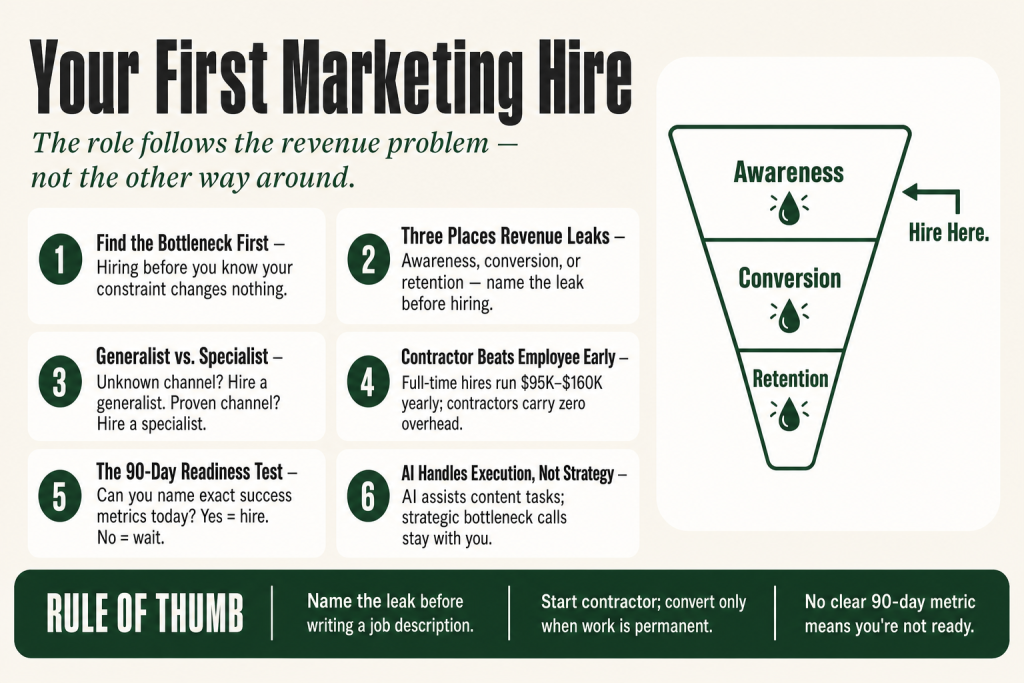
- Before anything else, find the bottleneck. Is revenue flat because too few people know you exist, because prospects aren’t converting, or because customers aren’t coming back? The role follows the answer.
- Generalist vs. specialist depends on what you already know. If you don’t yet know which channel will drive your growth, you need a generalist. If one channel is clearly working and needs to scale, hire a specialist for that channel.
- Contractor first, employee when the work is permanent. Contractors cost more per hour but carry no benefits, payroll taxes, or severance risk. Start there, convert when the role is clearly full-time and ongoing.
- The single question that reveals readiness: “If I handed this role to someone today, could I tell them exactly what success looks like in 90 days?” A yes means hire. A no means you need more clarity, not more headcount.
- AI and better systems may close the gap before you need a person. Audit what you can systematize or automate first, so you’re not hiring to solve a process problem.
Take this fix into your next scenario. The free Builder’s Companion Kit collects the checklists and templates that pair with this guide — so next time, you start from a template, not a blank page. Grab it free →
- Start With the Bottleneck, Not the Job Title
- Generalist vs. Specialist: The Choice Depends on What You Already Know
- Contractor vs. Employee: Start With the One That Matches the Risk
- Worked Example: The First Marketing Hire for a Local Service Business
- The Single Question That Tells You Whether It’s Time to Hire
- FAQ
The first marketing hire for small business is the decision that either buys you leverage or burns your runway. Most owners get it wrong, not because they pick the wrong person, but because they pick the wrong role for the wrong reason. They hire because they’re tired, or because a peer just hired someone, or because a salesperson convinced them they need “a social media person.” None of those are good reasons. The right reason is simple: you’ve identified the specific thing that’s keeping money off the table, and you need a human to fix it. This article gives you three lenses, one worked example, and one question to settle the matter this week.
Start With the Bottleneck, Not the Job Title
Every marketing problem looks like a staffing problem from the inside. You’re too busy, nothing is gaining traction, and you feel like you need help. That’s real. But hiring before you know your constraint is like buying a water pump before you know where the pipe is broken. You stay busy and nothing changes.
There are three places revenue can leak in a small business marketing funnel. Walk through each one honestly before you write a job description.
- Awareness: Not enough people know you exist. Traffic is low, referrals are thin, your name doesn’t come up in category conversations. The constraint is reach.
- Conversion: Enough people find you, but they don’t buy. Inquiries go cold, proposals don’t close, your website gets visitors but no calls. The constraint is the offer, the copy, or the follow-up.
- Retention: Customers buy once and disappear. Repeat purchases are rare. Word-of-mouth doesn’t happen. The constraint is the post-sale experience.
Most owners assume the problem is awareness and want to hire someone to “get us out there.” Sometimes that’s right. Often it’s not. If your conversion rate is below your industry average, more traffic just means more wasted leads. Fix conversion first.
To find your actual bottleneck, look at your numbers for the last 90 days. Where does the most revenue fall off? If you don’t have that data yet, that’s your first problem, and fixing it doesn’t require a hire. It requires an afternoon with your analytics. The article How to Read Your Marketing Data Without an Analyst walks you through exactly that.
Once you can name the leak, the role almost writes itself. A reach problem points toward someone who can generate content, run ads, or build partnerships. A conversion problem points toward a copywriter, a funnel builder, or someone who can audit and rewrite your offer. A retention problem points toward email, customer success, or a systematic referral program. Hire for the actual hole in the bucket.
Generalist vs. Specialist: The Choice Depends on What You Already Know
This debate comes up in every hiring conversation, and the answer is genuinely situational, not a matter of preference.
A generalist runs across the whole marketing function. They can keep your email list alive, update your website, run a basic ad test, and write a social post. They don’t do any of those things at the ceiling of what’s possible, but they keep everything moving. A specialist goes deep on one thing. A paid search specialist lives inside ad platforms all day, catches the wasted spend, and optimizes bids in ways a generalist juggling five channels won’t have time to notice.
The honest rule: if you don’t yet know which channel will drive your growth, hire a generalist. You need someone who can run experiments across content, email, and paid, and tell you what’s working. Paying for deep expertise in one channel before you have that data is a gamble. You might pick the wrong channel and find out six months later.
Once one channel clearly outperforms the rest and your revenue depends on squeezing more out of it, that’s the signal to hire a specialist for that channel. At that point, depth beats breadth, because the job is to optimize something that’s already working, not to discover what works.
One practical note: a T-shaped marketer is often the best first hire for a small business. They have broad working knowledge across channels and one area where they’re genuinely strong. You get range for the early experimentation phase plus a skill that’s immediately useful. When you interview, ask them to show you campaigns they built from scratch and point you to measurable results, not activity counts like posts published or emails sent.
Be honest about what you need them to own. A first marketer who owns “all of growth” owns nothing. Give them one bottleneck and one metric to move.
Contractor vs. Employee: Start With the One That Matches the Risk
This is the call most owners get wrong because they compare the wrong numbers. They look at a contractor’s hourly rate, compare it to a salary, and decide the employee is cheaper. That math ignores what a full-time employee actually costs.
A salaried marketing hire, once you add benefits, payroll taxes, tools, and onboarding time, can run well into six figures annually. Add the indirect costs: recruitment fees that commonly run 15 to 25% of first-year salary, training time, and the cost of a bad hire, which can reach 30% of that employee’s first-year pay. Contractors cost more per hour but carry none of those overhead costs. When the engagement ends, the cost ends.
The practical decision tree looks like this:
- Hire a contractor when: the need is project-based or experimental, you’re testing whether a channel or function pays off, you need a specific skill for a defined deliverable, or you don’t yet have the volume to keep someone busy full-time. Marketing software alone can run thousands per year; don’t add headcount before you’ve validated that the function justifies it.
- Convert to an employee when: the work is clearly ongoing and full-time, brand continuity and institutional knowledge are critical (someone who understands your business deeply, not just their deliverable), you can supervise and direct them daily, and your cash flow can absorb the full loaded cost without stress.
One caution: worker misclassification is a real compliance risk. If you’re directing someone’s hours and workflow the way you would an employee, the IRS may see it that way too, regardless of what your contract says. If you’re unsure, consult an employment attorney or HR professional before the engagement starts. This article can’t give you legal guidance, and the rules vary by state and circumstance.
A reasonable sequence for most small businesses: start with a contractor on a 90-day project, define one clear deliverable, measure the result, and then decide whether to extend, convert, or change direction. That approach gives you real data on whether the function moves the needle before you commit to the payroll.
If you want to stretch the value of any hire, contractor or employee, hand them documented processes from day one. The article Marketing SOP for Small Business shows you how to build those in one afternoon. Without them, you spend the first 30 days of every engagement answering the same questions repeatedly.
Worked Example: The First Marketing Hire for a Local Service Business
Here’s how this plays out in a real scenario.
The business: A residential HVAC company, six technicians, $1.4M in annual revenue. The owner handles all marketing himself. He posts sporadically on Facebook, runs a small Google Ads campaign he set up three years ago and hasn’t touched, and relies heavily on repeat customers and word-of-mouth.
Step 1: Find the bottleneck. Revenue has been flat for two years. He has more capacity, but the phone isn’t ringing enough in spring and fall shoulder seasons. Repeat customer rate is actually strong, around 60%. The bottleneck is awareness and lead generation, not conversion or retention. His close rate on inbound calls is over 70%. The problem is volume, not the pitch.
Step 2: Generalist or specialist? He doesn’t know whether paid search, SEO, local service ads, or referral campaigns will drive the most leads for his market. He’s never run a coordinated test. He needs someone who can run a few experiments across channels and tell him what works, not someone who goes deep on one channel he may not even need. That points to a generalist, specifically someone with hands-on experience in local service business marketing.
Step 3: Contractor or employee? He doesn’t have enough marketing work to keep someone busy full-time, and he can’t afford to find out the hard way that the function doesn’t pay off. The right move is a part-time contractor, likely a freelance digital marketer who specializes in local services, on a 90-day engagement. The deliverable: audit the existing Google Ads account, set up Google Local Service Ads if not already running, and produce a short content calendar for the shoulder seasons. One metric to move: inbound call volume from new customers over the engagement period. Whether that number moves, and by how much, depends on the market, the budget, and what the audit uncovers. The point is to have a single number you can watch, not a prediction of what it will be.
What he avoids: Hiring a social media manager because “we need to be on Instagram.” That would be a specialist in a channel that almost certainly isn’t where HVAC customers are searching when their system fails. It would address a problem he doesn’t have and ignore the one he does.
Once the 90-day engagement proves out a channel, he has data to decide whether to extend the contractor, hire a specialist in that specific channel, or convert the role to part-time permanent. The decision is now grounded in results, not guesswork.
If his conversion rate had been the problem instead, the call would have been different: a copywriter or funnel specialist to rewrite his estimate follow-up sequence. You can see a framework for that in Lead Follow Up Process: The Solo Operator’s Complete Playbook.
The Single Question That Tells You Whether It’s Time to Hire
Before you post the job, ask yourself one question: “If I handed this role to someone today, could I tell them exactly what success looks like in 90 days?”
If you can answer that with a specific metric (“30 qualified inbound calls per month” or “landing page conversion rate above 8%”), you’re ready to hire. You know the bottleneck, you know how to measure progress, and you can actually evaluate the person’s work. Those are your targets to aim at, not guarantees of what any hire will produce.
If you’d answer with something vague like “I need more visibility” or “I want us to look more professional,” you’re not ready. You’re tired and hoping a hire will figure it out. That never ends well. The marketer will optimize for whatever they can measure, which may or may not be what you actually need.
There’s also a prior question worth sitting with first: could AI and better systems close the gap before you need a person? AI tools can genuinely help with content production, copy drafts, and research tasks, cutting your dependence on outside help for execution work. But they assist with execution. They don’t make the strategic calls. As Harvard Business School research on entrepreneurs and AI found, the judgment to know which advice applies to your specific situation still has to come from you. AI can surface options and patterns; it can’t tell you whether those options fit your business, your market, or this moment. If your content isn’t going out consistently because writing takes you four hours, that might be a workflow problem, not a staffing problem. The article How to Write Marketing Copy With AI covers what that looks like in practice. A marketing calendar alone often reveals that you don’t have a capacity problem; you have a prioritization problem.
Hire when the constraint is clearly a human capability you don’t have and can’t build quickly. Don’t hire to solve a process or clarity problem. That just gives the process problem a salary.
The judgment about when to hire and who to hire stays with you. A contractor or employee brings execution capability. The strategic calls, what the bottleneck actually is, whether this role addresses it, and whether the results you’re seeing are worth continuing, those are yours to make. No hire, and no AI tool, relieves you of that responsibility. Any advisor who tells you otherwise is selling something.
FAQ
what should my first marketing hire be for a small business
It depends on your bottleneck. If you’re not getting enough leads, you need someone who can generate awareness through content, ads, or referrals. If leads come in but don’t close, you need a copywriter or funnel specialist. Map the leak first, then write the job description. The role follows the revenue problem, not the other way around.
should I hire a marketing generalist or specialist first
Hire a generalist first if you don’t yet know which channel will drive your growth. Generalists can test across content, email, and paid, and give you the data you need to make a smarter bet later. Once one channel clearly outperforms the rest and your revenue depends on it, that’s when a specialist earns their premium rate.
is it better to hire a marketing contractor or an employee
Start with a contractor when the work is experimental, project-based, or part-time. A full-time employee carries significant hidden costs beyond salary: payroll taxes, benefits, tools, onboarding, and recruitment fees. Convert to an employee when the work is clearly full-time, ongoing, and you have the cash flow to absorb the fully loaded cost without stress.
how much does a marketing hire cost for a small business
A full-time marketing hire typically runs $95,000 to $160,000 per year once you add salary, benefits, payroll taxes, tools, and onboarding. A part-time contractor or freelancer is more variable, typically billed hourly or by project, with no benefits overhead. The contractor rate will feel higher per hour, but the total annual cost is usually far lower for small businesses that don’t need someone full-time.
when is it too early to hire a marketing person
It’s too early if you can’t clearly name what success looks like in 90 days, if your offer isn’t working yet and you haven’t found product-market fit, or if you’re already struggling to serve current customers. Hiring more demand before you can handle it or measure it doesn’t accelerate growth. Fix the constraint you actually have first.
can AI replace my first marketing hire
No, and that’s the wrong frame. AI tools can close a real gap in content production, copy drafts, and research, cutting your dependence on outside help for execution tasks. But the strategic calls, identifying the bottleneck, choosing the channel, and evaluating whether the work is actually moving revenue, those stay with you. Research on how entrepreneurs use AI tools found that human judgment remains critical to interpreting and applying any advice, whatever the source. AI assists with execution. It doesn’t make the calls that determine whether your marketing is pointed in the right direction. You do.
Sources:
Sources consulted: Forbes Communications Council, “20 Pros and Cons of Hiring Marketing Generalists” (January 2025); 101 Agencies, “When to Hire Your First Marketing Person” (January 2026); GetFoundQuick, “Marketing Generalist vs. Specialist: When to Make the Switch” (June 2026); Ventiscale, “Marketing Agency vs. In-House: The Real Math for a Small Business” (April 2026); Tarmack, “Cost of Employee vs. Cost of Contractor: Full Breakdown” (August 2025); Fingercheck, “Contractor vs. Employee Cost Comparison” (July 2025); SkyFeather Studios, “When Should Founders Hire Marketing? 7 Signals” (August 2026); GrowthTalent.org, “When to Hire Your First Growth Marketer” (August 2026); Diplomatik Media, “How to Do a Marketing Audit for Your Small Business” (August 2026); Bureau of Labor Statistics (benefits cost data cited via Ventiscale, April 2026); Harvard Business School Institute for Business in Global Society, “AI Won’t Make the Call: Why Human Judgment Still Drives Innovation” (September 2025); Forbes Coaches Council, “The Value of Human Judgment in the AI Era” (July 2026). All cost figures are sourced ranges from published research and should be verified against current market conditions in your region before making hiring decisions.
Brian Kasday spent forty years in direct-response marketing before rebuilding the whole operation as a one-person shop. He writes The Operator’s Library — including “Build a Complete Marketing Department” — for operators who’d rather build it themselves than wait on someone else.
Get the Builder’s Companion Kit — the free checklists and templates that pair with this guide: mmsvegas.com/resources.
This guide handles one marketing job. Build a Complete Marketing Department builds the whole department. See the manual →
More Marketing guides
Free · Marketing Operator Toolkit
Running marketing on your own?
Get the free toolkit — the templates and the expensive mistakes behind a one-person marketing department, plus a note when this guide changes.
Get the free toolkit →