
The 30-second answer
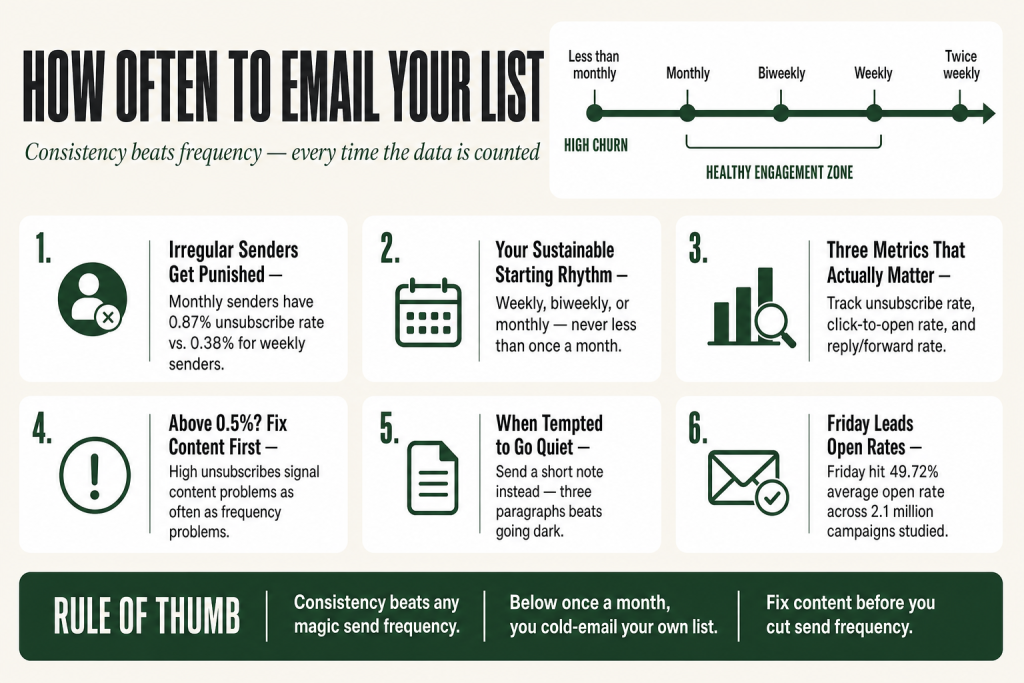
- Consistency matters more than frequency. An irregular schedule drives higher unsubscribe rates than sending too often or not enough.
- Start at once per week if you can sustain it. Once every two weeks is a legitimate alternative. Less than once a month is where things break.
- Watch three numbers: unsubscribe rate, click-to-open rate, and reply/forward rate. Those three tell you more than open rate alone.
- If your unsubscribe rate climbs above 0.5% per send, slow down and fix content before you fix frequency.
- When you’re tempted to go quiet, send a short one anyway. One honest email beats a perfect email that never goes out.
- Set a send day, write it in your calendar, and treat it like a client appointment.
Take this fix into your next scenario. The free Builder’s Companion Kit collects the checklists and templates that pair with this guide — so next time, you start from a template, not a blank page. Grab it free →
- Why Consistency Beats a Magic Frequency
- How Often to Email Your List: Reading Your Own Signals
- A Sustainable Starting Rhythm for a One-Person Operation
- A Realistic Sending Schedule: Worked Example
- The Rule for When You’re Tempted to Go Quiet
- FAQ
How often to email your list is one of those questions that sounds like it has a clever answer, and it doesn’t. There is no magic number that works for every list, every offer, and every sender. What there is: a principle that beats frequency every time, a set of signals in your own dashboard that tells you when you’re off, and a starting rhythm that a one-person operation can actually sustain. That’s what this article covers. Skip the 47-variable decision tree. You need a cadence you’ll send on.
Why Consistency Beats a Magic Frequency
Every few months a study comes out claiming the optimal send day is Tuesday at 10 a.m., or that three emails a week lifts revenue 30%. Those numbers are real for the dataset they came from. They’re not your dataset. (For what it’s worth, MailerLite’s analysis of over 2.1 million campaigns sent between December 2024 and November 2025 shows Friday generating the highest average open rate at 49.72%, closely followed by Monday at 49.44%. That’s a useful reminder that no single conventional wisdom day wins across every list. Tuesday and mid-week remain solid defaults across multiple platforms, but the gap between weekdays is narrow enough that your specific audience matters far more than the calendar.)
Here’s what is consistent across the research: irregular senders get punished. MailerLite analyzed data from over 1.4 million campaigns sent from 42,000+ accounts and found that accounts sending fewer than one email per month had an unsubscribe rate of 0.87%, more than double the rate of weekly senders (0.38%). Let that sit for a second. The thing most solo operators fear (emailing too often) produces less list churn than going quiet and sporadic.
The mechanics are straightforward. When you disappear for six weeks and then land in someone’s inbox, they don’t remember who you are. They hit unsubscribe, or worse, they hit spam. When too many recipients stop opening, inbox providers treat your content as less relevant, and future messages get filtered or quietly pushed to junk. Your active readers get caught in that drag too.
Think of it like a weekly radio show. Listeners build a habit. They know it’s on Thursday. If it goes dark for a month and comes back unannounced, half the audience has moved on. Your email list works the same way. The cadence is the show.
The practical upshot: pick a frequency you can maintain through a busy quarter, a slow week, and a minor personal crisis. That frequency beats the theoretically optimal one you’ll abandon in six weeks.
If you haven’t nailed your list-building foundation yet, start at Build an Email List from Scratch before you optimize cadence. Cadence only matters once you have people to send to.
How Often to Email Your List: Reading Your Own Signals
There’s no universal number, but there is a personal number, and your platform is already tracking it. You don’t need an analyst to read it. You need three metrics and a simple rule.
The three signals that matter
1. Unsubscribe rate per send. Industry benchmarks put a healthy unsubscribe rate between 0.1% and 0.5% per campaign. MailerLite’s benchmark data puts the median at 0.22% across campaigns studied through the 2024-2025 period (up from 0.08% in the prior year, partly due to Gmail changes that make one-click unsubscribing easier without opening the email). If you’re consistently above 0.5%, something is wrong, and frequency is only one possible cause. Irrelevant content, a mismatched lead magnet, or simply a list that forgot you are equally likely culprits. Don’t automatically slow down. Fix the content first and watch the number drop. In MailerLite, you can find per-campaign unsubscribe rates inside the campaign report and your monthly unsubscribe rates on the dashboard page.
2. Click-to-open rate (CTOR). Open rate is a compromised metric for many senders, and here’s why: Apple’s Mail Privacy Protection (MPP) routes email content through Apple-operated proxy servers, which preload images, including invisible tracking pixels, before the user has done anything. This means emails sent to Apple Mail users who have enabled MPP are registered as “opened” in your analytics whether or not the recipient actually read the message. MPP is an opt-in feature, so its impact on your numbers depends on how many of your subscribers use Apple Mail and have enabled it. Apple Mail accounts for a large share of email opens globally, so raw open data is meaningfully inflated for most lists. iOS 18 added further complications, including AI-generated previews and Link Tracking Protection that strips UTM parameters from links. The exact impact depends on your audience’s device mix, so treat your open rate as directional at best. CTOR, calculated as unique clicks divided by unique opens, filters out much of that noise. MailerLite’s benchmark data puts the median CTOR at 6.81% across campaigns in their dataset. If your CTOR sits consistently below 6% to 7%, your content isn’t earning the click from the people who do open. That’s a content problem, not a frequency problem. You can find CTOR in the campaign overview section of your MailerLite dashboard.
3. Reply and forward rate. Your platform may not surface this automatically, but you can track it manually. If people reply to your emails or forward them, your content is working. If replies dry up, the list is tuning out. That’s a cadence-and-content signal together.
The rule for reading a spike
One bad send doesn’t mean your cadence is broken. A topic can misfire, a subject line can underperform, a week can land at the wrong moment. Look for a trend across three to four consecutive sends. If unsubscribes are climbing and CTOR is falling across that window, change something. Change the content angle before you change the frequency.
If your open rates specifically are the number giving you trouble, there’s a prioritized fix list worth bookmarking: Low Email Open Rates: A Prioritized Fix List for Solo Operators.
A Sustainable Starting Rhythm for a One-Person Operation
Here’s a starting point grounded in real data. MailerLite’s analysis of over 1.4 million campaigns found that the range between monthly and twice-weekly is where open rates and click rates hold up without driving abnormal churn. Most small businesses land in the middle of that range. Sending less than once a month tends to suppress engagement over time because infrequent sends don’t build reading habits.
For a solo operator, the practical starting rhythm looks like this:
- Once per week if you have a reliable content system or a solid pipeline of repurposable material. Pick one send day and keep it.
- Once every two weeks if weekly feels like a stretch right now. This still trains a habit in your readers.
- Once per month as an absolute floor. Below this, you’re essentially cold-emailing your own list each time you show up.
The key constraint: the rhythm you pick has to survive your worst week. Not your best. A cadence you maintain during a slow patch, a project crunch, or a sick kid is the right cadence. A cadence you set during an inspired stretch and abandon under pressure costs you list health, deliverability, and reader trust.
One tactic that keeps a weekly cadence realistic: batch and repurpose. If you’re already creating content elsewhere, your content repurposing workflow can feed your email list without generating net-new writing every single week. The email becomes an extract and a take, not a full original. Your judgment about what’s worth sharing and how to frame it for your specific audience stays with you. AI tools can help draft or restructure material faster, but deciding what the email should say and whether it actually sounds like you is still your call.
Once your cadence is set, pair it with a marketing calendar so sends are pre-slotted instead of improvised. Improvised sends are the first thing that falls off under pressure.
A Realistic Sending Schedule: Worked Example
Meet Carla. She runs a bookkeeping practice targeting small service businesses. List size: 380 subscribers. Current open rate: reported at 41%, though she knows Apple Mail’s MPP inflates that figure for any subscribers using the Apple Mail app with MPP enabled. Her CTOR is 7.2%. Unsubscribe rate per send: around 0.15%.
Her signals say her content is working. The question is just cadence.
What she does:
- Sends every Tuesday at 8 a.m. local time.
- Each email is one idea, 250 to 400 words, with a single link.
- She batches two emails in a sitting on the first Sunday of each month, so she’s never writing under deadline pressure the night before a send.
- One email per month is evergreen (a tax tip, a common bookkeeping mistake, a checklist). The other three rotate based on what clients asked about that week.
What her calendar looks like in a given month:
- Week 1: Evergreen post, pre-written the Sunday prior
- Week 2: Q&A from a client conversation
- Week 3: Brief story, small win or miss, one takeaway
- Week 4: Soft prompt toward her discovery call (the only overt CTA in the month)
Total time: roughly 90 minutes per month of writing, spread across two sittings.
She doesn’t have a 50,000-person list. She doesn’t need one. Four sends a month at 380 subscribers with a 7% CTOR produces more booked calls per quarter than she had when she was sending one polished email every six weeks and wondering why nobody called.
The lesson: volume of sends multiplied by a consistent audience beats a beautiful email sent whenever inspiration strikes.
If you’re using AI to help draft those emails, the method is straightforward and faster than most people expect. AI handles the structural gruntwork: first drafts, reformatting repurposed content, punching up weak sentences. What it can’t do is decide what’s worth saying this week, catch where your voice goes flat, or know which client conversation actually belongs in the email. That part stays with you. See How to Write Marketing Copy With AI (the Solo Operator’s Method) for a process that keeps your judgment in the driver’s seat.
The Rule for When You’re Tempted to Go Quiet
You will be tempted to skip a send. The reasons will feel legitimate: nothing interesting happened this week, the email isn’t polished enough, the list has been quiet lately, you need to focus on client work. Those are real pressures. The cost of giving in to them is also real.
Once your messages feel unpredictable, readers stop looking for them. And once deliverability takes a hit from a stretch of disengagement, even your active subscribers suffer, because inbox providers make placement decisions based on overall engagement signals across your list.
Here’s the rule: when you’re tempted to go quiet, send a short one instead.
Not a masterpiece. Not a formal newsletter. A note. Three paragraphs. One idea from your week. One question for the reader. No graphic required.
That email does three things. It keeps your sender reputation intact. It reminds your list that you’re consistent. And it often produces better replies than the long, polished send you spent three hours on.
The version of this mistake I made early: I’d miss a week, then feel like I owed the list something big, then spend two more weeks overthinking the makeup email, then miss another two weeks. By the time I sent again, the list had cooled noticeably. The fix was simpler than any of that: write a shorter email and send it on time.
If a dry spell has already happened and you need to reintroduce yourself to a list that’s gone cold, that’s a re-engagement problem more than a cadence problem. Your welcome email sequence is the template to model: one clear reason to stay, one piece of value, one call to action.
One more note: going quiet for a quarter doesn’t just hurt engagement. It means the next send lands on a colder list, which pushes up your unsubscribe rate, which signals to inbox providers that your domain is less trustworthy. The hole gets deeper the longer you wait. The cheapest fix is the one you do before the gap opens: send the short email on schedule.
FAQ
how often should I email my list as a small business
The research-backed range is once a month at minimum up to twice a week. Most small businesses hit a sustainable rhythm at once a week or once every two weeks. The exact number matters less than picking one and keeping it. Irregular sending, where you disappear for weeks and then flood the inbox, produces worse unsubscribe rates than either consistent weekly or consistent monthly sending.
is it bad to email my list every day
For most service businesses and solo operators, daily is harder to justify by content quality alone. MailerLite’s cadence data shows open rates dip as you move to daily sends, though click-through rates can stay respectable if every email earns its place. The real constraint is content quality: if you can write something genuinely useful every day without burning out, the data doesn’t prohibit it. Most one-person shops can’t, and shouldn’t try.
what unsubscribe rate means I’m emailing too often
A consistent unsubscribe rate above 0.5% per send is the threshold worth investigating. MailerLite’s benchmark data puts the median at 0.22% across campaigns in their dataset (up from 0.08% in the prior year, driven partly by Gmail making one-click unsubscribing easier without opening the email), and industry benchmarks generally place a healthy range between 0.1% and 0.5%. But high unsubscribes don’t automatically mean you’re sending too frequently. Irrelevant content, a mismatched lead magnet, or a list that signed up for something different are equally likely causes. Fix the content angle before you pull back on frequency.
what happens if I stop emailing my list for a few months
Your list goes cold. When you come back, subscribers won’t remember who you are, and a percentage will unsubscribe or mark you as spam. That damages your sender reputation and affects deliverability for your active readers too. If you’ve already gone quiet, treat your comeback send like a re-engagement email: remind them who you are, explain what you send, and give them a reason to stay before you return to normal cadence.
does the day of the week I send emails matter
Day and time of send have modest effects on open and click rates, but they matter less than consistency and content quality. MailerLite’s analysis of over 2.1 million campaigns sent between December 2024 and November 2025 found Friday generating the highest average open rate (49.72%) and click rate (8.09%) of any day, which cuts against the conventional Tuesday-only advice. Tuesday and mid-week still rank as solid performers across multiple platforms, but the gap between weekdays is narrow, and the best day for your list depends on your specific audience. Test your own data over several sends before relocating your send day. Sending on the same day each week builds a reader habit regardless of which day you pick.
should I email my list more often during a product launch
Yes. A launch is a legitimate reason to step up frequency temporarily, and your list expects it if you’ve set that expectation. The key is returning to your normal cadence once the launch window closes. Sustained high-frequency sending after the launch ends is where people start to disengage. If you’re planning a launch sequence, the mechanics of building that out are covered in the solo operator’s launch playbook.
Sources:
Sources consulted for this article: MailerLite, “Email Cadence & Frequency: Data-Backed Strategy for 2026,” mailerlite.com (analysis of 1.4 million campaigns sent to over 340 million subscribers using 2025 send data; accounts sending fewer than one email per month had an unsubscribe rate of 0.87%, more than double the 0.38% rate of weekly senders); MailerLite, “Email Marketing Benchmarks 2025,” mailerlite.com (median unsubscribe rate 0.22%, average CTOR 6.81%, open rate 43.46%, based on 3.6 million campaigns); MailerLite, “14 Email Marketing Metrics,” mailerlite.com (cadence vs. unsubscribe rate data; campaign report and dashboard as locations for per-campaign and monthly unsubscribe data); MailerLite, “The Best Time to Send Email in 2026,” mailerlite.com (2.14 million campaigns, December 2024 through November 2025; Friday highest average open rate 49.72% and click rate 8.09%); Shopify, “Email Cadence: How Often Should You Email Customers?” shopify.com (MailerLite cadence data synthesis, 1 million+ 2024 campaigns); Omnisend, “Unsubscribe Rate Guide,” omnisend.com (industry unsubscribe benchmarks); Mailmodo, “State of Email 2024,” mailmodo.com (industry unsubscribe rate average 0.19%); beehiiv, “Email Frequency Best Practices,” beehiiv.com (creator send-frequency data); Customer.io, “Best Day and Time to Send Marketing Emails,” customer.io (send-day research synthesis); Litmus, “Apple Mail Privacy Protection,” litmus.com (MPP mechanism: proxy server preloads images including tracking pixels); Sender.net, “Apple Mail Privacy Protection: The 2026 Guide,” sender.net (MPP opt-in status, iOS 18 additions including Link Tracking Protection and AI-generated previews); Twilio, “Guide to Apple Mail Privacy Protection,” twilio.com (MPP open tracking reliability and opt-in requirement).
Brian Kasday spent forty years in direct-response marketing before rebuilding the whole operation as a one-person shop. He writes The Operator’s Library — including “Build a Complete Marketing Department” — for operators who’d rather build it themselves than wait on someone else.
Get the Builder’s Companion Kit — the free checklists and templates that pair with this guide: mmsvegas.com/resources.
This guide handles one marketing job. Build a Complete Marketing Department builds the whole department. See the manual →
More Marketing guides
Free · Marketing Operator Toolkit
Running marketing on your own?
Get the free toolkit — the templates and the expensive mistakes behind a one-person marketing department, plus a note when this guide changes.
Get the free toolkit →