
Last updated: July 2026
The StoryBrand framework is a messaging structure for making your business unmistakably clear to buyers, and by the end of this page, you’ll know exactly how to build the two deliverables that matter most for a small operator: a one-liner that earns a second look, and a homepage wireframe that stops people from bouncing the moment they arrive.
Here’s the problem the framework was built to solve. Most small-business websites talk about the owner’s credentials, the company’s history, and the features of the product, in that order. The person who just landed on the page reads three sentences, can’t tell what’s in it for them, and leaves. Not because they didn’t need what you sell. Because your copy made them do too much work to figure it out. Donald Miller’s core insight, put plainly, is that confused buyers don’t buy. So stop confusing them.
That sounds obvious. It turns out almost nobody does it. The StoryBrand framework gives you a structure for doing it consistently, across every page, every email, every pitch. Whether you use every piece of SB7 or just the parts that apply to your situation, the thinking behind it is worth internalizing.
The idea in 30 seconds
- The StoryBrand framework (SB7) is a messaging structure built by Donald Miller, your customer is the hero, you’re the guide who helps them win.
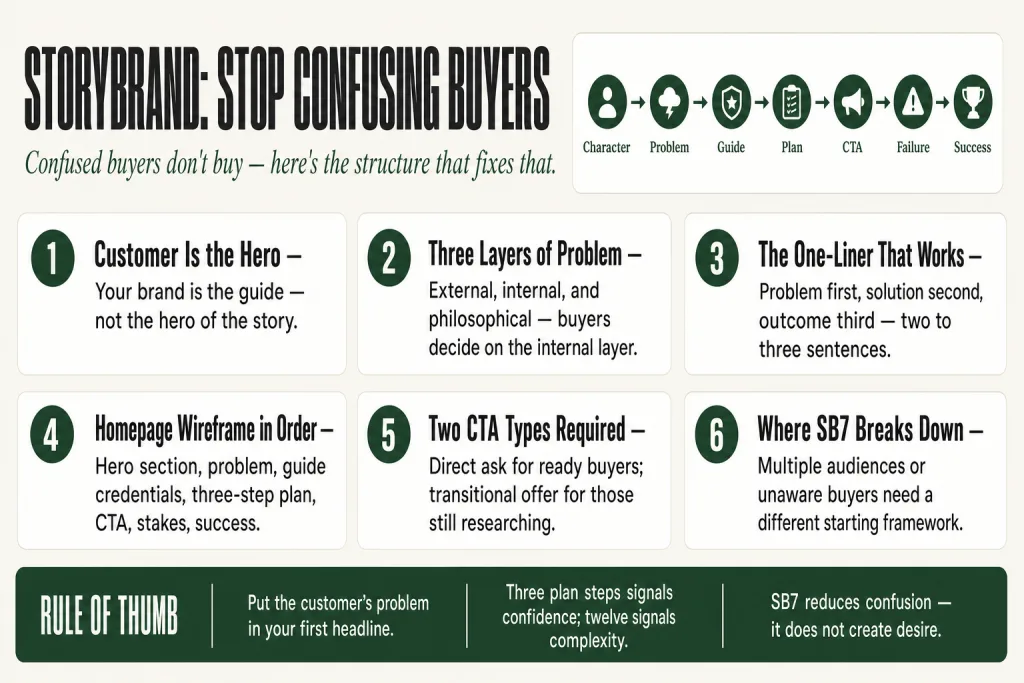
- The framework organizes your message around a story arc: who the customer is and what they want, the problem blocking them, your brand as their guide, a simple plan, a clear call to action, the stakes of inaction, and the vision of success after.
- The one-liner is the fastest practical output, a two-to-three sentence description of who you help, what problem you solve, and what their life looks like after.
- The SB7 wireframe maps those elements directly onto a homepage: hero section, problem acknowledgment, guide credentials, three-step plan, CTA, stakes, and success vision.
- The framework works best for clear, single-audience businesses with a direct problem-to-solution path. It gets over-applied when forced onto multi-audience or complex sales situations.
- The one mistake that kills every implementation: the operator casts themselves as the hero instead of the customer.
Where the StoryBrand Framework Came From
Donald Miller was a memoirist before he was a marketer, best known for Blue Like Jazz. The structural insight he brought to marketing came from storytelling: readers pay attention when they can follow a clear arc, and they tune out when they can’t. The hero’s journey, a pattern Joseph Campbell traced across myths in The Hero with a Thousand Faces (1949), gives that arc its skeleton: a hero wants something, a problem blocks the path, a guide appears, a plan is made, action is taken. Miller’s move was to apply that logic to brand messaging.
He published Building a StoryBrand in 2017, and the framework has since reached over one million readers. A revised edition, Building a StoryBrand 2.0was published by HarperCollins Leadership on January 7, 2025, with updated examples and exercises. The companion book, Marketing Made Simple (co-written with Dr. J.J. Peterson), translates the messaging logic into specific assets: the one-liner, the homepage wireframe, the lead-generating PDF, the email nurture sequence. Those are the operational pieces most operators actually need.
The gap the framework closes is simple: most companies write their marketing from the inside out, their history, their credentials, their features. Buyers read from the outside in, they want to know whether this brand understands the problem they woke up with. SB7 reorganizes the message around the buyer’s experience rather than the seller’s résumé.
The StoryBrand Framework: What Each Element Actually Does
SB7 maps your brand message onto a story arc. The elements aren’t seven separate sections of a website, they’re the underlying logic your site, emails, and sales copy all express in different words. Miss one, and you recreate exactly the friction you’re trying to remove.
Character, Your customer, and what they want
The customer is the hero. Not you. This is the move most operators resist, because they’ve spent years building something and their company feels like the main character. From the buyer’s side of the screen, your business is a supporting character. The framework starts by defining who your customer is and naming the specific outcome they want, not a list of your features, but one clear desire. The more precisely you name it, the faster they recognize that you get them.
Problem, Three layers, not one
SB7 separates problems into three levels. The external problem is the surface-level thing your product solves, the leaking pipe, the messy books, the empty appointment calendar. The internal problem is the feeling that external problem creates: the embarrassment, the frustration, the sense of being behind. The philosophical problem is the deeper wrongness, why it shouldn’t be this way at all. Buyers make decisions driven by their internal problems far more than their external ones. Most small-business copy only addresses the external layer and wonders why conversions are flat.
The framework also identifies a villain, not a competitor, but the root cause of the customer’s friction. For a CPA, the villain might be tax complexity or disorganized records, not H&R Block. In practice, operators often skip naming the villain explicitly on the homepage; the three-layer problem stack is the more workable piece.
Guide, Your brand, positioned correctly
Here’s where your brand enters the story, but as the guide, not the hero. Think Yoda, not Luke. The guide has two things the hero needs: empathy and authority. Empathy means you demonstrate that you understand what the customer is going through. Authority means you show you’ve helped others through it. Most operators over-rotate into authority, endless credential listings, years in business, award badges, and forget empathy entirely. The order matters. Lead with empathy, support with authority.
Plan, Three steps, not twelve
The guide gives the hero a plan. In SB7, this is a simple, named process that shows the customer how easy it is to start. The plan isn’t your full onboarding process, it’s the reassuring outline that makes taking the first step feel obvious. Something like: Schedule a call → We build a plan → You start growing. A twelve-step plan tells the buyer this is complicated. Three steps tells them you’ve done this before and made it manageable.
Call to Action, Direct and transitional
SB7 separates CTAs into two types. A direct CTA asks for the transaction: Book a Call, Get a Quote, Buy Now. A transitional CTA offers something lower-stakes for buyers not ready to commit: Download the Guide, Watch the Demo, Read the Case Study. Most small-business sites have neither, or they have one vague button labeled ‘Learn More.’ You need both, the direct ask for buyers who are ready, the transitional offer for those who need more time.
Failure, What’s at stake if they don’t act
Every good story has something at stake. Name what your customer risks if they don’t solve their problem. The right calibration: name the stakes clearly, don’t dwell, move on. A dentist doesn’t need to invoke jaw surgery; ‘your teeth get worse and cost more to fix later’ is sufficient. Think of failure in your messaging the way you think of salt in cooking, a pinch adds flavor, a fistful ruins the dish.
Success, The vision of life after
Paint the picture of what life looks like once the customer has worked with you. Not a feature list, the emotional and practical transformation: the clean books and the confidence that tax season is just another month, the calendar full of new clients, the lawn that finally looks like the neighbors’. Specificity beats vague aspiration every time.
Running your business through all of these prompts produces what Miller calls a BrandScript, a one-page document that becomes the source for every asset you create: homepage headlines, email sequences, sales scripts, ad copy. A free BrandScript tool is available at mystorybrand.com.
The StoryBrand One-Liner: The Most Useful Thing in the Framework
If you take nothing else from SB7, take the one-liner. It’s a two-to-three sentence statement that names the problem, offers your solution, and shows the outcome, the compressed version of your BrandScript. It’s the answer to ‘so what do you do?’ that actually makes someone want to know more.
The structure is: [The problem your customer has][what you do about it][so they can achieve X]. The problem goes first because it’s what the buyer already feels. Starting with your solution before they’ve seen themselves in the problem is why most elevator pitches slide off the brain like water off a windshield.
Here’s what that looks like applied. A bookkeeper’s standard pitch: ‘We provide bookkeeping and accounting services for small businesses.’ A one-liner version: ‘Most business owners dread tax season because their books are a mess all year. We keep your finances clean and organized month to month, so April is just another month.’ Same service. One of them makes the buyer nod; the other makes them check their phone.
The one-liner lives in multiple places at once: your website’s hero section, your email signature, your social bio, your answer when someone asks at a networking event. The more consistently you use it, the stickier it gets, not because repetition is magic, but because a clear, consistent message signals confidence.
One note: the one-liner is not your tagline. A tagline is three to five words optimized for recall. The one-liner is a functional explanation that earns a second conversation. They serve different jobs.
Applying the StoryBrand Framework to Your Website
The most practical application of SB7 for a small operator is the homepage wireframe. Miller and Dr. J.J. Peterson worked this out in Marketing Made Simpleand it’s one of the few messaging frameworks that translates almost directly into a web design brief.
Here’s how the story arc maps to page sections, and what each one is actually trying to do:
Hero section (above the fold). Your one-liner as the headline, one direct CTA button, and a visual that shows the customer’s successful outcome, not your office, not your product in isolation. Strangers give a homepage about three seconds before they decide whether to read on. If the headline doesn’t make clear who this is for and what they’ll get, those three seconds are up.
Problem acknowledgment. A short block naming the friction your customer is already living with, in their language, not yours. No solutions yet. Just proof that you get it. The internal problem layer belongs here: the embarrassment of disorganized books, the anxiety of watching competitors rank above you. Buyers who feel understood keep reading.
Guide credentials. Brief. Real logos, real numbers, real client results carry far more weight than anything you say about yourself. This section isn’t where you win the sale, it’s where you don’t lose it by seeming unknown.
Three-step plan. Named, visual, scannable. Three steps with one-line descriptions. The goal isn’t to explain your process, it’s to make the first step look obvious and the whole thing look manageable.
Transitional CTA. The lower-stakes offer for people still in research mode, a checklist, a guide, a free audit. This captures email addresses from buyers who aren’t ready to call but aren’t gone yet either. Don’t skip it; the people who download your guide before they book a call are often your best clients.
Stakes and success. A short reminder of what happens if nothing changes, one or two sentences, no more, followed by a vivid description of the outcome waiting on the other side. Testimonials, before-and-after stories, or a specific result land better here than aspirational adjectives.
Final CTA. Repeat the direct ask. Buyers who read all the way down are often the most ready, don’t make them scroll back up to find the button.
The real value of this wireframe isn’t that it’s magic. It’s that it gives you an opinionated structure to react to. Most small-business homepages fail not because the design is bad, but because the content has no logic, sections exist because someone thought they looked nice, not because they move a buyer forward. The SB7 wireframe forces every section to earn its place.
One practical note: you can reflow a homepage to this structure in an afternoon once you have the copy. The copy takes longer, expect to spend a few hours just clarifying your BrandScript before you write a word of the page itself. That work is not wasted. It’s the job.
Putting this to work? The ideas in the Canon are the foundation under the tactical playbook in Build a Complete Marketing Departmentgrab the free companion kit at mmsvegas.com/resources.
Why the StoryBrand Framework Works, and Why It Spread So Fast
The reason SB7 works is cognitive, not creative. The brain is an efficiency machine, it tunes out anything that requires too much processing. A narrative structure is familiar because we’ve been absorbing stories since childhood. When your marketing follows that structure, the reader doesn’t have to work to understand it. They just follow along.
The customer-as-hero reframe is more disruptive than it sounds. Most businesses, left to their own devices, write their own origin story. ‘Founded in 2009 with a commitment to excellence…’ reads like the hero introducing himself. Buyers don’t care. They care whether you can solve their problem. Flipping that around doesn’t just change the tone, it rewires whose story the page is actually telling.
The other reason SB7 spread fast is its operability. It produces tangible deliverables, a BrandScript, a one-liner, a wireframe, that non-marketers can actually use. Most brand strategy work produces beautiful decks that go in a drawer. SB7 produces a one-page document that becomes the source for the homepage, the email sequence, and the sales script. Marketing agencies adopted it quickly for exactly that reason: they could show a client a concrete output on day one.
Where the StoryBrand Framework Belongs in Your Business
SB7 earns its place in a few specific situations:
Website homepage and landing pages. This is the sweet spot. A homepage that follows the SB7 arc, problem recognized, guide introduced, plan presented, action invited, success envisioned, is almost always clearer than one that doesn’t. For most small operators, this alone justifies learning the framework.
Elevator pitches and one-liners. Any situation where you have to explain what you do in thirty seconds benefits from having a polished one-liner built on SB7 logic. Networking events, conference introductions, your social bio. If you have to open your mouth and describe your business, having this ready means you sound confident instead of rambling.
Email marketing. The SB7 arc translates naturally into a five-to-seven email nurture sequence. Email one names the problem. Email two offers empathy and positions you as the guide. Email three describes the plan. Emails four and five share proof. The final email makes the ask. This is the Marketing Made Simple playbook, and it’s a solid structure for warming up a new subscriber.
Local and professional services with a clear buyer journey. Plumbers, accountants, physical therapists, HVAC companies, personal trainers, insurance agents, anyone with a single-audience, problem-to-solution arc benefits from SB7 clarity. The framework was essentially built for this use case.
Sales scripts and proposals. Running your sales conversation through the SB7 arc, naming the problem before pitching the solution, presenting a clear plan, naming the stakes, produces pitches that feel less like a sales pitch and more like a useful consultation.
Where the StoryBrand Framework Doesn’t Work, and Gets Over-Applied
SB7 has genuine limits, and the marketing ecosystem around it tends to undersell them because there are a lot of certified coaches who’d like to sell you an implementation engagement.
Multiple audiences with different problems. If you serve two genuinely distinct buyer types, say, both enterprise procurement officers and small-business owners, forcing both into a single story arc produces messaging that’s vague to everyone. Multi-audience businesses need either separate pages for each audience or a different starting point, like a positioning exercise followed by audience-specific messaging.
Complex B2B sales with multiple stakeholders. A buying committee with a CFO, a procurement manager, and a technical lead is not one hero on one journey. Each person has their own problem, their own internal frustration, their own stakes. Trying to fit all of that into a single BrandScript gets awkward fast. A cybersecurity firm serving Fortune 500 companies and scrappy tech startups simultaneously is a good example, those two audiences have different problems, different budgets, and different decision-making processes. One BrandScript can’t hold all of that.
Highly differentiated or category-creating brands. If part of your appeal is that you’re doing something nobody else is, if the brand itself is the story, then erasing yourself to become the invisible guide costs you something real. Brands trying to design a new category often need to be characters in the story, not just guides. SB7 would sand off that edge. A bespoke watchmaker doesn’t need to position itself as the humble guide to your watch-ownership journey. The brand is part of the appeal.
The formulaic website trap. Spend enough time looking at SB7-built homepages and a pattern emerges: same headline structure, same three-step plan with icons, same CTA button placement. The framework is sound; the cookie-cutter execution produces websites that look identical to each other. When a formula everyone runs produces the same output, the output stops differentiating you. The framework should inform the structure, it shouldn’t write the copy for you. Clarity and distinctiveness aren’t the same thing, and SB7 optimizes only for clarity.
There’s also a critique worth naming directly: the framework is better at reducing confusion than at creating desire. If your product solves a problem buyers don’t yet have language for, a true innovation, a new category, SB7 can work against you by starting at the problem. Eugene Schwartz’s Market Awareness framework is a better starting point when buyers aren’t yet problem-aware. SB7 works best when awareness is already there and clarity is the bottleneck.
StoryBrand Framework in Practice: What Good Execution Looks Like
The framework shows up most cleanly on service-business homepages where there’s a clear one-to-one relationship between buyer and solution. A personal injury law firm that leads with ‘Most accident victims feel lost and overwhelmed after a crash, we walk alongside you so you get the settlement you deserve and can put this behind you’ is running SB7 whether they know it or not. The problem is named, the emotion is named, the guide position is clear, the outcome is vivid.
What good implementation actually changes: Casandra Laymon, president of Beacon Wealth Consultants, described receiving zero leads from their website before an SB7 rebuild, and two $2 million leads within the first month of relaunching with a clearer message. That’s what happens when you stop making buyers work to figure out what you do.
Where it gets murkier is in highly differentiated brand categories, luxury goods, premium creative services, founder-led businesses with a distinct point of view. These brands sometimes need to be the interesting character in the story, not the invisible guide. SB7 would flatten that, and in flattening it, lose the very thing that makes the brand valuable.
What People Get Wrong About the StoryBrand Framework
Misunderstanding: The one-liner is a tagline. They’re not the same. A tagline is short and designed for recall, three to five words that stick. The StoryBrand one-liner is a functional explanation of who you help, what problem you solve, and what the outcome looks like. It’s two to three sentences. Using it as a three-word brand slogan misses the point entirely.
Misunderstanding: SB7 is a design framework. It’s a messaging framework. It produces copy logic, not visual logic. You can implement it in Squarespace, Webflow, or a plain Google Doc. The design comes after the copy, always. Operators who lead with design and try to fit SB7 into it afterward are doing it backwards.
Misunderstanding: The villain is your competitor. It’s not. The villain in SB7 is the source of your customer’s problem, the force causing the friction in their life. For a CPA, that might be ‘tax complexity’ or ‘disorganized records,’ not H&R Block. Making a competitor your villain turns the page combative and shifts focus away from the customer’s experience.
Misunderstanding: The BrandScript is your marketing plan. The BrandScript is a one-page messaging document, the starting point, not the finished product. You still have to decide which channels to use, what cadence to publish, how to run paid media. SB7 clarifies the message; it doesn’t build the distribution system.
Misunderstanding: You need all elements on every asset. The BrandScript informs every asset, but not every asset needs to express all of them. A Facebook ad might only express one or two. An email subject line expresses one. The full arc plays out across the customer journey, not necessarily on a single page or in a single message.
Common Mistakes
- Casting yourself as the heroDo the homepage headline test right now: read your first headline out loud and ask who the subject is. If it’s your company name, your founding year, or your credentials, swap it for the customer’s problem or desired outcome. A landscaping company that changed ‘Family-Owned Lawn Care Since 1997’ to ‘Your lawn should be the best on the block, we make sure it is’ reported a noticeable uptick in quote requests within the first few weeks. The fix is a sentence, not a redesign.
- Only addressing the external problem in your copyAfter naming the surface problem (the messy books, the slow-loading website, the broken HVAC at 5 p.m. on a Friday), add one sentence naming the feeling it creates. A pest control company added ‘Nobody should feel uncomfortable in their own home’ to their problem section, a single line, and saw their contact form completions climb because buyers felt seen, not just categorized. The internal layer is where the buying decision actually lives. Leave it out and you’re describing a problem your buyer already knows they have, without showing you understand what it costs them.
- A twelve-step process on the homepageA regional IT firm had a detailed eight-step onboarding process displayed on their homepage. When they collapsed it to three named steps, ‘Call us → We assess your setup → You stop losing time to IT problems’, their demo bookings doubled in the following month. The full process belongs in the client portal welcome email, not above the fold. More than three steps signals complexity; three steps signals confidence.
- No direct call to action above the foldA one-person HR consulting practice had ‘Explore our services’ as their only homepage button. After switching to ‘Book a Free 30-Minute Audit’ above the fold and repeating it at the bottom of the page, their calendar filled for the first time in two years. ‘Learn More’ is an invitation to think about it later. Buyers who are ready to act shouldn’t have to hunt for the ask. One verb-first button, above the fold, repeated at the bottom.
- Letting the BrandScript go stale after launchBlock ninety minutes every six months to read every page of copy on your site, especially new service pages, blog posts, and team bios added since launch. They almost always drift back to company-as-hero. One B2B software company did this audit a year after their SB7 launch and found that eleven of their fourteen blog posts opened with ‘At [Company], we…’ Run the hero test on every new piece of copy before it ships: who’s the subject of the first sentence? If it’s you, rewrite it before it goes live.
- Using AI to generate the BrandScript without real customer inputsA management consultant fed only their job title and industry into a chatbot and got a BrandScript back that could have described any of their forty closest competitors. Then they pulled verbatim language from five recent client testimonials and two post-project interview transcripts, fed those in, and got something that actually sounded like their clients talking about their real problem. Before prompting, gather real customer language, specific reviews, call notes, the exact phrase a client used to describe their situation before they hired you. Use the AI output as a rough draft, then rewrite anything that sounds like it came from a template.
Operator’s Take
Here’s my honest read after watching a lot of operators go through this: SB7 is one of the best diagnostic tools for small-business marketing that exists. But most people either under-use it or apply it so rigidly that the brand loses its personality entirely. Both mistakes are easy to avoid, if you know what you’re actually optimizing for.
Start with the fastest possible test. Pull up your homepage right now and read the first headline out loud. Who’s the subject, your company name, or your customer’s problem? If it’s your company, that’s the thing to fix before you touch anything else. ‘Trusted Accounting Services Since 2008’ can become ‘Tired of dreading tax season? We keep your books clean all year so April is just another month.’ That one swap, applied consistently across every touchpoint, will outperform most expensive consulting engagements. You don’t need the full apparatus. You need that one flip.
But here’s where I’d push back on how the framework gets taught: SB7 reduces confusion. It doesn’t create desire. Those aren’t the same thing. If your offer is weak, or if you’re selling into a market where buyers haven’t yet named their own problem, a clear message just gets more people to ‘no’ faster. That sounds harsh, but it’s actually useful information. A conversion rate that doesn’t budge after an SB7 overhaul usually means one of two things: either the audience isn’t problem-aware yet (in which case start with Eugene Schwartz’s awareness framework before you rewrite a word of copy), or the offer itself needs work before the messaging can do anything for it.
The other problem I’ve watched repeatedly is what I’d call the BrandScript shelf-life problem. An operator spends a Saturday building a solid BrandScript, relaunches the site, sees an improvement, and then quietly stops using it as the filter for new content. Six months later, half the blog posts open with ‘At [Company], we believe…’ and the new service page leads with a paragraph about the team’s combined experience. Build a simple check into your workflow: before any new page, email, or ad ships, ask who’s the subject of the first sentence. If it’s you, rewrite it. The BrandScript only works as a living filter, not a document you laminate and hang on the wall.
There’s also a real tension between the framework’s emphasis on simplicity and the reality of running a business with a meaningful brand personality. Some of the most generic professional websites I’ve ever seen were textbook SB7 implementations, correct structure, recognizable format, zero voice. The clarity was there. The reason to choose them over any competitor wasn’t. That’s a genuine limitation, not a user error. The framework optimizes for clarity. Distinctiveness is your job, on top of it.
On AI: if you prompt a chatbot to write a BrandScript for your industry and service type, you’ll get something that describes every company in your category with equal accuracy, meaning it describes none of them. The output will be structurally correct and completely interchangeable with your three closest competitors. Before you prompt anything, pull real customer language from your reviews and sales calls. Find a specific before-and-after story, not a hypothetical one. Feed those in first, use the AI output as a rough draft, then rewrite anything that sounds like it came from a template. Because it did. The judgment about whether the problem statement uses your customer’s actual words, not your industry’s jargon, that call stays with you.
Used in
- ✓ Build a Complete Marketing Department
Used to structure the messaging layer of the marketing system, the one-liner and BrandScript become the source document that governs copy across all channels and assets. - ✓ The Missing Manual for FunnelKit
The SB7 homepage wireframe maps directly onto FunnelKit page sections, hero block, problem acknowledgment, plan steps, and CTA structure follow the story arc beat for beat. - ✓ The Missing Manual for Make
Used to ensure automated email sequences (onboarding, nurture, re-engagement) follow the SB7 arc, problem-first framing, guide positioning, and transitional offers at the right trigger points.
FAQ
Do I need to hire a StoryBrand Certified Guide to use the framework?
No. The framework is fully documented in Miller’s books, and a free BrandScript tool is available at mystorybrand.com. A certified guide can accelerate the work and pressure-test your output, but the framework itself is available to anyone willing to sit with the prompts for a few hours.
How long does it take to build a BrandScript?
A serious first draft takes two to four hours if you know your customer well. The problem section takes the longest, naming the internal and philosophical layers specifically enough to ring true is harder than it looks. The one-liner that comes out of it usually takes another hour of iteration.
Can the StoryBrand framework work for a business that sells to other businesses?
Yes, and it often works better for B2B than for consumer products, because the internal problem in a business purchase tends to be acute. A B2B buyer often fears making a bad vendor choice and looking bad to their boss. Naming that internal fear explicitly is something most B2B sites never do.
What’s the difference between a StoryBrand one-liner and a tagline?
A tagline is short, memorable, and designed for recall, three to five words that stick. A one-liner is a two-to-three sentence functional explanation of who you help, what problem you solve, and what the outcome looks like. They serve different jobs and shouldn’t be confused.
My business serves very different customer types. Can I still use the StoryBrand framework?
With modification. The framework assumes one core audience with one problem arc. If your audiences are genuinely distinct, different problems, different language, different desired outcomes, build separate BrandScripts and separate pages for each. Trying to merge them into one message produces something too generic to move anyone.
Does following the SB7 wireframe mean my website will look like everyone else’s?
The wireframe governs the order of content and the job each section does, it doesn’t govern the visual design, the voice, or the brand personality. The sameness people notice in SB7 sites comes from lazy copy, not from the wireframe itself. Use the structure; write your own words in your own voice.
Further reading
- Building a StoryBrand 2.0: Clarify Your Message So Customers Will ListenDonald Miller (HarperCollins Leadership, January 2025). The primary source for the framework and the BrandScript process.
- Marketing Made Simple: A Step-by-Step StoryBrand Guide for Any BusinessDonald Miller and Dr. J.J. Peterson (HarperCollins Leadership). The operational companion that translates messaging clarity into the one-liner, homepage wireframe, and email nurture sequence.
- The Hero with a Thousand FacesJoseph Campbell (1949). The upstream source for the story structure SB7 borrows from. Not a marketing book, understanding the original makes you a sharper user of any framework built on it.
Sources: Donald Miller, Building a StoryBrand (2017) and Building a StoryBrand 2.0 (HarperCollins Leadership, January 7, 2025); Donald Miller and Dr. J.J. Peterson, Marketing Made Simple (HarperCollins Leadership); leadgen-economy.com SB7 analysis (May 2026); storybrand.com case study testimonials; columncontent.com StoryBrand limitations analysis (November 2025); leapaheadapp.com StoryBrand review (April 2026); knapsackcreative.com StoryBrand website examples (2026); markets.financialcontent.com Building a StoryBrand 2.0 release announcement (November 2024).
Brian Kasday spent forty years in direct-response marketing before rebuilding the whole operation as a one-person shop. He writes The Operator’s Library, including “Build a Complete Marketing Department”, for operators who’d rather build it themselves than wait on someone else.
Build the department these ideas describethe free companion kit: mmsvegas.com/resources.
More The Operator's Canon guides
Free · Operator Toolkit
Want the tools, not just the guide?
Get the free operator toolkit — templates and checklists for the systems you actually run, plus a note when this guide changes.
Get the free toolkit →How to cite: StoryBrand Framework (SB7). Associated with Donald Miller, 2017. The Operator’s Canon, MMS Vegas. https://mmsvegas.com/library/storybrand-framework-explained/