
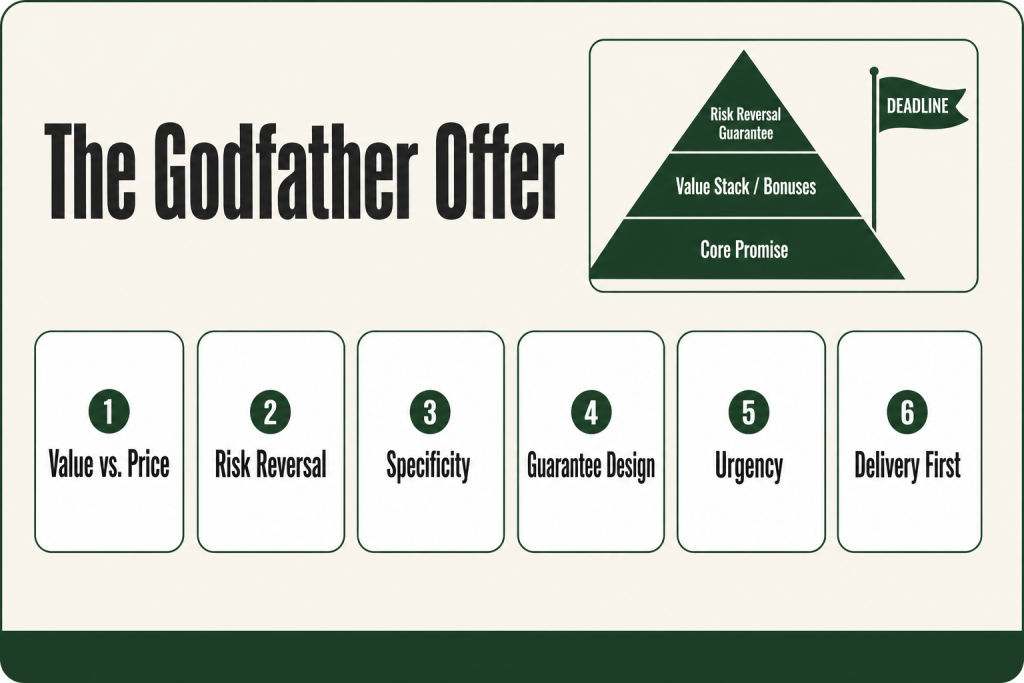
Last updated: July 2026
The godfather offer is the most operator-friendly idea in all of direct response marketing. The premise is disarmingly simple: construct an offer so loaded with value, so specific in its promises, and so free of buyer risk that the rational response is to say yes. Not because you pressured anyone. Not because you slashed your price. Because declining would feel like leaving something obvious on the table.
In No B.S. Direct Marketing (first published January 2006, Entrepreneur Press), Kennedy wrote that a key distinguishing characteristic of direct-response advertising is the presentation of a very specific offer, and that the ideal version is a Godfather’s Offer: one the appropriate prospect can’t refuse. The phrase borrows the famous movie line, but the marketing version flips the coercion entirely. No threats. Just so much value, with so little risk, that the sensible choice becomes obvious.
Most operators who hear about this idea think it means ‘discount heavily.’ That’s exactly wrong, and it’s the mistake this page is going to help you avoid.
The idea in 30 seconds
- A godfather offer is structured so that saying no feels irrational, not because of pressure, but because the perceived value vastly exceeds the perceived risk.
- The engine is risk reversal: you absorb the buyer’s fear of being wrong, not by discounting, but by making the guarantee do the selling.
- Value stacking, layering bonuses, premiums, and specific promises on top of your core deliverable, is what separates this from a standard pitch.
- Discounting is the lazy version. A real godfather offer keeps the price intact and piles value on top until the math feels absurd in the buyer’s favor.
- It only works if you can actually deliver. An overbuilt offer on a mediocre product accelerates your bad reputation, not your revenue.
- By the end of this page, you’ll be able to draft an offer your best prospect would feel genuinely foolish declining, without touching your base price.
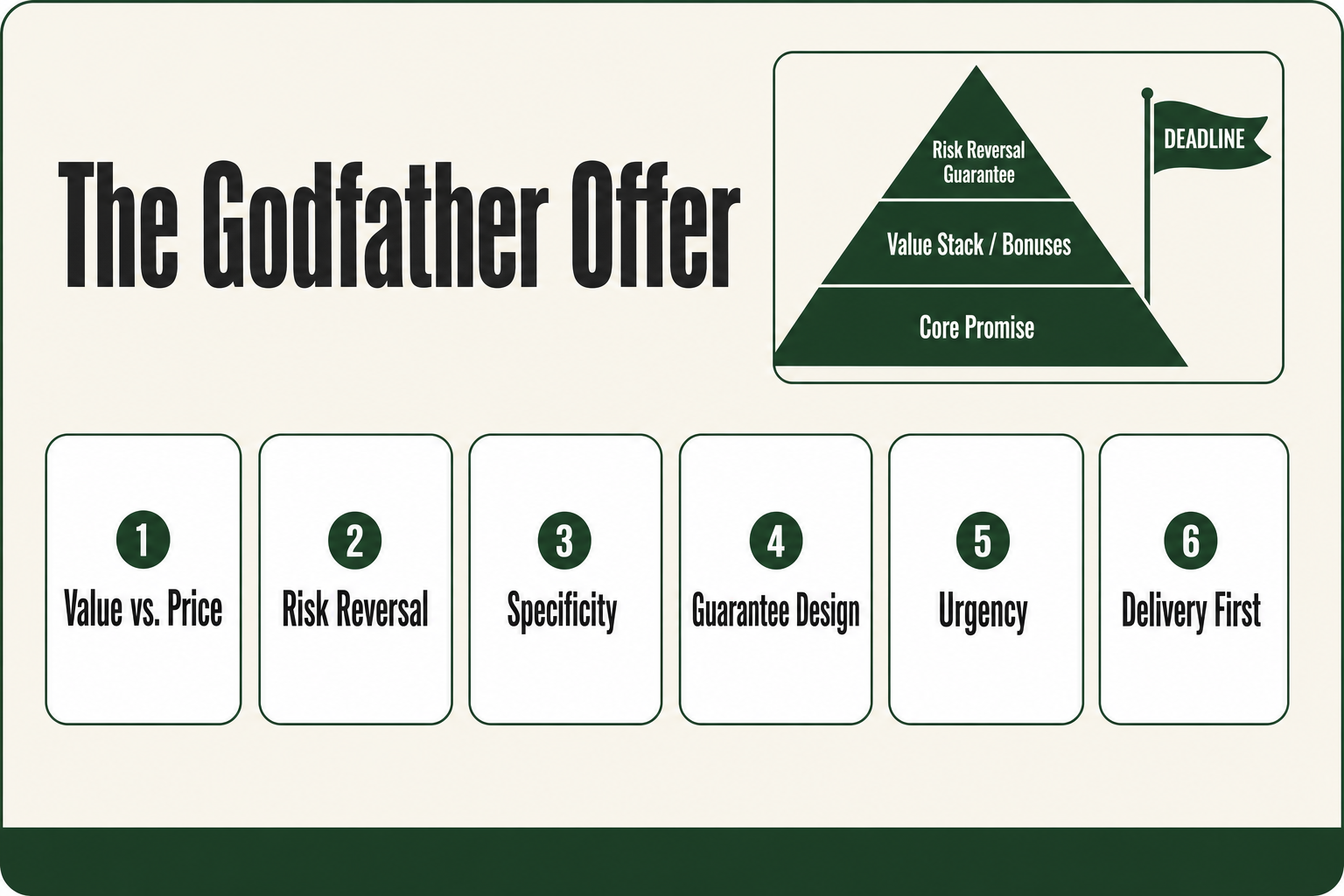
Where the Godfather Offer Came From
The phrase has two lineages, and confusing them sends operators toward the wrong playbook.
In mergers and acquisitions, a ‘godfather offer’ is a bid so far above market value that the target’s board can’t ethically tell shareholders to refuse it. The offer wins through math that’s too good to ignore. That structural logic is precisely what Kennedy imported into direct response marketing: bundle a specific core promise, concrete bonuses, a deadline for action, and a risk-reversing guarantee into a single proposition that the right prospect finds nearly impossible to set aside. Kennedy’s ten rules of direct marketing, codified in No B.S. Direct Marketing and first published in January 2006, open with Rule #1: There Will Always Be an Offer. The Godfather’s Offer is his name for that rule at its most fully realized.
Two practitioners extended the framework in ways worth knowing. Sabri Suby founded King Kong in Melbourne in 2014, starting from his bedroom with $50 and a laptop, and built what became Australia’s fastest-growing digital marketing agency around what he calls the Godfather Strategy, crafting offers so compelling that the right prospect can’t set them aside, backed by outcome guarantees at a time when most digital agencies refused to discuss ROI at all. Alex Hormozi’s $100M Offers (2021) then gave operators a detailed construction system, his Grand Slam Offer framework, for translating the same underlying logic into repeatable process through value stacking and disciplined guarantee design.
The Real Problem: Buyers Carry All the Risk
Before a prospect buys from you, they’re carrying real exposure, money, time, and the underrated social risk of having made a bad call in front of a spouse, a boss, or a business partner. They’ve probably been burned before. Every time a buyer hands money to a business they haven’t fully tested, they absorb that downside alone.
Most marketing ignores this completely. It describes features, benefits, credentials, then asks for a decision. The buyer’s real question, ‘what happens to me if I’m wrong?’, never gets addressed. So they hesitate. They say ‘I need to think about it.’ They don’t come back.
The godfather offer solves this by flipping the risk equation before the buyer has to ask. Jay Abraham has taught risk reversal as a core business discipline for decades, making the point that every transaction has risk sitting somewhere, on one side or the other, and that smart operators deliberately put it on theirs. A strong risk reversal integrated up front lifts conversions not because you’re discounting, but because you’ve removed the obstacle keeping people from saying yes.
Hormozi makes the underlying insight plain in $100M Offers: people don’t fear paying, they fear paying and not getting the result. Guarantees attack that fear directly. A well-designed godfather offer answers the buyer’s unspoken question so specifically and so favorably that it stops being a reason to hesitate.
What Actually Makes a Godfather Offer Work
A godfather offer isn’t one thing. It’s a structure. Understanding each component separately is the only way to assemble one that holds together.
1. A Specific, Credible Core Promise
The offer has to begin with a claim precise enough to be falsifiable. ‘We’ll help grow your business’ is not a promise, it’s a placeholder. ‘We’ll generate 15 qualified leads in your first 30 days or we work free until we do’ is a promise. Specificity signals that you’ve actually thought through what you can deliver, which itself builds credibility. Vague claims cost nothing to make, and buyers know it.
Kennedy was always clear in No B.S. Direct Marketing that the godfather offer is aimed at the right prospect. You’re not trying to make every human say yes, you’re making it impossible for your best prospect to say no. An offer aimed at the wrong person will fall flat no matter how generous the terms.
2. Value Stacking
The core deliverable is your entry point, not your whole offer. A godfather offer layers bonuses, premiums, fast-action incentives, and complementary services on top of the core until the total perceived value feels disproportionate to the price. The goal is a mental math problem the buyer can’t help doing: ‘I’m paying X and getting all of this?’
Hormozi’s framing in $100M Offers is useful here: never discount the main offer, add bonuses instead to raise perceived value. The bonuses you choose reveal your expertise. A tax strategist who offers a complimentary year-end planning checklist is demonstrating depth. A plumber who throws in a seasonal maintenance inspection is showing they understand the lifecycle of the problem. Choose bonuses that reinforce your authority, not ones that just happen to be lying around.
3. Risk Reversal
This is the engine. Everything else can be present and the offer can still fail if the buyer doesn’t trust that they’re protected. Risk reversal transfers the downside of a bad decision from the buyer’s column to yours.
The standard form is a money-back guarantee. That’s a floor, not a ceiling. Hormozi catalogs four guarantee types in $100M Offers: unconditional (no-questions-asked refunds), conditional (refunds tied to specific client actions), anti-guarantees (all-sales-final policies that signal supreme confidence in the product’s value), and implied or performance-based guarantees (models where you earn nothing unless the client succeeds). The stronger and more specific the guarantee, the more selling it does on its own.
One practical nuance: a longer guarantee window typically reduces refund requests in service and information businesses. When a buyer knows they can get their money back for 90 days, they feel secure enough to actually engage. Engagement produces results. Results eliminate the impulse to refund. The tight 7-day guarantee, designed to minimize exposure, often produces more refund requests, not fewer, because the buyer never got far enough in to experience value.
4. A Reason to Act Now
An offer available forever is psychologically equivalent to one that doesn’t exist. The godfather offer includes a real reason why the terms are available now and not indefinitely. Kennedy was emphatic about this across his writing and speaking: every offer needs a deadline, and every deadline has to be real. Manufactured urgency, ‘act now or this deal disappears’ for a deal that never disappears, damages trust faster than almost anything else. Real constraints work: a cohort that closes, a genuine capacity limit, a bonus tied to a scheduling window, an introductory price during a defined launch phase. Buyers can smell the difference.
5. An Unambiguous Call to Action
Kennedy’s Rule #3 in No B.S. Direct Marketing is: You Will Give Clear Instructions. Tell the buyer exactly what to do next, not ‘feel free to reach out,’ not ‘learn more,’ but a specific action with friction removed. Call this number. Fill out this form. Come in before Thursday. The best offer in the world dissolves if the next step is unclear.
The Godfather Offer Is Not a Discount
This confusion costs operators real money, so it earns its own section.
Discounting reduces price. A godfather offer increases perceived value. Those are opposite moves on the margin equation, even if both make the buyer feel like they’re getting a good deal.
When you discount, you’re implicitly signaling that the original price was padded, which trains buyers to wait for sales and degrades your pricing authority over time. Kennedy and pricing strategist Jason Marrs explored this in No B.S. Price Strategyarguing that one of the core pricing failures is attracting customers who buy by price, exactly the trap discounting sets. Once you’ve taught buyers to evaluate you on cost, you’ve moved the entire conversation away from value, and that’s a negotiation you generally don’t want to be in.
A godfather offer does the opposite. The price stays. You pile specific, tangible value on top of it until the price looks small relative to everything the buyer receives. The buyer’s frame shifts from ‘is this too expensive?’ to ‘why is this so generous?’ Those are very different conversations.
There’s also a positioning benefit. A business willing to stand behind its work with a strong, specific guarantee signals confidence. It’s the difference between a mechanic who says ‘trust me’ and one who offers a 24-month warranty on every repair. Both might be equally skilled. Only one communicates certainty.
The practical test: if building your godfather offer requires you to lower your price, you haven’t built a godfather offer yet. You’ve built a promotion. Go back and figure out what you can add, bonuses, guarantees, specificity of promise, that makes the existing price feel like a bargain.
Putting this to work? The ideas in the Canon are the foundation under the tactical playbook in Build a Complete Marketing Departmentgrab the free companion kit at mmsvegas.com/resources.
The Godfather Offer in the Wild, Real Examples
The clearest large-scale example in American business history is Domino’s delivery guarantee. Starting in 1979, Tom Monaghan built ’30 minutes or it’s free’ into the operational core of the company, not a slogan bolted onto an existing model, but a structural commitment the entire operation was engineered to fulfill. The guarantee removed the primary anxiety of delivery pizza, ‘will it show up hot?’, and replaced it with a specific, testable promise backed by a real consequence. The chain grew from roughly 200 stores to 5,000 by 1989.
It’s also the most instructive cautionary tale. By the late 1980s, over 20 fatalities had been linked to Domino’s drivers, and in 1993 a St. Louis jury awarded Jean Kinder $78 million in punitive damages after a Domino’s driver broadsided her car. Monaghan dropped the guarantee four days after the verdict. The lesson for operators isn’t that bold guarantees are dangerous, it’s that a guarantee is a check your operations have to cash. The offer was brilliant. The delivery system didn’t match it.
In digital agency work, Sabri Suby built King Kong, started in Melbourne in 2014 from his bedroom with $50 and a laptop, into what became Australia’s fastest-growing digital marketing agency using what he explicitly calls the Godfather Strategy. His stated point of difference was direct: in a market where most agencies refused to discuss ROI, Suby guaranteed results and structured his fees around agreed performance benchmarks. That specificity, and the confidence behind it, made his offer impossible for the right client to ignore.
At the small-business level, the pattern shows up in less glamorous but equally effective forms. A residential HVAC company that offers ‘we’ll diagnose your system same day or the diagnostic is free, and if we can’t beat your current service contract by 15%, we’ll tell you to stay where you are’ is making a godfather offer. The specificity, the risk transfer, and the implied confidence in the comparison all do the selling. The company isn’t cheap, it’s confident.
A management consultant who offers ‘pay half upfront, half only after we’ve hit the agreed revenue benchmark, and if we miss by more than 10%, the second payment disappears’ is not giving away margin. They’re using risk reversal as a positioning statement: I believe in this enough to make my income contingent on it working.
Where the Godfather Offer Works Best
The godfather offer earns its best returns in situations where buyer hesitation is the primary conversion obstacle. That description covers a wide range:
High-consideration purchases. Anything a buyer has to ‘think about’, professional services, coaching, agency retainers, significant equipment, home improvement, is a candidate. The longer a buyer is likely to deliberate, the more a well-constructed godfather offer can compress the decision timeline by eliminating the things they’d be deliberating about.
First-time buyers. A prospect who’s never bought from you is carrying maximum uncertainty. Risk reversal does its best work here. Once someone has bought from you and been well-served, the offer can thin out because trust has replaced it. The godfather offer is primarily a trust substitute for new relationships.
Commodity categories. If your service looks interchangeable with four competitors, the godfather offer is a genuine differentiator, not on price, but on confidence. The competitor who backs a 90-day outcome guarantee while everyone else offers a 30-day refund has done something structural to their positioning, not just their marketing.
Direct response contexts. Email, direct mail, landing pages, paid ads, any channel where the buyer is making a decision in isolation, without a salesperson present, is exactly the environment Kennedy designed this for. The offer has to carry the full weight of the conversation because there’s no one to handle objections live.
Where It Doesn’t Work, And Why
A godfather offer on a product you can’t actually deliver is an acceleration device for the wrong outcome. The offer is powerful and a little dangerous, precisely because it relies on the product or service living up to the promise. Overdeliver on the offer and you earn customers for life. Miss on it and you’ve created a marketing event that produces disappointment at scale.
Domino’s is the obvious lesson. The offer was brilliant. The operational infrastructure didn’t match it, and the consequences were catastrophic, not just legally, but for the brand’s trust with the public. For a small business, the equivalent failure is less dramatic but equally real: a generous guarantee that triggers a flood of refund requests because the product didn’t support the promise.
It also struggles in high-trust repeat relationships. If you’ve served a client well for three years, they’re not buying on the strength of your guarantee anymore. Bolting a heavy guarantee onto a renewal conversation can actually introduce doubt, ‘why do they need to offer that?’, where none existed. The godfather offer is a relationship-starter, not a relationship-maintenance tool.
Finally, it doesn’t work when the audience can’t afford the core offer, no matter how loaded it is. Stacking value on top of a price point that’s already outside your prospect’s budget doesn’t shift the conversation. The offer has to be priced for the right buyer first; then the stacking does its job.
What People Get Wrong About the Godfather Offer
It’s about generosity. It’s not. Every bonus you add, every guarantee extension you grant, is a calculated investment in conversion rate and client quality. Operators who add bonuses because they feel nice, rather than because each bonus addresses a specific buyer objection or reinforces a specific promise, end up with bloated offers that don’t convert any better than lean ones. Ask of each element: what hesitation does this remove? If you can’t answer, cut it.
A stronger guarantee means more refunds. The data consistently runs the other way. A longer, more specific guarantee typically reduces refund requests because it selects for serious buyers who feel secure enough to actually engage with what they bought. Tight guarantees designed to minimize exposure often produce more requests, not fewer, because the buyer never gets far enough in to experience value.
It replaces the need for a good product. This is where the concept gets dangerous when misapplied. The godfather offer is a persuasion structure. It doesn’t create value; it communicates and de-risks it. The underlying product or service has to be able to deliver on the specific promises made. Anything less and the offer machinery runs in reverse, generating buyers who are quickly disappointed and vocal about it.
It’s only for consumer marketing. Kennedy’s framework was forged in consumer direct response, but the logic applies just as cleanly in B2B. A consultant who offers an outcome-contingent fee structure, a software vendor who offers a pilot with defined success metrics and an easy exit, a staffing firm that guarantees a replacement hire at no cost within 90 days, these are all godfather offers. The specific form changes; the structure doesn’t.
‘Irresistible’ means universally appealing. Kennedy was precise about this in No B.S. Direct Marketing: the godfather offer is irresistible to the right prospect. An offer that converts everyone is a fantasy. An offer that converts your best-fit prospect at a dramatically higher rate than your current one is a real business result. Specificity in who the offer is for matters as much as the offer’s content.
Building Your Godfather Offer, A Practical Operator’s Sequence
Forget the template for a second. The single most useful thing you can do before you write a word of offer copy is sit down and list every reason your best prospect would hesitate to buy from you. Not reasons they’d never buy, reasons they’d delay, hedge, or ask to ‘think about it.’ That list is your construction blueprint. Every element of your godfather offer should map directly to one item on that list.
Hormozi’s $100M Offers recommends a version of this problem-mapping exercise: list every micro-problem your customer faces, generate solutions for each, then cherry-pick the highest-impact, lowest-cost combinations for your offer. Solid process. What’s missing from any checklist is the judgment call on what you can actually back with a guarantee, and that judgment stays with you, not with any framework or tool.
Step 1: Name the outcome specifically. Not ‘we improve your marketing’, ‘we generate X qualified leads in Y timeframe for businesses in your category.’ If you can’t name a specific outcome, the offer can’t be backed by a meaningful guarantee, and the whole structure weakens.
Step 2: Identify the primary fear. For most buyers: wasting money on something that doesn’t work. For B2B buyers, add: looking bad internally for recommending it. Your guarantee needs to address the primary fear directly. If the fear is wasted time, a money-back guarantee is insufficient, you need to address the time exposure too.
Step 3: Design the guarantee around the outcome, not just the transaction. ‘Satisfaction guaranteed’ is weak because it’s vague, satisfied by whose definition? ‘If we don’t hit the agreed benchmark by day 60, you don’t pay for month two’ is specific, falsifiable, and signals genuine confidence. Paradoxically, the more specific the guarantee, the more credible it is, because vague guarantees are easy to make and everyone knows it.
Step 4: Stack value that addresses the next tier of objections. Once the primary fear is handled by the guarantee, buyers have secondary objections, often practical ones like ‘I don’t have time to implement this’ or ‘I won’t know how to use it.’ Bonuses that pre-solve these objections are worth far more than random extras. An implementation guide, a done-for-you setup call, access to templates, these aren’t giveaways, they’re objection handlers in disguise.
Step 5: Build in a genuine reason to act now. What’s structurally true about your business that creates a real constraint? Capacity limits, cohort closes, introductory pricing during a launch phase, a bonus that requires scheduling, use what’s real. If nothing real exists, create something structural: limit the number of clients you take per month (which you probably should be doing anyway) and that limit becomes honest scarcity.
Step 6: Test the offer against the discomfort test. One rule of thumb with clear Kennedy lineage: if your offer doesn’t make you slightly uncomfortable, it’s probably not strong enough. That discomfort is your signal that you’ve pushed the perceived value to a point where the buyer genuinely feels the math is in their favor. If you’re entirely comfortable, so is the buyer, and comfortable buyers delay.
On using AI in offer construction: AI tools can accelerate the drafting phase, mapping out bonus stacks, drafting guarantee language, identifying objections you hadn’t thought of. What they can’t do is make the judgment call on what you can actually deliver. The guarantee’s credibility lives entirely in the gap between what you promise and what you deliver. You have to close that gap through operations, not through copy. AI helps you write the offer; it doesn’t build the business that honors it.
Common Mistakes
- Guarantee language that’s vague enough to ignoreWrite the guarantee around a specific outcome, a specific timeframe, and a specific consequence. If it sounds like boilerplate when you read it aloud, it will be treated like boilerplate. Rewrite until a prospect would remember and repeat it, that’s your test.
- Publishing a bold offer before auditing deliveryMap your proposed guarantee terms against your actual fulfillment process before anything goes live. Know exactly what happens, operationally, when someone invokes it. If you can’t answer that question clearly, the offer isn’t ready.
- Bonus stacking without buyer-objection mappingFor every bonus in your stack, name the specific hesitation it removes. If you can’t name one, the bonus doesn’t belong there. Three targeted bonuses that each do work consistently outperform eight random extras, and they’re easier for the buyer to process.
- Discounting the core offer instead of building on top of itLowering your price to make the offer feel generous is a promotion, not a godfather offer. Hold the price and add guarantees, bonuses, and promise specificity until the existing price feels like the bargain. If you can’t get there without cutting the price, the value stack needs more work.
- Treating the offer as a one-time buildThe first version is a draft. Track which guarantee language shows up in sales call notes, which bonuses clients mention at onboarding, and which parts of the offer prospects ask about. Revise quarterly. The compounding advantage belongs to operators who keep sharpening.
- Applying cold-acquisition risk-reversal language to existing client renewalsWith a client who already trusts you, a heavy guarantee framing can introduce doubt rather than confidence. Restate your backing in terms of what you’ve delivered together, ‘last year we hit X, this year I’ll guarantee Y’, rather than leading with the same language you’d use on a cold prospect.
Operator’s Take
Here’s something most operators get backwards: they spend weeks obsessing over ad creative and ignore the offer entirely. The ad gets the click. The offer closes or loses the lead. A mediocre ad with a sharp godfather offer will almost always beat a beautiful ad attached to a generic one. If you’re split-testing headlines before you’ve stress-tested your guarantee language, you’re optimizing the wrong thing.
So let me be direct about what ‘building a godfather offer’ actually requires, and where most operators stall out.
Your guarantee language has to be specific enough to screenshot. ‘One hundred percent satisfaction guaranteed’ is invisible. Every competitor has it. It registers as noise. You need outcome-specific language tied to a real deliverable and a real timeframe, something like: ‘If you haven’t booked at least three new consults from this campaign by day 45, we refund your management fee and keep running your ads free until you do.’ That’s a sentence a prospect will read aloud to a spouse or business partner as a reason to say yes. Generic guarantee language gets skimmed. Specific guarantee language gets repeated. Write yours, then read it aloud, if it sounds like every other guarantee you’ve read, rewrite it until it doesn’t.
Pick the right guarantee structure for your offer type. Unconditional money-back guarantees work well for lower-ticket, lower-fulfillment offers. For high-ticket service work, conditional guarantees, ‘full refund if we don’t hit X by date Y, provided you’ve completed Z’, select for better clients and still do serious persuasion work. For purely performance-based engagements, an implied or revenue-share guarantee is often more credible than any refund promise, because it says you’re willing to eat the result, not just return the fee. Match the structure to what your operations can actually honor. Then make the language as specific as possible within that structure.
Cut your bonus stack in half. With AI tools everywhere, buyers are drowning in generic deliverables, PDFs nobody opens, recordings nobody watches, checklists nobody uses. A bonus that saves them a specific, painful decision carries ten times the perceived value of one that just adds volume. One done-for-you onboarding call, one 30-minute implementation review three weeks in, one real human touching the work, that converts. Three more downloadable guides does not. The rule: if you can’t name the specific buyer objection a bonus handles, pull it from the stack.
Before you publish anything bold, audit your delivery against it. The guarantee writes checks your operations have to cash. If your fulfillment has quality problems, fix those first, an irresistible offer on a shaky product just gets you disappointed customers faster, and they leave reviews before they ask for refunds. Know what happens operationally when someone invokes the guarantee. No clear answer means the offer isn’t ready.
Use the offer as a retention tool, not just an acquisition tool. When a client renews, restate what you’re backing, updated to reflect what you’ve delivered together. ‘Last year we hit X. This year I’ll guarantee Y or we credit the difference’ is a renewal conversation that rarely fails. Most operators treat renewals as administrative. They’re actually your best offer moment, because trust is already in place and a strong guarantee on top of it reads as confidence rather than desperation. Just don’t wheel out the full cold-acquisition risk-reversal language on a three-year client, that introduces doubt where none existed.
Treat offer construction as a quarterly discipline, not a launch event. Test your guarantee language against what clients actually mention in sales calls. Rotate bonuses based on what comes up in onboarding conversations. Tighten your core promise as real delivery data accumulates. Your first godfather offer will be better than what you have now. Your fifth will be noticeably better than your first. The operators who win at this aren’t the ones who built the cleverest offer once, they’re the ones who kept sharpening it.
Used in
- ✓ Build a Complete Marketing Department
Used to design the core offer that anchors every campaign, the page that all traffic lands on must contain a godfather-level proposition to convert cold and warm audiences alike. - ✓ The Missing Manual for FunnelKit
Used to structure the offer block on checkout and landing pages, guarantee copy, bonus stacking, and urgency elements are each mapped to specific FunnelKit components. - ✓ The Missing Manual for Make
Used to automate offer delivery logistics, bonus fulfillment sequences, guarantee-trigger follow-ups, and time-sensitive bonus expiration notifications are built as Make scenarios.
FAQ
Does a godfather offer require a money-back guarantee?
Not strictly, but risk reversal of some kind is non-negotiable. A money-back guarantee is the most common form, but outcome-contingent pricing, free pilots, or performance warranties can all do the same structural work, transferring the buyer’s fear of being wrong from their column to yours.
Won’t a stronger guarantee just attract more refund requests?
Usually the opposite. A longer, more specific guarantee selects for buyers who are serious and makes them feel secure enough to actually engage with what they bought. Engagement produces results, and results eliminate the refund impulse. Tight guarantees designed to minimize exposure frequently produce more requests, not fewer.
How is a godfather offer different from a discount or a sale?
A discount reduces your price and trains buyers to wait for the next one. A godfather offer holds your price and piles specific, tangible value on top until the price looks small relative to everything included. The buyer’s focus shifts from cost to value, that’s the key structural difference.
Can the godfather offer work in B2B sales?
Yes, and it’s underused there. Outcome-contingent fee structures, pilot programs with defined success metrics, performance warranties, and no-cost replacement guarantees are all B2B godfather offer formats. The specific form changes; the underlying logic, make refusal feel irrational for the right buyer, doesn’t.
How many bonuses should I stack?
Fewer than you think. Three targeted bonuses that each address a real buyer objection outperform eight random ones. Every bonus should answer a specific hesitation; if you can’t name which one, cut the bonus.
What if my product isn’t strong enough to support a bold guarantee?
Build the guarantee you can honestly back, and fix the product. A godfather offer on a mediocre product doesn’t solve your business problem, it accelerates disappointed customers. The guarantee is a check your operations have to cash; get your fulfillment tight first.
Further reading
- Dan Kennedy, No B.S. Direct Marketing (Entrepreneur Press, first edition January 2006), the source text for Kennedy’s godfather offer doctrine and his ten rules of direct-response marketing, including the rule that the ideal offer is a Godfather’s Offer the appropriate prospect can’t refuse.
- Dan Kennedy and Jason Marrs, No B.S. Price StrategyKennedy and pricing strategist Jason Marrs on why discounting attracts the wrong customers and how to use pricing as a tool of authority rather than concession.
- Sabri Suby, Sell Like Crazy (2019)Suby’s account of building King Kong using the Godfather Strategy; useful for operators who want to see the same core mechanics applied specifically to digital lead generation and agency growth.
- Alex Hormozi, $100M Offers (2021)the most detailed modern construction manual for value stacking and risk reversal; Hormozi’s Grand Slam Offer framework is a step-by-step extension of the same underlying logic Kennedy established.
- Jay Abraham, Getting Everything You Can Out of All You’ve GotAbraham’s treatment of risk reversal as a core business strategy, not just a copywriting tactic, worth reading separately from the offer-construction frameworks.
Sources: Dan Kennedy, No B.S. Direct Marketing (Entrepreneur Press, first edition January 2006; updated editions 2013 and later with coauthors Darcy Juarez and Marty Fort), primary source for the godfather offer doctrine, Kennedy’s Rule #1 (There Will Always Be an Offer), and the principle that the ideal version of that offer is a Godfather’s Offer the appropriate prospect can’t refuse; the phrasing ‘a key distinguishing characteristic of direct-response advertising is the presentation of a very specific offer’ and ‘Ideally, yours is a Godfather’s Offer’ appears in Kennedy’s own chapter in that book, as reproduced in publisher and third-party summaries. Dan Kennedy and Jason Marrs, No B.S. Price Strategy (Entrepreneur Press), source for the discounting-as-failure argument and the risk of attracting price-first customers. Sabri Suby, Sell Like Crazy (2019) and associated interviews in Foundr Magazine and Dynamic Business, source for King Kong founding details (2014, Melbourne, $50 and a laptop), growth trajectory, and explicit Godfather Strategy attribution; the 17-step selling system Suby describes is documented as an extension of the godfather strategy concept. Alex Hormozi, $100M Offers (2021), primary source for Grand Slam Offer construction, value stacking, and guarantee typology (unconditional, conditional, anti-guarantee, and implied/performance-based). Jay Abraham, published interviews and Getting Everything You Can Out of All You’ve Gotsource for risk reversal as a core business discipline. The Hustle, Tasting Table, and Mel Magazine, source for Domino’s guarantee history (launched 1979, dropped by Tom Monaghan in 1993 four days after $78M punitive damages verdict for Jean Kinder). Corporate Finance Institute, source for M&A origins of the godfather offer term.
Brian Kasday spent forty years in direct-response marketing before rebuilding the whole operation as a one-person shop. He writes The Operator’s Library, including “Build a Complete Marketing Department”, for operators who’d rather build it themselves than wait on someone else.
Build the department these ideas describethe free companion kit: mmsvegas.com/resources.
More The Operator's Canon guides
Free · Operator Toolkit
Want the tools, not just the guide?
Get the free operator toolkit — templates and checklists for the systems you actually run, plus a note when this guide changes.
Get the free toolkit →