
Last updated: July 2026
The marketing hourglass is a customer journey model created by John Jantsch of Duct Tape Marketing. It maps seven stages, Know, Like, Trust, Try, Buy, Repeat, and Refer, and it will change where you spend your next marketing dollar. By the end of this page, you can map your entire customer relationship, identify exactly where people stall, and build deliberate systems, not just goodwill, for repeat business and referrals.
Here’s the problem with the way operators think about marketing: the funnel. Leads in the top, customers out the bottom, done. Celebrate the sale, move on, chase the next one. It’s a model built for transactions, not relationships, and it treats the moment a customer hands over money as the finish line, when it’s actually closer to the starting gun for everything that makes a small business profitable.
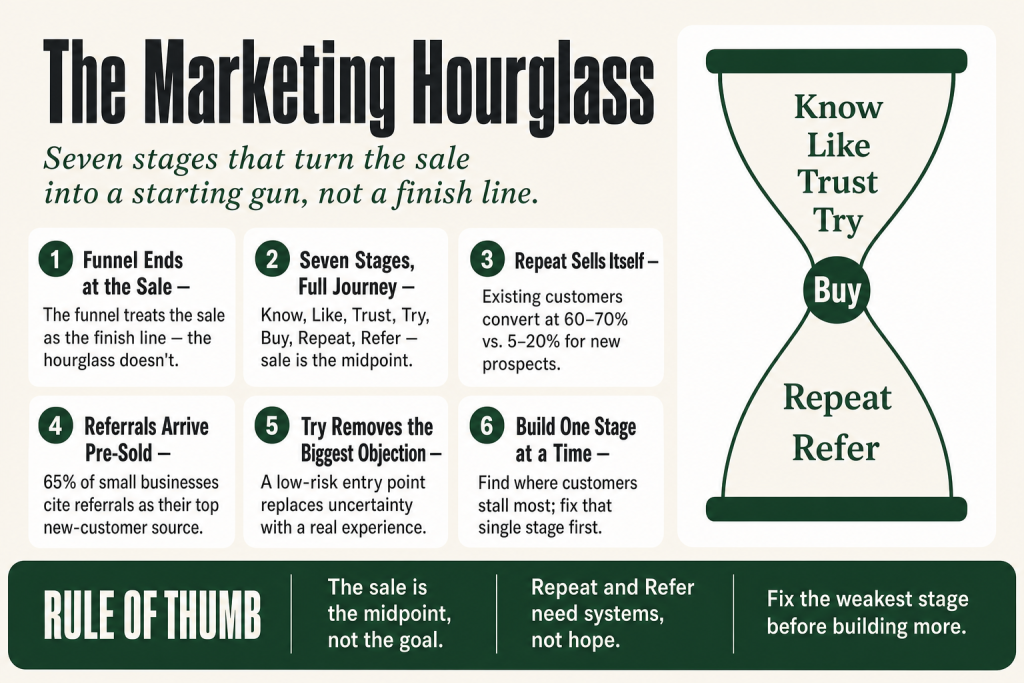
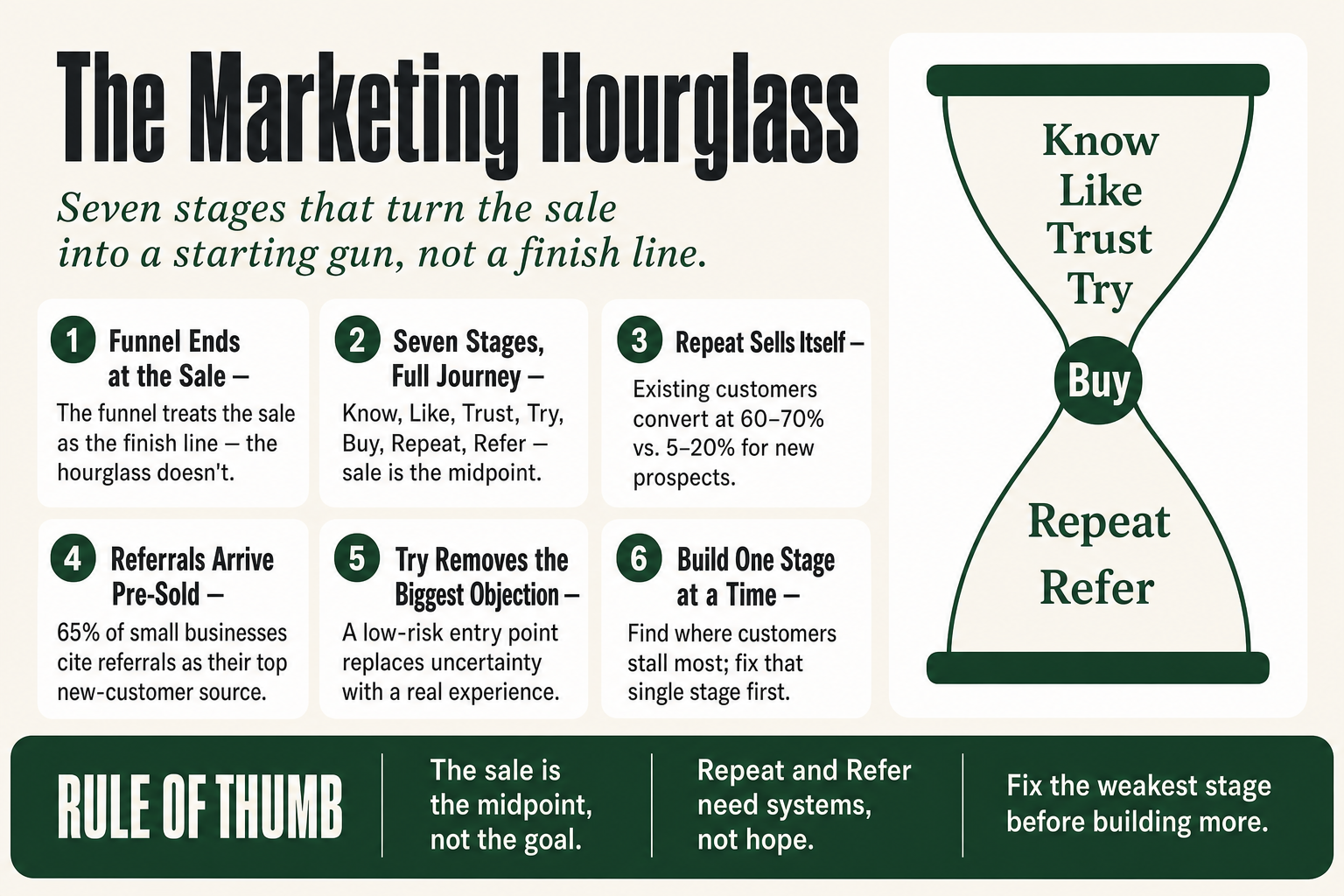
The hourglass fixes that framing. The top half, getting someone to know you, like you, trust you, try something, and then buy, works like a funnel. But then it widens back out. Because after the sale, if you do it right, you get repeat business and referrals. Those two stages are where the math gets interesting for an operator working without an enterprise budget. You already paid to acquire that customer. Everything they spend after the first purchase, and every new customer they send your way, is growth you didn’t have to buy twice.
The idea in 30 seconds
- The marketing hourglass is John Jantsch’s model that extends the traditional sales funnel past the purchase through seven stages: Know, Like, Trust, Try, Buy, Repeat, and Refer.
- The funnel ends at the sale. The hourglass treats the sale as the midpoint, the bottom half (Repeat and Refer) is where the real profit lives for most small businesses.
- A customer who buys, returns, and refers is worth dramatically more than one who buys once and disappears, and the math gets lopsided fast.
- You probably have some system for the top five stages. Almost nobody has a deliberate system for Repeat and Refer, which is exactly why those two stages are the biggest opportunity.
- Applying it means mapping every customer touchpoint to a stage, finding where people stall, and building a specific mechanism to move them forward.
- The referral half isn’t about asking awkwardly, it’s about designing the experience so the ask becomes the natural next step.
Where the Marketing Hourglass Came From
John Jantsch built Duct Tape Marketing starting in 2002 as a system for small business owners who needed something that held together without a VP of Marketing to run it. In 2007, Duct Tape Marketing: The World’s Most Practical Small Business Marketing Guide put the hourglass in print. He continued developing the model across later books, most recently The Ultimate Marketing Engine (HarperCollins Leadership, 2021), which builds out what he calls the Customer Success Track: a structured approach to the post-purchase relationship.
The shape itself came from stacking two funnels, one right-side up, one inverted, so the pinch point is the sale. The widening below represents where customers turn into repeat buyers and, eventually, into people who send new business without being asked twice. The insight behind it was almost embarrassingly obvious once Jantsch said it out loud: marketing stops at the sale, and that’s exactly when the most valuable part of the relationship is just getting started.
The Real Problem the Marketing Hourglass Fixes
The funnel model isn’t wrong, exactly. It’s just incomplete in a way that costs operators real money. Marketing content, agency work, most advice, it obsesses over the conversion event. Everything before the sale gets a process, a sequence, a budget line. Everything after gets hope.
That’s a strange allocation when you look at the numbers. Acquiring a new customer costs five to twenty-five times more than retaining an existing one, depending on industry, and yet acquisition gets the meetings, acquisition gets the budget, and retention gets the leftovers. According to a Gartner CMO Survey, 44% of companies acknowledge they spend more on acquisition than they should, while only 18% have concrete plans to shift the balance. The gap between what businesses say they believe and what they actually fund is one of the stranger features of the marketing industry.
The marketing hourglass has seven stages: Know, Like, Trust, Try, Buy, Repeat, Refer. Small businesses generally have systems for the first five. They know how to get found, how to build some trust, how to close. Then the marketing ends. Repeat and Refer, the back half, get left to chance. Good work, happy customers, and a hope that someone mentions you. That’s expensive.
The other failure the hourglass corrects is the assumption that moving straight from awareness to purchase is a reasonable ask. A lot of marketing is an attempt to jump from Know directly to Buy, skipping five relationship-building steps in one leap. People don’t work that way. They need intermediate experiences: content that builds familiarity, social proof that builds trust, a low-stakes entry point that lets them try before they fully commit.
The hourglass names all of those intermediate steps and forces you to build something for each one. That’s not a minor tweak to the funnel, it’s a different way of accounting for how customers actually decide.
The Marketing Hourglass: All Seven Stages, What They Actually Mean
The hourglass acknowledges that your job as a marketer is to get someone with a need to know, like, and trust you, and then to turn that know, like, and trust into try, buy, repeat, and refer, with each stage addressing a prospect’s evolving relationship with your business. Here’s what each one actually demands from an operator.
Know
Someone becomes aware your business exists. That’s it. SEO, paid ads, word of mouth, a sign on a building, a podcast interview, a referral from an existing client, all of it counts. The job at this stage isn’t to close; it’s to exist in the right place at the right time. Have a legible, credible answer wherever they might go looking.
Like
Awareness without affinity goes nowhere. After someone finds you, they’re deciding whether they want to spend more time with you, whether your tone, your values, your style feel right. This is where technically competent businesses lose ground to less competent ones that communicate better. Being good at your work is table stakes. Seeming like someone worth working with is what gets you to the next stage.
Trust
Like without trust doesn’t convert. Trust is proof, case studies, testimonials, reviews, third-party validation, consistent follow-through on small promises. Saying you’re trustworthy is worth almost nothing. Showing a dozen clients who say it for you is worth a great deal.
Try
One of the most underused stages in the marketing hourglass. A Try moment is any low-risk way for a prospect to experience your work before committing to a full purchase. A free consultation, a small pilot project, a sample, a workshop, a downloadable guide that demonstrates your thinking. For service businesses especially, this is where a lot of sales happen. People buy the Try, have a good experience, and converting to a full engagement feels obvious rather than scary.
Buy
The sale itself. Operators generally have more attention here than anywhere else. But even here, the hourglass framing matters: the Buy experience sets the tone for everything that follows. A clunky purchase process, an awkward onboarding, a week of silence after the contract is signed, these are inflection points. Get Buy wrong and the back half of the marketing hourglass never has a chance to work.
Repeat
This is where the hourglass widens back out, and where most small businesses are leaving the most money on the table. Repeat doesn’t happen by itself. What specifically brings your customers back? Waiting for the customer to remember is not a system; it’s a wish. Deliberate repeat mechanisms include regular check-in emails, maintenance plans, retainers, upsell sequences, seasonal outreach, anniversary campaigns. The probability of selling to an existing customer runs 60 to 70%, compared to 5 to 20% for a new prospect, a gap that a system targeting existing customers closes faster than almost any acquisition tactic.
Refer
The last stage, and the most valuable for a small business. According to LocaliQ research cited by Clutch, 65% of small businesses say customer referrals are their top source for acquiring new customers. A referred customer arrives pre-sold on trust. They convert faster, complain less, and refer more often themselves. The problem is that referrals don’t happen at scale without a system. Happy customers want to refer you, they just need a prompt, a mechanism, and a reason to do it now rather than later.
Funnels end at the purchase. The marketing hourglass continues past the sale, turning the back half into a self-reinforcing engine: every referral creates a new Know. When it’s working, you’re not starting over with every new customer, you’re compounding.
Why the Marketing Hourglass Works Better for Small Businesses Than the Funnel
Big companies can afford to run the funnel as an acquisition machine and throw money at the top every quarter. They have marketing teams, budgets, and enough volume that a leaky bottom barely registers as a problem. Small businesses don’t have that margin for waste.
For an operator running a service business, a local shop, or a B2B consultancy, the economics look different. Acquisition costs are high relative to revenue. Capacity is limited. Reputation is everything. In that context, the difference between a customer who buys once and one who buys multiple times and sends referrals isn’t just a nice win, it’s often the difference between a business that struggles and one that grows without grinding.
Average customer acquisition costs have climbed 40 to 60% since 2023, driven by ad competition, cookie deprecation, and attribution headwinds, and retention costs grew only about 12% over the same period. That’s not a temporary blip; it’s a structural shift. The operators who built systematic back-half processes two years ago are now growing their retained customer base while their competitors pay more and more per new lead.
A 5% improvement in customer retention can lift profits between 25% and 95%, a figure that comes from Bain & Company and Harvard Business Review research, and one that holds up across industries. You could run the most sophisticated top-of-funnel campaign in your category and still not see numbers like that. The back half of the marketing hourglass is the highest-ROI section of marketing available to most small operators, and it gets the least attention.
There’s also a structural advantage here for businesses with strong relationships. When the Refer stage feeds the Know stage, you’ve built an engine that compounds. Unlike paid acquisition, which stops the moment you stop paying, a referral network builds over time. Every satisfied customer who refers one more person expands the base from which future referrals come. Slow to start, real caveat, but durable in a way that ad spend isn’t.
Putting this to work? The ideas in the Canon are the foundation under the tactical playbook in Build a Complete Marketing Departmentgrab the free companion kit at mmsvegas.com/resources.
Building the Back Half of the Marketing Hourglass: Repeat and Refer as Deliberate Systems
This is the section operators need most, and the one that gets the least attention in the marketing literature, which tends to obsess over acquisition. So let’s spend real time on it.
The Repeat System
Repeat business requires a reason to come back and a mechanism to deliver that reason. Most businesses have neither. They deliver the work, send the invoice, and wait. The customer doesn’t come back not because they were unhappy, they just forgot, got busy, or found someone else who stayed in touch.
A repeat system answers one question: what specifically triggers a customer to re-engage? For a landscaping company, it’s a seasonal maintenance reminder. For an accountant, it’s tax season outreach plus a mid-year check-in. For a B2B agency, it’s a quarterly review call. For a product business, it’s a replenishment email timed to when they’d naturally run out.
Jantsch’s framework for the post-purchase relationship, laid out in The Ultimate Marketing Enginecenters on four deliberate components: onboarding, repeat engagement, a referral system, and reactivation. The first 90 days after a customer buys is where the relationship gets established or lost. Treat it as operations, deliver the thing, move on, and you’ve left the most valuable relationship-building window untouched. A structured onboarding process does something different: it confirms the customer made the right decision, surfaces anything that needs fixing before it becomes a problem, and connects their good outcome to you rather than to chance.
Build a 30/60/90-day post-purchase sequence. Day 1 is a welcome with clear next steps. Day 14 is a check-in asking how things are going. Day 30 is a value-add, a resource, a tip, an insight specific to what they bought. Day 60 is a case study or success story from a similar client. Day 90 is the natural moment to surface the next logical offer. None of this needs to be elaborate. Most of it can be automated. Klaviyo’s 2026 benchmark data shows automated post-purchase flows achieve 40 to 45% open rates, the highest of any automated email type, and customers in the first 30 days after a purchase are 60 to 70% likely to buy again. The key is that it happens by design, not by accident.
Automation matters here, but don’t let it go cold. A CRM sequence that sounds like a robot beats no contact at all, but a short, personal note from you beats a polished template. Use the template for the structure and rewrite the opening two sentences yourself. That’s enough to make it feel human.
The Referral System
Happy customers want to refer you. Research from Texas Tech University found that 83% of satisfied customers are willing to refer, but only 29% actually do. The gap isn’t motivation; it’s structure. There’s no ask, no easy mechanism, no prompt. That gap is worth real money.
A post-purchase sequence creates the natural moment to ask for a review, a referral, or both. Timing matters more than wording, which is the thing operators get backwards when they finally do ask.
A solid referral system has three parts: the ask, the mechanism, and the follow-through. The ask should come at a moment of demonstrated success, when the customer has just expressed satisfaction, not cold. The mechanism is whatever makes it easy to actually refer: a link to your Google review page, a referral card, a short email template they can forward, a formal program with an incentive. The follow-through is what happens when a referral comes in, how quickly you acknowledge it, how you thank the person who sent them.
According to Nielsen data, more than 9 in 10 consumers trust referrals from friends and family over any other form of advertising. That tells you what a referred customer is worth compared to a cold lead. They arrive pre-trusting. They close faster. They stick longer. Research published in the Journal of Marketing (Wharton School) found that referred customers have a 16% higher lifetime value than non-referred customers with similar demographics, and they generate 30 to 57% more referrals themselves, according to Harvard Business Review.
One practical note: don’t over-engineer the referral program. Complex incentive tiers and formal portals are fine for companies processing thousands of referrals a month. For a small business, the system can be much simpler, a direct ask, a clear mechanism, and a genuine thank-you. Simplicity wins because your customers will actually do it.
The Top Half of the Marketing Hourglass: Know, Like, Trust, Try
The top four stages of the hourglass aren’t new territory, most marketing content lives here. But a few things are worth saying precisely because the hourglass framing changes how you think about them.
First, the stages are sequential in terms of customer psychology, but not always sequential in how a customer actually experiences your business. Someone might read a case study (Trust) before they’ve read anything that would normally be filed under Know. A referred customer might skip from Know directly to Try because the referral source already did the Like and Trust work for you. That’s fine. The stages describe what has to be true before someone buys, not necessarily in what order your content delivers it.
Second, each stage must match where the person actually is, psychologically. An ad targeting a cold audience that asks for a commitment is tone-deaf to the Know stage. A nurture email that restates your origin story to someone who’s been a client for two years is wasted. Match the message to the moment.
Third, the Try stage is genuinely underused in the marketing hourglass and worth your attention. For any service business, a low-risk entry point does three things simultaneously: it removes the biggest objection (uncertainty), it creates an experience your prospect can evaluate rather than a promise they have to believe, and it gives you a chance to demonstrate value in a context where you control the outcome. A free 30-minute audit, a small paid diagnostic, a workshop, a trial project, these all function as Try. Design your Try experience so that completing it makes the next step feel obvious, not like a new decision.
The Like stage is also worth more than operators give it. Technical excellence is expected. Personality, point of view, communication style, the sense that working with you will be enjoyable, is differentiating. Buyers don’t move in straight lines. They read reviews, Google comparisons, ask friends, and often make decisions without you even knowing you’re being evaluated. The Like stage is doing a lot of work in that pre-conversation window, and most of what happens there is content: your website copy, your emails, your social presence, your podcast appearances, your case study language. All of it signals who you are, not just what you do.
The Marketing Hourglass in Action: Examples Worth Stealing
The model is abstract until you see it working in a specific business. Here are patterns that illustrate what each section looks like when deliberately built.
The Referral-Fed Know
A CPA firm in a midsize market decided to treat its referral program as a marketing channel rather than a passive benefit. Instead of waiting for clients to mention them, they built a 90-day post-engagement sequence that ended with a direct ask: a personal note, not a form email, saying they’d loved working with the client and would be honored to help anyone in a similar situation. Within a year, referrals accounted for roughly 60% of new client inquiries, clients who arrived already trusting the firm, already predisposed to say yes.
The principle is well-documented. Research by the Journal of Marketing (Wharton School) found that referred customers carry 16% higher lifetime value than non-referred customers with comparable demographics. When the marketing hourglass Refer stage feeds the Know stage, you’ve built an engine that compounds, and operators who build deliberate referral systems consistently outperform those relying on passive goodwill.
The Onboarding That Creates Repeat
A landscape services business at roughly $4 million in revenue was growing through Google Ads and word of mouth, but had no structured post-sale process. Within 12 months of installing a structured customer follow-up system, referral and repeat revenue accounted for roughly 45% of total new revenue, up from about 10%. Paid acquisition spend dropped by a third because the back half of the hourglass was finally doing its job. The mechanism was not complicated: a post-project review call, a seasonal maintenance program offer, and a referral ask timed to the moment clients expressed satisfaction.
The Try That Becomes the Buy
A business coach offered a 90-minute paid strategy session at $297, low enough to be a genuine Try, high enough to signal that it was substantive work. The session was designed so that by the end, the logical next step was obvious: a six-month engagement. Roughly 40% of strategy session clients converted to the full program. The Try paid for itself in attention and revealed which prospects were serious buyers, before either party made a larger commitment.
The Content That Builds Like and Trust
A B2B software consultancy built a library of implementation guides, detailed, opinionated, free, that taught their exact methodology. This seems counterintuitive: giving away the “how” before someone pays. But it did exactly what the Like and Trust stages of the marketing hourglass require. Prospects who read three or four guides arrived at sales conversations already sold on the firm’s thinking, already familiar with the team’s voice, already trusting their expertise. The guides functioned as a long-form Try experience: here is how we think, here is how we work, here is what it would be like.
Where the Marketing Hourglass Applies, and Where It Doesn’t
The hourglass model is nearly universally applicable to small and mid-sized businesses, with honest caveats about where it fits better and where a different frame is more useful.
Where it works best: Service businesses where relationships drive revenue. B2B businesses where the sales cycle is long and trust is everything. Local businesses where referrals and reputation are the primary acquisition channels. Any business where customer lifetime value is significantly higher than the first transaction. Subscription and retainer businesses where Repeat is built into the model and Refer compounds it further.
Small businesses thrive with systematic, not scattered, marketing. That’s the underlying argument for the marketing hourglassit forces you to build systems across the full customer journey, not just the acquisition half.
Where it’s less central: Pure e-commerce businesses selling commodity products, where the Refer stage matters (reviews, affiliate programs) but the interpersonal relationship stages are thinner. One-time transaction businesses where there’s no natural Repeat path. Businesses in very early stages who haven’t yet found product-market fit, the hourglass assumes you have a customer worth retaining. Figure out who that customer is first.
The hourglass also isn’t a substitute for offer quality. Customers don’t refer businesses that didn’t deliver. The Repeat and Refer stages are downstream effects of doing the work well. The hourglass gives you the system to capture and compound that goodwill, but the goodwill has to be there to start.
Common Mistakes
- Firing the onboarding gun and then going silentHere’s a pattern that plays out constantly: a new client signs, gets a welcome email the agency clearly built in 2019, and then hears nothing for three weeks while the work happens in the background. By week four, they’re quietly wondering if they made the right call, and no one on your side would know it. The fix isn’t complicated. A Day 14 check-in email, two sentences, plainly written, sent from your actual address, catches problems early and signals that you’re paying attention. That email does more for Repeat and Refer than any nurture campaign you’d spend days designing.
- Running a referral ‘program’ that exists only in the employee handbookA lot of small businesses create a referral incentive structure, $100 gift card, 10% off, whatever, announce it once, and then wonder why nothing changes. The problem isn’t the incentive. It’s that no one ever actually asks. A plumbing company in Phoenix revamped their referral ‘program’ by eliminating the formal tier structure entirely and replacing it with one thing: a technician asking satisfied customers, at the end of the job, if they knew anyone who’d been putting off a plumbing issue. Referrals nearly doubled in the first quarter. No portal. No gift cards. Just a timed ask from a real person.
- Using the hourglass as a diagnostic but never as a build listTeams run the audit, map every touchpoint to a stage, find the gaps, and then file it next to last year’s strategic plan and move on. The marketing hourglass is genuinely useful as a diagnostic, but the gap between ‘we identified the weakness’ and ‘we built something for it’ is where most implementation dies. A regional HR consulting firm went through this exercise, identified that their Try stage was completely empty, and… scheduled a follow-up meeting. Eight months later, they launched a $199 compliance audit product. In those eight months, every sales conversation that didn’t close was a prospect who had no low-risk way in. Set a 30-day deadline on the gap you identify. Not a meeting to discuss it, a shipped thing.
- Treating the Repeat stage as automatic for ‘good’ businessesThe assumption runs like this: we do great work, clients are happy, they’ll come back. Sometimes true. Usually not sufficient. A financial planning firm with strong client satisfaction scores noticed their second-engagement rate was under 30%, clients who used them once for a plan, had a good experience, and never returned for the annual review or the next life event. The culprit wasn’t quality; it was silence. No outreach, no calendar nudge, no reason to re-engage surfaced at the right moment. They added a single annual ‘portfolio check-in’ email sent 11 months after plan delivery. Second-engagement rate climbed to 51% within two years. One email. Automated. Already written.
- Building all seven stages simultaneouslyOperators see the full marketing hourglass and feel compelled to fix everything at once, a new content strategy for Know, a redesigned website for Like, a testimonial campaign for Trust, a new offer for Try, a new checkout flow for Buy, a retention program for Repeat, and a referral portal for Refer. Six months later, all seven are 60% done and none are working. If you’re under $500K in revenue, identify the single weakest stage, the one where the most customers are stalling or disappearing, fix that, measure it, then move. Sequence beats parallelism every time.
Operator’s Take
Here’s my honest read on the marketing hourglass after watching operators use it, ignore it, and half-use it: the gap between what operators say they believe and what they actually do is almost always in the same two places. Repeat. Refer. Everybody nods. Almost nobody builds anything.
So let me tell you exactly what I’d do, in order, if I were coming at this fresh.
Step one: do the audit before touching anything else. Pull up a blank spreadsheet. List every customer touchpoint, from the first ad impression or referral through the final invoice or delivery confirmation. Assign each one to a stage. Then look at what’s missing. For most businesses under $1M, Know through Buy has something, maybe rough, maybe inconsistent, but something exists. Repeat has almost nothing systematic. Refer has even less. That gap is where you start, because that’s where you’re leaving money every single week.
Step two: build the 30/60/90 post-purchase sequence. This is the single highest-leverage thing most operators aren’t doing. Day 1: a welcome message with clear next steps, what happens now, what they should expect, who to contact. Day 14: a short check-in. Literally two sentences. “How are things going? Anything you need from us?” Day 30: send something useful, a resource, a tip, an insight tied to what they bought. Day 60: share a case study or result from a similar client. Day 90: surface the next logical offer, and ask for the referral.
That last part matters. Day 90 in a post-purchase sequence is when clients are still engaged, still thinking about you, still in the window where a good experience is top of mind. That’s when to ask, not in a cold email six months after the project wrapped. Klaviyo’s 2026 benchmark data shows automated post-purchase flows achieve 40 to 45% open rates, the highest of any automated email type. You paid to acquire that customer. Now actually talk to them. A plain-language sequence written by you will outperform almost any acquisition campaign you’re currently running, not because it’s clever, but because the competition for that customer’s attention after the sale is essentially zero.
Step three: fix your Try stage. If you’re a service business and your only offer is a full engagement, you’re asking prospects to make a large bet on thin evidence. A paid diagnostic at $250, $500, a 90-minute strategy session, a small fixed-scope project, any of these lowers the barrier, filters out people who were never going to commit, and gives you a live demonstration of what it’s like to work with you. I’ve seen consultants run 40% conversion from a paid diagnostic to a full engagement. That number on cold outreach would be absurd. The Try stage is probably the cheapest improvement most service businesses can make to their close rate.
On AI: the post-purchase sequence, the referral ask workflow, and the 90-day check-in cadence can all be automated in a CRM or email platform, and AI inside those platforms handles the drafting, A/B testing, and send-time optimization without you touching it. Tools like ActiveCampaign (starting around $49/month for small lists), Klaviyo (strongest for e-commerce), and HubSpot all let you build the full 90-day sequence in an afternoon. AI cuts your dependence on an agency or consultant to set this up. The judgment about what offer to surface at day 90, how to frame the referral ask for your specific client base, whether the tone is right, that stays with you. Automation just means it actually fires.
One place I’d push back on how the marketing hourglass gets used in practice: it becomes a completionist’s trap. Operators see all seven stages and feel compelled to build everything at once, then execute none of it well. If you’re under $500K in revenue, pick two improvements: one in the top half (usually Try), one in the back half (the post-purchase sequence). Run those hard. A thin but actually-running hourglass beats an elaborate diagram living in your Google Drive every time.
The insight itself isn’t new, Jantsch said it clearly in 2007. What’s rare is actually building Repeat and Refer rather than just agreeing they’re important. That’s the whole game. And it’s less crowded than you’d expect.
Used in
- ✓ Build a Complete Marketing Department
Used as the organizing framework for the entire customer journey, the marketing hourglass stages map directly to the departments, systems, and campaigns an operator needs to build in sequence. - ✓ The Missing Manual for FunnelKit
The hourglass informs how automation sequences are structured in FunnelKit, particularly post-purchase flows for the Repeat and Refer stages that most funnel builders never build. - ✓ The Missing Manual for Make
Used to design automation workflows that activate the back half of the marketing hourglass, check-in sequences, referral requests, and re-engagement triggers built in Make.
FAQ
What is the marketing hourglass?
The marketing hourglass is a customer journey model created by John Jantsch of Duct Tape Marketing. It extends the traditional sales funnel through seven stages, Know, Like, Trust, Try, Buy, Repeat, and Refer, treating the sale as the midpoint rather than the goal, and building deliberate systems for post-purchase growth.
How is the marketing hourglass different from a sales funnel?
A funnel ends at the sale. The marketing hourglass continues past the sale into Repeat and Refer, the stages where most small businesses generate their highest-ROI growth. The funnel is an acquisition model; the hourglass is a relationship model.
Do I need to build all seven stages of the marketing hourglass at once?
No. Audit where customers are stalling most, pick the single weakest stage, and fix that first. A partial hourglass that’s actually working beats a complete diagram that sits on a whiteboard.
How do I build a referral system without it feeling awkward?
Time the ask to a moment of demonstrated success, when the client has just expressed satisfaction, rather than making it a cold request. A direct, personal ask at that moment feels natural. The post-purchase sequence creates the context that makes the ask comfortable.
Is the marketing hourglass only for service businesses?
It applies broadly, but it works best for businesses where customer relationships are meaningful and lifetime value significantly exceeds the first transaction. Service businesses, B2B, local businesses, and subscription models benefit most. Pure commodity e-commerce gets less from the middle stages.
What’s the fastest win most operators can get from the marketing hourglass?
Build a 90-day post-purchase email sequence if you don’t have one, and add a single referral ask at day 60 or 90. Automated post-purchase flows hit 40 to 45% open rates according to Klaviyo’s 2026 benchmarks, the highest of any automated flow type. Something simple and personal beats nothing at all by a wide margin.
Further reading
- Duct Tape Marketing by John Jantsch (2007), the original source; presents the marketing hourglass as part of a complete small business marketing system.
- The Ultimate Marketing Engine by John Jantsch (HarperCollins Leadership, 2021), the most developed treatment of the hourglass, including the Customer Success Track framework for the back half.
- The Referral Engine by John Jantsch, focused entirely on systematizing the Refer stage; worth reading alongside the marketing hourglass if referrals are your primary growth lever.
Sources: Duct Tape Marketing (ducttapemarketing.com), primary source for marketing hourglass framework and stage definitions. The Ultimate Marketing Engine by John Jantsch (HarperCollins Leadership, 2021). Duct Tape Marketing by John Jantsch (2007). The Referral Engine by John Jantsch. StealthAgents, ‘Customer Retention Cost Statistics 2026’ (stealthagents.com, May 2026), acquisition cost increase figures. Releva.ai, ‘Customer Retention vs Acquisition Cost: Beyond 5x’ (April 2026), CAC/CRC ratio sourcing Envive and Profitwell/Paddle data. Searchlab, ‘Customer Retention Statistics 2026’ (searchlab.nl, March 2026), Gartner CMO Survey data on acquisition/retention priorities. Loyaltypass, ‘Customer Retention Statistics 2026’ (November 2025), Bain & Company / HBR retention profit-lift research. Clutch.co, ‘7 Small Business Stats to Know in 2025’, LocaliQ referral sourcing data. Firework, ‘Referral Marketing Statistics’ (August 2025), small business referral stat. DemandSage, ‘Latest Referral Marketing Statistics 2026′, word-of-mouth and referral sourcing figures. Talkable, ’50 Referral Marketing Statistics for 2026’, HBR referred-customer referral generation, Deloitte retention, Nielsen trust data. Hausadvisors, ‘B2B Referral Marketing Statistics 2026’ (June 2026), Wharton School Journal of Marketing CLV research, Texas Tech willingness-to-refer research. CommerceV3, ‘Post-Purchase Emails Repeat Customer Revenue Guide’ (June 2026), Klaviyo 2026 post-purchase flow open rate benchmark. Top Growth Marketing, ‘Ecommerce Post Purchase Email Flow’ (March 2026), post-purchase open rate and repeat purchase rate ranges. Mailsoftly, ‘Best Marketing Automation Tools & Software 2026’, AI feature availability and platform pricing context. ActiveCampaign pricing (activecampaign.com, accessed July 2025). etropo.com, ‘Marketing Automation Tools: Pricing Comparison 2026.’
Brian Kasday spent forty years in direct-response marketing before rebuilding the whole operation as a one-person shop. He writes The Operator’s Library, including “Build a Complete Marketing Department”, for operators who’d rather build it themselves than wait on someone else.
Build the department these ideas describethe free companion kit: mmsvegas.com/resources.
More The Operator's Canon guides
Free · Operator Toolkit
Want the tools, not just the guide?
Get the free operator toolkit — templates and checklists for the systems you actually run, plus a note when this guide changes.
Get the free toolkit →