
Last updated: July 2026
Buying temperature is the single variable your marketing either raises or ignores, and ignoring it is probably the most expensive mistake a small-business operator makes. Most operators think about marketing backwards. They lead with the offer. They show up in someone’s inbox or feed, announce what they’re selling, list the features, and wait. When nobody buys, they tinker with the headline or drop the price. But the headline was never the problem. The problem is that they asked for the sale before the prospect wanted anything.
Buying temperature is the metaphor that fixes this. Think of your prospect as a car engine on a January morning. You can floor the accelerator before it’s warm, and it’ll sputter, resist, maybe flood. Or you can let it run for ninety seconds and then it pulls cleanly. The engine hasn’t changed. Only the temperature has. That’s what’s happening with your buyers.
The idea in 30 seconds
- Buying temperature is the prospect’s current level of desire and readiness to purchase, it exists on a spectrum from frozen-cold to red-hot.
- Pitching a cold prospect before raising their temperature is why most ads, emails, and sales calls underperform, the offer arrives before the desire does.
- Your job as the operator is to engineer a sequence of messages that steadily raises that temperature: resolving doubt, proving a mechanism, building belief, so the offer lands on fertile ground.
- The concept traces through Gary Halbert’s direct-mail instincts and was systematized for modern funnel marketing by Todd Brown’s E5 Customer Acquisition Marketing Protocol.
- Raising buying temperature is not hype. It’s education, proof, and belief-shifting, delivered in the right order.
- The Annuitas Group’s research, widely cited across demand-generation literature and compiled by HubSpot, shows nurtured leads make 47% larger purchases than non-nurtured leads. That gap exists almost entirely because of the temperature differential at the point of offer.
Where the Idea Comes From
The temperature metaphor for buyer readiness crystallized across decades of direct-response practice, built by people who wrote copy that had to work without a salesperson in the room, no charm, no voice, no second chance.
Gary Halbert’s whole approach started with the reader’s emotional starting point. His Boron Letters, written to his son from a Florida correctional facility in the early 1980s, treat the reader’s psychology as the only thing that matters before a word of selling begins. His line, repeated across every seminar transcript that survived him: you don’t open by mentioning your product. You open by meeting the reader where their head already is.
Eugene Schwartz had put harder edges on that same instinct in Breakthrough Advertising (1966). His core argument: desire can’t be created from thin air, it can only be channeled. He mapped five stages of consumer awareness, from completely unaware to ready-to-buy, and argued that the colder the prospect’s awareness, the more runway the copy needs before the product can even be named. That’s the intellectual root of what we now call buying temperature.
Todd Brown, creator of the E5 Customer Acquisition Marketing Protocol, systematized the sequencing logic for the internet era. His framework is explicit: education and belief-shifting happen first, proof of a unique mechanism comes second, and only after both does the offer appear. Selling is what happens at the end of a marketing campaign, not the beginning.
What Buying Temperature Actually Measures
Buying temperature isn’t excitement. It’s not how much a prospect likes your brand, or how many times they’ve seen your ad. It’s something more precise: the current degree to which a prospect wants the result your product delivers, believes that result is achievable for them specifically, and trusts that your solution is the right vehicle to get there.
Those three components, desire for the outcome, belief it’s personally achievable, trust in your mechanism, are the thermostat controls. Turn any one of them up and the temperature rises. Leave any one near zero and the whole system stays cold, regardless of how good the offer looks on paper.
This is why a prospect can want the outcome desperately, more clients, less financial stress, a body that doesn’t ache, and still not buy. They may not believe they can get there, given their history of trying. Or they believe the outcome is possible but think your method is another version of something they’ve already failed with. Desire alone is not temperature. Belief and trust are the other two inputs, and both need work.
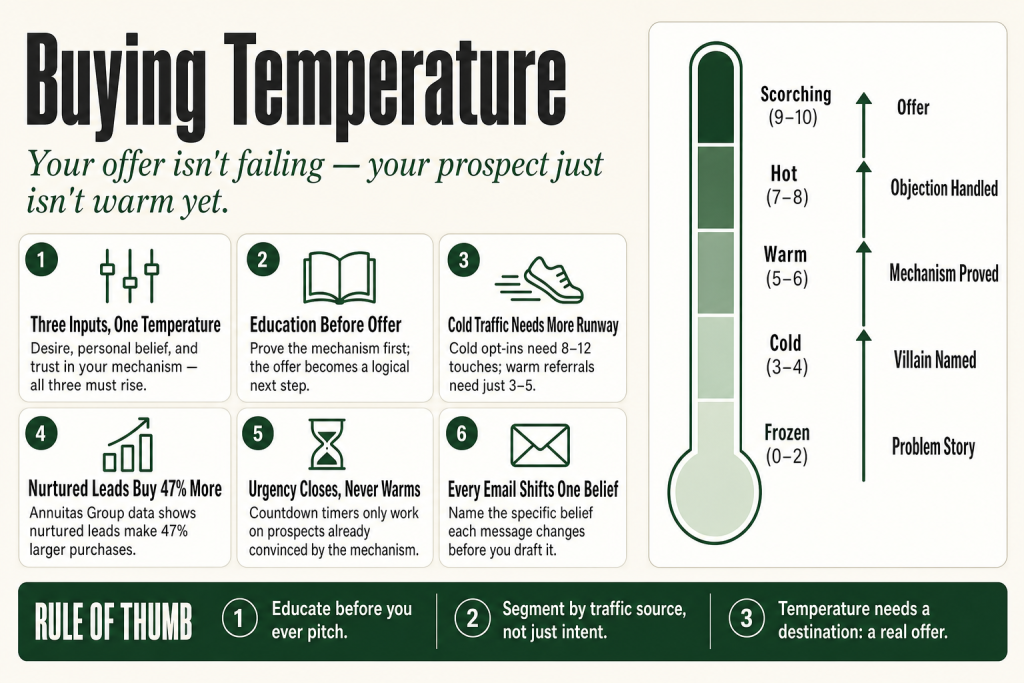
Here’s a rough working scale:
- Frozen (0 to 2): Not aware of the problem, or doesn’t believe a solution exists. Any offer is invisible to them.
- Cold (3 to 4): Problem-aware but not solution-aware. Knows something’s wrong; doesn’t know what to do about it.
- Warm (5 to 6): Solution-aware. Has evaluated options, possibly tried some. Has specific skepticism or objections blocking action.
- Hot (7 to 8): Product-aware. Knows you exist, is interested, is weighing whether to move now.
- Scorching (9 to 10): Ready. Waiting for the right offer framing, a reason to act, or simple reassurance.
Most small-business marketing pitches cold-to-warm prospects as though they’re scorching. That mismatch is the gap this concept closes.
The Core Mechanic: Education Before Offer
If buying temperature is what you’re measuring, the campaign is what raises it. And campaigns that raise it reliably share one structural feature: the majority of their content is spent educating before any of it is spent selling.
The education portion, what Todd Brown calls the ‘marketing argument’, exists to prove one specific thing: that a particular way of solving the problem (your mechanism) is not just different from what the prospect has tried before, but genuinely superior for achieving the result they want. Once the prospect accepts that argument, the offer isn’t a pitch. It’s a logical next step.
That distinction, warming versus pitching, matters more than most operators realize. Pitching says: here is the product, here are its features, here is the price. Warming says: here is why your past attempts failed (and it’s not your fault), here is why a different approach works, here is evidence it works, and only then, here is where to go.
The sequence matters enormously. The same offer, delivered cold versus after a warming sequence, converts at dramatically different rates. The offer didn’t change. The prospect did. Their belief stack shifted. Their objections were pre-answered.
For an operator running automated email sequences or a multi-touch campaign, this becomes one practical question you should be able to answer for every message in your stack: what temperature am I leaving this prospect at when they finish reading this? If you can’t answer that, the message isn’t doing temperature work.
Buying Temperature and the Schwartz Awareness Ladder
Buying temperature and Eugene Schwartz’s five stages of market awareness are closely related but not identical, and keeping them distinct makes you a sharper operator.
Schwartz’s stages are about what the prospect knows: whether they know the problem exists, whether they know solutions exist, whether they know your product exists. It’s a diagnostic for what information needs to be delivered, and in what order.
Buying temperature adds the emotional and motivational layer on top. A prospect can score high on Schwartz’s scale, fully product-aware, knows who you are, and still be cold if their desire has stalled, a competitor burned them, or they’ve simply lost faith that anything will work for them. Conversely, a problem-aware prospect can run surprisingly hot if the pain is acute enough today.
Use both. Schwartz tells you what to say; temperature tells you how much distance you have to travel before an offer can appear. A prospect who is both problem-unaware and emotionally cold needs the longest runway. A prospect who is product-aware and feeling the pain needs the clearest, shortest path to a frictionless offer.
Putting this to work? The ideas in the Canon are the foundation under the tactical playbook in Build a Complete Marketing Departmentgrab the free companion kit at mmsvegas.com/resources.
How an Operator Actually Raises Buying Temperature
Here’s where most explanations of this concept go soft. They describe it beautifully and then say something like ‘create valuable content that builds trust.’ Technically true. Practically useless. More specific:
Start with the problem story, not the product story
The first message in any warming sequence should acknowledge the prospect’s current situation and frustration in language they’d actually use themselves, not your language. This signals that you understand them, which is the first prerequisite for trust. A well-written problem-aware piece will outperform a product pitch even when the audience already knows the product exists. Being understood is warmer than being sold at.
Name the villain, not the victim
The next temperature-raising move is to explain why previous attempts failed, and attribute the failure not to the prospect, but to a flawed approach. If you run a physiotherapy practice, the villain isn’t the patient’s lack of discipline; it’s the generic protocol that doesn’t account for their specific movement pattern. If you’re a financial planner, the villain isn’t the prospect’s poor savings habits; it’s an advice structure that doesn’t align incentives correctly. Naming the real culprit relieves guilt, activates attention, and begins repositioning your approach as different.
Prove the mechanism, don’t assert it
This is where most operators lose the temperature they’ve built. They claim their approach is better without showing why. Temperature rises through evidence: client stories with specific outcomes, demonstrations of the mechanism working, data that makes the argument concrete. A forty-five-second video of a measurable before-and-after result does more warming work than five emails of explanation. Case studies with real numbers outperform testimonials with vague praise. Specificity is warmer than generality, always.
Handle the core objection before the offer exists
Every market has one or two objections that block the majority of would-be buyers. For many service businesses it’s ‘I’ve tried something like this before and it didn’t work.’ For B2B offers it’s often ‘I don’t have time to implement this properly.’ Address it directly, not in the sales copy, but in the warming content, before the offer page appears. By the time you pitch, the blocking belief should already be gone.
Then, and only then, present the offer
An offer that lands at the right temperature behaves differently. The price reads as more reasonable. The features feel more relevant. The guarantee feels less necessary. The prospect is already comparing you to alternatives they’ve tried and found wanting, alternatives you’ve helped them evaluate through the education sequence. At this point, your job in the offer presentation is much smaller: make it clear, easy, and low-friction. The heavy lifting is already done.
The Sequencing Question Every Operator Needs to Answer
Warming a prospect takes time and touches. How many depends almost entirely on how cold they were when they entered your world. A prospect who opted in after a thirty-minute webinar where you explained the problem, introduced the mechanism, showed proof, and handled objections is already close to scorching before the pitch slide appears. That’s one long touch doing enormous temperature work. A prospect who clicked a cold social ad and landed on your homepage is probably at a three or four and needs a longer runway.
A few working heuristics:
- Warm opt-in sources (referrals, existing subscribers, people who arrived through specific search intent) can handle a shorter warming sequence, three to five emails before an offer is often enough.
- Cold traffic (paid social, cold outreach, display) needs a longer sequence, sometimes eight to twelve touches, before an offer converts reliably. The average cold email reply rate sits around 3.43% across billions of sends (Instantly Benchmark Report, 2026); top-performing sequences targeting audiences with prior relationship or clear intent context see reply rates of 10 to 15%. That gap is almost entirely a temperature gap, not a copy gap.
- Re-engagement lists (people who’ve heard from you before and gone dormant) need a different kind of warm-up: remind them of the result, acknowledge the gap, reintroduce the mechanism with fresh proof. Don’t pick up where you left off. Start closer to the beginning.
The mistake most operators make is running one sequence for every entrant. The same five-email welcome flow goes to the referral who’s already half-sold and to the cold opt-in who barely remembers signing up. Segmenting by traffic source, and tailoring the warming sequence accordingly, is one of the highest-leverage structural moves in a small-business marketing system.
AI tools can cut the drafting time for these sequences by a significant margin, what used to take two days of copy work can often be compressed into a focused afternoon of directing and editing. But the judgment about which beliefs need to shift, in what order, for your specific buyer, that stays with you. The tool drafts; the operator decides what actually needs to change in someone’s head before they can say yes.
Where Buying Temperature Applies Today
The concept is format-agnostic. The medium keeps changing. The physics don’t.
Email sequences: The most natural home for temperature management. A well-structured nurture campaign, built deliberately around raising temperature rather than just ‘providing value’, delivers education, mechanism proof, objection handling, and social proof in a sequence that mirrors the internal journey a buyer needs to take. The first message earns the next. Each message leaves the reader warmer than it found them. The Annuitas Group’s research, widely cited in demand-generation literature and compiled by HubSpot, shows nurtured leads make 47% larger purchases than non-nurtured ones, a gap that traces directly to the temperature differential at the point of offer.
Video sales letters and webinars: The long-form VSL exists precisely because some products need the full warming sequence delivered in one sitting. A well-built VSL runs through problem identification, villain mechanism, proof, objection handling, and offer, in that order. Operators who skip the early temperature-raising content and jump to features wonder why their conversion rate is sitting at 0.8% instead of 3%.
Podcast and content marketing: Every episode, every article, every useful explanation is a micro-warming event. The operator who consistently names problems clearly, identifies the villain mechanisms in their market, and shows specific results is raising the temperature of their entire audience without a single pitch. When they finally make an offer, it lands on a crowd that’s been warming for weeks.
Sales conversations: Even one-to-one calls have a temperature dynamic. Discovery questions that surface the full cost of the problem raise temperature. Walking a prospect through why their previous approach didn’t work, without condescension, raises it further. Jumping straight to pricing drops it. Same conversation, different structure, entirely different outcome.
Retargeting campaigns: Retargeting is, at its best, a temperature management tool. A prospect who visited your site and left is probably at a four or five. Retargeting exists to move them toward a seven or eight before they see the offer again. Data from AdRoll, WordStream, and Meta consistently shows retargeted audiences convert at 2 to 5x the rate of cold traffic, but only when the retargeting content is doing temperature work. Operators who retarget with the same offer the prospect already ignored aren’t doing retargeting. They’re repeating the pitch louder. According to SQ Magazine’s 2026 retargeting performance analysis, segmented retargeting campaigns, where audiences are split by behavior and served educational or proof content before a direct offer, increase conversions by 147% compared to broad, undifferentiated campaigns.
Where It Doesn’t Apply, or Gets Misused
Buying temperature is not a universal permission slip to delay everything. There are situations where warming is overkill, and situations where the model gets misapplied in ways that actively hurt conversion.
High-intent, ready-to-buy traffic: If someone searches ’emergency plumber Las Vegas’ at 11pm, their temperature is already scorching. They don’t need a three-part educational sequence about why pipe corrosion is the real villain. They need a phone number, a price range, and a promise you’ll show up tonight. Slowing a hot prospect down with warming content is just friction.
Commodity purchases with established category awareness: If the category is well-understood and the prospect is already comparing options, they’re warm. What they need isn’t more education about why the problem matters, they know. They need clear differentiation, specific proof you’re better than the alternatives, and a frictionless path to purchase.
The warming-as-stalling trap: Some operators use the temperature model as justification for never making an offer. They produce educational content indefinitely, nurture endlessly, and wonder why the list doesn’t convert. Temperature has to go somewhere. A warming sequence without a destination isn’t a campaign, it’s a newsletter. Set the offer as the endpoint, build the sequence toward it, and actually make the pitch.
Injecting urgency where belief hasn’t landed yet: Operators mistake excitement for temperature. They layer countdown timers, scarcity language, and emotional amplification over a prospect who hasn’t been shown why the mechanism works, who hasn’t had the core objection addressed. That produces a spike of interest that collapses the moment the analytical brain kicks back in. Real temperature is built on belief that holds up after the emotional moment has passed. Urgency is a closer, not a warmer. Use it on a prospect who’s already convinced and it’s a legitimate nudge across a finish line they were approaching anyway. Use it on a cold prospect and you get refunds and resentment.
Common Mistakes
- Pitching cold traffic as though it arrived warm, and then blaming the offer when it failsA team running paid Facebook ads to a webinar opt-in, then pitching on email two of a five-part welcome sequence, is a common version of this error. The leads aren’t warm, they clicked an ad they found interesting, filled in a form, and woke up the next morning with no strong reason to buy. Before dropping your price or rewriting your sales page, add one belief-shifting email between the opt-in confirmation and the first pitch: a specific client story with a named result, or a mechanism explanation that directly addresses why previous attempts in this category fail. In most tests operators run, that single addition moves conversion rate before the offer itself changes at all.
- Running one welcome sequence for every traffic sourceA referral who opted in after a personal recommendation from someone they trust is not the same prospect as someone who clicked a cold Instagram ad at 7am while scrolling between reels. Sending both the same five-email sequence is a guaranteed misfire for at least one of them, usually both. Tag by source at opt-in (referral, paid cold, organic search, event) and route each into a sequence whose length matches the entry temperature. The referral might need two emails before the offer lands cleanly. The cold opt-in might need ten. The practical tell that you’ve conflated them: your referral close rate and your cold-traffic close rate are within ten points of each other. They shouldn’t be.
- Calling every message a warming email without knowing which belief it movesA B2B SaaS company reported a 22% quarter-over-quarter increase in marketing-qualified leads from their nurture sequence, but flat pipeline contribution. The sequence was running; it was sending content. It just wasn’t shifting beliefs. Every message has to have one named belief outcome, written out before drafting begins, not inferred after. Not ‘this email builds trust.’ Something like: ‘After this email, the reader should believe their previous CRM failed not because of adoption problems, but because it was built for enterprises, not for their team size.’ If you can swap your email into a competitor’s nurture sequence and it would fit without anyone noticing, it isn’t warming anyone toward you specifically.
- Using retargeting to repeat the same offer ad the prospect already ignoredA prospect who saw your offer ad, didn’t click, and is now seeing it again in their feed isn’t waiting for the same message delivered louder. Their objection didn’t go away between impressions. Rotate at least two pieces of mechanism-proof content, a client result video, an objection-response carousel, into the retargeting sequence before the direct offer ad reappears. The difference in results is not marginal: according to SQ Magazine’s 2026 retargeting performance analysis, segmented retargeting sequences that serve educational or proof content before a direct offer increase conversions by 147% compared to broad campaigns repeating the same offer to the same audience. The sequence structure is the variable, not the audience size or the ad budget.
- Building a warming sequence with no offer at the end, and calling it nurture strategyThis is especially common in B2B, where ‘we’re nurturing’ becomes cover for never making the ask. Map every nurture sequence to a hard offer endpoint before you write the first email, a specific call-to-action, a specific date, a specific product. Build backwards from that endpoint. Without it, the sequence is a newsletter with an automation tag on it. Marketing Sherpa’s data, cited across multiple demand-generation audits, shows 79% of marketing leads never convert to sales, not because the leads are bad, but because there’s no structured path from warm to converted. Temperature has to go somewhere.
Operator’s Take
Before you touch your headline, your offer price, or your ad creative, find out what temperature your leads actually arrive at. Not the temperature you’re hoping for. The actual one.
Here’s a fast diagnostic: pull your last thirty opt-ins. How did they find you? Paid cold social? Referral? Organic search with a specific keyword? Sort them by source. You’ll almost certainly find that referrals close at two or three times the rate of cold social opt-ins, and the difference isn’t your offer, it’s the temperature at entry. Referrals walk in at a six or seven. Cold-traffic opt-ins walk in at a three or four. If you’re running one welcome sequence for both groups, you’re either boring the referrals or losing the cold leads before you’ve had a chance to warm them.
Fix that first. Tag by source at opt-in. Route referrals into a two-to-three email sequence that moves quickly to the offer. Route cold-traffic opt-ins into an eight-to-twelve touch sequence that earns belief before it asks for anything. Do this before you rewrite a single line of copy. That structural change alone, without touching the offer, tends to shift conversion rates more than any headline test I’ve seen operators run.
Second thing, and this one’s harder: before you write any email in a warming sequence, write one sentence, outside the draft, in a notes field, that names the specific belief this message is supposed to change. Not ‘educate them about our process.’ Something precise, like: ‘After this email, they should believe the reason their last attempt at X failed was the intake protocol, not their discipline.’ If you can’t write that sentence, you don’t know what the email is for yet. Write the sentence first. Draft the email after.
Third: build your offer endpoint before you write your first warming email, then work backwards. What does the prospect need to believe to say yes on the offer page? What belief immediately precedes that one? Keep walking it back until you hit wherever they’re likely to start. That chain is your sequence. Most operators write nurture content forward, whatever feels vaguely useful, and then wonder why the list warms without ever converting. There’s no destination. Temperature has to go somewhere, and ‘somewhere’ needs to be a specific offer on a specific date.
On countdown timers and ‘only three spots left’ copy: these work, but only on prospects who already believe the mechanism. Run urgency on a cold prospect and you get buyers who feel tricked by morning. Run it on a hot prospect who’s been through your full warming sequence and it’s a clean push across a finish line they were already approaching. The copy is identical. The temperature behind it is everything.
On AI in the drafting process: use it. Seriously. Building out an eight-email warming sequence from scratch used to take two to three days of copy work. With a tight brief, you can compress that to a focused afternoon of directing and editing. What AI can’t do is identify which specific beliefs block your actual buyer, determine the order those beliefs need to move in, or tell you whether the villain you’ve named is the one your market actually blames for their failures. That diagnostic work is yours. Hand the tool a specific brief and you’ll get useful copy. Hand it ‘write a nurture sequence for my coaching business’ and you’ll get polished words that warm no one toward anything in particular.
Used in
- ✓ Build a Complete Marketing Department
Used to design the campaign architecture for each customer segment, mapping which messages do temperature work (education, proof, objection handling) and which messages are offer moments, so the full department operates as a warming-then-converting system rather than a constant pitch. - ✓ The Missing Manual for FunnelKit
Applied in the construction of email automation sequences within FunnelKit, specifically in sequencing the pre-offer emails that shift beliefs before any sales page or cart link appears. - ✓ The Missing Manual for Make
Used to design the logic that routes leads into the appropriate warming sequence based on traffic source and entry-point behavior, ensuring cold traffic gets more runway and warm referrals get a faster path to offer.
FAQ
How many emails or touches does it take to warm a prospect?
It depends entirely on how cold they were when they entered. A warm referral may need one or two touches before an offer lands. A cold-traffic opt-in may need eight to twelve. The rule is: the sequence should be exactly as long as it takes to shift the core blocking beliefs, no longer, no shorter. The average cold email reply rate sits at 3.43% across billions of sends (Instantly Benchmark Report, 2026), while top-performing sequences targeting audiences with prior context or relationship see reply rates of 10 to 15%. The gap is almost entirely explained by the temperature differential at the moment of the ask, not the subject line.
Is buying temperature the same as a lead nurture sequence?
Related, but not identical. Lead nurture is a format; buying temperature is the goal of that format. A nurture sequence that just ‘provides value’ without shifting specific beliefs isn’t doing temperature work. The sequence is the vehicle. Temperature is what you’re trying to move. Measure it by asking, after each message, whether the prospect is closer to believing the core argument, not whether you sent something useful.
Can you raise buying temperature for a product people haven’t heard of?
Yes, and it actually requires more temperature work upfront, because you’re starting from problem-unaware. The sequence needs to surface the problem first, then introduce the mechanism, then prove it, before the product can appear. This is a longer runway but entirely workable with the right educational content. The cold awareness stage simply means the education phase does more of the lifting.
Does this apply to B2B sales cycles, not just consumer marketing?
Arguably more so. B2B buying cycles are longer, involve more skepticism, and require more internal objections cleared across more stakeholders. The committee that signs off on a vendor decision needs beliefs shifted across multiple people. A warming sequence that reaches the buying group, through content, case studies, and proof, is doing temperature work at scale. Forrester’s 2024 Buyers’ Journey Survey found that 92% of B2B buyers start their journey with at least one vendor already in mind, and 41% have a single preferred vendor selected before formal evaluation begins. That preference was built during the warming phase, whether you shaped it or not.
What’s the fastest way to diagnose whether my current marketing is warming prospects?
Look at your first message, ad, email, landing page, or pitch deck, and ask: does this assume the prospect already believes they need the result I deliver? If yes, you’ve skipped the warming. The fastest fix is to add one piece of mechanism education or a specific client story before the offer appears. Don’t change the offer yet. Change what comes before it.
Is raising buying temperature the same as building rapport?
Rapport is one input into temperature, it operates at the trust dimension. But you can have warm rapport with a prospect who still doesn’t believe the result is achievable for them, which keeps the overall temperature low. Full temperature requires desire for the outcome, belief it’s personally possible, and trust in your specific approach. Rapport handles the last piece. The other two need mechanism proof and evidence.
Further reading
- Breakthrough Advertising by Eugene Schwartz, The foundational text on consumer awareness states and why desire can only be channeled, not created; the intellectual root of the entire temperature concept.
- The Boron Letters by Gary Halbert, Halbert’s letters to his son are the most human articulation of how to meet a reader where they are before asking anything of them; essential reading for anyone who writes marketing copy.
- E5 Customer Acquisition Marketing Protocol by Todd Brown, Brown’s systematic campaign framework, which operationalizes the warming sequence into a step-by-step protocol for cold-to-buyer conversion; the most practically detailed treatment of this idea in a modern funnel context.
Sources: Concept lineage and framework details drawn from Todd Brown’s published E5 Customer Acquisition Marketing Protocol materials and podcast appearances; Eugene Schwartz’s Breakthrough Advertising (1966) for the awareness-state foundation; Gary Halbert’s documented direct-response practice and The Boron Letters for the Halbert lineage. Nurture purchase-size data: The Annuitas Group’s research finding that nurtured leads make 47% larger purchases than non-nurtured leads, as compiled and cited by HubSpot’s marketing automation statistics database and corroborated across multiple demand-generation benchmark sources including Data Axle USA (2025) and LaunchLeads (2026). B2B buyer journey data: Forrester Research 2024 Buyers’ Journey Survey, as reported by Digital Commerce 360 (July 2025) and The B2B Marketer (July 2025). Cold email reply rate data: Instantly Benchmark Report (2026), as compiled by Martal (2026) and Reachoutly (2026); Saleshandy analysis (2026). Retargeting conversion data: AdRoll, WordStream, and Meta as reported by NewswireJet (2025) and OwlClaw Technologies (2026); segmented retargeting lift data from SQ Magazine’s 2026 Retargeting Ad Performance Statistics report (fact-checked by Barry Elad; published May 2026), corroborated by SalesHive (2025) and Remarketing.agency (2026). Lead-nurture pipeline failure rate: Marketing Sherpa, as cited across multiple demand-generation benchmark compilations.
Brian Kasday spent forty years in direct-response marketing before rebuilding the whole operation as a one-person shop. He writes The Operator’s Library, including “Build a Complete Marketing Department”, for operators who’d rather build it themselves than wait on someone else.
Build the department these ideas describethe free companion kit: mmsvegas.com/resources.
More The Operator's Canon guides
Free · Operator Toolkit
Want the tools, not just the guide?
Get the free operator toolkit — templates and checklists for the systems you actually run, plus a note when this guide changes.
Get the free toolkit →