
Last updated: July 2026
Voice of customer is the practice of systematically extracting your buyers’ actual language, the words they use to describe their problem, the phrases that made them pull out their credit card, the objections they almost let stop them, and using that language to write your marketing instead of your own. By the end of this page, you’ll be able to run a VoC mining session on your own business, identify the two or three phrases your best customers repeat most, and rewrite your homepage headline in the time it takes to drink a cup of coffee.
Here’s the problem it solves: founders are the worst writers of their own marketing. Not because they can’t write, but because they know too much. They describe their product using internal language, the features, the process, the methodology, while their customers are searching for relief from a specific, named pain. There’s a gap between what you say about your business and what made someone actually buy it. VoC research closes that gap.
This is different from customer discovery, which is what you do before you’ve built anything, pre-product interviews to validate an idea. VoC works on your existing customers. You’re not asking “would you buy this?” You’re mining what they already said after they bought. The evidence is sitting in your Google reviews, your Yelp page, your sales call recordings, and your support inbox right now. Most operators walk past it every day.
The idea in 30 seconds
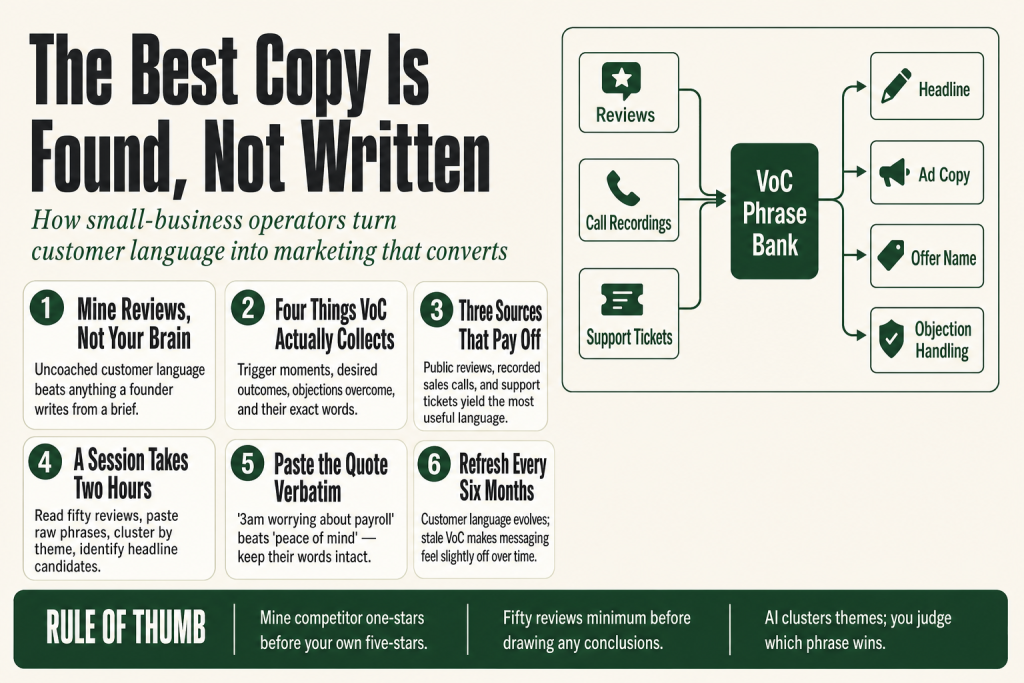
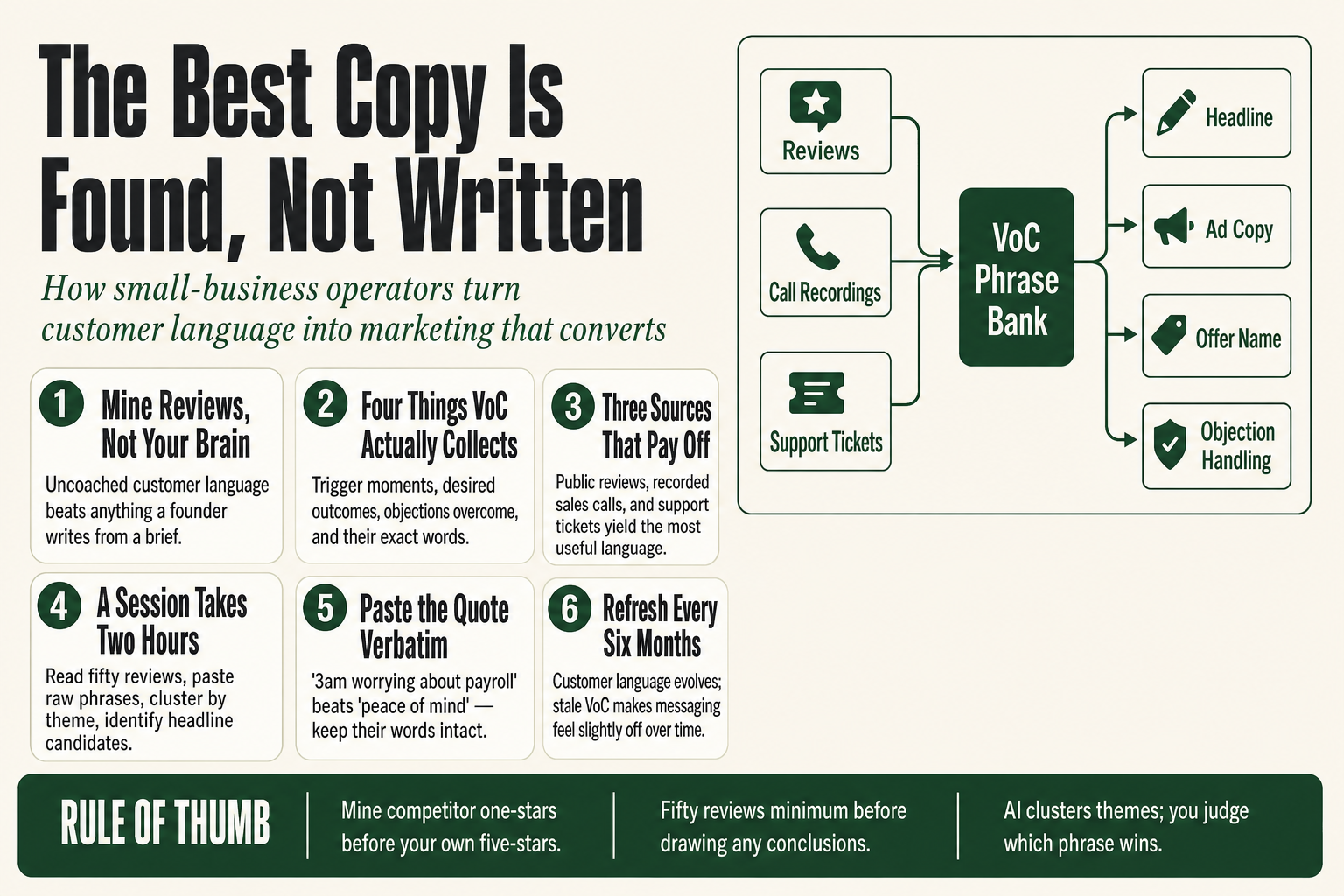
- Voice of customer (VoC) is the practice of systematically collecting and using your customers’ own language, from reviews, calls, and support tickets, to write messaging, offers, and positioning.
- The goal is not more data. It’s finding the specific phrases, fears, and desired outcomes your buyers already use, then mirroring them back in your copy.
- The three richest sources for a small-business operator: public reviews (yours and competitors’), recorded sales and onboarding calls, and support/chat transcripts.
- VoC is not customer discovery, you’re mining existing buyers, not interviewing prospects to validate a product idea.
- AI tools can now transcribe calls and cluster themes at scale, but reading the raw quotes yourself is still where the real insight lives.
- Done right, VoC becomes the foundation for your USP, your StoryBrand script, your offer framing, and your ad headlines, every downstream messaging decision improves when this one is grounded in evidence.
Where the Term Came From, and Why It Barely Matters for Operators
The formal term traces back to a 1993 Marketing Science paper by Abbie Griffin and John Hauser. It wasn’t about copywriting or marketing messaging, it was a product-development study examining how firms could capture and prioritize customer needs within Quality Function Deployment (QFD), a total-quality-management process that linked customer needs to engineering and manufacturing requirements. Heavy, structured, built for large organizations with cross-functional product teams.
What Griffin and Hauser contributed was a rigorous academic framework for the underlying idea: that customer language should drive business decisions, not internal assumptions. That core logic has endured. The machinery they described, hierarchical needs maps, affinity charts, structured interview protocols, has not traveled with it. What operators actually do with VoC today looks nothing like the QFD context it came from, and that’s fine. The term stuck; the methodology went in a completely different direction.
How VoC Became a Marketing Tool
The shift that matters for operators happened much later and in a completely different discipline. Conversion copywriters started applying the underlying logic, use the customer’s words, not yours, directly to web copy. No QFD required. Just someone smart enough to realize that uncoached, emotionally raw customer language was better source material than anything a founder or agency could write from a brief.
The most widely cited practitioner example is Joanna Wiebe, founder of CopyHackers, who developed what she calls review mining, pulling language from public reviews to find headline-ready copy. Working on Beachway, a Florida-based rehabilitation center, Wiebe couldn’t extract useful language directly from clients or prospects, the subject matter made candid interviews nearly impossible. So she mined Amazon book reviews on addiction and recovery instead, surfacing a phrase that became a headline candidate. When tested, it outperformed the control by a significant margin.
The primary source for that case study and the review mining approach is documented directly at copyhackers.com. The specific methodology, her structured tables, her exact process, is hers. Read it there. What matters for this page is the principle she demonstrated: the best copy isn’t written, it’s found. Your customers have already described their problem, their fear, and their desired outcome, in reviews, in call recordings, in support tickets. Your job is to surface those descriptions and mirror them back.
That principle is not proprietary. Using it doesn’t require a CopyHackers subscription. But credit belongs where it’s due, Wiebe made review mining a standard practice in conversion copywriting, and the practitioner community owes her that acknowledgment.
What Voice of Customer Research Actually Collects
There’s a version of VoC that large enterprises run, multi-year NPS tracking programs, sentiment dashboards, annual brand surveys. That’s not what this page is about. For an operator, VoC comes down to four specific categories of information, and you want all four before you rewrite a single word of your marketing.
1. The trigger moment
What was happening in the customer’s life right before they went looking for you? Not the general pain, the specific event. “My accountant retired” is worth ten times more than “I needed accounting services.” Trigger moments show up in review language as time references: “after,” “when,” “finally,” “I’d been struggling for months.” They tell you when your customer entered the market, which tells you where to reach them and what to say first.
2. The desired outcome (not the feature)
Customers do not buy your service. They buy a version of their life after your service. A fitness client isn’t buying personal training sessions, she’s buying the ability to keep up with her kids without her back giving out. A business owner isn’t buying accounting software, he’s buying the feeling of not dreading tax season. VoC research surfaces the actual destination your customer is headed toward, which is almost always more emotionally specific than anything on your pricing page.
3. The objections they almost didn’t overcome
Objections that show up in reviews and call transcripts are gold. They’re the ones your customer had, almost let stop them, and then overcame, which means they can tell you exactly how to neutralize those objections for future buyers. “I was worried it would be too expensive but…” is an objection and a resolution in one sentence. You just got your price-objection copy handed to you for free.
4. The specific language they use
Not synonyms. Not your professional terminology. Their words. If your customers call it “the nightmare of dealing with insurance companies,” don’t write “navigating complex claims processes” on your website. The vocabulary gap between how experts describe a problem and how sufferers describe it is where most small-business marketing dies. Your job is to close that gap.
Putting this to work? The ideas in the Canon are the foundation under the tactical playbook in Build a Complete Marketing Departmentgrab the free companion kit at mmsvegas.com/resources.
The Three Voice of Customer Sources That Actually Pay Off
There are more than a dozen ways to collect VoC data, surveys, usability tests, in-app intercepts, focus groups. Most of them are either too slow, too expensive, or too structured to give you the raw, unfiltered language you’re actually after. For a small-business operator, three sources produce the vast majority of useful material.
Public reviews, yours and your competitors’
Your Google, Yelp, TripAdvisor, G2, or Capterra reviews are a free, always-on VoC stream. So are your competitors’ reviews. This is the single highest-leverage starting point because the language is uncoached, nobody told the reviewer what to say or how to say it. They wrote what they actually felt. Reading fifty reviews of competitors in your category will frequently surface the exact frustrations that drove customers to look for an alternative, which means you’re reading a roadmap of the objections and desires your category creates, and your positioning can directly address them.
The method: read in bulk, copy phrases that stop you, anything emotionally specific, any phrase you wouldn’t have written yourself, any sentence that describes an outcome rather than a feature, into a running document. After fifty reviews, patterns emerge. You’ll see the same two or three frustrations mentioned in different words. Those are your message pillars.
Sales and onboarding call recordings
If you record sales calls or onboarding sessions, you have some of the most valuable VoC data available to any business. The moment a prospect describes their problem in their own words, before your team has introduced any of your framing, is pure signal. Platforms like Gong can transcribe and analyze these conversations at scale, surfacing language patterns, objections, and competitor mentions across hundreds of calls. For a smaller operation without Gong, even manually reviewing ten to fifteen recorded calls and noting the moments that made you stop and listen will surface patterns you can use immediately.
What to listen for: the exact words they use to name their problem, any phrase where they sound relieved or excited, the hesitation before they said yes, and any comparison they made to something you didn’t offer. That last one, the comparison, often reveals how the customer categorizes your product in their head, which may be completely different from how you categorize it.
Support tickets, chat logs, and FAQ threads
Your support queue is an unsolicited VoC stream that most operators completely ignore for marketing purposes. A customer who writes in with a complaint or a question is doing so because something is important enough to take action on, which means it’s probably important to other customers who didn’t write in. Cluster your tickets by theme and you’ll find your FAQ copy, your objection-handling copy, and frequently your product gaps, all in one place. The language in a frustrated support message is often the most vivid language a customer will ever produce about your product.
How to Run a Voice of Customer Mining Session
This is not a research project that takes six weeks. A useful first session takes two to three hours. Here’s the shape of it.
Pick your source first. If you have reviews, start there. If you don’t have enough, under twenty, pull your closest category competitors’ reviews from the same platform. You want at least fifty data points before you start drawing conclusions.
Read without editing. Open a blank document. Read each review and paste any phrase that is emotionally specific, uses non-generic language, describes an outcome or a fear, names a specific moment or trigger, or is simply something you wouldn’t have written yourself. Don’t summarize. Don’t paraphrase. Paste the raw phrase. The discipline here is real, the instinct to rewrite in professional language kills the exercise.
Cluster by theme. After you’ve pulled phrases from all your sources, group them. You’ll typically find three to five themes: a trigger cluster, a desired-outcome cluster, an objection cluster, and a surprise-delight cluster. Phrases that show up across multiple themes are your strongest signals.
Identify headline candidates. Look for phrases that are specific, emotionally resonant, and non-generic. “I finally felt like someone actually listened” is a headline candidate. “Great service” is not. The best VoC phrases make a future customer reading your website think that’s exactly how I feelthe recognition response. That’s the whole game.
Test before you commit. VoC gives you hypotheses, not certainties. The phrases you pull are strong starting points for headlines, subject lines, ad copy, and offer framing, but they should be tested against your existing control.
AI can help at the clustering step. Paste a batch of reviews into a capable LLM and ask it to extract the most emotionally specific phrases, then group them by theme. This is one area where AI genuinely cuts the time cost, but read the raw quotes yourself before you hand anything to a model. The phrases that stop you personally carry information a cluster summary doesn’t. The judgment about which phrase becomes the headline stays with you, not the model.
Where Voice of Customer Language Goes in Your Marketing
The point of VoC research is not a research report. It’s a specific set of words and phrases that flow directly into actual marketing assets. Here’s where the output goes.
Homepage and landing page headlines
Your headline is doing more work than any other sentence on your website. It either creates the recognition response, “yes, that’s my problem”, or it doesn’t. VoC-sourced headlines almost always outperform founder-written ones because they describe the problem the way the customer experiences it, not the way the founder solved it. If your reviews consistently use the phrase “finally someone who explains it in plain English,” that phrase belongs in your headline or subhead, not buried in a testimonial at the bottom of the page.
Offer framing and naming
The name of your offer and how you describe it should use category-native language, the terms your customers already use to describe what they’re hiring you to do. If they call it “getting my books in order,” don’t call your service “financial systems implementation.” VoC research gives you the vocabulary your market uses naturally, which removes friction from the first contact a prospect has with your offer.
Ad copy and email subject lines
Short-form copy, ads, subject lines, SMS, rewards specificity. The vague, generic language that founders default to (“professional,” “trusted,” “quality”) is invisible in a feed. A phrase pulled from a customer review is specific, human, and unexpected in that context, which is what earns attention. The trigger-moment language is especially useful here: if your customers consistently mention a specific frustrating event before they found you, an ad that names that event will stop the right people cold.
Objection handling on sales pages and in proposals
The objection cluster from your VoC research tells you exactly what price, risk, and effort concerns to pre-empt before the customer raises them. A sales page that addresses the three most common objections, using the language customers actually use to express those objections, converts significantly better than one that doesn’t. You’re not guessing at objections; you’re reading the ones your best customers had and overcame.
Testimonial selection and placement
Most operators use testimonials that say nice things about the business. VoC-informed operators use testimonials that directly address the objections, trigger moments, and desired outcomes that their research surfaced. A testimonial that says “I was skeptical about the price but within two months I’d made it back three times over” is doing active objection work. A testimonial that says “great team, highly recommend” is not.
Where Voice of Customer Works, and Where It Has Limits
VoC is one of the highest-ROI research activities available to a small-business operator. It costs almost nothing, it’s fast, and the output flows directly into revenue-affecting copy. But it’s not the right tool for every question.
Where it works well: Any business with existing customers and any publicly available review presence. Service businesses, local businesses, e-commerce, SaaS, professional services, if you have buyers who have expressed an opinion about you or your category anywhere online, you have VoC material. It works especially well when you’re rewriting stale copy that was written before you really knew your customer, when you’re launching a new offer to an existing customer base, or when your ads are generating clicks but not conversions (a messaging problem, not a targeting problem).
Where it has limits: VoC tells you what customers say, it doesn’t always tell you why they do what they do. A customer review describes the experience; it rarely explains the underlying mechanism. For deeper causal understanding of buying behavior, VoC pairs well with Jobs to Be Done research, which asks “what were you trying to accomplish when you hired this?” rather than “what did you think of it?” The two approaches are complementary. VoC gives you language; JTBD gives you structure.
VoC also has a recency bias problem. The customers who leave reviews skew toward the extremes, very happy or very unhappy, and may not represent your median customer. The best approach is to triangulate: reviews give you the raw language, call recordings give you the full-spectrum middle, and support tickets give you the problems that didn’t make it into public reviews. When all three sources point at the same theme, you’re on solid ground.
Finally: VoC is a snapshot. Customer language evolves, market context shifts, and the phrases that resonated two years ago may feel dated now. Build a habit of refreshing your VoC file every six to twelve months, especially after any significant market change, new competitor entry, or offer revision.
Common Mistakes
- Reading reviews for sentiment scores instead of languageIgnore the stars entirely. Open a doc and read every review for phrases you wouldn’t have written yourself, anything with a feeling word, a named moment, or a specific outcome. Copy them verbatim. Your next headline comes from that doc, not from the aggregate score.
- Paraphrasing the quotes you findPaste the raw sentence into your doc, word for word. Then paste it directly into a headline test. ‘Peace of mind’ is your vocabulary. ‘3am worrying about payroll’ is theirs. The entire exercise depends on keeping their words intact, because that’s the phrase that stops the next reader cold.
- Surveying first and mining secondSurveys confirm patterns you’ve already spotted in unstructured sources. Use them after you’ve identified themes from reviews and call recordings, not as the starting point. The structure of a survey shapes the language, which defeats the whole purpose. Unsolicited language leads; surveys follow.
- Skipping competitor reviewsPull at least thirty reviews from your top two competitors before you write a word of positioning copy. The complaints in those reviews are a direct description of the problem your business was built to solve. That’s free differentiation research, and it’s often sharper than your own five-stars, which tend toward generic praise.
- Treating VoC as a one-time projectSchedule a ninety-minute VoC refresh every six months. Treat any of the following as an automatic trigger: a meaningful offer change, a new competitor entering your space, or a quiet decline in conversion rate with no obvious cause. Put the recurring block in your calendar now, before you close this tab.
- Mining the wrong customer pool when repositioningFind where your target tier leaves reviews, G2, Capterra, industry forums, and mine there instead. Run two or three exploratory conversations with buyers who already operate at that price point. Your current customer language reflects who you’ve served, not who you’re trying to serve next. Using it to write copy aimed at a different segment is how you end up with messaging that feels almost right and converts almost never.
Operator’s Take
Here’s something that doesn’t come up enough: VoC research will occasionally tell you something you don’t want to hear. Not just “here’s a better headline”, but “your customers are buying this for a reason you’ve never mentioned anywhere.” That’s uncomfortable. It means your homepage is built around a secondary selling point while the primary one is sitting in your reviews, unacknowledged.
I’ve watched operators run a first VoC session and come back with phrases that contradict their entire brand narrative. A bookkeeping firm marketed on “accuracy and compliance” only to find that every five-star review mentioned something like “I actually understand my numbers now for the first time.” Clarity, not compliance. Those are different positionings. They point at different headlines, different offers, different clients. The VoC didn’t just give them better copy, it told them they’d been selling to a secondary fear while the primary one went unaddressed.
That’s where VoC earns its keep. Not in marginal headline improvements. In the occasional moment where the customer language and your brand narrative are pointed at different things entirely, and you have to decide which one to trust.
So. A few specific things I’d do differently than what most operators actually do.
Mine your one-star and two-star competitor reviews first, not your own five-stars. Your happy customers will tell you what you did well; your competitors’ unhappy customers will tell you what the whole category fails at. That’s your positioning gap. One afternoon on your top competitor’s G2 or Yelp page, reading the complaints, is worth more than a week of reading your own glowing reviews. The frustration language in a two-star review is the most vivid your market will ever produce.
For service businesses with sales calls: pull the transcript from the first two minutes before you’ve said much of anything. That’s the window where the prospect is still speaking their own language, before your framing has replaced theirs. The sentence they use to name their problem in those first two minutes is very often the most precise articulation they’ll ever produce. It almost never shows up in the post-sale review. You have to catch it live, or in the recording, before you forget it.
One thing AI actually changes here: you can now drop fifty call transcripts into a capable model and ask it to surface the ten most common ways prospects named their problem in the first two minutes. That’s a task that used to take a half-day. Now it takes twenty minutes. Use that time savings to go back and read the raw quotes the model flagged, not to trust the summary, but to sense-check it. The model finds the frequency. You find the nuance. That division of labor is the right one.
Last thing: the mistake I see most often isn’t bad VoC execution. It’s treating the output as final instead of as a starting hypothesis. A phrase that resonates with your current customers may actively repel the segment you’re trying to reach next. If you’re moving upmarket, your existing VoC pool is probably the wrong pool. Pull competitor reviews at the tier you’re targeting. Run two or three exploratory calls with people who already buy at that price point. The language shifts, sometimes significantly, and your messaging has to shift with it before you make the move, not after you’ve noticed the conversion rate drop.
Used in
- ✓ Build a Complete Marketing Department
Used as the research foundation for all messaging decisions, the customer language mined through VoC governs the central claim, offer framing, and headline hierarchy across every channel. - ✓ The Missing Manual for FunnelKit
Used to write the headline, subhead, and objection-handling copy on each funnel step, VoC phrases are directly placed into page templates so every screen speaks in the buyer’s own language. - ✓ The Missing Manual for Make
Used to design automated review-collection and transcript-processing workflows that continuously feed VoC data into a research document without manual effort.
FAQ
How is voice of customer different from customer discovery?
Customer discovery is pre-product research, you’re interviewing prospects to find out whether a problem worth solving exists. Voice of customer works with existing buyers after the sale, mining their language for messaging. The questions, sources, and outputs are different.
How many reviews do I need to run a useful VoC session?
Fifty is a good starting target. Below twenty, patterns are hard to spot. Above two hundred, you hit diminishing returns quickly. If you don’t have fifty of your own reviews, use competitor reviews from your category, the language your market uses to describe frustration and relief doesn’t change much between businesses in the same niche.
Can I use AI to do my VoC research for me?
AI tools can dramatically speed up transcription and clustering, paste in a batch of reviews and a capable model will surface themes and pull specific phrases efficiently. But read the raw quotes yourself before you act on any cluster summary. The phrases that stop you personally, that feel surprising or vivid, carry information a summary can’t convey. AI reduces the time cost; the judgment stays with you.
What if my business is new and I don’t have many customers or reviews?
Mine your closest competitors’ reviews on Google, Yelp, G2, or whichever platform your category uses. The frustrations and desired outcomes your market expresses about competitors are directly relevant to your positioning, you’re reading the problems your market is hiring someone to solve.
How often should I update my VoC research?
At minimum every six to twelve months, and any time your offer changes significantly, a major competitor enters your market, or you notice your ads or conversion rates declining without an obvious cause. Customer language evolves, and messaging built on stale VoC starts to feel slightly off even when nothing else has changed.
Where exactly do I put the language I collect from VoC research?
The highest-impact placements are: your homepage headline and subhead, your offer name and description, your ad copy and email subject lines, and your objection-handling sections on sales pages. Testimonial selection is also VoC-informed, choose quotes that directly address the objections and desired outcomes your research surfaced.
Further reading
- Joanna Wiebe, CopyHackers, “How to Find Your Message Using Review Mining”The primary source for the Beachway rehab center case study and the review mining approach. Read it directly; any secondhand account loses detail that matters.
- Buyer Personas by Adele RevellaFocuses on structured buyer interviews rather than passive mining, but the five rings of buying insight she describes provide a useful framework for organizing what you find in VoC research.
- Griffin, A. & Hauser, J. R., “The Voice of the Customer,” Marketing Science12(1), 1993The academic origin of the term, written for a product-development and QFD audience. Worth a skim to understand where the language came from, keeping in mind the marketing application has traveled very far from those roots.
Sources: Griffin, A. & Hauser, J. R. (1993). “The Voice of the Customer.” Marketing Science12(1), pp. 1 to 27., Joanna Wiebe, CopyHackers, copyhackers.com/2014/10/amazon-review-mining/ (review mining methodology and Beachway rehab center case study)., CXL Institute blog (conversion copywriting and VoC application)., HelpScout blog, “10 Techniques for Collecting Voice of the Customer Data.”, Chatmeter, “Voice of the Customer Research Methodologies 2025.”, QuestionPro, “VoC Research: Methods, Uses, How to Design.”, Gong.io (conversation intelligence and call analysis capabilities).
Brian Kasday spent forty years in direct-response marketing before rebuilding the whole operation as a one-person shop. He writes The Operator’s Library, including “Build a Complete Marketing Department”, for operators who’d rather build it themselves than wait on someone else.
Build the department these ideas describethe free companion kit: mmsvegas.com/resources.
More The Operator's Canon guides
Free · Operator Toolkit
Want the tools, not just the guide?
Get the free operator toolkit — templates and checklists for the systems you actually run, plus a note when this guide changes.
Get the free toolkit →