
Last updated: July 2026
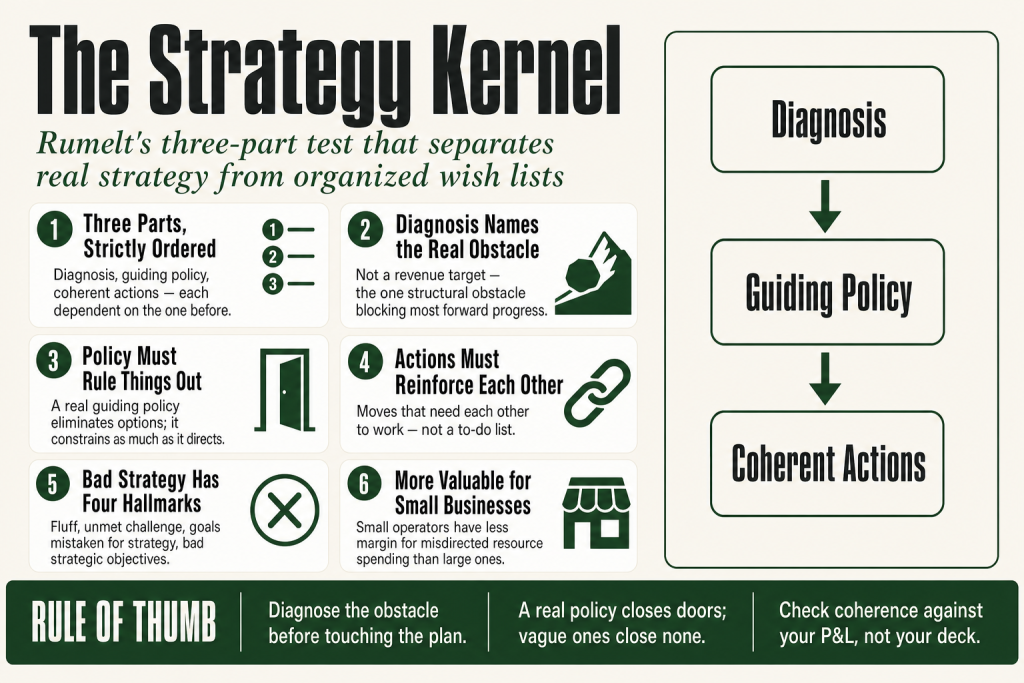
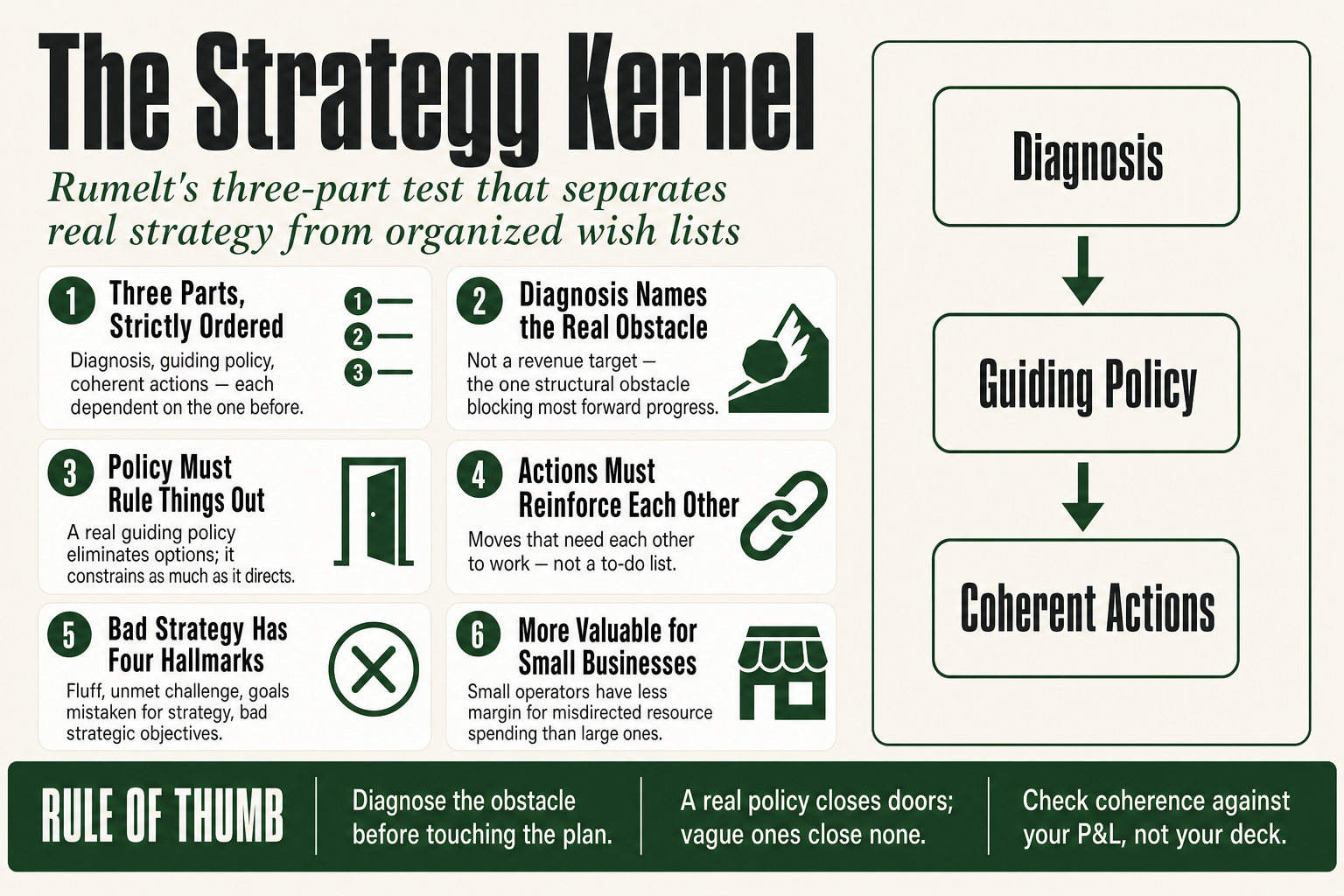
The strategy kernel is Richard Rumelt’s name for the irreducible structure that every real strategy must contain. Take your own business plan, marketing calendar, or annual goals and apply three questions, you’ll know in about ten minutes whether you actually have a strategy or just a very organized wish list.
That distinction matters more than most operators realize. Most small businesses don’t suffer from a lack of ambition. They suffer from mistaking ambition for direction. A strategy is a reasoned response to a specific obstacle. The kernel is the minimum structure that response has to have.
Rumelt published the idea in Good Strategy Bad Strategy in 2011, drawing on decades of consulting and research at UCLA. His corrective was simple: three elements, no more, that force an operator to think before they plan.
The idea in 30 seconds
- Strategy kernel is Richard Rumelt’s name for the three-part structure of every real strategy: diagnosis, guiding policy, and coherent actions.
- Most small-business “strategies” are goals or slogans dressed up in strategic language, the kernel is a three-question test that exposes the difference fast.
- Diagnosis first: name the specific obstacle blocking forward progress. Not a revenue target, a problem.
- Guiding policy: choose an approach that directly addresses the obstacle; it rules out as many options as it rules in.
- Coherent actions: everything you spend, hire, and build must reinforce each other and the guiding policy, or one of them is wasted.
- A kernel with a weak diagnosis is like a prescription written before the patient is examined, it might work, but you got lucky.
Where the Strategy Kernel Came From
Rumelt spent decades watching organizations confuse activity with strategy. His frustration had a specific shape: the growing tendency to treat motivational slogans, financial targets, and buzzword-dense documents as though they constituted strategic thinking. He called this bad strategy, and he was emphatic that bad strategy isn’t just weak strategy. It’s a different thing entirely.
The kernel was his corrective. He chose the word with care. The kernel is the bare-bones center, the hard nut at the core, what remains when you strip everything decorative away. Mission statements, visions, values posters, org charts: those things might have their place, but they’re not strategy.
The Three Elements of the Strategy Kernel
In Rumelt’s framing, the kernel of any strategy comprises three parts: diagnosis, a clear definition of the challenge at hand; guiding policy, your overall approach to dealing with that challenge; and coherent actions, the specific steps that implement the guiding policy. Three elements, strictly ordered, each one dependent on the one before it.
1. Diagnosis: What’s Actually in the Way?
Rumelt argues that a good diagnosis simplifies the often overwhelming complexity of reality by identifying certain aspects of the situation as critical. Not everything, certain aspects. That’s the discipline. A diagnosis isn’t a list of everything that’s hard about running your business. It’s a judgment call about the one thing that, if you got it right, would unlock most of the forward progress you’re looking for.
The most common cause of bad strategy is a weak diagnosis. The second most common is confusing goals with strategy. These two failures are related. When you skip the diagnostic work, you don’t have a real obstacle to respond to, so you fill the gap with targets and slogans instead.
Rumelt uses a medical analogy to make the structure concrete: the doctor makes a clinical diagnosis, naming a disease or pathology; the therapeutic approach chosen is the guiding policy; the specific prescriptions for diet, therapy, and medication are the coherent actions. A doctor who skips the diagnosis and goes straight to treatment is dangerous. An operator who does the same is just expensive.
For a small business, a real diagnosis sounds like: “Our customer acquisition cost has tripled in three years because paid search in our category is now dominated by two well-funded national chains, and our current margins can’t support the bids they can sustain.” That’s a diagnosis. It names the problem, identifies who’s creating it, and contains an implicit indication of where leverage might be found. Compare that to “we need to improve our digital marketing”, you could spend six figures on that and still lose, because the problem you named isn’t specific enough to prescribe against.
2. Guiding Policy: The Approach That Rules Things Out
The guiding policy outlines an overall approach to overcoming the obstacles highlighted in the diagnosis. Rumelt compares it to guardrails on a highway, it directs and constrains action without fully defining it. That last part is what most operators miss. A guiding policy isn’t a vision. It’s a constraint. It rules out as many approaches as it rules in.
“Be the best service provider in the market” is not a guiding policy, it doesn’t eliminate any option. “Compete exclusively on speed of response and same-week availability, not on price” is a guiding policy, because it tells your team what not to do as clearly as what to do. You will not compete on price. You will not be the cheapest. You will not take contracts with a six-week lead time.
Without a guiding policy that actually constrains, every shiny new channel or offer idea gets evaluated in isolation, and you end up doing twelve things adequately instead of three things well.
3. Coherent Actions: Where Everything Has to Fit
Coherent actions, in Rumelt’s structure, are the coordinated steps that carry out the guiding policy. The key word is “coordinated”, these aren’t a to-do list. They’re a set of moves that need each other to work.
“Coherent” doesn’t just mean “consistent.” It means mutually reinforcing. If your guiding policy is to win on response speed, your coherent actions include hiring for coverage, keeping a buffer in your schedule, routing inquiries to a single point of contact, and, here’s where it gets real, probably not offering the most aggressive pricing, because that would attract volume you can’t turn around fast enough. The actions coordinate to create an effect that none of them could produce alone.
When actions aren’t coherent, the strategy falls apart in execution even when it looked fine on paper. You say you’re competing on quality, but your compensation structure rewards volume. You say you’re targeting premium customers, but your entry-level package dilutes the positioning. The incoherence is almost never intentional, it’s the residue of decisions made at different times, by different people, without a guiding policy to hold them together.
What Bad Strategy Actually Looks Like, and Why It’s Everywhere
Rumelt named four hallmarks of bad strategy: fluff, failure to face the challenge, mistaking goals for strategy, and bad strategic objectives. Most operators have sat through meetings that embodied all four at once.
Fluff is the easiest to spot once you know what you’re looking for. The classic test: read your strategy document and ask whether any competitor couldn’t say exactly the same things. If the answer is no, if your competitors could publish your strategy doc verbatim and it would fit their business perfectly, you have fluff, not strategy.
Kmart’s self-description as a “mass merchandising company that offers customers quality products through a portfolio of exclusive brands and labels” is a fair stand-in for that kind of non-strategy. Any retailer could have said it. Walmart built its strategy around lowest price and a proprietary satellite-based logistics system, a specific, defensible approach that competitors couldn’t simply copy. Target positioned around accessible design at affordable rates. One is decorative language. The other two tell you something real about how those companies make decisions.
Mistaking goals for strategy is the failure mode most relevant to small-business operators. When you see “entering new markets” or “becoming the leading [anything]” in a strategy document, you’re looking at desire, not strategy. The actual obstacle goes unexamined, which means the plan built around those phrases has no real logic to it.
Failure to face the challenge is subtler and, in some ways, the most damaging. It happens when an operator knows what the real obstacle is but finds it uncomfortable to name, because naming it implies a trade-off they’d rather avoid. The local service business that knows it’s losing on price but writes a strategy about “value-added services” instead of confronting the pricing structure is failing to face the challenge. The strategy will be real but will address a problem adjacent to the actual one.
Bad strategic objectives show up as a strategy document with 47 initiatives and no clear ranking. When everything is a priority, nothing is. Rumelt observed a Pacific Northwest city that had produced 47 “strategies” and 178 action items, with item 122 being “Create a strategic plan.” Every operator who has been through a multi-day planning offsite has seen something close to it.
The Strategy Kernel in Practice: Real Examples
Two examples illustrate the kernel cleanly, one showing what happens when you get the diagnosis right, one showing what happens when you don’t.
IBM under Lou Gerstner (1993). When Gerstner took over a struggling IBM, the prevailing view, from Wall Street, from inside the company, was that IBM was too integrated and should be broken up into separate pieces. Gerstner studied the situation and changed the diagnosis: in an increasingly fragmented industry, IBM was the one company with expertise across all areas. Its problem was not that it was integrated but that it was failing to use the integrated skills it possessed. The new guiding policy flowed directly from that reread: exploit IBM’s uniqueness through tailored customer solutions. Same facts, different diagnosis, completely different strategy. If IBM had accepted the conventional diagnosis, it would have dismantled the one asset that made it defensible.
Digital Equipment Corporation, a cautionary contrast. Rumelt was present at DEC’s 1992 strategy session. Three senior executives proposed three mutually incompatible directions, one argued for continuing to integrate hardware and software into complete systems, one argued the company’s only real asset was customer relationships and it should pivot to solutions, a third pointed to semiconductors as the future. Rather than forcing a hard conversation, the group settled on statements that everyone could accept without giving anything up: “we need to be more competitive,” “we must improve execution.” Not diagnoses, aspirations that could mean anything. Because the challenge was never defined, resources scattered across conflicting initiatives, and DEC drifted toward its eventual acquisition by Compaq in 1998. Same era as Gerstner’s IBM, same competitive pressures. One company named its obstacle precisely and built around it. The other never did.
A small grocery, outgunned by a big-box competitor. Rumelt uses the example of a small grocery store owner facing a big-box competitor open 24/7 that could undercut her on price. Her options included fresh organic produce, specialty food for the area’s large student population, longer hours, or better service. She divided her customers into categories, price-sensitive students, time-sensitive professionals, and the diagnosis sharpened the choice: target the busy professional who doesn’t have time to cook. That guiding policy then suggested specific coherent actions, including a second checkout line to handle the 5pm rush and repurposed shelf space for high-quality prepared meals. Simple example, but exactly the situation most small-business operators face: outspent across the board, forced to choose a lane. The kernel gave her a structure to choose with clear logic instead of trying to be everything to everyone.
Putting this to work? The ideas in the Canon are the foundation under the tactical playbook in Build a Complete Marketing Departmentgrab the free companion kit at mmsvegas.com/resources.
The Strategy Kernel vs. Other Strategy Frameworks
Two frameworks get compared to the kernel often enough that it’s worth addressing them directly: Lafley and Martin’s Playing to Win cascade, and Blue Ocean Strategy.
Kernel vs. Playing to Win
Rumelt’s kernel and Martin’s Strategy Choice Cascade are complementary structures, not rivals. The cascade specifies the choices a strategy must make; the kernel specifies the argument a strategy must be. A cascade without a diagnosis is a set of confident answers to questions nobody asked.
The practical difference: if you’re not sure whether you even have a real strategy, start with the kernel. If you have a clear diagnosis and guiding policy but need to make specific “where to play / how to win” choices, the Playing to Win cascade is the right next step. Use them sequentially, not interchangeably.
Kernel as Prerequisite to Blue Ocean Strategy
Blue Ocean Strategy asks businesses to create uncontested market space by making the competition irrelevant. Compelling idea, but it requires that you’ve already done the diagnostic work the kernel demands. Before you can reconstruct market boundaries, you need to honestly diagnose why competing in the current boundaries isn’t working. Operators who jump straight to Blue Ocean thinking without first diagnosing their actual challenge often end up with creative positioning exercises built on a misreading of their core problem.
What the Kernel Is Not
The kernel is not a planning process. It’s not a template you fill out at the start of Q4. It’s a test you apply to whatever you’ve produced, a three-question audit of whether what you’re calling a strategy actually is one. Does it start with an honest diagnosis of the specific challenge? Does it pick an approach that actually constrains your choices? Do the actions reinforce each other and the policy? If yes to all three, you have a strategy. If no on any one, you have something else, and it’s worth knowing that before you commit budget to it.
Applying the Strategy Kernel as a Small-Business Operator
The kernel is more useful for small businesses than for large ones, for a simple reason: a small operator who commits resources in the wrong direction has very little margin to recover. The diagnostic step, the one most businesses skip, is exactly the step that prevents the expensive wrong turn.
How to Run Your Own Diagnosis
Start by ignoring your goals entirely. Forget what you want to achieve. Instead, ask: what is the one thing most responsible for the gap between where we are and where we’d otherwise be? You’ll be tempted to list symptoms, leads are down, conversion rate dropped, rather than causes. Push past the symptoms. What’s the structural obstacle? Is it that your acquisition channel is getting more expensive while margins hold flat? That your best customers have a 60-day sales cycle but your cash flow requires 30-day-or-less deal flow? That a competitor just entered with a price point you can’t match without restructuring your cost base?
A useful diagnostic question: If I could change one thing about the situation we’re competing in, what change would unlock the most forward progress? The answer should make you a little uneasy. If your diagnosis doesn’t create some discomfort, you probably haven’t named the real thing yet.
Rumelt’s later work introduces the concept of the crux, borrowed from rock climbing, where the crux is the hardest move on a route, the one that stops you if you can’t get past it. What’s the hardest part of your challenge? For a small operator, the crux question is often: what’s the one constraint that, if removed, would make the rest of the plan feel manageable?
How to Write a Guiding Policy That Actually Guides
The test for a real guiding policy is simple: does it eliminate options? If you write your guiding policy and a team member could respond “so we can still do X” to any reasonable X, the policy isn’t constraining enough to be useful.
Good guiding policies for small businesses are often built on an honest asset assessment, what do you have that a competitor can’t easily replicate? A specific customer relationship, a production capability, a location, a reputation in a niche, a team with unusual expertise? The guiding policy should lean into that asset and organize everything else around it. Real strategy concentrates resources on the most critical issues rather than spreading thin across every opportunity.
How to Check Whether Your Actions Are Actually Coherent
Make a list of every significant resource commitment in your business: what you’re spending on marketing, how you’re paying your team, what you’re offering as products or services, where your time goes. Then ask: does each of these reinforce the guiding policy, or does it pull against it?
Incoherence rarely looks dramatic. It looks like a “premium quality” positioning combined with a race-to-the-bottom pricing offer designed to win new customers. It looks like a “relationships-first” sales model combined with a high-volume outbound prospecting system that treats contacts as numbers. The contradictions don’t show up in the plan, they show up six months later in the results, and they’re hard to diagnose because each individual initiative looks fine in isolation.
A useful coherence check: could you explain in two sentences how each action on your list directly supports the guiding policy? If you can’t, either the action doesn’t belong, or the guiding policy isn’t clear enough yet.
Where AI Helps, and Where It Doesn’t
AI tools are genuinely useful for the diagnostic phase. You can use them to analyze customer feedback data, identify patterns in churn, compare market positioning across competitors, and surface assumptions in your current plan that you haven’t examined. Research and data assembly that used to take days now takes hours, and you get better raw material for the diagnostic judgment call.
What AI can’t do is make the diagnostic judgment itself. The diagnosis requires you to decide which of the problems you’ve found is the one that actually matters most, and that decision depends on your knowledge of your customers, your team’s real capabilities, and your own honest assessment of what you’re willing to commit to. The judgment and the accountability stay with you. AI gets you better information faster; you still decide what it means.
Where the Strategy Kernel Works, and Where It Falls Short
The kernel is nearly universally applicable as a diagnostic tool. If you have a business with a real challenge and real resource constraints, which describes every business, the three questions apply. The framework doesn’t care about industry, size, or business model.
That said, there are situations where operators misapply it.
Early-stage businesses with no customer data yet. The kernel requires a real diagnosis, and a real diagnosis requires evidence. If you’re pre-revenue, you don’t have enough signal to diagnose confidently. You have hypotheses. That’s fine, but run experiments to build evidence before treating a hypothesis as a diagnosis. The kernel applied to pure guesswork just gives bad guessing a formal structure.
Businesses in genuinely stable, low-competition environments. If your market isn’t particularly competitive and your main challenge is operational, get the work done well, deliver reliably, grow steadily, the kernel can feel like overkill. Not every business needs a war-room diagnosis. Some businesses just need good operations and word-of-mouth. The kernel is most valuable when there’s a real strategic obstacle to overcome.
Very fast-moving environments. The kernel assumes you can identify a central challenge that remains stable long enough to build a guiding policy around it. In a market changing so fast that the landscape looks different every quarter, the challenge itself keeps shifting. That doesn’t make the kernel wrong, it means the diagnosis needs more frequent revision than the guiding policy. Separate the two, and recognize that the policy should be stable enough to actually coordinate action, even if the diagnosis needs periodic updating.
Where it always applies: the bad-strategy test. Even if you don’t use the kernel to build your strategy from scratch, you can always use it to evaluate what you’ve already built. Run the four hallmarks of bad strategy against your current plan. Fluff? Goals masquerading as strategy? Failure to name the real obstacle? If any of these are present, the kernel gives you a precise vocabulary for what’s missing.
Common Misunderstandings About the Strategy Kernel
“The guiding policy is the strategy.” Understandable mistake, the guiding policy is the most memorable part. But without a diagnosis, it’s just a direction. “Compete on quality” is not a strategy. “Compete on quality because our diagnosis shows that price competition in this market erodes margin for everyone, including the price leaders” is the beginning of one.
“A strategy needs more than three elements to be complete.” Operators who’ve been through formal strategic planning processes often feel that a one-page kernel is too sparse, surely you need a SWOT analysis, a competitive landscape, financial projections? Those things are inputs to the diagnosis, not the strategy itself. The kernel is the output. The apparatus can be useful as preparation; the kernel is what you’re working toward.
“The kernel replaces planning.” It doesn’t. The kernel defines the logic of the strategy. You still need a plan to execute it, timelines, budget allocations, team assignments, milestones. Without a kernel, planning is just scheduling. With one, you can evaluate every item in the plan against a clear standard: does this support the guiding policy, given the diagnosis?
“Strategy is about picking where to grow.” Rumelt’s diagnosis-first approach means the first step of good strategy is not goal-setting but identifying the central obstacle. Those who cannot name the obstacle cannot overcome it. Growth is almost always the desired outcome, not the strategy. The strategy is the response to the specific obstacle that’s currently preventing you from growing as fast as your assets and position could support.
“The kernel is a one-time exercise.” It’s not. A good kernel should be revisited any time the central challenge changes materially. Market conditions shift, competitors make moves, customer behavior evolves. Rumelt’s own observation is that most deep strategic changes in business are brought about by a change in diagnosis, a change in the definition of the situation, as Gerstner’s IBM turnaround illustrates. The kernel isn’t carved in stone; it’s a live check on whether your logic still holds.
Common Mistakes
- Writing the diagnosis after you’ve already decided on the actionsIf your diagnosis conveniently justifies what you were already planning to do, that’s a red flag. Run the diagnosis before you touch the plan. One practical check: could your diagnosis have led to a different guiding policy than the one you ended up with? If not, you probably reverse-engineered it.
- A guiding policy with no ‘therefore we won’t’ clauseEvery real guiding policy eliminates something. Write the policy, then immediately write the explicit trade-offs: ‘Therefore we will not compete on price,’ ‘Therefore we will not pursue customers with fewer than 50 employees,’ ‘Therefore we will not add services outside our core category.’ If you can’t write those sentences, the policy isn’t constraining enough to coordinate action.
- Treating the diagnosis as a one-time input to the annual planning deckA diagnosis accurate in January can be wrong by June if a major competitor enters, a key channel’s economics shift, or a flagship customer churns for a structural reason. Build a quarterly review trigger: pull out the diagnosis, ask whether the central obstacle has changed, and update the guiding policy if it has. Most operators do this annually at best, which means months of execution against a stale map.
- Running coherence checks on paper but not against the budgetThe plan can look coherent while the actual spending pulls in a different direction. Take the real line items from your last quarter’s P&L and run each one against your guiding policy. Marketing spend, payroll allocation, software subscriptions, everything. You’ll almost always find at least one significant spend that exists for historical reasons and reinforces nothing in the current strategy.
- Confusing a change in tactics with a change in strategyWhen results disappoint, the instinctive response is to swap tactics, new channel, new offer, new campaign. Most of the time the tactics are fine and the diagnosis is wrong. Before you change what you’re doing, ask whether the obstacle you originally diagnosed is still the right one. A tactics swap without a diagnostic review is just rearranging the plan on top of a bad foundation.
Operator’s Take
Here’s an honest read on this framework, after watching operators confuse planning with strategy for years: the kernel is the most practically useful strategy tool available for a small business, and it’s not close. One specific reason. It starts by naming what’s wrong, not what you want. That single inversion changes everything about which actions you end up choosing.
Where the framework gets misused, though, is worth saying plainly. The kernel gets treated as a planning ritual, something you fill out in an offsite, laminate, and ignore for eleven months. That’s exactly backwards. The diagnosis is supposed to be a live claim about the world, one that’s either true or false and can be challenged. So the first concrete step any operator can take: put your diagnosis in writing, share it with two or three people who know your market, and ask them to argue with it. Not validate it, argue with it. If nobody can find a hole, it might genuinely be right. If it collapses under the first objection, you haven’t named the real obstacle yet. That exercise takes 30 minutes. It’ll save you months of building in the wrong direction.
The second trap that shows up constantly: writing the diagnosis to justify the plan you already had. You know what you want to do, so you build a diagnosis that conveniently lands on it. The whole thing looks like a kernel but it’s reverse-engineered. The check is simple, could your diagnosis have led to a different guiding policy than the one you chose? If there’s no other plausible response to the obstacle you named, you probably didn’t name a real obstacle. You named a signpost pointing at your preferred answer. Start over with the problem, not the solution.
On the guiding policy: most operators have decent instincts here even without the vocabulary. They know roughly what lane they’re in. What the kernel demands is writing it down in a form that actually closes doors. Not “we focus on quality”, that closes nothing. Something more like “we won’t compete on price, we won’t take projects that require a turnaround we can’t staff, and we won’t add a service category until we’ve saturated our current one.” That specificity feels uncomfortable because it means giving things up. Good. If your guiding policy doesn’t make you feel like you’re leaving money on the table somewhere, it’s not constraining enough to coordinate action across your team.
One tactical move worth trying: write a not-to-do list alongside your guiding policy. For every lane you’re choosing, name two or three you’re explicitly ruling out. This isn’t just a thought exercise, it becomes a live filter for inbound decisions. New client inquiry, new partnership pitch, new product idea, you run it against the not-to-do list in five minutes instead of agonizing for a week. Real operational benefit, not just a strategy exercise.
The coherence check is where the sharpest surprises show up. The number of businesses running a premium positioning strategy while simultaneously offering a discounted entry-level product “to get people in the door” is staggering. The entry product undercuts the premium signal every time, and nobody planned it that way, they just added it at different moments in response to different pressures. The practical suggestion here: run the coherence check against your actual P&L, not your strategy doc. Pull last quarter’s line items, marketing spend, payroll allocation, software subscriptions, every significant commitment, and ask whether each one reinforces the guiding policy. You’ll almost always find at least one significant spend that exists for historical reasons and supports nothing in the current strategy. That’s the one to cut or redirect first, before you add anything new.
One caveat that matters more than most people want to hear: the kernel is a tool for strategy, not for operations. If your core problem is that you can’t hire and retain good people, your delivery process is broken, or your product has quality issues, fix those first. A sharp strategy applied to a broken operation just accelerates the bleeding. The kernel will tell you where to focus, but it won’t fix what’s structurally broken underneath. Know which problem you’re actually solving before you reach for the framework.
Used in
- ✓ Build a Complete Marketing Department
Used as the strategic layer that precedes all campaign and channel decisions, the kernel’s diagnosis and guiding policy determine which marketing problems are worth solving and which tactics are actually coherent with the business position. - ✓ The Missing Manual for FunnelKit
Used to ensure funnel architecture reflects a real guiding policy, the kernel test helps operators avoid building elaborate automations in service of a vague or incoherent strategic direction. - ✓ The Missing Manual for Make
Used at the automation design stage to verify that every workflow being built supports coherent actions derived from a real guiding policy, rather than automating activity for its own sake.
FAQ
What is the strategy kernel in simple terms?
The strategy kernel is Richard Rumelt’s name for the three-part structure every real strategy must have: a diagnosis of the specific obstacle you’re facing, a guiding policy for how you’ll approach it, and a set of coherent actions that all reinforce each other and the policy. Without all three, you have goals or tactics, not strategy.
How is the strategy kernel different from a business plan?
A business plan typically describes what you want to achieve and the steps to get there. The kernel starts with what’s actually in your way, the obstacle, and builds the logic from there. Most business plans skip the honest diagnostic step and jump straight to objectives, which is why Rumelt classifies most strategic plans as bad strategy.
Can a small business actually use the strategy kernel, or is it for big companies?
It’s arguably more valuable for small businesses than large ones. A small operator has less margin for misdirected resource spending, which makes getting the diagnosis right, before committing to a direction, even more critical. The framework scales down cleanly: the kernel for a solo operator or a five-person team can fit on one page.
What’s the difference between a guiding policy and a goal?
A goal states an outcome you want. A guiding policy states the approach you’ll take to overcome the obstacle the diagnosis identified, and it constrains choices, ruling out as many options as it rules in. ‘Grow revenue 30%’ is a goal. ‘Compete exclusively on turnaround speed rather than price in the enterprise segment’ is a guiding policy.
How often should an operator revisit the kernel?
The guiding policy and coherent actions should be stable enough to actually coordinate sustained effort, review them annually unless something significant changes. The diagnosis should be revisited any time market conditions shift materially: a major competitor entering, a channel’s economics changing, or a significant customer behavior shift are all triggers.
How does the strategy kernel relate to the Playing to Win framework?
The kernel is upstream, it diagnoses the challenge and sets the guiding policy. Playing to Win’s choice cascade (winning aspiration, where to play, how to win) helps you articulate the specific competitive choices within that policy. Rumelt starts with the problem; Lafley and Martin start with the win condition. Used in sequence, they’re complementary.
Further reading
- Good Strategy Bad Strategy by Richard Rumelt (Crown Business, 2011), the source of the kernel; read it for the examples, not just the framework.
- Playing to Win by A.G. Lafley and Roger Martin (HBR Press, 2013), the natural next read once you have a diagnosis and guiding policy; the choice cascade helps you make the ‘where to play / how to win’ decisions with precision.
Sources: Richard Rumelt, Good Strategy Bad Strategy (Crown Business, 2011); Roger Martin, “Good Strategy/Bad Strategy & Playing to Win” (Medium/Roger Martin, 2024); Perdoo, “Book Review: Good Strategy / Bad Strategy” (2025); Aydoo, “Good Strategy Bad Strategy: Rumelt’s Diagnosis Framework” (2026); Lenny’s Newsletter, “Good Strategy Bad Strategy” (2024); Shortform Books, “Richard Rumelt: Good Strategy, Bad Strategy Overview” (2021); youexec.com, “Good Strategy Bad Strategy Book Summary”; hellostepchange.com, “The 3 Absolute Essentials of Good Strategy” (2025).
Brian Kasday spent forty years in direct-response marketing before rebuilding the whole operation as a one-person shop. He writes The Operator’s Library, including “Build a Complete Marketing Department”, for operators who’d rather build it themselves than wait on someone else.
Build the department these ideas describethe free companion kit: mmsvegas.com/resources.
More The Operator's Canon guides
Free · Operator Toolkit
Want the tools, not just the guide?
Get the free operator toolkit — templates and checklists for the systems you actually run, plus a note when this guide changes.
Get the free toolkit →