
Last updated: July 2026
The Fogg Behavior Model says any customer action, clicking, booking, buying, referring, requires three things to converge at exactly the same moment: enough motivation, enough ability, and a prompt that says ‘do it now.’ By the end of this page, you’ll be able to diagnose why a specific conversion isn’t happening and identify which of the three levers to fix first, instead of guessing.
The reason this matters for operators more than it does for product teams or academics is the cost of getting it wrong. When a customer doesn’t book, doesn’t reply, doesn’t click ‘pay’, the instinct is to write better copy, add a discount, or run another ad. Sometimes that’s the right call. But often the person wanted to act. The motivation was there. What killed it was a five-field form on mobile, or a prompt that landed three days after peak interest, or a checkout that demanded account creation. The model’s central design insight, that increasing ability is almost always more effective and sustainable than trying to raise motivation, is one most operators spend years learning the hard way.
That’s the practical edge of B=MAP: it tells you where to look. Not just ‘something is off’, it points to the specific element that broke, so you can stop rebuilding the whole funnel and start tightening the one link that’s failing.
The idea in 30 seconds
- Behavior only happens when MotivationAbilityand a Prompt are all present at the same moment, miss any one and nothing happens.
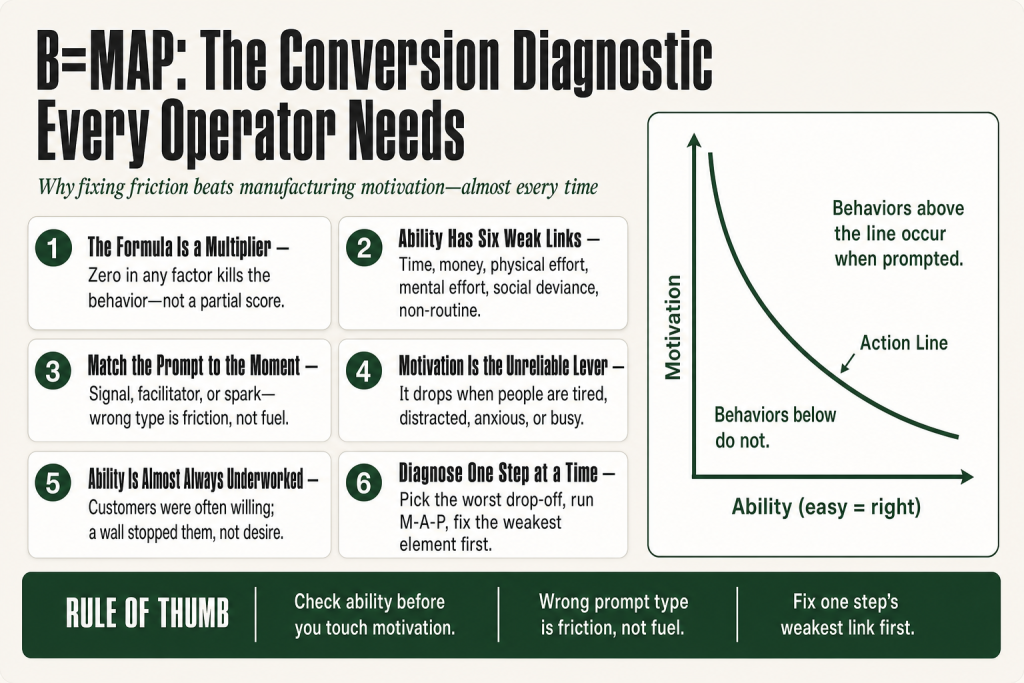
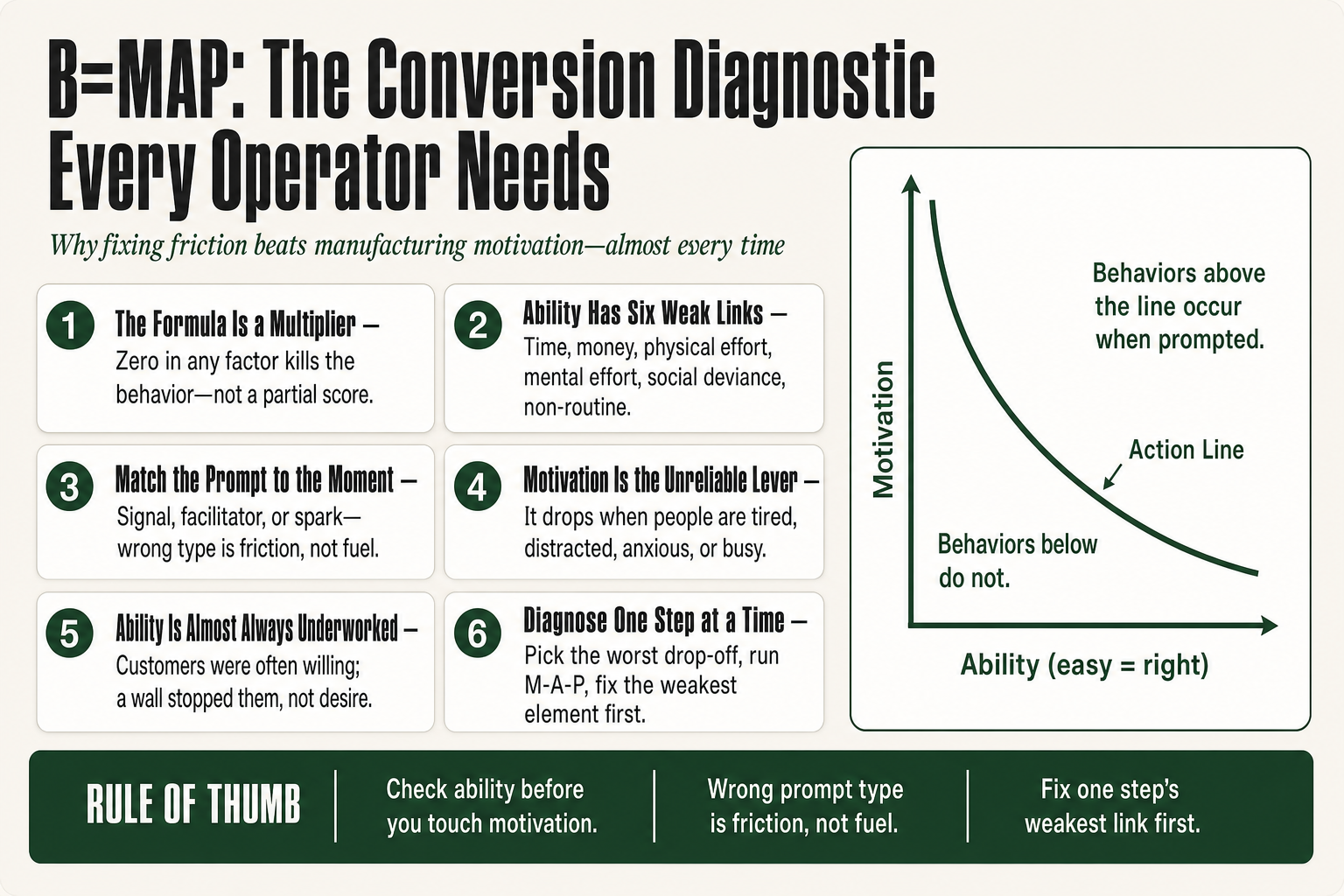
- The formula is B = MAP. Think of it as a multiplier, not a sum: one factor at zero kills the whole equation.
- Most operators over-invest in motivation (more copy, more urgency, better offers) when the real bottleneck is ability, the action is just too hard to do right now.
- Ability has six sub-factors, time, money, physical effort, mental effort, social deviance, and non-routine, and your weakest link is the one killing conversions.
- Prompts come in three types: signals (high M, high A), facilitators (high M, low A), and sparks (low M, high A). The wrong prompt type is friction, not fuel.
- The Fogg Behavior Model is a diagnostic first. Run every broken conversion point through M, A, and P before you change anything.
Where the Fogg Behavior Model Came From
BJ Fogg developed the model in 2007 and published it formally in 2009 in a paper titled A Behavior Model for Persuasive Designpresented at the 4th International Conference on Persuasive Technology. At that point it was B=MAT, Motivation, Ability, Trigger. By Tiny Habits in 2019, ‘Trigger’ had become ‘Prompt.’ Fogg made the switch because ‘trigger’ had picked up negative connotations and implied a mechanical, fixed cue, when real prompts are contextual, emotional, and sometimes self-generated.
The lab he founded, originally the Persuasive Technology Lab, is now the Stanford Behavior Design Lab. The framework has since accumulated over 2,000 academic citations, though it’s worth knowing the original paper is a conference paper rather than a peer-reviewed journal article, and most of those citations use it as a design heuristic, not an empirically tested theory. That’s fine for operators. You’re not running clinical trials. You’re diagnosing why someone didn’t book.
The Fogg Behavior Model: B=MAP in Plain Language
The formula is deceptively clean: Behavior = Motivation × Ability × Prompt. The multiplication sign matters. This isn’t a checklist where partial credit counts. If any one of the three factors is zero at the moment of decision, the behavior doesn’t happen, full stop. A customer who desperately wants to buy but can’t find your checkout button won’t buy. A customer who sees a clear prompt to act but has no idea why they should bother won’t act. And a customer who is motivated and capable but never receives a cue will just go about their day.
Motivation
Fogg identifies three core motivators, sensation (pleasure/pain), anticipation (hope/fear), and belonging (social acceptance/rejection). Each has two sides: moving toward something desirable or away from something aversive. Motivation is the lever operators reach for first, often reflexively. More testimonials. A ticking countdown. A bigger discount. These work sometimes. The problem is motivation fluctuates, it’s high right after someone discovers you and low three days later when they’re distracted by something else. Motivation is the least reliable lever in the formula. You can pour energy into it and get nothing if the other two aren’t there.
Ability
This is where the Fogg Behavior Model gets genuinely useful. Fogg defines ability not as skill but as simplicity, and he breaks it into six sub-factors, any one of which can be the bottleneck: time (how long the action takes), money (what it costs), physical effort (how much exertion), mental effort (cognitive load and complexity), social deviance (how much the action goes against social norms), and non-routine (how much it disrupts existing habits). Whichever factor is scarcest for your specific customer at your specific moment is the real friction point. The simplicity chain works like any chain: only as strong as its weakest link.
Non-routine is the one operators most often miss. Asking someone to do something they’ve never done before, in a way they’ve never done it, with a tool they’ve never used, that stacks three non-routine costs on top of each other. Plenty of small-business onboarding flows do exactly this and then blame the customer for dropping off.
Prompt
The prompt is the cue that says ‘do it now.’ Even a highly motivated person with every ability to act won’t act without one. There are three types. A signal works when motivation and ability are both already high, just a simple reminder, a notification, a button. A facilitator is right when motivation is high but ability is low, it doesn’t push harder, it makes the action easier (‘click here and we’ll pre-fill everything’). A spark is for the opposite situation: ability is high but motivation is low, the prompt needs to remind people why they wanted this in the first place.
Sending the wrong type of prompt for where your customer sits is one of the most common silent conversion killers. A spark at someone who already desperately wants to buy just wastes their time. A signal at someone who hasn’t been convinced yet does nothing.
The Action Line: Why Motivation and Ability Trade Off
Fogg visualizes the relationship between motivation and ability on a two-axis chart. Motivation runs vertically. Ability runs horizontally, the right side means high ability, meaning the behavior is easy. An ‘action line’ curves across the chart, and behaviors that fall above it will occur when prompted; behaviors below won’t, regardless of the prompt.
The key insight is the trade-off: high ability can compensate for lower motivation, and vice versa. Someone mildly interested in your service might still sign up if all it takes is one tap. Someone absolutely desperate for your help might push through a complicated 12-step intake form. Neither is ideal, but understanding the trade-off tells you which dial to turn.
For most small-business operators, this chart surfaces something uncomfortable: a lot of customers are above the action line on motivation, they want this, but they’re stuck on the left side of the chart, in high-friction territory. They want to book, they want to buy, they want to refer a friend, and then they hit a speed bump and the moment passes. Fixing that is often faster, cheaper, and more durable than manufacturing more motivation through ad spend or urgency tactics.
The practical question isn’t ‘is motivation or ability more important?’ It’s ‘which one is the bottleneck right now, for this specific action, for this specific customer?’ That’s what the model is for.
Why Ability Is Almost Always the Underworked Lever
Operators default to motivation. When conversions are flat, they add urgency copy. They discount. They write longer emails. They A/B test headlines. And sometimes that works. But far more often, the customer was already willing, they just hit a wall.
Think about what a ‘simple’ lead form actually asks of someone on a mobile phone at 7 PM: name, email, phone, company name, message, CAPTCHA, then wait for a confirmation email. Each step is small. Cumulatively they’ve burned mental effort on fields they don’t want to fill, physical effort on a keyboard that’s too small, time they didn’t have, and they’ve broken their routine in a way that feels like homework. Then we wonder why they bounced.
Fogg’s argument, and it’s one worth taking seriously, is that motivation is unreliable by design. It drops when people are tired, distracted, anxious, or busy. A funnel that depends on ‘users really wanting this’ is fragile. Ability and prompts, by contrast, are engineerable. You can design a behavior to be easier and anchor it to a reliable trigger. That’s durable in a way that a better subject line is not.
The six ability sub-factors give you somewhere specific to look. ‘Reduce friction’ is advice. Identifying that your bottleneck is mental effortbecause your pricing page requires customers to do arithmetic to figure out what they actually owe, is a diagnosis. Those are different things. Only one leads to the right fix.
Putting this to work? The ideas in the Canon are the foundation under the tactical playbook in Build a Complete Marketing Department — grab the free companion kit at mmsvegas.com/resources.
Applying the Fogg Behavior Model to Your Funnel
Pick any conversion point that’s underperforming and run it through three questions: Does the person have enough motivation to act here? Is the action easy enough to complete right now? Did they receive a clear, well-timed prompt? One of those three failed. Go find which one.
Ads and awareness
At the top of your funnel, the behavior you want is usually a click or an opt-in. Motivation at this stage is typically low, people weren’t looking for you. So the ability bar has to be low too. A one-field opt-in with an immediately obvious value exchange clears the action line. A three-step signup flow doesn’t. The prompt needs to function as a spark, reconnecting them with something they already want, not just announcing that you exist.
Lead follow-up and booking
Once someone has raised their hand, motivation is at its peak. Strip ability friction to zero and fire a signal-style prompt. Calendar link immediately. One click to book. No account creation. No form asking them to describe their project in 500 words before they’ve spoken to anyone. If your follow-up sequence has a 24-hour delay and a qualification questionnaire, you’re letting motivation decay while adding ability friction, a double loss that’s completely preventable.
Checkout and purchase
The ability sub-factor doing the most damage in e-commerce and service bookings is usually mental effort, decision complexity. Too many options. Unclear pricing. Conditional terms that require hard thinking at the wrong moment. Amazon’s one-click purchase is the canonical ability optimization: it eliminates every friction step and fires a signal-level prompt. You’re not Amazon, but the principle transfers: one-page checkout, saved payment, no mandatory account creation. Each of those is an ability fix, not a motivation fix.
Referrals and reviews
This is where operators most often get the prompt type wrong. The customer is willing, motivation is there, but they’re asked to do something non-routine that requires time and mental effort: write a paragraph, navigate to a new platform, figure out how to leave a star rating. Fix ability. Send a direct link to the specific review submission form. Pre-populate whatever you can. The behavior you want is a click and a sentence, not a project.
Using AI as a diagnostic tool
An AI assistant is useful here, it cuts your dependence on outside consultants for this kind of audit. Feed it your current checkout flow, your opt-in sequence, or your onboarding emails and ask it to identify which of the six ability sub-factors each step taxes. It can map mental-effort costs in your form fields, flag non-routine asks that need instructional copy, and draft alternative prompts based on whether you need a spark, signal, or facilitator. The judgment call, which fix matters most in your specific context, stays with you. But the initial audit takes twenty minutes instead of a day.
Where You See the Fogg Behavior Model Working in the Wild
Duolingo is the clearest case of all three elements deliberately engineered. The lessons are bite-sized, time cost is near zero. They’re free, money factor eliminated. The interface pre-makes decisions for you, mental effort is minimal. And the daily streak notification is a textbook signal prompt: it fires when motivation and ability are already established from prior habit formation. The streak feature has become what Duolingo credits as its single most effective retention lever, with learners who hit a 7-day streak roughly 2.4 times more likely to return the next day. None of that is accidental.
Google’s search autofill is an ability optimization so smooth most people don’t notice it. It cuts the time and mental-effort cost of starting a search, exactly the bottleneck Google needed to eliminate to keep the behavior frequent and habitual.
On the marketing side: abandoned cart emails are prompt interventions. The motivation was there, the person literally put items in a cart. The ability was there, they were mid-purchase. What failed was the prompt; they got distracted and needed a reminder. The ones that work are short, show the item, and link directly back to a pre-populated cart. The ones that fail add a promo code requirement, ask for feedback, or arrive three days later when the moment has passed.
For service businesses, the Fogg Behavior Model explains why ‘call us to book’ underperforms versus an online booking link, even when phone calls close at higher rates. The population willing to book via a lower-friction path is simply larger. More volume at a slightly lower rate still wins in most markets. The ability bottleneck of picking up the phone, navigating hold times, and explaining yourself to a stranger filters out too many people who would have become customers.
Where the Fogg Behavior Model Works, and Where It Runs Out of Road
The model is most powerful for discrete, one-time behaviors: click, book, buy, refer, review. Any specific moment where you need someone to cross an action threshold, B=MAP gives you a structured way to diagnose why they didn’t. For that use case, it’s nearly always useful.
It starts to strain under a few conditions.
Complex, multi-session decisions. Big purchases, B2B software, renovation work, professional services engagements, aren’t decided in a single moment. They unfold across touchpoints over days or weeks, with motivation shifting the whole time. B=MAP is still useful at each individual touchpoint, but it doesn’t tell you how to build and maintain desire across the full journey. For that, you need something like the Buying Temperature framework running alongside it.
Habitual re-engagement. The Fogg Behavior Model describes conditions for a behavior to occur, but it doesn’t explain how behaviors compound into habits. Nir Eyal’s Hook Model picks up here, it operationalizes Fogg’s prompt concept into a four-stage loop (trigger → action → variable reward → investment) designed to turn one-time behaviors into routines. If your goal is recurring engagement rather than a single conversion, the Hook Model’s variable reward and investment stages fill the gap B=MAP leaves open.
Motivation you don’t understand yet. The model tells you motivation needs to be present, but not what creates it for your specific customer. If you haven’t done the work to understand what your buyers actually fear, hope for, and care about, the motivation lever is opaque. Tools like Voice of Customer and Jobs to Be Done fill that gap.
Ethical limits. The model is value-neutral, it works just as well for building compulsive, attention-extracting products as for building healthy habits. Dark patterns, coercive urgency, friction deliberately built into cancellation flows, all of these use B=MAP against the people it should be helping. Customers figure it out. The trust damage outlasts the conversion bump.
Common Misunderstandings About the Fogg Behavior Model
‘It’s about habit formation.’ Fogg’s later book Tiny Habits is explicitly about habits, so readers often backfill that purpose onto the behavior model itself. B=MAP is about single behavior occurrences. Habits require repeated behaviors over time, plus reinforcement loops Fogg covers separately. Use it to get the first behavior to happen, then reach for something else.
‘Higher motivation always helps.’ Motivation is the most expensive and most volatile lever. If ability is the bottleneck, pumping up motivation won’t change the outcome, and adding urgency to a high-friction flow can actually highlight the gap between how badly someone wants to act and how hard you’ve made it. That mismatch damages trust. Check ability before you touch motivation.
‘A prompt is just a CTA button.’ A button is one type of prompt. A follow-up email, a push notification, a text, an in-store display, a salesperson saying ‘ready to move forward?’, all prompts. The distinction matters because the right type of prompt depends on where the customer sits on the motivation-ability chart. Match the type to the situation, or you’re just noise.
‘This is only for digital products.’ Most examples online involve apps and UX flows because Fogg developed the framework partly in the context of persuasive computing. But the model applies just as cleanly to a brick-and-mortar restaurant’s reservations flow, a home services company’s quote request process, or a professional firm’s onboarding paperwork. The medium changes. The three variables don’t.
‘Ability means the customer’s skill level.’ This leads operators to add tutorials and training when what they actually need to do is remove steps. Fogg defines ability as situational simplicity, how easy it is to perform the action right now, under the customer’s actual constraints. Someone can be perfectly capable of completing your form on a desktop and completely unable to do it on mobile with one thumb while waiting for coffee. Ability is contextual, not fixed. Cut the steps.
Common Mistakes
- Treating every conversion problem as a motivation problem — Before touching copy or offers, name the specific ability sub-factor blocking the action, time, money, mental effort, non-routine, physical effort, or social deviance. Fix that first. Motivation work before ability work is usually wasted motion.
- Firing the wrong prompt type for the customer’s position — Before you write a prompt, ask where the customer sits: convinced but stuck (use a facilitator), not yet interested (use a spark), or ready to go (use a signal and get out of the way). Urgency copy sent to someone already sold doesn’t close them faster, it makes them suspicious.
- Running the model on the whole funnel simultaneously — Pick the one step with the worst drop-off. Run M-A-P on that step only, fix the weakest element, then move to the next. Attempting everything at once produces a list and no momentum.
- Confusing ability with customer skill level — Stop asking whether customers are capable in principle. Ask whether they can do this specific action right now, on this device, with this much time and attention available. If the answer is probably not, remove a step, don’t add a tutorial.
- Only auditing the purchase step — Every conversion event has its own M-A-P profile: the ad click, the opt-in, the booking, the onboarding task, the referral request, the review ask. A fix at checkout won’t save you if the opt-in form already lost half your leads.
Operator’s Take
Here’s the most useful way I’ve found to think about B=MAP in practice: it’s a triage system. Something is broken in your funnel. You have three possible diagnoses. Pick the right one before you start treating anything.
Run this test on any underperforming conversion point. Write down, specifically, not vaguely, the answer to each of these: What is the customer’s motivation to act at this exact moment? What is the hardest thing about doing this action right now? When, exactly, does the prompt arrive, and what type is it? If you can’t answer all three concretely, you’re not ready to fix anything yet.
On the motivation-vs-ability question: the marketing industry has a financial incentive to keep you focused on motivation. Agencies write copy. Copywriters don’t shorten forms. So the default prescription is ‘stronger messaging, better offer, more urgency’, even when the problem is a mandatory account-creation step that has been quietly killing purchases for two years. The Fogg Behavior Model is useful partly because it forces the question: is motivation actually the problem here? Most of the time, it’s not. Check ability first. Run through all six sub-factors: time, money, physical effort, mental effort, social deviance, non-routine. Find your weakest link and pull it.
On prompts: most operators fire urgency-based sparks across every touchpoint regardless of where the customer actually sits. If someone is already convinced and capable, they need a signal, a clear, frictionless path forward. A button. A link. Get out of their way. A spark sent to someone already sold on you doesn’t close them faster; it makes them wonder why you’re still trying so hard.
One move worth building into your workflow: any time you’re designing a form, a landing page, a checkout, or an onboarding email, run each step through the six ability sub-factors and name which one costs the most. That single pass surfaces more actionable fixes than most full-day funnel reviews. And you don’t need a developer for most of what it turns up, cut a field, add a calendar link, change a five-option radio button to a single default. Small stuff. Fast stuff. The kind of thing that was always in the way and just never got named.
Where B=MAP genuinely runs out of road: relationship-driven sales. If someone is evaluating a significant purchase, a contractor, a law firm, a six-figure software contract, the model helps you optimize individual touchpoints, but it won’t tell you how to build the desire and trust that make them choose you. That’s Buying Temperature territory, the slow accumulation of familiarity and credibility over months. B=MAP handles moments. Don’t ask it to do more than that.
Used in
- ✓ Build a Complete Marketing Department
Used to audit every funnel stage for motivation-ability-prompt gaps, ensuring each conversion step is diagnosed before new campaigns are layered on top of broken flows. - ✓ The Missing Manual for FunnelKit
Applied to checkout and opt-in flow design, specifically to eliminate ability friction (form fields, step count, cognitive load) and match prompt types to cart-stage motivation levels. - ✓ The Missing Manual for Make
Used to design automated prompt sequences, abandoned cart emails, follow-up triggers, review requests, that fire the right signal, spark, or facilitator at the right behavioral moment.
FAQ
What does B=MAP stand for in the Fogg Behavior Model?
B=MAP stands for Behavior = Motivation × Ability × Prompt. All three elements must be present simultaneously for a behavior to occur. If any one is missing or too weak, the behavior won’t happen, it’s a multiplier, not a sum.
Is the Fogg Behavior Model the same as the Hook Model?
They’re related but different. The Fogg Behavior Model diagnoses what must be true for a single behavior to occur. Nir Eyal’s Hook Model, loosely based on Fogg’s work, extends it into a four-stage loop (trigger, action, variable reward, investment) designed to build repeated habits. Use Fogg for conversion diagnosis; use the Hook Model when you’re designing for habitual re-engagement.
What’s the most common bottleneck in small-business funnels?
Almost always ability, specifically mental effort and non-routine friction. Customers are often willing but the action asks too much in the moment: too many fields, too many decisions, too unfamiliar a process. Fixing ability is faster and more reliable than amplifying motivation.
How do the three types of prompts work?
A signal works when motivation and ability are both already high, it just needs to remind the person to act. A facilitator is for when motivation is high but ability is low, it makes the action easier, not more urgent. A spark is for low motivation and high ability, it needs to reconnect the person with why they wanted this. The wrong type for the situation is friction, not fuel.
Can the Fogg Behavior Model apply to offline and in-person businesses?
Yes. A restaurant booking flow, a service firm’s intake process, an in-store upsell, all involve the same three variables. The model is about human behavior, not digital interfaces. Anywhere a customer should act but doesn’t, M-A-P gives you a diagnostic lens.
What is the ‘action line’ in the Fogg Behavior Model?
The action line is a curved threshold on a chart with motivation on one axis and ability on the other. Behaviors that fall above the line will occur when prompted; those below will not. It illustrates the trade-off: very high motivation can compensate for some ability friction, and vice versa. The goal is to get the desired behavior above that line.
Is the Fogg Behavior Model evidence-based?
The model draws on established behavioral science principles around motivation, friction, and cueing, but the original 2009 paper is a conference paper rather than a peer-reviewed journal article, and the model’s specific predictions haven’t been tested in randomized controlled trials. Most researchers use it as a design heuristic, not a clinical framework. For operators, that’s fine, it’s a diagnostic tool, not a scientific theory you need to defend.
Further reading
- Tiny Habits by BJ Fogg (2019), the fullest explanation of the Fogg Behavior Model from its creator, with practical exercises for applying it to personal and business behavior change.
- Hooked: How to Build Habit-Forming Products by Nir Eyal (2014), extends Fogg’s prompt concept into a four-stage habit loop; worth reading once you’ve put the single-behavior diagnostic to work.
- Influence: The Psychology of Persuasion by Robert Cialdini, provides the specific motivation-raising tools (social proof, authority, reciprocity) that fill in Fogg’s motivation variable with operational detail.
Sources: BJ Fogg, behaviormodel.org (official model site); BJ Fogg, ‘A Behavior Model for Persuasive Design,’ Proceedings of the 4th International Conference on Persuasive Technology, April 2009 (ACM, doi:10.1145/1541948.1541999); Stanford Behavior Design Lab, behaviordesign.stanford.edu; The Behavioral Scientist, ‘The Fogg Behavior Model: B=MAP’ (February 2026); The Decision Lab, ‘Fogg Behavior Model’ reference guide; Yu-kai Chou, ‘BJ Fogg Behavior Model: The 6 Factors of Ability’; Northbeam, ‘Fogg Behavior Model: Motivation, Ability, and Prompts’; Jorge Mazal, ‘How Duolingo Reignited User Growth,’ Lenny’s Newsletter (2025); EngageFabric, ‘Building a Duolingo-Style Streak System’ (February 2026); Maria Shriver interview with BJ Fogg, mariashriver.com (February 2020).
Brian Kasday spent forty years in direct-response marketing before rebuilding the whole operation as a one-person shop. He writes The Operator’s Library — including “Build a Complete Marketing Department” — for operators who’d rather build it themselves than wait on someone else.
Build the department these ideas describe — the free companion kit: mmsvegas.com/resources.
More The Operator's Canon guides
Free · Operator Toolkit
Want the tools, not just the guide?
Get the free operator toolkit — templates and checklists for the systems you actually run, plus a note when this guide changes.
Get the free toolkit →