
Last updated: July 2026
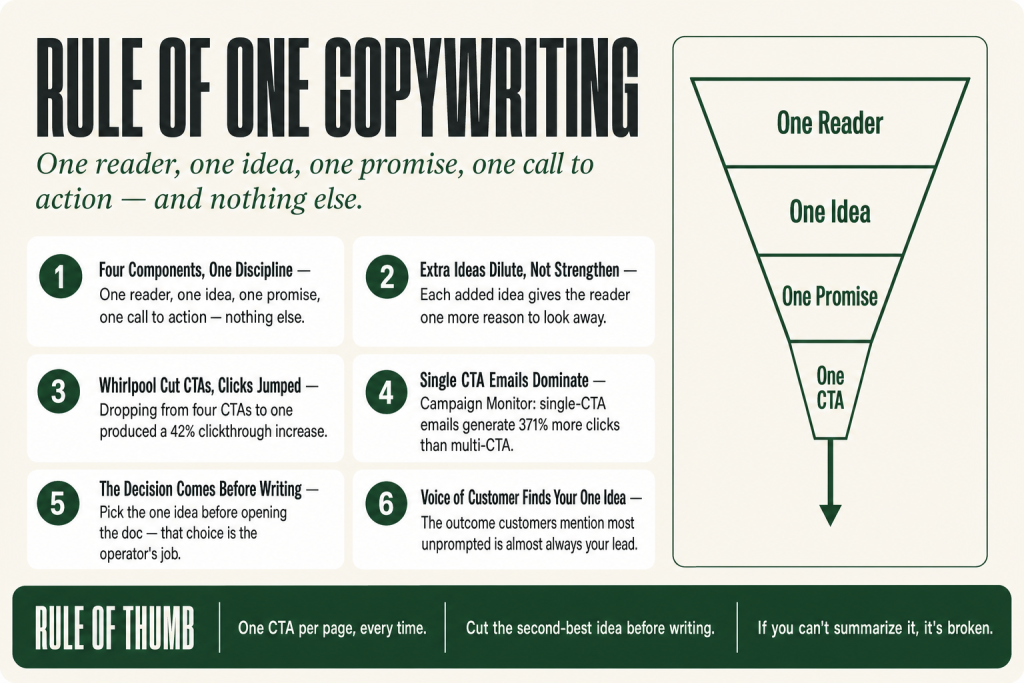
Rule of one copywriting is the discipline of building every single piece of marketing communication around one reader, one idea, one promise, and one call to action, and nothing else. By the end of this page, you’ll be able to look at any email, landing page, or ad you’ve written, identify exactly where you broke the rule, and fix it before you spend another dollar sending traffic to it.
The instinct to add more is almost always wrong, and almost everyone follows it anyway. When your offer has six real benefits, choosing only one feels irresponsible. Why leave five on the table? So you throw them all in: a headline that gestures at three different outcomes, a body that bounces between features, a page that ends with four buttons going four different places. Direct response veterans call this toss-salad copy. Everything’s technically present, but the reader can’t tell what you want her to do.
Rule of one copywriting exists because that’s not how persuasion works. A message lands when one clear idea occupies the reader’s attention long enough to take root. The moment a second idea competes with the first, both weaken. Your reader ends up choosing nothing, not because the offer was bad, but because the message made her work too hard to figure out what you wanted.
This isn’t stylistic preference. It’s a structural principle with real conversion numbers behind it. For a small-business operator, where every dollar of ad spend and every email subscriber counts, ignoring it is one of the most expensive, most avoidable mistakes you can make.
The idea in 30 seconds
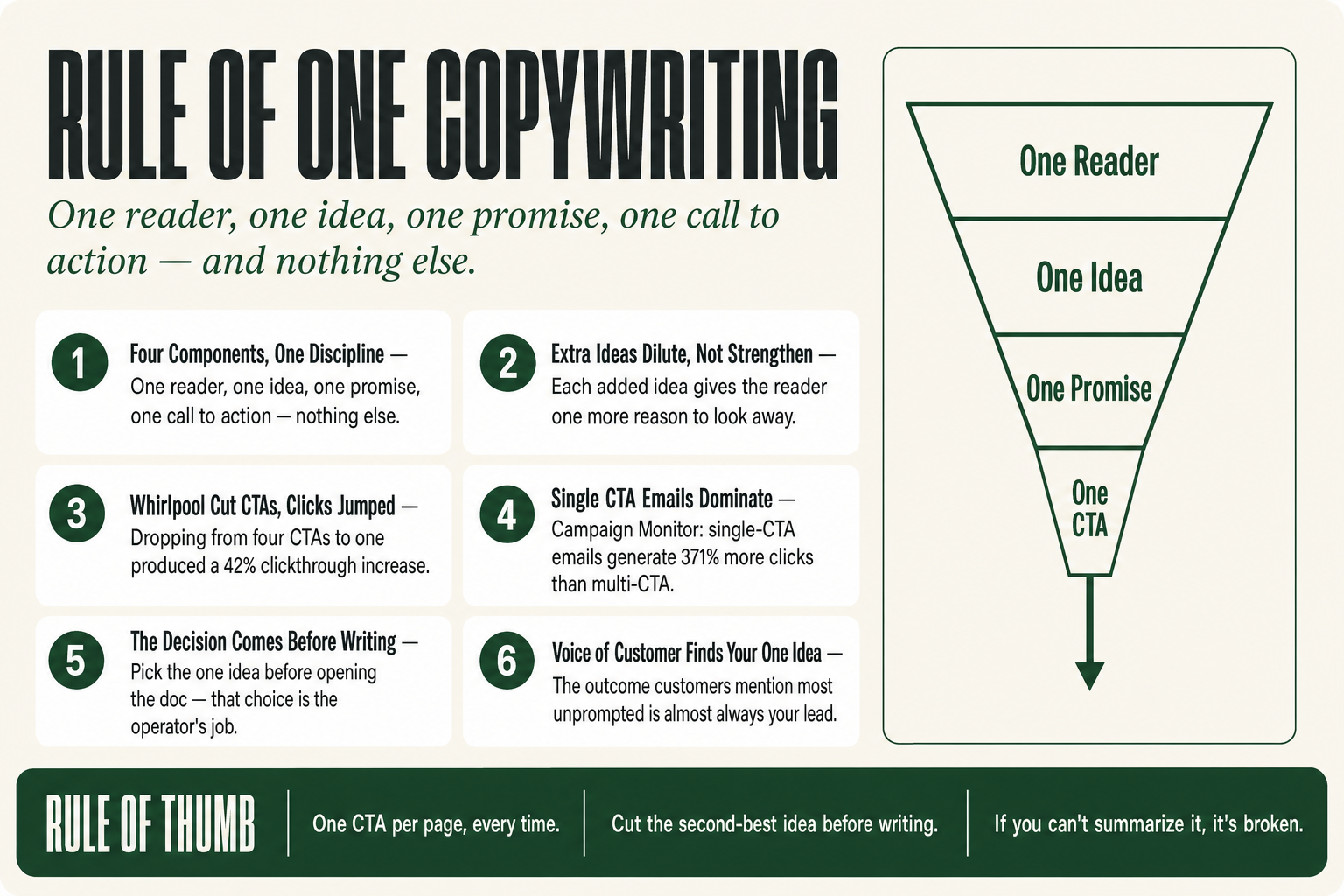
- Rule of one copywriting means every piece of copy, ad, email, landing page, sales page, is built around exactly one big idea, one reader, one promise, and one call to action.
- Stacking multiple ideas, benefits, or CTAs doesn’t strengthen a message; it dilutes it. Each addition gives the reader one more reason to look away.
- The discipline forces a decision before you write: pick the single most compelling thing about your offer and build everything else around that. That decision is the operator’s job, not the AI’s, not the designer’s.
- It applies to every format, a five-word ad headline, a 3,000-word sales letter, a nurture email sequence, the unit of focus just shifts slightly by format.
- Operators who apply it consistently report sharper positioning, faster writing, and measurably higher conversion rates on the same traffic.
- The hardest part isn’t the writing. It’s the discipline to cut the second-best idea before you start.
Where Rule of One Copywriting Came From
The rule wasn’t invented at a whiteboard. It was extracted from decades of direct-response testing by people whose income depended on getting it right.
The clearest articulation came from Michael Masterson, the pen name of Mark Ford, a consultant who spent decades working with Agora, Inc. Masterson presented and wrote extensively about what he called “The Power of One” through AWAI, arguing that a single good idea, clearly and convincingly presented, beat a dozen so-so ideas strung together. That wasn’t philosophy, it was pattern recognition from watching promotions convert or fail. The principle was later named, codified into four components, and published in Great Leads: The Six Easiest Ways to Start Any Sales Messageco-authored with John Forde (American Writers & Artists Inc. 2011).
What this history actually tells you: the rule was reverse-engineered from what converted, not derived from theory. The reader’s attention hasn’t changed since the era of direct mail, and neither has the principle.
The Four Components of Rule of One Copywriting
Rule of one copywriting has four parts. Simple to list; genuinely hard to execute, because each one demands a choice, and the temptation to reverse that choice mid-draft is real.
One Reader
Your copy is addressed to a single, specific person. Not a demographic segment. Not “men 35 to 55 interested in home improvement.” A person. You know roughly what she’s worried about right now, what she tried last time that didn’t work, and what would make her immediately skeptical of your claim. You write to her, not the imaginary “everyone” who might theoretically buy.
This sounds obvious until you look at most small-business copy, which hedges: “Whether you’re a homeowner or a property manager, whether you want a quick fix or a full renovation…” That sentence is writing to three people and converting none of them. When copy is designed to offend no one, it connects with no one. Writing to one reader doesn’t shrink your market. It sharpens your message so the right reader recognizes herself immediately, and feels like you wrote this specifically for her.
One Idea
Every piece of copy has one central claim, a single big idea that is easy to understand, easy to believe, and genuinely interesting or specific. Sub-bullets, supporting facts, and testimonials can all reinforce that idea. What they can’t do is introduce a competing one.
The discipline here is the edit before the draft. Most operators can generate six legitimate reasons their product is worth buying. The job is to pick the one that will resonate most powerfully with that one reader, and cut the other five before the first sentence gets written. Secondary benefits are welcome as reinforcement. A second central claim is not.
One Promise
The promise is the specific, credible outcome your reader can expect. It has to match what she actually wants, not what you’re proud of delivering. It has to be believable enough that her skepticism doesn’t activate before you’ve made your case. And it has to be tied to one emotional driver, the dominant feeling that motivates her to act.
“We help businesses grow” is not a promise. “You’ll have your first three paying clients within 30 days, or we’ll keep working with you until you do”, that’s a promise. One outcome. One belief she either gains or doesn’t. Singular, specific, credible enough to stand on its own.
One Call to Action
Every page, email, or ad serves one goal. If you want someone to book a call, every element drives toward booking the call, not also downloading the guide, not also following you on Instagram. One destination. One decision point.
This is where operators most visibly violate the rule, and the data is unambiguous. In 2014, Thomas Mender, Senior Manager of Database Marketing at Whirlpool, ran an A/B test on an email promoting the company’s Ice Kitchen Collections. The control had four CTA buttons, three “Learn more” buttons directing to separate product pages, plus a “See Details” button linking to the rebate landing page that was the campaign’s actual goal. The treatment kept only the “See Details” CTA. The single-CTA version produced a 42% increase in email clickthrough rate, reported by MarketingSherpa.
A landing page test by Pluimen.nl, a Dutch gift voucher company, points the same direction. The original page had two CTA buttons, “Buy Now” and “Check Experiences”, alongside multiple competing links. After a 47-day A/B test using VWO, the streamlined single-CTA version delivered a 19.7% revenue increase, a 10.9% conversion lift, and an 8.5% drop in bounce rate, per VWO’s published case study. Options cost you action. Every time.
You can repeat the CTA button multiple times on a long page, that’s not a violation. What you can’t do is give the reader a fork in the road. When people face multiple options, a meaningful share of them choose none. That’s Hick’s Law applied to copy, and it costs you conversions on every piece you publish.
Why Rule of One Copywriting Beats Six Good Points Every Time
There’s an old observation from the copywriting world about two speeches delivered at a conference. One focused on a single idea, the importance of clarity in writing. The other presented twelve rules the speaker followed when crafting copy. Both talks were well-received in the room. But at the end of the night, people were still discussing the single-idea speech. Nobody could coherently summarize the twelve-rule talk, even though they’d found it interesting in the moment. The focused idea stuck. The list dispersed.
This isn’t a copywriting quirk. It’s how human attention and memory actually work. We don’t hold six competing claims in parallel, weigh them equally, and pick a winner. We latch onto one clear signal and filter everything else through it. A message that gives us one strong idea gives us something to carry. A message that gives us six gives us nothing, we just remember that we looked at something.
Rule of one copywriting also does something important for the writer before the draft starts: it forces a strategic decision. Weak copy is rarely weak because the writer can’t write. It’s weak because the writer never decided what the message was actually for. The rule is a pre-writing discipline. You make the one-idea decision before you open the doc, not during the edit.
There’s an underappreciated competitive benefit here for small operators. Specificity is scarce online. Most competitors are writing benefit-stuffed, hedging, everyone-welcome copy. A message that speaks directly to one person about one outcome reads as startlingly focused by contrast. Your reader thinks: “This is exactly what I was looking for.” Not because the offer is better, because the message was aimed at her instead of at the crowd.
Putting this to work? The ideas in the Canon are the foundation under the tactical playbook in Build a Complete Marketing Department — grab the free companion kit at mmsvegas.com/resources.
Rule of One Copywriting in Practice: Examples Worth Stealing From
The rule shows up clearly in the best-converting digital copy running today. You don’t need to look at old direct mail to find clean examples.
Basecamp’s homepage copy is a useful reference point. For years their above-the-fold headline read: “The calm, simple way for teams to work together.” One promise, calm simplicity over feature overload, aimed at one reader, the overwhelmed team manager drowning in notifications, driving one action: start a free trial. No feature grid. No comparison table. One idea, plainly stated. The people it was written for recognized themselves in it immediately.
Email marketing shows rule of one copywriting in its starkest form. The best-performing nurture emails in tested sequences do one thing per message: tell one story, make one point, link to one destination. The discipline isn’t about being brief, a 600-word email is fine. It’s about making sure the whole email serves one central idea. When you read an email and can’t answer “what was that about?” in one sentence, the sender broke the rule.
Contrast that with the email your bank or cable company sends: three offers, two product categories, a retention message and an upsell pitch crammed into the same 500-word send. You open it, scan it, feel vaguely marketed at, and delete it. The message was written for a segment. Segments don’t buy things. People do.
For paid ads, the discipline applies at the headline. Your ad creative doesn’t tell the whole story, that’s not its job. The ad has one job: get the right person to click. One claim. One hook. One invitation. The landing page carries the rest, but only after the ad has done that one job cleanly.
Campaign Monitor’s data shows that emails built around a single CTA generate 371% more clicks than emails with multiple CTAs, a finding that holds across thousands of sends. The direction is consistent: fewer options produce more action.
Where Rule of One Copywriting Pays Off Most
The rule applies anywhere you’re writing copy, but the leverage varies significantly by format.
Landing pages are where violations hurt most and compliance pays off most visibly. A page with a single conversion goal eliminates competing actions. When visitors face sign-up, video-watch, download, and purchase in the same scroll, they’re far more likely to do none of them. Every competing option is a reason not to commit to the primary one. The Pluimen and Whirlpool results didn’t happen at any particular traffic volume, they happened because the message structure changed.
Cold outreach and email sequences are where the rule is most consistently ignored. Operators writing their own sequences try to cover too much ground in each send, reintroducing the brand, making a pitch, offering a resource, and asking for a referral, all in one email. Recipients parse the subject line, can’t instantly identify what you want, and move on. One email, one idea, one link. Stack the sequence so each message builds on the last. Let the sequence carry the full story; let each email carry one chapter of it.
Paid adssearch, social, display, have enforced brevity that encourages rule of one copywriting by default. You have limited characters. The discipline is making sure you spend those characters on the single most compelling thing about your offer for this specific audience, not trying to mention everything you do in 90 characters.
Sales pages and long-form copy are more nuanced. A 3,000-word sales page does need supporting evidence, testimonials, objection handling, and secondary benefits. Rule of one copywriting doesn’t mean you mention only one thing on the whole page, it means every element reinforces the same central idea. Sub-bullets support the one promise. Stories illustrate the one outcome. Testimonials confirm the one claim. Length is fine; competing central ideas are not.
Proposals and B2B sales documentsoperators almost never think of these as copywriting, but they are. A proposal that buries the lead in three pages of company background before making a recommendation, then makes four separate recommendations, is violating the rule. Your proposal should center on the one outcome you’re delivering, the one approach you’re recommending, and the one decision the prospect needs to make.
Where Rule of One Copywriting Breaks Down (and You Need to Know This)
The rule is the right frame for persuasion-driven copy, but it has edges worth acknowledging honestly. Misapplying it creates its own problems.
Navigation menus, catalogs, and product directories aren’t governed by it. When someone is browsing an e-commerce catalog or exploring your services page, they need enough information to self-select. Rule of one copywriting applies when you’re trying to move a specific person to a specific action, not when you’re providing an index. Don’t strip your services page down to a single service because you misread this principle.
Email newsletters with multiple articles are a partial exception. A curated roundup newsletter, where the implicit contract with the reader is “here are several things you might find interesting”, isn’t a persuasion vehicle in the same way a promotional email is. The rule governs messages with a primary conversion goal. If your goal is top-of-mind value across multiple topics, the format allows more flexibility. That said, even roundups benefit from having one lead story that anchors the issue.
The rule can make you overly rigid if you apply it to strategy rather than execution. Your overall business should absolutely address multiple customer problems. Your service offering can include multiple components. Rule of one copywriting applies at the message level, what this particular piece of copy is trying to do, right now, for this specific reader. It’s a writing and messaging discipline, not a product design principle.
Post-purchase sequences have different dynamics. After someone has already bought, their skepticism is lower and they’re more open to hearing about related things. A post-purchase email that mentions two related products isn’t necessarily breaking the rule, the reader’s context has changed. The primary goal is still one thing, but the environment is more permissive than cold-traffic copy or a first-touch ad.
The rule is most critical with cold traffic and at the top of any funnel. A reader who’s been on your list for two years and opens everything you send has extended you a kind of credit. An occasional two-topic email won’t destroy your conversions. But cold traffic gives you one chance to make one impression. Don’t spend it trying to say everything.
What Operators Actually Get Wrong Applying Rule of One Copywriting
The misunderstandings below aren’t theoretical. They show up in real business copy every day, often from operators who’ve read about the rule but applied it partially or too literally.
Confusing one idea with short copy. The best direct-response sales letters in history run to 8, 12, even 20+ pages, and they’re built around a single central idea. Length is about how much proof and persuasion the reader needs to believe the promise, not about how many ideas the writer wants to share. A single idea supported by ten pages of evidence beats ten ideas each supported by one paragraph.
Treating secondary benefits as a loophole. The rule doesn’t prohibit supporting proof and sub-benefits. It prohibits introducing a second central claim. If your primary promise is “you’ll spend 50% less time on payroll administration,” every supporting point should serve that promise. The moment you pivot to “and it also helps you with HR compliance” as a co-equal claim, you’ve started a second message that competes with the first.
Assuming the rule only matters for copywriters. This is probably the most expensive misunderstanding. Operators who’ve never thought about copy principles violate rule of one copywriting constantly, in their website homepage, in the emails they write to their list, in the proposals they send, in the ads they run. You don’t need to know the rule’s name. You need to decide, for every piece of communication you publish, what the one thing is that you want the reader to do or believe when she finishes reading. That decision should come before the first word.
Believing a single promise is a weaker offer. Six promises stacked on top of each other actually signals uncertainty. It suggests you’re not sure which one is most important, and neither is your reader. One confident, specific promise signals that you know exactly what you deliver and for whom. Confidence in a clear promise is more persuasive than a defensive list of hedges dressed up as benefits.
Thinking single CTA means leaving revenue on the table. The data consistently says the opposite. The Whirlpool test didn’t suppress demand for secondary products, it clarified the primary path enough that more people took it. Secondary offers belong in the next message in the sequence, not alongside the primary offer in the same email. The sequence is the vehicle. Each message is one step.
Common Mistakes
- Homepage written for everyone — Write your homepage headline and sub-head for your single most valuable customer type. Rewrite the above-the-fold section to speak directly to her most specific problem. Everyone else will still read it, but the right person will feel immediately seen, and she’s the one who converts.
- Multiple CTAs on the same landing page — Choose one primary conversion goal per page. If you need to drive multiple different actions to different audiences, build separate pages with separate traffic sources, don’t merge them onto one page and wonder why conversions are low.
- Emails that teach AND pitch AND ask for a referral — Assign every email one job before you write it. Value, pitch, objection-handling, follow-up, pick one. Save the others for separate emails in the sequence. If you can’t describe what you want the reader to do in one sentence, the email isn’t ready to send.
- Leading with the second-best benefit because it feels safer — Survey or interview your three to five best customers. Ask them what changed after using your product. Their unprompted answer is almost always your lead. The most honest, specific claim you can credibly prove is almost always the most effective one, and the one most operators leave on the table.
- Asking AI to decide the one idea for you — The one-idea decision is the operator’s job, not the AI’s. Write out your one reader, one promise, and one action before you touch any writing tool. Feed those constraints into the prompt as explicit requirements. The output will be focused because the brief was focused, not because the AI figured it out.
Operator’s Take
Most operators lose the game not in the offer, not in the traffic, in the copy that bridges the two. The fix is usually one structural change. Here’s where to start, and what actually works.
Count your CTAs on your highest-traffic landing page right now. If the answer is more than one destination, that’s your first fix, and it probably costs less than an hour to make. Whirlpool cut from four CTAs to one and logged a 42% clickthrough lift on the same list, same email, zero other changes (MarketingSherpa, 2014). Pluimen went from two CTAs to one and measured a 19.7% revenue lift and an 8.5% bounce rate drop over a 47-day A/B test (VWO). If you’re keeping multiple CTAs because you can’t decide which offer to prioritize, that’s a positioning problem wearing a design costume. Make the positioning call first, then simplify the page to match it.
Before your next email, write one sentence describing what you want the reader to do when she finishes reading. One sentence, one verb, one destination. If you can’t write that sentence before you open the draft, you’re not ready to write the email yet. The combo email, useful content, then a pitch, then a PS with a different offer, then a social follow link, is almost always the result of skipping this step. Pick one job. Write to it. Save the rest for separate sends. Campaign Monitor’s data puts the stakes plainly: single-CTA emails generate 371% more clicks than multi-CTA emails. That gap exists regardless of industry or list size, it’s a structural advantage you’re either taking or leaving.
Run a voice-of-customer sweep before your next major copy project. The hardest part of rule of one copywriting isn’t the writing, it’s committing to which idea to anchor on when you have six legitimate options. Pull the last 20 unprompted customer reviews, reply emails, or post-purchase survey responses. Read them looking for the outcome customers mention most often and with the most specific language. That outcome is your one idea. The others become supporting proof, not co-equal claims. This takes about 90 minutes and tends to change what you write for the next six months.
Write a reader profile card before any major piece of copy. One index card, or the top of your doc: name, current situation, specific frustration, what she tried last time that didn’t work. Write to that person. When you finish the draft, read it back and ask: does this read like a letter to one specific person, or a press release aimed at a crowd? Copy written for everyone uses plural constructions, passive voice, and hedging qualifiers. Copy written for one person uses “you,” says who it’s for, and doesn’t apologize for being specific.
When using AI to draft copy, make the one-idea decision yourself, before touching the prompt. AI doesn’t know which of your six benefits to anchor on. You do. Translate your reader profile and chosen promise into explicit constraints before you write a single prompt: one reader, one problem, one outcome, one action, no secondary offers. “Write an email for a small-business owner frustrated with payroll errors. Promise: one click eliminates manual data entry. CTA: book a 15-minute demo. No other offers, no secondary links.” That brief produces a focused draft. “Write an email about my software” produces toss-salad copy. The judgment stays with you. AI handles execution once the brief is locked, not before.
Test it informally before investing in a full A/B platform. Send your next promotional email to a 10% segment with one CTA and compare clickthrough to your historical average. Or rewrite your highest-traffic landing page to anchor on a single specific outcome, then watch bounce rate and conversion for 30 days. Your numbers, on your list, with your offer, matter more than any benchmark. But the direction is consistent, and you can get meaningful signal in a single send cycle.
Used in
- ✓ Build a Complete Marketing Department
Used as the governing discipline for writing every customer-facing message, ads, emails, landing pages, and proposals, ensuring each piece drives toward a single, clearly defined outcome. - ✓ The Missing Manual for FunnelKit
Applied page-by-page through funnel builds: each step in a FunnelKit sequence is evaluated against rule of one copywriting to ensure a single CTA, a single offer, and a single message per page. - ✓ The Missing Manual for Make
Informs the design of automated email and notification workflows, each automated message is assigned one job in the sequence before automation logic is built around it.
FAQ
Does rule of one copywriting mean I can only mention one feature or benefit?
No. Long-form copy can include many supporting points, testimonials, and proof elements. The rule means all of them must serve one central idea, not that you’re limited to one sentence or one paragraph. Think of it as one spine the whole piece hangs from, not one vertebra.
Can I repeat the CTA button multiple times on a long landing page?
Yes, absolutely. Repeating the same CTA at multiple scroll positions on a long page is good practice. Rule of one copywriting prohibits multiple different CTAs going to different destinations, not repetition of the same one.
How does rule of one copywriting apply to a homepage, which has to serve multiple purposes?
Your homepage should have one primary CTA above the fold, aimed at your most valuable conversion goal. Navigation and secondary links are necessary infrastructure, but they shouldn’t compete with that primary action. Lead with your best offer for your best customer; let the navigation serve everyone else.
If my offer has multiple strong benefits, don’t I lose sales by leading with just one?
Testing consistently says no. A single promise builds stronger conviction than a list of equal-weight claims. Leads and subject lines anchored on one idea outperform those covering multiple angles. You can mention secondary benefits deeper in the copy, but lead with your strongest one and make the case for it fully before moving on.
Does rule of one copywriting apply to social media posts?
Yes, especially to posts with a conversion intent, a post promoting an offer, driving to a link, or asking for a specific action. Organic content posts are more flexible, but any post with a goal benefits from single-idea focus.
How do I decide which benefit is the ‘one idea’ to anchor my message?
Start with what your best customers say unprompted, in reviews, reply emails, post-purchase conversations. The outcome they mention most often and most passionately is almost always your one idea. If you don’t have that data yet, identify the benefit that solves the most urgent, most specific problem your target reader has right now, and lead with that.
Further reading
- Great Leads: The Six Easiest Ways to Start Any Sales MessageMichael Masterson & John Forde (American Writers & Artists Inc. 2011). The source text where the rule of one is named and codified into four components. The opening chapters are worth any operator’s time.
- ‘The Power of One, One Big Idea’Michael Masterson / Mark Ford, AWAI.com (2010). The original essay where Masterson articulates the principle in his own words. Free to read at AWAI.com.
- Scientific AdvertisingClaude Hopkins (1923). Short, free to read online, and still the sharpest argument for measurable, focused messaging ever written.
- Ogilvy on AdvertisingDavid Ogilvy (1983). Ogilvy’s sustained argument for the big idea, the creative practitioner’s version of the same discipline, illustrated with real campaigns and real numbers.
- How to Write a Good AdvertisementVictor O. Schwab (1962). A direct-response classic whose headline analysis informed John Forde’s thinking on single-idea focus. Predates most digital marketing orthodoxy by decades.
Sources: Michael Masterson & John Forde, Great Leads: The Six Easiest Ways to Start Any Sales Message (American Writers & Artists Inc. 2011); Michael Masterson / Mark Ford, ‘The Power of One, One Big Idea,’ AWAI.com (August 2010), source for four-component articulation of the Power of One principle; Victor O. Schwab, How to Write a Good Advertisement (Harper, 1962); Whirlpool single-CTA email A/B test, Thomas Mender, Senior Manager Database Marketing, Whirlpool, reported by MarketingSherpa (February 2014) and MarketingSherpa Email Summit 2014 slide deck (SlideShare); Pluimen.nl landing page CTA consolidation, 47-day VWO A/B test, results published in VWO Success Stories and VWO landing page optimization case study (vwo.com/success-stories/pluimen), 19.7% revenue increase, 10.9% conversion lift, 8.5% bounce rate reduction; Campaign Monitor single-CTA email data (371% more clicks vs. multi-CTA emails), Campaign Monitor knowledge base (campaignmonitor.com/resources), corroborated by WordStream and cited by HubSpot (’15 Call-to-Action Statistics,’ blog.hubspot.com) and Foundry CRO CTA Conversion Rate Benchmarks (foundrycro.com, 2026); WordStream single-CTA reporting (1,617% more sales), cited by HubSpot and confirmed by Foundry CRO CTA Conversion Rate Benchmarks (foundrycro.com, 2026); Hick’s Law and paradox of choice connection via Foundry CRO CTA Conversion Rate Benchmarks (foundrycro.com, 2026); conceptual synthesis and operator application by Brian Kasday / The Operator’s Canon.
Brian Kasday spent forty years in direct-response marketing before rebuilding the whole operation as a one-person shop. He writes The Operator’s Library — including “Build a Complete Marketing Department” — for operators who’d rather build it themselves than wait on someone else.
Build the department these ideas describe — the free companion kit: mmsvegas.com/resources.
More The Operator's Canon guides
Free · Operator Toolkit
Want the tools, not just the guide?
Get the free operator toolkit — templates and checklists for the systems you actually run, plus a note when this guide changes.
Get the free toolkit →