The 30-second answer
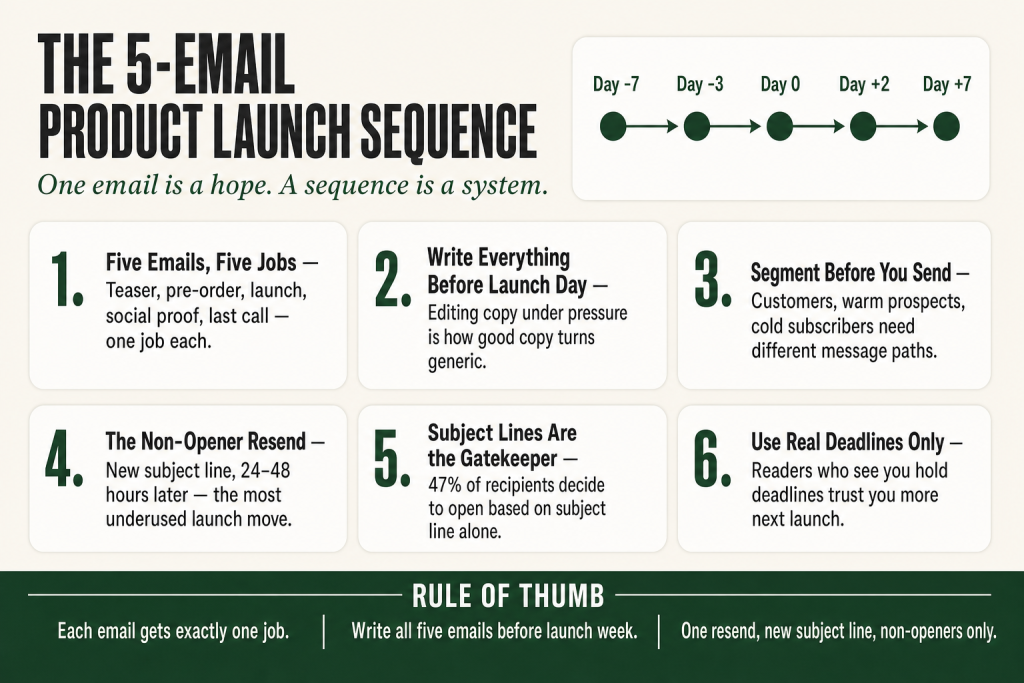
- The core sequence is five emails: teaser (Day -7), pre-order or waitlist close (Day -3), launch announcement (Day 0), social proof follow-up (Day +2), and last call (Day +5 to +7).
- Write every email before launch day. Editing copy under pressure is how good copy turns generic.
- Each email has one job. Curiosity, desire, announcement, validation, urgency. Mix them and you dilute all five.
- Segment before you send. Existing customers, warm prospects, and cold subscribers need different message paths, not the same blast.
- Resend the launch email to non-openers with a changed subject line 24-48 hours after the first send. It’s the highest-ROI step most operators skip.
- Your judgment stays on. AI can draft these emails quickly. You decide what’s true, what matches your voice, and what claim you can back up.
Take this fix into your next scenario. The free Builder’s Companion Kit collects the checklists and templates that pair with this guide — so next time, you start from a template, not a blank page. Grab it free →
- Why One Email Always Leaves Money on the Table
- Before You Write a Word: The Three Things You Need to Lock Down
- The Product Launch Email Sequence, Email by Email
- The Non-Opener Resend: The Highest-ROI Step Most Operators Skip
- A Worked Example: A Five-Email Sequence for a Solo Service Business
- Subject Lines: The One Decision That Determines Whether Any of This Matters
- What AI Can Do in This Sequence (And What Stays With You)
- After the Sequence: What to Measure and What to Fix Next Time
- FAQ
A product launch email sequence is not a single announcement email with a buy link slapped at the bottom. It’s a planned series of messages that moves a reader from “I’ve never heard of this” to “I’m in” over the course of seven to fourteen days. Most solo operators get this wrong in the same direction: they write one email, send it to everyone, and then wonder why the numbers are flat. One email is a hope. A sequence is a system.
The good news is you don’t need a team to build one. You need a plan, a clear through-line, and enough discipline to write the emails before launch week, not during it. This article gives you that plan, email by email, with the timing and the logic behind each send.
Why One Email Always Leaves Money on the Table
Think of your list like a crowd at a train station. Some people are already walking toward the platform. Others are reading a sign. Most are just passing through. One announcement email reaches all of them at the same moment with the same message. The people already walking buy. Everyone else deletes it or saves it for later and forgets.
A sequence spreads the message across multiple touchpoints so the folks who weren’t ready on Day 0 get another chance to catch up. The data backs this up hard. Stores that use a structured multi-email launch sequence generate significantly more launch revenue than those who send a single announcement email, because you’re working with buyer psychology rather than against it: curiosity first, then excitement, then validation, then urgency.
The other reason a sequence works: not every subscriber opens every email. The bulk of opens land within the first few hours of a send, then drop off sharply. A subscriber who missed your Monday launch email may open Thursday’s follow-up. If Thursday’s email doesn’t exist, that sale doesn’t happen.
If you’re still figuring out the broader launch picture, the article on how to launch a product by yourself covers the full pre-launch and channel plan. This article focuses specifically on the email side of that plan.
Before You Write a Word: The Three Things You Need to Lock Down
Jumping into email copy without answering these three questions first is how you end up with a sequence that reads like five disconnected blog posts.
1. What is the one outcome this launch produces for the buyer?
Not a feature list. One outcome. “You stop losing leads between your first call and your follow-up” is an outcome. “Our new CRM module” is a feature. The outcome goes in every subject line and opening sentence. The features show up in the body, briefly, as proof the outcome is real. If you’re unsure how to frame the outcome, the article on writing a sales page yourself walks through the exact framing process, and the same logic applies to email.
2. Who are you actually writing to?
Your list probably contains at least three groups who need different treatment. Existing customers already trust you, so they need to know what’s new for them, not a brand pitch. Warm prospects know you exist but haven’t bought, so they need more context and validation. Cold subscribers need to understand why you’re credible before they care about what you’re selling.
You don’t need three entirely separate sequences at first. You need to know which group you’re writing the primary sequence for, and then make simple adjustments (a different opening sentence, a suppression rule) for the others. Segmenting before you send consistently lifts conversion compared to uniform list blasts, and it protects your deliverability by keeping unengaged subscribers from dragging down your sender reputation.
3. Is your list warm enough to receive a launch?
If you haven’t emailed your list in 90 days or more, a product launch is a rough way to re-introduce yourself. Consider sending two or three value-only emails in the weeks before the pre-launch phase starts. Give less-active subscribers a clear reason to stay subscribed, and remove the ones who don’t engage. Deliverability damage during a launch is expensive and slow to recover. The article on how often to email your list covers the cadence logic that keeps your list warm between launches.
The Product Launch Email Sequence, Email by Email
This is the baseline plan. Five emails across roughly fourteen days. Each one has a single job. Don’t load multiple jobs into a single email, because you dilute both.
Email 1: The Teaser (Day -7)
One job: create curiosity.
This email hints at what’s coming without revealing everything. You’re not selling yet. You’re opening a question in the reader’s mind that the launch email will answer. The best teaser emails focus on the problem your product solves, not on the product itself. “Something is broken about how most service businesses follow up with leads, and next week we’re fixing it” is a teaser. “Our new product launches Monday” is just a calendar notification.
Keep it short. One paragraph. One link, if any. If you’re opening a waitlist or early-access sign-up, link to that. The subscribers who opt into a waitlist at this stage are your most motivated buyers and deserve a slightly more direct sequence.
Subject line: Tease a detail, not the product. Something like “A question we kept getting, and what we did about it” or a specific number that creates a gap (“83% of our customers said the same thing”).
Email 2: The Pre-Order or Early Access Close (Day -3)
One job: take money or take a name before launch.
Confirm the launch date. Show one concrete detail about the product: a result from a beta user, a screenshot, a short clip. Drive pre-orders if your platform supports them, or drive waitlist sign-ups if it doesn’t. The word “first” earns its place in the subject line here. People who pre-order or join the waitlist have already committed psychologically, which makes them your easiest Day 0 buyers.
This email can also go out to the general list without a pre-order push if early access isn’t part of your model. In that case, the job becomes building desire: you’re showing the product in enough detail to make people want it, without answering every question yet.
Email 3: The Launch Announcement (Day 0, Morning)
One job: get the click.
Full reveal. Clear benefit summary. One call to action. That’s it. The announcement email is not the place for your company history or a three-paragraph backstory. Lead with the outcome, not the product name. Show the product in action if you can: a short video, a demo, a before-and-after. State the price clearly. Tell people exactly how to buy.
The structure that holds up: open with the outcome the buyer gets, explain briefly why you built this, show proof it works (one line is enough for now), state the offer and price, and close with a single clear CTA. Your sign-off P.S. is valuable real estate. Use it to restate the most important constraint, whether that’s a deadline, a bonus, or early pricing that expires.
Subject line: Name the product plainly and lead with the outcome. This is not the email for clever. “[Product name] is live” plus a short benefit phrase in the preview text is often enough.
Email 4: Social Proof (Day +2)
One job: validate the purchase for people who are still on the fence.
By Day +2 you should have at least a few buyers. If you ran a beta, you have feedback. Use it here. Real testimonials that answer a specific objection outperform generic praise. “I was worried it would take too long to set up, but I had it running in 20 minutes” is more persuasive than “Love this product!” because it removes a reason not to buy.
Build desire first, then introduce any scarcity or urgency. If you lead with scarcity before the reader is sold on the product, it reads as pressure. If you lead with proof and then mention a limited bonus or expiring price, it reads as a heads-up. Sequence matters.
This is also the right moment to handle the one objection you know is sitting in your readers’ heads. You know what it is. You’ve heard it from prospects. Name it and answer it directly.
For more on collecting the right testimonials for this email, see how to get customer testimonials without making the ask awkward.
Email 5: Last Call (Day +5 to +7)
One job: close the window honestly.
A real deadline. Not “supplies are limited” with no specifics. A real date, a real price expiration, a real bonus cutoff. If you don’t have a genuine deadline, create one by closing early-bird pricing or a launch bonus on a specific date and then honor it. Readers who see you hold your deadlines trust you more on the next launch.
Keep this email short. Three to five sentences is enough. The product, the deadline, the link. The final email that over-explains reads as desperation. The final email that stays confident and brief reads as a reminder from a seller who doesn’t need the sale. You want to be the second kind.
Consider sending a plain-text version of this last-call message to non-openers a few hours before the offer closes. Plain-text emails often bypass promotional filters and feel more personal, which can recover a meaningful slice of conversions from subscribers who missed the earlier sends.
The Non-Opener Resend: The Highest-ROI Step Most Operators Skip
Here’s the pattern: you send your launch email Monday morning. By Monday afternoon, roughly half your list still hasn’t opened it. By Tuesday morning, that number hasn’t moved much. Those people aren’t necessarily disinterested. They were busy. The subject line didn’t connect. They read on mobile and forgot to act. The email slid down the inbox.
Resending to non-openers with a new subject line, 24 to 48 hours after the first send, is a controlled way to recover those opens. Most operators skip this step, and it’s genuinely the single most underused move in a launch sequence. Resending to non-openers with a fresh subject line typically recovers a substantial share of additional opens, making it the highest-return step in the entire sequence.
A few caveats you need to hold onto:
- Change the subject line. Sending the exact same subject line is the fastest way to train annoyed readers to ignore you. Write a second angle: a different hook, a customer quote, a specific result.
- Don’t resend to everyone. Require recent positive engagement beyond opens alone, such as recent clicks or purchases. Suppress recent complainers, unsubscribers, and people who have received too many campaigns already.
- Open rates are less reliable as the sole measure. Apple Mail Privacy Protection and similar features inflate open counts. Judge the resend by clicks and conversions, not just opens.
- One resend per email, maximum. If the second subject line doesn’t get the open, a third attempt on the same message is spam behavior, not marketing.
Most major email platforms let you build a segment of contacts who received a specific campaign but did not open it within a defined window, then send a duplicate campaign to that segment with a revised subject line. Check your platform’s campaign or automation documentation for the exact steps, since the interface labels vary by tool.
A Worked Example: A Five-Email Sequence for a Solo Service Business
Here’s how this looks in practice for a solo bookkeeper launching a monthly close package for e-commerce store owners. Concrete context makes the logic easier to steal.
The one outcome: Store owners stop dreading their monthly numbers because everything is done and delivered by the 5th of every month.
The audience: The primary sequence targets warm prospects (people on the email list who have downloaded a freebie but haven’t hired). Existing clients get a one-email note with a referral ask, suppressed from the main sequence.
- Day -7 (Teaser): Subject: “The question I get every January” / Body: Two short paragraphs about how most e-commerce owners finish their year not knowing if they were profitable. No product mention. Closes with: “Next week I’m opening something that fixes this permanently. Stay tuned.”
- Day -3 (Early Access): Subject: “First look: Monthly Close, done by the 5th” / Body: Names the product, shows one beta client’s result (“December books closed and delivered January 4th”), announces the early-bird price for the first five sign-ups, links to a short waitlist form.
- Day 0 (Launch, 9am): Subject: “Monthly Close is open” / Body: Outcome up top, what’s included, price, one CTA button. P.S. names the early-bird deadline (this Friday at midnight).
- Day +2 (Social Proof): Subject: “What two beta clients said after their first close” / Body: Two short testimonials that each handle a specific objection (“I wasn’t sure you’d understand my Shopify setup” and “I thought monthly was overkill until I saw the report”). Restates offer. One CTA.
- Day +7 (Last Call): Subject: “Last day, then price goes up” / Body: Three sentences. The offer, the deadline (tonight at midnight), the link. Plain-text version sent four hours before close to non-openers with subject: “Closing tonight, in case this got buried.”
That sequence requires five emails total, all written before Day -7. It’s about two hours of writing work if you’ve already completed the positioning and pricing work described in how to price your product or service without guessing.
If you’re using AI to speed up the drafting, the methodology in how to write marketing copy with AI applies directly here. You’re still making every factual claim, choosing every angle, and approving every word. The AI cuts the blank-page time, not the judgment calls.
Subject Lines: The One Decision That Determines Whether Any of This Matters
The subject line is the gatekeeper. An unread email has zero conversion rate, regardless of how good the copy inside is. Roughly 47% of recipients decide whether to open based on the subject line alone. Get it right and your sequence does its job. Get it wrong and you’re broadcasting to yourself.
A few principles that hold up in practice:
- Short wins on mobile. Most mobile email clients truncate subject lines at roughly 41 to 50 characters. Front-load the most important information. If the rest gets cut off, the key message still lands.
- Benefit over feature, always. Short, specific, benefit-focused subject lines consistently outperform feature-focused or formal ones. “Your books closed by the 5th” outperforms “Introducing the Monthly Close Package.”
- One angle per subject line. Trying to combine curiosity and urgency and personalization in one subject line produces a cluttered mess. Pick one and execute it cleanly.
- Test the teaser differently from the announcement. Teaser subject lines earn opens through a curiosity gap. Announcement subject lines earn opens through clarity and desire. Urgency subject lines earn opens through a real deadline. Match the tool to the job.
- Write two subject lines for every email. You’ll use one for the primary send and one for the non-opener resend. Having the backup ready in advance means the resend goes out in minutes, not after an hour of staring at a blank field under launch-week pressure.
A/B testing subject lines is worth doing if your list is large enough that the test reaches statistical significance before the email goes cold. For most solo operators with a list under 5,000, just pick the stronger of your two options and save the other for the resend. Chasing significance on a small list burns time you don’t have.
What AI Can Do in This Sequence (And What Stays With You)
AI is a useful drafting tool for a sequence like this. You give it the outcome, the audience, the objections, the price, and the deadline. It produces a working draft. You rewrite every line that sounds like an AI wrote it, cut anything you can’t verify, and replace every generic claim with a specific one you can back up.
Here’s where the line sits:
- AI can: Draft the five emails from a clear brief, suggest alternative subject lines, rewrite for length or tone, generate objection lists from a product description, and identify gaps in your argument structure.
- AI cannot: Know whether your beta client result is real, verify your pricing claims, decide what your deadline should be, or replicate the specific voice your list has come to recognize. Those stay with you, every time.
The most common mistake operators make when using AI for launch copy is skipping the brief and going straight to “write me a product launch email.” The output reflects the input. A vague prompt produces a generic email. A specific brief (outcome, audience, objection, offer, deadline, tone) produces something you can actually use with minor edits. The planning work in this article is, functionally, the brief.
One honest caveat: AI-drafted emails tend to land in the Promotions tab more often when they’re loaded with buzzwords and formatting that looks like a template. Plain language, short paragraphs, and a single CTA help deliverability more than any technical setting you’ll find in your platform.
After the Sequence: What to Measure and What to Fix Next Time
Once the sequence closes, you have data you didn’t have before launch. Use it.
Pull these numbers for each email: open rate, click-through rate, and conversions (if your platform or UTM setup supports it). The pattern that matters most is the drop between emails. If opens stay high but clicks fall off on Email 3, the launch email copy isn’t connecting. If clicks are strong but conversions are low, the issue is on the landing page or the offer itself, not the sequence.
For tracking launches across campaigns with clean UTM data, the UTM naming convention article will save you a lot of GA4 confusion. Tag every link in every email before you send, not after.
A few things worth noting down while the launch is fresh:
- Which subject line got the best open rate?
- Which email drove the most clicks?
- Which objection came up most in replies or customer conversations?
- Did the non-opener resend produce meaningful additional conversions?
That debrief is the brief for your next launch sequence. Your second launch will be faster to write and more effective because your first one told you what your specific list actually responds to, which no benchmark can tell you. And if you’re planning your next launch as part of a broader calendar, the marketing calendar article shows how to build launch windows into your annual cadence without crowding everything else out.
FAQ
How many emails should be in a product launch sequence?
Five emails is the practical baseline for most solo operators: teaser, early access or pre-order, launch announcement, social proof follow-up, and last call. You can go up to seven or eight emails for a major launch with a longer sales window, but beyond five on the same announcement, unsubscribe rates tend to climb. For a minor product update or feature announcement, two or three emails is enough.
How far in advance should I start sending launch emails?
Start the sequence seven to ten days before launch day for a standard product. If you’re running a larger launch with a waitlist and early-access phase, begin pre-launch emails two to four weeks out. Anything earlier than two weeks for a teaser risks your audience forgetting about the launch entirely by the time it arrives.
Should I send the same launch email to my whole list?
No. At minimum, separate existing customers from prospects and suppress cold subscribers who haven’t engaged in 90 days. Existing customers get a shorter, warmer message. Prospects get the full sequence. Cold subscribers, if you include them at all, should only receive emails that stand on their own without assuming familiarity, and you should consider whether sending to them at launch is worth the deliverability risk.
Is it okay to resend a launch email to people who didn’t open it?
Yes, with conditions. Change the subject line, wait at least 24 to 48 hours, limit it to one resend per email, and only send to subscribers who have shown recent positive engagement beyond opens alone (clicks, purchases, logins). Sending the exact same subject line or resending to your full cold segment is how you train readers to ignore you and how you damage your sender reputation.
Can I use AI to write my launch email sequence?
AI can draft a solid working sequence quickly, but only if you give it a specific brief: the one outcome the product produces, the objections you know exist, the offer details, the price, and the deadline. Every factual claim still needs your verification, every subject line still needs your judgment, and every email that sounds like a template needs a rewrite before it goes out. AI cuts drafting time. It doesn’t replace the decisions.
What’s the best time of day to send a product launch email?
The honest answer is: check your own platform’s engagement data for your specific list first, because your audience is the only dataset that matters for your sender. General benchmarks point to mid-morning sends performing well for opens, with late afternoon capturing clicks as people finish their workday. Avoid Monday mornings and late-night sends. And whatever send time you choose, test it, because your list’s habits are not the average.
Sources:
Research and claims in this article are informed by the following sources, verified against live documentation and current practice as of October 2026: Media Intercept, Dedicated Email Campaign for Product Launch: 2026 Guide; Panoramata, How to Launch New Products Successfully With Email Campaigns; Zeliq, Launch Email 2026: Structure, Timing, and Templates; Suped, Is Resending Emails to Non-Openers a Good Tactic? (updated August 2026); Brevo Help Documentation, Resend Emails to Non-Openers; Flowjam, How to Announce a Product Launch in 2026; InsiderOne, Email Subject Line Best Practices 2026; AdoptKit, Product Launch Email Templates and Best Practices for 2026.
Brian Kasday spent forty years in direct-response marketing before rebuilding the whole operation as a one-person shop. He writes The Operator’s Library — including “Build a Complete Marketing Department” — for operators who’d rather build it themselves than wait on someone else.
Get the Builder’s Companion Kit — the free checklists and templates that pair with this guide: mmsvegas.com/resources.
This guide handles one marketing job. Build a Complete Marketing Department builds the whole department. See the manual →
More Marketing guides
Free · Marketing Operator Toolkit
Running marketing on your own?
Get the free toolkit — the templates and the expensive mistakes behind a one-person marketing department, plus a note when this guide changes.
Get the free toolkit →